 Скачать презентацию The Design-Manufacturing Roadmap Andrew B Kahng UC San
4fd3952450a4dd89f06816fe2866f307.ppt
- Количество слайдов: 58



The Design-Manufacturing Roadmap Andrew B. Kahng UC San Diego CSE & ECE Departments http: //vlsicad. ucsd. edu A. Kahng, EDA Forum 2003 Keynote, 031106
Outline • The Design Roadmap • DFM: Symptoms, Problem, Solution • DFM Futures: Some Examples A. Kahng, EDA Forum 2003 Keynote, 031106
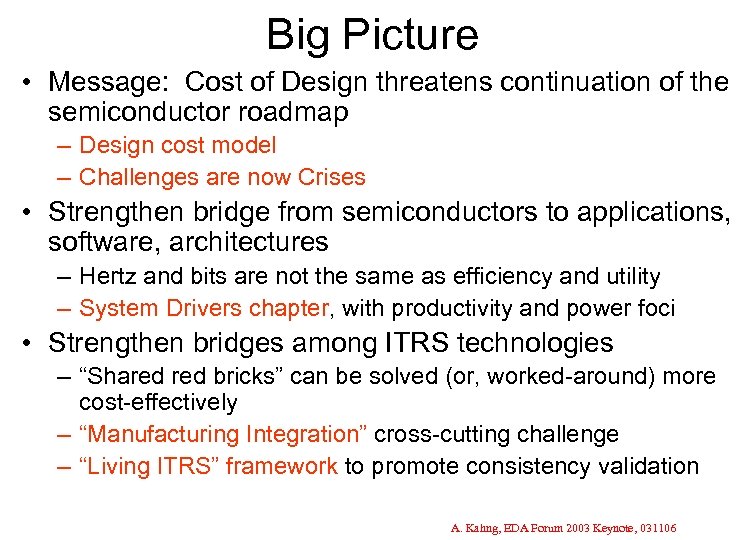
Big Picture • Message: Cost of Design threatens continuation of the semiconductor roadmap – Design cost model – Challenges are now Crises • Strengthen bridge from semiconductors to applications, software, architectures – Hertz and bits are not the same as efficiency and utility – System Drivers chapter, with productivity and power foci • Strengthen bridges among ITRS technologies – “Shared bricks” can be solved (or, worked-around) more cost-effectively – “Manufacturing Integration” cross-cutting challenge – “Living ITRS” framework to promote consistency validation A. Kahng, EDA Forum 2003 Keynote, 031106
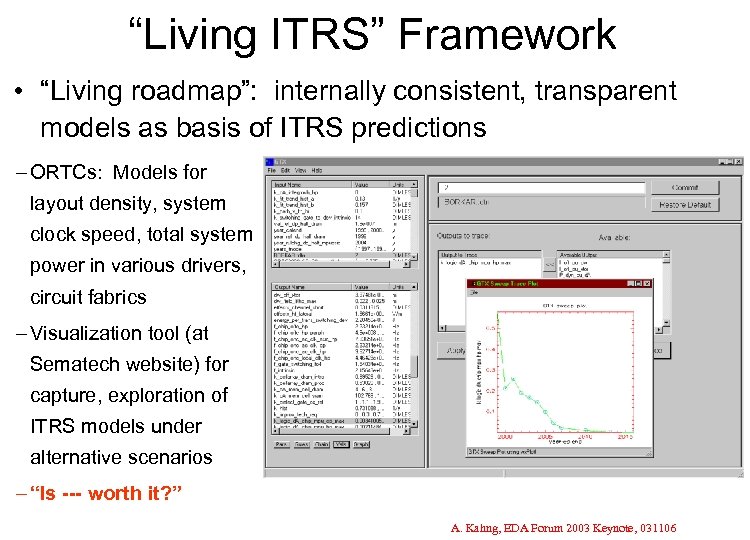
“Living ITRS” Framework • “Living roadmap”: internally consistent, transparent models as basis of ITRS predictions – ORTCs: Models for layout density, system clock speed, total system power in various drivers, circuit fabrics – Visualization tool (at Sematech website) for capture, exploration of ITRS models under alternative scenarios – “Is --- worth it? ” A. Kahng, EDA Forum 2003 Keynote, 031106
Design Challenges - Silicon • Silicon Complexity = impact of process scaling, new materials, new device/interconnect architectures • Non-ideal scaling (leakage, power management, circuit/device innovation, current delivery) • Coupled high-frequency devices and interconnects (signal integrity analysis and management) • Manufacturing variability (library characterization, analog and digital circuit performance, error-tolerant design, layout reusability, static performance verification methodology/tools) • Scaling of global interconnect performance (communication, synchronization) • Decreased reliability (SEU, gate insulator tunneling and breakdown, joule heating and electromigration) • Complexity of manufacturing handoff (reticle enhancement and mask writing/inspection flow, manufacturing NRE cost) A. Kahng, EDA Forum 2003 Keynote, 031106
Design Challenges - System • System Complexity = exponentially increasing transistor counts, with increased diversity (mixed-signal SOC, …) • Reuse (hierarchical design support, heterogeneous SOC integration, reuse of verification/test/IP) • Verification and test (specification capture, design for verifiability, verification reuse, system-level and software verification, AMS self-test, noise-delay fault tests, test reuse) • Cost-driven design optimization (manufacturing cost modeling and analysis, quality metrics, die-package co-optimization, …) • Embedded software design (platform-based system design methodologies, software verification/analysis, codesign w/HW) • Reliable implementation platforms (predictable chip implementation onto multiple fabrics, higher-level handoff) • Design process management (team size / geog distribution, data mgmt, collaborative design, process improvement) A. Kahng, EDA Forum 2003 Keynote, 031106
Design Chapter Outline • Introduction – Scope of design technology – Complexities (silicon, system) • Design Cross-Cutting Challenges – – – Productivity Power Manufacturing Integration Interference Error-Tolerance • Details of five traditional technology areas: Design Process, System-Level, Logical/Physical/Circuit, Functional Verification, Test • Key 2003 changes – Increased analog and circuits content – Refinement of design cost metrics – Design system architecture and flow – SEU and reliability A. Kahng, EDA Forum 2003 Keynote, 031106
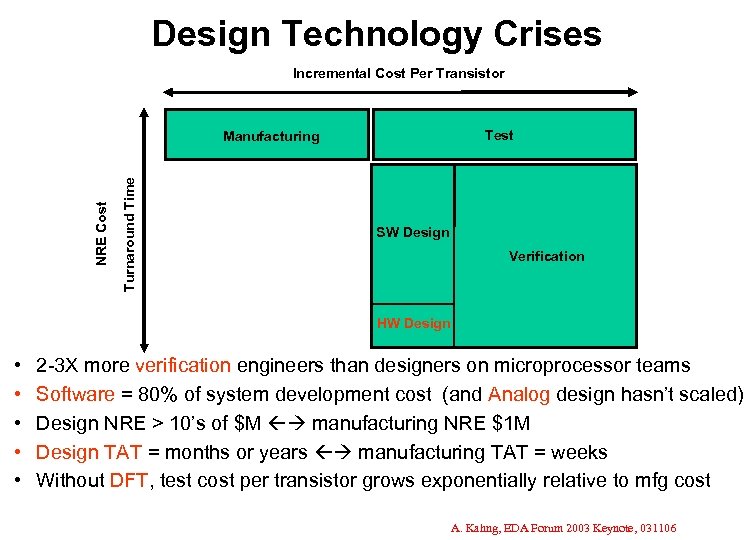
Design Technology Crises Incremental Cost Per Transistor Test Turnaround Time NRE Cost Manufacturing SW Design Verification HW Design • • • 2 -3 X more verification engineers than designers on microprocessor teams Software = 80% of system development cost (and Analog design hasn’t scaled) Design NRE > 10’s of $M manufacturing NRE $1 M Design TAT = months or years manufacturing TAT = weeks Without DFT, test cost per transistor grows exponentially relative to mfg cost A. Kahng, EDA Forum 2003 Keynote, 031106
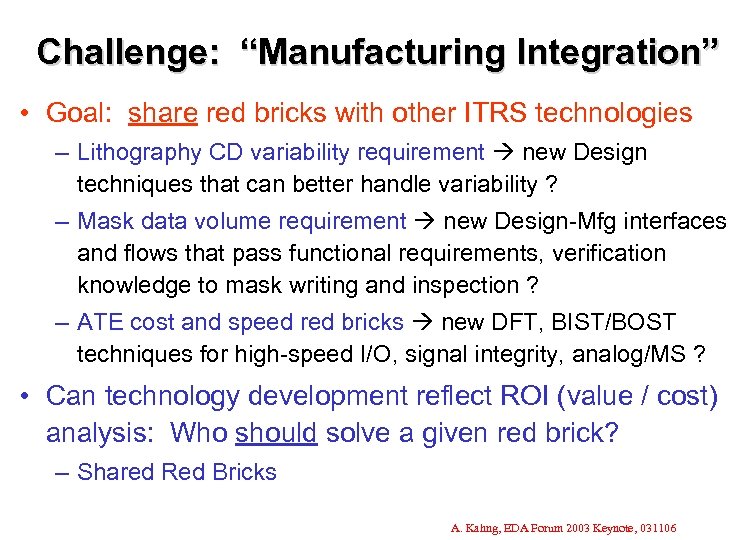
Challenge: “Manufacturing Integration” • Goal: share red bricks with other ITRS technologies – Lithography CD variability requirement new Design techniques that can better handle variability ? – Mask data volume requirement new Design-Mfg interfaces and flows that pass functional requirements, verification knowledge to mask writing and inspection ? – ATE cost and speed red bricks new DFT, BIST/BOST techniques for high-speed I/O, signal integrity, analog/MS ? • Can technology development reflect ROI (value / cost) analysis: Who should solve a given red brick? – Shared Red Bricks A. Kahng, EDA Forum 2003 Keynote, 031106
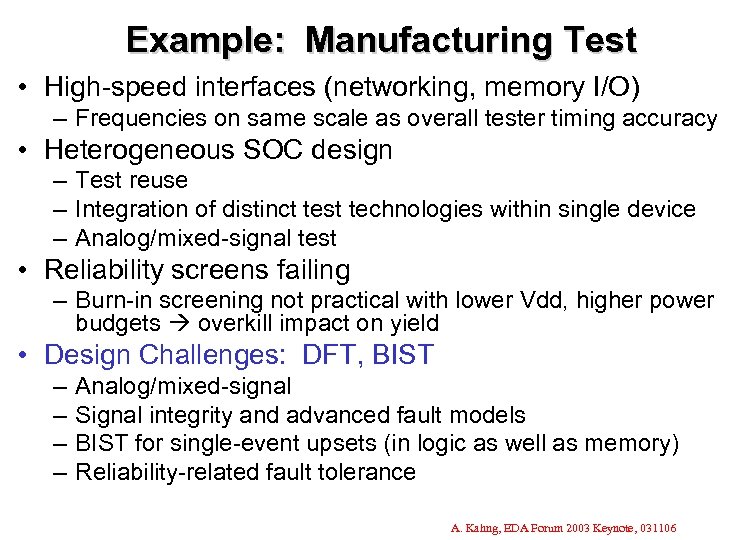
Example: Manufacturing Test • High-speed interfaces (networking, memory I/O) – Frequencies on same scale as overall tester timing accuracy • Heterogeneous SOC design – Test reuse – Integration of distinct test technologies within single device – Analog/mixed-signal test • Reliability screens failing – Burn-in screening not practical with lower Vdd, higher power budgets overkill impact on yield • Design Challenges: DFT, BIST – – Analog/mixed-signal Signal integrity and advanced fault models BIST for single-event upsets (in logic as well as memory) Reliability-related fault tolerance A. Kahng, EDA Forum 2003 Keynote, 031106
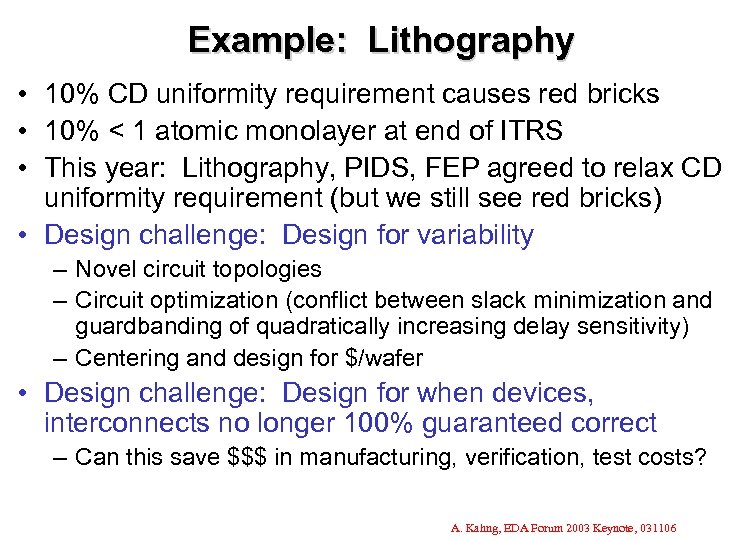
Example: Lithography • 10% CD uniformity requirement causes red bricks • 10% < 1 atomic monolayer at end of ITRS • This year: Lithography, PIDS, FEP agreed to relax CD uniformity requirement (but we still see red bricks) • Design challenge: Design for variability – Novel circuit topologies – Circuit optimization (conflict between slack minimization and guardbanding of quadratically increasing delay sensitivity) – Centering and design for $/wafer • Design challenge: Design for when devices, interconnects no longer 100% guaranteed correct – Can this save $$$ in manufacturing, verification, test costs? A. Kahng, EDA Forum 2003 Keynote, 031106
Outline • The Design Roadmap • DFM: Symptoms, Problem, Solution • DFM Futures: Some Examples A. Kahng, EDA Forum 2003 Keynote, 031106
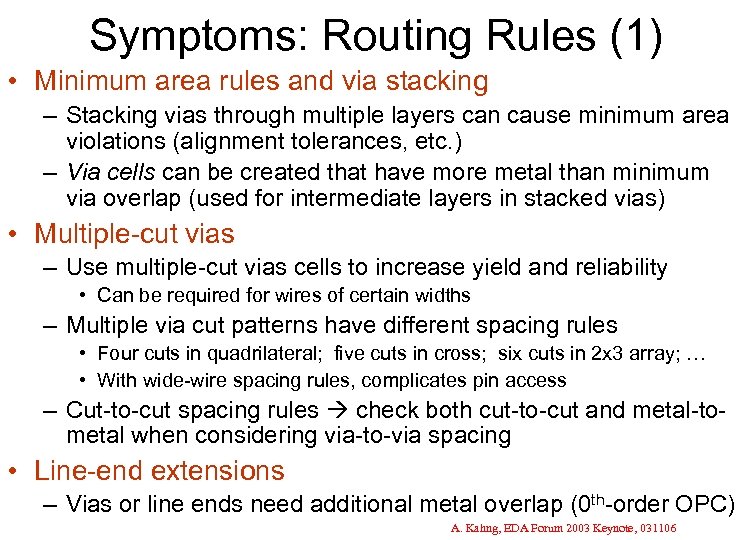
Symptoms: Routing Rules (1) • Minimum area rules and via stacking – Stacking vias through multiple layers can cause minimum area violations (alignment tolerances, etc. ) – Via cells can be created that have more metal than minimum via overlap (used for intermediate layers in stacked vias) • Multiple-cut vias – Use multiple-cut vias cells to increase yield and reliability • Can be required for wires of certain widths – Multiple via cut patterns have different spacing rules • Four cuts in quadrilateral; five cuts in cross; six cuts in 2 x 3 array; … • With wide-wire spacing rules, complicates pin access – Cut-to-cut spacing rules check both cut-to-cut and metal-tometal when considering via-to-via spacing • Line-end extensions – Vias or line ends need additional metal overlap (0 th-order OPC) A. Kahng, EDA Forum 2003 Keynote, 031106
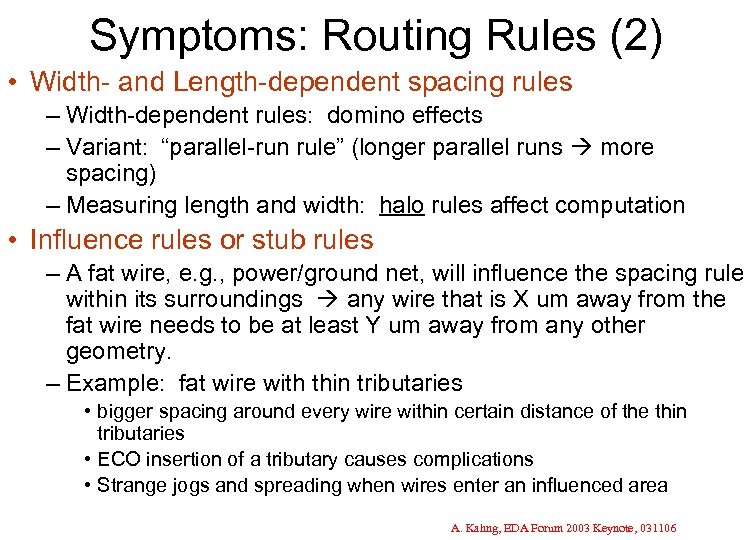
Symptoms: Routing Rules (2) • Width- and Length-dependent spacing rules – Width-dependent rules: domino effects – Variant: “parallel-run rule” (longer parallel runs more spacing) – Measuring length and width: halo rules affect computation • Influence rules or stub rules – A fat wire, e. g. , power/ground net, will influence the spacing rule within its surroundings any wire that is X um away from the fat wire needs to be at least Y um away from any other geometry. – Example: fat wire with thin tributaries • bigger spacing around every wire within certain distance of the thin tributaries • ECO insertion of a tributary causes complications • Strange jogs and spreading when wires enter an influenced area A. Kahng, EDA Forum 2003 Keynote, 031106
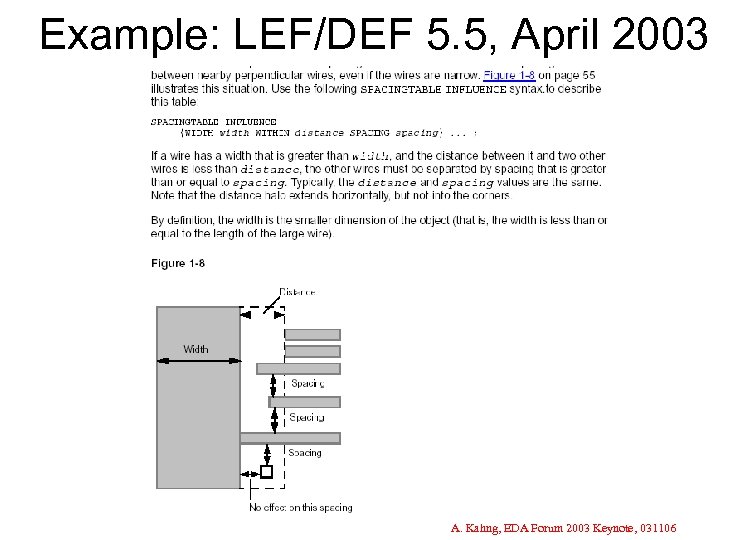
Example: LEF/DEF 5. 5, April 2003 A. Kahng, EDA Forum 2003 Keynote, 031106
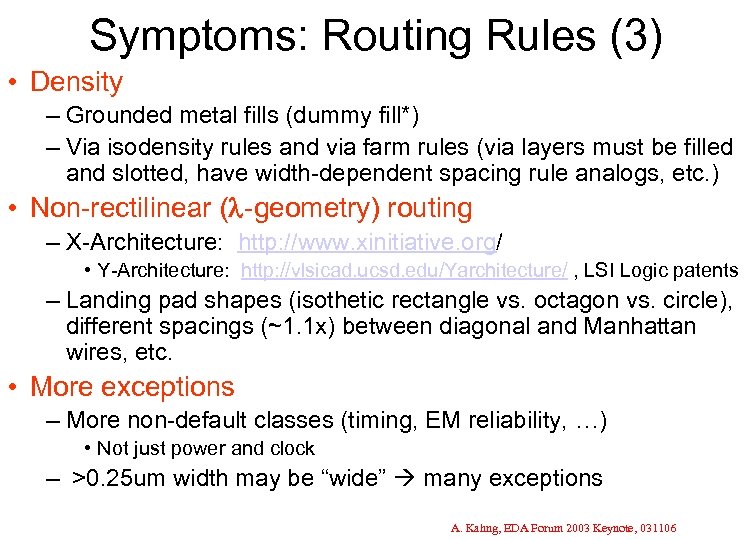
Symptoms: Routing Rules (3) • Density – Grounded metal fills (dummy fill*) – Via isodensity rules and via farm rules (via layers must be filled and slotted, have width-dependent spacing rule analogs, etc. ) • Non-rectilinear ( -geometry) routing – X-Architecture: http: //www. xinitiative. org/ • Y-Architecture: http: //vlsicad. ucsd. edu/Yarchitecture/ , LSI Logic patents – Landing pad shapes (isothetic rectangle vs. octagon vs. circle), different spacings (~1. 1 x) between diagonal and Manhattan wires, etc. • More exceptions – More non-default classes (timing, EM reliability, …) • Not just power and clock – >0. 25 um width may be “wide” many exceptions A. Kahng, EDA Forum 2003 Keynote, 031106
Symptoms: Routing Rules • Degrade completion rates, runtime efficiency • “Postprocessing” likely no longer suffices – E. g. , antennas • There is no chip until the router is done • Must / Should / Can tomorrow’s IC routers “independently” address these issues? A. Kahng, EDA Forum 2003 Keynote, 031106
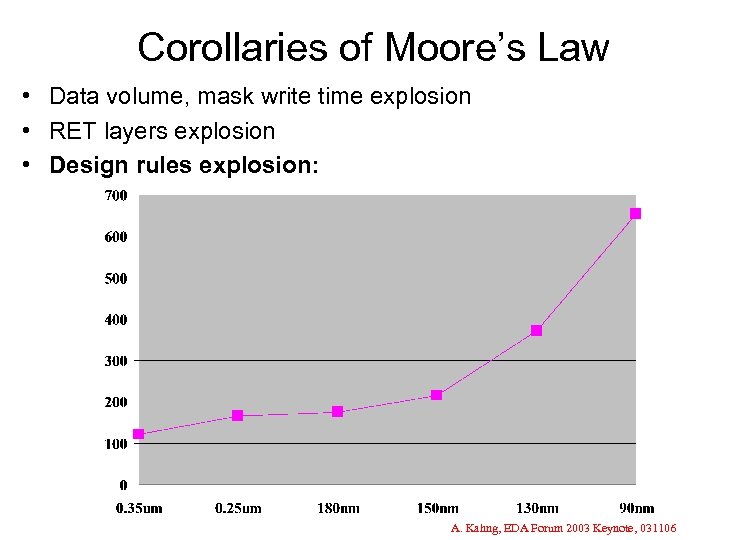
Corollaries of Moore’s Law • Data volume, mask write time explosion • RET layers explosion of design rules per process node Number • Design rules explosion: A. Kahng, EDA Forum 2003 Keynote, 031106
Whose Job Is It To Solve: • Mask NRE cost ( runtimes shapes complexity) • BEOL catastrophic yield loss – Deposited copper can infer yield loss mechanisms • Open faults more prevalent than short or bridging faults • High-resistance via faults • Cf. “non-tree routing” for reliability and yield? – Variability budget for planarization • Copper is soft dual-material polish mechanisms • Oxide erosion and copper dishing cross-sectional variability, inter-layer bridging faults, … • Low-k: thermal properties, anisotropy, nonuniformity • Resistivity at small conductor dimensions A. Kahng, EDA Forum 2003 Keynote, 031106
The Problem: Evolution • Conflicting goals – Designer: “freedom”, “reuse”, “migration” – EDA: “maintenance mode” – Process/foundry: “enhance perceived value” (= add rules) – Prisoner’s Dilemma: who will invest in change? • Fiddling: Incremental, linear extrapolation of current trajectory – “GDS-3” – Thin post-processing layers (decompaction, RET insertion, …) – Leads to “dark future” (12 th Japan DA Show keynote) A. Kahng, EDA Forum 2003 Keynote, 031106
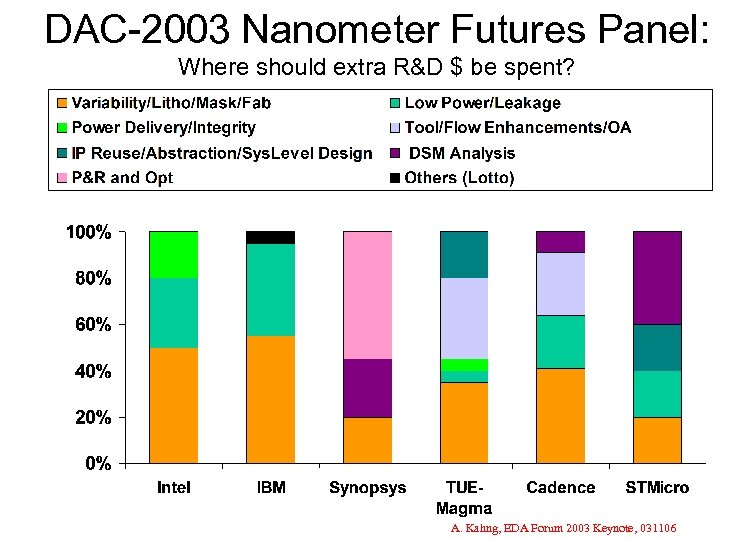
DAC-2003 Nanometer Futures Panel: Where should extra R&D $ be spent? A. Kahng, EDA Forum 2003 Keynote, 031106

The Solution: Co-Evolution • Designer, EDA, and process communities cooperate and co-evolve to maintain the cost (value) trajectory of Moore’s Law – Must escape Prisoner’s Dilemma – Must be financially viable – At 90 nm to 65 nm transition, this is a matter of survival for the worldwide semiconductor industry • Example Focus Areas: – – – Explicit manufacturability and cost/value optimization Restricted layout Intelligent mask data prep “Analog” (not binary) rules (Many layout and design optimizations) Disclaimer: Not a complete listing A. Kahng, EDA Forum 2003 Keynote, 031106
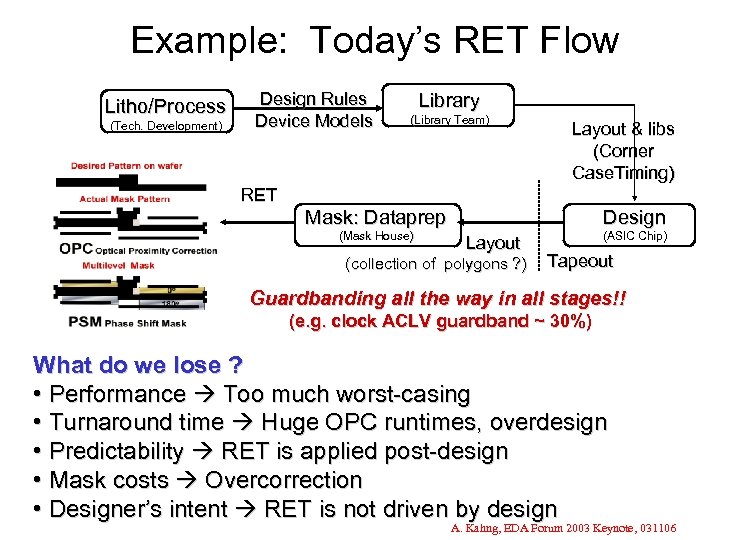
Example: Today’s RET Flow Litho/Process (Tech. Development) Design Rules Device Models RET Library (Library Team) Layout & libs (Corner Case. Timing) Mask: Dataprep (Mask House) Design Layout (collection of polygons ? ) (ASIC Chip) Tapeout Guardbanding all the way in all stages!! (e. g. clock ACLV guardband ~ 30%) What do we lose ? • Performance Too much worst-casing • Turnaround time Huge OPC runtimes, overdesign • Predictability RET is applied post-design • Mask costs Overcorrection • Designer’s intent RET is not driven by design A. Kahng, EDA Forum 2003 Keynote, 031106
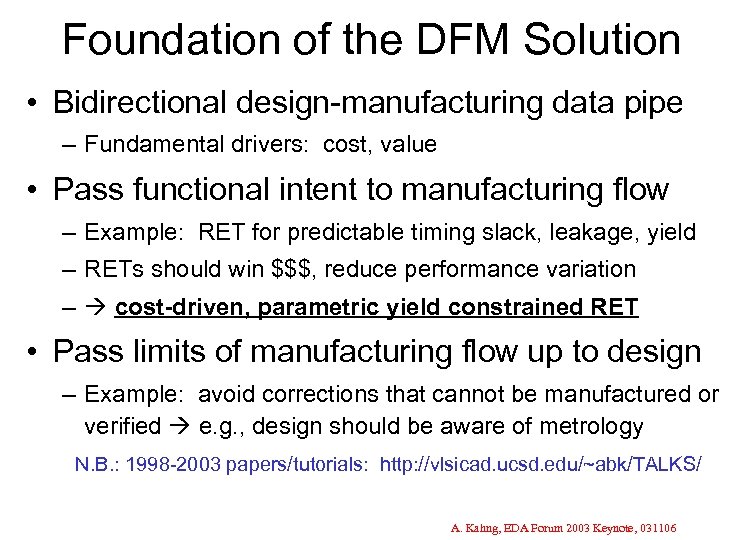
Foundation of the DFM Solution • Bidirectional design-manufacturing data pipe – Fundamental drivers: cost, value • Pass functional intent to manufacturing flow – Example: RET for predictable timing slack, leakage, yield – RETs should win $$$, reduce performance variation – cost-driven, parametric yield constrained RET • Pass limits of manufacturing flow up to design – Example: avoid corrections that cannot be manufactured or verified e. g. , design should be aware of metrology N. B. : 1998 -2003 papers/tutorials: http: //vlsicad. ucsd. edu/~abk/TALKS/ A. Kahng, EDA Forum 2003 Keynote, 031106
Outline • The Design Roadmap • DFM: Symptoms, Problem, Solution • DFM Futures: Some Examples A. Kahng, EDA Forum 2003 Keynote, 031106
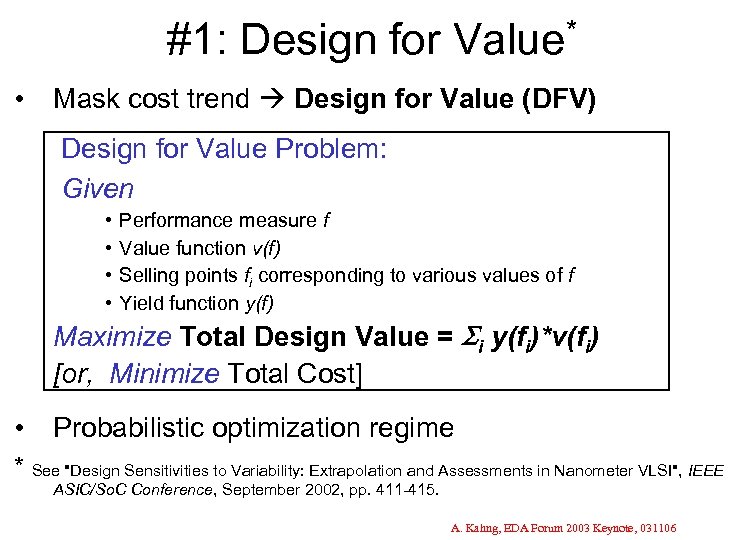
#1: Design for Value* • Mask cost trend Design for Value (DFV) Design for Value Problem: Given • • Performance measure f Value function v(f) Selling points fi corresponding to various values of f Yield function y(f) Maximize Total Design Value = i y(fi)*v(fi) [or, Minimize Total Cost] • Probabilistic optimization regime * See "Design Sensitivities to Variability: Extrapolation and Assessments in Nanometer VLSI", IEEE ASIC/So. C Conference, September 2002, pp. 411 -415. A. Kahng, EDA Forum 2003 Keynote, 031106
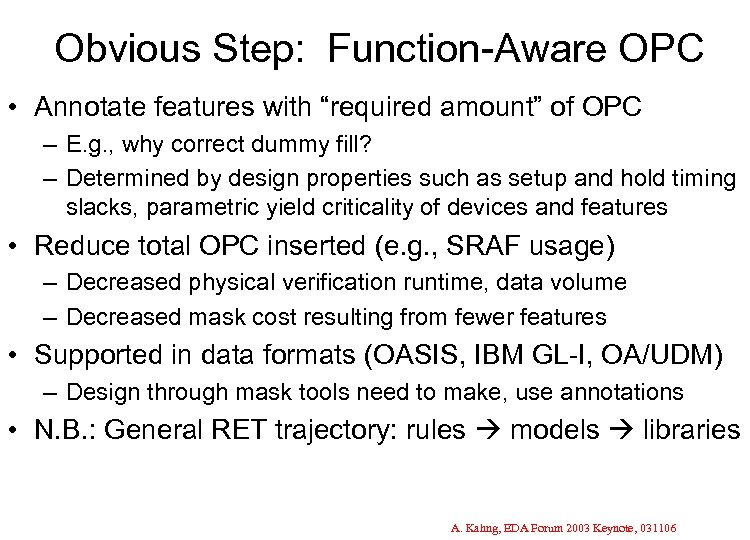
Obvious Step: Function-Aware OPC • Annotate features with “required amount” of OPC – E. g. , why correct dummy fill? – Determined by design properties such as setup and hold timing slacks, parametric yield criticality of devices and features • Reduce total OPC inserted (e. g. , SRAF usage) – Decreased physical verification runtime, data volume – Decreased mask cost resulting from fewer features • Supported in data formats (OASIS, IBM GL-I, OA/UDM) – Design through mask tools need to make, use annotations • N. B. : General RET trajectory: rules models libraries A. Kahng, EDA Forum 2003 Keynote, 031106
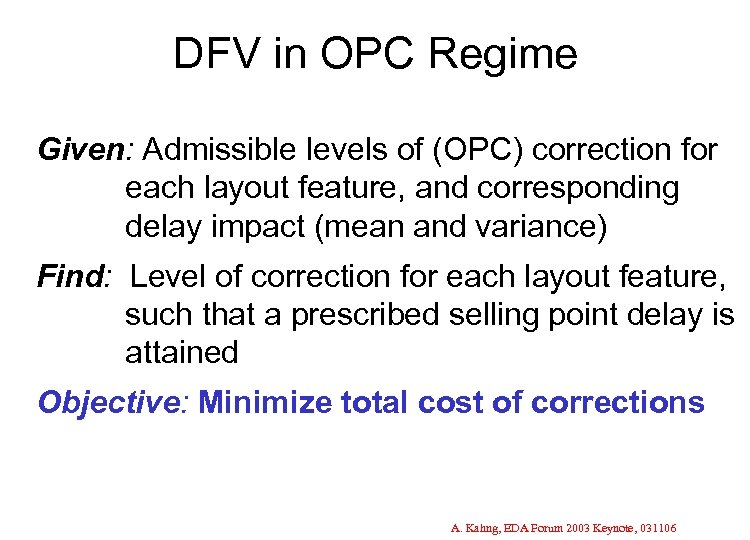
DFV in OPC Regime Given: Admissible levels of (OPC) correction for each layout feature, and corresponding delay impact (mean and variance) Find: Level of correction for each layout feature, such that a prescribed selling point delay is attained Objective: Minimize total cost of corrections A. Kahng, EDA Forum 2003 Keynote, 031106
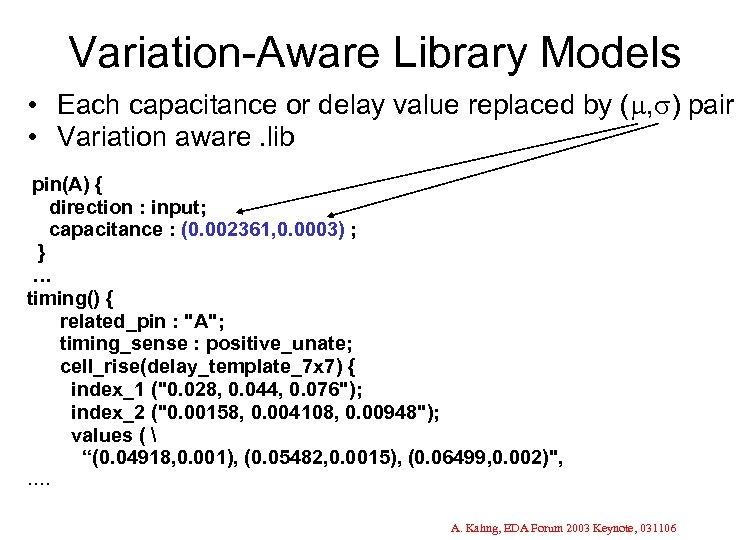
Variation-Aware Library Models • Each capacitance or delay value replaced by ( , ) pair • Variation aware. lib pin(A) { direction : input; capacitance : (0. 002361, 0. 0003) ; } … timing() { related_pin : "A"; timing_sense : positive_unate; cell_rise(delay_template_7 x 7) { index_1 ("0. 028, 0. 044, 0. 076"); index_2 ("0. 00158, 0. 004108, 0. 00948"); values ( “(0. 04918, 0. 001), (0. 05482, 0. 0015), (0. 06499, 0. 002)", …. A. Kahng, EDA Forum 2003 Keynote, 031106
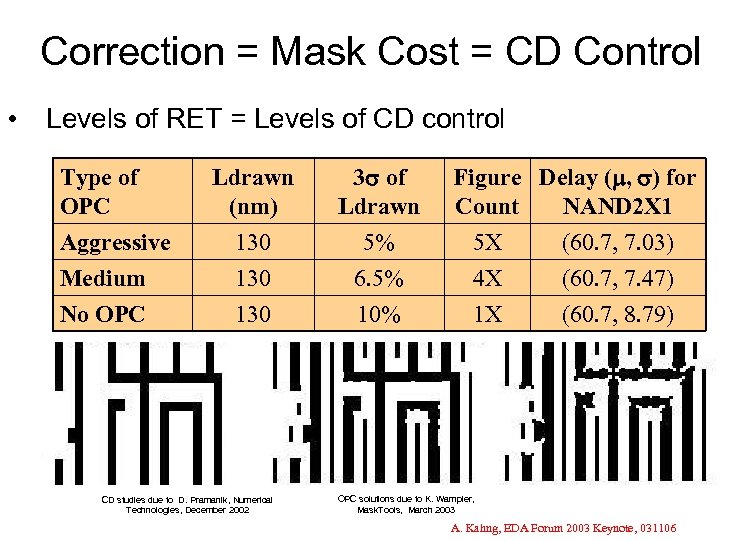
Correction = Mask Cost = CD Control • Levels of RET = Levels of CD control • Levels of RET = Type of Ldrawn 3 of OPC levels of CD(nm) control Ldrawn Figure Delay ( , ) for Count NAND 2 X 1 Aggressive 130 5% 5 X (60. 7, 7. 03) Medium No OPC 130 6. 5% 10% 4 X 1 X (60. 7, 7. 47) (60. 7, 8. 79) CD studies due to D. Pramanik, Numerical Technologies, December 2002 OPC solutions due to K. Wampler, Mask. Tools, March 2003 A. Kahng, EDA Forum 2003 Keynote, 031106
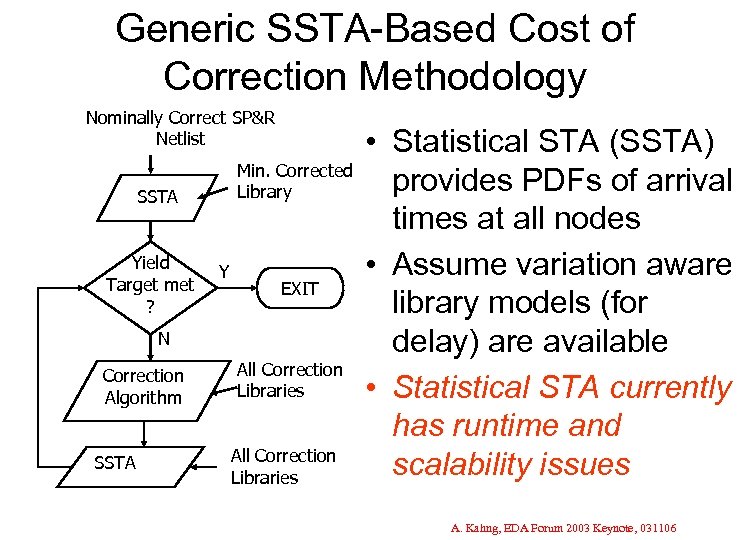
Generic SSTA-Based Cost of Correction Methodology Nominally Correct SP&R Netlist Min. Corrected Library SSTA Yield Target met ? Y EXIT N Correction Algorithm SSTA All Correction Libraries • Statistical STA (SSTA) provides PDFs of arrival times at all nodes • Assume variation aware library models (for delay) are available • Statistical STA currently has runtime and scalability issues A. Kahng, EDA Forum 2003 Keynote, 031106
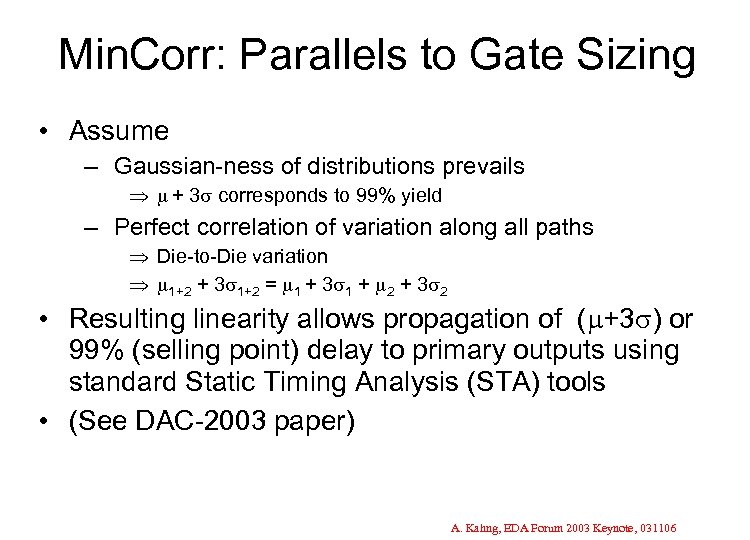
Min. Corr: Parallels to Gate Sizing • Assume – Gaussian-ness of distributions prevails Þ + 3 corresponds to 99% yield – Perfect correlation of variation along all paths Þ Die-to-Die variation Þ 1+2 + 3 1+2 = 1 + 3 1 + 2 + 3 2 • Resulting linearity allows propagation of ( +3 ) or 99% (selling point) delay to primary outputs using standard Static Timing Analysis (STA) tools • (See DAC-2003 paper) A. Kahng, EDA Forum 2003 Keynote, 031106
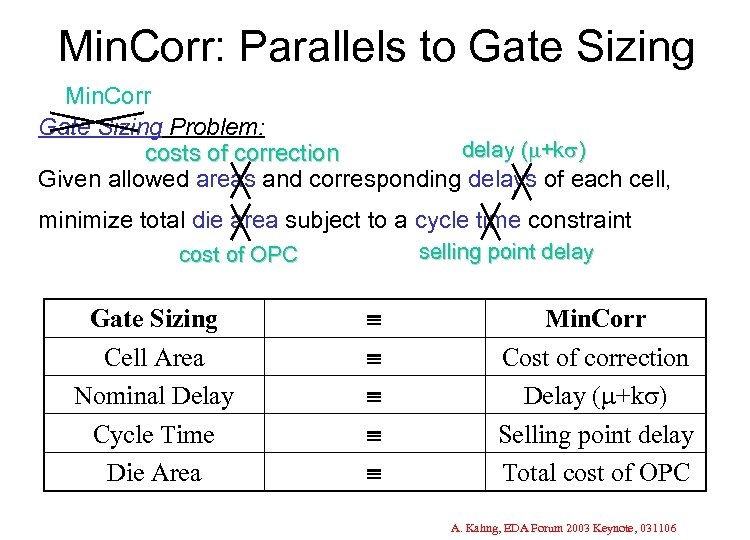
Min. Corr: Parallels to Gate Sizing Min. Corr Gate Sizing Problem: delay ( +k ) costs of correction Given allowed areas and corresponding delays of each cell, minimize total die area subject to a cycle time constraint selling point delay cost of OPC Gate Sizing Cell Area Nominal Delay Cycle Time Die Area Min. Corr Cost of correction Delay ( +k ) Selling point delay Total cost of OPC A. Kahng, EDA Forum 2003 Keynote, 031106
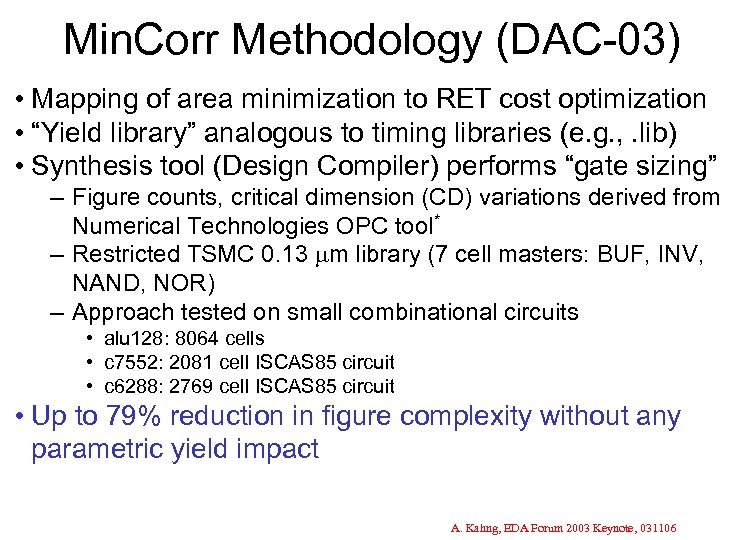
Min. Corr Methodology (DAC-03) • Mapping of area minimization to RET cost optimization • “Yield library” analogous to timing libraries (e. g. , . lib) • Synthesis tool (Design Compiler) performs “gate sizing” – Figure counts, critical dimension (CD) variations derived from Numerical Technologies OPC tool* – Restricted TSMC 0. 13 m library (7 cell masters: BUF, INV, NAND, NOR) – Approach tested on small combinational circuits • alu 128: 8064 cells • c 7552: 2081 cell ISCAS 85 circuit • c 6288: 2769 cell ISCAS 85 circuit • Up to 79% reduction in figure complexity without any parametric yield impact A. Kahng, EDA Forum 2003 Keynote, 031106
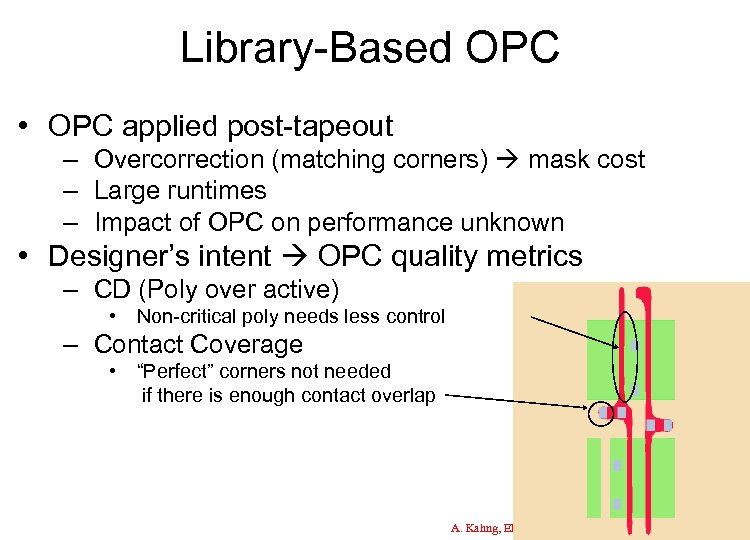
Library-Based OPC • OPC applied post-tapeout – Overcorrection (matching corners) mask cost – Large runtimes – Impact of OPC on performance unknown • Designer’s intent OPC quality metrics – CD (Poly over active) • Non-critical poly needs less control – Contact Coverage • “Perfect” corners not needed if there is enough contact overlap A. Kahng, EDA Forum 2003 Keynote, 031106
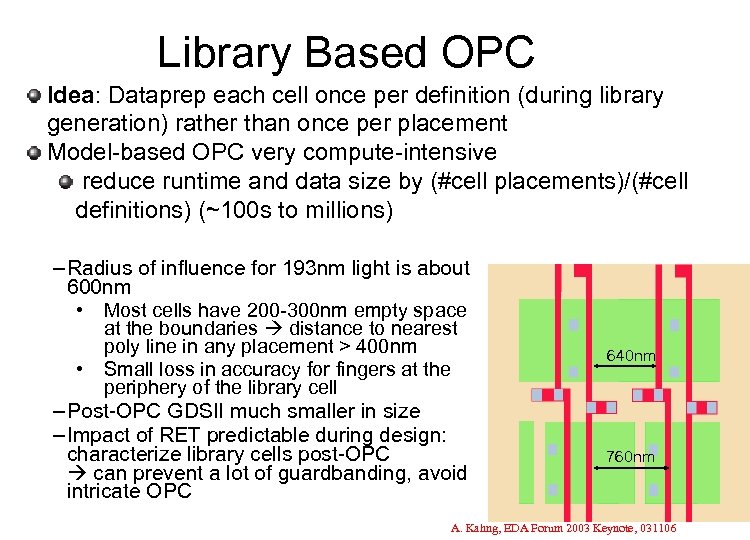
Library Based OPC Idea: Dataprep each cell once per definition (during library generation) rather than once per placement Model-based OPC very compute-intensive reduce runtime and data size by (#cell placements)/(#cell definitions) (~100 s to millions) – Radius of influence for 193 nm light is about 600 nm • Most cells have 200 -300 nm empty space • at the boundaries distance to nearest poly line in any placement > 400 nm Small loss in accuracy for fingers at the periphery of the library cell – Post-OPC GDSII much smaller in size – Impact of RET predictable during design: characterize library cells post-OPC can prevent a lot of guardbanding, avoid intricate OPC 640 nm 760 nm A. Kahng, EDA Forum 2003 Keynote, 031106
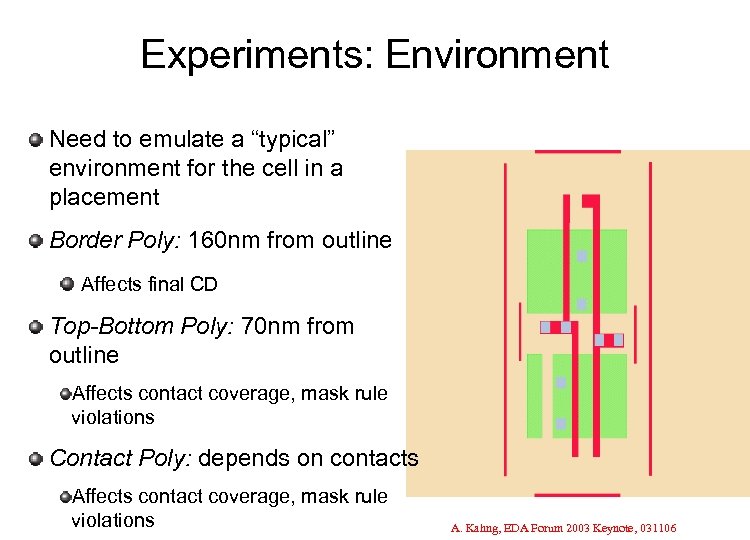
Experiments: Environment Need to emulate a “typical” environment for the cell in a placement Border Poly: 160 nm from outline Affects final CD Top-Bottom Poly: 70 nm from outline Affects contact coverage, mask rule violations Contact Poly: depends on contacts Affects contact coverage, mask rule violations A. Kahng, EDA Forum 2003 Keynote, 031106
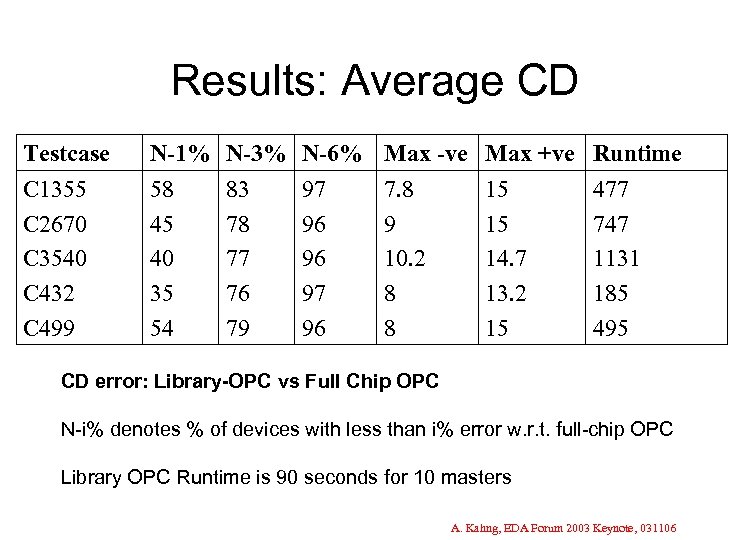
Results: Average CD Testcase N-1% N-3% N-6% Max -ve Max +ve Runtime C 1355 C 2670 C 3540 C 432 C 499 58 45 40 35 54 83 78 77 76 79 97 96 96 97 96 7. 8 9 10. 2 8 8 15 15 14. 7 13. 2 15 477 747 1131 185 495 CD error: Library-OPC vs Full Chip OPC N-i% denotes % of devices with less than i% error w. r. t. full-chip OPC Library OPC Runtime is 90 seconds for 10 masters A. Kahng, EDA Forum 2003 Keynote, 031106
#2: Process-Aware Design • Anisotropy in H vs. V bias – Features in one direction (scanning, raster write, …) may be better controllable than those in the orthogonal direction – Single orientation throughout layout is preferred – Dominant (critical-feature) orientation in layout design should match write direction • Wafer symmetries (e. g. , etch gradient due to spin-on) • Iso-Dense balancing (imaging through focus) A. Kahng, EDA Forum 2003 Keynote, 031106
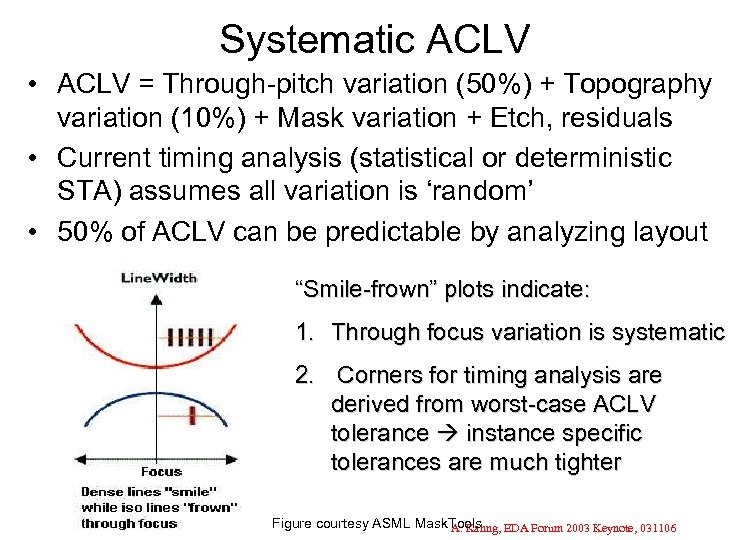
Systematic ACLV • ACLV = Through-pitch variation (50%) + Topography variation (10%) + Mask variation + Etch, residuals • Current timing analysis (statistical or deterministic STA) assumes all variation is ‘random’ • 50% of ACLV can be predictable by analyzing layout “Smile-frown” plots indicate: 1. Through focus variation is systematic 2. Corners for timing analysis are derived from worst-case ACLV tolerance instance specific tolerances are much tighter Figure courtesy ASML Mask. Tools A. Kahng, EDA Forum 2003 Keynote, 031106
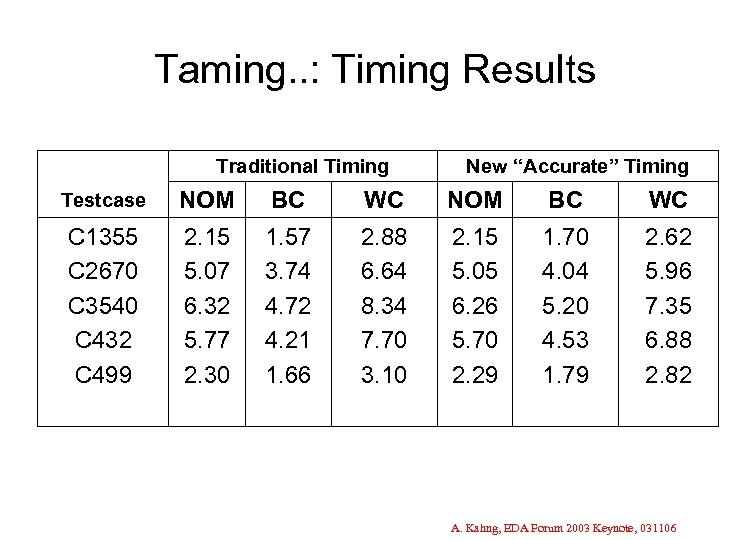
Taming Pattern and Focus Variation 1. Obtain a set of nominal CD (wafer image simulation) for typical environments of the cell in a chip environment specific timing libs (typical ASIC libs very limited set of environments) 2. Run in-context STA (post-placement) with context-specific timing libs accurate nominal timing at zero focus condition 3. Input to output delay modeling based on the isoness and dense-ness of transistors in the input to output paths more accurate delay variation analysis in STA A. Kahng, EDA Forum 2003 Keynote, 031106
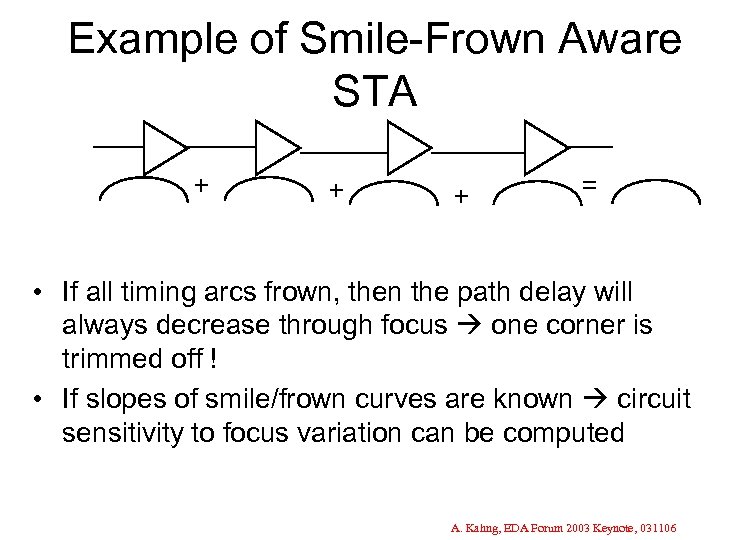
Example of Smile-Frown Aware STA + + + = • If all timing arcs frown, then the path delay will always decrease through focus one corner is trimmed off ! • If slopes of smile/frown curves are known circuit sensitivity to focus variation can be computed A. Kahng, EDA Forum 2003 Keynote, 031106
Taming. . : Timing Results Traditional Timing New “Accurate” Timing Testcase NOM BC WC C 1355 C 2670 C 3540 C 432 C 499 2. 15 5. 07 6. 32 5. 77 2. 30 1. 57 3. 74 4. 72 4. 21 1. 66 2. 88 6. 64 8. 34 7. 70 3. 10 2. 15 5. 05 6. 26 5. 70 2. 29 1. 70 4. 04 5. 20 4. 53 1. 79 2. 62 5. 96 7. 35 6. 88 2. 82 A. Kahng, EDA Forum 2003 Keynote, 031106
#3: Intelligent MDP + Mask Write • MDP driven by (write error * MEEF) = wafer CD error – Partitioning into multiple gray-scale writing passes – Apertures, beam currents, dwell times, shot ordering, … • EDA tools define stripe, major field, subfield boundaries! • Electrical / functional defect criteria A. Kahng, EDA Forum 2003 Keynote, 031106
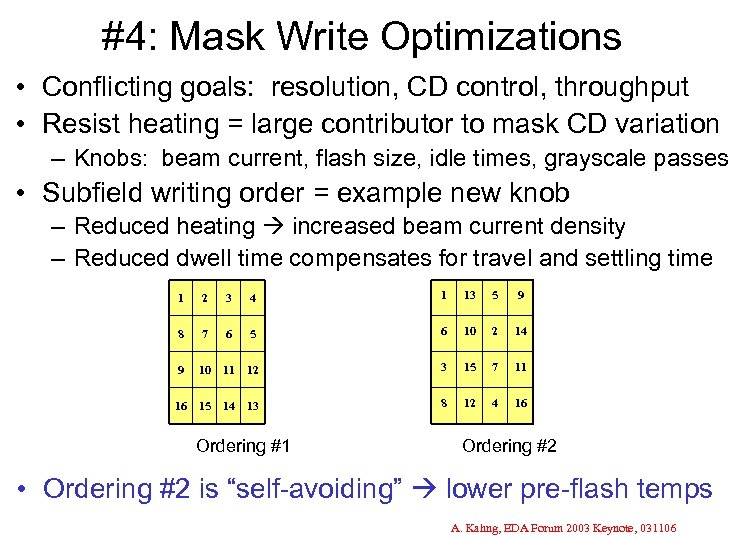
#4: Mask Write Optimizations • Conflicting goals: resolution, CD control, throughput • Resist heating = large contributor to mask CD variation – Knobs: beam current, flash size, idle times, grayscale passes • Subfield writing order = example new knob – Reduced heating increased beam current density – Reduced dwell time compensates for travel and settling time 1 2 3 4 1 13 5 9 8 7 6 5 6 10 2 14 9 10 11 12 3 15 7 11 16 15 14 13 8 12 4 16 Ordering #1 Ordering #2 • Ordering #2 is “self-avoiding” lower pre-flash temps A. Kahng, EDA Forum 2003 Keynote, 031106
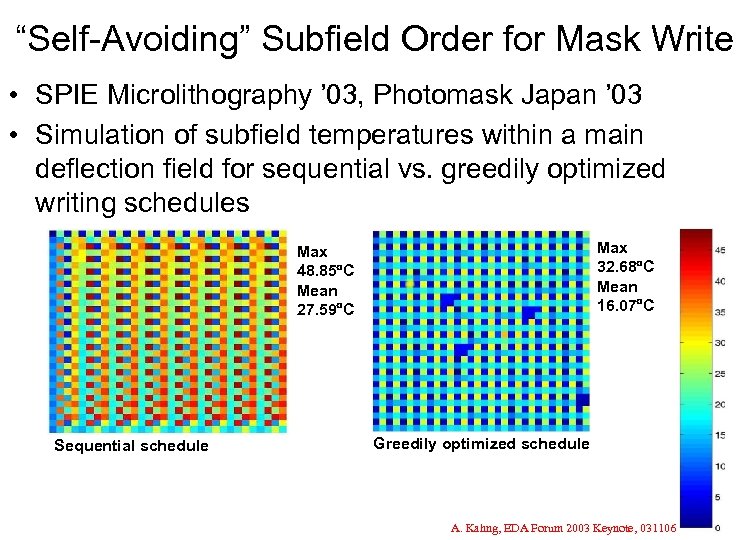
“Self-Avoiding” Subfield Order for Mask Write • SPIE Microlithography ’ 03, Photomask Japan ’ 03 • Simulation of subfield temperatures within a main deflection field for sequential vs. greedily optimized writing schedules Max 32. 68 C Mean 16. 07 C Max 48. 85 C Mean 27. 59 C Sequential schedule Greedily optimized schedule A. Kahng, EDA Forum 2003 Keynote, 031106
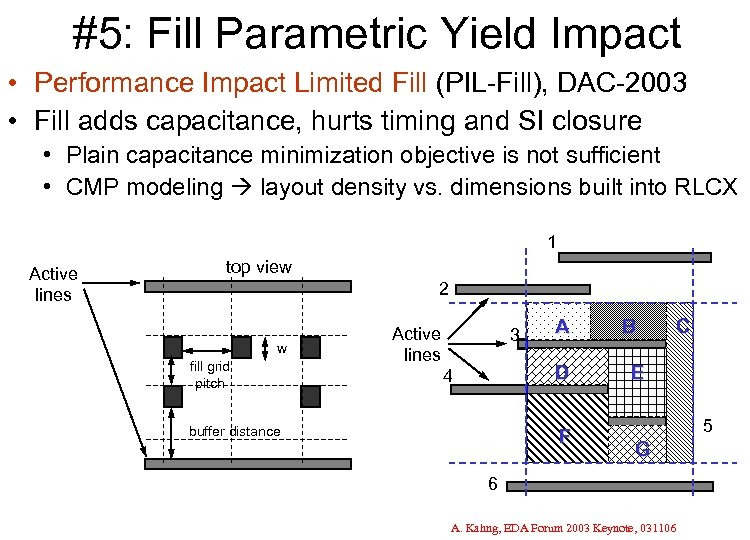
#5: Fill Parametric Yield Impact • Performance Impact Limited Fill (PIL-Fill), DAC-2003 • Fill adds capacitance, hurts timing and SI closure • Plain capacitance minimization objective is not sufficient • CMP modeling layout density vs. dimensions built into RLCX 1 Active lines top view 2 w fill grid pitch Active lines 3 A D 4 buffer distance F B C E 5 G 6 A. Kahng, EDA Forum 2003 Keynote, 031106
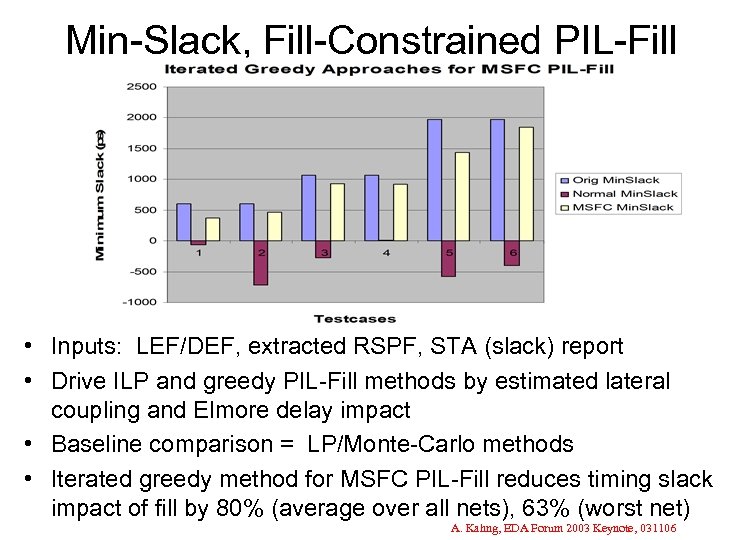
Min-Slack, Fill-Constrained PIL-Fill • Inputs: LEF/DEF, extracted RSPF, STA (slack) report • Drive ILP and greedy PIL-Fill methods by estimated lateral coupling and Elmore delay impact • Baseline comparison = LP/Monte-Carlo methods • Iterated greedy method for MSFC PIL-Fill reduces timing slack impact of fill by 80% (average over all nets), 63% (worst net) A. Kahng, EDA Forum 2003 Keynote, 031106
#6: Analog Rules • We don’t need no $#(*&(! “rules” – Rules just make lithographers feel better (? ) • Ultimately, bottom line is cost of ownership, TCOG • Given adequate models of MDP, RET and Litho flows, design tools can and should optimize parametric yield, $/wafer, profits – More examples: critical-area reduction by decompaction, introducing redundancy (vias, wires), … • Automated learning of models and “implicit rules” – Current approach: test wafers, test structures, second-hand understanding – Future: machine learning techniques A. Kahng, EDA Forum 2003 Keynote, 031106
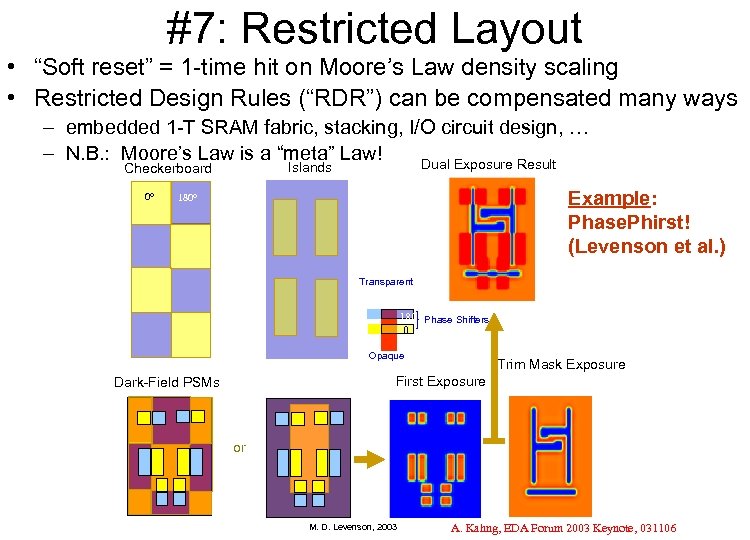
#7: Restricted Layout • “Soft reset” = 1 -time hit on Moore’s Law density scaling • Restricted Design Rules (“RDR”) can be compensated many ways – embedded 1 -T SRAM fabric, stacking, I/O circuit design, … – N. B. : Moore’s Law is a “meta” Law! Dual Exposure Result Islands Checkerboard 0 Example: Phase. Phirst! (Levenson et al. ) 180 Transparent 180 Phase Shifters 0 Opaque Trim Mask Exposure First Exposure Dark-Field PSMs or M. D. Levenson, 2003 A. Kahng, EDA Forum 2003 Keynote, 031106
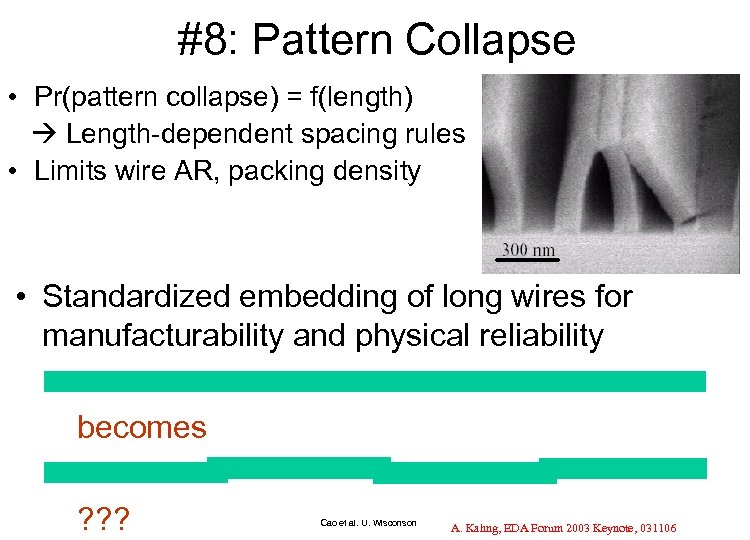
#8: Pattern Collapse • Pr(pattern collapse) = f(length) Length-dependent spacing rules • Limits wire AR, packing density • Standardized embedding of long wires for manufacturability and physical reliability becomes ? ? ? Cao et al. U. Wisconson A. Kahng, EDA Forum 2003 Keynote, 031106
#9: Data Compression • Today: RET + complexity exploding data volume • Partitioning of compression and decompression? – Equipment architecture question – where to put engines, I/F’s, storage? – Largely orthogonal to design considerations – Procedural compression largely unexplored? (Ex: Verilog + SP&R binaries + runscripts = representation of detail-routed layout) • Design for compressibility? (DATE ’ 03, SPIE ML ’ 03) – What is ROI of relaxing constraints on layout? Of +k bytes of data? – How context-sensitive must patterning be? (Lessons from RET…) • Use of lossy compression? (SPIE ML ’ 03) – What design features can be “lost”? (Ex: dummy fill) A. Kahng, EDA Forum 2003 Keynote, 031106
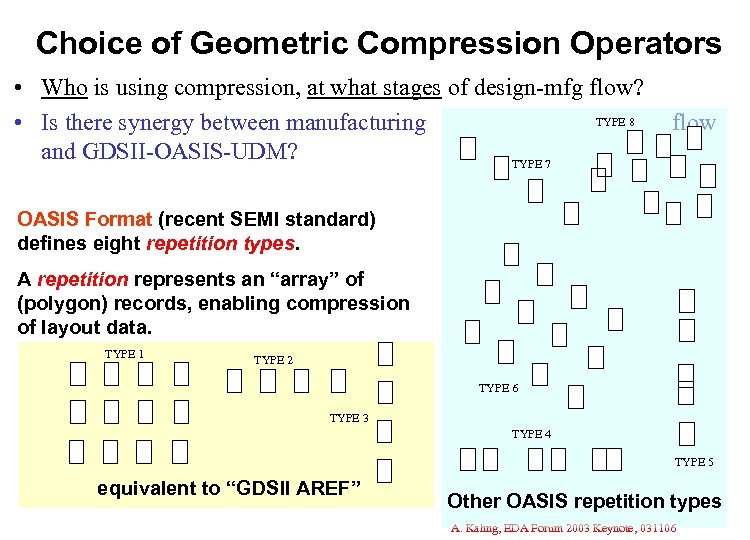
Choice of Geometric Compression Operators • Who is using compression, at what stages of design-mfg flow? TYPE 8 • Is there synergy between manufacturing and GDSII-OASIS-UDM? TYPE 7 flow OASIS Format (recent SEMI standard) defines eight repetition types. A repetition represents an “array” of (polygon) records, enabling compression of layout data. TYPE 1 TYPE 2 TYPE 6 TYPE 3 TYPE 4 TYPE 5 equivalent to “GDSII AREF” Other OASIS repetition types A. Kahng, EDA Forum 2003 Keynote, 031106
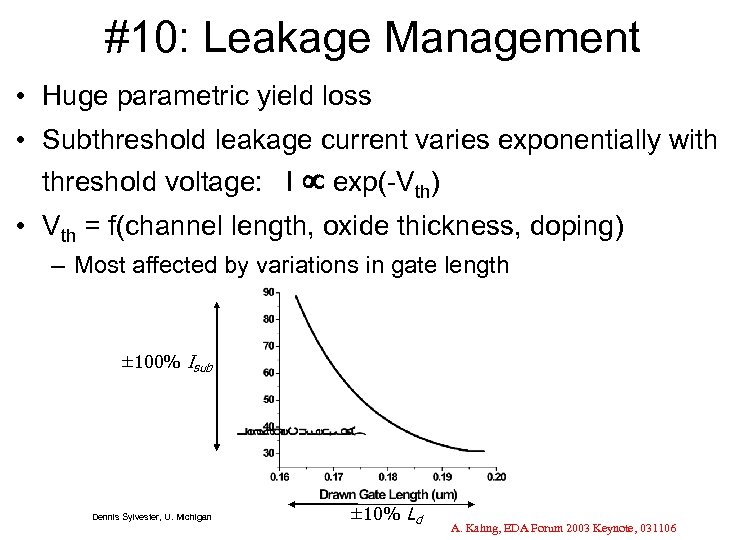
#10: Leakage Management • Huge parametric yield loss • Subthreshold leakage current varies exponentially with threshold voltage: I exp(-Vth) • Vth = f(channel length, oxide thickness, doping) – Most affected by variations in gate length ± 100% Isub Dennis Sylvester, U. Michigan ± 10% Ld A. Kahng, EDA Forum 2003 Keynote, 031106
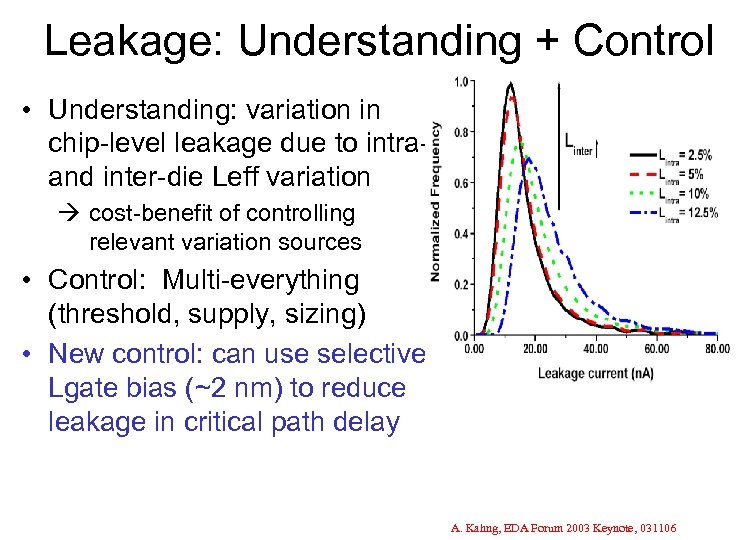
Leakage: Understanding + Control • Understanding: variation in chip-level leakage due to intraand inter-die Leff variation cost-benefit of controlling relevant variation sources • Control: Multi-everything (threshold, supply, sizing) • New control: can use selective Lgate bias (~2 nm) to reduce leakage in critical path delay A. Kahng, EDA Forum 2003 Keynote, 031106
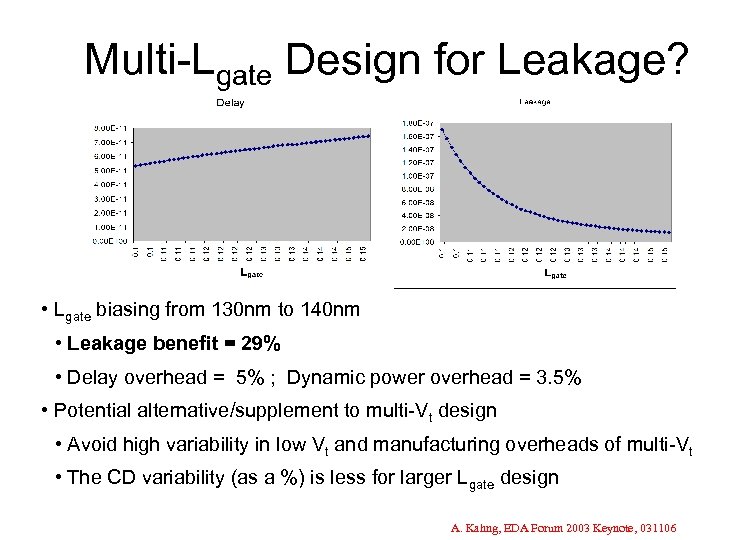
Multi-Lgate Design for Leakage? • Lgate biasing from 130 nm to 140 nm • Leakage benefit = 29% • Delay overhead = 5% ; Dynamic power overhead = 3. 5% • Potential alternative/supplement to multi-Vt design • Avoid high variability in low Vt and manufacturing overheads of multi-Vt • The CD variability (as a %) is less for larger Lgate design A. Kahng, EDA Forum 2003 Keynote, 031106
Conclusions • Designer, EDA, and mask communities must co-evolve to maintain the cost (value) trajectory of Moore’s Law – Wakeup call: Intel 157 nm announcement • Basic goal: bidirectional design-mfg data pipe – Drivers: cost, value – Pass functional intent to mask and foundry flows – Pass limits of mask and foundry flows up to design • Several examples given – – – Manufacturability and cost/value optimization Leakage power Restricted layout Intelligent mask data prep “Analog” rules • Much (valuable) work is ahead of us ! A. Kahng, EDA Forum 2003 Keynote, 031106

THANK YOU ! A. Kahng, EDA Forum 2003 Keynote, 031106
Скачать презентацию The Design-Manufacturing Roadmap Andrew B Kahng UC San
4fd3952450a4dd89f06816fe2866f307.ppt