


 Скачать презентацию The Department of the Navy 2004 Logistics Conference
995991cf21c2c20fb7dba749c7354bbc.ppt
- Количество слайдов: 13
 The Department of the Navy 2004 Logistics Conference Performance Based Logistics Panel 20 May 2004 Joe Grosson Corp. Director of Logistics
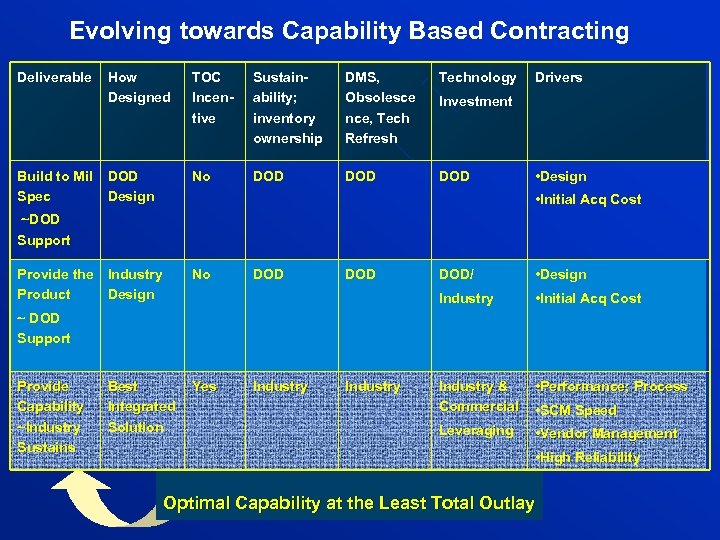 Evolving towards Capability Based Contracting Deliverable Build to Mil Spec How Designed TOC Incentive Sustainability; inventory ownership DMS, Obsolesce nce, Tech Refresh Technology DOD Design No DOD DOD Drivers Investment • Design • Initial Acq Cost ~DOD Support No DOD DOD/ • Design Industry Provide the Industry Product Design • Initial Acq Cost Industry & Commercial • Performance; Process Leveraging • Vendor Management ~ DOD Support Provide Capability ~Industry Sustains Best Integrated Solution Yes Industry • SCM Speed • High Reliability Optimal Capability at the Least Total Outlay
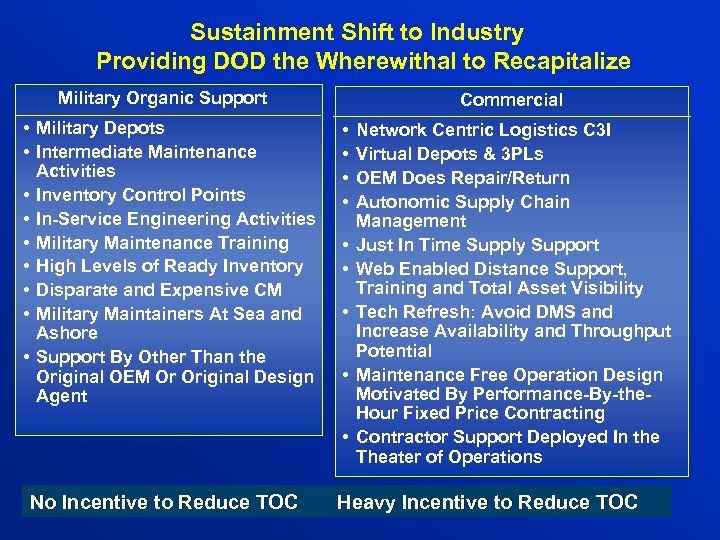 Sustainment Shift to Industry Providing DOD the Wherewithal to Recapitalize Military Organic Support • Military Depots • Intermediate Maintenance Activities • Inventory Control Points • In-Service Engineering Activities • Military Maintenance Training • High Levels of Ready Inventory • Disparate and Expensive CM • Military Maintainers At Sea and Ashore • Support By Other Than the Original OEM Or Original Design Agent Commercial • • • No Incentive to Reduce TOC Network Centric Logistics C 3 I Virtual Depots & 3 PLs OEM Does Repair/Return Autonomic Supply Chain Management Just In Time Supply Support Web Enabled Distance Support, Training and Total Asset Visibility Tech Refresh: Avoid DMS and Increase Availability and Throughput Potential Maintenance Free Operation Design Motivated By Performance-By-the. Hour Fixed Price Contracting Contractor Support Deployed In the Theater of Operations Heavy Incentive to Reduce TOC
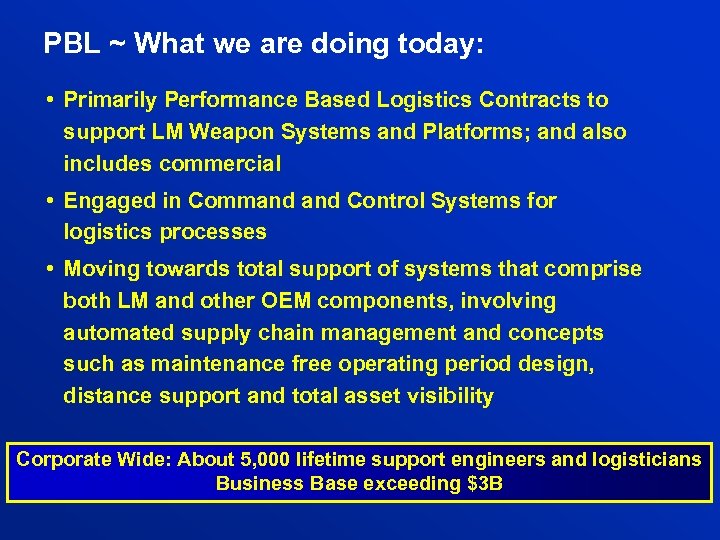 PBL ~ What we are doing today: • Primarily Performance Based Logistics Contracts to support LM Weapon Systems and Platforms; and also includes commercial • Engaged in Command Control Systems for logistics processes • Moving towards total support of systems that comprise both LM and other OEM components, involving automated supply chain management and concepts such as maintenance free operating period design, distance support and total asset visibility Corporate Wide: About 5, 000 lifetime support engineers and logisticians Business Base exceeding $3 B
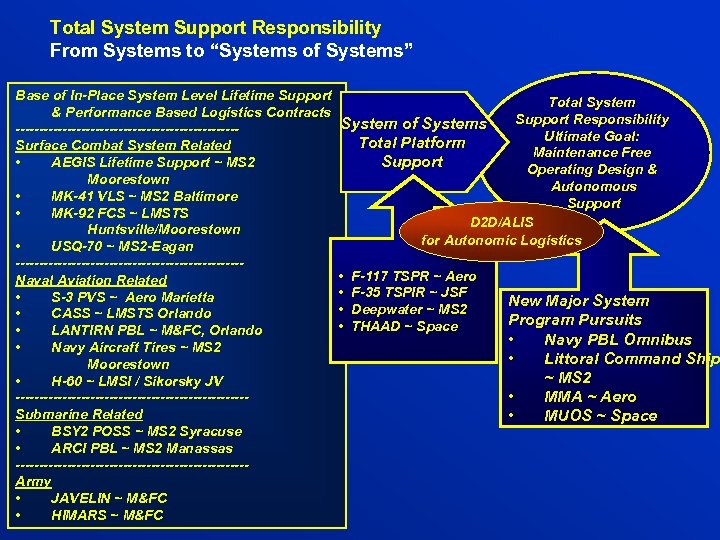 Total System Support Responsibility From Systems to “Systems of Systems” Base of In-Place System Level Lifetime Support & Performance Based Logistics Contracts ------------------------Surface Combat System Related • AEGIS Lifetime Support ~ MS 2 Moorestown • MK-41 VLS ~ MS 2 Baltimore • MK-92 FCS ~ LMSTS Huntsville/Moorestown • USQ-70 ~ MS 2 -Eagan ------------------------Naval Aviation Related • S-3 PVS ~ Aero Marietta • CASS ~ LMSTS Orlando • LANTIRN PBL ~ M&FC, Orlando • Navy Aircraft Tires ~ MS 2 Moorestown • H-60 ~ LMSI / Sikorsky JV -------------------------Submarine Related • BSY 2 POSS ~ MS 2 Syracuse • ARCI PBL ~ MS 2 Manassas -------------------------Army • JAVELIN ~ M&FC • HIMARS ~ M&FC Total System Support Responsibility System of Systems Ultimate Goal: Total Platform Maintenance Free Support Operating Design & Autonomous Support D 2 D/ALIS for Autonomic Logistics • • F-117 TSPR ~ Aero F-35 TSPIR ~ JSF Deepwater ~ MS 2 THAAD ~ Space New Major System Program Pursuits • Navy PBL Omnibus • Littoral Command Ship ~ MS 2 • MMA ~ Aero • MUOS ~ Space
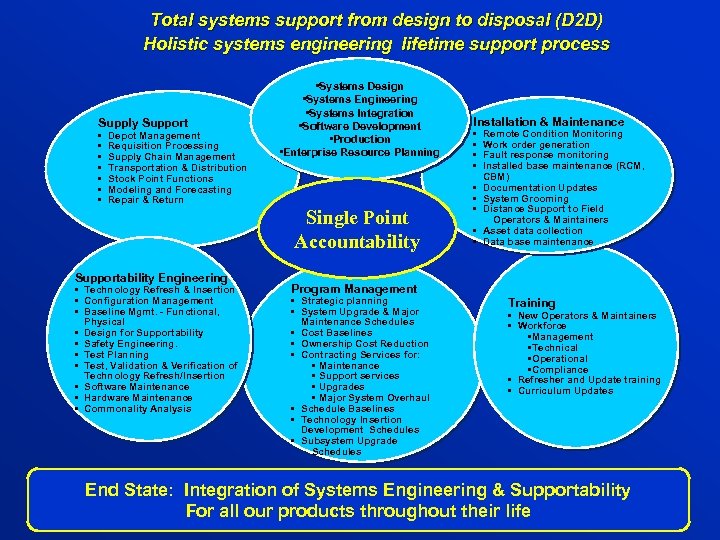 Total systems support from design to disposal (D 2 D) Holistic systems engineering lifetime support process Supply Support • • Depot Management Requisition Processing Supply Chain Management Transportation & Distribution Stock Point Functions Modeling and Forecasting Repair & Return • Systems Design • Systems Engineering • Systems Integration • Software Development • Production • Enterprise Resource Planning Single Point Accountability Supportability Engineering • Technology Refresh & Insertion • Configuration Management • Baseline Mgmt. - Functional, Physical • Design for Supportability • Safety Engineering. • Test Planning • Test, Validation & Verification of Technology Refresh/Insertion • Software Maintenance • Hardware Maintenance • Commonality Analysis Installation & Maintenance • • • Remote Condition Monitoring Work order generation Fault response monitoring Installed base maintenance (RCM, CBM) Documentation Updates System Grooming Distance Support to Field Operators & Maintainers Asset data collection Data base maintenance Program Management • Strategic planning • System Upgrade & Major Maintenance Schedules • Cost Baselines • Ownership Cost Reduction • Contracting Services for: • Maintenance • Support services • Upgrades • Major System Overhaul • Schedule Baselines • Technology Insertion Development Schedules • Subsystem Upgrade Schedules Training • New Operators & Maintainers • Workforce • Management • Technical • Operational • Compliance • Refresher and Update training • Curriculum Updates End State: Integration of Systems Engineering & Supportability For all our products throughout their life
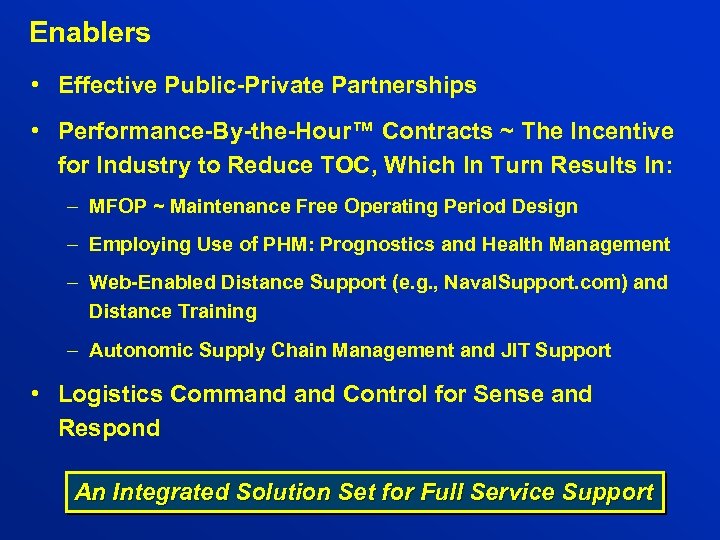 Enablers • Effective Public-Private Partnerships • Performance-By-the-Hour™ Contracts ~ The Incentive for Industry to Reduce TOC, Which In Turn Results In: – MFOP ~ Maintenance Free Operating Period Design – Employing Use of PHM: Prognostics and Health Management – Web-Enabled Distance Support (e. g. , Naval. Support. com) and Distance Training – Autonomic Supply Chain Management and JIT Support • Logistics Command Control for Sense and Respond An Integrated Solution Set for Full Service Support
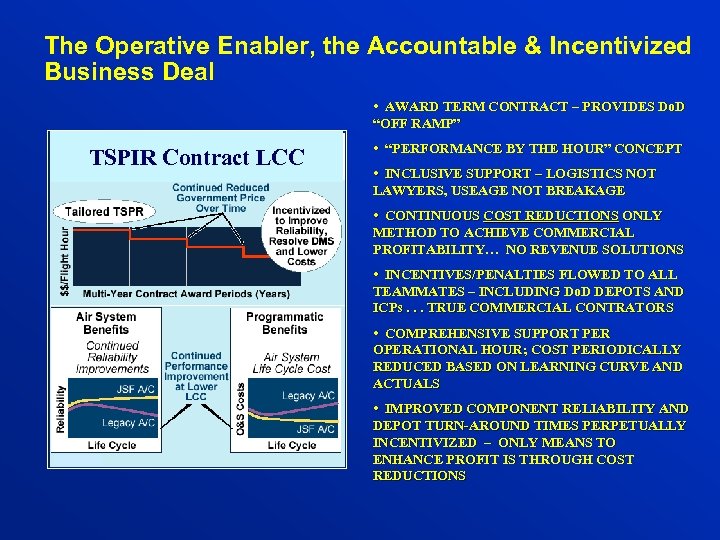 The Operative Enabler, the Accountable & Incentivized Business Deal • AWARD TERM CONTRACT – PROVIDES Do. D “OFF RAMP” TSPIR Contract LCC • “PERFORMANCE BY THE HOUR” CONCEPT • INCLUSIVE SUPPORT – LOGISTICS NOT LAWYERS, USEAGE NOT BREAKAGE • CONTINUOUS COST REDUCTIONS ONLY METHOD TO ACHIEVE COMMERCIAL PROFITABILITY… NO REVENUE SOLUTIONS • INCENTIVES/PENALTIES FLOWED TO ALL TEAMMATES – INCLUDING Do. D DEPOTS AND ICPs. . . TRUE COMMERCIAL CONTRATORS • COMPREHENSIVE SUPPORT PER OPERATIONAL HOUR; COST PERIODICALLY REDUCED BASED ON LEARNING CURVE AND ACTUALS • IMPROVED COMPONENT RELIABILITY AND DEPOT TURN-AROUND TIMES PERPETUALLY INCENTIVIZED – ONLY MEANS TO ENHANCE PROFIT IS THROUGH COST REDUCTIONS
 Questions?
 Back-Up Slides
 How Does Total Systems Support Responsibility Reduce Costs? By coalescing all TSSR responsibilities under a single, long term contract, with single point accountability and clear performance metrics, we can then: – Consolidate lifetime support functions across companies that support the Combat System, improving productivity, efficiency and reducing administrative overhead. Reallocate some of these savings to focus on direct war fighter support – Consolidate the architectural design capabilities across Companies to truly optimize the open architecture and COTs management – Because of contract incentive structure, Institute the trade-space paradigm that focuses on achieving continuous TOC reductions coupled with increases in operational effectiveness, readiness and sustainability – Use a standard architecture for total sustainment management & standardized processes thus eliminating duplicate investment and maintenance costs – Standardize on automated Supply Chain Management to lean-out all supply chain and total asset visibility processes and materially reduce inventory while improving supportability
 How Does Total Systems Support Responsibility Reduce Costs? – Reduce redundant infrastructure (with its attendant hardware and software maintenance costs) through consolidation including depots, stock points, and test environments – Have a single collaborative design, development, configuration management and testing environment that truly provides the capability for virtual development, test and management. – Coalesce the technology refresh/insertion strategies within one organization to optimize planning, testing, and sparing philosophies; import the Submarine approach for maintenance free operating period design in order to reduce inventory, maintenance, training and documentation; while increasing operational effectiveness through continuous processing power growth and Ao improvements – Continue the implementation of Public-Private partnerships in a common fashion across the customer community to rationalize and optimize workload assignments that reduce redundancy in work performance and infrastructure – Implement one standard distance support system thereby streamlining the maintenance, diagnostics and parts ordering process; this in-turn, reduces inventory levels, simplifies training and significantly reduces maintenance documentation
 How Does Total Systems Support Responsibility Reduce Costs for Do. D? Coalescing all TSSR responsibilities under a single, long term contract, with single point accountability and clear performance metrics, enables the following: – The need for third party reviewers and non-value add activities can be eliminated at significant savings – The roles of Warfare Centers, Depots and ISEAs can be redefined to engagement with technical authority and approval matters with an attendant decrease in funding requirements as contract performance is the responsibility of the prime contractor – Focusing on employment of CITE activities, public-private partnerships will be optimized to reduce all areas of unnecessary functions and hardware/software infrastructure – Instituting one standard supply support arrangement will substantially decrease government administrative costs and thus lower the Fleet Surcharge – Use of prime contractor training facilities will reduce cost of redundant infrastructure and instructors; real time incorporation of configuration changes into training curriculum and IETMs will improve operator/maintainer efficiencies