 Скачать презентацию The Defense S T Budget and Investment Focus Mr
47c464662d0637643bff84076af85e67.ppt
- Количество слайдов: 39



The Defense S&T Budget and Investment Focus Mr. Robert W. Baker April, 2004 Deputy Director, Plans & Programs, ODDR&E
DDR&E Priorities for CY 2004 Technical • Support Transformation Non-Technical • Technology Transition – National Aerospace Initiative, • National Energy and Power Technologies, Surveillance Security S&E and Knowledge Systems Workforce – 6 QDR Operational Goals • Support War on Terrorism • Expand Outreach to Combatant Commands & Intelligence Community
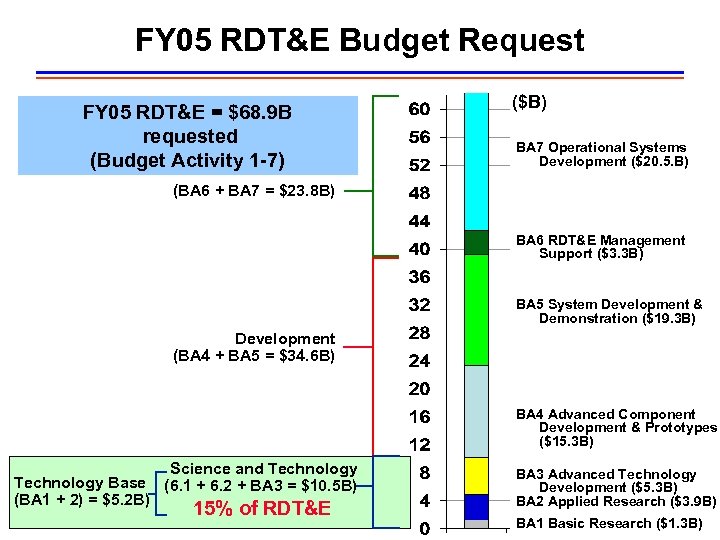
FY 05 RDT&E Budget Request FY 05 RDT&E = $68. 9 B requested (Budget Activity 1 -7) ($B) BA 7 Operational Systems Development ($20. 5. B) (BA 6 + BA 7 = $23. 8 B) BA 6 RDT&E Management Support ($3. 3 B) BA 5 System Development & Demonstration ($19. 3 B) Development (BA 4 + BA 5 = $34. 6 B) BA 4 Advanced Component Development & Prototypes ($15. 3 B) Technology Base (BA 1 + 2) = $5. 2 B) Science and Technology (6. 1 + 6. 2 + BA 3 = $10. 5 B) 15% of RDT&E BA 3 Advanced Technology Development ($5. 3 B) BA 2 Applied Research ($3. 9 B) BA 1 Basic Research ($1. 3 B)
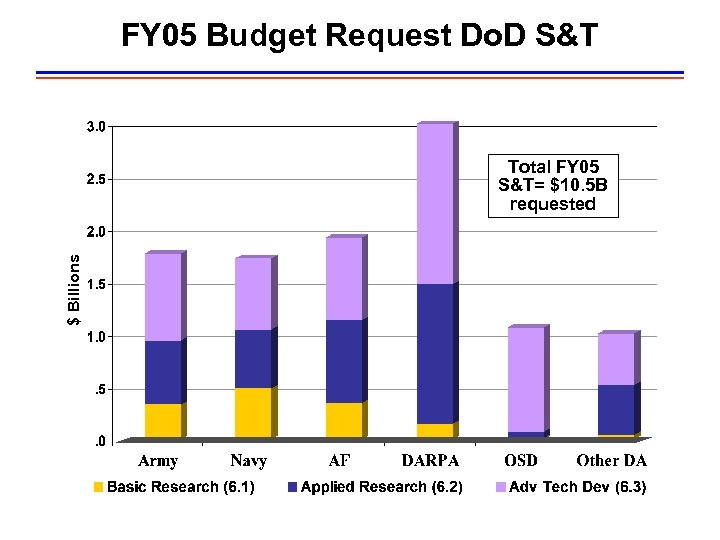
FY 05 Budget Request Do. D S&T $ Billions Total FY 05 S&T= $10. 5 B requested
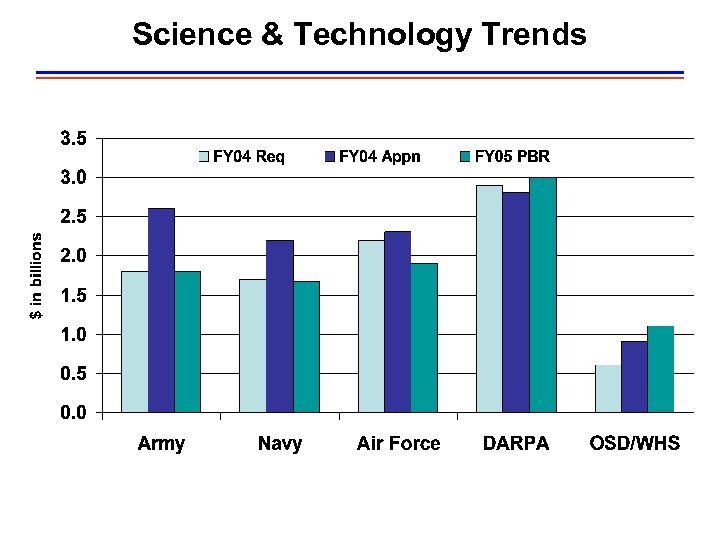
Science & Technology Trends
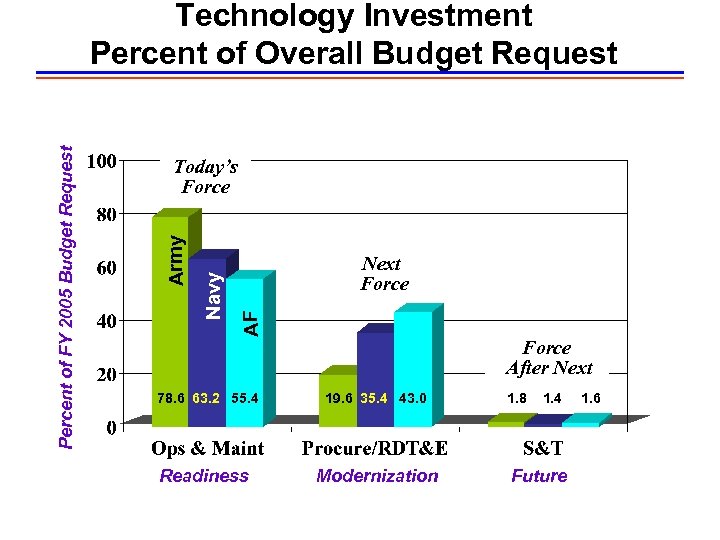
Next Force AF Navy Today’s Force Army Percent of FY 2005 Budget Request Technology Investment Percent of Overall Budget Request Force After Next 78. 6 63. 2 55. 4 19. 6 35. 4 43. 0 Readiness Modernization 1. 8 1. 4 Future 1. 6
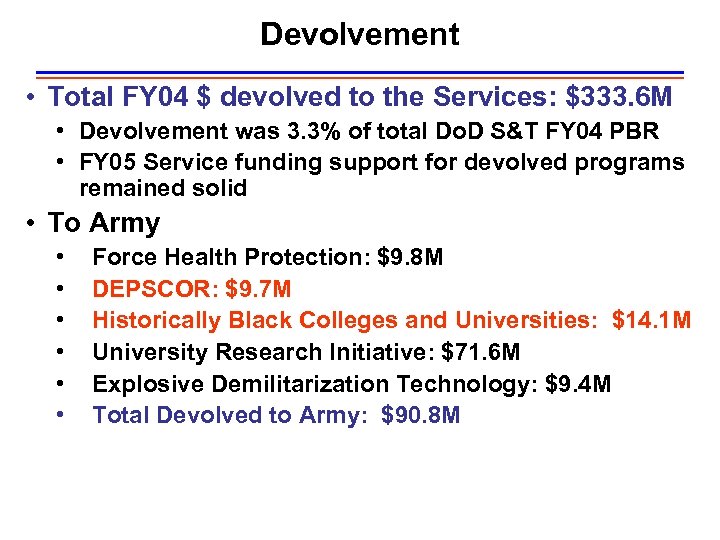
Devolvement • Total FY 04 $ devolved to the Services: $333. 6 M • Devolvement was 3. 3% of total Do. D S&T FY 04 PBR • FY 05 Service funding support for devolved programs remained solid • To Army • • • Force Health Protection: $9. 8 M DEPSCOR: $9. 7 M Historically Black Colleges and Universities: $14. 1 M University Research Initiative: $71. 6 M Explosive Demilitarization Technology: $9. 4 M Total Devolved to Army: $90. 8 M
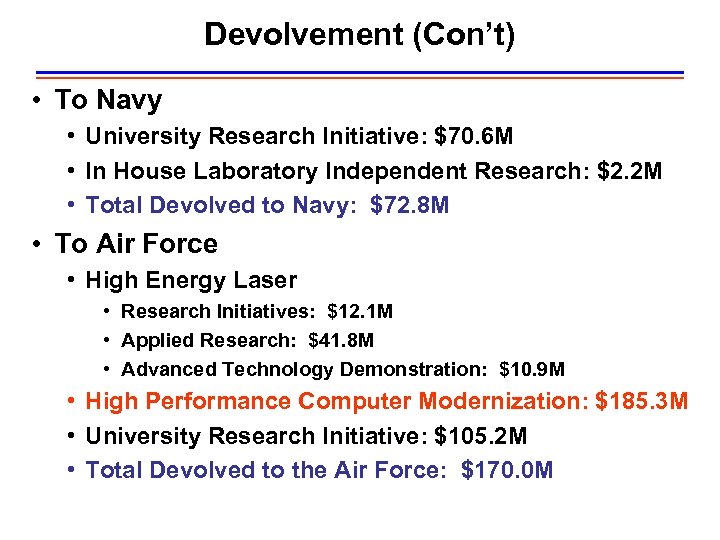
Devolvement (Con’t) • To Navy • University Research Initiative: $70. 6 M • In House Laboratory Independent Research: $2. 2 M • Total Devolved to Navy: $72. 8 M • To Air Force • High Energy Laser • Research Initiatives: $12. 1 M • Applied Research: $41. 8 M • Advanced Technology Demonstration: $10. 9 M • High Performance Computer Modernization: $185. 3 M • University Research Initiative: $105. 2 M • Total Devolved to the Air Force: $170. 0 M
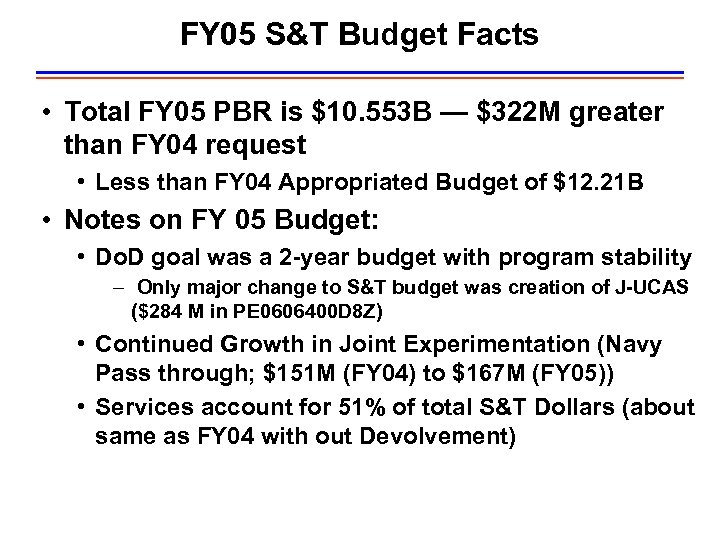
FY 05 S&T Budget Facts • Total FY 05 PBR is $10. 553 B — $322 M greater than FY 04 request • Less than FY 04 Appropriated Budget of $12. 21 B • Notes on FY 05 Budget: • Do. D goal was a 2 -year budget with program stability – Only major change to S&T budget was creation of J-UCAS ($284 M in PE 0606400 D 8 Z) • Continued Growth in Joint Experimentation (Navy Pass through; $151 M (FY 04) to $167 M (FY 05)) • Services account for 51% of total S&T Dollars (about same as FY 04 with out Devolvement)
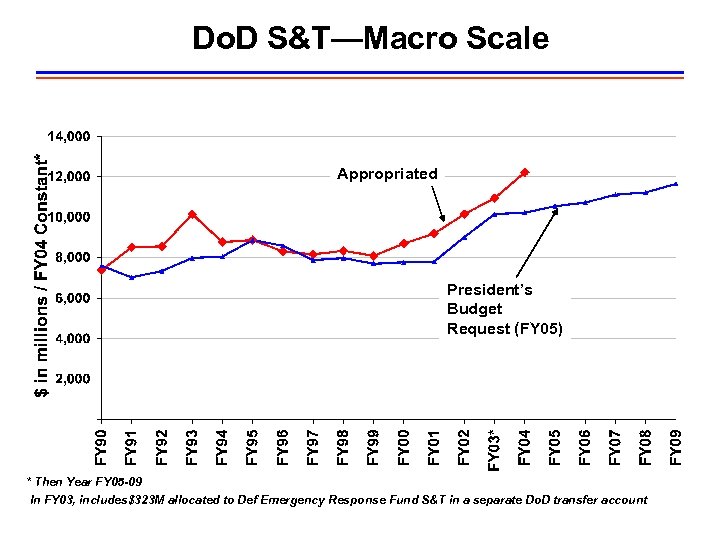
Do. D S&T—Macro Scale Appropriated President’s Budget Request (FY 05) * Then Year FY 05 -09 In FY 03, includes$323 M allocated to Def Emergency Response Fund S&T in a separate Do. D transfer account
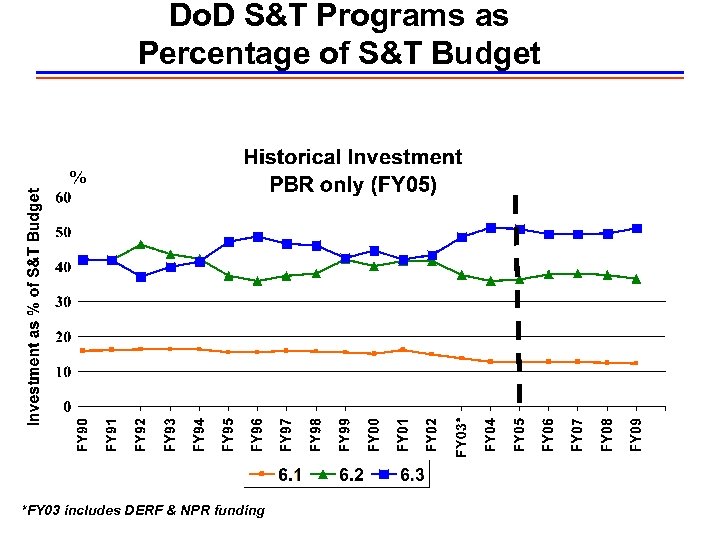
Do. D S&T Programs as Percentage of S&T Budget % *FY 03 includes DERF & NPR funding
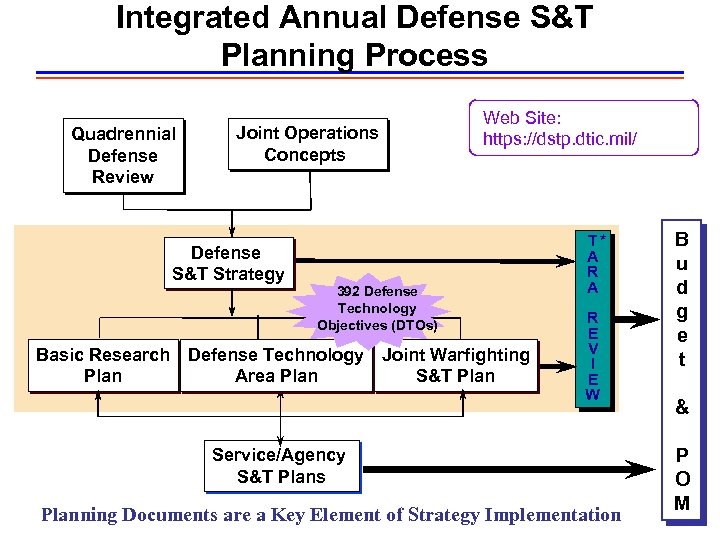
Integrated Annual Defense S&T Planning Process Quadrennial Defense Review Joint Operations Concepts Defense S&T Strategy Web Site: https: //dstp. dtic. mil/ 392 Defense Technology Objectives (DTOs) Basic Research Defense Technology Joint Warfighting Plan Area Plan S&T Plan T* A R E V I E W Service/Agency S&T Plans Planning Documents are a Key Element of Strategy Implementation B u d g e t & P O M
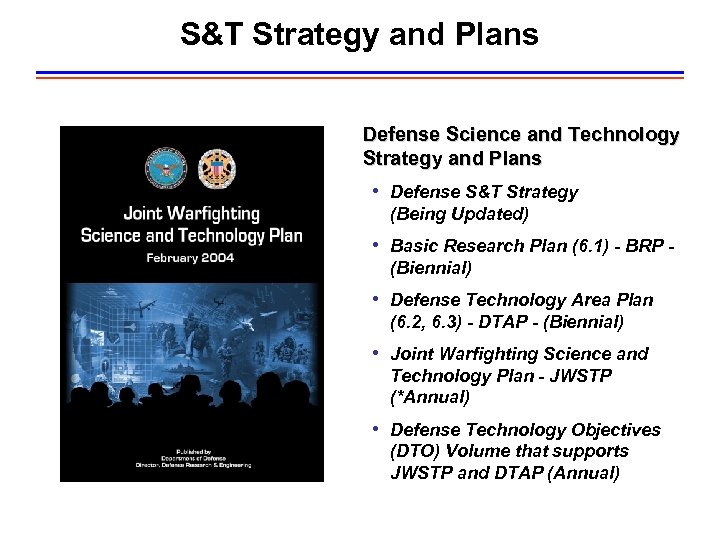
S&T Strategy and Plans Defense Science and Technology Strategy and Plans • Defense S&T Strategy (Being Updated) • Basic Research Plan (6. 1) - BRP (Biennial) • Defense Technology Area Plan (6. 2, 6. 3) - DTAP - (Biennial) • Joint Warfighting Science and Technology Plan - JWSTP (*Annual) • Defense Technology Objectives (DTO) Volume that supports JWSTP and DTAP (Annual)
Basic Research Plan (BRP) BRP-- A strategic plan to link longer term research to broad, revolutionary warfighter capabilities • Basic Research Areas – Physics – Chemistry – Mathematics and Computer Science – Electronics – Materials Science – Mechanics – Terrestrial and Ocean Sciences – Atmospheric and Space Sciences – Biological Sciences – Cognitive and Neural Science A Strategic plan guiding new technology development built around Basic Research Areas
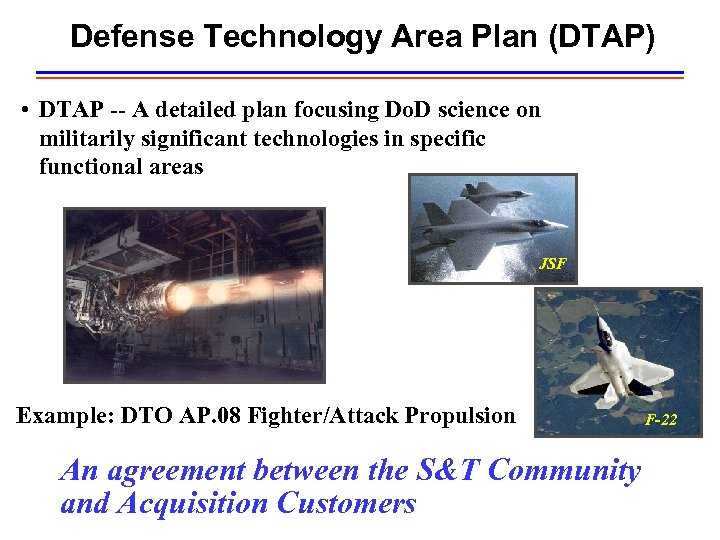
Defense Technology Area Plan (DTAP) • DTAP -- A detailed plan focusing Do. D science on militarily significant technologies in specific functional areas JSF Example: DTO AP. 08 Fighter/Attack Propulsion An agreement between the S&T Community and Acquisition Customers F-22
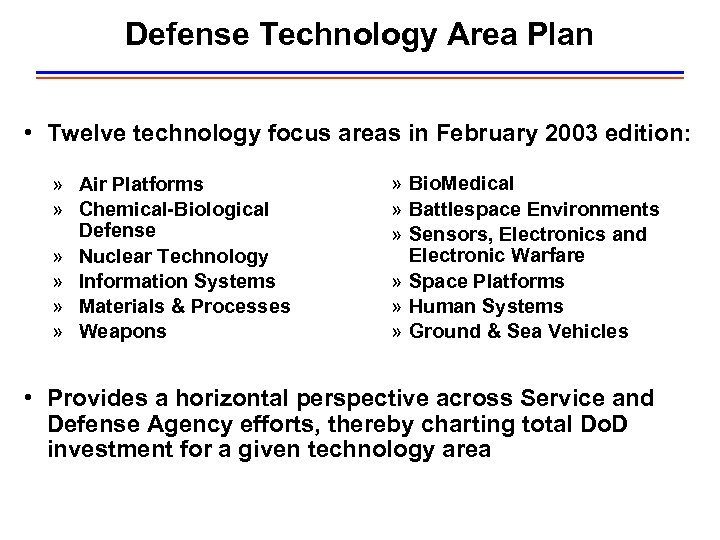
Defense Technology Area Plan • Twelve technology focus areas in February 2003 edition: » Air Platforms » Chemical-Biological Defense » Nuclear Technology » Information Systems » Materials & Processes » Weapons » Bio. Medical » Battlespace Environments » Sensors, Electronics and Electronic Warfare » Space Platforms » Human Systems » Ground & Sea Vehicles • Provides a horizontal perspective across Service and Defense Agency efforts, thereby charting total Do. D investment for a given technology area
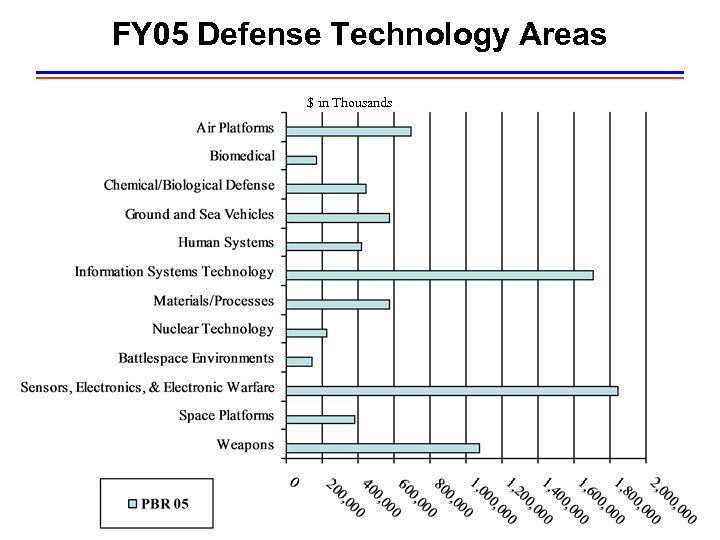
FY 05 Defense Technology Areas $ in Thousands
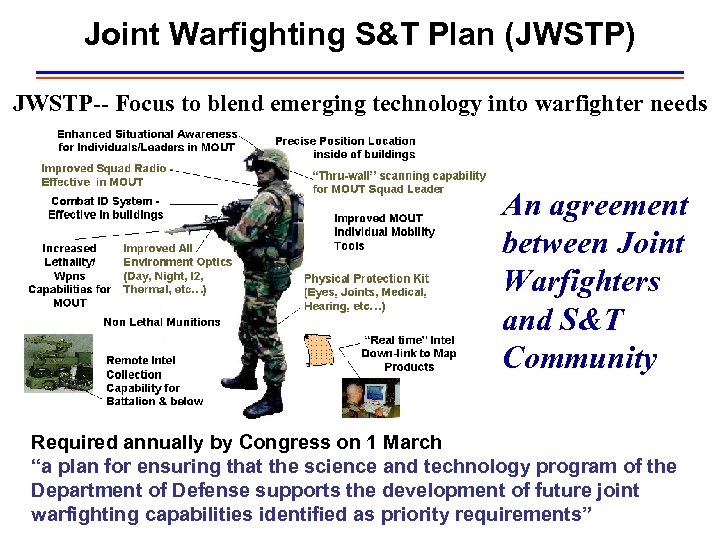
Joint Warfighting S&T Plan (JWSTP) JWSTP-- Focus to blend emerging technology into warfighter needs An agreement between Joint Warfighters and S&T Community Required annually by Congress on 1 March “a plan for ensuring that the science and technology program of the Department of Defense supports the development of future joint warfighting capabilities identified as priority requirements”
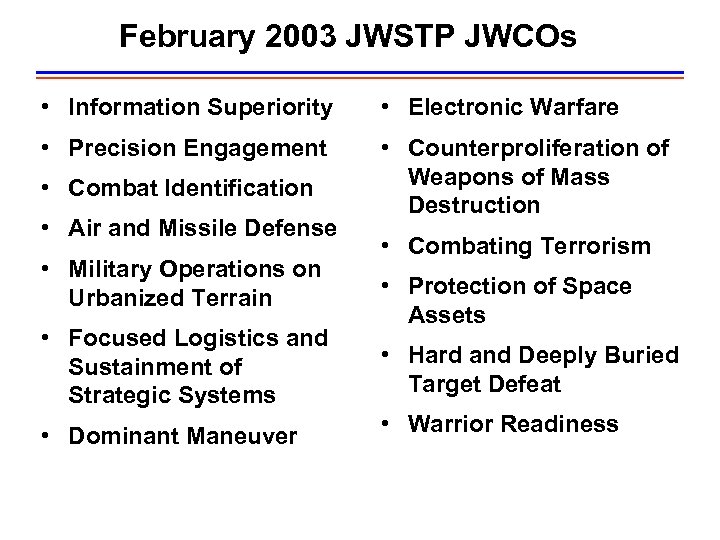
February 2003 JWSTP JWCOs • Information Superiority • Electronic Warfare • Precision Engagement • Counterproliferation of Weapons of Mass Destruction • Combat Identification • Air and Missile Defense • Military Operations on Urbanized Terrain • Focused Logistics and Sustainment of Strategic Systems • Dominant Maneuver • Combating Terrorism • Protection of Space Assets • Hard and Deeply Buried Target Defeat • Warrior Readiness
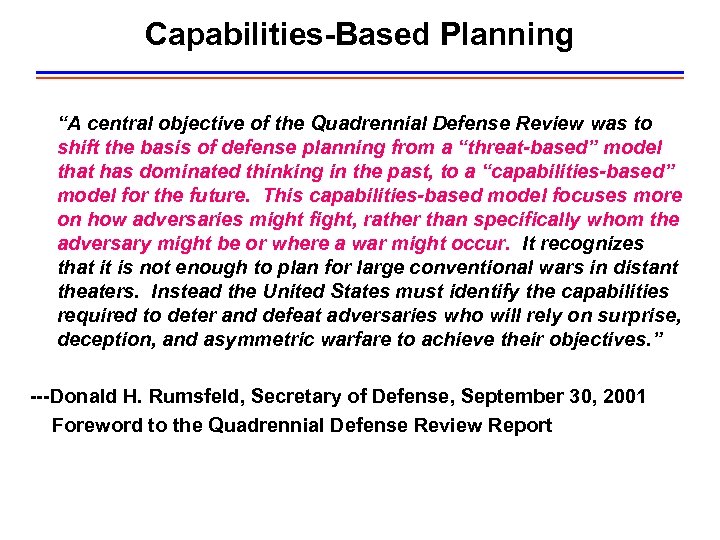
Capabilities-Based Planning “A central objective of the Quadrennial Defense Review was to shift the basis of defense planning from a “threat-based” model that has dominated thinking in the past, to a “capabilities-based” model for the future. This capabilities-based model focuses more on how adversaries might fight, rather than specifically whom the adversary might be or where a war might occur. It recognizes that it is not enough to plan for large conventional wars in distant theaters. Instead the United States must identify the capabilities required to deter and defeat adversaries who will rely on surprise, deception, and asymmetric warfare to achieve their objectives. ” ---Donald H. Rumsfeld, Secretary of Defense, September 30, 2001 Foreword to the Quadrennial Defense Review Report
Capabilities-Based Planning (Role of Science and Technology) • Joint Staff instruction for implementing capabilities-based planning – Joint Capabilities Integration and Development System (JCIDS) - CJCSI 3170. 01 C, June 24, 2003 “Science and Technology. The priorities of joint warfighting capabilities established through the JCIDS process should serve to inform the science and technology community and focus the development efforts of the community as specified in the Joint Warfighting Science and Technology Plan. ” • The JCIDS process provides an opportunity for the S&T community to be more involved much earlier in the process
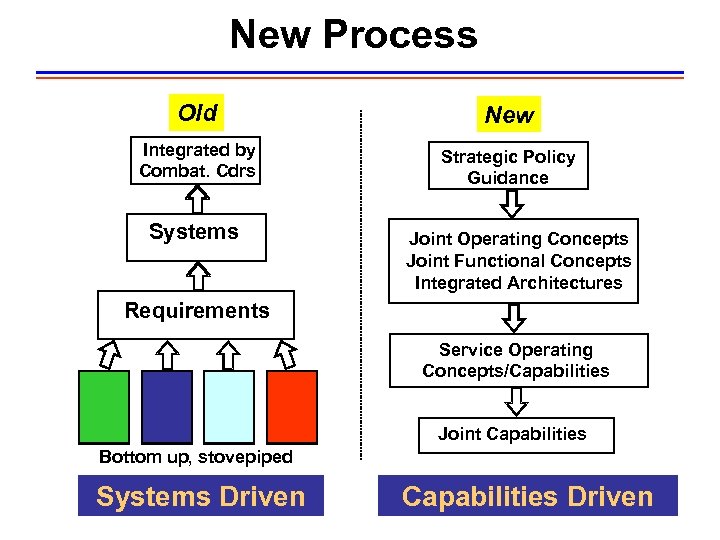
New Process Old New Integrated by Department Combat. Cdrs. Strategic Policy Guidance Systems Joint Operating Concepts Joint Functional Concepts Integrated Architectures Requirements Service Operating Concepts/Capabilities Joint Capabilities Bottom up, stovepiped Systems Driven Capabilities Driven
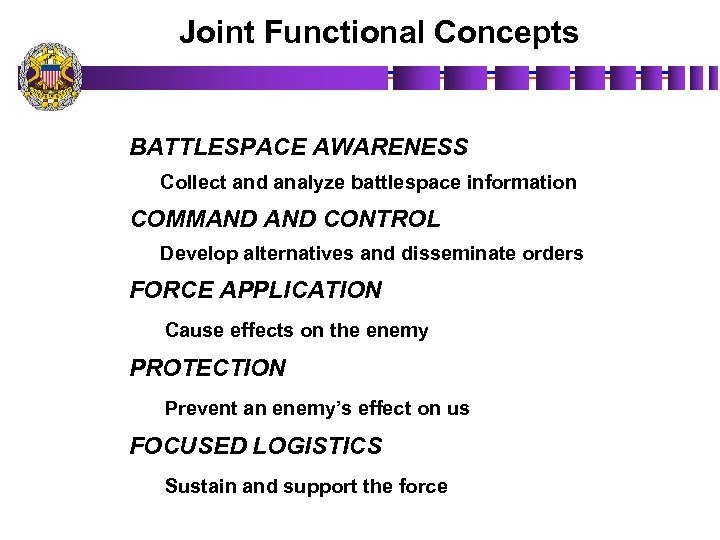
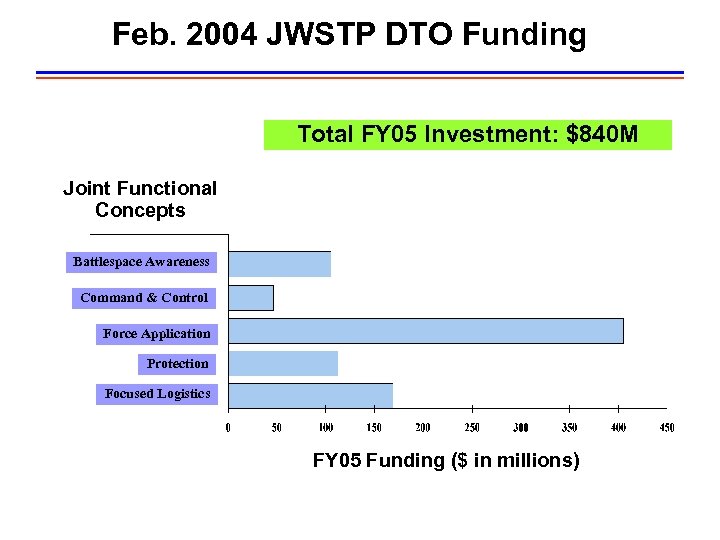
Joint Functional Concepts BATTLESPACE AWARENESS Collect and analyze battlespace information COMMAND CONTROL Develop alternatives and disseminate orders FORCE APPLICATION Cause effects on the enemy PROTECTION Prevent an enemy’s effect on us FOCUSED LOGISTICS Sustain and support the force
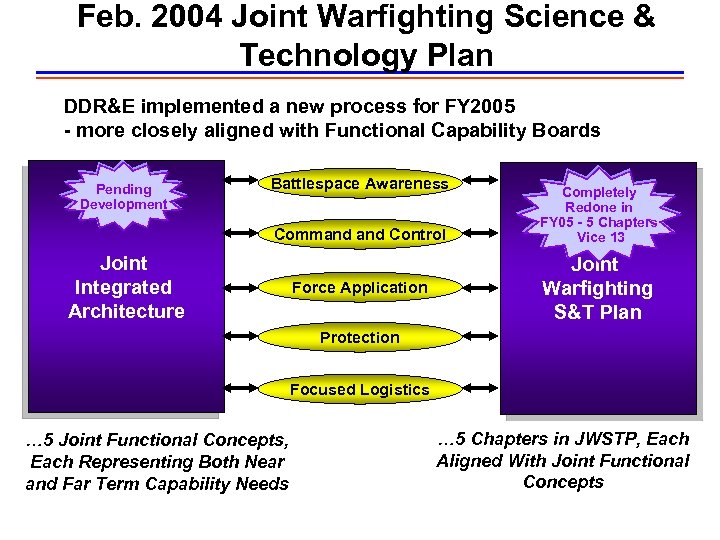
Feb. 2004 Joint Warfighting Science & Technology Plan DDR&E implemented a new process for FY 2005 - more closely aligned with Functional Capability Boards Pending Development Battlespace Awareness Command Control Joint Integrated Architecture Force Application Completely Redone in FY 05 - 5 Chapters Vice 13 Joint Warfighting S&T Plan Protection Focused Logistics … 5 Joint Functional Concepts, Each Representing Both Near and Far Term Capability Needs … 5 Chapters in JWSTP, Each Aligned With Joint Functional Concepts
Feb. 2004 JWSTP DTO Funding Total FY 05 Investment: $840 M Joint Functional Concepts Battlespace Awareness Command & Control Force Application Protection Focused Logistics FY 05 Funding ($ in millions)
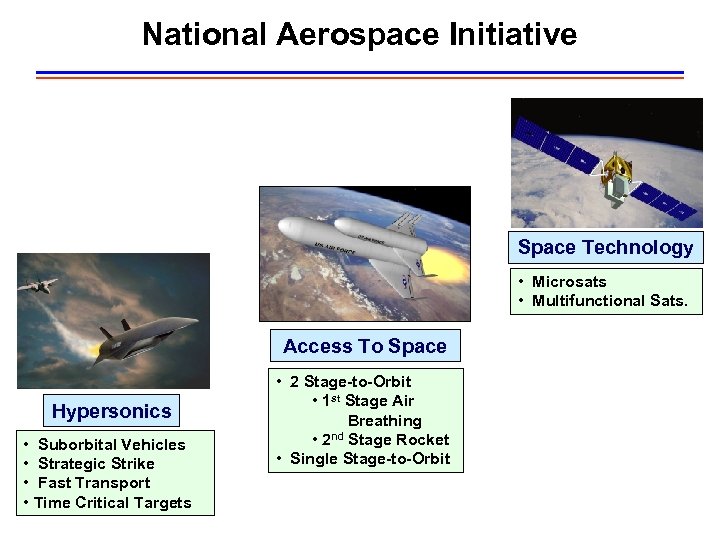
National Aerospace Initiative Space Technology • Microsats • Multifunctional Sats. Access To Space Hypersonics • Suborbital Vehicles • Strategic Strike • Fast Transport • Time Critical Targets • 2 Stage-to-Orbit • 1 st Stage Air Breathing nd Stage Rocket • 2 • Single Stage-to-Orbit
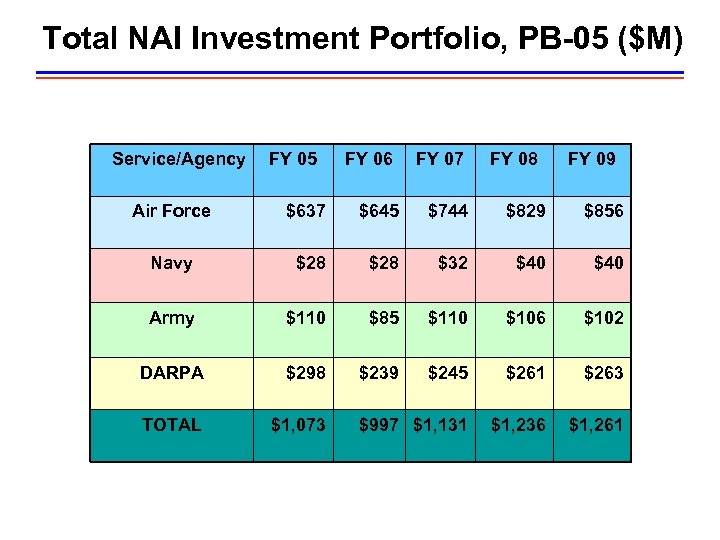
Total NAI Investment Portfolio, PB-05 ($M) Service/Agency FY 05 FY 06 FY 07 FY 08 FY 09 Air Force $637 $645 $744 $829 $856 Navy $28 $32 $40 Army $110 $85 $110 $106 $102 DARPA $298 $239 $245 $261 $263 TOTAL $1, 073 $997 $1, 131 $1, 236 $1, 261
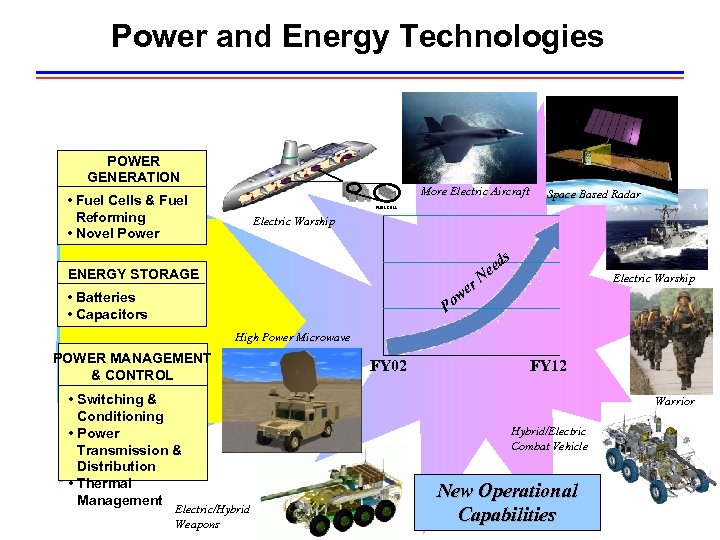
Power and Energy Technologies POWER GENERATION More Electric Aircraft • Fuel Cells & Fuel Reforming • Novel Power Space Based Radar FUEL CELL Electric Warship ENERGY STORAGE r we • Batteries • Capacitors ds ee N Electric Warship Po High Power Microwave POWER MANAGEMENT & CONTROL • Switching & Conditioning • Power Transmission & Distribution • Thermal Management Electric/Hybrid Weapons FY 02 FY 12 Warrior Hybrid/Electric Combat Vehicle New Operational Capabilities
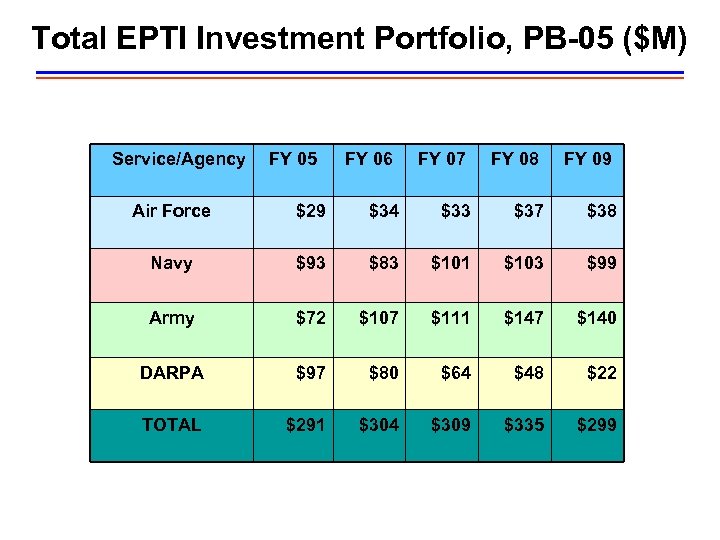
Total EPTI Investment Portfolio, PB-05 ($M) Service/Agency FY 05 FY 06 FY 07 FY 08 FY 09 Air Force $29 $34 $33 $37 $38 Navy $93 $83 $101 $103 $99 Army $72 $107 $111 $147 $140 DARPA $97 $80 $64 $48 $22 TOTAL $291 $304 $309 $335 $299
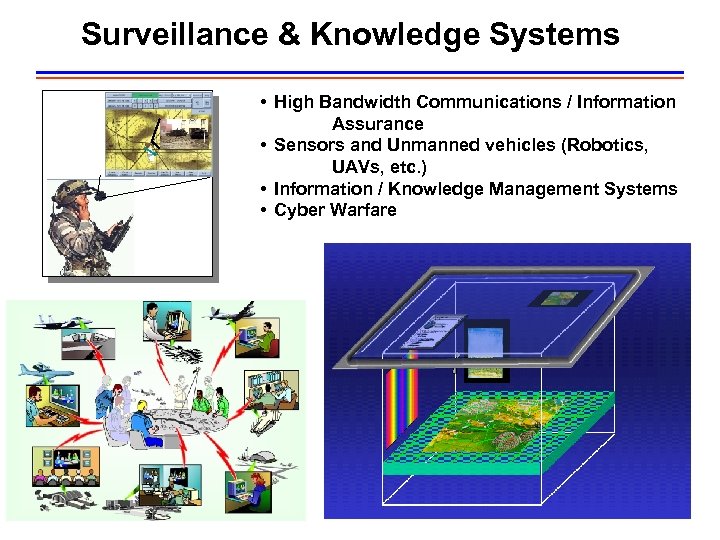
Surveillance & Knowledge Systems • High Bandwidth Communications / Information Assurance • Sensors and Unmanned vehicles (Robotics, UAVs, etc. ) • Information / Knowledge Management Systems • Cyber Warfare
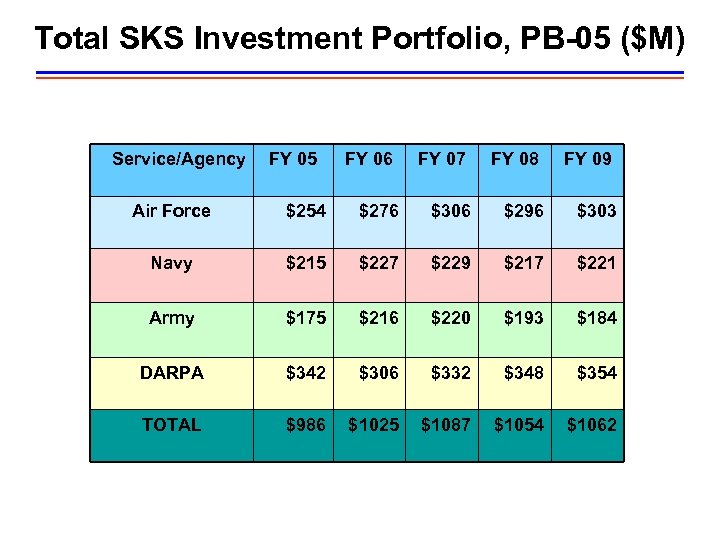
Total SKS Investment Portfolio, PB-05 ($M) Service/Agency FY 05 FY 06 FY 07 FY 08 FY 09 Air Force $254 $276 $306 $296 $303 Navy $215 $227 $229 $217 $221 Army $175 $216 $220 $193 $184 DARPA $342 $306 $332 $348 $354 TOTAL $986 $1025 $1087 $1054 $1062
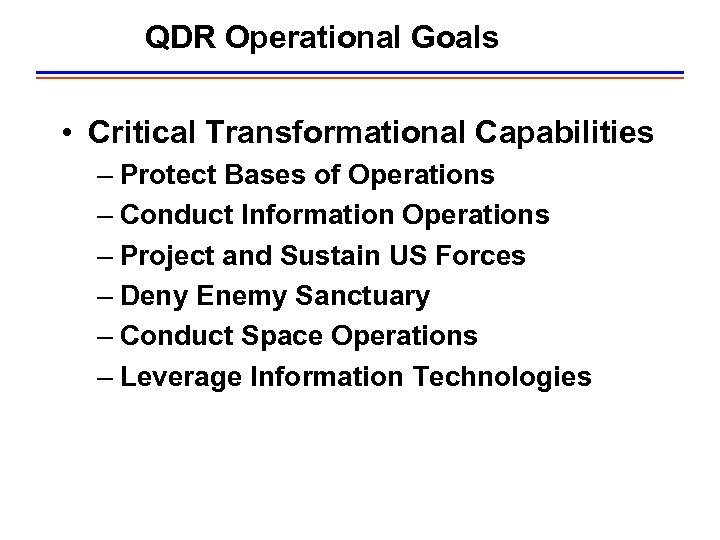
QDR Operational Goals • Critical Transformational Capabilities – Protect Bases of Operations – Conduct Information Operations – Project and Sustain US Forces – Deny Enemy Sanctuary – Conduct Space Operations – Leverage Information Technologies
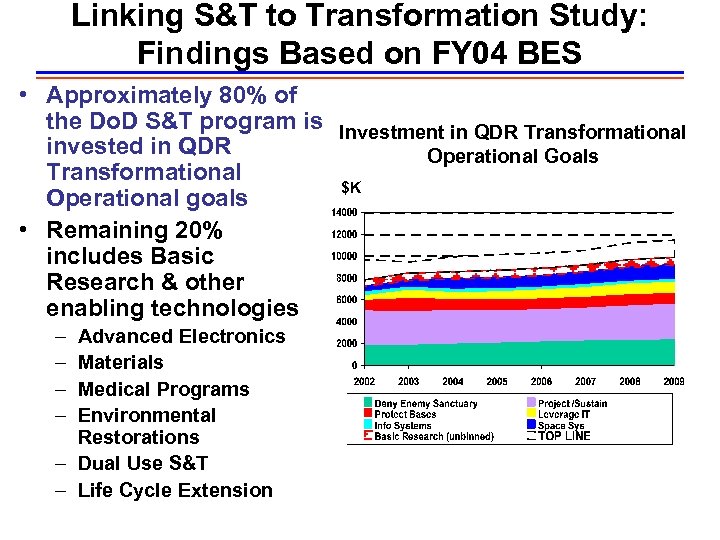
Linking S&T to Transformation Study: Findings Based on FY 04 BES • Approximately 80% of the Do. D S&T program is Investment in QDR Transformational invested in QDR Operational Goals Transformational $K Operational goals • Remaining 20% includes Basic Research & other enabling technologies – – Advanced Electronics Materials Medical Programs Environmental Restorations – Dual Use S&T – Life Cycle Extension
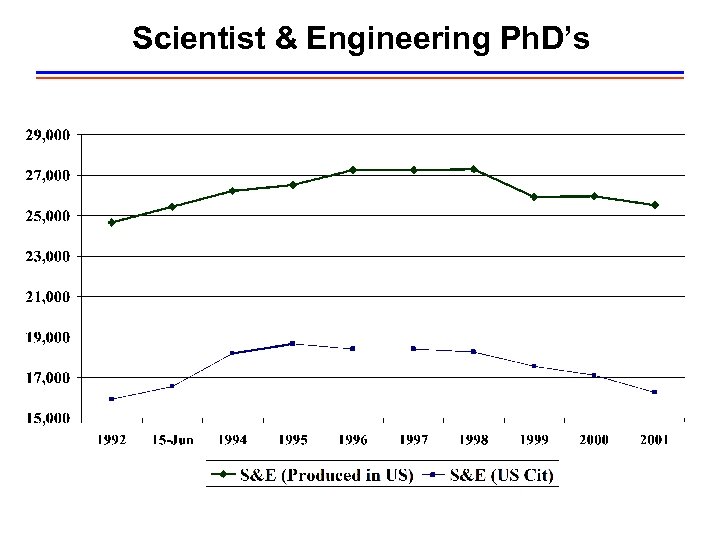
Scientist & Engineering Ph. D’s
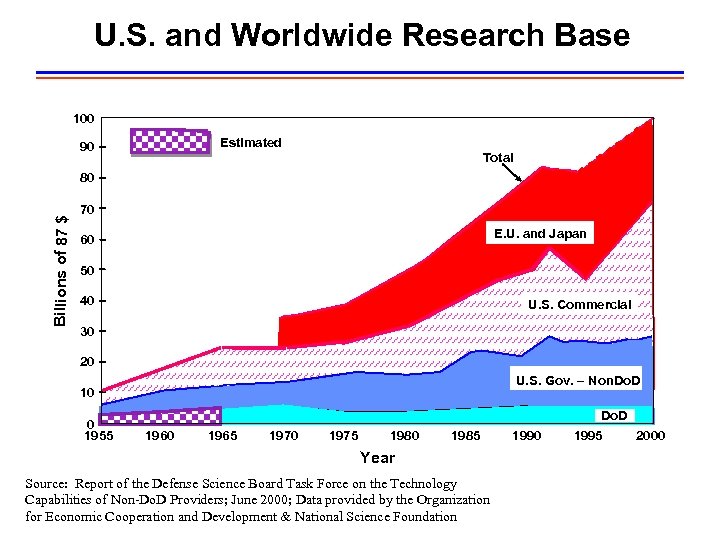
U. S. and Worldwide Research Base 100 Estimated 90 Total Billions of 87 $ 80 70 E. U. and Japan 60 50 40 U. S. Commercial 30 20 U. S. Gov. – Non. Do. D 10 0 1955 Do. D 1960 1965 1970 1975 1980 1985 Year Source: Report of the Defense Science Board Task Force on the Technology Capabilities of Non-Do. D Providers; June 2000; Data provided by the Organization for Economic Cooperation and Development & National Science Foundation 1990 1995 2000
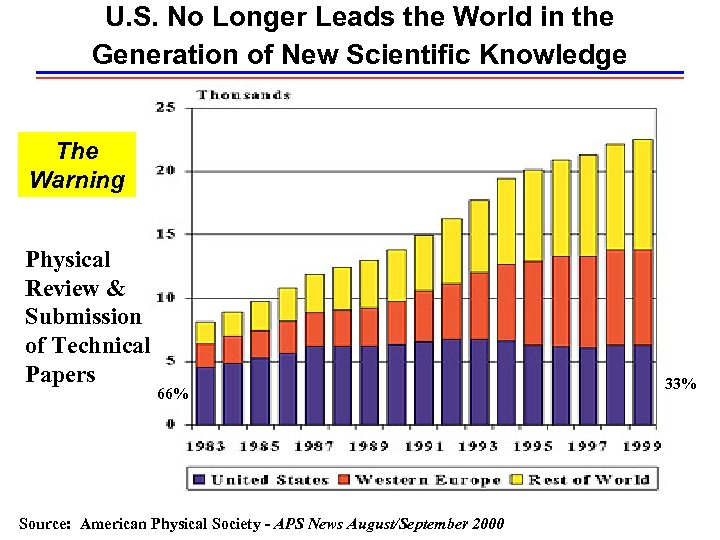
U. S. No Longer Leads the World in the Generation of New Scientific Knowledge The Warning Physical Review & Submission of Technical Papers 66% Source: American Physical Society - APS News August/September 2000 33%
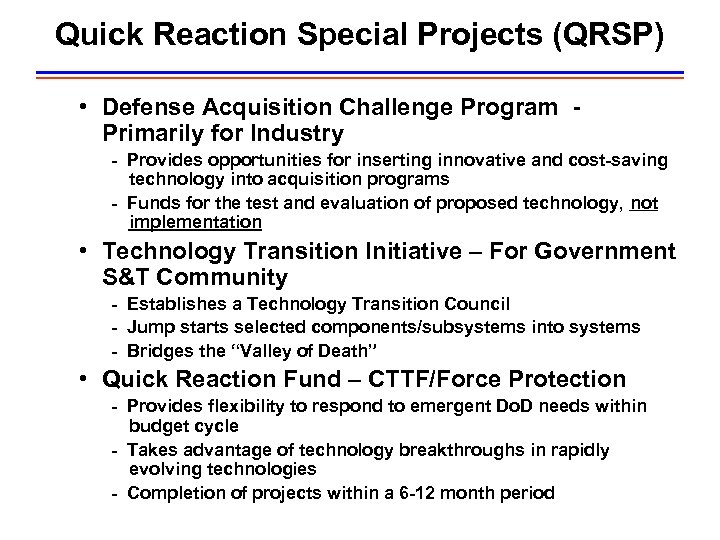
Quick Reaction Special Projects (QRSP) • Defense Acquisition Challenge Program Primarily for Industry - Provides opportunities for inserting innovative and cost-saving technology into acquisition programs - Funds for the test and evaluation of proposed technology, not implementation • Technology Transition Initiative – For Government S&T Community - Establishes a Technology Transition Council - Jump starts selected components/subsystems into systems - Bridges the “Valley of Death” • Quick Reaction Fund – CTTF/Force Protection - Provides flexibility to respond to emergent Do. D needs within budget cycle - Takes advantage of technology breakthroughs in rapidly evolving technologies - Completion of projects within a 6 -12 month period
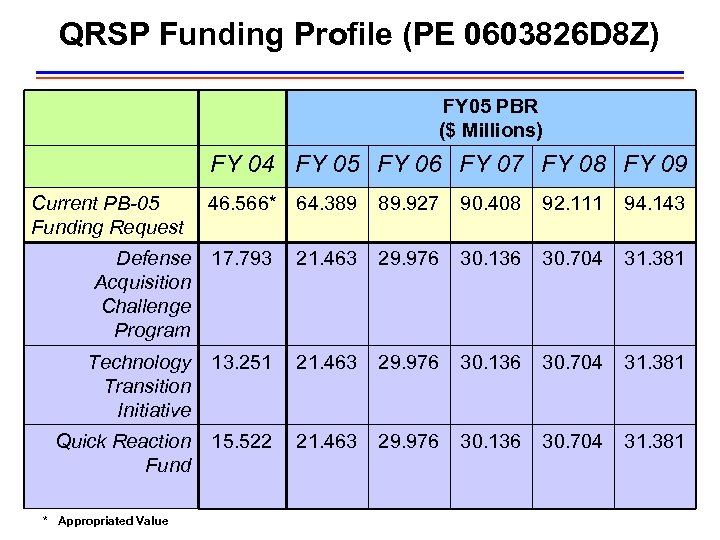
QRSP Funding Profile (PE 0603826 D 8 Z) FY 05 PBR ($ Millions) FY 04 FY 05 FY 06 FY 07 FY 08 FY 09 Current PB-05 Funding Request 46. 566* 64. 389 89. 927 90. 408 92. 111 94. 143 Defense Acquisition Challenge Program 17. 793 21. 463 29. 976 30. 136 30. 704 31. 381 Technology Transition Initiative 13. 251 21. 463 29. 976 30. 136 30. 704 31. 381 Quick Reaction Fund 15. 522 21. 463 29. 976 30. 136 30. 704 31. 381 * Appropriated Value
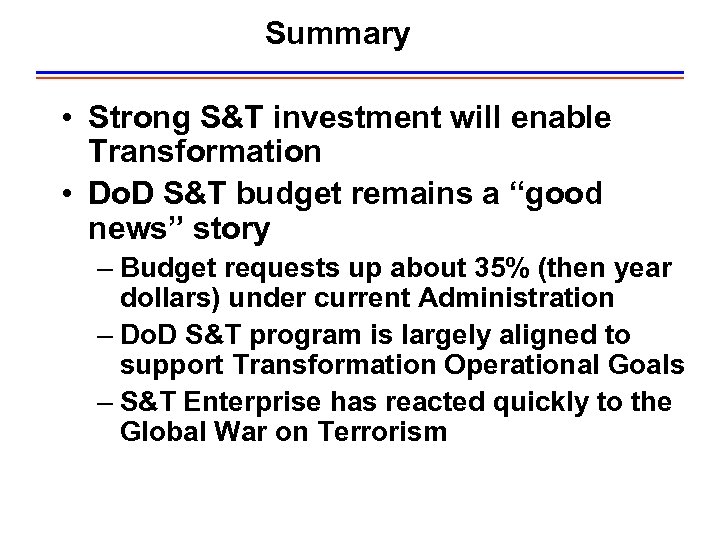
Summary • Strong S&T investment will enable Transformation • Do. D S&T budget remains a “good news” story – Budget requests up about 35% (then year dollars) under current Administration – Do. D S&T program is largely aligned to support Transformation Operational Goals – S&T Enterprise has reacted quickly to the Global War on Terrorism
Скачать презентацию The Defense S T Budget and Investment Focus Mr
47c464662d0637643bff84076af85e67.ppt