



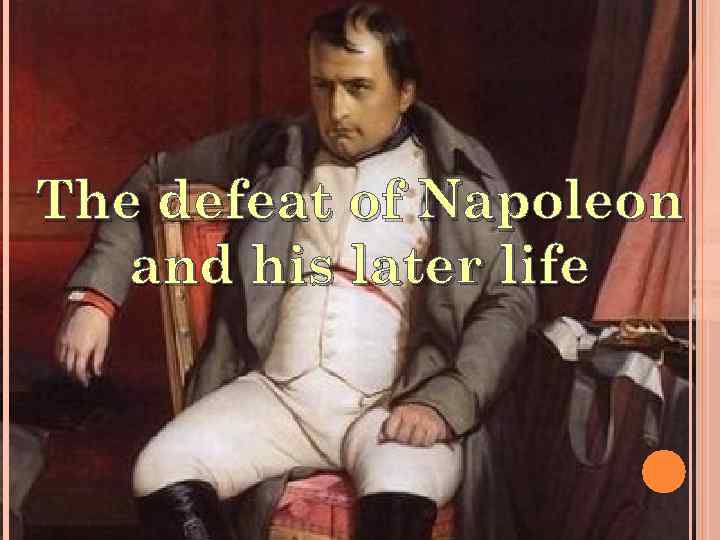
 The defeat of Napoleon and his later life
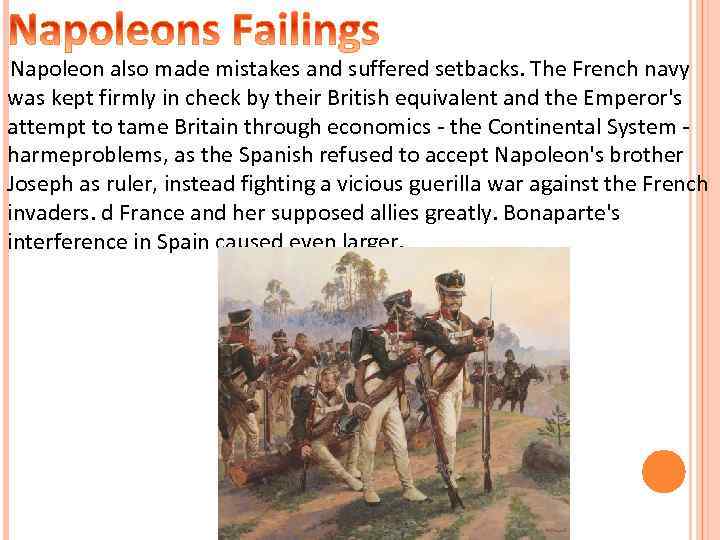 Napoleon also made mistakes and suffered setbacks. The French navy was kept firmly in check by their British equivalent and the Emperor's attempt to tame Britain through economics - the Continental System harmeproblems, as the Spanish refused to accept Napoleon's brother Joseph as ruler, instead fighting a vicious guerilla war against the French invaders. d France and her supposed allies greatly. Bonaparte's interference in Spain caused even larger.
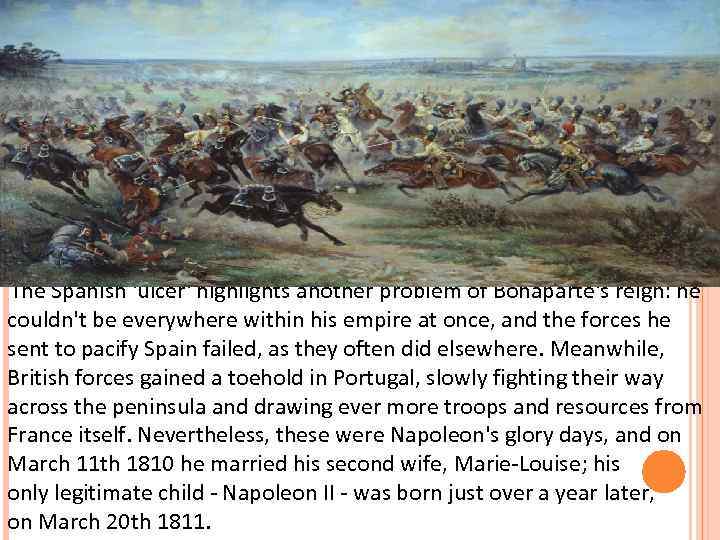 The Spanish 'ulcer' highlights another problem of Bonaparte's reign: he couldn't be everywhere within his empire at once, and the forces he sent to pacify Spain failed, as they often did elsewhere. Meanwhile, British forces gained a toehold in Portugal, slowly fighting their way across the peninsula and drawing ever more troops and resources from France itself. Nevertheless, these were Napoleon's glory days, and on March 11 th 1810 he married his second wife, Marie-Louise; his only legitimate child - Napoleon II - was born just over a year later, on March 20 th 1811.
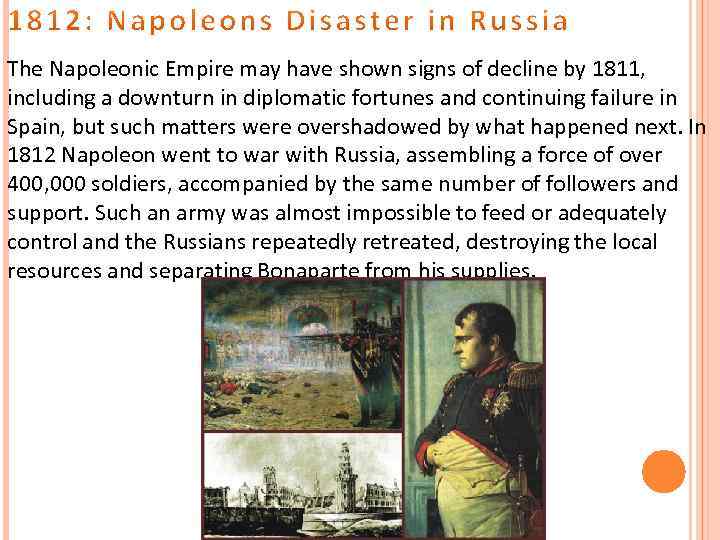 The Napoleonic Empire may have shown signs of decline by 1811, including a downturn in diplomatic fortunes and continuing failure in Spain, but such matters were overshadowed by what happened next. In 1812 Napoleon went to war with Russia, assembling a force of over 400, 000 soldiers, accompanied by the same number of followers and support. Such an army was almost impossible to feed or adequately control and the Russians repeatedly retreated, destroying the local resources and separating Bonaparte from his supplies.
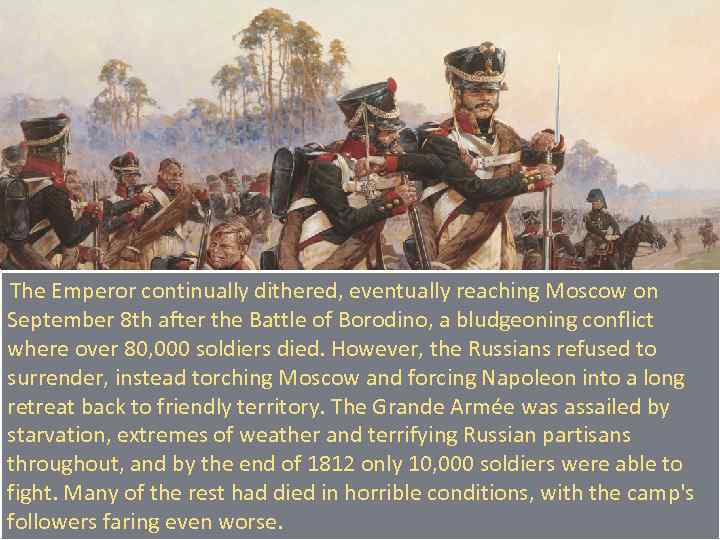 The Emperor continually dithered, eventually reaching Moscow on September 8 th after the Battle of Borodino, a bludgeoning conflict where over 80, 000 soldiers died. However, the Russians refused to surrender, instead torching Moscow and forcing Napoleon into a long retreat back to friendly territory. The Grande Armée was assailed by starvation, extremes of weather and terrifying Russian partisans throughout, and by the end of 1812 only 10, 000 soldiers were able to fight. Many of the rest had died in horrible conditions, with the camp's followers faring even worse.
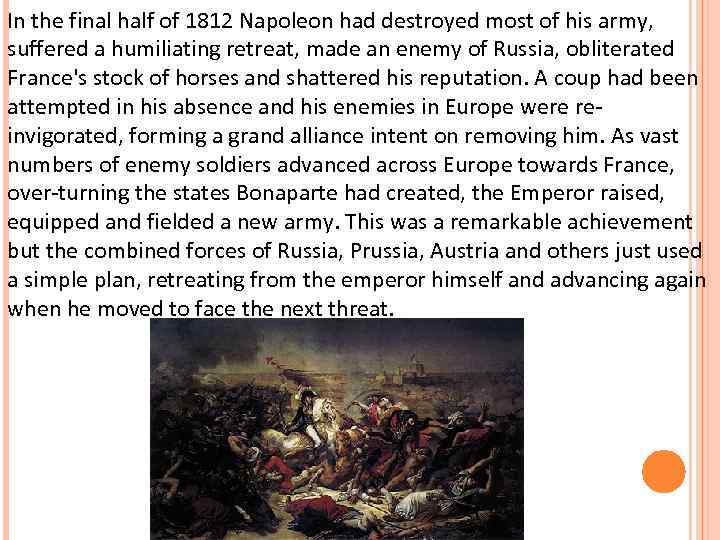 In the final half of 1812 Napoleon had destroyed most of his army, suffered a humiliating retreat, made an enemy of Russia, obliterated France's stock of horses and shattered his reputation. A coup had been attempted in his absence and his enemies in Europe were reinvigorated, forming a grand alliance intent on removing him. As vast numbers of enemy soldiers advanced across Europe towards France, over-turning the states Bonaparte had created, the Emperor raised, equipped and fielded a new army. This was a remarkable achievement but the combined forces of Russia, Prussia, Austria and others just used a simple plan, retreating from the emperor himself and advancing again when he moved to face the next threat.
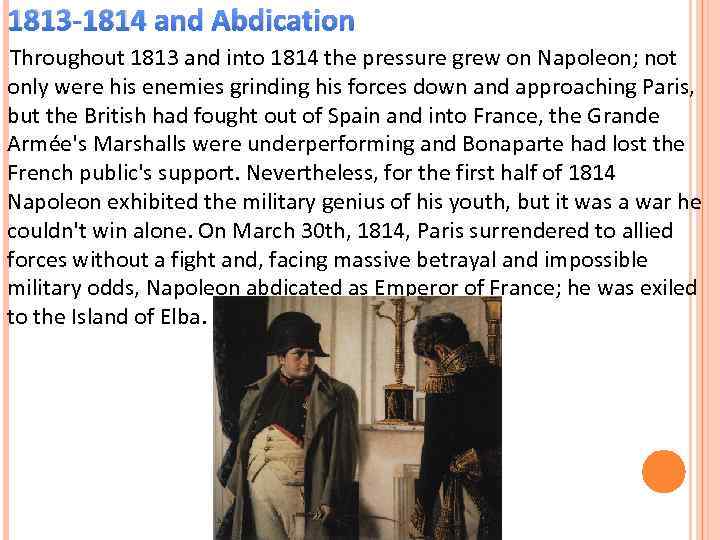 1813 -1814 and Abdication Throughout 1813 and into 1814 the pressure grew on Napoleon; not only were his enemies grinding his forces down and approaching Paris, but the British had fought out of Spain and into France, the Grande Armée's Marshalls were underperforming and Bonaparte had lost the French public's support. Nevertheless, for the first half of 1814 Napoleon exhibited the military genius of his youth, but it was a war he couldn't win alone. On March 30 th, 1814, Paris surrendered to allied forces without a fight and, facing massive betrayal and impossible military odds, Napoleon abdicated as Emperor of France; he was exiled to the Island of Elba.
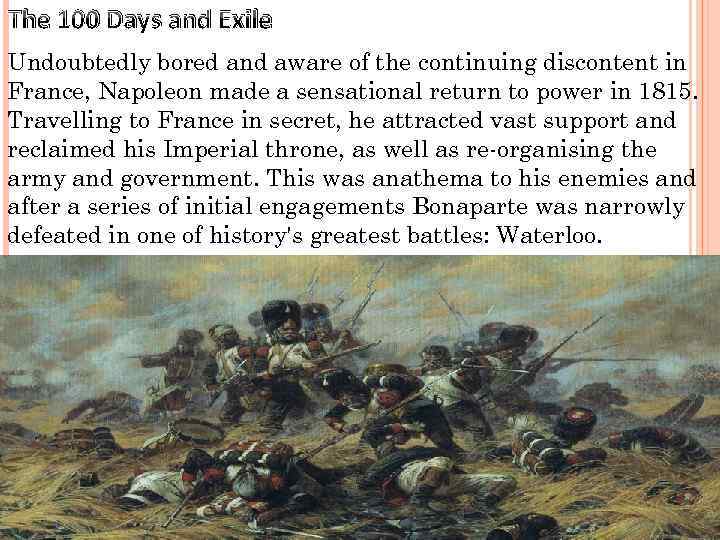 The 100 Days and Exile Undoubtedly bored and aware of the continuing discontent in France, Napoleon made a sensational return to power in 1815. Travelling to France in secret, he attracted vast support and reclaimed his Imperial throne, as well as re-organising the army and government. This was anathema to his enemies and after a series of initial engagements Bonaparte was narrowly defeated in one of history's greatest battles: Waterloo.
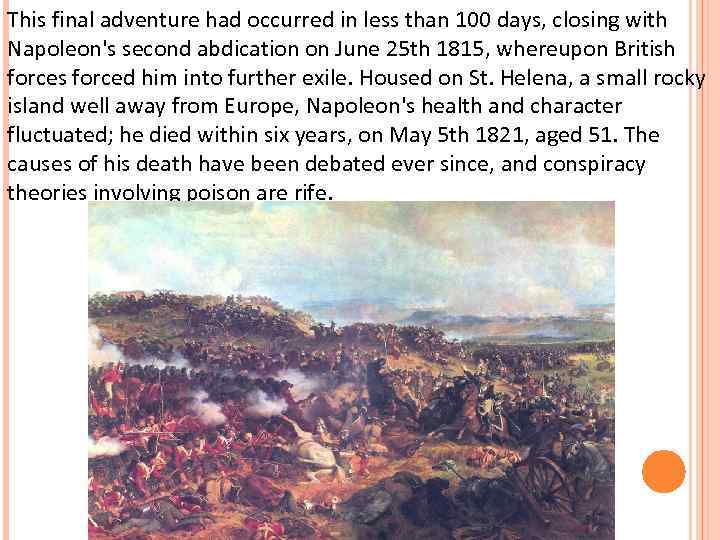 This final adventure had occurred in less than 100 days, closing with Napoleon's second abdication on June 25 th 1815, whereupon British forces forced him into further exile. Housed on St. Helena, a small rocky island well away from Europe, Napoleon's health and character fluctuated; he died within six years, on May 5 th 1821, aged 51. The causes of his death have been debated ever since, and conspiracy theories involving poison are rife.
 Simple narratives of Napleon's life can fill whole books, let alone detailed discussions of his achievements, and historians remain divided over the Emperor: was he a cruel tyrant or an enlightened despot? Was he a tortured genius or a blunderer with luck on his side? These discussions are unlikely to be resolved, thanks partly to the weight of source material making it unlikely that a historian could truly master everything - and Napoleon himself. He is, and remains, so fascinating precisely because he was such a massive blend of contradictions - itself prohibiting conclusions - and because of the massive effect he had on Europe: no one should forget that he helped first perpetuate, then actively create, a state of European wide-warfare that lasted for twenty years. Few individuals have ever had such a huge effect on the world, on economics, politics, technology, culture and society, making Bonaparte's life more fantastic than any believable fiction.
 Nevertheless, it is possible to attempt a small summary on his character: Napoleon may not have been a general of utter genius, but he was very good; he may not have been the best politician of his age, but he was often superb; he may not have been a perfect legislator, but his contributions were hugely important. Whether you admire him or hate him, the real and undoubted genius of Napoleon, the qualities that have drawn praise such as Promethean, was to combine all these talents, to have somehow - be it luck, talent or force of will - risen from chaos, then built, steered and spectacularly destroyed an empire before doing it all again in a tiny microcosm one year later. Whether hero or tyrant, the reverberations were felt across Europe for a century.
 THE END…