


 Скачать презентацию The Deep Impact Mission Karen J Meech Astronomer
66c539cab27310999937493b6304a233.ppt
- Количество слайдов: 44
 The Deep Impact Mission Karen J. Meech, Astronomer Institute for Astronomy ESO, Feb 13, 2004
 Photo: Olivier Hainaut (MKO, ESO)
 Comets Inspire Terror l l Sudden appearance in sky Only a few bright naked-eye comets / century Tail physically large millions of km Early composition: toxic chemicals
 Historical Highlights 1066 1456 1531 1744 1858 1811 1861 1901 Halley De Cheseaux Donati Flaugergeus Tebbutt Great S Wm conqueror Excommunicated Obs by Kepler 6 tails Most beautiful comet wine Naked eye, aurorae Daytime visibility
 Historical Understanding l Tycho Brahe 1577 l l Edmund Halley l l Parallax – outside atm. 1531, 1607, 1681 Orbit determination Newton – Principia 1950’s – Models l l Whipple ‘Dirty Snowball’ Lyttleton ‘Sandbank’
 Physical Processes - Sublimation
 Physical Processes l l Sublimation of gases Drags dust from nucleus l l l Gravity low Most dust escapes Solar radiation pressure coma dust tail photodissociation Ionization gas tail Energy Balance Sunlight Scattered light + Heating/Sublimation + Conduction Usually very small Energy needed depends on ice Inverse square law: 1/r 2
 A. Gomez Comet Spectra l l l Reflected sunlight from dust (blackbody radiation) Emitted “heat” Fluorescence 1 P/Halley, 1910
 Archaeological Remnants l l Icy debris left from formation Keys to chemistry & physics in nebula Preservation of interstellar material? Sources of organics necessary for life
 Comet Paradigms l “Comets are the most pristine things in the Solar System” l “Comets tell us about the formation of the Solar System
 Comet Formation
 Ice Physics l l Ices condense T < 100 K trap gasses T < 30, trap @ solar abundance Fractionation @ higher T Annealing, 35 K, 60 K – gas release
 Comet Formation Regions • Oort: • form in Jupiter-Neptune zone • KBO: • form in-situ • hot population scattered out • 1/3 scatter to Oort cloud • Oort LP comets, HF SP comets • KBO Centaurs JF SP comets
 Evolutionary Processes l Pre-Solar Nebula l l Accretion phase l l Sublimation/re-condense Storage in Oort Cloud l l l l CR bombardment Radiation damage Volatile loss Chemical alteration Heating from stars, SN Radioactive Decay Gardening / erosion Active Phase l l l Loss of surface Crystallization of ice Build up of dust mantle
 Aging Processes l Build up of surface dust l l Lower albedo Large grains cannot leave Uneven surface jets Non gravitational acceleration
 Observing Techniques l l l Sun-warmed ices vaporize, drag dust Ground-based telescopes observe when bright Complex processes & chemistry Primordial composition? Comet surface evolves over 4. 5 Billion years
 Comet Missions l l l Giotto Halley 1986 Flyby Deep Space 1 9/01 Flyby Stardust 1/04 Sample return CONTOUR 3/12 Tour 3 comets Deep Impact 4/05 Active Experiment Rosetta(ESA) 2015 Orbit/Lander
 ESA Giotto Mission l 1 P/Halley – March 1986 l l l ESA – Giotto USSR – Vega Size 15. 3 x 7. 22 km Sunward Jets (from “craters”) Mass spec: CHON particles Plasma experiments
 Deep Space 1 l l Encounter with 19 P/Borrelly 9/22/01 Flyby distance 3417 km 8 km long nucleus Large albedo variations (0. 009 -0. 03)
 Stardust Results l l l Entered coma 12/31/03 Dust collection 1/2/04 Close approach l l l 236 km Comet diam 5 km Pass through zero phase

 The Deep Impact Mission l Primary Goal l Differences between interior and surface Pristine Solar System material Secondary Goal l l Cratering physics Assess comet impact hazard Calibrate crater record Comet evolution
![Simple but Challenging, 33 yrs ago “ It [an asteroid] was racing past them](https://present5.com/presentation/66c539cab27310999937493b6304a233/image-23.jpg "Simple but Challenging, 33 yrs ago “ It [an asteroid] was racing past them") Simple but Challenging, 33 yrs ago “ It [an asteroid] was racing past them at almost thirty miles a second; they had only a few frantic minutes in which to observe it closely. The automatic cameras took dozens of photographs, the navigation radar's returning echoes were carefully recorded for future analysis - and there was just time for a single impact probe. The probe carried no instruments; none could survive a collision at such cosmic speeds. It was merely a small slug of metal, shot out from Discovery on a course which should intersect that of the asteroid. . . They were aiming at a hundred-foot-diameter target, from a distance of thousands of miles. . . Against the darkened portion of the asteroid there was a sudden, dazzling explosion of light. . ” Arthur C. Clarke, 1968. In 2001: A Space Odyssey. Chapter 18
Simple but Challenging, 33 yrs ago “ It [an asteroid] was racing past them at almost thirty miles a second; they had only a few frantic minutes in which to observe it closely. The automatic cameras took dozens of photographs, the navigation radar's returning echoes were carefully recorded for future analysis - and there was just time for a single impact probe. The probe carried no instruments; none could survive a collision at such cosmic speeds. It was merely a small slug of metal, shot out from Discovery on a course which should intersect that of the asteroid. . . They were aiming at a hundred-foot-diameter target, from a distance of thousands of miles. . . Against the darkened portion of the asteroid there was a sudden, dazzling explosion of light. . ” Arthur C. Clarke, 1968. In 2001: A Space Odyssey. Chapter 18
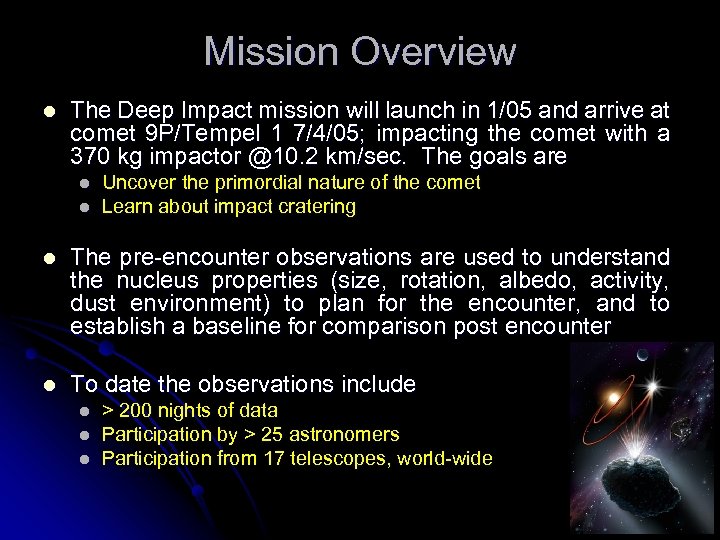 Mission Overview l The Deep Impact mission will launch in 1/05 and arrive at comet 9 P/Tempel 1 7/4/05; impacting the comet with a 370 kg impactor @10. 2 km/sec. The goals are l l Uncover the primordial nature of the comet Learn about impact cratering l The pre-encounter observations are used to understand the nucleus properties (size, rotation, albedo, activity, dust environment) to plan for the encounter, and to establish a baseline for comparison post encounter l To date the observations include l l l > 200 nights of data Participation by > 25 astronomers Participation from 17 telescopes, world-wide
 Interplanetary Trajectory • Launch Dec 2004 • Encounter July 4, 2005 • Geocentric Dist • Heliocentric Dist • Approach phase • Solar Elong 0. 89 AU 1. 49 AU (q) 63 o 104 o
 Approach & Encounter Impactor Release E-24 hours Auto. Nav Enabled E-2 hr ITM-1 Start E-88 min ITM-2 E-48 min ITM-3 E-15 min Tempel-1 Nucleus 64 kbps 2 -way S-band Crosslink 500 km Flyby S/C Deflection Maneuver E-23. 5 hr Science and Autonav Imaging to Impact + 800 sec Flyby S/C Science And Impactor Data at 175 kbps* Flyby Science Realtime Data at 175 kbps* Shield Mode Attitude through Inner Coma TCA + TBD sec Flyby S/C Science Data Playback at 175 kbps* to 70 -meter DSS * data rates without Reed-Solomon encoding
 Spacecraft Overview Instruments MRI, ITS, HRI
![Imagers Parameter HRI MRI ITS FOV [mrad] 2. 05 10. 2 IFOV [mrad] 2](https://present5.com/presentation/66c539cab27310999937493b6304a233/image-28.jpg "Imagers Parameter HRI MRI ITS FOV [mrad] 2. 05 10. 2 IFOV [mrad] 2") Imagers Parameter HRI MRI ITS FOV [mrad] 2. 05 10. 2 IFOV [mrad] 2 10 10 Dl [mm] 0. 3 -1. 0 PSF FWHM <1. 3 [@0. 7 mm] <0. 6 Full Frame Rate [s-1] 1/1. 7 Radiometric Stars 0. 1 s Sensitivity m~11. 3 Stars 0. 1 s m~11. 3 Stars m~11. 3 Boresight Alignment <1 mrad N/A 0. 3 -1. 0 1/1. 7 <1 mrad
Imagers Parameter HRI MRI ITS FOV [mrad] 2. 05 10. 2 IFOV [mrad] 2 10 10 Dl [mm] 0. 3 -1. 0 PSF FWHM <1. 3 [@0. 7 mm] <0. 6 Full Frame Rate [s-1] 1/1. 7 Radiometric Stars 0. 1 s Sensitivity m~11. 3 Stars 0. 1 s m~11. 3 Stars m~11. 3 Boresight Alignment <1 mrad N/A 0. 3 -1. 0 1/1. 7 <1 mrad
 HRI Spectrograph Slit FOV 2. 6 Mrad IFOV 10 mrad Dl 1. 05 -4. 8 mm PSF FWHM < 1 pix l/dl 744 @ 1. 04 mm 209 @ 2. 6 mm 385 @ 4. 8 mm
 Cratering Physics l Gravity control expected l l Strength control possible l l l Size (& ejecta speed) depends on impactor density Smaller crater than gravity control Greater depth/diameter Details sensitive to impactor shape Compression control possible l l l Size & time sensitive to comet properties Size ~ (impactor mass)1/3; insensitive to other properties Ejecta speed, jets – sensitive to other properties Scaling relationships not known Mechanism used to explain Mathilde’s craters Distinguish mode by ejecta morphology and crater size
 Formation Time Scaling T ~ m 1/6 T ~ rc-2/3 T ~ Rc-2/3 nsi De Bulk 800 -sec observing window provides large margin for extreme cometary properties, even down to bulk density 0. 1 g/cc 0. 3 g ty = c ity Dens Bulk Most important thing is to know impactor properties /c 0. 8 g =
 Baseline Predictions l l Gravity Controlled Crater l l Diameter – 110 m Depth – 27 m Formation Time 200 s Ejecta l l l Max v = 2 km/s Negligible boulders Ejecta clumping -> tracking (mass) l Long-term changes l l l New active area (dys to months) Increase ratio of CO and CO 2 to H 2 O Simulations Mass determination l l Dv = 1. 09 x 10 -3 mm/s Below doppler limit Need “sub-surface” flyby Ejecta plume can get mass
 HRI Spectroscopy l Halley spectra @ 42000 km
 Ames Vertical Gun Facility l l l Experiments: P. Schultz Cu sphere @ 4. 5 km/s Target: porous pumice (1 g/cc) 500 frames / sec 60 o impact angle Gravity control
 Strength dominated l l Cone detaches Volatiles – drive ejecta, fill in cone Gravity dominated l Expected scenario Simulations: J. Richardson Ejecta Plume Simulations
 Modelling Mass / Density l l Viewing time 900 s Use velocity to est M Simulations: J. Richardson
 Ground-Based Support l Characterize nucleus l Size & Albedo l l Rotation period & pole l l l l RN = 2. 6 +/- 0. 2, pv = 0. 07 Periods 22. 104, 42. 091 hr (a, d) = 283+/-3, 18+/-3, (a, d) = 62+/-3, 73+/-3 a: b = 3. 3+/-0. 2 a = 5. 4, b=c=1. 6+/-0. 2 Phase Function Baseline for activity Dust Environment 10 microns R band
 l Dust models velocity distn, size distn, Qdust l l Evaluate motion of dust after leaving comet Add up the scattered light from grains Fit to observations of surface brightness of coma versus time Want observations spread so observing geometry changes a lot l l Dust Small dust (fast) – many images/short time (mostly anti-solar) Large dust – equally spaced – long periods (monthly) (along orbit) Critical periods l Mar-Apr 04 l l Onset Feb-Jul 05 l STSP Feb 15 2005 Jan 1 2004 Mar 1 2004 Apr 15 2005 May 1 2004 May 15 2005 Jun 15 2005
 l Mauna Kea: Keck 10 m, UH 2. 2 m l l l l M. Belton N. Samarasinha B. Mueller P. Massey R. Millis CTIO: 4 m, 1. 5 m l l l KPNO: 4 m, Wiyn 3. 5 m, 2. 1 m l l M. Mateo N. Suntzeff K. Krisciunas Participating Observatories Mc. Donald: 2. 7 m 82” T. Farnham H. Boehnhardt O. Hainaut K. Meech l l l G. P. Tozzi J. Licandro ESO: VLT 8. 0 m, NTT 3. 6 m, Dan 1. 5 m l l TNG 3. 6 m l l K. Meech, M. F. A’Hearn M. Belton, C. Lisse Y. Fernandez, J. Pittichova H. Hsieh, G. Bauer S. Sheppard, P. Henry l l l Bohyunsan 1. 8 m (Korea) l l l Lowell 72” 42” Y-C. Choi D. Prialnik Wise 1. 1 m (Israel) l l Y-C. Choi D. Prialnik M. Buie
 Comet Paradigms l “Comets are the most pristine things in the Solar System” l “Comets tell us about the formation of the Solar System

 Stardust Mission l Timeline l l l Launch 2/7/99 – Delta II Dust 1: Feb-May 2000 Dust 2: Aug-Dec 2002 Enter coma: Dec 31, ’ 03 Earth Return 1/15/06 Science Goals l l l Comet imaging – 81 P/Wild 2 ISM Dust collection Comet dust collection
 Earth collection l l l Arrival 1/15/06 Final descent via parchute Curation and study – Johnson Space Center
 Dust Collection l Captured in aerogel l 99. 8% air 40 x more insulation than fiberglass No heating at 6. 1 km/s