 Скачать презентацию The DE Language Erik Reeber 6 30 04 Overview
25d281fd4fca586a73b103a2ebfac78d.ppt
- Количество слайдов: 23



The DE Language Erik Reeber 6/30/04
Overview • Introduction & Motivation • Examples • Implementation and Static Checking Overview • Verification & Tool Flow • Verification Example • Summary & Conclusion
Introduction • DE is a Hardware Description Language – Simple FSM semantics • Embedded in ACL 2 • Predecessor: DUAL-EVAL – FM 9001 proof – No combinational loops – Primitives are modules – No types
Motivation • Need to get design into ACL 2 – Advantages to embedded approach: • Closer to actual design • Can verify optimization and verification tools • Can write and verify generation functions • Need Finite Decision Procedures – Type system • Explore HDL design – Simple semantics – May put specification in the code
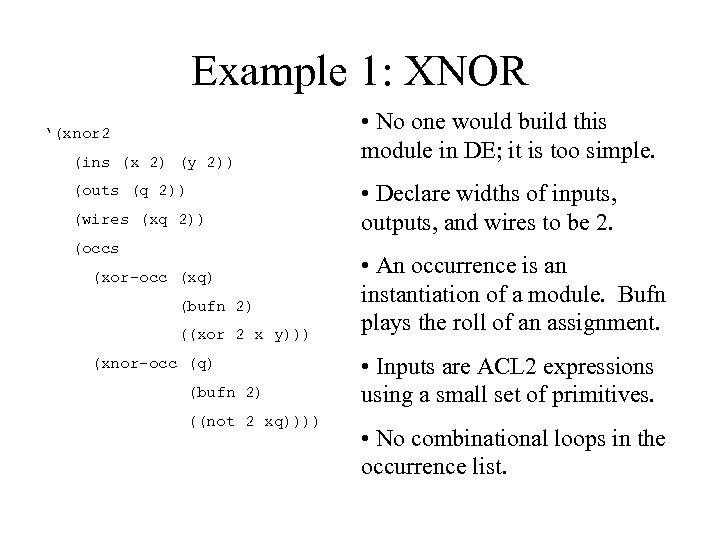
Example 1: XNOR ‘(xnor 2 (ins (x 2) (y 2)) (outs (q 2)) (wires (xq 2)) (occs (xor-occ (xq) (bufn 2) ((xor 2 x y))) (xnor-occ (q) (bufn 2) ((not 2 xq)))) • No one would build this module in DE; it is too simple. • Declare widths of inputs, outputs, and wires to be 2. • An occurrence is an instantiation of a module. Bufn plays the roll of an assignment. • Inputs are ACL 2 expressions using a small set of primitives. • No combinational loops in the occurrence list.
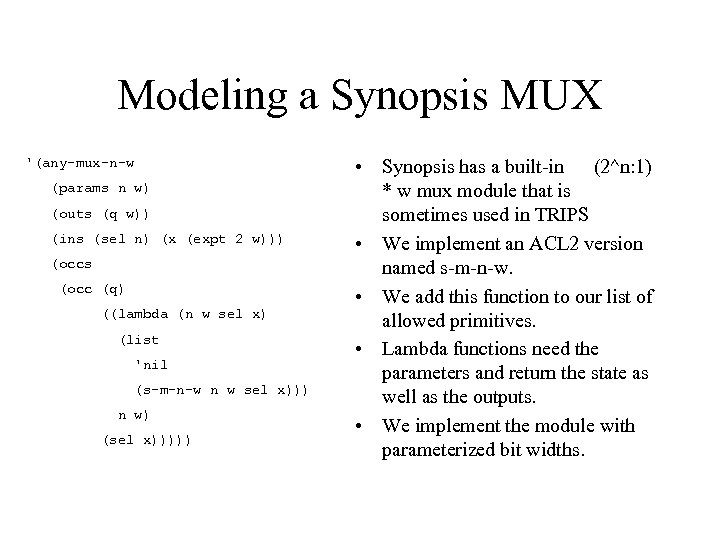
Modeling a Synopsis MUX '(any-mux-n-w (params n w) (outs (q w)) (ins (sel n) (x (expt 2 w))) (occs (occ (q) ((lambda (n w sel x) (list 'nil (s-m-n-w n w sel x))) n w) (sel x))))) • Synopsis has a built-in (2^n: 1) * w mux module that is sometimes used in TRIPS • We implement an ACL 2 version named s-m-n-w. • We add this function to our list of allowed primitives. • Lambda functions need the parameters and return the state as well as the outputs. • We implement the module with parameterized bit widths.
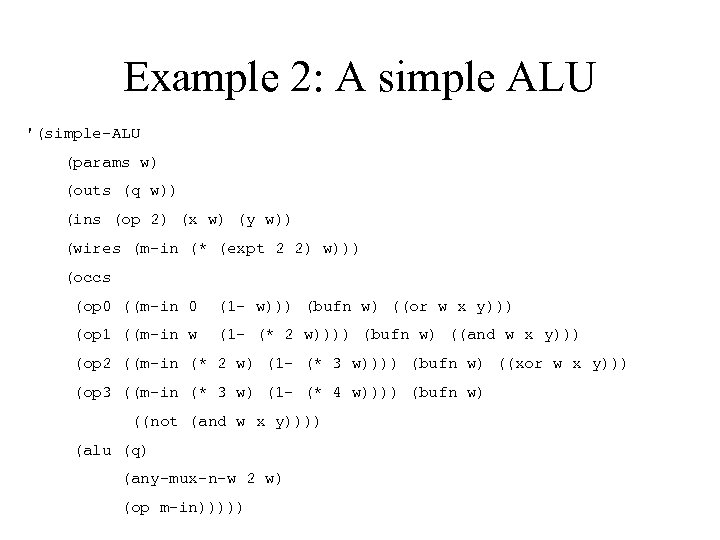
Example 2: A simple ALU '(simple-ALU (params w) (outs (q w)) (ins (op 2) (x w) (y w)) (wires (m-in (* (expt 2 2) w))) (occs (op 0 ((m-in 0 (1 - w))) (bufn w) ((or w x y))) (op 1 ((m-in w (1 - (* 2 w)))) (bufn w) ((and w x y))) (op 2 ((m-in (* 2 w) (1 - (* 3 w)))) (bufn w) ((xor w x y))) (op 3 ((m-in (* 3 w) (1 - (* 4 w)))) (bufn w) ((not (and w x y)))) (alu (q) (any-mux-n-w 2 w) (op m-in)))))
Example 2 Comments • Using parameters to generalize a little bit – Need actual parameters to synthesize • Using a lot of buffers and ACL 2 functions – This is a lot more similar to the TRIPS style than using only module instantiations
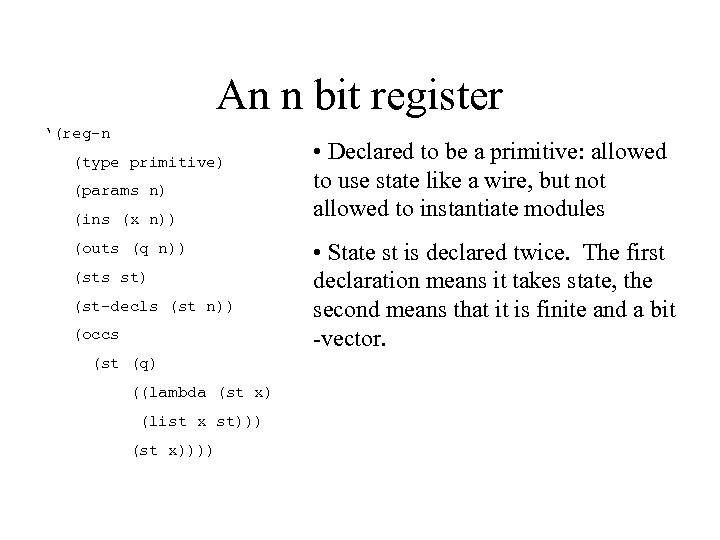
An n bit register ‘(reg-n (type primitive) (params n) (ins (x n)) (outs (q n)) (sts st) (st-decls (st n)) (occs (st (q) ((lambda (st x) (list x st))) (st x)))) • Declared to be a primitive: allowed to use state like a wire, but not allowed to instantiate modules • State st is declared twice. The first declaration means it takes state, the second means that it is finite and a bit -vector.
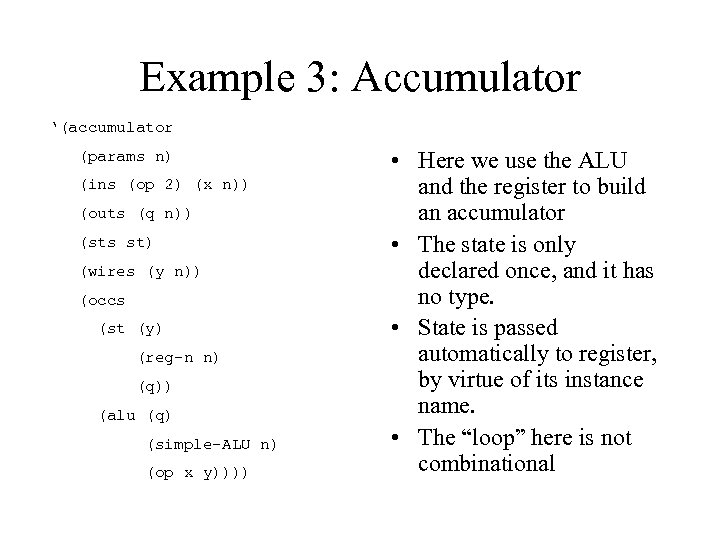
Example 3: Accumulator ‘(accumulator (params n) (ins (op 2) (x n)) (outs (q n)) (sts st) (wires (y n)) (occs (st (y) (reg-n n) (q)) (alu (q) (simple-ALU n) (op x y)))) • Here we use the ALU and the register to build an accumulator • The state is only declared once, and it has no type. • State is passed automatically to register, by virtue of its instance name. • The “loop” here is not combinational
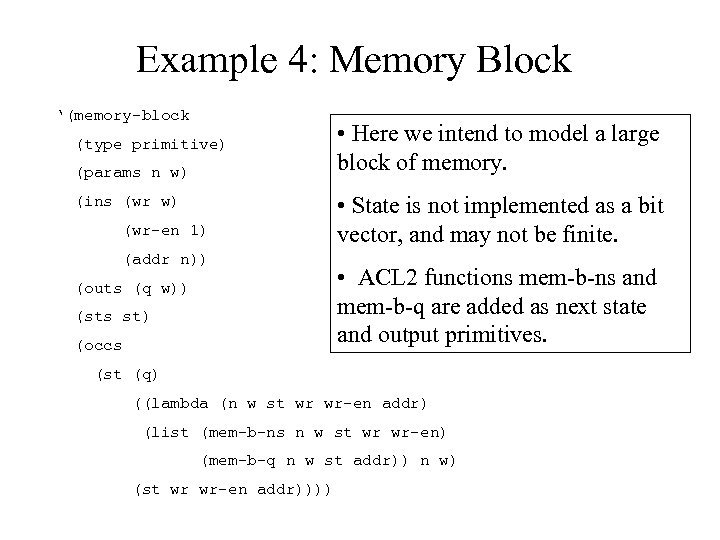
Example 4: Memory Block ‘(memory-block (type primitive) (params n w) (ins (wr w) (wr-en 1) (addr n)) (outs (q w)) (sts st) (occs • Here we intend to model a large block of memory. • State is not implemented as a bit vector, and may not be finite. • ACL 2 functions mem-b-ns and mem-b-q are added as next state and output primitives. (st (q) ((lambda (n w st wr wr-en addr) (list (mem-b-ns n w st wr wr-en) (mem-b-q n w st addr)) n w) (st wr wr-en addr))))
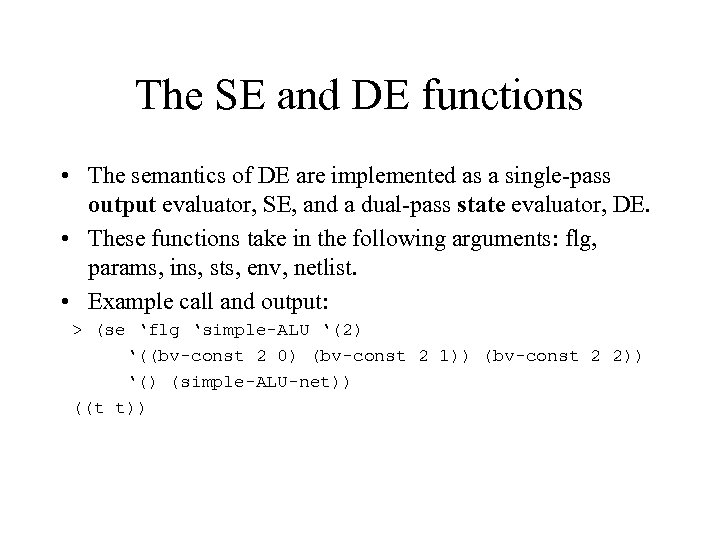
The SE and DE functions • The semantics of DE are implemented as a single-pass output evaluator, SE, and a dual-pass state evaluator, DE. • These functions take in the following arguments: flg, params, ins, sts, env, netlist. • Example call and output: > (se ‘flg ‘simple-ALU ‘(2) ‘((bv-const 2 0) (bv-const 2 1)) (bv-const 2 2)) ‘() (simple-ALU-net)) ((t t))
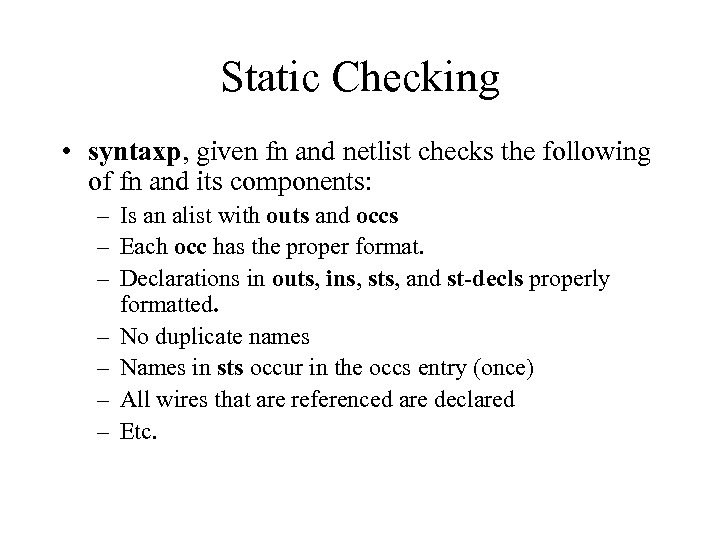
Static Checking • syntaxp, given fn and netlist checks the following of fn and its components: – Is an alist with outs and occs – Each occ has the proper format. – Declarations in outs, ins, sts, and st-decls properly formatted. – No duplicate names – Names in sts occur in the occs entry (once) – All wires that are referenced are declared – Etc.
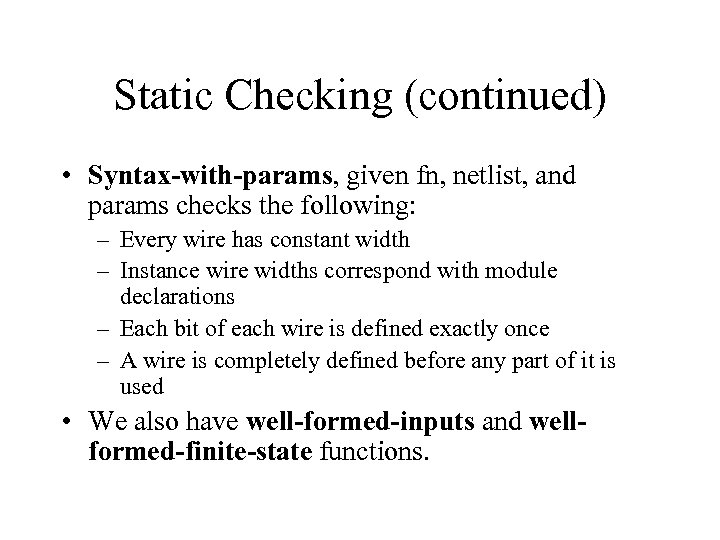
Static Checking (continued) • Syntax-with-params, given fn, netlist, and params checks the following: – Every wire has constant width – Instance wire widths correspond with module declarations – Each bit of each wire is defined exactly once – A wire is completely defined before any part of it is used • We also have well-formed-inputs and wellformed-finite-state functions.
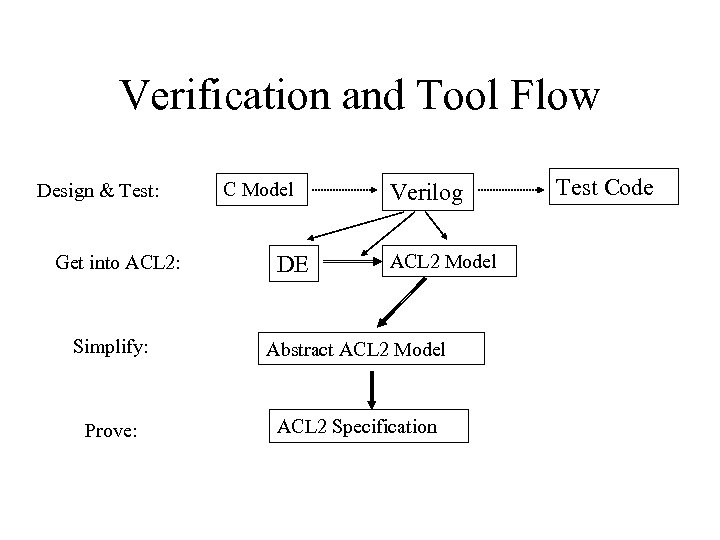
Verification and Tool Flow Design & Test: Get into ACL 2: C Model DE Verilog ACL 2 Model Simplify: Abstract ACL 2 Model Prove: ACL 2 Specification Test Code
![Verification Example -- Verilog module dt_lsq_dsn_valid_blocks (valid_block_mask, youngest, oldest, empty); output [7: 0] valid_block_mask;](https://present5.com/presentation/25d281fd4fca586a73b103a2ebfac78d/image-16.jpg "Verification Example -- Verilog module dt_lsq_dsn_valid_blocks (valid_block_mask, youngest, oldest, empty); output [7: 0] valid_block_mask;")
Verification Example -- Verilog module dt_lsq_dsn_valid_blocks (valid_block_mask, youngest, oldest, empty); output [7: 0] valid_block_mask; input [2: 0] youngest; input [2: 0] oldest; input empty; wire [7: 0] youngest_set_up, oldest_set_down; wire youngest_lt_oldest; … … … assign valid_block_mask = empty ? 8'd 0 : youngest_lt_oldest ? youngest_set_up | oldest_set_down : youngest_set_up & oldest_set_down; endmodule // dt_lsq_dsn
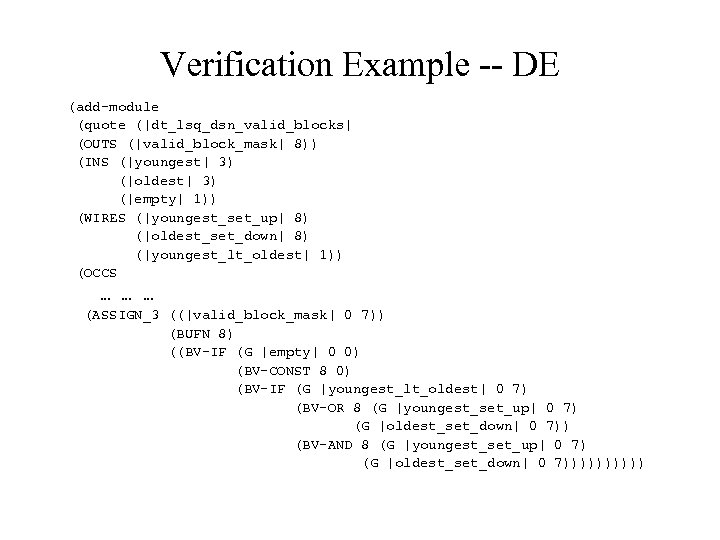
Verification Example -- DE (add-module (quote (|dt_lsq_dsn_valid_blocks| (OUTS (|valid_block_mask| 8)) (INS (|youngest| 3) (|oldest| 3) (|empty| 1)) (WIRES (|youngest_set_up| 8) (|oldest_set_down| 8) (|youngest_lt_oldest| 1)) (OCCS … … … (ASSIGN_3 ((|valid_block_mask| 0 7)) (BUFN 8) ((BV-IF (G |empty| 0 0) (BV-CONST 8 0) (BV-IF (G |youngest_lt_oldest| 0 7) (BV-OR 8 (G |youngest_set_up| 0 7) (G |oldest_set_down| 0 7)) (BV-AND 8 (G |youngest_set_up| 0 7) (G |oldest_set_down| 0 7)))))
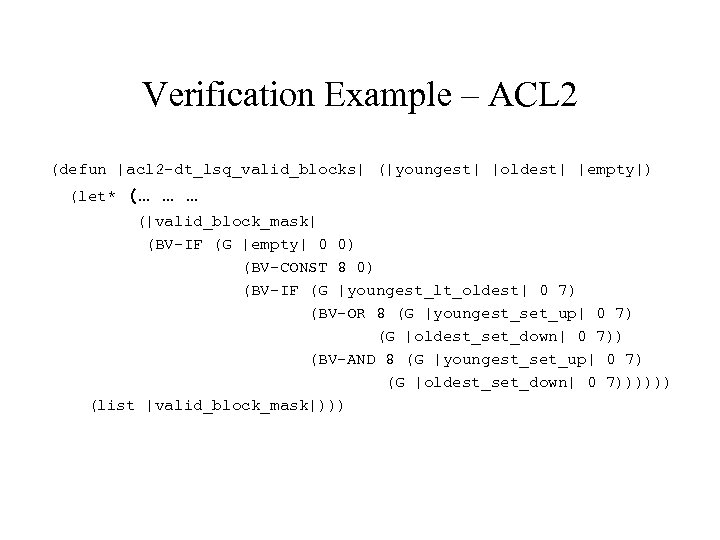
Verification Example – ACL 2 (defun |acl 2 -dt_lsq_valid_blocks| (|youngest| |oldest| |empty|) (let* (… … … (|valid_block_mask| (BV-IF (G |empty| 0 0) (BV-CONST 8 0) (BV-IF (G |youngest_lt_oldest| 0 7) (BV-OR 8 (G |youngest_set_up| 0 7) (G |oldest_set_down| 0 7)) (BV-AND 8 (G |youngest_set_up| 0 7) (G |oldest_set_down| 0 7)))))) (list |valid_block_mask|)))
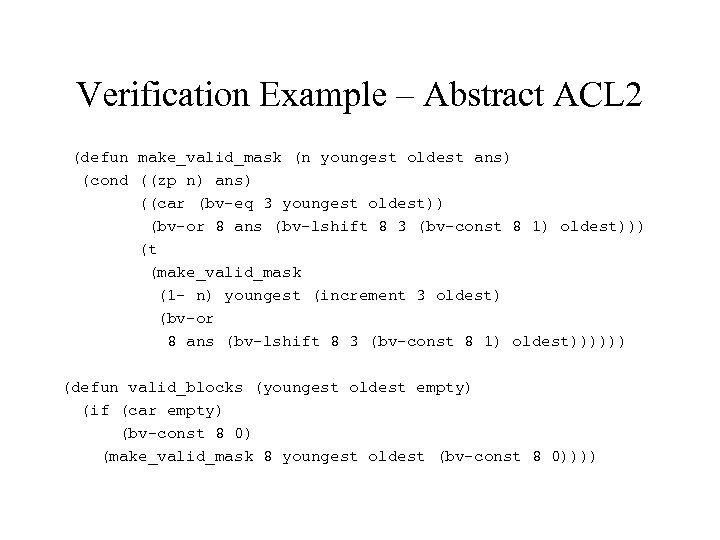
Verification Example – Abstract ACL 2 (defun make_valid_mask (n youngest oldest ans) (cond ((zp n) ans) ((car (bv-eq 3 youngest oldest)) (bv-or 8 ans (bv-lshift 8 3 (bv-const 8 1) oldest))) (t (make_valid_mask (1 - n) youngest (increment 3 oldest) (bv-or 8 ans (bv-lshift 8 3 (bv-const 8 1) oldest)))))) (defun valid_blocks (youngest oldest empty) (if (car empty) (bv-const 8 0) (make_valid_mask 8 youngest oldest (bv-const 8 0))))
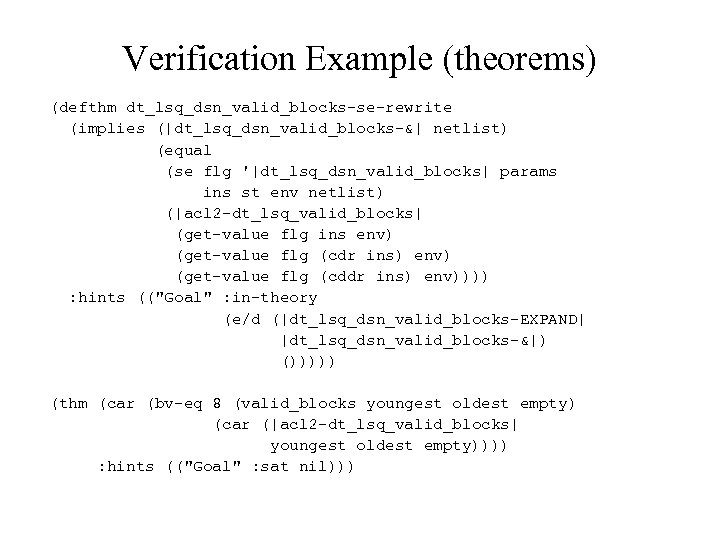
Verification Example (theorems) (defthm dt_lsq_dsn_valid_blocks-se-rewrite (implies (|dt_lsq_dsn_valid_blocks-&| netlist) (equal (se flg '|dt_lsq_dsn_valid_blocks| params ins st env netlist) (|acl 2 -dt_lsq_valid_blocks| (get-value flg ins env) (get-value flg (cdr ins) env) (get-value flg (cddr ins) env)))) : hints (("Goal" : in-theory (e/d (|dt_lsq_dsn_valid_blocks-EXPAND| |dt_lsq_dsn_valid_blocks-&|) ())))) (thm (car (bv-eq 8 (valid_blocks youngest oldest empty) (car (|acl 2 -dt_lsq_valid_blocks| youngest oldest empty)))) : hints (("Goal" : sat nil)))
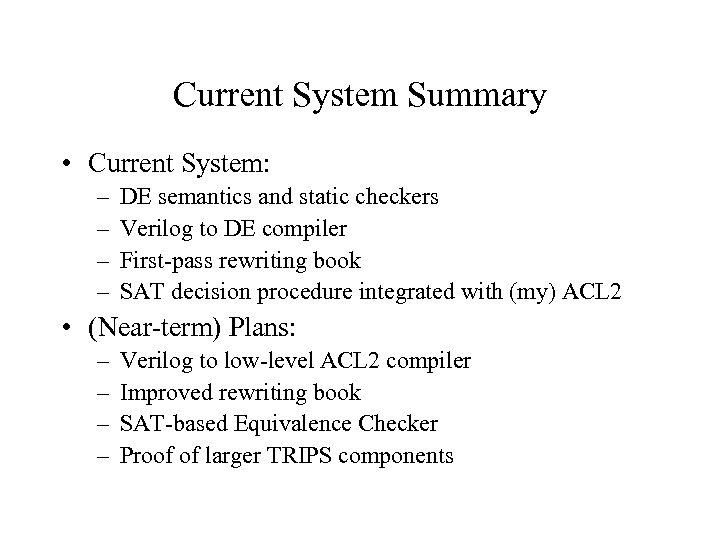
Current System Summary • Current System: – – DE semantics and static checkers Verilog to DE compiler First-pass rewriting book SAT decision procedure integrated with (my) ACL 2 • (Near-term) Plans: – – Verilog to low-level ACL 2 compiler Improved rewriting book SAT-based Equivalence Checker Proof of larger TRIPS components
Issues • Combining the finite theorems with ACL 2 is still a bit cumbersome. • Is Embedded the right approach? • Is SAT in the right place? • Can we make DE more compact? • Should we put more power in the parameters? – Could we then eliminate the need for defining ACL 2 functions for each Synopsis primitive? • Are we handling state right? • Is the type system too limiting?
Conclusion • • DE is a simple HDL embedded in ACL 2. We can implement complex hardware in it. We can quickly verify small hardware in it. We hope to verify complex hardware using a hierarchical approach. • It now has a strong parameterized type system.
Скачать презентацию The DE Language Erik Reeber 6 30 04 Overview
25d281fd4fca586a73b103a2ebfac78d.ppt