


 Скачать презентацию The DDA Negotiations Trade Round launched in
cd5896dd0fdbc72f21d10b11a68f8e7a.ppt
- Количество слайдов: 66
 The DDA Negotiations • Trade Round launched in Doha (Qatar) at Fourth WTO Ministerial Conference, November 2001 • Previous failure in Seattle, USA in December 1999 • Concerns of developing countries – marginalisation in the MTS, lack of transparency and inclusiveness • Members resolved to place needs and interests of developing countries at heart of negotiations • Work Programme: 2 tracks – negotiating issues under the TNC, and non-negotiating issues under the General Council – work being carried out in various WTO bodies
 Areas Under The Negotiations • Agriculture (Including Cotton) • Services • Non- Agricultural Market Access • TRIPS (GIs Register) • WTO Rules (AD, Subsidies, RTAs) • DSU → outside Single-Undertaking • Trade and Environment • Special and Differential Treatment • Trade Facilitation *Single Undertaking – Nothing is agreed until everything is agreed
 DDA Negotiations: Key Reference Materials • Doha Declaration (WT/MIN/(01)/DEC/1) • August 2004, General Council Decision (WT/L/579) • Hong Kong Declaration (WT/MIN(05)/DEC) • Draft Agriculture Modalities (TN/AG/W/4/Rev. 1; 8 February 2008) • Draft NAMA Modalities (TN/MA/W/103; 8 February 2008)
 State of Play Ø Negotiations were supposed to have been concluded by 1 January 2005 Ø Modalities for agriculture and NAMA were to have been agreed by March 2003 Ø Deadline was missed. Efforts to agree on the modalities in Cancun in September 2003 also failed Ø A framework agreement reached in July 2004 Ø Efforts to reach agreement on full modalities in July 2005 failed Ø Objective to achieve full modalities also proved elusive at the Hong Kong Ministerial Conference in December 2005
 State of Play Ø After intensive consultations in the first half of 2006, the negotiations were suspended in July 2006 Ø They were resumed in Feb 2007, but agreement on modalities for agriculture and NAMA have still proved elusive Ø Members’ positions on the key issues in agriculture and NAMA have evolved but not significantly Ø Members currently working on the draft texts circulated on 8 February by the Ag and NAMA Chairpersons
 State of Play Ø Whereas work had advanced on agriculture, the same cannot be said of the NAMA text. Wide differences in the views of Members, particularly on the formula and flexibilities Ø Horizontal process to be chaired by the WTO DG to find key compromises. Expectation is to have agreement on the modalities by the end of May (July) 2008 Ø Not certain at this stage when mini-Ministerial will be held
 Key Issues in Agriculture under the three pillars • Market Access • Domestic Support • Export Competition
 Agriculture-Market Access • Substantial improvement for all agricultural products • Agreement in HK that a tiered formula would be used to reduce tariffs – 4 tiers • Progressivity – higher tariffs to be reduced by a greater percentage • Lack of progress on the tariff bands (thresholds) and the cuts to be made within each band
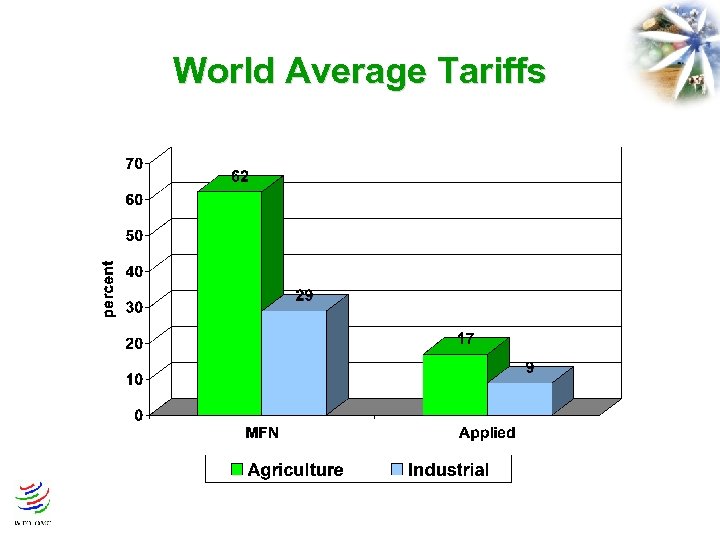 World Average Tariffs
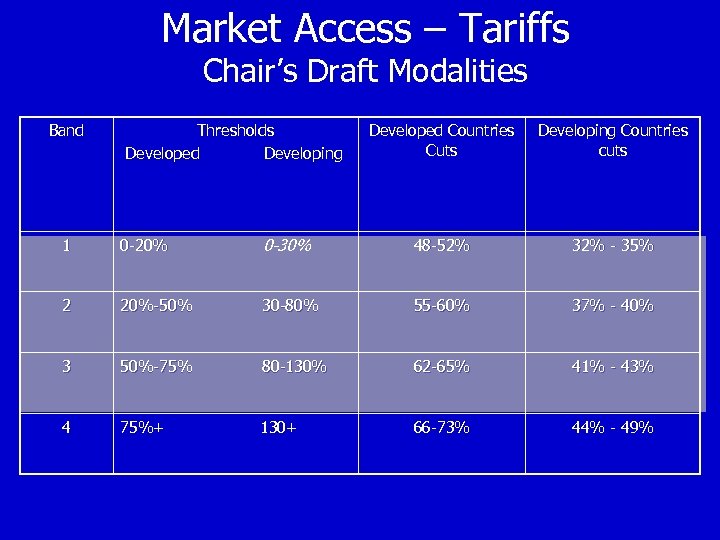 Market Access – Tariffs Chair’s Draft Modalities Band Thresholds Developed Developing Developed Countries Cuts Developing Countries cuts 1 0 -20% 0 -30% 48 -52% 32% - 35% 2 20%-50% 30 -80% 55 -60% 37% - 40% 3 50%-75% 80 -130% 62 -65% 41% - 43% 4 75%+ 130+ 66 -73% 44% - 49%
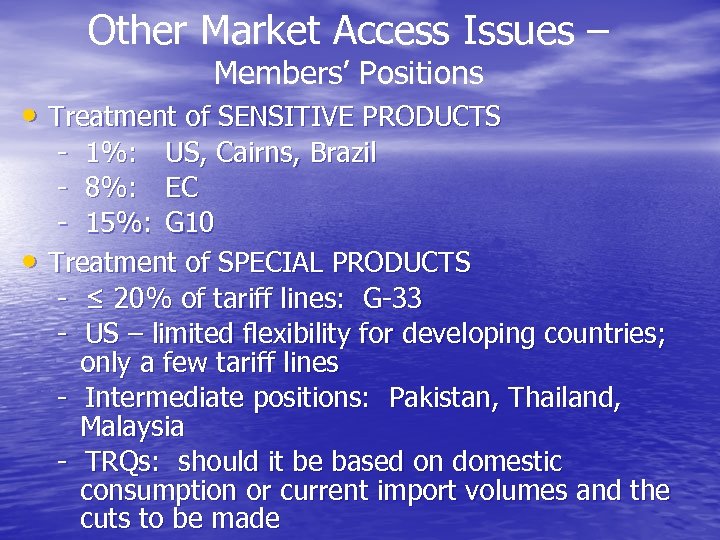 Other Market Access Issues – Members’ Positions • Treatment of SENSITIVE PRODUCTS • - 1%: US, Cairns, Brazil - 8%: EC - 15%: G 10 Treatment of SPECIAL PRODUCTS - ≤ 20% of tariff lines: G-33 - US – limited flexibility for developing countries; only a few tariff lines - Intermediate positions: Pakistan, Thailand, Malaysia - TRQs: should it be based on domestic consumption or current import volumes and the cuts to be made
![Other Market Access Issues – Chair’s Draft Modalities • SENSITIVE PRODUCTS – Number: [4]](https://present5.com/presentation/cd5896dd0fdbc72f21d10b11a68f8e7a/image-13.jpg "Other Market Access Issues – Chair’s Draft Modalities • SENSITIVE PRODUCTS – Number: [4]") Other Market Access Issues – Chair’s Draft Modalities • SENSITIVE PRODUCTS – Number: [4] [6] per cent of [dutiable] tariff lines or [6] [8] per cent where over 30 per cent of the developedcountry tariff lines are in the top band or where tariff concessions have been scheduled at the 6 digit level – Developing countries can designate one-third more of tariff lines as sensitive – Treatment: ⅓, ½ or ⅔ of the normal reduction for developed countries. Thus if developed countries have to reduce their tariffs by 66%, it could be 22%, 33% and 44%, respectively
Other Market Access Issues – Chair’s Draft Modalities • SENSITIVE PRODUCTS – Number: [4] [6] per cent of [dutiable] tariff lines or [6] [8] per cent where over 30 per cent of the developedcountry tariff lines are in the top band or where tariff concessions have been scheduled at the 6 digit level – Developing countries can designate one-third more of tariff lines as sensitive – Treatment: ⅓, ½ or ⅔ of the normal reduction for developed countries. Thus if developed countries have to reduce their tariffs by 66%, it could be 22%, 33% and 44%, respectively
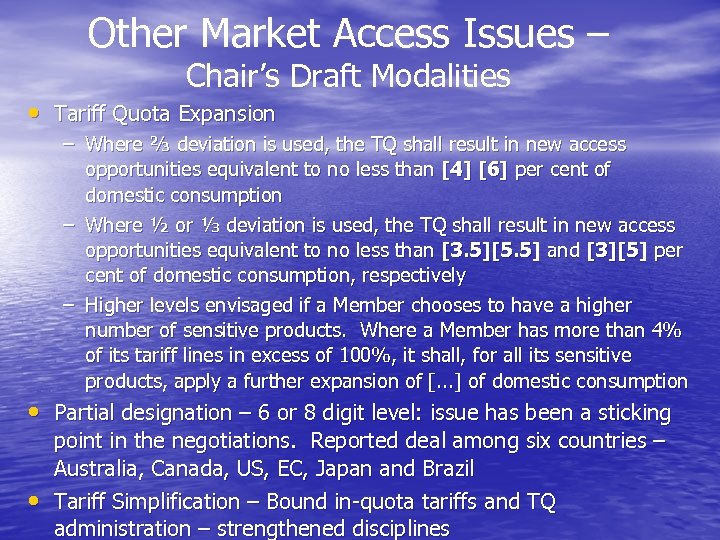 Other Market Access Issues – Chair’s Draft Modalities • Tariff Quota Expansion – Where ⅔ deviation is used, the TQ shall result in new access opportunities equivalent to no less than [4] [6] per cent of domestic consumption – Where ½ or ⅓ deviation is used, the TQ shall result in new access opportunities equivalent to no less than [3. 5][5. 5] and [3][5] per cent of domestic consumption, respectively – Higher levels envisaged if a Member chooses to have a higher number of sensitive products. Where a Member has more than 4% of its tariff lines in excess of 100%, it shall, for all its sensitive products, apply a further expansion of [. . . ] of domestic consumption • Partial designation – 6 or 8 digit level: issue has been a sticking • point in the negotiations. Reported deal among six countries – Australia, Canada, US, EC, Japan and Brazil Tariff Simplification – Bound in-quota tariffs and TQ administration – strengthened disciplines
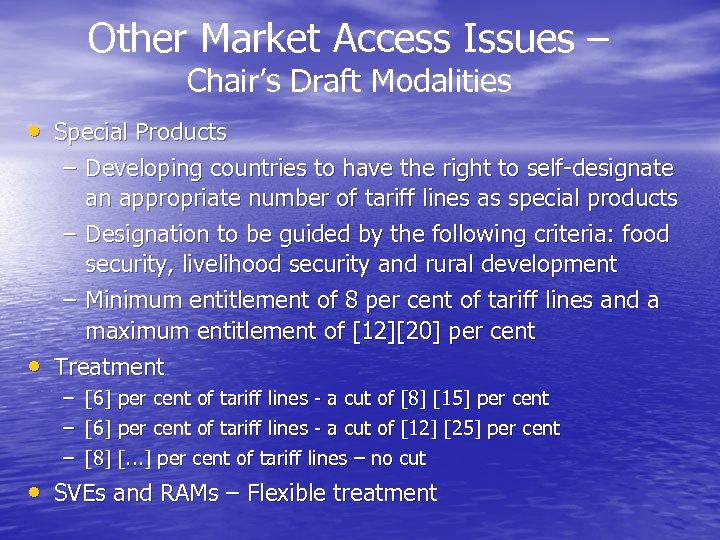 Other Market Access Issues – Chair’s Draft Modalities • Special Products – Developing countries to have the right to self-designate an appropriate number of tariff lines as special products – Designation to be guided by the following criteria: food security, livelihood security and rural development – Minimum entitlement of 8 per cent of tariff lines and a maximum entitlement of [12][20] per cent • Treatment – – – [6] per cent of tariff lines - a cut of [8] [15] per cent [6] per cent of tariff lines - a cut of [12] [25] per cent [8] [. . . ] per cent of tariff lines – no cut • SVEs and RAMs – Flexible treatment
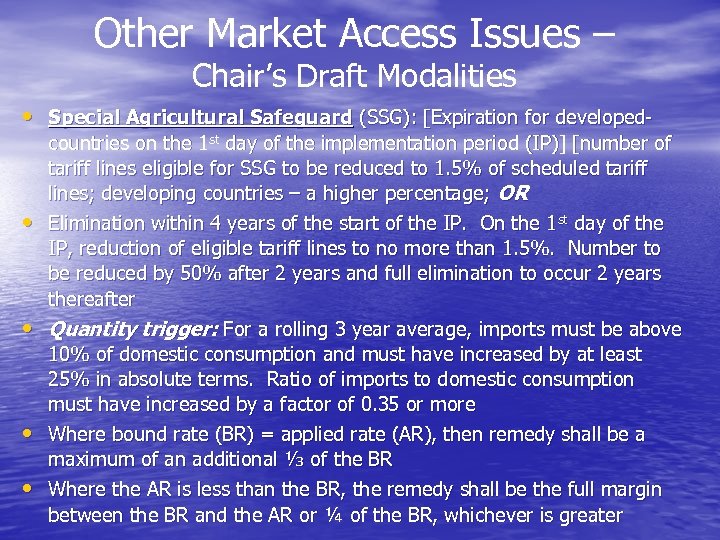 Other Market Access Issues – Chair’s Draft Modalities • Special Agricultural Safeguard (SSG): [Expiration for developed- • • countries on the 1 st day of the implementation period (IP)] [number of tariff lines eligible for SSG to be reduced to 1. 5% of scheduled tariff lines; developing countries – a higher percentage; OR Elimination within 4 years of the start of the IP. On the 1 st day of the IP, reduction of eligible tariff lines to no more than 1. 5%. Number to be reduced by 50% after 2 years and full elimination to occur 2 years thereafter Quantity trigger: For a rolling 3 year average, imports must be above 10% of domestic consumption and must have increased by at least 25% in absolute terms. Ratio of imports to domestic consumption must have increased by a factor of 0. 35 or more Where bound rate (BR) = applied rate (AR), then remedy shall be a maximum of an additional ⅓ of the BR Where the AR is less than the BR, the remedy shall be the full margin between the BR and the AR or ¼ of the BR, whichever is greater
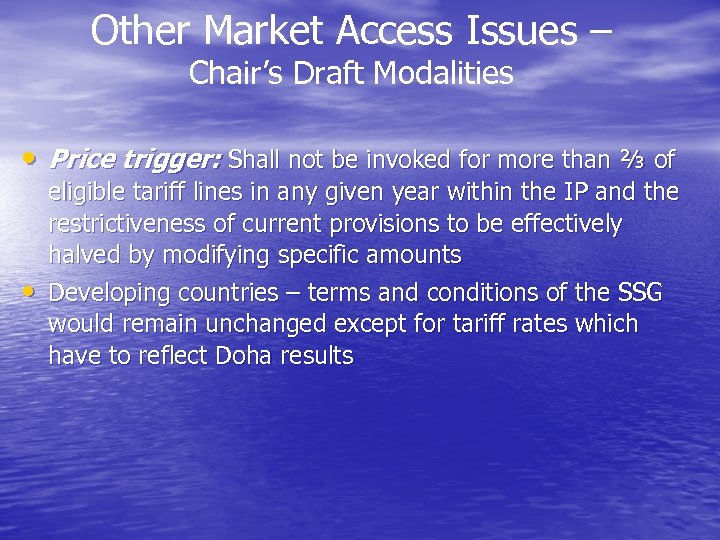 Other Market Access Issues – Chair’s Draft Modalities • Price trigger: Shall not be invoked for more than ⅔ of • eligible tariff lines in any given year within the IP and the restrictiveness of current provisions to be effectively halved by modifying specific amounts Developing countries – terms and conditions of the SSG would remain unchanged except for tariff rates which have to reflect Doha results
 Other Market Access Issues – Chair’s Draft Modalities • Special Safeguard Mechanism (SSM): To be available • • for all products. However, not to be invoked for more than [3][8] products in any given 12 -month period TRIGGERS: Both price and volume-based SSM will be available. The two may not be imposed at the same time. Neither can any one of them be imposed in respect of a product which is the subject of a safeguard measure, including under Art 5 of the Ao. A, an anti-dumping or countervailing measure Detailed rules on volume and price triggers and their remedies
 Other MA issues – Chair’s Draft Modalities: Tropical Products – Annex G • Deeper tariff cuts – [Where the scheduled tariff is less or equal to 25% ad valorem, it shall be reduced to zero – [Where the scheduled tariff is greater than 25% ad valorem, the applicable tariff cut shall be 85%] – [Where the scheduled tariff is greater than or equal to 10%, the applicable tariff cut shall be [66][73]%], except for tariffs in the top band, which shall be reduced by the tariff escalation tariff cut for that band increased by 2% – [Where the scheduled tariff is less than 10%, the applicable tariff cut shall be 0] • [Tropical products shall not be designated as sensitive] • [Implementation by developed-country members in 4 equal • instalments] Dev’g countries in a position to do so encouraged to do more
 Other MA issues – Chair’s Draft Modalities: Preference Erosion – Annex H • [No tariff cuts on the items listed in Annex for 10 years • Tariff cuts to be implemented thereafter over 5 years in equal • • • instalments] [Where a product is listed in the Annex and the ff conditions are met, the implementation period will be 10 years (8+2) – [the pre-Doha MFN tariff is greater than 10% ad valorem] – [the total value of trade over a 3 year representative period is greater than $50, 000 or constitutes [3][5]% of the long standing preferencereceiving country’s total agricultural trade to the market concerned] – [there is unlimited long-standing preference eligibility in the market concerned] Provisions to prevail where there is overlap with provisions on tariff escalation / tropical products Targeted technical assistance
 Other MA issues – Chair’s Draft Modalities: Tariff Escalation • Tariff escalation • [Tariffs on processed products to be reduced more steeply. Instead of taking the cut that would otherwise apply to final bound tariffs in the band to which the processed product belongs (with the exception of the top band), the processed product shall take the cut applicable to tariffs that fall in the next highest band [Products falling in the top band to be reduced by a cut which is equal to 1. 3 times the cut that would otherwise have been applicable / increased by 6 ad valorem points] • Supplementary cuts to be moderated where the absolute difference • between the processed and primary product after the application of the normal tariff formula would be 5 ad valorem percentage points or less in any given tier except the bottom tier – no additional tariff escalation adjustment to be required Application of adjustment formula should not lead to a higher tariff on the primary product than the processed product
 Other Market Access Issues – Chair’s Draft Modalities - Commodities • Where problems persist after the application of the formula, • • • including the tariff escalation adjustment formula, Members are to engage with commodity-dependent producing countries to ensure satisfactory solutions Identification of products for the purpose of applying the tariff escalation formula – specific targets; non-ad valorem duties to be converted and bound Elimination of NTBs Joint action – intergovernmental commodity agreements etc
 Other Market Access Issues – Chair’s Draft Modalities - LDCs • • LDCs: No reduction commitments DFQF – 100% : By 2008 or the start of the implementation period; where there are difficulties, 97% at the beginning to be increased gradually to 100% Developing countries in a position to do so encouraged to grant DFQF – phase in of commitments Cotton Market Access: DFQF for LDCs
 Other Market Access Issues – Chair’s Draft Modalities - SVEs • The term SVEs to apply to Members with economies that, in the period 1999 to 2004, had an average share of: – World merchandise trade of no more than 0. 16% or less – World trade in non-agricultural products of no more than 0. 1% – World trade in agricultural products of no more than 0. 4% • SVEs to moderate the two-thirds cut by developing • • countries by a further [10] ad-valorem points in each band Flexibility in the designation of special products – SVEs can deviate from the tiered formula cut for as many tariff lines as they choose to designate as SPs provided they meet the overall average cut of 24% Products designated as SPs need not be subject to a minimum tariff cut nor designation be guided by the indicators
 Other Market Access Issues – Chair’s Draft Modalities - RAMs • Entitled to moderate tariff cuts by [7. 5] ad valorem • • percentage points Saudi Arabia, Macedonia, Vietnam, Tonga, [Cape Verde; Ukraine] exempted from undertaking cuts For other RAMs, where there is an overlap between accession commitments and commitments associated with modalities, the start of the IP shall be one year after the end of the accession commitment Implementation period shall be 10 years (8+2) Flexibility in the designation of special products
 Domestic Support • High levels of support by developed countries • Few developing countries provide subsidies • Amounts provided by most developing • countries not substantial- justifiable as de minimis or under Article 6. 2 of the Ao. A Agreement in HK that there will be three bands for the reduction of Overall Trade-distorting Domestic Support (OTDS) – EC in top band, Japan and US in second band, all others (including developing-country Members) in third band
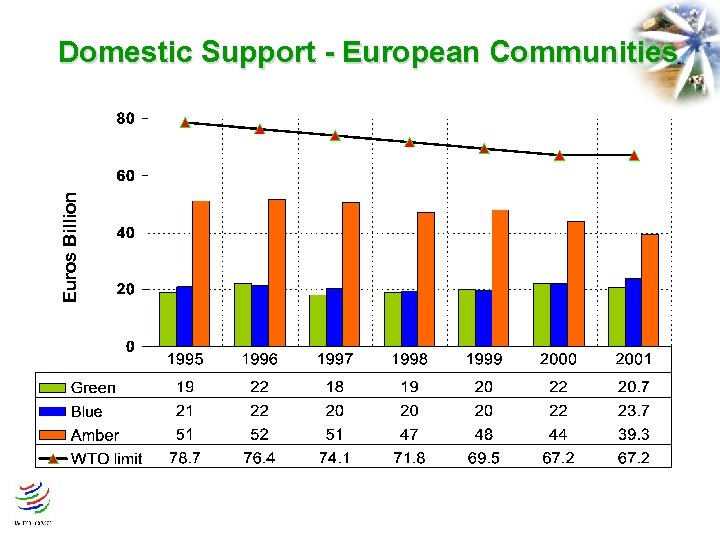 Euros Billion Domestic Support - European Communities
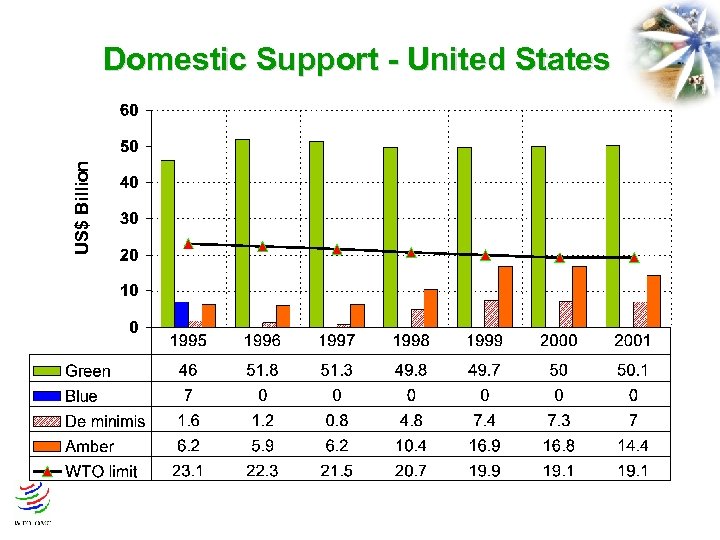 US$ Billion Domestic Support - United States
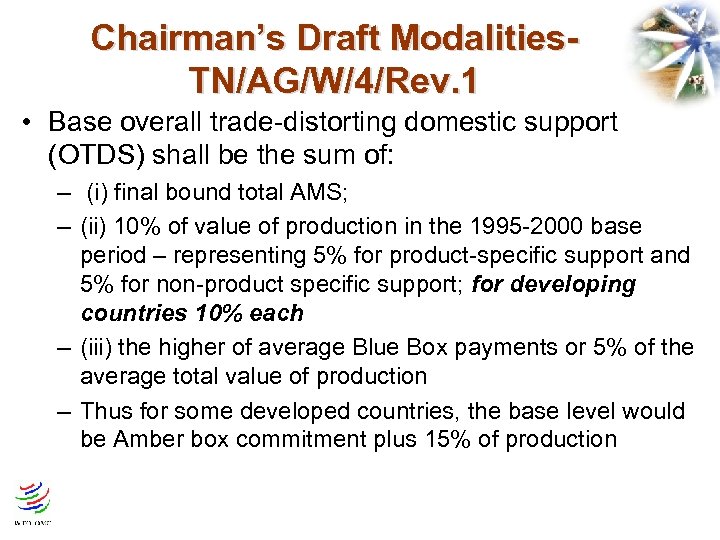 Chairman’s Draft Modalities. TN/AG/W/4/Rev. 1 • Base overall trade-distorting domestic support (OTDS) shall be the sum of: – (i) final bound total AMS; – (ii) 10% of value of production in the 1995 -2000 base period – representing 5% for product-specific support and 5% for non-product specific support; for developing countries 10% each – (iii) the higher of average Blue Box payments or 5% of the average total value of production – Thus for some developed countries, the base level would be Amber box commitment plus 15% of production
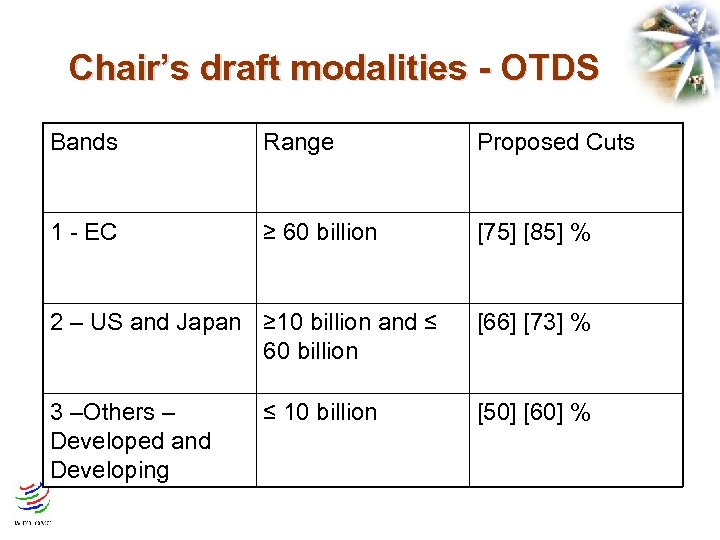 Chair’s draft modalities - OTDS Bands Range Proposed Cuts 1 - EC ≥ 60 billion [75] [85] % 2 – US and Japan ≥ 10 billion and ≤ 60 billion [66] [73] % 3 –Others – Developed and Developing [50] [60] % ≤ 10 billion
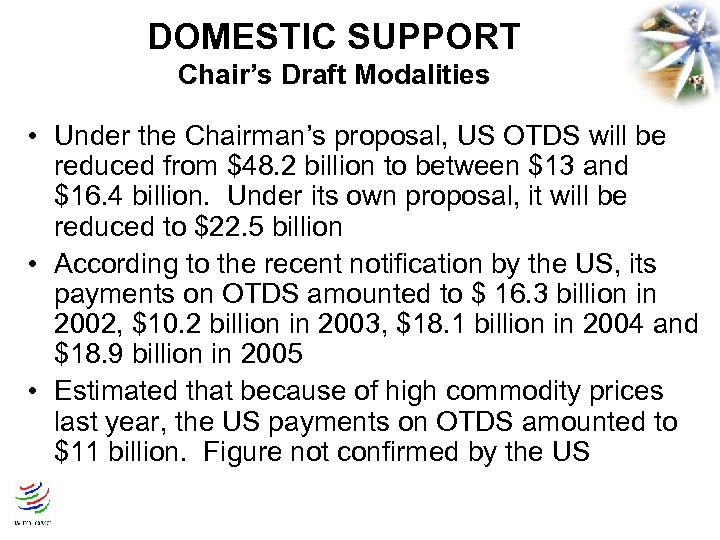 DOMESTIC SUPPORT Chair’s Draft Modalities • Under the Chairman’s proposal, US OTDS will be reduced from $48. 2 billion to between $13 and $16. 4 billion. Under its own proposal, it will be reduced to $22. 5 billion • According to the recent notification by the US, its payments on OTDS amounted to $ 16. 3 billion in 2002, $10. 2 billion in 2003, $18. 1 billion in 2004 and $18. 9 billion in 2005 • Estimated that because of high commodity prices last year, the US payments on OTDS amounted to $11 billion. Figure not confirmed by the US
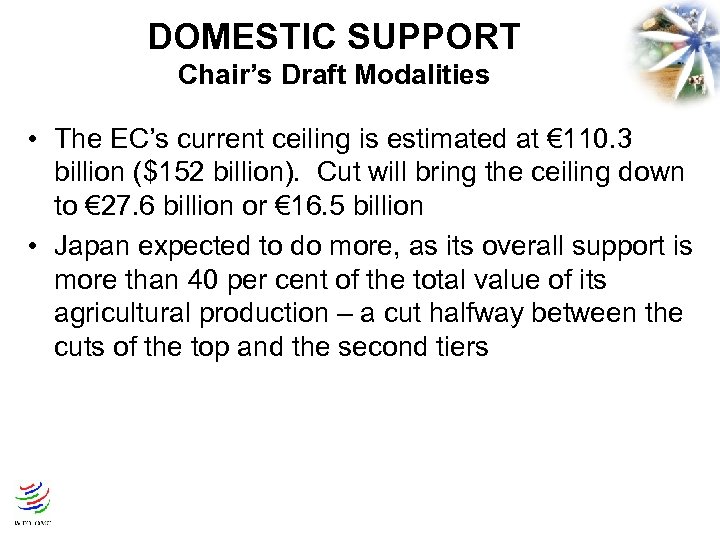 DOMESTIC SUPPORT Chair’s Draft Modalities • The EC’s current ceiling is estimated at € 110. 3 billion ($152 billion). Cut will bring the ceiling down to € 27. 6 billion or € 16. 5 billion • Japan expected to do more, as its overall support is more than 40 per cent of the total value of its agricultural production – a cut halfway between the cuts of the top and the second tiers
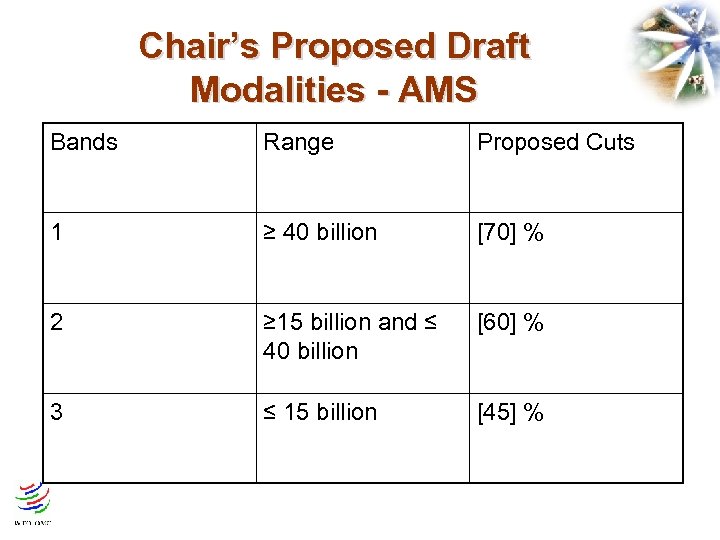 Chair’s Proposed Draft Modalities - AMS Bands Range Proposed Cuts 1 ≥ 40 billion [70] % 2 ≥ 15 billion and ≤ 40 billion [60] % 3 ≤ 15 billion [45] %
 Domestic Support Chairman’s proposals • Under the Chairman’s proposal, the amber box limit of the US will be reduced from $19. 1 billion to $7. 6 billion • According to figures provided by the US, AMS payments for 2002, 2003, 2004 and 2005 were $9. 6 billion, $6. 9 billion, $11. 6 billion and 12. 9 billion, respectively. • Brazil and Canada are alleging in the dispute settle proceedings that the US exceeded its WTO limits for most of these years, a claim the US denies.
 Domestic Support • PRODUCT-SPECIFIC AMS CAPS – average applied during the UR implementation period (1995 -2000) • For the US – average between 1995 -2004 and 1995 -2000 • S&D for developing countries – base period (1995 -2000 or 19952004) • DE MINIMIS: to be reduced by [50] [60] per cent by developed countries – i. e. cap at 2. 5 or 2 per cent of the value of production • S&D for developing countries: some exempted, others to make two-thirds of the cuts of developed countries • BLUE BOX: maximum permitted value not to exceed 2. 5 per cent of the average total value of agricultural production • Lesser cut if over 40% of Member’s support placed in the blue box • Deeper cut in AMS support for cotton
 Export Competition – Chair’s Draft Modalities • Elimination of all forms of export subsidies by 2013. • • • Budgetary outlays- 50% reduction by 2010 and the rest in equal instalments Reduction commitments also on quantity of exported products S&D for developing countries - 2016 Developing countries to benefit from the provisions of Article 9. 4 until 5 yrs after the end of the implementation period Proposed strengthened disciplines on agricultural exporting STEs and international food aid Elimination of all forms of export subsidies for cotton
 General Reactions to Chair’s draft modalities • Most Members welcomed the draft Ag text • • and said could be basis for further work Since its circulation, efforts have focussed on reaching compromises. The Chair’s suggestion that Members split the difference between the ranges proposed was not well received More positive reaction than to NAMA draft modalities text. Concerns about the formula and the flexibilities
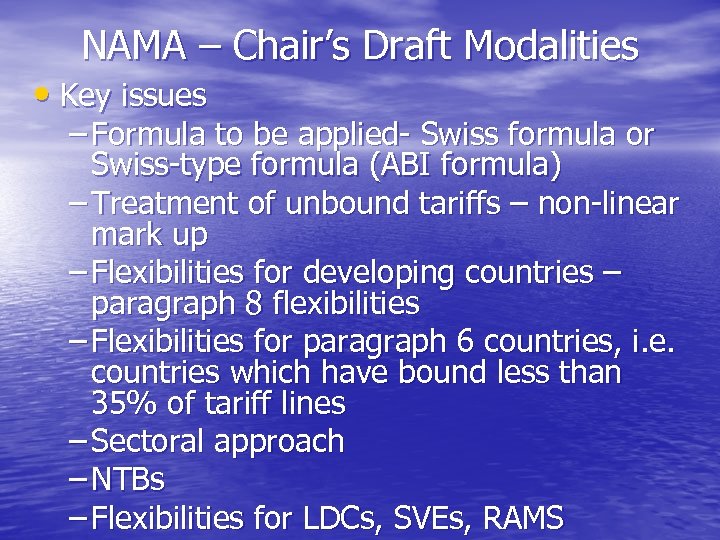 NAMA – Chair’s Draft Modalities • Key issues – Formula to be applied- Swiss formula or Swiss-type formula (ABI formula) – Treatment of unbound tariffs – non-linear mark up – Flexibilities for developing countries – paragraph 8 flexibilities – Flexibilities for paragraph 6 countries, i. e. countries which have bound less than 35% of tariff lines – Sectoral approach – NTBs – Flexibilities for LDCs, SVEs, RAMS
![Formula • Adoption of a simple Swiss Formula with two co-efficients – [8 -9]](https://present5.com/presentation/cd5896dd0fdbc72f21d10b11a68f8e7a/image-39.jpg "Formula • Adoption of a simple Swiss Formula with two co-efficients – [8 -9]") Formula • Adoption of a simple Swiss Formula with two co-efficients – [8 -9] for developed countries; and – [19 -23] for developing countries • Product coverage to be comprehensive without a priori exclusions • Reductions or elimination on the basis of bound rates
Formula • Adoption of a simple Swiss Formula with two co-efficients – [8 -9] for developed countries; and – [19 -23] for developing countries • Product coverage to be comprehensive without a priori exclusions • Reductions or elimination on the basis of bound rates
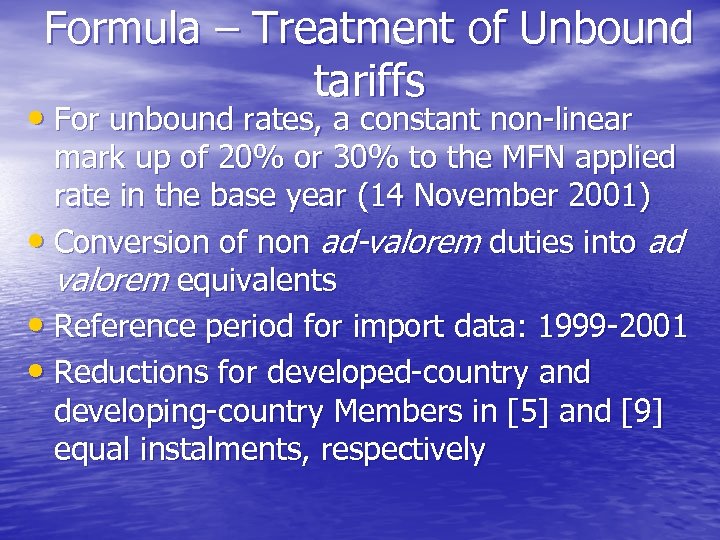 Formula – Treatment of Unbound tariffs • For unbound rates, a constant non-linear mark up of 20% or 30% to the MFN applied rate in the base year (14 November 2001) • Conversion of non ad-valorem duties into ad valorem equivalents • Reference period for import data: 1999 -2001 • Reductions for developed-country and developing-country Members in [5] and [9] equal instalments, respectively
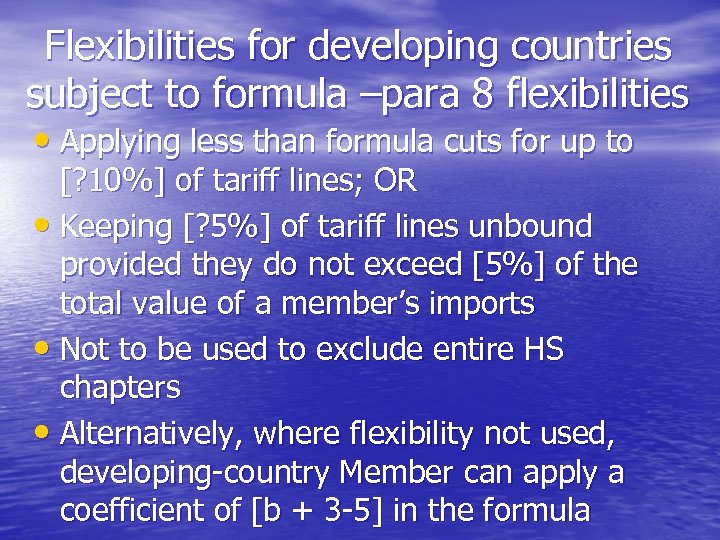 Flexibilities for developing countries subject to formula –para 8 flexibilities • Applying less than formula cuts for up to [? 10%] of tariff lines; OR • Keeping [? 5%] of tariff lines unbound provided they do not exceed [5%] of the total value of a member’s imports • Not to be used to exclude entire HS chapters • Alternatively, where flexibility not used, developing-country Member can apply a coefficient of [b + 3 -5] in the formula
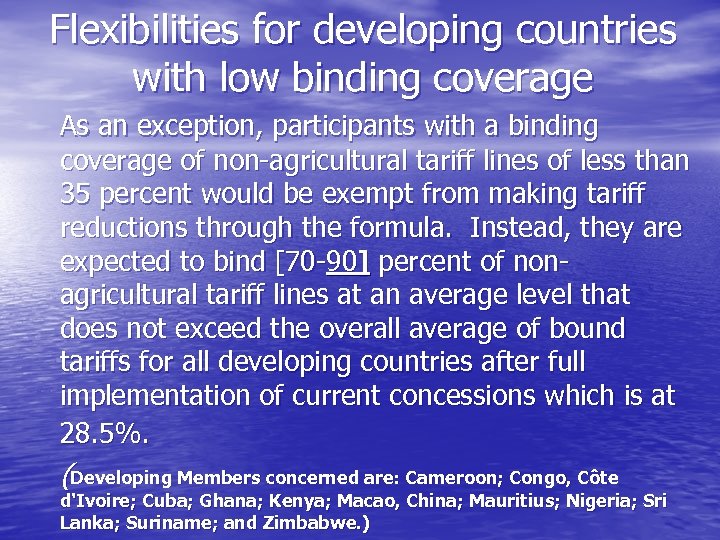 Flexibilities for developing countries with low binding coverage As an exception, participants with a binding coverage of non-agricultural tariff lines of less than 35 percent would be exempt from making tariff reductions through the formula. Instead, they are expected to bind [70 -90] percent of nonagricultural tariff lines at an average level that does not exceed the overall average of bound tariffs for all developing countries after full implementation of current concessions which is at 28. 5%. (Developing Members concerned are: Cameroon; Congo, Côte d'Ivoire; Cuba; Ghana; Kenya; Macao, China; Mauritius; Nigeria; Sri Lanka; Suriname; and Zimbabwe. )
 Flexibilities for LDCs • LDCs exempted from applying the formula for • • tariff reduction and the sectoral approach. However, as part of contribution to this Round of negotiations, LDCs expected to substantially increase the level of tariff binding commitments. Individual LDCs to determine the extent and level of tariff binding commitments in accordance with their individual development objectives. Duty-free, quota-free access for LDCs – transparency ( Hong Kong Declaration)
 Flexibilities for LDCs • Accordingly, by the time Members submit their comprehensive draft schedules of concessions, developed-country Members shall, and developing -country Members declaring themselves in a position to do so should: - inform the WTO of the products that are currently covered under duty free and quota free market access for LDCs; - notify the internal procedures by which they will implement the Decision; and - provide an indication of the possible time frame within which they intend to fully implement the Decision as agreed.
 Flexibility for Small Vulnerable Economies • Search for benchmarks of vulnerability abandoned. Single eligibility criterion based on value of NAMA trade from 1999 -2001: 0. 1% • Two options: a formula tariff reduction with expanded flexibilities or a target average tariff reduction as proposed by SVEs • Chair’s recommendation: tariff average approach, in 3 tiers based on average bound tariffs, and including a minimum lineby-line tariff reduction
 Flexibility for Small Vulnerable Economies • Where the SVE has bound 50% or more of its • • • tariff lines, its overall tariff average shall not exceed [22 -32%]. Fiji – special consideration on account of its low level of binding coverage and the fact that SVEs will be expected to bind 100% of their tariff lines Where the SVE has bound between 30% and 49% of its tariff lines, its overall tariff average shall not exceed [18 -28%] Where the SVE has bound less than 30% of its tariff lines, its overall tariff average shall not exceed [14 -20%] SVEs to make a minimum tariff reduction of [510%] for [90 -95] per cent of their tariff lines
 Flexibility for Small Vulnerable Economies • All tariff lines to be bound on 1 January following • • • the entry into force of the DDA results at initial bound rates For bound tariff lines, existing bindings will be used. For unbound tariff lines, SVE to determine the level of the initial binding of those tariff lines Overall binding target average to be made effective at the end of the implementation period through 9 equal rate reductions. First reduction to be made 1 year after the implementation of the DDA results All duties to be bound on an ad-valorem basis
 Flexibility for Recently Acceded Members • Potential list of RAMs: Ecuador, Bulgaria, • • Mongolia, Panama, Kyrgyz Republic, Jordan, Georgia, Albania, Oman, Croatia, Moldova, Chinese Taipei, Armenia, Former Yugoslav Republic of Macedonia, Saudi Arabia, Vietnam and Tonga RAMs have to apply the formula, with the exception of Armenia, Former Yugoslav Republic of Macedonia, Saudi Arabia, Vietnam and Tonga A grace period of [2 -3] years shall apply on a lineby-line basis and shall begin as of the date of full implementation of the accession commitment on that tariff line
![Flexibility for Recently Acceded Members • An extended implementation period of [2 -5] equal](https://present5.com/presentation/cd5896dd0fdbc72f21d10b11a68f8e7a/image-49.jpg "Flexibility for Recently Acceded Members • An extended implementation period of [2 -5] equal") Flexibility for Recently Acceded Members • An extended implementation period of [2 -5] equal • • • rate reductions to implement commitments (i. e. in addition to the 5 or 9 equal instalments foreseen) First reduction to be implemented on 1 January of the year following the entry into force of the DDA results, with the exception of those tariff lines covered above In respect of those tariff lines, the first reduction shall be implemented on 1 January of the year following completion of the grace period In both cases, each successive reduction to be made effective on 1 January of each of the following years
Flexibility for Recently Acceded Members • An extended implementation period of [2 -5] equal • • • rate reductions to implement commitments (i. e. in addition to the 5 or 9 equal instalments foreseen) First reduction to be implemented on 1 January of the year following the entry into force of the DDA results, with the exception of those tariff lines covered above In respect of those tariff lines, the first reduction shall be implemented on 1 January of the year following completion of the grace period In both cases, each successive reduction to be made effective on 1 January of each of the following years
 Sectorals • Key element in fulfilling the Doha mandate • Participation on anon-mandatory basis • Discussions to date have focussed on defining critical mass, scope of product coverage, implementation period and SDT for developing countries • Members participating in sectorals to intensify their work
 Non-reciprocal preferences • Assessment of the scope of the preference erosion problem greatly assisted by a Secretariat analysis of the key products, key countries and key markets concerned. element in fulfilling the Doha mandate • Suggested possible solutions: - Aid-for-Trade to address the underlying challenges faced by beneficiary countries – diversification of exports and strengthening competitiveness; - Possible longer implementation periods; - Correction coefficient – opposed by several Members, who argue that trade measures are not apposite for addressing the problem
 Non-reciprocal preferences • Recognition that MFN liberalization will erode preferences • Reduction of tariff on eligible products to be implemented in [7] equal rate reductions instead of 5 equal rate reductions by preference-giving countries • First reduction to be implemented on 1 January of the [second] year following the entry into force of DDA results
 Others • Supplementary modalities: Request and offer approach • Low Duties: elimination encouraged • NTBs: Members encouraged to merge proposals to facilitate text-based negotiations; resolution of bilateral requests; intensification of work • Capacity-building measures • Non-agricultural environmental goods
 Services • Number of offers on the table quite satisfactory, • • • but problem is their quality. In some cases, the offers do not match prevailing access granted by countries Key issue is how to get improved offers. Will the plurilateral request/offer approach deliver improved offers? Proposal of developed countries that there should be a plurilateral component committing Members to a certain level of ambition Some developed-country Members would want an express linkage to the level of ambition in services to those in agriculture and NAMA
 Services • Demand by developed-country Members that there • • should be a ministerial signalling exercise around the time of agreement on agriculture and NAMA modalities. Meeting to be chaired by the DG Objection to the proposals by most developingcountry Members who insist that any multilateral text should respect faithfully the agreed guidelines for the negotiations Issues of concern to developing countries: Mode 4 (Temporary movement of persons) GATS rules – progress on domestic regulation disciplines – draft being discussed by Members Draft text to be circulated (When? )→ link with timing of other texts
 Rules • RTAS – transparency mechanism agreed in December 2006. • • • Applied provisionally. To be reviewed in light of experience and agreed rules incorporated as part of the Doha package No progress on the substantive rules – scope of Article XXIV of the GATT 1994, Article V of the GATS and the Enabling Clause As regards antidumping, work has advanced. Chair issued a draft text in November 2007. Proposals made on a number of subjects, including product under investigation/ consideration, like product, domestic injury, dumped imports, standing rules, determination of normal value, constructed export price, conditions under which export price can be disregarded, cumulative assessment of imports, price undertakings, lesser duty rule, public notice and period of data collection for investigations
 Rules • Whereas the text contains some positive elements, it has • • been criticised by many Members for its provisions on zeroing. Whereas the Appellate Body has ruled that zeroing is prohibited both in investigations (WA-WA and T-T) and in reviews, the new text only prohibits zeroing in WA-WA transactions. As regards subsidies, the proposals have focussed mostly on the following issues: clarification and improvement of the trade remedy provisions, definition of a subsidy and calculation methodology, prohibited subsidies – export and import substitution subsidies, remedies for prohibited subsidies, export credits, serious prejudice, non-actionable subsidies, subsidy notifications, SDT, natural resource and energy pricing, taxation
 Rules • The Chairman’s text covers the following issues: benefit • • • definition, specificity and regulated prices, scope of illustrative list, benefit calculation for regulated prices, upstream subsidies, allocation of benefits Does not include language on the following: Dual pricing, presumption of serious prejudice, non-actionable subsidies, “development policy space”, Inputs consumed (for drawback), harmonization of CVD & AD procedures As regards fisheries subsidies, substantial progress has been made since the resumption of negotiations in February 2007. Progress reflected in Chairman’s text. Prohibition of subsidies which contribute to overfishing, overcapacity and depletion of global stocks, including subsidies for vessel construction, transfer of vessels, operating costs, fishing and port infrastructure, income and price support
 Rules • A number of exemptions: subsidies for improvement for • • vessel and crew safety, selective gear/techniques, other environmentally-friendly techniques, vessel decommissioning, capacity reduction A number of S&D provisions for developing countriesaccess fees, support for artisanal fishing etc LDCs exempted from obligations Next steps: Chairman of the NG on Rules has resisted calls for a revised text to be issued before the start of the horizontal process Linkage with other negotiating areas
 Special and Differential Treatment • Not much progress since the Cancun Ministerial • • • Conference Impasse over whether the 28 Agreement-specific proposals agreed in Hong Kong should be harvested or revisited to make them more enforceable? African Group not in a hurry to adopt the decisions on the grounds that they lack economic value Decisions on 5 Agreement-specific LDCs proposals in HK, the most significant being the decision on duty-free, quota-free access for products of export interest to LDCs
 Special and Differential Treatment • Issues about implementation of the DFQF decision remain • Category II proposals – not much progress in the relevant WTO bodies • The African Group wants the CTD Special Session to examine these proposals. Opposed by developed-country Members • 16 remaining category I and III proposals – focus on 7 proposals. New language needed on the remaining 9 proposals as Members’ positions are widely divergent
 Trade Facilitation • Good progress in the negotiations • Text-based contributions from Members covering • Articles V, VIII and X of the GATT 1994 Proposals have focussed on, inter alia, publication and availability of information, time periods between publication and entry into force of rules/regulations, consultations and possibility to provide comments on draft rules/regulations, information on policy objectives, advance rulings, appeals procedures and due process, impartiality and non-discrimination, import/export fees and documentation, consular transactions, cooperation between customs authorities and relevant officials, transit matters
 Trade Facilitation • Bottom-up approach has provided the Chairperson of the • • • NGTF inputs to prepare a draft text for Members’ consideration Main challenge would be how to come up with effective disciplines while at the same time giving effect to the broad provisions on special and differential treatment for LDCs and developing countries. Will they be watertight or voluntary as far as developing countries are concerned? On implementation of obligations, two approaches – a staged approach and a tailor-made approach which takes into account the circumstances of each developing-country Member. Emphasis on building the technical and financial capacities to implement any new disciplines Timing of the Chair’s text dependent on developments in other areas – Ag, NAMA, Services, Rules etc
 Other Issues • Dispute Settlement (outside the single undertaking) – • • Progress has been made on the following issues: third party rights, sequencing, remand authority, post-retaliation Timing of draft text based on developments in other areas of the negotiations, even though the DSU negotiations are outside of the single undertaking Trade and Environment: Progress has been uneven. Work advanced on the preparation of lists of environmental goods and services TRIPS Issues – Extension of the additional protection provided to wines and spirits to other products. Members’ positions are widely divergent. Progress dependent on the results of the agriculture negotiations TRIPS Register – automatic legal effects or not and the issue of participation- should it be mandatory or voluntary
 Process Forward • Establish modalities in Ag and NAMA: May or July 2008? • Prepare schedules based on modalities • Verification of schedules • Conclude negotiations in other areas including services, rules, development etc • Legal drafting • Signing of Final Act • Domestic ratification processes
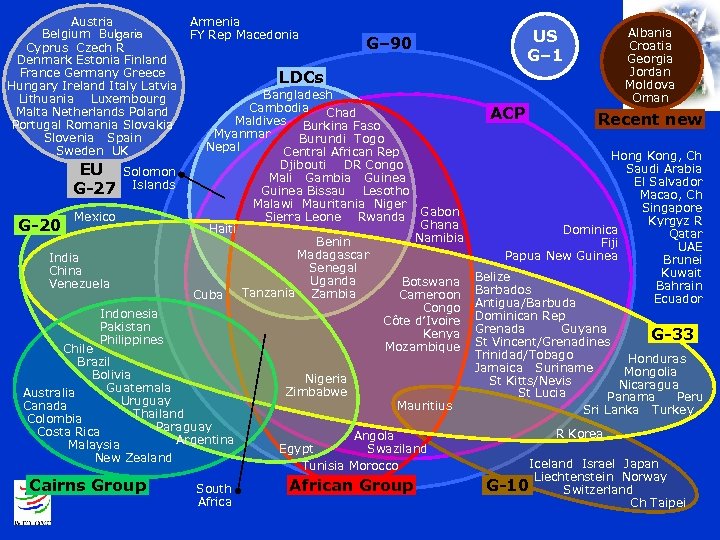 Austria Belgium Bulgaria Cyprus Czech R Denmark Estonia Finland France Germany Greece Hungary Ireland Italy Latvia Lithuania Luxembourg Malta Netherlands Poland Portugal Romania Slovakia Slovenia Spain Sweden UK EU G-27 G-20 Solomon Islands Mexico India China Venezuela Indonesia Pakistan Philippines Armenia FY Rep Macedonia LDCs Bangladesh Cambodia Chad Maldives Burkina Faso Myanmar Burundi Togo Nepal Central African Rep Djibouti DR Congo Mali Gambia Guinea Bissau Lesotho Malawi Mauritania Niger Sierra Leone Rwanda Gabon Ghana Haiti Namibia Benin Madagascar Senegal Uganda Botswana Tanzania Zambia Cuba Cameroon Congo Côte d’Ivoire Kenya Mozambique Chile Brazil Bolivia Guatemala Australia Uruguay Canada Thailand Colombia Paraguay Costa Rica Argentina Malaysia New Zealand Cairns Group Albania Croatia Georgia Jordan Moldova Oman US G– 1 G– 90 South Africa Nigeria Zimbabwe Mauritius Angola Swaziland Egypt Tunisia Morocco African Group ACP Recent new Hong Kong, Ch Saudi Arabia El Salvador Macao, Ch Singapore Kyrgyz R Dominica Qatar Fiji UAE Papua New Guinea Brunei Kuwait Belize Bahrain Barbados Ecuador Antigua/Barbuda Dominican Rep Grenada Guyana G-33 St Vincent/Grenadines Trinidad/Tobago Honduras Jamaica Suriname Mongolia St Kitts/Nevis Nicaragua St Lucia Panama Peru Sri Lanka Turkey R Korea Iceland Israel Japan Liechtenstein Norway G-10 Switzerland Ch Taipei