


 Скачать презентацию The Dative Case a k a The Indirect
2e23a61b99a865e2b60191ea0506bc4a.ppt
- Количество слайдов: 22
 The Dative Case a. k. a. The Indirect Object Deutsch II Frau Spampinato
 Just a quick review… l Nominative refers to the subject of the sentence l Accusative refers to the direct object of the sentence Asks the question “what” for the verb l Receives the action of the verb directly l z. B. Ich kaufe einen Rechner. l Was kaufe ich? einen Rechner (masculine) l **Remember: only masculine changes!!
 Dative refers to the indirect object of the sentence
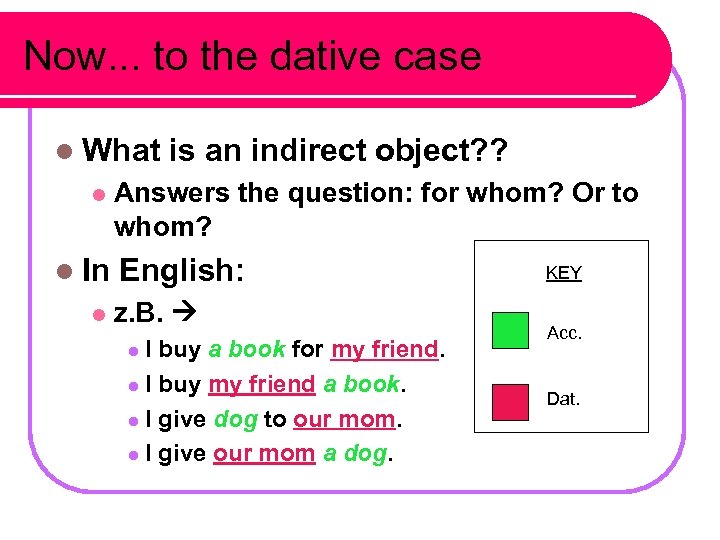 Now. . . to the dative case l What l l In l is an indirect object? ? Answers the question: for whom? Or to whom? English: z. B. I buy a book for my friend. l I buy my friend a book. l I give dog to our mom. l I give our mom a dog. KEY Acc. l Dat.
 The dative case in German… KEY z. B. Acc. l Ich kaufe ein Buch. Dat. l Was kaufe ich? What do I buy? l Ich kaufe meinem Freund ein Buch. l For whom is the book? I buy the book for…? l In this sentence, meinem Freund is the indirect object, a. k. a. the dative. Ein Buch is the direct object or accusative. l l z. B. Ich gebe meiner Mutter einen Kuli. l l For whom is the pen? I give the pen to whom? In this sentence, meiner Mutter is the dative, and einen Kuli is the accusative.
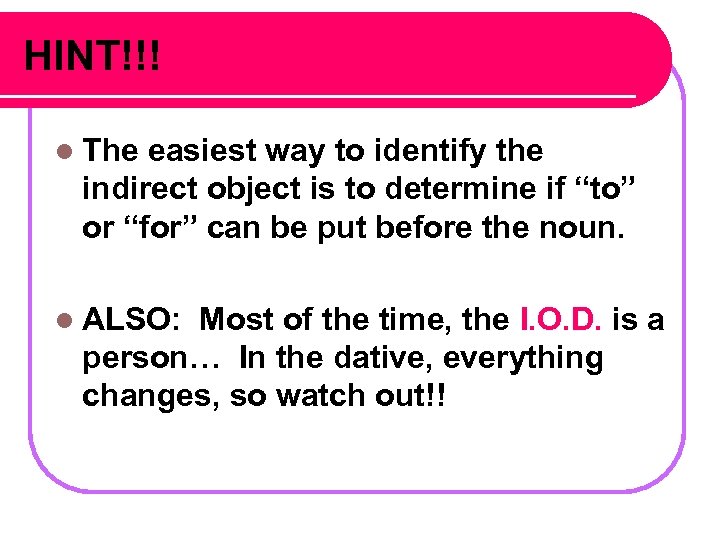 HINT!!! l The easiest way to identify the indirect object is to determine if “to” or “for” can be put before the noun. l ALSO: Most of the time, the I. O. D. is a person… In the dative, everything changes, so watch out!!
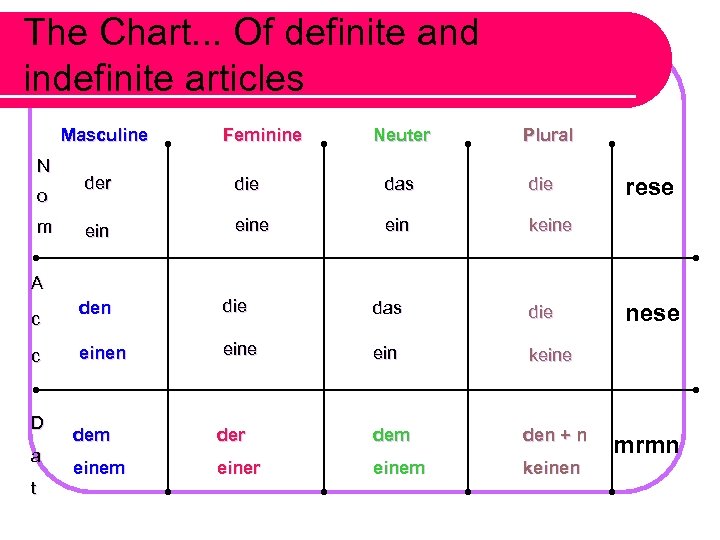 The Chart. . . Of definite and indefinite articles Masculine N o m Feminine Neuter Plural der die das die eine ein keine rese A c c D a t den die das die einen eine ein keine dem der dem den + n einem einer einem keinen nese mrmn
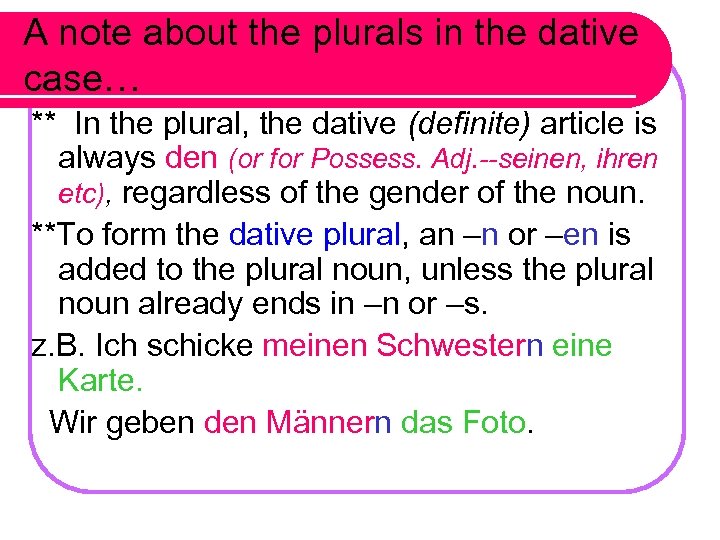 A note about the plurals in the dative case… ** In the plural, the dative (definite) article is always den (or for Possess. Adj. --seinen, ihren etc), regardless of the gender of the noun. **To form the dative plural, an –n or –en is added to the plural noun, unless the plural noun already ends in –n or –s. z. B. Ich schicke meinen Schwestern eine Karte. Wir geben den Männern das Foto.
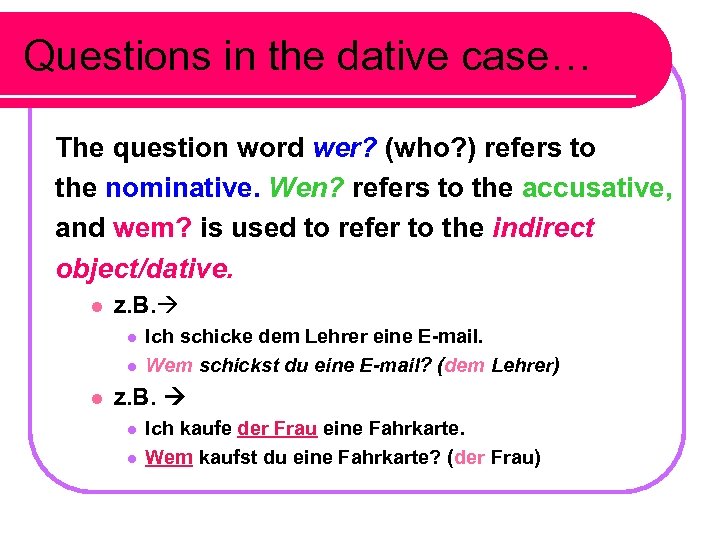 Questions in the dative case… The question word wer? (who? ) refers to the nominative. Wen? refers to the accusative, and wem? is used to refer to the indirect object/dative. l z. B. l l l Ich schicke dem Lehrer eine E-mail. Wem schickst du eine E-mail? (dem Lehrer) z. B. l l Ich kaufe der Frau eine Fahrkarte. Wem kaufst du eine Fahrkarte? (der Frau)
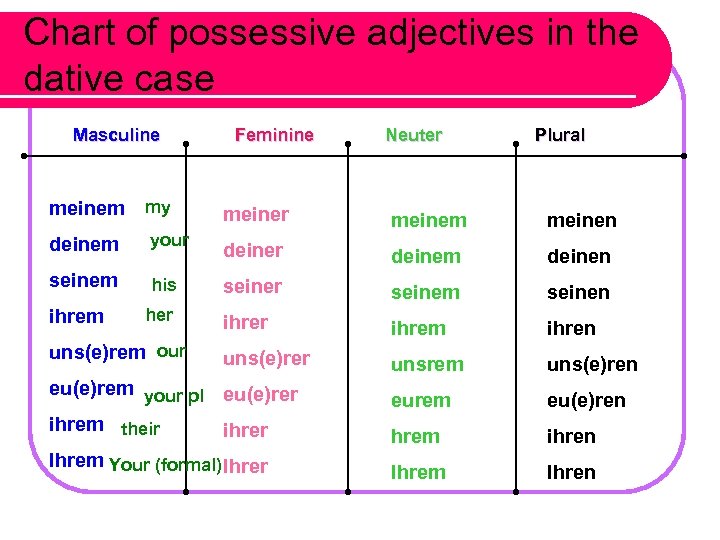 Chart of possessive adjectives in the dative case Masculine meinem my deinem your seinem his ihrem her uns(e)rem our Feminine Neuter Plural meiner meinem meinen deiner deinem deinen seiner seinem seinen ihrer ihrem ihren uns(e)rer unsrem uns(e)ren eurem eu(e)ren hrem ihren Ihrem Ihren eu(e)rem your pl eu(e)rer ihrem their ihrer Ihrem Your (formal) Ihrer
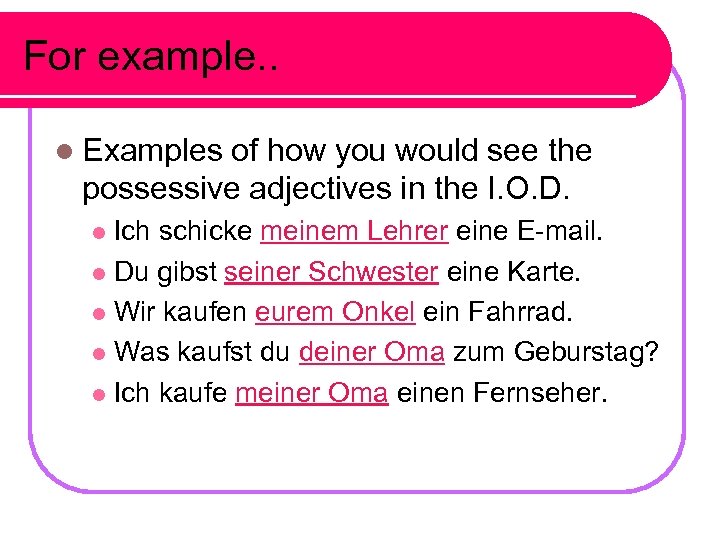 For example. . l Examples of how you would see the possessive adjectives in the I. O. D. Ich schicke meinem Lehrer eine E-mail. l Du gibst seiner Schwester eine Karte. l Wir kaufen eurem Onkel ein Fahrrad. l Was kaufst du deiner Oma zum Geburstag? l Ich kaufe meiner Oma einen Fernseher. l
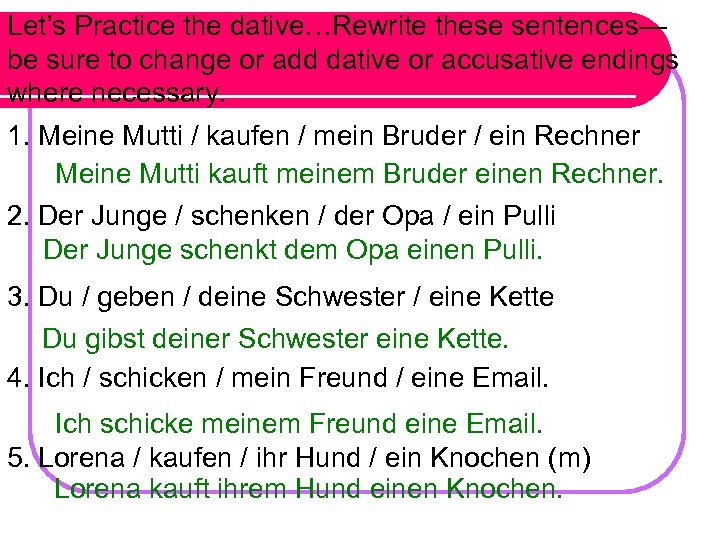 Let’s Practice the dative…Rewrite these sentences— be sure to change or add dative or accusative endings where necessary. 1. Meine Mutti / kaufen / mein Bruder / ein Rechner Meine Mutti kauft meinem Bruder einen Rechner. 2. Der Junge / schenken / der Opa / ein Pulli Der Junge schenkt dem Opa einen Pulli. 3. Du / geben / deine Schwester / eine Kette Du gibst deiner Schwester eine Kette. 4. Ich / schicken / mein Freund / eine Email. Ich schicke meinem Freund eine Email. 5. Lorena / kaufen / ihr Hund / ein Knochen (m) Lorena kauft ihrem Hund einen Knochen.
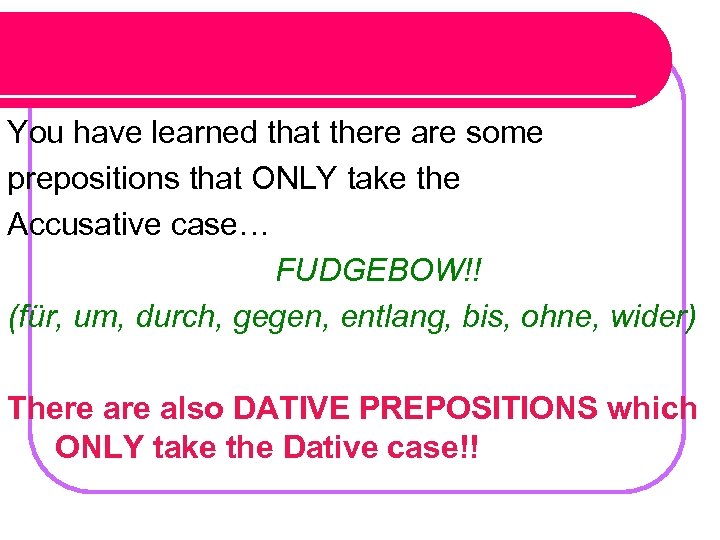 You have learned that there are some prepositions that ONLY take the Accusative case… FUDGEBOW!! (für, um, durch, gegen, entlang, bis, ohne, wider) There also DATIVE PREPOSITIONS which ONLY take the Dative case!!
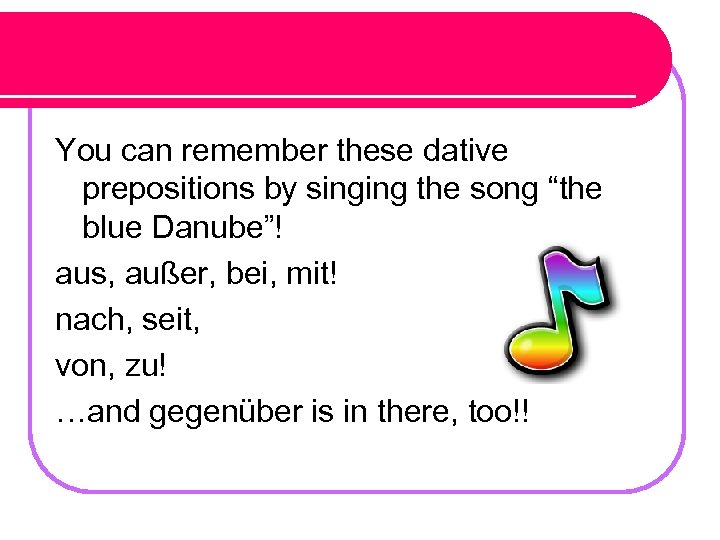 You can remember these dative prepositions by singing the song “the blue Danube”! aus, außer, bei, mit! nach, seit, von, zu! …and gegenüber is in there, too!!
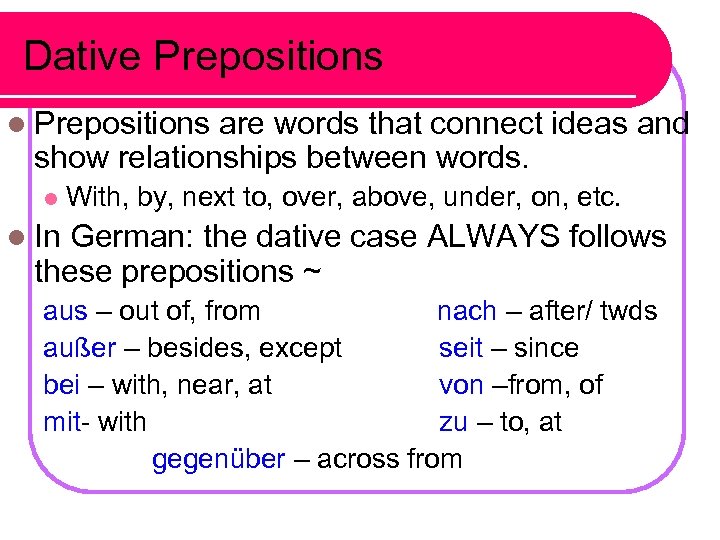 Dative Prepositions l Prepositions are words that connect ideas and show relationships between words. l With, by, next to, over, above, under, on, etc. l In German: the dative case ALWAYS follows these prepositions ~ aus – out of, from nach – after/ twds außer – besides, except seit – since bei – with, near, at von –from, of mit- with zu – to, at gegenüber – across from
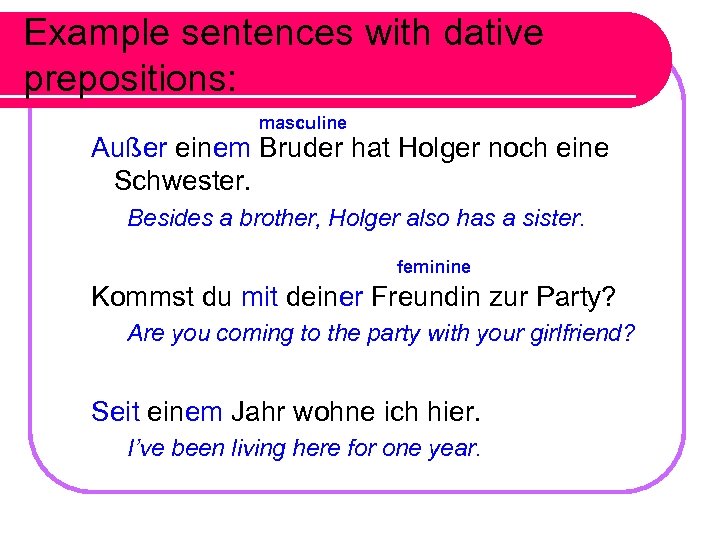 Example sentences with dative prepositions: masculine Außer einem Bruder hat Holger noch eine Schwester. Besides a brother, Holger also has a sister. feminine Kommst du mit deiner Freundin zur Party? Are you coming to the party with your girlfriend? Seit einem Jahr wohne ich hier. I’ve been living here for one year.
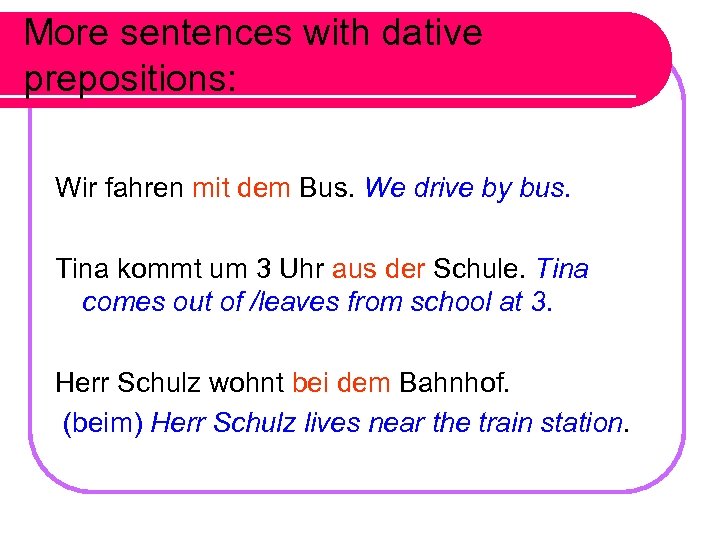 More sentences with dative prepositions: Wir fahren mit dem Bus. We drive by bus. Tina kommt um 3 Uhr aus der Schule. Tina comes out of /leaves from school at 3. Herr Schulz wohnt bei dem Bahnhof. (beim) Herr Schulz lives near the train station.
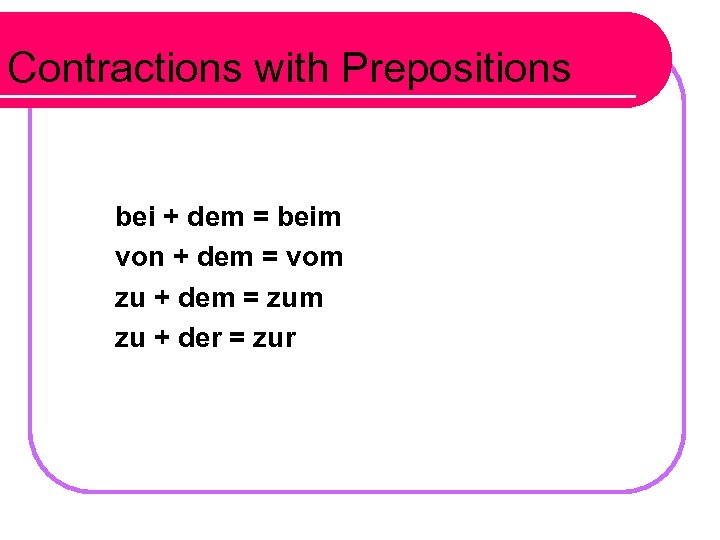 Contractions with Prepositions bei + dem = beim von + dem = vom zu + dem = zum zu + der = zur
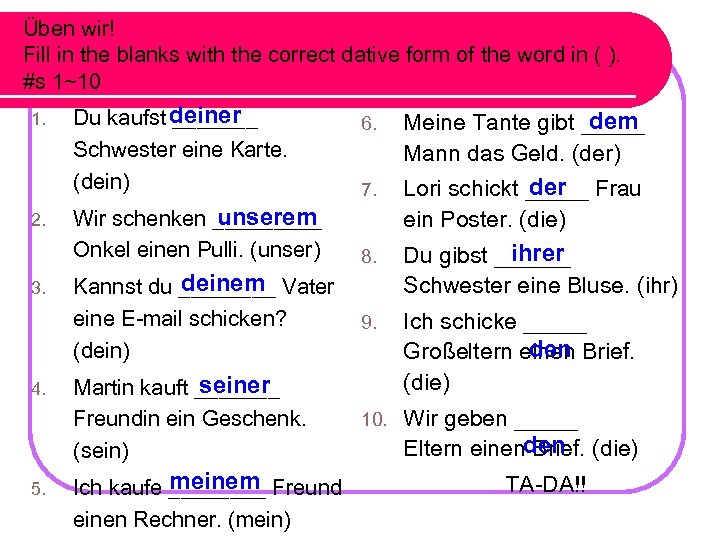 Üben wir! Fill in the blanks with the correct dative form of the word in ( ). #s 1~10 1. 2. 3. 4. 5. Du kaufst deiner _______ Schwester eine Karte. (dein) unserem Wir schenken _____ Onkel einen Pulli. (unser) 6. 7. 8. dem Meine Tante gibt _____ Mann das Geld. (der) der Lori schickt _____ Frau ein Poster. (die) ihrer Du gibst ______ Schwester eine Bluse. (ihr) deinem Kannst du ____ Vater eine E-mail schicken? (dein) 9. seiner Martin kauft _______ Freundin ein Geschenk. (sein) Ich schicke _____ den Großeltern einen Brief. (die) 10. Wir geben _____ Eltern einenden (die) Brief. meinem Ich kaufe ____ Freund einen Rechner. (mein) TA-DA!!
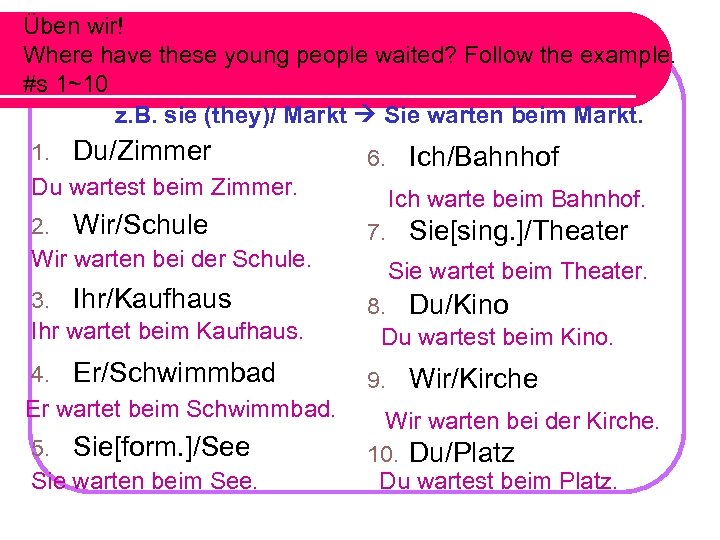 Üben wir! Where have these young people waited? Follow the example. #s 1~10 z. B. sie (they)/ Markt Sie warten beim Markt. 1. Du/Zimmer 6. Du wartest beim Zimmer. Ich/Bahnhof Ich warte beim Bahnhof. 2. Wir/Schule Wir warten bei der Schule. 7. 3. Ihr/Kaufhaus Ihr wartet beim Kaufhaus. 8. Du/Kino Du wartest beim Kino. 4. Er/Schwimmbad Er wartet beim Schwimmbad. 5. Sie[form. ]/See Sie warten beim See. Sie[sing. ]/Theater Sie wartet beim Theater. 9. Wir/Kirche Wir warten bei der Kirche. 10. Du/Platz Du wartest beim Platz.
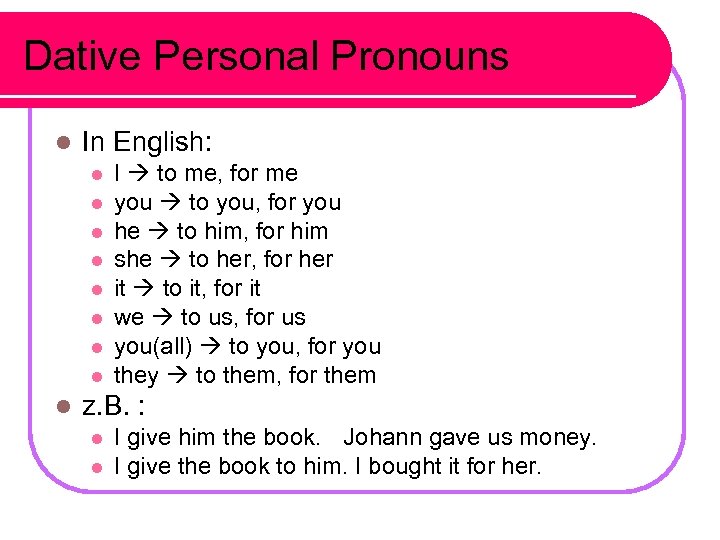 Dative Personal Pronouns l In English: l l l l l I to me, for me you to you, for you he to him, for him she to her, for her it to it, for it we to us, for us you(all) to you, for you they to them, for them z. B. : l l I give him the book. Johann gave us money. I give the book to him. I bought it for her.
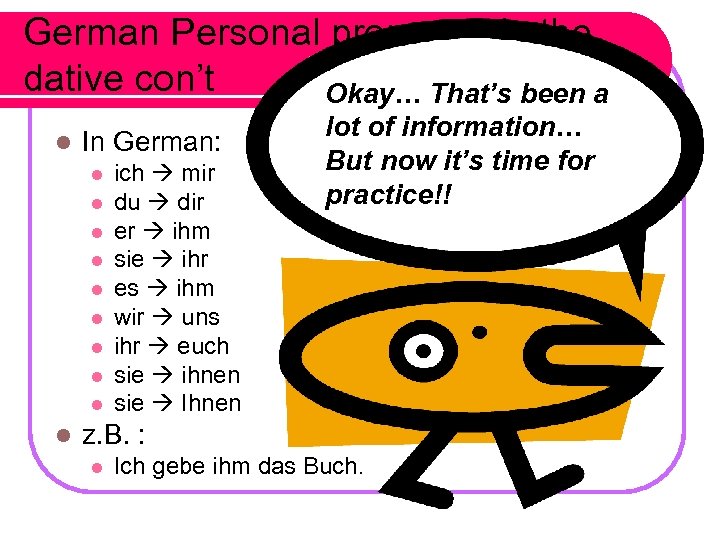 German Personal pronouns in the dative con’t Okay… That’s been a l In German: l l l l l ich mir du dir er ihm sie ihr es ihm wir uns ihr euch sie ihnen sie Ihnen lot of information… But now it’s time for practice!! z. B. : l Ich gebe ihm das Buch.