 Скачать презентацию The Crucible First — What is a
1e8847f807d82a5ed1e59660c3e087f7.ppt
- Количество слайдов: 37



The Crucible
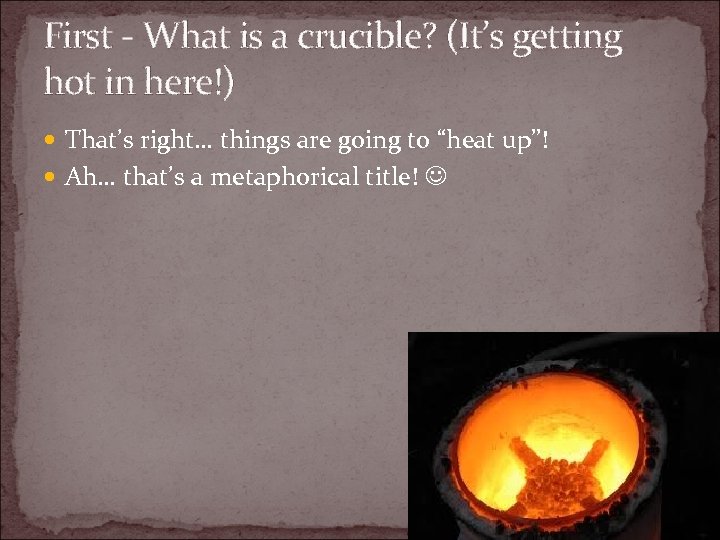
First - What is a crucible? (It’s getting hot in here!) That’s right… things are going to “heat up”! Ah… that’s a metaphorical title!
Allegory A work with TWO levels of meaning – literal and symbolic. Purpose may be to convey truths about real life or teach a lesson or point out injustice. So means one thing literally, symbolizes something else. Ever see Avatar? Xmen? The Matrix?
What’s the Scenario 6 groups – 3 scenarios, 1 a, 1 b, 2 a, 2 b, 3 a, 3 b Step one: write your opinion/respond on your own. You have 10 minutes. Step two: Get with your group and discuss your decisions. You will present your answers to the rest of the class.
Roles 1. Manager – keep everyone on task 2. Timekeeper – keep an eye on the clock 3. Record Keeper – write down the variety of answers 4. Speaker – will present to the class 5. Bouncer – keep the discussions civil 6. Equalizer (make sure everyone talks, no 1 person dominates!) (COMBINE ROLES IF NEEDED – write names of group members and roles on your record keeper’s notes!)
Mob mentality What is “mob mentality”? What are some examples you can think of? What fuels a mob? Please tell me you’ve seen Monty Python and the Holy Grail
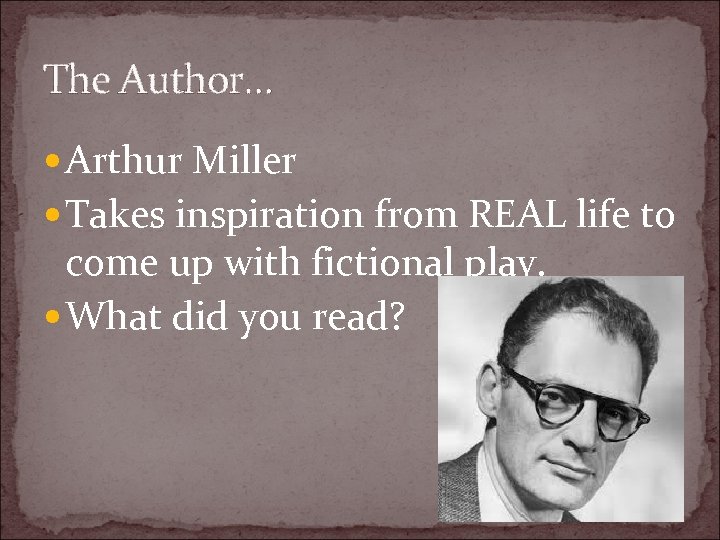
The Author… Arthur Miller Takes inspiration from REAL life to come up with fictional play. What did you read?
Mc. Carthyism (video) Senator Joseph Mc. Carthy (Wisconsin) was a U. S. Senator from 1946 -1957 (when he died). He burst on the scene in 1950, stating Communists worked in the State Dept. During the next 3 years, he charged many with subversive activities and labeled them “Communists”. Many equated it to a witch hunt.
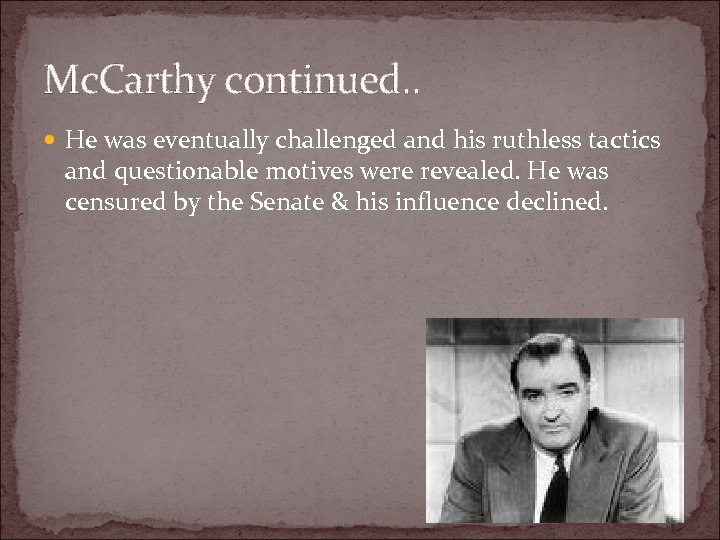
Mc. Carthy continued. . He was eventually challenged and his ruthless tactics and questionable motives were revealed. He was censured by the Senate & his influence declined.
Mc. Carthyism Mc. Carthyism: the practice of making accusations of disloyalty, especially of pro-Communist activity, in many instances unsupported by proof or based on slight, doubtful, or irrelevant evidence.
Communism Communism: A system of social organization in which all economic and social activity is controlled by a totalitarian state, dominated by a single & self-perpetuating political party.
Cold War… Cold War: A state of political tension that stops short of full-scale war. Rivalry after World War II between the Soviet Union and its satellites and the democratic countries of the Western world, under the leadership of the U. S.
Color Terminology A Red: Communist Red Scare: Widespread fears of Communist influence on U. S. society and Communist infiltration of the U. S. government Blacklisted: A list of persons or organizations that have incurred disapproval or suspicion or are to be boycotted or otherwise penalized. Yellow: cowardly Pinko: Communist sympathizer
Reading DRAMA (it ain’t just for yo’ mama!) Subtext (ya know. . Those directions? ) Those are important to your reading and comprehension. Don’t skip over! Draw a picture of the characters in your head. This is why you hear “The book was soooo much better than the movie!”
Drama elements Review: protagonist/antagonist Tragedy/comedy Exposition/rising action/climax/falling action/resolution Monologue: long speech by a single character to audience or another char. Soliloquy: reflective speech where character speaks his/her private thoughts aloud, but other char’s don’t hear it. (Shakespeare!)
More! Aside: short speech or comment that is delivered by a character to the audience but is not heard by the other char’s who are present. Motivation is key in drama – what motivates the character’s behavior. Think of yourself, in that person’s body, in that period of time and try to understand what makes a character do what he/she does. Think: what’s motivating ppl in Crucible?
Setting Conditions in Salem, MA Fear Real: Native Americans Elements, lots of death 50% birth mortality rate. Hard Work: harsh weather, disease Other settlers: being killed by others for religious reasons
Conditions in Salem, Mass. Cont’d IMAGINARY: Ghosts Devil Witches All are used to explain the “unexplained” (How is Mrs. Putnam the best example of this? )
Puritanism Hard-fisted rule Severe punishments (including corporal punishment) Lead a “pure” life – no dancing, drinking Abide by the 10 Commandments
Town of Salem Isolated Bordered by forest Only about 40 years old in 1692 (new) No books, little education Many lost relatives to “heathens” (N. Am’s) Separated from Jamestown for religious independence. Ships out products of value
Before Act I Focus on the characters – who is motivated by WHAT? Jot down what you know about the characters, details in your notes and study guides as we move through the play. Proctor vs. Parris Putnam vs. Proctor Ann Putnam vs. Rebecca Nurse Proctor vs. Abigail Elizabeth vs. Proctor
Act I How do you see the beginnings of hysteria? What fuels a mob? Please tell me you’ve seen Monty Python and the Holy Grail
Act I (after reading/viewing) What conclusions can you draw about Abigail’s character? How are the neighbors getting along in this town? Who’s got “beef” with whom? Rev. Parris – describe him. Why hesitant to say “witchcraft”? Who is Tituba? Why do they blame her? What is a scapegoat? Who is Rev. Hale?
Continued… How does Abigail react to John calling her a child? (FYI – watch how Abigail acts depending on who is there/situation) Why does John not go to church? Who is Rebecca Nurse? Giles Corey? What’s Rebecca’s take on the girls’ sickness?
Motivations What motivates these characters to behave how they do? Rev. Parris? Abigail? Hale? Mr. Putnam? Mrs. Putnam? (first mentions witchcraft!!!!) Betty and Ruth?
SKIP to next“Why I Wrote The Crucible” CHOICE: Read alone or with a partner or with your table (yes, you can move around the room). Question to Consider: What influence did Mc. Carthy and the Red Scare have on Arthur Miller and his writings? What is a red herring? (Look up!) Be ready to reconvene for a Focus Q in 10 -15 minutes.
Instead. . Read 217 -219 about Mc. Carthyism & Miller CHOICE: Read alone or with a partner or with your table (yes, you can move around the room). Question to Consider: What influence did Mc. Carthy and the Red Scare have on Arthur Miller and his writings? What is a red herring? (Look up!)
From Nizkorproject. org Description of Red Herring Topic A is under discussion. Topic B is introduced under the guise of being relevant to topic A (when topic B is actually not relevant to topic A). Topic A is abandoned. The student dress code is strict, but because there are so many other discipline issues, we should abandon dress code
After reading/viewing Act II Should Elizabeth forgive John for his affair? I mean, it’s been 7 months! What do the people in town think of Abigail? Allusion – “…where she walks the crowd will part like the sea for Israel” p. 166 How does power affect Mary Warren? Why is John Proctor hesitant to testify in court about Abigail’s private admission that the girls’ sickness had nothing to do with witchcraft?
More Act II What is motivating Mary Warren? Why were Sarah Good & Sarah Osbourne easy targets? Who is Ezekiel Cheever? Why is Hale being so stubborn about believing this fake? Why is John forcing Mary to go to court? How has Abigail taken this to the next level?
Focus Q Is Elizabeth right to continue to mistrust John even though his affair with Abigail has been over for seven months? Or is John right in believing that by now Elizabeth should have forgiven and forgotten his affair with Abigail and come to trust him again? Choose to support either Elizabeth’s or John’s viewpoint in your answer. Answer Plan: 1. Restate the question into a topic sentence, taking a position. 2. Cite TWO reasons, backing up reasoning with textual evidence from the play. 3. Conclude your paragraph by not merely repeating information.
After Act III Judge Hathorne (FYI. . American writer Nathaniel Hawthorne was a descendent). Why does Francis Nurse fear he has brought trouble to the 91 people who signed their names to the document presented in court? What problems does Mary Warren’s testimony create for the court? What change are you seeing in Rev. Hale?
After Act III continued… Why is Giles Corey in contempt of court? Why does John Proctor say “God is dead”? The real Abigail was 11 or 12 years old in 1692 and no evidence of an affair (ew!). Why did Arthur Miller put this in? How would the play be different?
Focus Q Why did John Proctor disclose his affair with Abigail? Answer Plan 1. Restate the question. 2. Write a number of sentences that detail what John hoped to achieve by disclosing the affair. 3. Conclude by giving your opinion of his decision.
After Act IV The beginning is different from the movie: see the jail. Why are the women acting this way? The scene w/John in jail did not happen in the play. What became of Abigail? Both Parris and Hale ask Danforth to postpone the executions, but their reasons for wanting a postponement are vastly different. What motivates each one?
After Act IV After the shift in “evidence”, why does Danforth STILL not stay the executions? John will confess, but what will he NOT do? Why? What are themes in the play?
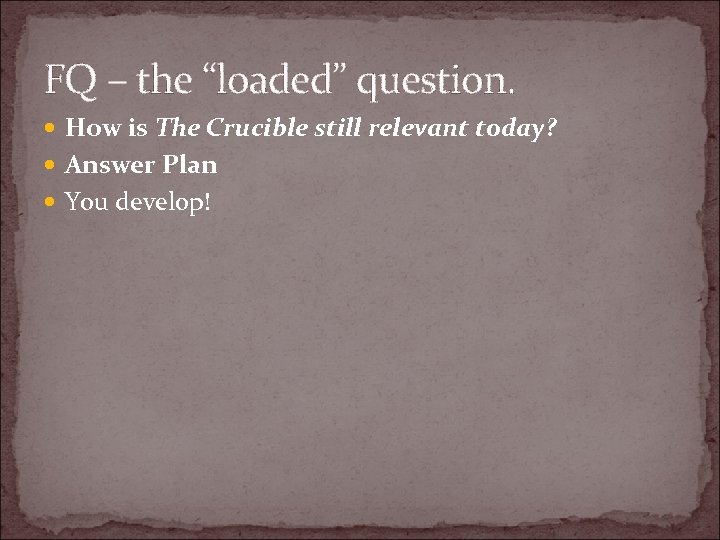
FQ – the “loaded” question. How is The Crucible still relevant today? Answer Plan You develop!
Скачать презентацию The Crucible First — What is a
1e8847f807d82a5ed1e59660c3e087f7.ppt