


 Скачать презентацию The Crisis of IT Leadership Vincent Milich Director
cc4c326915b2683267380fc4efa8aecf.ppt
- Количество слайдов: 24
 The Crisis of IT Leadership Vincent Milich Director, IT Effectiveness (201) 557 -8418 Vincent_milich@haygroup. com April 5, 2005 SM
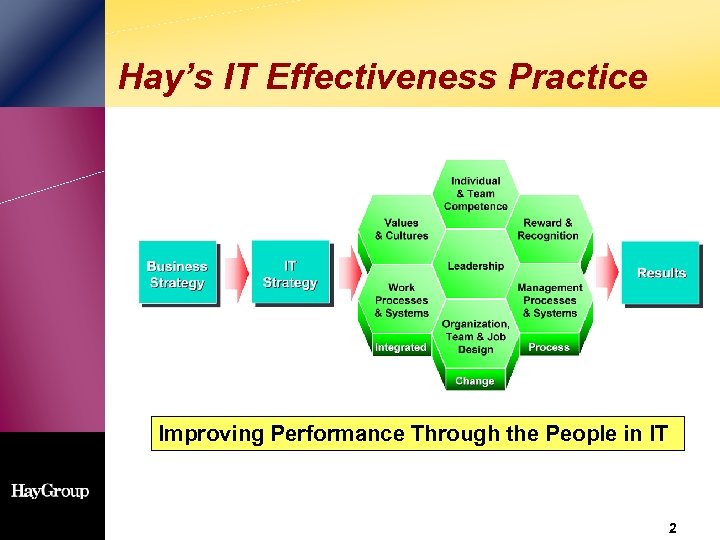 Hay’s IT Effectiveness Practice Improving Performance Through the People in IT 2
 Why Leadership? Survey Conducted with 20 CIOs n What are the greatest skills/knowledge gaps in your IT organization today? Ø Ø Ø Knowledge of the business Project management skills People management skills Technical skills Customer relationship management skills Other 3
 Why Leadership? Survey Conducted with 20 CIOs 1. 2. Project management skills People management skills Ø 60% of respondents named these as 1 -2 4
 Why is There a Lack of Leadership in IT? n Self – Selection n Not in my “Sweet Spot” n Not the Focus of Development in IT n Not Rewarded – Promoted Based on Technical Expertise n Overall Shortage 5
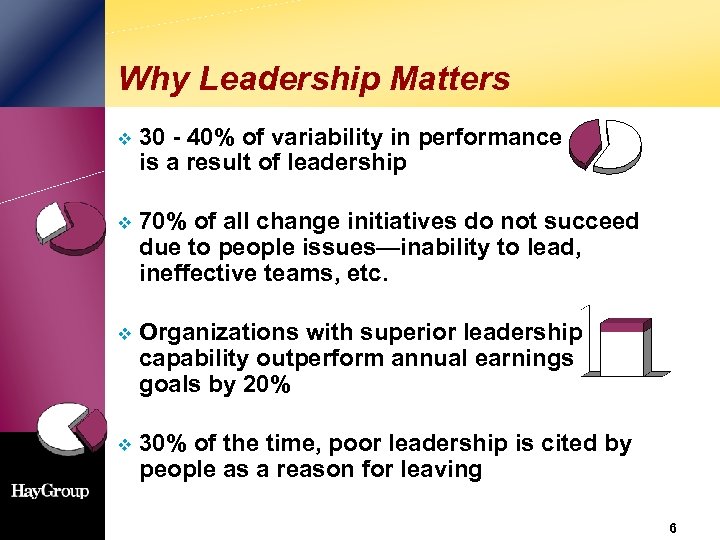 Why Leadership Matters v 30 - 40% of variability in performance is a result of leadership v 70% of all change initiatives do not succeed due to people issues—inability to lead, ineffective teams, etc. v Organizations with superior leadership capability outperform annual earnings goals by 20% v 30% of the time, poor leadership is cited by people as a reason for leaving 6
 What Differentiates Effective Leaders? EMOTIONAL INTELLIGENCE, as defined by our colleague and best selling author, Dan Goleman, is the ability of an individual to: Ø Manage themselves effectively when under stress and/or dealing with ambiguous circumstances; to remain calm and stay focused Ø Be intensely in touch with what the people they lead are thinking and feeling in order to motivate and energize them Ø Act in ways that leave those people, their customers, and their business partners feeling stronger and more capable 7
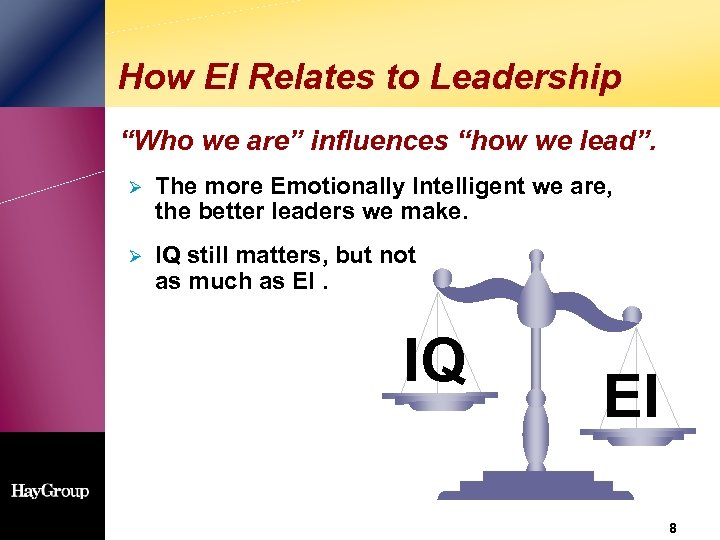 How EI Relates to Leadership “Who we are” influences “how we lead”. Ø The more Emotionally Intelligent we are, the better leaders we make. Ø IQ still matters, but not as much as EI. IQ EI 8
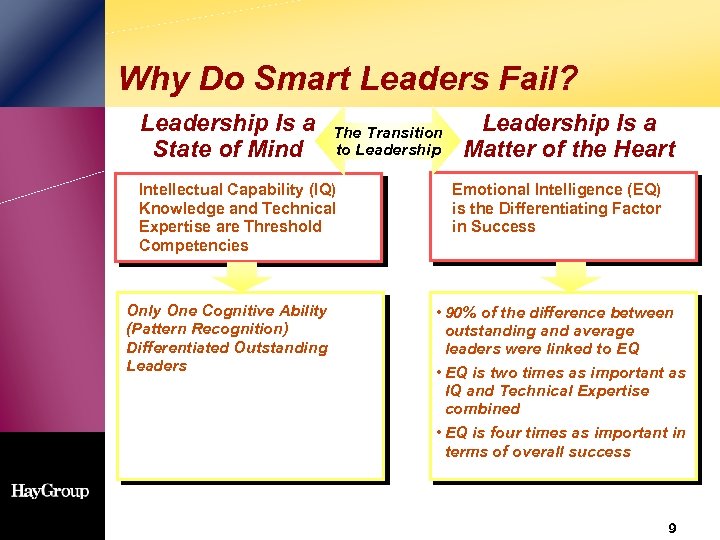 Why Do Smart Leaders Fail? Leadership Is a State of Mind The Transition to Leadership Intellectual Capability (IQ) Knowledge and Technical Expertise are Threshold Competencies Only One Cognitive Ability (Pattern Recognition) Differentiated Outstanding Leadership Is a Matter of the Heart Emotional Intelligence (EQ) is the Differentiating Factor in Success • 90% of the difference between outstanding and average leaders were linked to EQ • EQ is two times as important as IQ and Technical Expertise combined • EQ is four times as important in terms of overall success 9
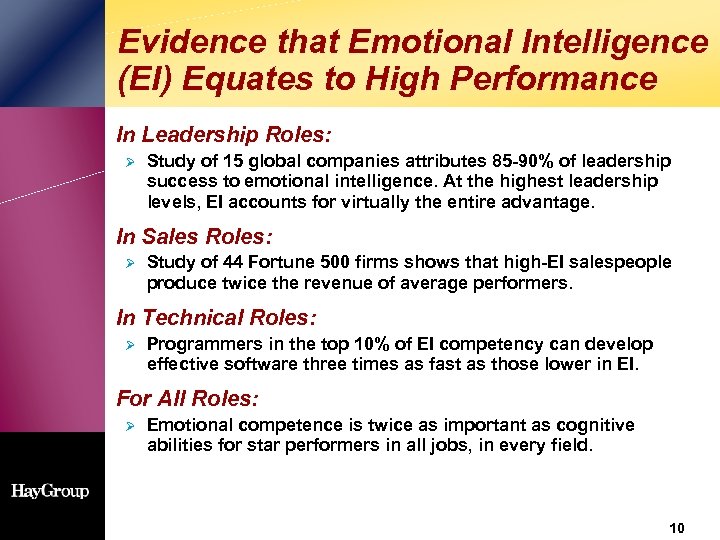 Evidence that Emotional Intelligence (EI) Equates to High Performance In Leadership Roles: Ø Study of 15 global companies attributes 85 -90% of leadership success to emotional intelligence. At the highest leadership levels, EI accounts for virtually the entire advantage. In Sales Roles: Ø Study of 44 Fortune 500 firms shows that high-EI salespeople produce twice the revenue of average performers. In Technical Roles: Ø Programmers in the top 10% of EI competency can develop effective software three times as fast as those lower in EI. For All Roles: Ø Emotional competence is twice as important as cognitive abilities for star performers in all jobs, in every field. 10
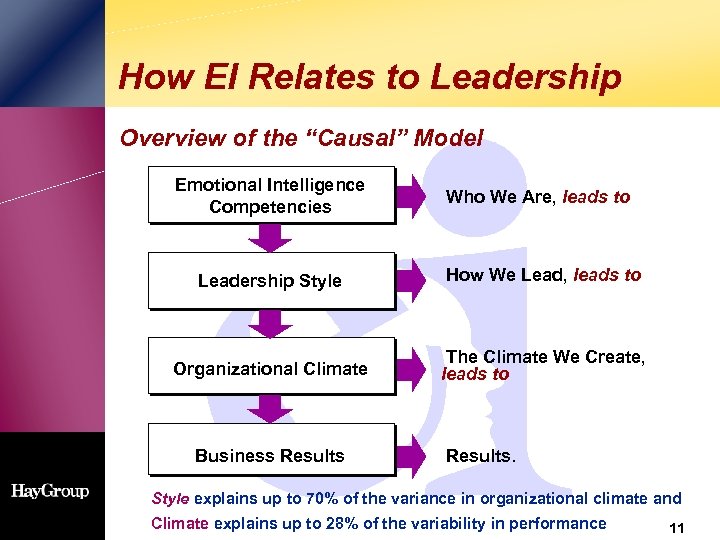 How EI Relates to Leadership Overview of the “Causal” Model Emotional Intelligence Competencies Who We Are, leads to Leadership Style How We Lead, leads to Organizational Climate The Climate We Create, leads to Business Results. Style explains up to 70% of the variance in organizational climate and Climate explains up to 28% of the variability in performance 11
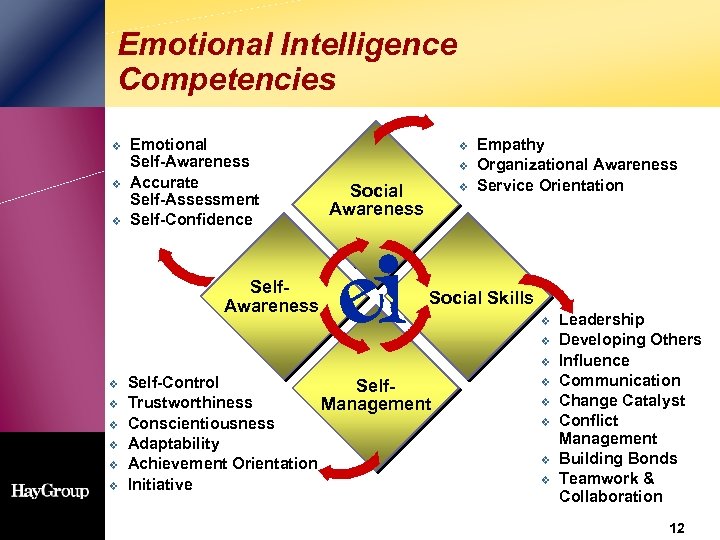 Emotional Intelligence Competencies v v v Emotional Self-Awareness Accurate Self-Assessment Self-Confidence Self. Awareness v v Social Awareness v Empathy Organizational Awareness Service Orientation Social Skills v v v v v Self-Control Self. Trustworthiness Management Conscientiousness Adaptability Achievement Orientation Initiative v v v Leadership Developing Others Influence Communication Change Catalyst Conflict Management Building Bonds Teamwork & Collaboration 12
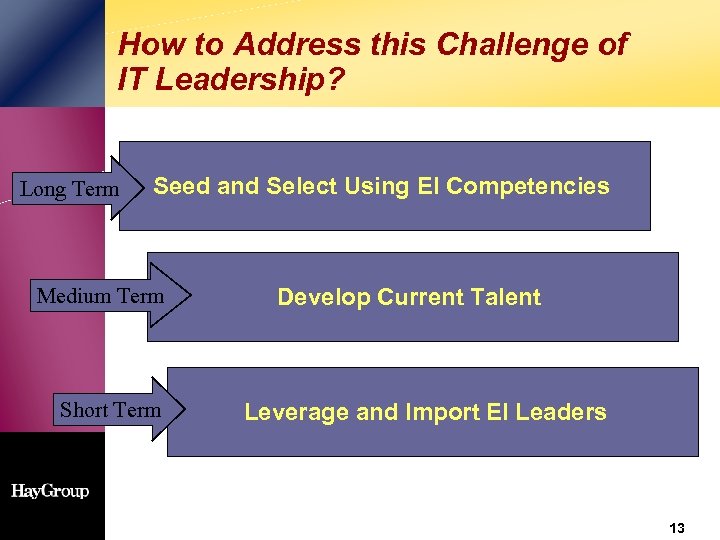 How to Address this Challenge of IT Leadership? Long Term Seed and Select Using EI Competencies Medium Term Short Term Develop Current Talent Leverage and Import EI Leaders 13
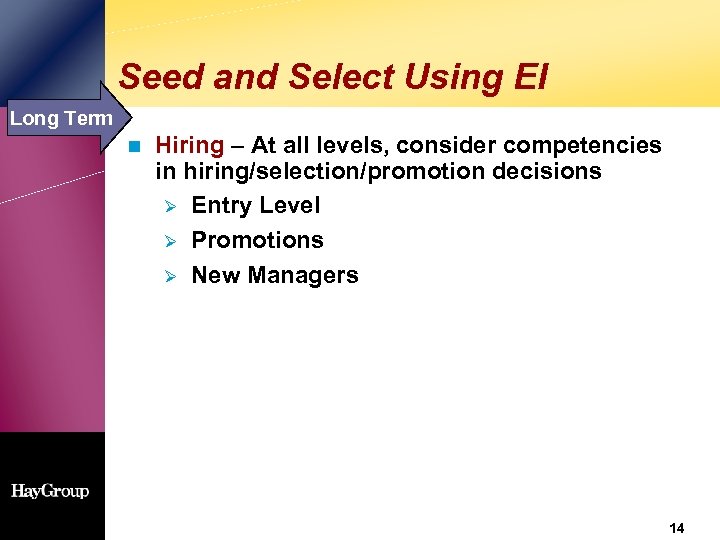 Seed and Select Using EI Long Term n Hiring – At all levels, consider competencies in hiring/selection/promotion decisions Ø Entry Level Ø Promotions Ø New Managers 14
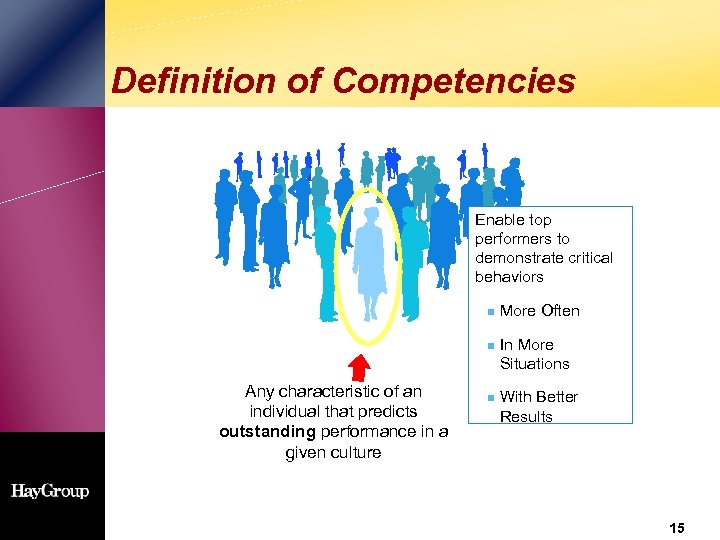 Definition of Competencies Enable top performers to demonstrate critical behaviors n n Any characteristic of an individual that predicts outstanding performance in a given culture n More Often In More Situations With Better Results 15
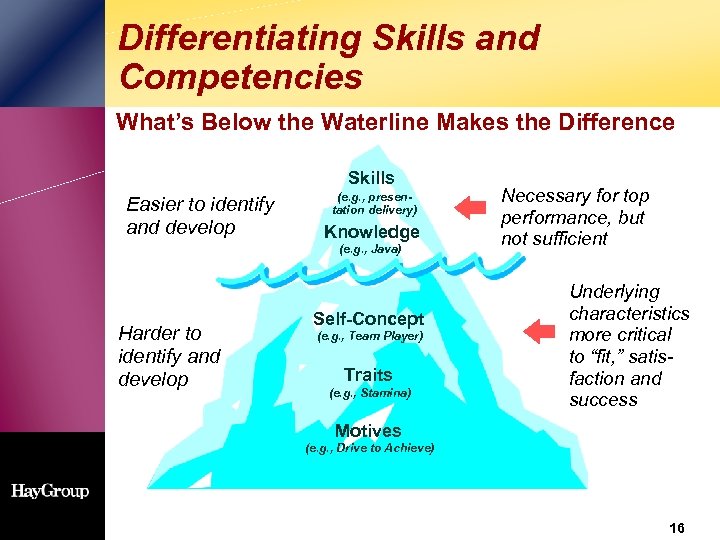 Differentiating Skills and Competencies What’s Below the Waterline Makes the Difference Skills Easier to identify and develop (e. g. , presentation delivery) Knowledge (e. g. , Java) Harder to identify and develop Self-Concept (e. g. , Team Player) Traits (e. g. , Stamina) Necessary for top performance, but not sufficient Underlying characteristics more critical to “fit, ” satisfaction and success Motives (e. g. , Drive to Achieve) 16
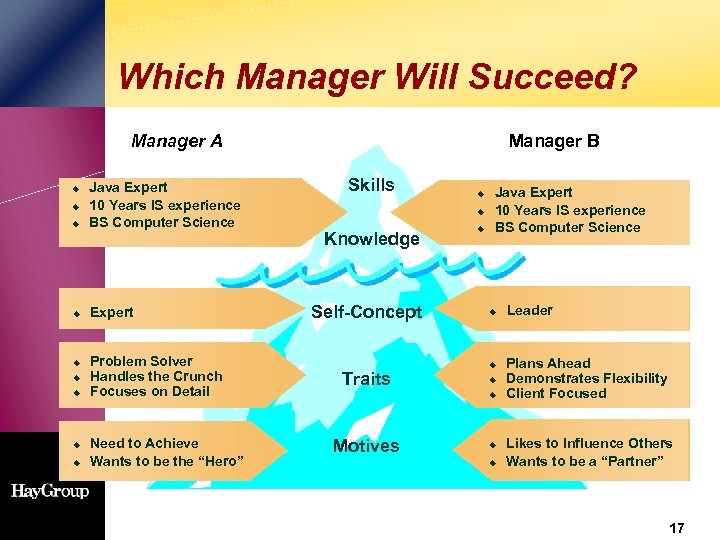 Which Manager Will Succeed? Manager A u Java Expert 10 Years IS experience BS Computer Science u Expert u u u u Problem Solver Handles the Crunch Focuses on Detail Need to Achieve Wants to be the “Hero” Manager B Skills u u Knowledge Self-Concept Traits u Java Expert 10 Years IS experience BS Computer Science u u Motives u u Leader Plans Ahead Demonstrates Flexibility Client Focused Likes to Influence Others Wants to be a “Partner” 17
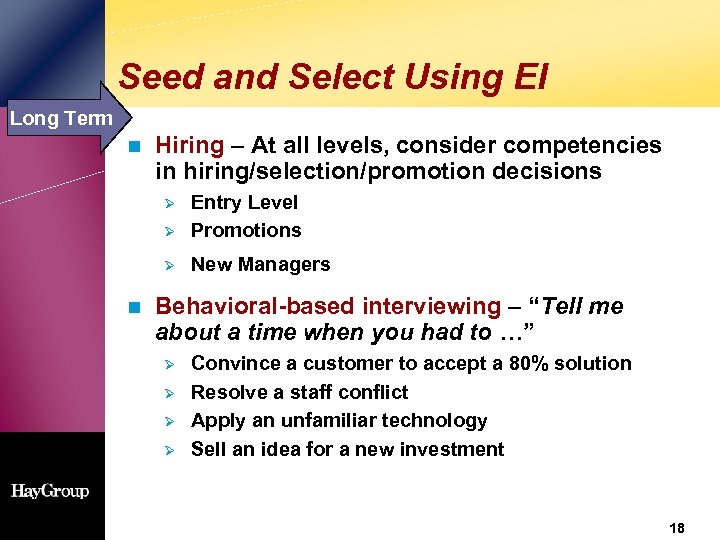 Seed and Select Using EI Long Term n Hiring – At all levels, consider competencies in hiring/selection/promotion decisions Ø Entry Level Promotions Ø New Managers Ø n Behavioral-based interviewing – “Tell me about a time when you had to …” Ø Ø Convince a customer to accept a 80% solution Resolve a staff conflict Apply an unfamiliar technology Sell an idea for a new investment 18
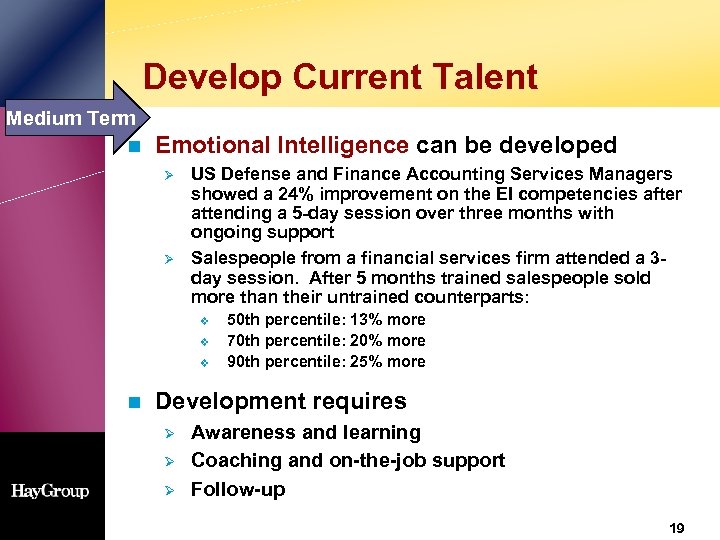 Develop Current Talent Medium Term n Emotional Intelligence can be developed Ø Ø US Defense and Finance Accounting Services Managers showed a 24% improvement on the EI competencies after attending a 5 -day session over three months with ongoing support Salespeople from a financial services firm attended a 3 day session. After 5 months trained salespeople sold more than their untrained counterparts: v v v n 50 th percentile: 13% more 70 th percentile: 20% more 90 th percentile: 25% more Development requires Ø Ø Ø Awareness and learning Coaching and on-the-job support Follow-up 19
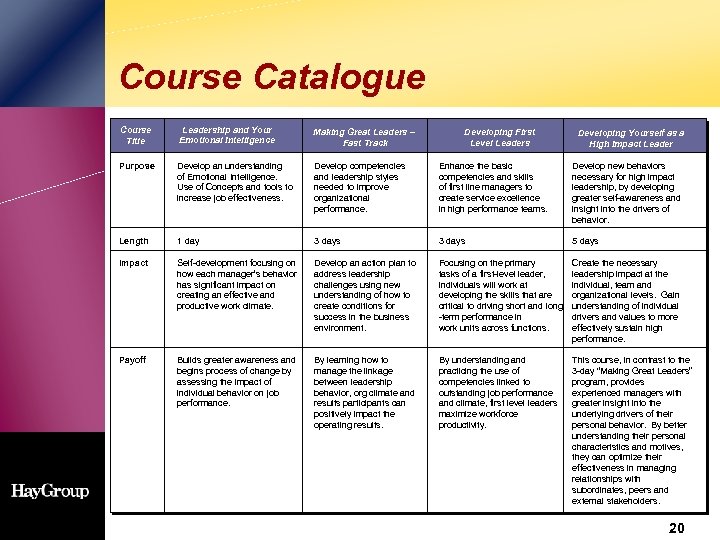 Course Catalogue Course Title Leadership and Your Emotional Intelligence Making Great Leaders – Fast Track Purpose Develop an understanding of Emotional Intelligence. Use of Concepts and tools to increase job effectiveness. Develop competencies and leadership styles needed to improve organizational performance. Enhance the basic competencies and skills of first line managers to create service excellence in high performance teams. Develop new behaviors necessary for high impact leadership, by developing greater self-awareness and insight into the drivers of behavior. Length 1 day 3 days 5 days Impact Self-development focusing on how each manager’s behavior has significant impact on creating an effective and productive work climate. Develop an action plan to address leadership challenges using new understanding of how to create conditions for success in the business environment. Focusing on the primary tasks of a first-level leader, individuals will work at developing the skills that are critical to driving short and long -term performance in work units across functions. Create the necessary leadership impact at the individual, team and organizational levels. Gain understanding of individual drivers and values to more effectively sustain high performance. Payoff Builds greater awareness and begins process of change by assessing the impact of individual behavior on job performance. By learning how to manage the linkage between leadership behavior, org climate and results participants can positively impact the operating results. By understanding and practicing the use of competencies linked to outstanding job performance and climate, first level leaders maximize workforce productivity. This course, in contrast to the 3 -day “Making Great Leaders” program, provides experienced managers with greater insight into the underlying drivers of their personal behavior. By better understanding their personal characteristics and motives, they can optimize their effectiveness in managing relationships with subordinates, peers and external stakeholders. Developing First Level Leaders Developing Yourself as a High Impact Leader 20
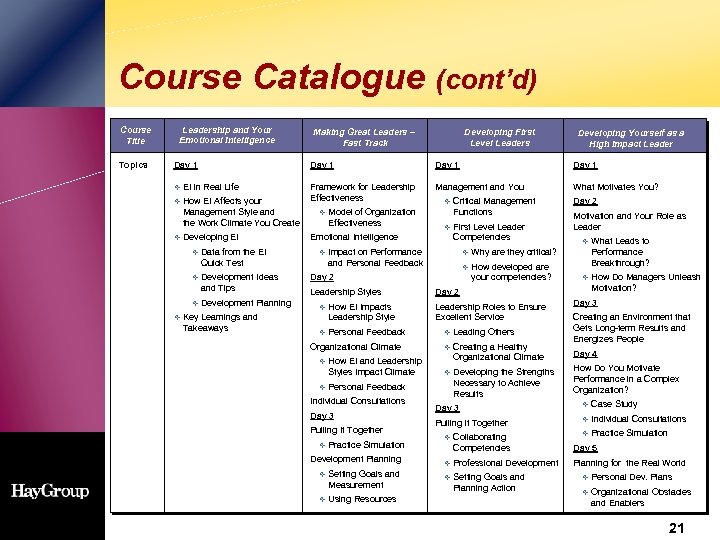 Course Catalogue (cont’d) Course Title Topics Leadership and Your Emotional Intelligence Day 1 EI in Real Life v How EI Affects your Management Style and the Work Climate You Create Developing EI v Data from the EI Quick Test v Development Ideas and Tips v v Developing First Level Leaders Developing Yourself as a High Impact Leader Day 1 v v Making Great Leaders – Fast Track Development Planning Key Learnings and Takeaways Day 1 Framework for Leadership Effectiveness Management and You What Motivates You? v Model of Organization Effectiveness v Critical Management Functions v First Level Leader Competencies Emotional Intelligence v Impact on Performance and Personal Feedback v Leadership Styles v How EI Impacts Leadership Style v Personal Feedback Organizational Climate v v How EI and Leadership Styles Impact Climate Day 3 Pulling It Together v Practice Simulation Development Planning v v Setting Goals and Measurement Using Resources v What Leads to Performance Breakthrough? v How Do Managers Unleash Motivation? Day 2 Leadership Roles to Ensure Excellent Service v Leading Others v Creating a Healthy Organizational Climate v Developing the Strengths Necessary to Achieve Results Personal Feedback Individual Consultations How developed are your competencies? Motivation and Your Role as Leader Why are they critical? v Day 2 Day 3 Creating an Environment that Gets Long-term Results and Energizes People Day 4 How Do You Motivate Performance in a Complex Organization? Day 3 v Case Study Pulling it Together v Individual Consultations v Practice Simulation Collaborating Competencies Day 5 v Professional Development Planning for the Real World v Setting Goals and Planning Action v v Personal Dev. Plans v Organizational Obstacles and Enablers 21
 Develop Current Talent Medium Term n Development requires Ø Ø Ø n Awareness and learning Coaching and on-the-job support Follow-up 70% of development happens on the job Ø Training starts the process 22
 Leverage and Import EI Leaders Short Term n Leverage – Identify excellent people leaders and stretch them to their limits Ø Implement a technical career ladder to remove (“un-leverage”) poor people leaders n Promote - Promote into future leadership roles based on EI competencies n Import – Identify talented leaders in non-IT areas and import them to appropriate IT roles, and/or Ø Hire based on the EI competencies for future leadership roles 23
 In Summary … The Crisis of IT Leadership n Address all the options – short, medium and long-term n Think “below the waterline” in all human resource decisions Ø n You can always buy the top of the iceberg skills Value the development of non-technical capabilities 24