



 The Costs of Production Chapter 13 Copyright © 2001 by Harcourt, Inc. All rights reserved. Requests for permission to make copies of any part of the work should be mailed to: Permissions Department, Harcourt College Publishers, 6277 Sea Harbor Drive, Orlando, Florida 32887 -6777.
 The Costs of Production The Law of Supply: u. Firms are willing to produce and sell a greater quantity of a good when the price of the good is high. u. This results in a supply curve that slopes upward. Harcourt, Inc. items and derived items copyright © 2001 by Harcourt, Inc.
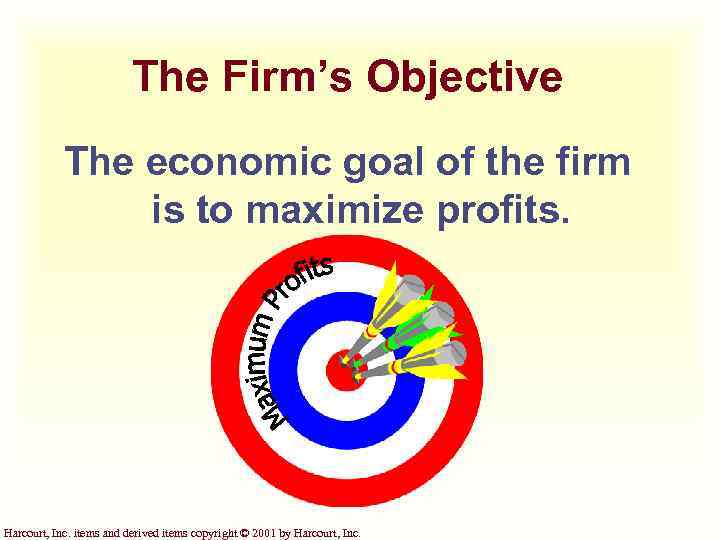 The Firm’s Objective The economic goal of the firm is to maximize profits. Harcourt, Inc. items and derived items copyright © 2001 by Harcourt, Inc.
 A Firm’s Total Revenue and Total Cost u. Total Revenue u The amount that the firm receives for the sale of its output. u. Total Cost u The amount that the firm pays to buy inputs. Harcourt, Inc. items and derived items copyright © 2001 by Harcourt, Inc.
 A Firm’s Profit is the firm’s total revenue minus its total cost. Profit = Total revenue - Total cost Harcourt, Inc. items and derived items copyright © 2001 by Harcourt, Inc.
 Costs as Opportunity Costs A firm’s cost of production includes all the opportunity costs of making its output of goods and services. Harcourt, Inc. items and derived items copyright © 2001 by Harcourt, Inc.
 Explicit and Implicit Costs A firm’s cost of production include explicit costs and implicit costs. u. Explicit costs involve a direct money outlay for factors of production. u. Implicit costs do not involve a direct money outlay. Harcourt, Inc. items and derived items copyright © 2001 by Harcourt, Inc.
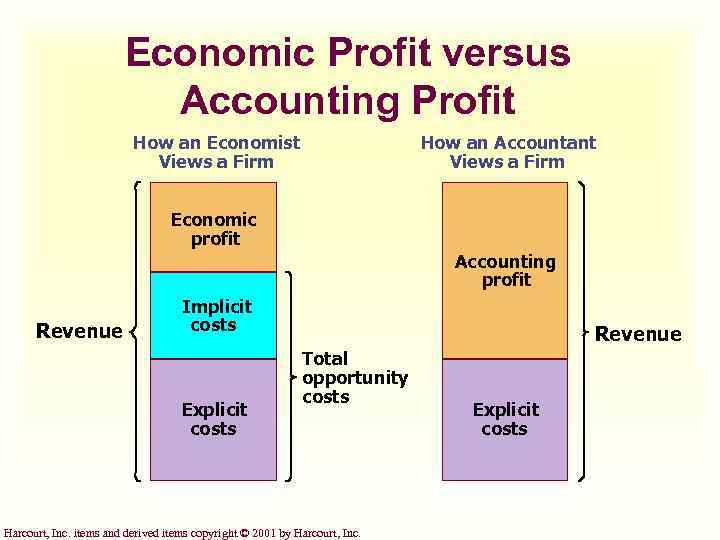
 Economic Profit versus Accounting Profit u Economists measure a firm’s economic profit as total revenue minus all the opportunity costs (explicit and implicit). u Accountants measure the accounting profit as the firm’s total revenue minus only the firm’s explicit costs. In other words, they ignore the implicit costs. Harcourt, Inc. items and derived items copyright © 2001 by Harcourt, Inc.
 Economic Profit versus Accounting Profit u. When total revenue exceeds both explicit and implicit costs, the firm earns economic profit. u Economic profit is smaller than accounting profit. Harcourt, Inc. items and derived items copyright © 2001 by Harcourt, Inc.
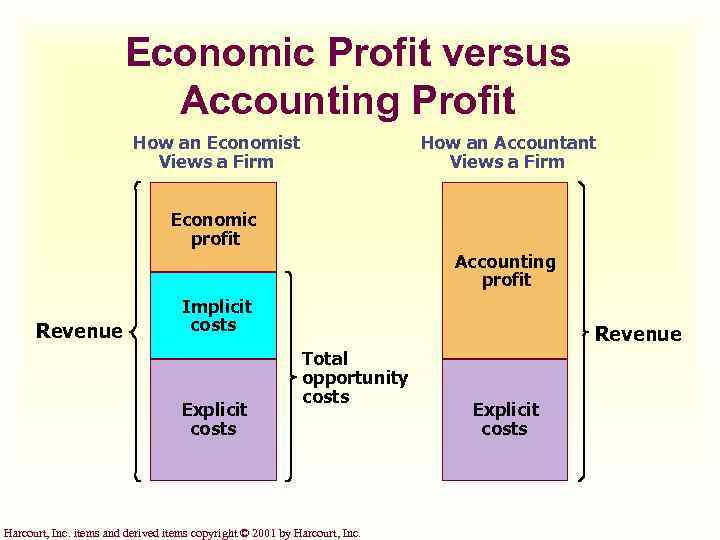 Economic Profit versus Accounting Profit How an Economist Views a Firm How an Accountant Views a Firm Economic profit Accounting profit Revenue Implicit costs Explicit costs Revenue Total opportunity costs Harcourt, Inc. items and derived items copyright © 2001 by Harcourt, Inc. Explicit costs
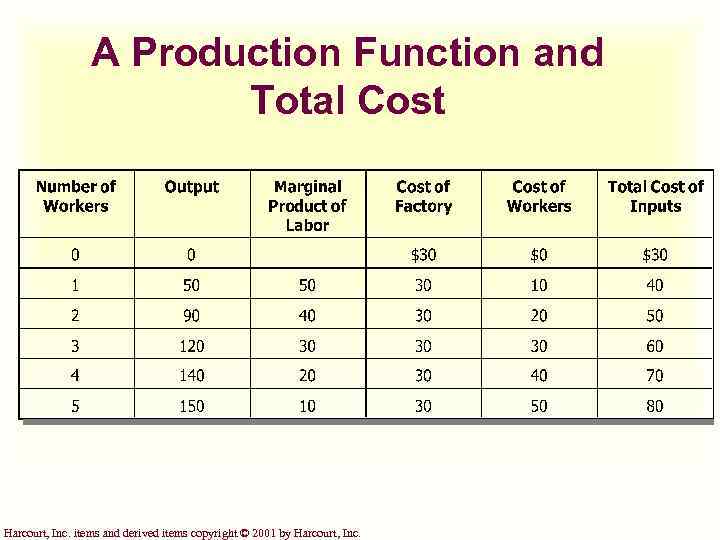 A Production Function and Total Cost Harcourt, Inc. items and derived items copyright © 2001 by Harcourt, Inc.
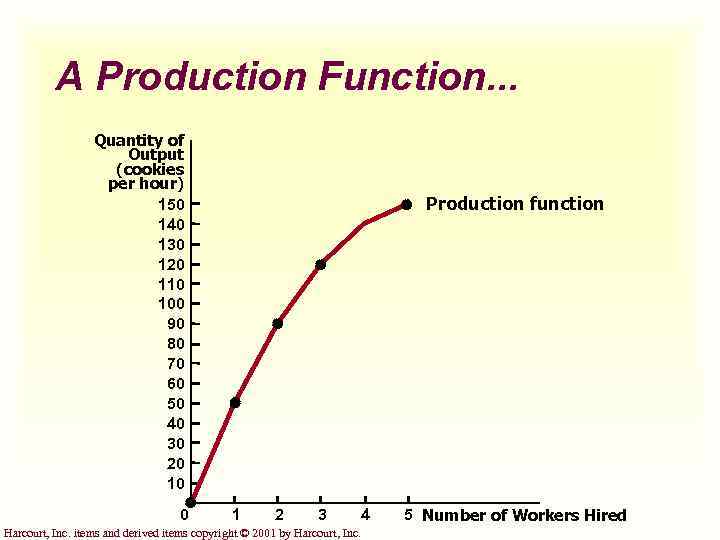
 The Production Function The production function shows the relationship between quantity of inputs used to make a good and the quantity of output of that good. Harcourt, Inc. items and derived items copyright © 2001 by Harcourt, Inc.
 Marginal Product The marginal product of any input in the production process is the increase in the quantity of output obtained from an additional unit of that input. Harcourt, Inc. items and derived items copyright © 2001 by Harcourt, Inc.
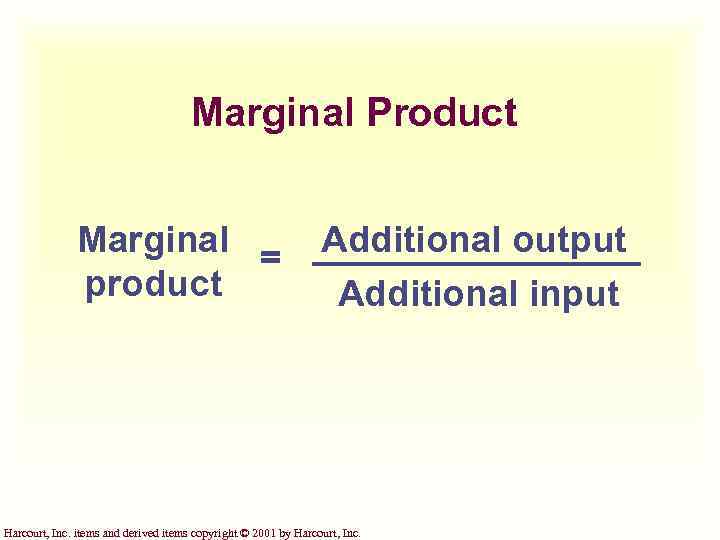 Marginal Product Marginal = product Additional output Additional input Harcourt, Inc. items and derived items copyright © 2001 by Harcourt, Inc.
 Diminishing Marginal Product u. Diminishing marginal product is the property whereby the marginal product of an input declines as the quantity of the input increases. u. Example: As more and more workers are hired at a firm, each additional worker contributes less and less to production because the firm has a limited amount of equipment. Harcourt, Inc. items and derived items copyright © 2001 by Harcourt, Inc.
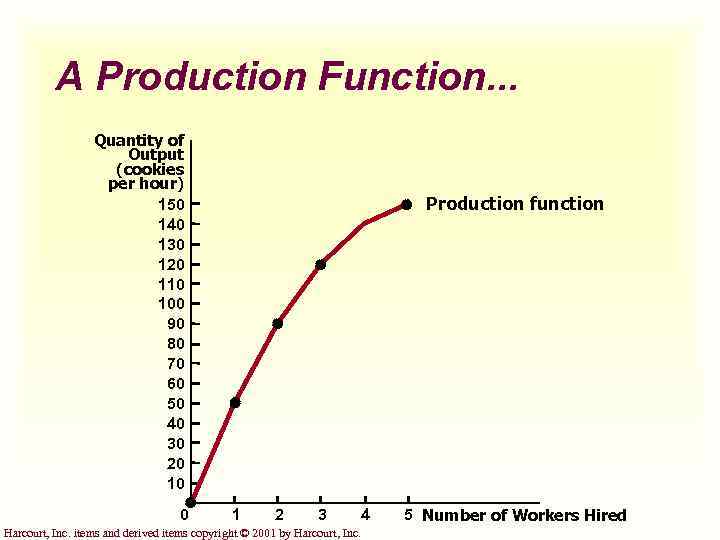 A Production Function. . . Quantity of Output (cookies per hour) 150 140 130 120 110 100 90 80 70 60 50 40 30 20 10 0 Production function 1 2 3 Harcourt, Inc. items and derived items copyright © 2001 by Harcourt, Inc. 4 5 Number of Workers Hired
 Diminishing Marginal Product u. The slope of the production function measures the marginal product of an input, such as a worker. u. When the marginal product declines, the production function becomes flatter. Harcourt, Inc. items and derived items copyright © 2001 by Harcourt, Inc.
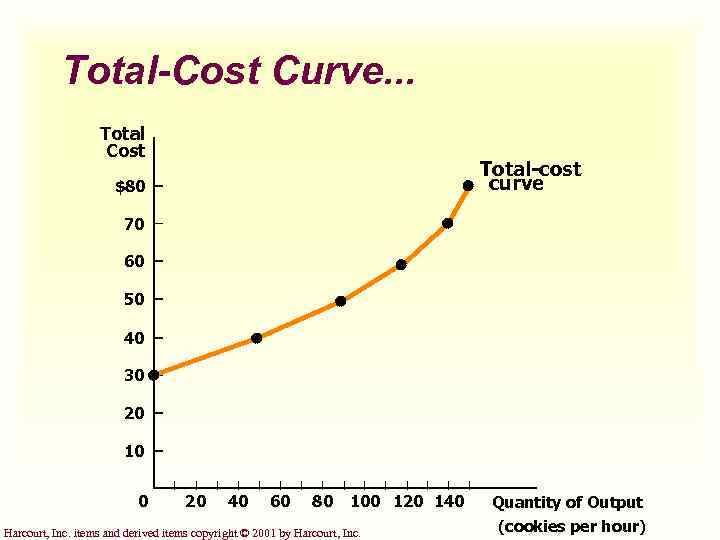
 From the Production Function to the Total-Cost Curve u. The relationship between the quantity a firm can produce and its costs determines pricing decisions. u. The total-cost curve shows this relationship graphically. Harcourt, Inc. items and derived items copyright © 2001 by Harcourt, Inc.
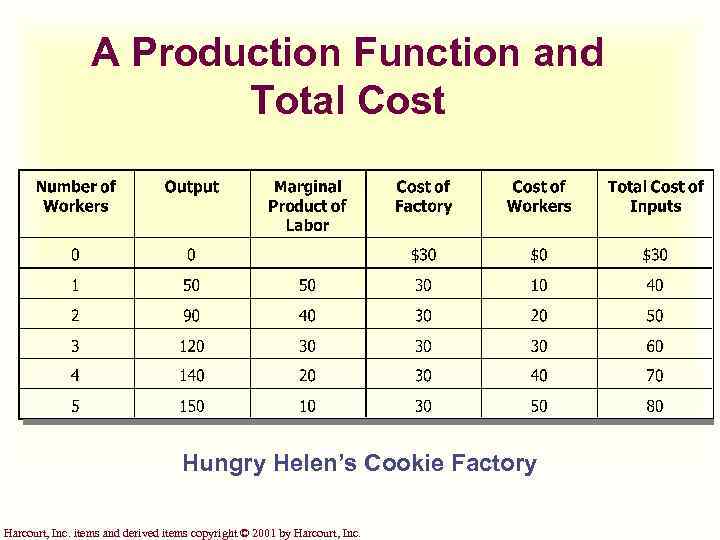 A Production Function and Total Cost Hungry Helen’s Cookie Factory Harcourt, Inc. items and derived items copyright © 2001 by Harcourt, Inc.
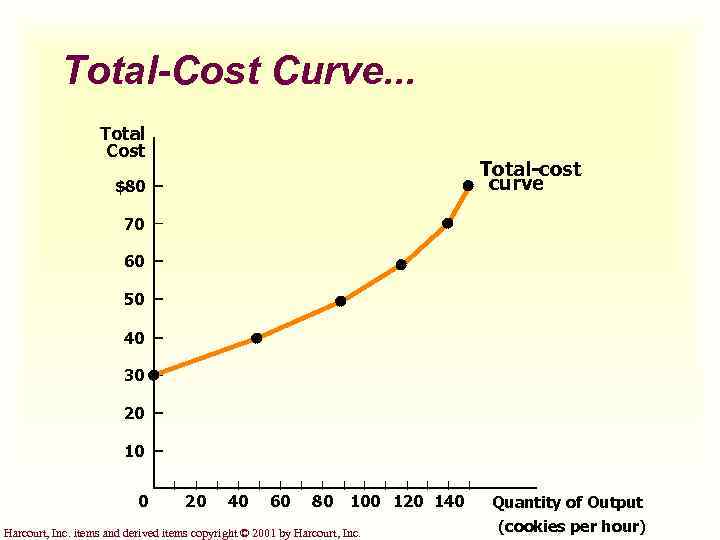 Total-Cost Curve. . . Total Cost Total-cost curve $80 70 60 50 40 30 20 10 0 20 40 60 80 100 120 140 Harcourt, Inc. items and derived items copyright © 2001 by Harcourt, Inc. Quantity of Output (cookies per hour)
 The Various Measures of Costs of production may be divided into fixed costs and variable costs. Harcourt, Inc. items and derived items copyright © 2001 by Harcourt, Inc.
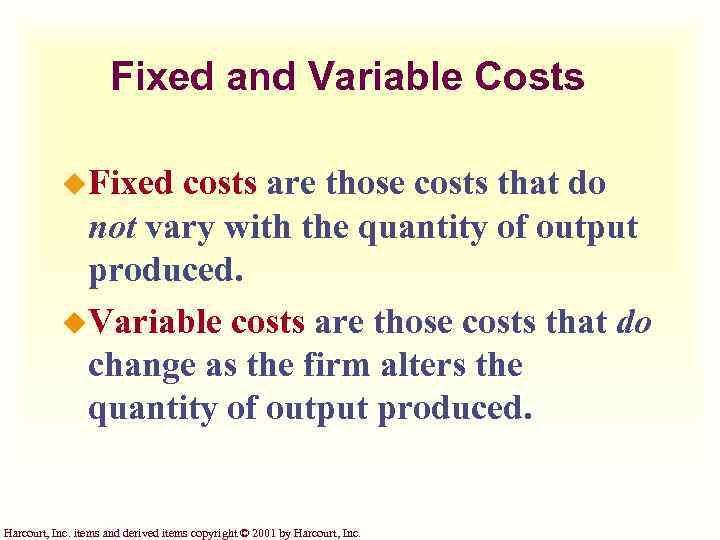 Fixed and Variable Costs u. Fixed costs are those costs that do not vary with the quantity of output produced. u. Variable costs are those costs that do change as the firm alters the quantity of output produced. Harcourt, Inc. items and derived items copyright © 2001 by Harcourt, Inc.
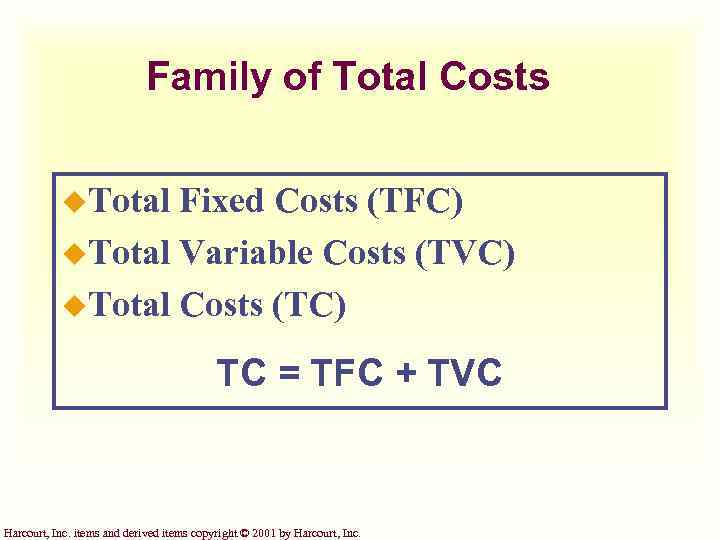 Family of Total Costs u. Total Fixed Costs (TFC) u. Total Variable Costs (TVC) u. Total Costs (TC) TC = TFC + TVC Harcourt, Inc. items and derived items copyright © 2001 by Harcourt, Inc.
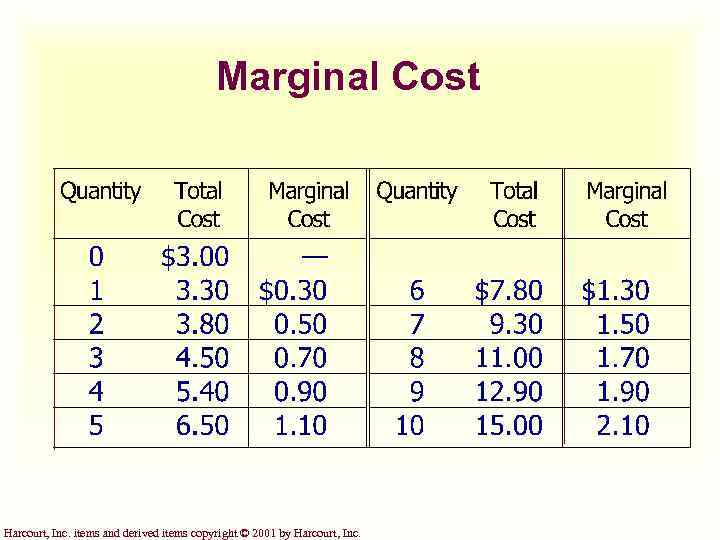
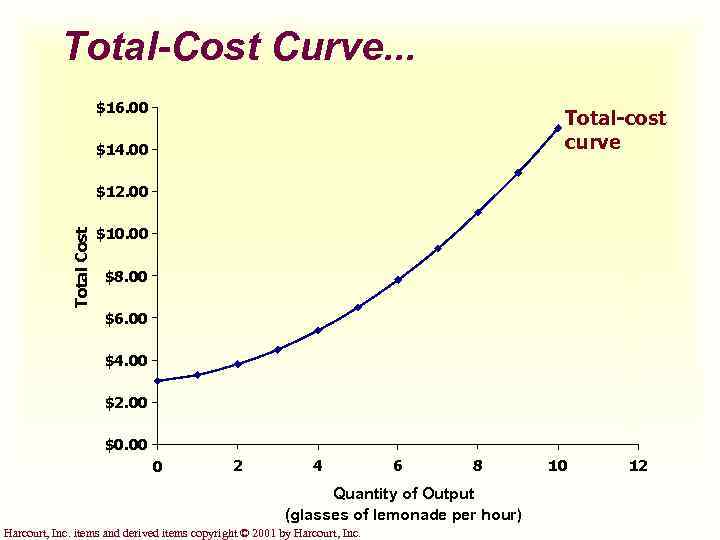
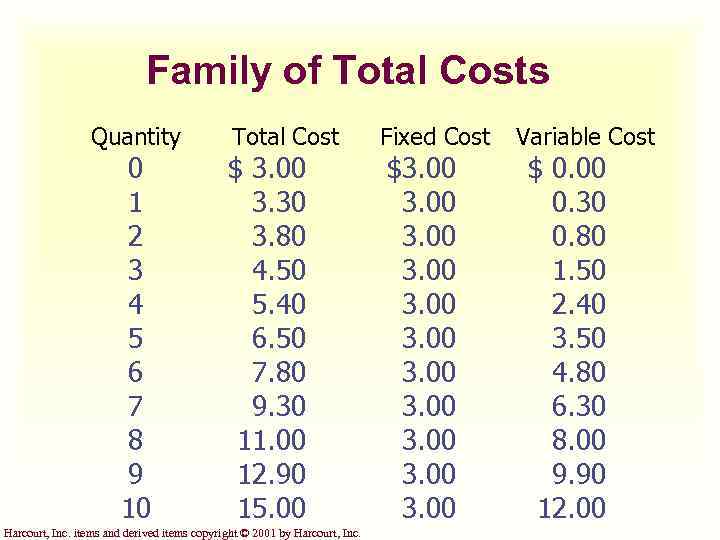 Family of Total Costs Quantity 0 1 2 3 4 5 6 7 8 9 10 Total Cost Fixed Cost $ 3. 00 3. 30 3. 80 4. 50 5. 40 6. 50 7. 80 9. 30 11. 00 12. 90 15. 00 $3. 00 3. 00 Harcourt, Inc. items and derived items copyright © 2001 by Harcourt, Inc. Variable Cost $ 0. 00 0. 30 0. 80 1. 50 2. 40 3. 50 4. 80 6. 30 8. 00 9. 90 12. 00
 Average Costs u. Average costs can be determined by dividing the firm’s costs by the quantity of output produced. u. The average cost is the cost of each typical unit of product. Harcourt, Inc. items and derived items copyright © 2001 by Harcourt, Inc.
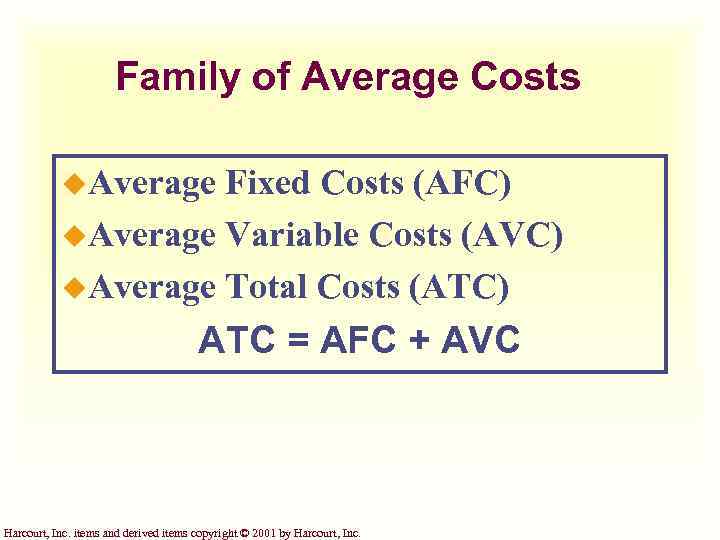 Family of Average Costs u. Average Fixed Costs (AFC) u. Average Variable Costs (AVC) u. Average Total Costs (ATC) ATC = AFC + AVC Harcourt, Inc. items and derived items copyright © 2001 by Harcourt, Inc.
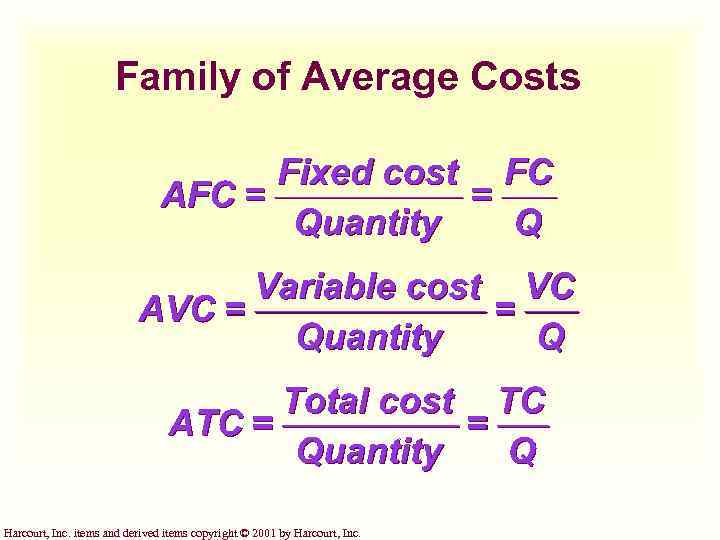 Family of Average Costs Harcourt, Inc. items and derived items copyright © 2001 by Harcourt, Inc.
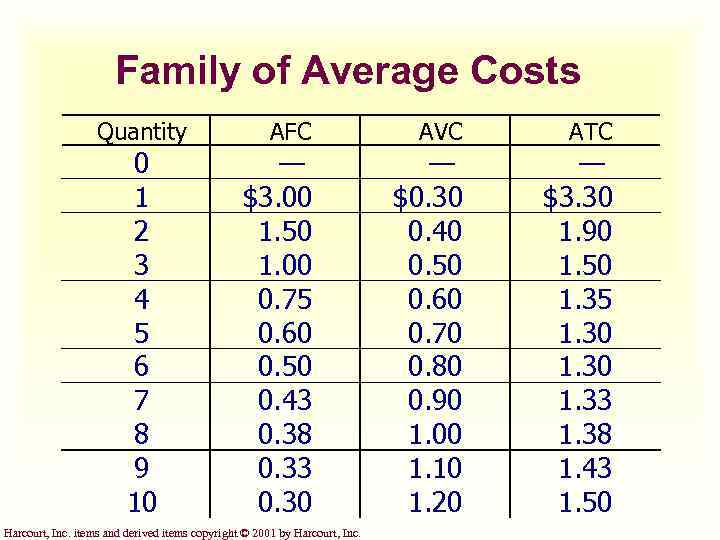 Family of Average Costs Quantity 0 1 2 3 4 5 6 7 8 9 10 AFC AVC ATC — $3. 00 1. 50 1. 00 0. 75 0. 60 0. 50 0. 43 0. 38 0. 33 0. 30 — $0. 30 0. 40 0. 50 0. 60 0. 70 0. 80 0. 90 1. 00 1. 10 1. 20 — $3. 30 1. 90 1. 50 1. 35 1. 30 1. 33 1. 38 1. 43 1. 50 Harcourt, Inc. items and derived items copyright © 2001 by Harcourt, Inc.
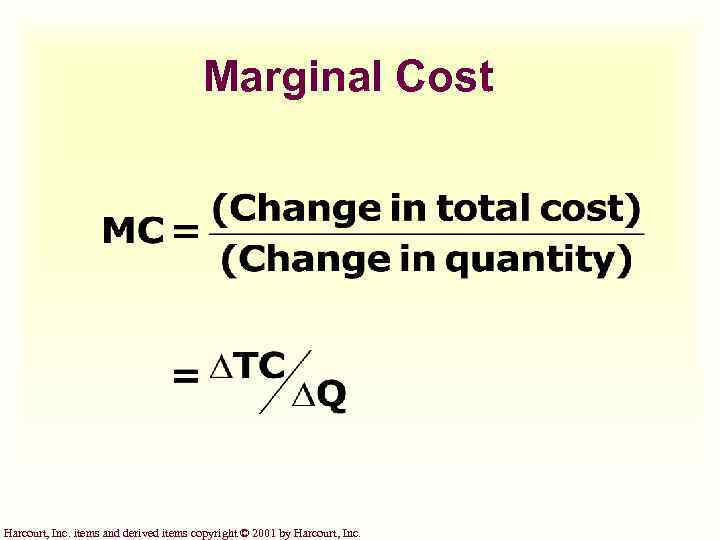
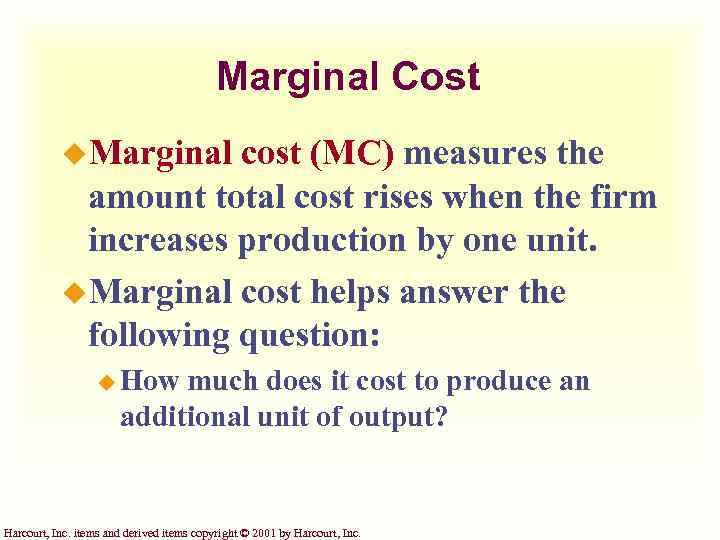 Marginal Cost u. Marginal cost (MC) measures the amount total cost rises when the firm increases production by one unit. u. Marginal cost helps answer the following question: u How much does it cost to produce an additional unit of output? Harcourt, Inc. items and derived items copyright © 2001 by Harcourt, Inc.
 Marginal Cost Harcourt, Inc. items and derived items copyright © 2001 by Harcourt, Inc.
 Marginal Cost Harcourt, Inc. items and derived items copyright © 2001 by Harcourt, Inc.
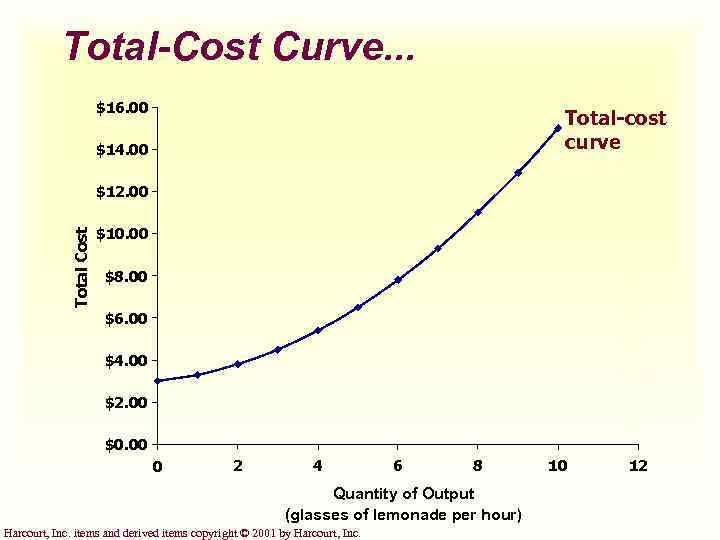 Total-Cost Curve. . . $16. 00 Total-cost curve $14. 00 Total Cost $12. 00 $10. 00 $8. 00 $6. 00 $4. 00 $2. 00 $0. 00 0 2 4 6 8 Quantity of Output (glasses of lemonade per hour) Harcourt, Inc. items and derived items copyright © 2001 by Harcourt, Inc. 10 12
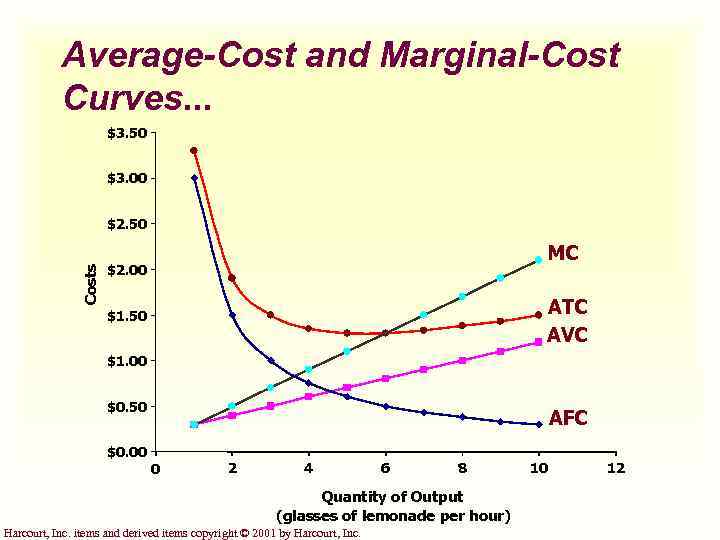 Average-Cost and Marginal-Cost Curves. . . $3. 50 $3. 00 Costs $2. 50 MC $2. 00 ATC AVC $1. 50 $1. 00 $0. 50 $0. 00 AFC 0 2 4 6 8 Quantity of Output (glasses of lemonade per hour) Harcourt, Inc. items and derived items copyright © 2001 by Harcourt, Inc. 10 12
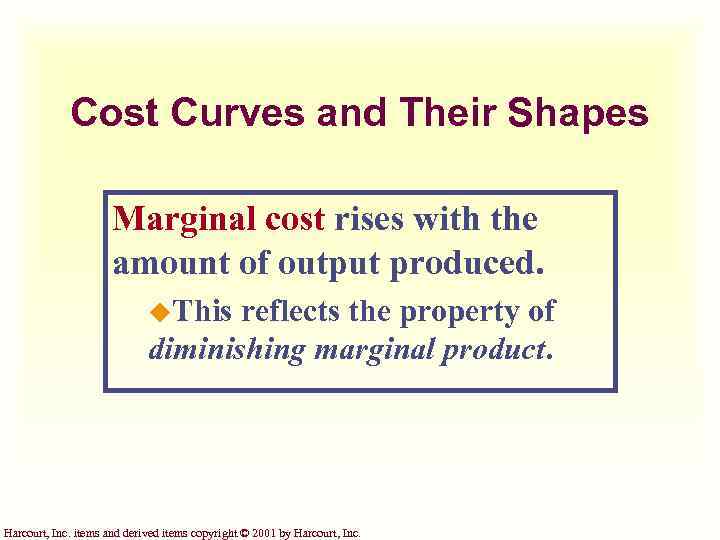 Cost Curves and Their Shapes Marginal cost rises with the amount of output produced. u. This reflects the property of diminishing marginal product. Harcourt, Inc. items and derived items copyright © 2001 by Harcourt, Inc.
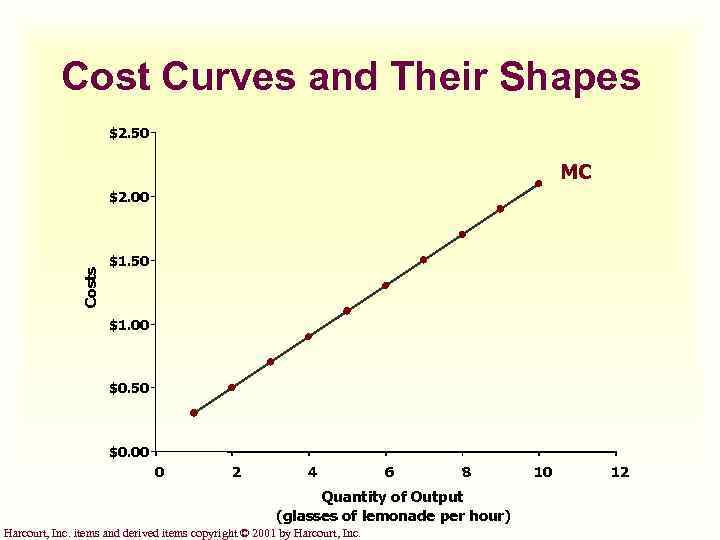 Cost Curves and Their Shapes $2. 50 MC Costs $2. 00 $1. 50 $1. 00 $0. 50 $0. 00 0 2 4 6 8 Quantity of Output (glasses of lemonade per hour) Harcourt, Inc. items and derived items copyright © 2001 by Harcourt, Inc. 10 12
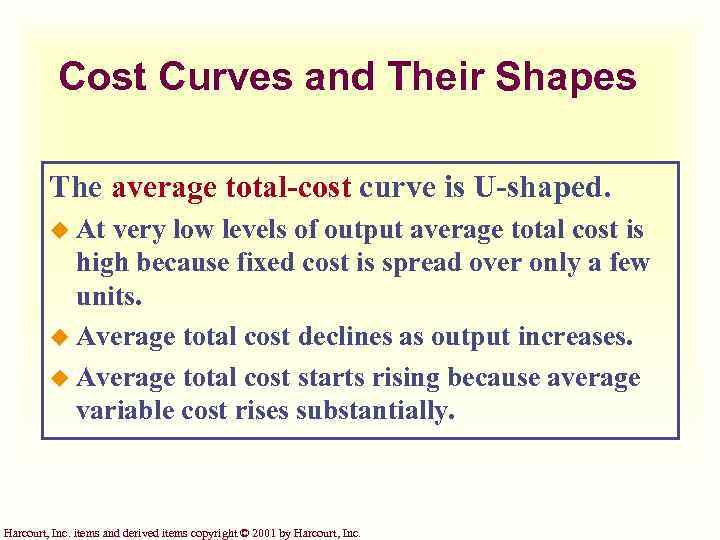 Cost Curves and Their Shapes The average total-cost curve is U-shaped. u At very low levels of output average total cost is high because fixed cost is spread over only a few units. u Average total cost declines as output increases. u Average total cost starts rising because average variable cost rises substantially. Harcourt, Inc. items and derived items copyright © 2001 by Harcourt, Inc.
 Cost Curves and Their Shapes The bottom of the U-shape occurs at the quantity that minimizes average total cost. This quantity is sometimes called the efficient scale of the firm. Harcourt, Inc. items and derived items copyright © 2001 by Harcourt, Inc.
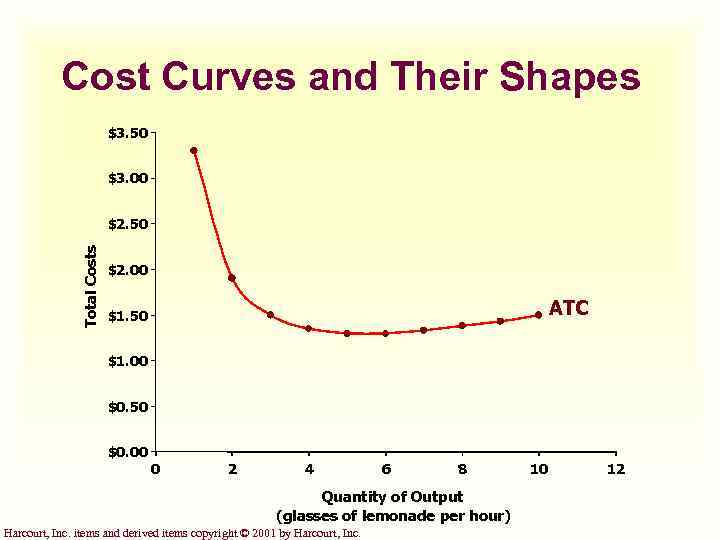 Cost Curves and Their Shapes $3. 50 $3. 00 Total Costs $2. 50 $2. 00 ATC $1. 50 $1. 00 $0. 50 $0. 00 0 2 4 6 8 Quantity of Output (glasses of lemonade per hour) Harcourt, Inc. items and derived items copyright © 2001 by Harcourt, Inc. 10 12
 Relationship Between Marginal Cost and Average Total Cost u. Whenever marginal cost is less than average total cost, average total cost is falling. u. Whenever marginal cost is greater than average total cost, average total cost is rising. Harcourt, Inc. items and derived items copyright © 2001 by Harcourt, Inc.
 Relationship Between Marginal Cost and Average Total Cost The marginal-cost curve crosses the average-total-cost curve at the efficient scale. u. Efficient scale is the quantity that minimizes average total cost. Harcourt, Inc. items and derived items copyright © 2001 by Harcourt, Inc.
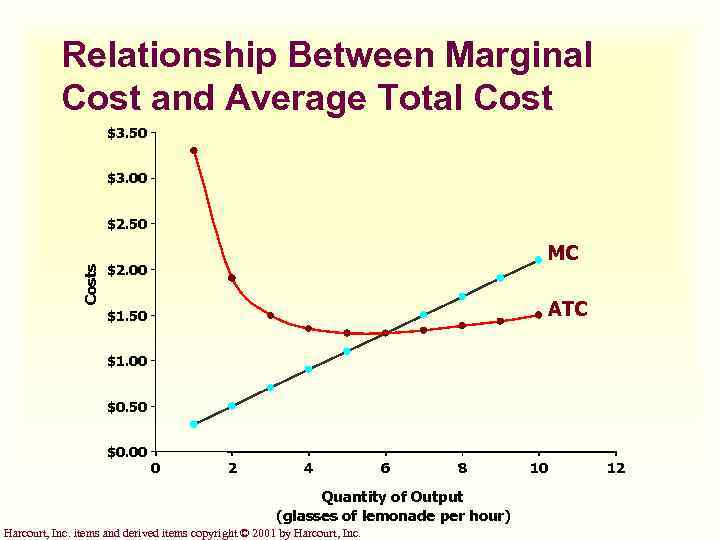 Relationship Between Marginal Cost and Average Total Cost $3. 50 $3. 00 Costs $2. 50 MC $2. 00 ATC $1. 50 $1. 00 $0. 50 $0. 00 0 2 4 6 8 Quantity of Output (glasses of lemonade per hour) Harcourt, Inc. items and derived items copyright © 2001 by Harcourt, Inc. 10 12
 The Various Measures of Cost It is now time to examine the relationships that exist between the different measures of cost. Harcourt, Inc. items and derived items copyright © 2001 by Harcourt, Inc.
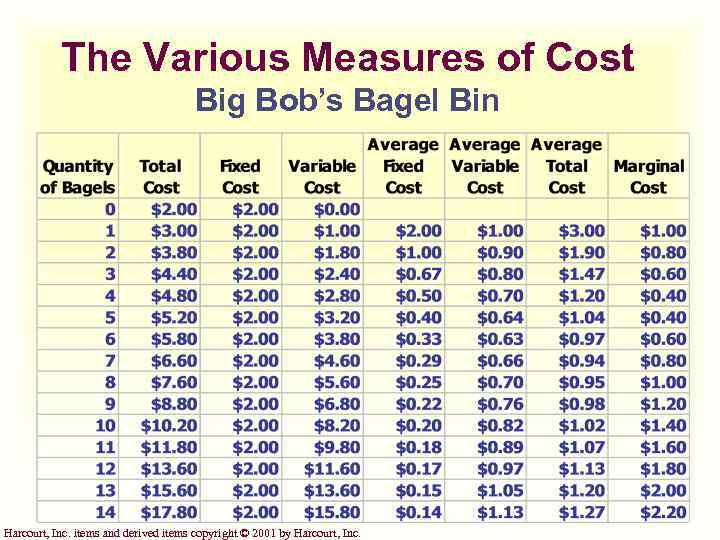 The Various Measures of Cost Big Bob’s Bagel Bin Harcourt, Inc. items and derived items copyright © 2001 by Harcourt, Inc.
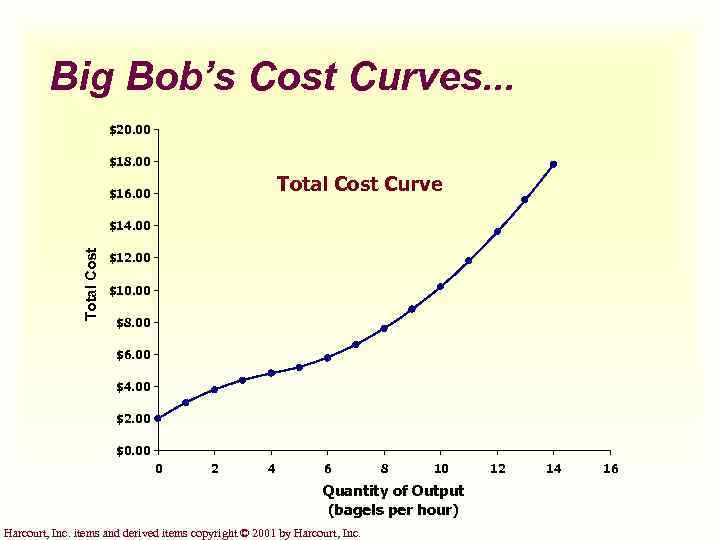 Big Bob’s Cost Curves. . . $20. 00 $18. 00 Total Cost Curve $16. 00 Total Cost $14. 00 $12. 00 $10. 00 $8. 00 $6. 00 $4. 00 $2. 00 $0. 00 0 2 4 6 8 10 Quantity of Output (bagels per hour) Harcourt, Inc. items and derived items copyright © 2001 by Harcourt, Inc. 12 14 16
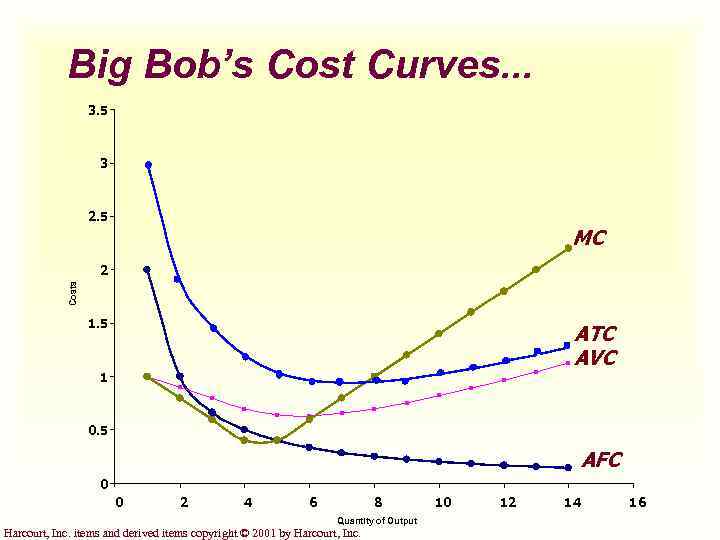 Big Bob’s Cost Curves. . . 3. 5 3 2. 5 MC Costs 2 1. 5 ATC AVC 1 0. 5 AFC 0 0 2 4 6 8 Quantity of Output Harcourt, Inc. items and derived items copyright © 2001 by Harcourt, Inc. 10 12 14 16
 Three Important Properties of Cost Curves u. Marginal cost eventually rises with the quantity of output. u. The average-total-cost curve is Ushaped. u. The marginal-cost curve crosses the average-total-cost curve at the minimum of average total cost. Harcourt, Inc. items and derived items copyright © 2001 by Harcourt, Inc.
 Costs in the Long Run u. For many firms, the division of total costs between fixed and variable costs depends on the time horizon being considered. u In the short run some costs are fixed. u In the long run fixed costs become variable costs. Harcourt, Inc. items and derived items copyright © 2001 by Harcourt, Inc.
 Costs in the Long Run Because many costs are fixed in the short run but variable in the long run, a firm’s long-run cost curves differ from its short-run cost curves. Harcourt, Inc. items and derived items copyright © 2001 by Harcourt, Inc.
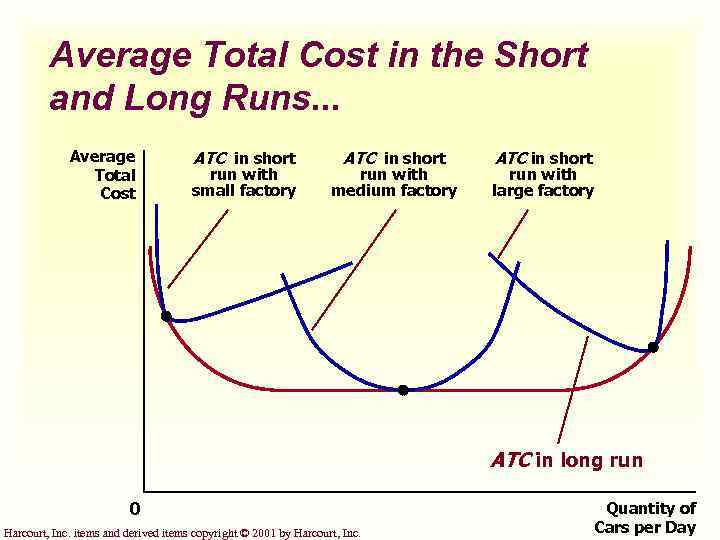 Average Total Cost in the Short and Long Runs. . . Average Total Cost ATC in short run with small factory ATC in short run with medium factory ATC in short run with large factory ATC in long run 0 Harcourt, Inc. items and derived items copyright © 2001 by Harcourt, Inc. Quantity of Cars per Day
 Economies and Diseconomies of Scale u Economies of scale occur when long-run average total cost declines as output increases. u Diseconomies of scale occur when longrun average total cost rises as output increases. u Constant returns to scale occur when long-run average total cost does not vary as output increases. Harcourt, Inc. items and derived items copyright © 2001 by Harcourt, Inc.
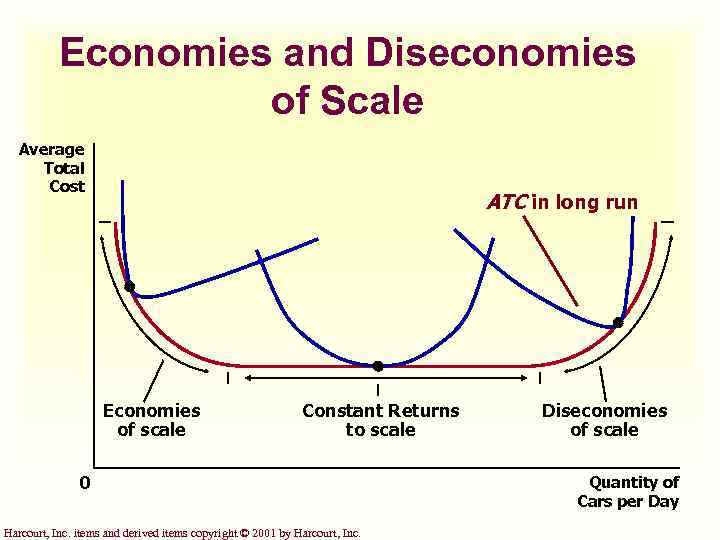 Economies and Diseconomies of Scale Average Total Cost ATC in long run Economies of scale Constant Returns to scale 0 Harcourt, Inc. items and derived items copyright © 2001 by Harcourt, Inc. Diseconomies of scale Quantity of Cars per Day
 Summary u. The goal of firms is to maximize profit, which equals total revenue minus total cost. u. When analyzing a firm’s behavior, it is important to include all the opportunity costs of production. u. Some opportunity costs are explicit while other opportunity costs are implicit. Harcourt, Inc. items and derived items copyright © 2001 by Harcourt, Inc.
 Summary u. A firm’s costs reflect its production process. u A typical firm’s production function gets flatter as the quantity of input increases, displaying the property of diminishing marginal product. u A firm’s total costs are divided between fixed and variable costs. Fixed costs don’t vary with quantities produced; variable costs do. Harcourt, Inc. items and derived items copyright © 2001 by Harcourt, Inc.
 Summary u. Average total cost is total cost divided by the quantity of output. u. Marginal cost is the amount by which total cost would rise if output were increased by one unit. u. The marginal cost always rises with the quantity of output. Harcourt, Inc. items and derived items copyright © 2001 by Harcourt, Inc.
 Summary u. The average-total-cost curve is Ushaped. u. The marginal-cost curve always crosses the average-total-cost curve at the minimum of ATC. u. A firm’s costs often depend on the time horizon being considered. Harcourt, Inc. items and derived items copyright © 2001 by Harcourt, Inc.
 Graphical Review Harcourt, Inc. items and derived items copyright © 2001 by Harcourt, Inc.
 Economic Profit versus Accounting Profit How an Economist Views a Firm How an Accountant Views a Firm Economic profit Accounting profit Revenue Implicit costs Explicit costs Revenue Total opportunity costs Harcourt, Inc. items and derived items copyright © 2001 by Harcourt, Inc. Explicit costs
 A Production Function. . . Quantity of Output (cookies per hour) 150 140 130 120 110 100 90 80 70 60 50 40 30 20 10 0 Production function 1 2 3 Harcourt, Inc. items and derived items copyright © 2001 by Harcourt, Inc. 4 5 Number of Workers Hired
 Total-Cost Curve. . . Total Cost Total-cost curve $80 70 60 50 40 30 20 10 0 20 40 60 80 100 120 140 Harcourt, Inc. items and derived items copyright © 2001 by Harcourt, Inc. Quantity of Output (cookies per hour)
 Total-Cost Curve. . . $16. 00 Total-cost curve $14. 00 Total Cost $12. 00 $10. 00 $8. 00 $6. 00 $4. 00 $2. 00 $0. 00 0 2 4 6 8 Quantity of Output (glasses of lemonade per hour) Harcourt, Inc. items and derived items copyright © 2001 by Harcourt, Inc. 10 12
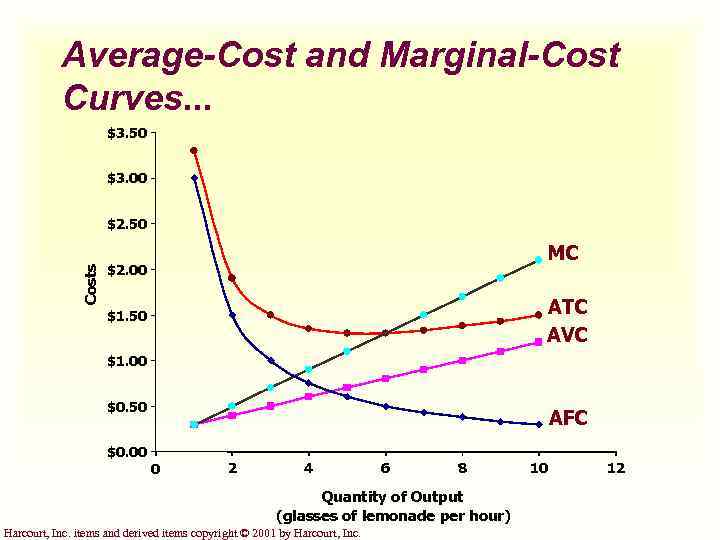 Average-Cost and Marginal-Cost Curves. . . $3. 50 $3. 00 Costs $2. 50 MC $2. 00 ATC AVC $1. 50 $1. 00 $0. 50 $0. 00 AFC 0 2 4 6 8 Quantity of Output (glasses of lemonade per hour) Harcourt, Inc. items and derived items copyright © 2001 by Harcourt, Inc. 10 12
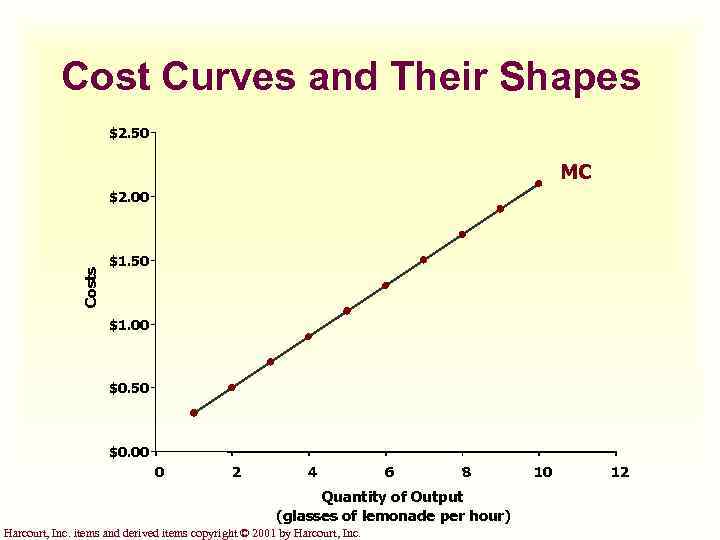 Cost Curves and Their Shapes $2. 50 MC Costs $2. 00 $1. 50 $1. 00 $0. 50 $0. 00 0 2 4 6 8 Quantity of Output (glasses of lemonade per hour) Harcourt, Inc. items and derived items copyright © 2001 by Harcourt, Inc. 10 12
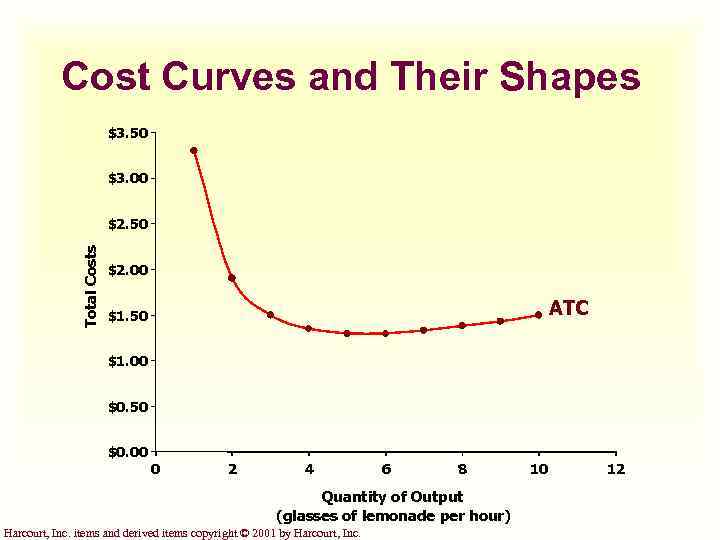 Cost Curves and Their Shapes $3. 50 $3. 00 Total Costs $2. 50 $2. 00 ATC $1. 50 $1. 00 $0. 50 $0. 00 0 2 4 6 8 Quantity of Output (glasses of lemonade per hour) Harcourt, Inc. items and derived items copyright © 2001 by Harcourt, Inc. 10 12
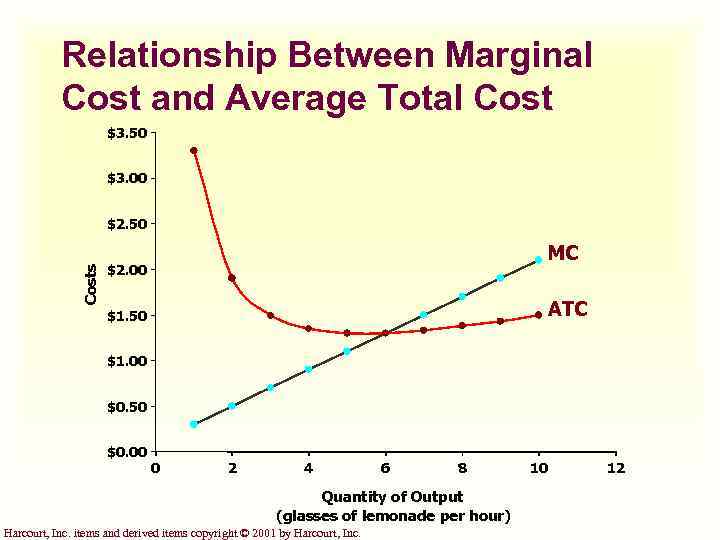 Relationship Between Marginal Cost and Average Total Cost $3. 50 $3. 00 Costs $2. 50 MC $2. 00 ATC $1. 50 $1. 00 $0. 50 $0. 00 0 2 4 6 8 Quantity of Output (glasses of lemonade per hour) Harcourt, Inc. items and derived items copyright © 2001 by Harcourt, Inc. 10 12
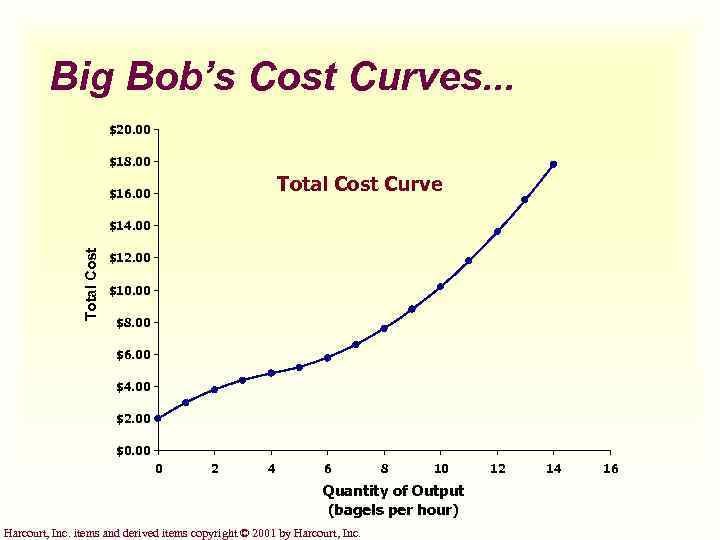 Big Bob’s Cost Curves. . . $20. 00 $18. 00 Total Cost Curve $16. 00 Total Cost $14. 00 $12. 00 $10. 00 $8. 00 $6. 00 $4. 00 $2. 00 $0. 00 0 2 4 6 8 10 Quantity of Output (bagels per hour) Harcourt, Inc. items and derived items copyright © 2001 by Harcourt, Inc. 12 14 16
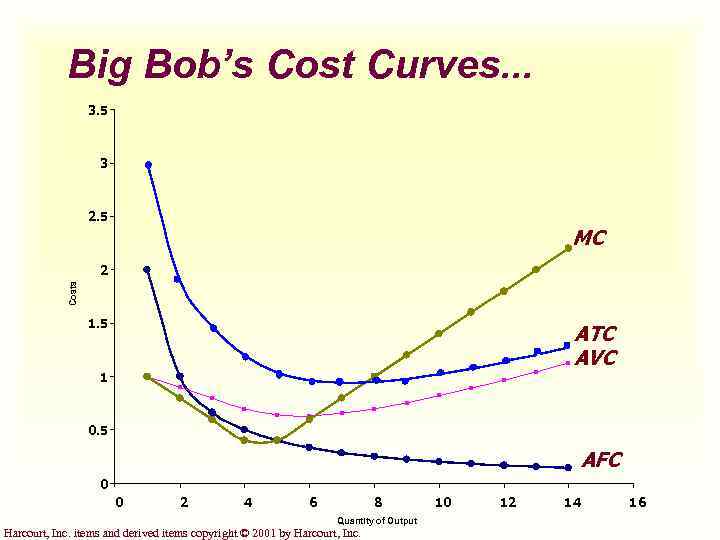 Big Bob’s Cost Curves. . . 3. 5 3 2. 5 MC Costs 2 1. 5 ATC AVC 1 0. 5 AFC 0 0 2 4 6 8 Quantity of Output Harcourt, Inc. items and derived items copyright © 2001 by Harcourt, Inc. 10 12 14 16
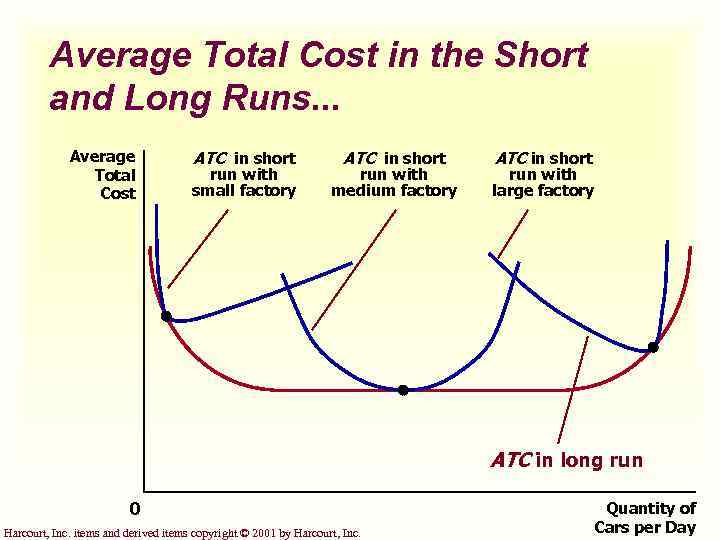 Average Total Cost in the Short and Long Runs. . . Average Total Cost ATC in short run with small factory ATC in short run with medium factory ATC in short run with large factory ATC in long run 0 Harcourt, Inc. items and derived items copyright © 2001 by Harcourt, Inc. Quantity of Cars per Day
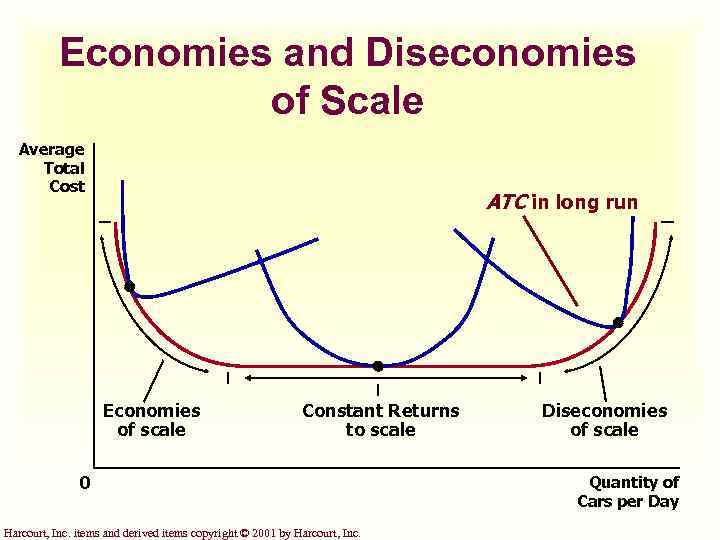 Economies and Diseconomies of Scale Average Total Cost ATC in long run Economies of scale Constant Returns to scale 0 Harcourt, Inc. items and derived items copyright © 2001 by Harcourt, Inc. Diseconomies of scale Quantity of Cars per Day