


 Скачать презентацию The Cost of Capital 1 Learning Goals
d7ea087f029c551cdeafd1c99dc2f2e7.ppt
- Количество слайдов: 131
 The Cost of Capital 1
 Learning Goals • Sources of capital • Cost of each type of funding • Calculation of the weighted average cost of capital (WACC) • Construction and use of the marginal cost of capital schedule (MCC) 2
 Factors Affecting the Cost of Capital • General Economic Conditions – Affect interest rates • Market Conditions – Affect risk premiums • Operating Decisions – Affect business risk • Financial Decisions – Affect financial risk • Amount of Financing – Affect flotation costs and market price of security 3
 Weighted Cost of Capital Model • Compute the cost of each source of capital • Determine percentage of each source of capital in the optimal capital structure • Calculate Weighted Average Cost of Capital (WACC) 4
 1. Compute Cost of Debt • Required rate of return for creditors • Same cost found in Chapter 12 as yield to maturity on bonds (kd). • e. g. Suppose that a company issues bonds with a before tax cost of 10%. • Since interest payments are tax deductible, the true cost of the debt is the after tax cost. • If the company’s tax rate (state and federal combined) is 40%, the after tax cost of debt • AT kd = 10%(1 -. 4) = 6%. 5
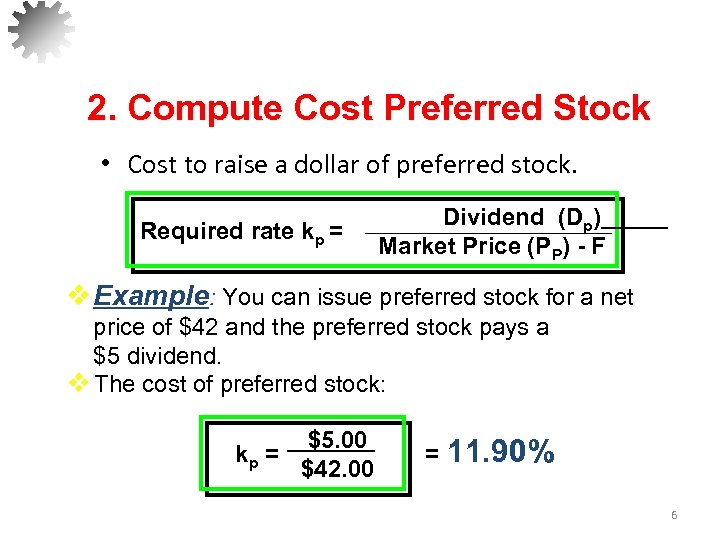 2. Compute Cost Preferred Stock • Cost to raise a dollar of preferred stock. Required rate kp = Dividend (Dp) Market Price (PP) - F v Example: You can issue preferred stock for a net price of $42 and the preferred stock pays a $5 dividend. v The cost of preferred stock: kp = $5. 00 $42. 00 = 11. 90% 6
 3. Compute Cost of Common Equity • Two Types of Common Equity Financing – Retained Earnings (internal common equity) – Issuing new shares of common stock (external common equity) 7
 3. Compute Cost of Common Equity • Cost of Internal Common Equity – Management should retain earnings only if they earn as much as stockholder’s next best investment opportunity of the same risk. – Cost of Internal Equity = opportunity cost of common stockholders’ funds. – Two methods to determine • Dividend Growth Model • Capital Asset Pricing Model 8
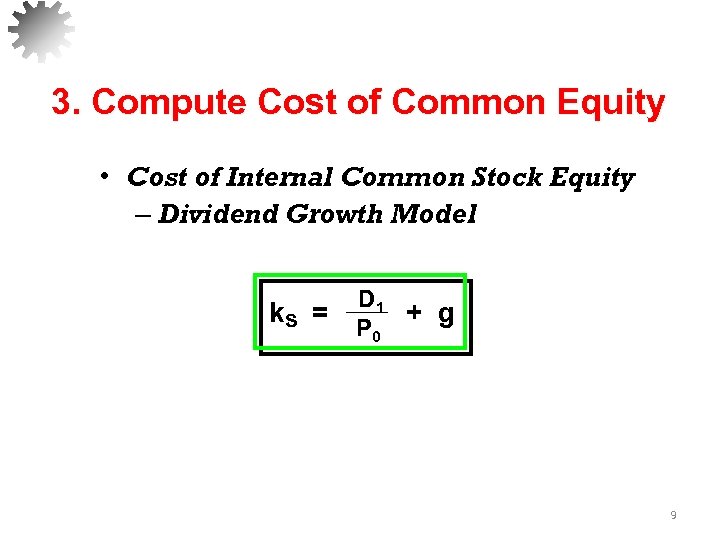 3. Compute Cost of Common Equity • Cost of Internal Common Stock Equity – Dividend Growth Model k. S = D 1 + g P 0 9
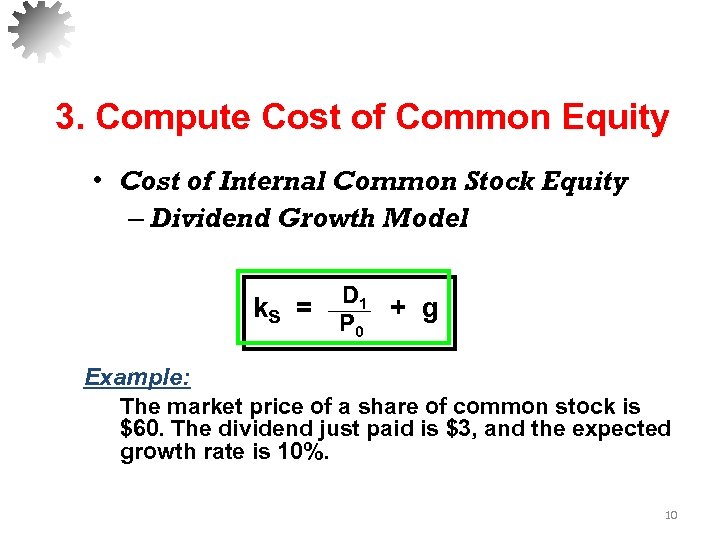 3. Compute Cost of Common Equity • Cost of Internal Common Stock Equity – Dividend Growth Model k. S = D 1 + g P 0 Example: The market price of a share of common stock is $60. The dividend just paid is $3, and the expected growth rate is 10%. 10
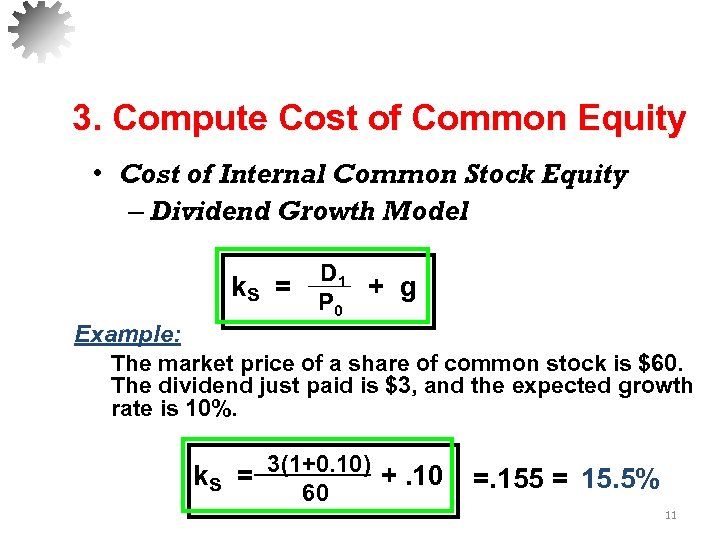 3. Compute Cost of Common Equity • Cost of Internal Common Stock Equity – Dividend Growth Model k. S = D 1 + g P 0 Example: The market price of a share of common stock is $60. The dividend just paid is $3, and the expected growth rate is 10%. k. S = 3(1+0. 10) +. 10 60 =. 155 = 15. 5% 11
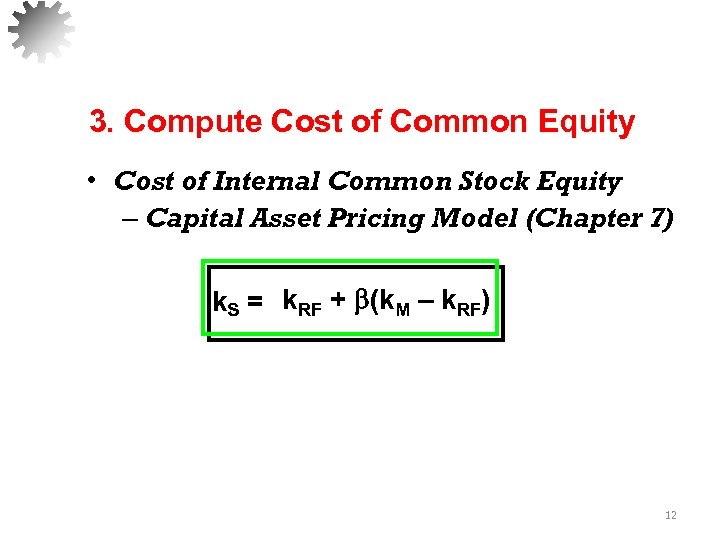 3. Compute Cost of Common Equity • Cost of Internal Common Stock Equity – Capital Asset Pricing Model (Chapter 7) k. S = k. RF + (k. M – k. RF) 12
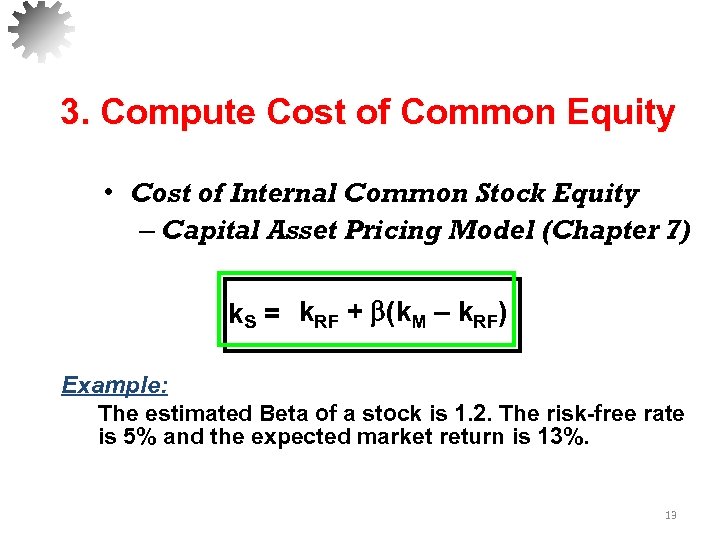 3. Compute Cost of Common Equity • Cost of Internal Common Stock Equity – Capital Asset Pricing Model (Chapter 7) k. S = k. RF + (k. M – k. RF) Example: The estimated Beta of a stock is 1. 2. The risk-free rate is 5% and the expected market return is 13%. 13
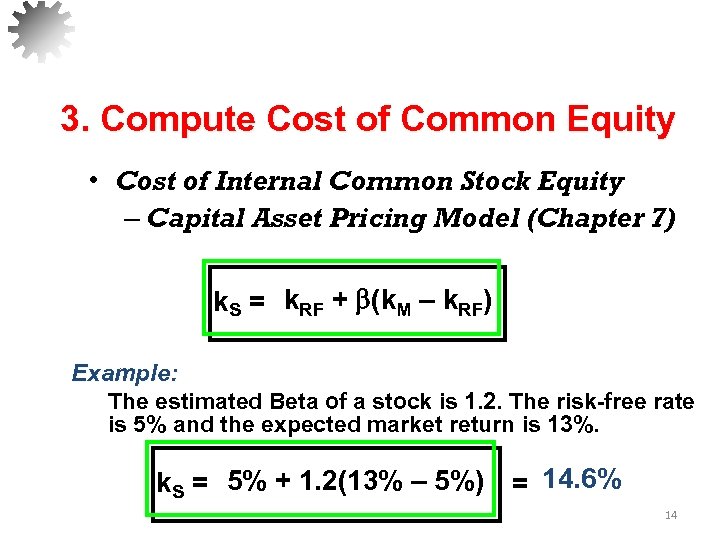 3. Compute Cost of Common Equity • Cost of Internal Common Stock Equity – Capital Asset Pricing Model (Chapter 7) k. S = k. RF + (k. M – k. RF) Example: The estimated Beta of a stock is 1. 2. The risk-free rate is 5% and the expected market return is 13%. k. S = 5% + 1. 2(13% – 5%) = 14. 6% 14
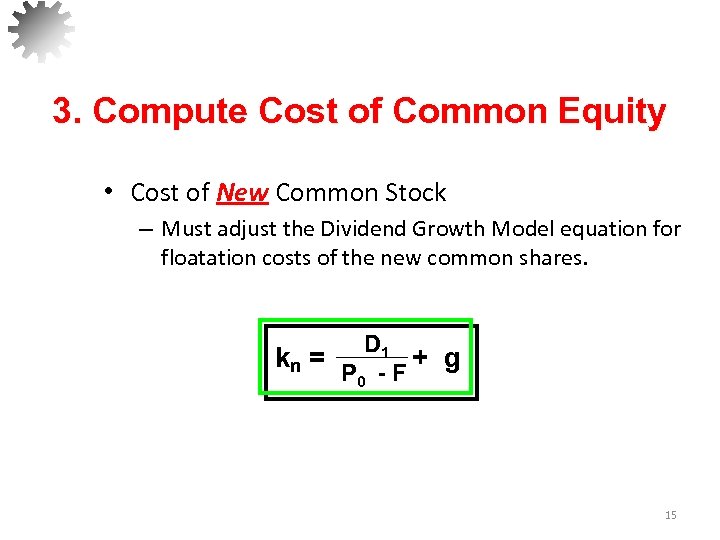 3. Compute Cost of Common Equity • Cost of New Common Stock – Must adjust the Dividend Growth Model equation for floatation costs of the new common shares. kn = D 1 + g P 0 - F 15
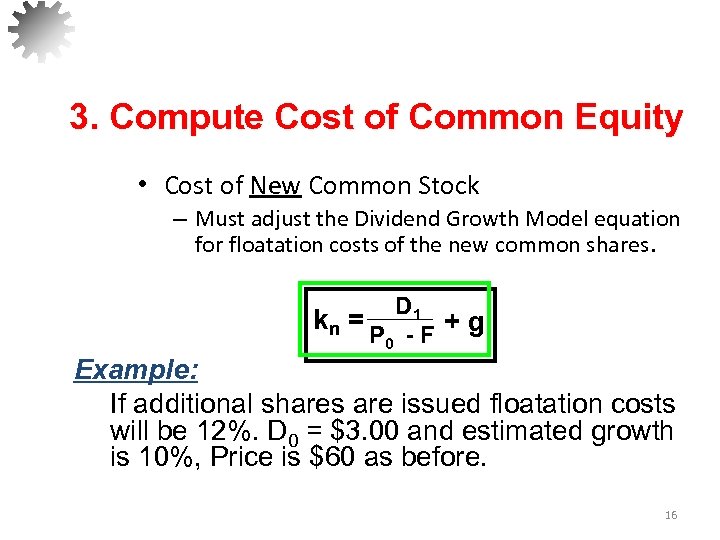 3. Compute Cost of Common Equity • Cost of New Common Stock – Must adjust the Dividend Growth Model equation for floatation costs of the new common shares. D 1 kn = +g P 0 - F Example: If additional shares are issued floatation costs will be 12%. D 0 = $3. 00 and estimated growth is 10%, Price is $60 as before. 16
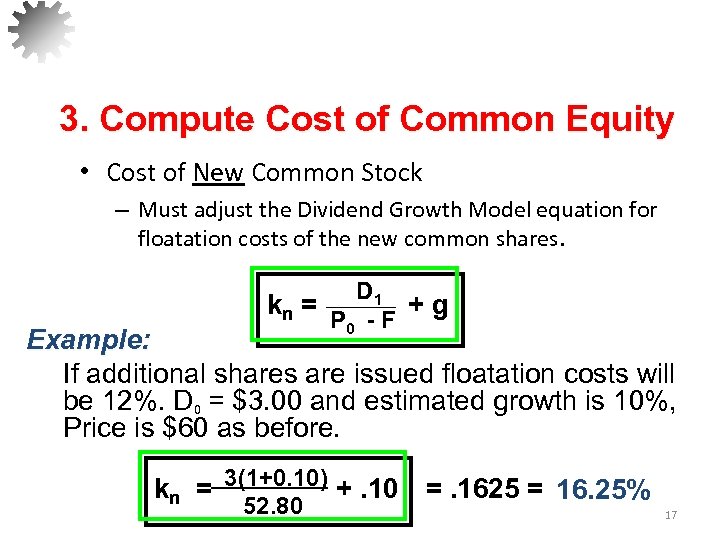 3. Compute Cost of Common Equity • Cost of New Common Stock – Must adjust the Dividend Growth Model equation for floatation costs of the new common shares. D 1 +g kn = P 0 - F Example: If additional shares are issued floatation costs will be 12%. D 0 = $3. 00 and estimated growth is 10%, Price is $60 as before. kn = 3(1+0. 10) +. 10 =. 1625 = 16. 25% 52. 80 17
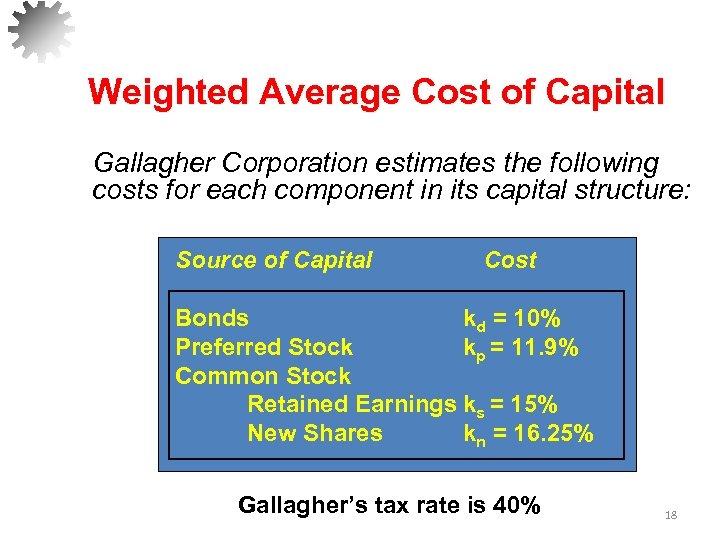 Weighted Average Cost of Capital Gallagher Corporation estimates the following costs for each component in its capital structure: Source of Capital Cost Bonds kd = 10% Preferred Stock kp = 11. 9% Common Stock Retained Earnings ks = 15% New Shares kn = 16. 25% Gallagher’s tax rate is 40% 18
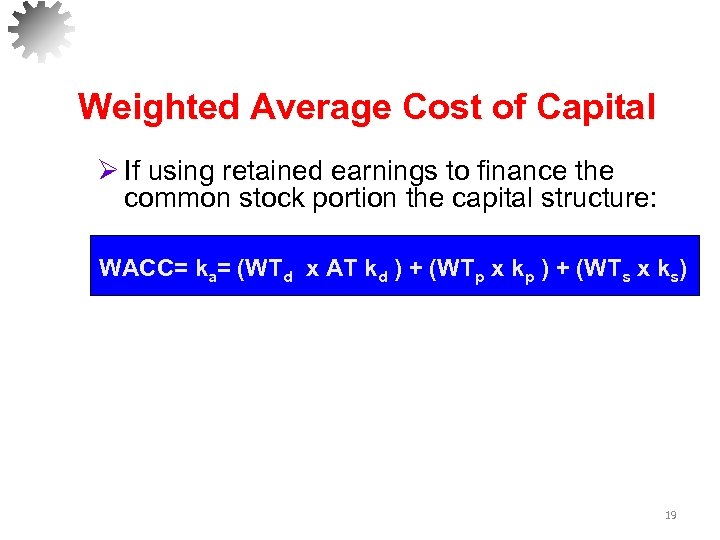 Weighted Average Cost of Capital Ø If using retained earnings to finance the common stock portion the capital structure: WACC= ka= (WTd x AT kd ) + (WTp x kp ) + (WTs x ks) 19
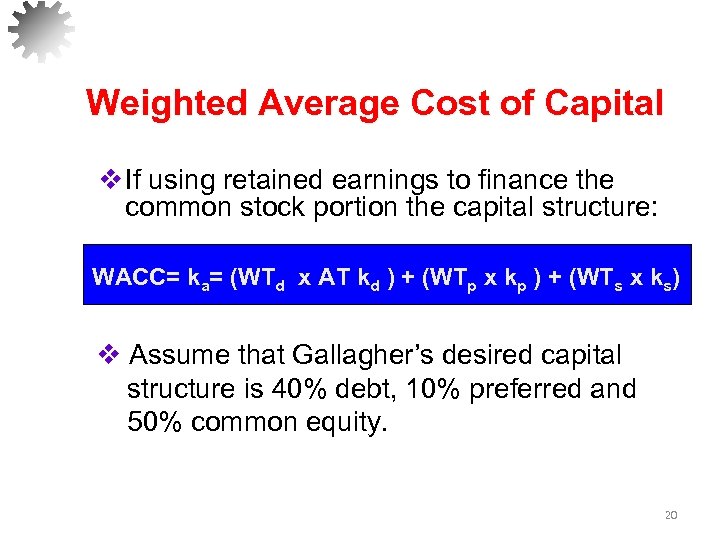 Weighted Average Cost of Capital v If using retained earnings to finance the common stock portion the capital structure: WACC= ka= (WTd x AT kd ) + (WTp x kp ) + (WTs x ks) v Assume that Gallagher’s desired capital structure is 40% debt, 10% preferred and 50% common equity. 20
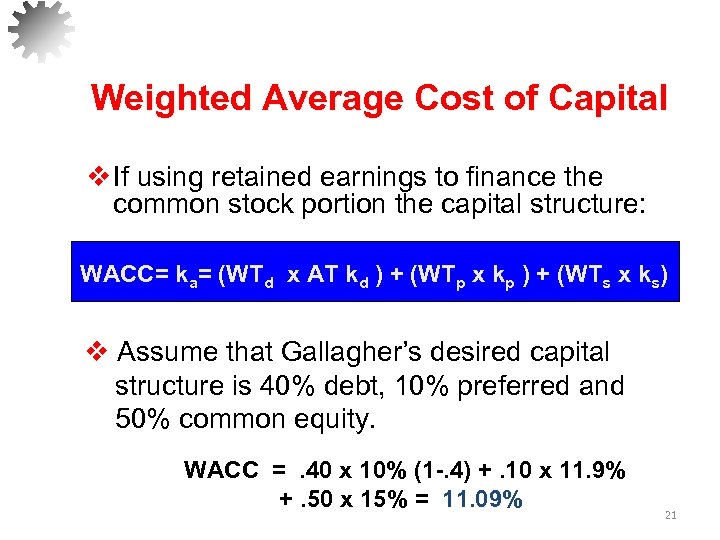 Weighted Average Cost of Capital v If using retained earnings to finance the common stock portion the capital structure: WACC= ka= (WTd x AT kd ) + (WTp x kp ) + (WTs x ks) v Assume that Gallagher’s desired capital structure is 40% debt, 10% preferred and 50% common equity. WACC =. 40 x 10% (1 -. 4) +. 10 x 11. 9% +. 50 x 15% = 11. 09% 21
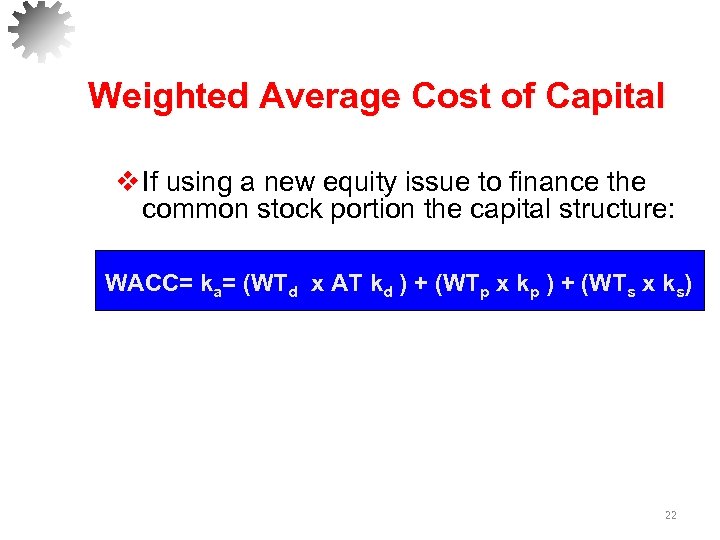 Weighted Average Cost of Capital v If using a new equity issue to finance the common stock portion the capital structure: WACC= ka= (WTd x AT kd ) + (WTp x kp ) + (WTs x ks) 22
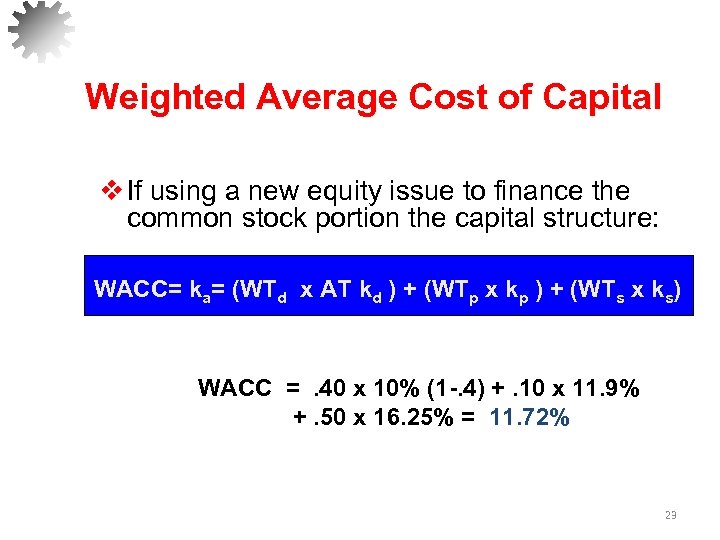 Weighted Average Cost of Capital v If using a new equity issue to finance the common stock portion the capital structure: WACC= ka= (WTd x AT kd ) + (WTp x kp ) + (WTs x ks) WACC =. 40 x 10% (1 -. 4) +. 10 x 11. 9% +. 50 x 16. 25% = 11. 72% 23
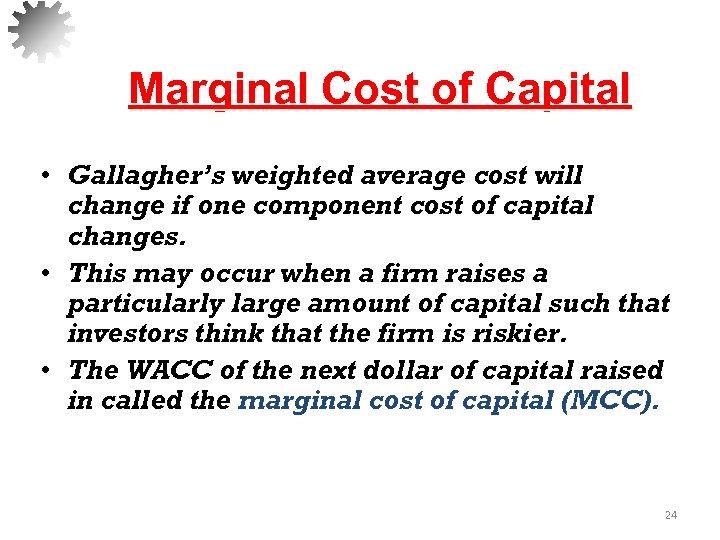 Marginal Cost of Capital • Gallagher’s weighted average cost will change if one component cost of capital changes. • This may occur when a firm raises a particularly large amount of capital such that investors think that the firm is riskier. • The WACC of the next dollar of capital raised in called the marginal cost of capital (MCC). 24
 Graphing the MCC curve • Assume now that Gallagher Corporation has $100, 000 in retained earnings with which to finance its capital budget. • We can calculate the point at which they will need to issue new equity since we know that Gallagher’s desired capital structure calls for 50% common equity. 25
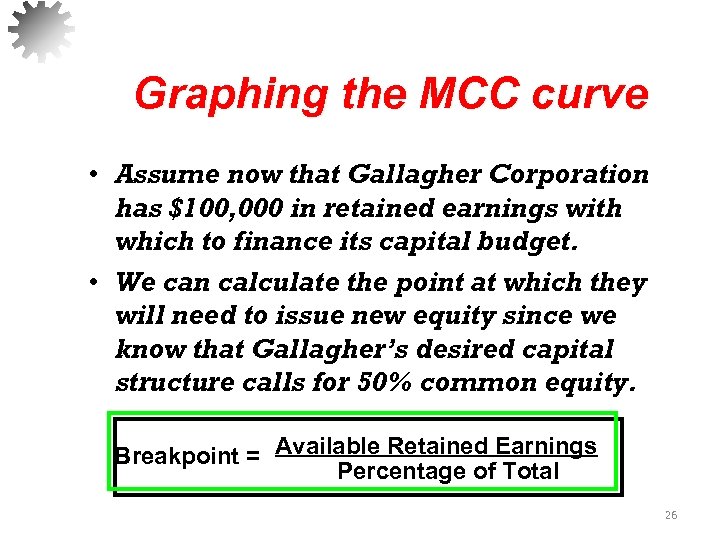 Graphing the MCC curve • Assume now that Gallagher Corporation has $100, 000 in retained earnings with which to finance its capital budget. • We can calculate the point at which they will need to issue new equity since we know that Gallagher’s desired capital structure calls for 50% common equity. Breakpoint = Available Retained Earnings Percentage of Total 26
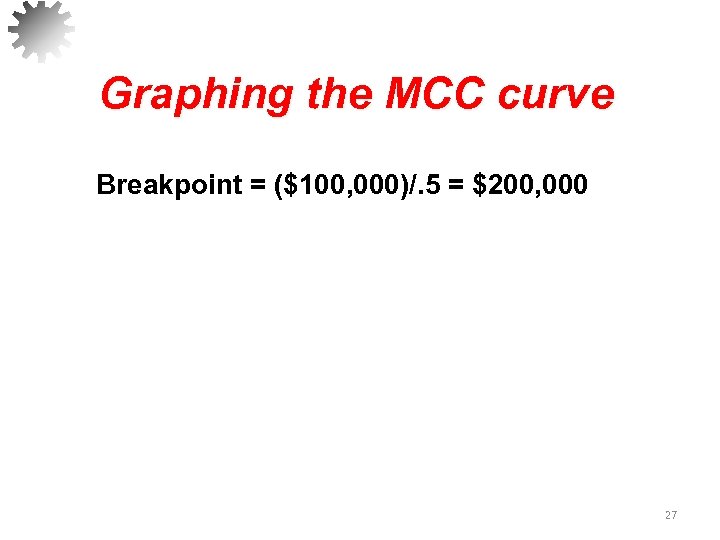 Graphing the MCC curve Breakpoint = ($100, 000)/. 5 = $200, 000 27
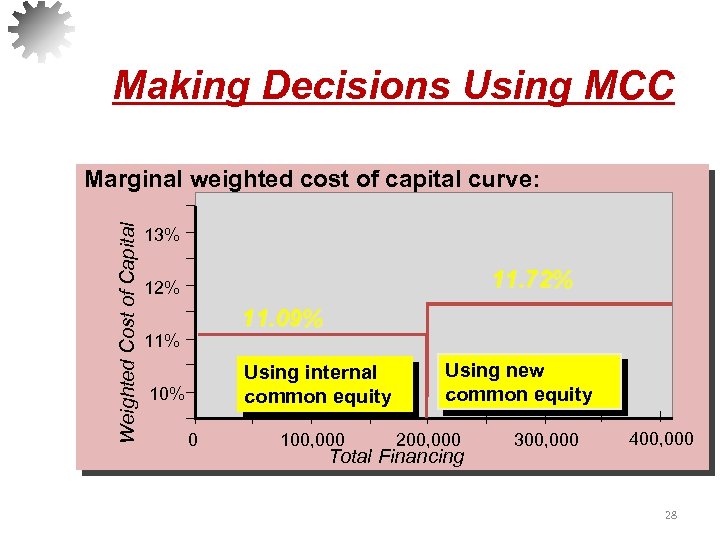 Making Decisions Using MCC Weighted Cost of Capital Marginal weighted cost of capital curve: 13% 11. 72% 11. 09% 11% Using internal common equity 10% 0 100, 000 Using new common equity 200, 000 Total Financing 300, 000 400, 000 28
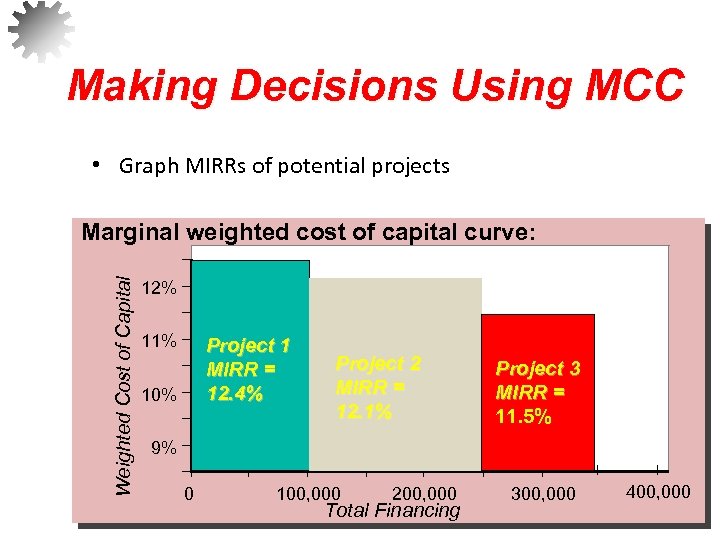 Making Decisions Using MCC • Graph MIRRs of potential projects Weighted Cost of Capital Marginal weighted cost of capital curve: 12% 11% Project 1 MIRR = 12. 4% 10% Project 2 MIRR = 12. 1% Project 3 MIRR = 11. 5% 9% 0 100, 000 200, 000 Total Financing 300, 000 400, 000 29
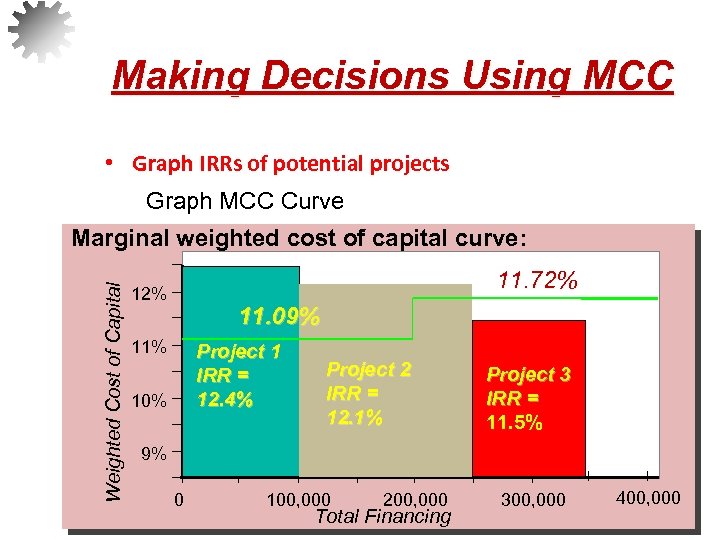 Making Decisions Using MCC • Graph IRRs of potential projects Graph MCC Curve Weighted Cost of Capital Marginal weighted cost of capital curve: 11. 72% 11. 09% 11% Project 1 IRR = 12. 4% 10% Project 2 IRR = 12. 1% Project 3 IRR = 11. 5% 9% 0 100, 000 200, 000 Total Financing 300, 000 400, 000 30
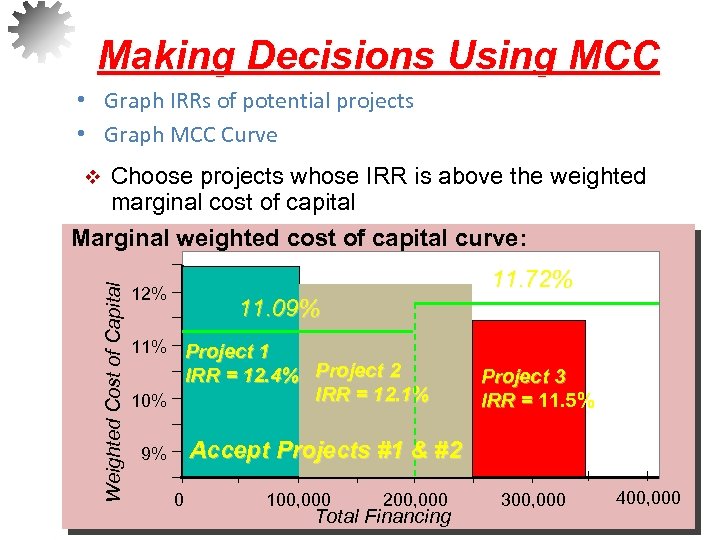 Making Decisions Using MCC • Graph IRRs of potential projects • Graph MCC Curve v Choose projects whose IRR is above the weighted marginal cost of capital Weighted Cost of Capital Marginal weighted cost of capital curve: 11. 72% 11. 09% 11% Project 1 IRR = 12. 4% Project 2 IRR = 12. 1% 10% Project 3 IRR = 11. 5% Accept Projects #1 & #2 9% 0 100, 000 200, 000 Total Financing 300, 000 400, 000 31
 Answer the following questions and do the following problems and include them in you ECP Notes. If the cost of new common equity is higher than the cost of internal equity, why would a firm choose to issue new common stock? Why is it important to use a firm’s MCC and not a firm’s initial WACC to evaluate investments? Calculate the AT kd, ks, kn for the following information: Loan rates for this firm = 9% Growth rate of dividends = 4% Tax rate = 30% Common Dividends at t 1 = $ 4. 00 Price of Common Stock = $35. 00 Flotation costs = 6% Your firm’s ks is 10%, the cost of debt is 6% before taxes, and the tax rate is 40%. Given the following balance sheet, calculate the firm’s after tax WACC: Total assets = $25, 000 Total debt = 15, 000 Total equity = 10, 000 32
 Your firm is in the 30% tax bracket with a before-tax required rate of return on its equity of 13% and on its debt of 10%. If the firm uses 60% equity and 40% debt financing, calculate its after-tax WACC. Would a firm use WACC or MCC to identify which new capital budgeting projects should be selected? Why? A firm's before tax cost of debt on any new issue is 9%; the cost to issue new preferred stock is 8%. This appears to conflict with the risk/return relationship. How can this pricing exist? What determines whether to use the dividend growth model approach or the CAPM approach to calculate the cost of equity? 33
 Capital Budgeting Decision Methods 1
 Learning Objectives • The capital budgeting process. • Calculation of payback, NPV, IRR, and MIRR for proposed projects. • Capital rationing. • Measurement of risk in capital budgeting and how to deal with it. 2
 The Capital Budgeting Process • Capital Budgeting is the process of evaluating proposed investment projects for a firm. • Managers must determine which projects are acceptable and must rank mutually exclusive projects by order of desirability to the firm. 3
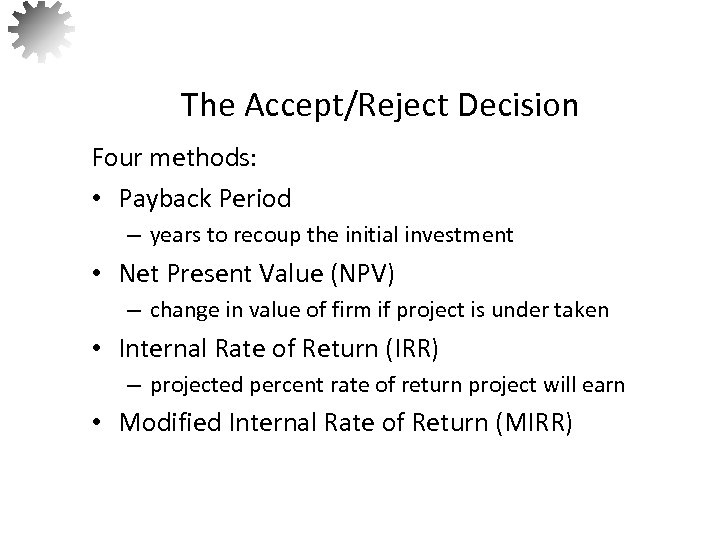 The Accept/Reject Decision Four methods: • Payback Period – years to recoup the initial investment • Net Present Value (NPV) – change in value of firm if project is under taken • Internal Rate of Return (IRR) – projected percent rate of return project will earn • Modified Internal Rate of Return (MIRR) 4
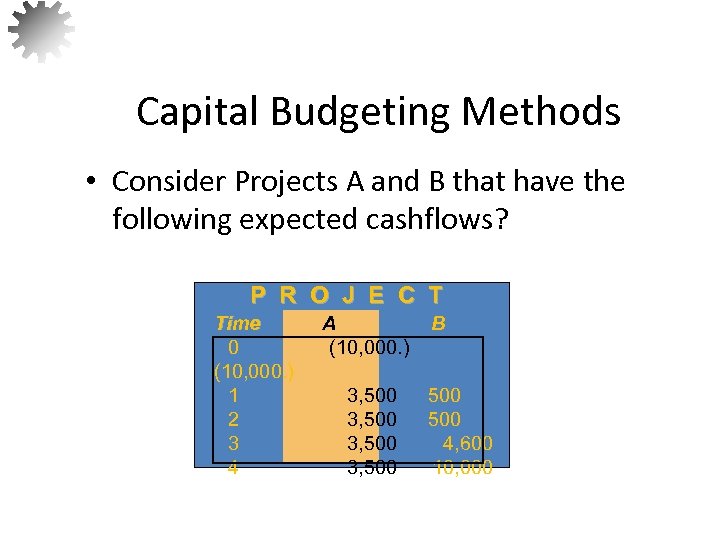 Capital Budgeting Methods • Consider Projects A and B that have the following expected cashflows? P R O J E C T Time 0 (10, 000. ) 1 2 3 4 A (10, 000. ) 3, 500 B 500 4, 600 10, 000 5
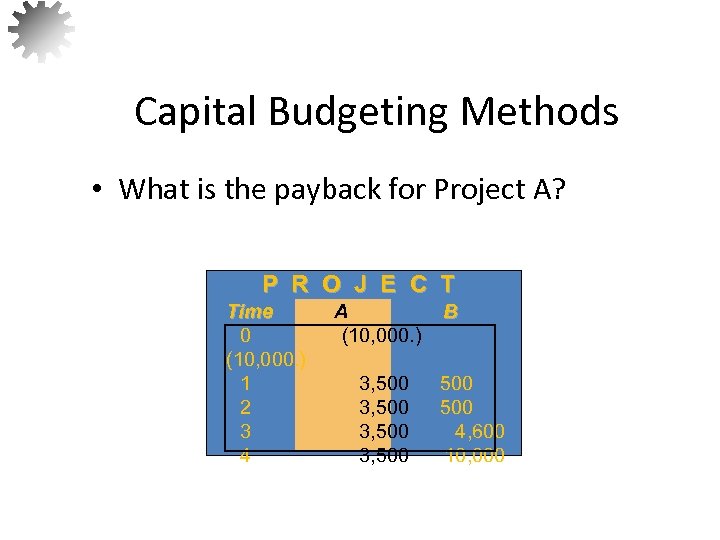 Capital Budgeting Methods • What is the payback for Project A? P R O J E C T Time 0 (10, 000. ) 1 2 3 4 A (10, 000. ) 3, 500 B 500 4, 600 10, 000 6
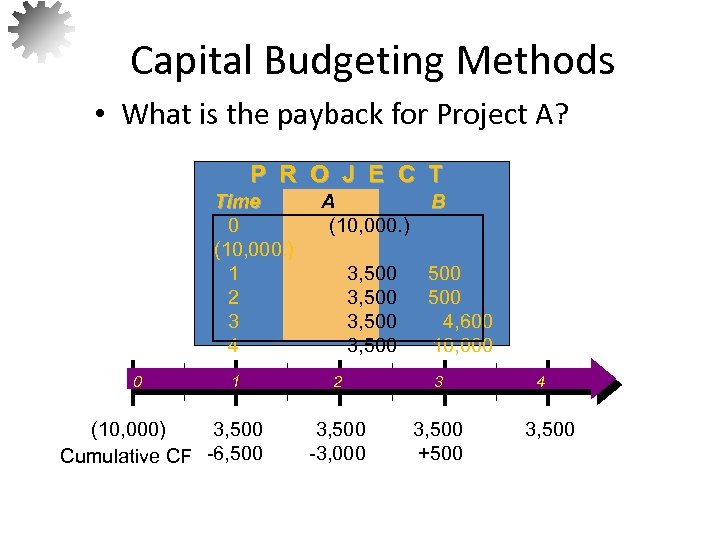 Capital Budgeting Methods • What is the payback for Project A? P R O J E C T Time 0 (10, 000. ) 1 2 3 4 0 1 (10, 000) 3, 500 Cumulative CF -6, 500 A (10, 000. ) 3, 500 B 500 4, 600 10, 000 2 3 3, 500 -3, 000 3, 500 +500 4 3, 500 7
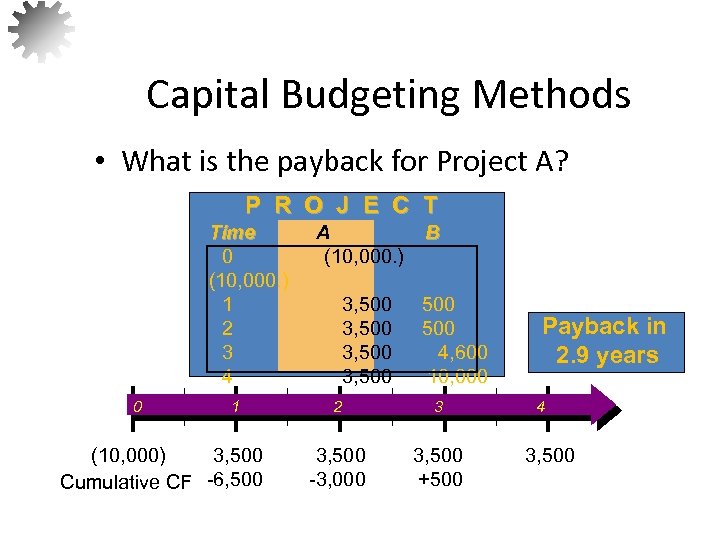 Capital Budgeting Methods • What is the payback for Project A? P R O J E C T Time 0 (10, 000. ) 1 2 3 4 0 1 (10, 000) 3, 500 Cumulative CF -6, 500 A (10, 000. ) 3, 500 B 500 4, 600 10, 000 2 3 3, 500 -3, 000 3, 500 +500 Payback in 2. 9 years 4 3, 500 8
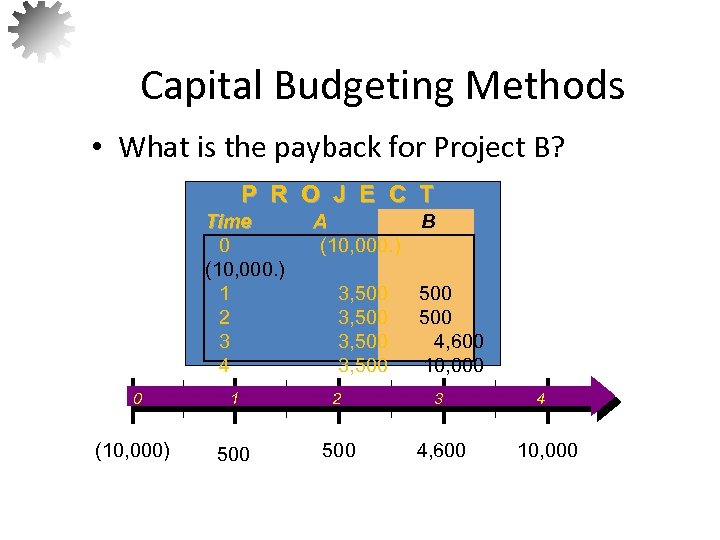 Capital Budgeting Methods • What is the payback for Project B? P R O J E C T Time 0 (10, 000. ) 1 2 3 4 A (10, 000. ) 3, 500 B 500 4, 600 10, 000 0 1 2 3 (10, 000) 500 4, 600 4 10, 000 9
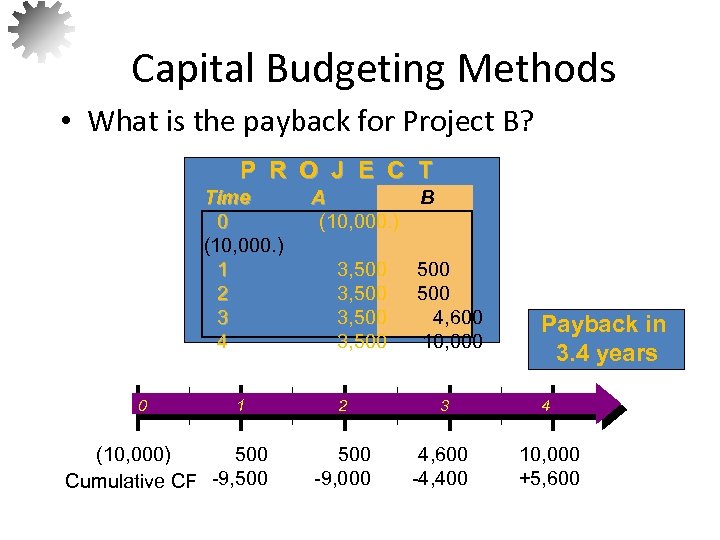 Capital Budgeting Methods • What is the payback for Project B? P R O J E C T Time 0 (10, 000. ) 1 2 3 4 0 1 (10, 000) 500 Cumulative CF -9, 500 A (10, 000. ) 3, 500 B 500 4, 600 10, 000 Payback in 3. 4 years 2 3 4 500 -9, 000 4, 600 -4, 400 10, 000 +5, 600 10
 Payback Decision Rule • Accept project if payback is less than the company’s predetermined maximum. • If company has determined that it requires payback in three years or less, then you would: – accept Project A – reject Project B 11
 Capital Budgeting Methods Net Present Value • Present Value of all costs and benefits (measured in terms of incremental cash flows) of a project. • Concept is similar to Discounted Cashflow model for valuing securities but subtracts the cost of the project. 12
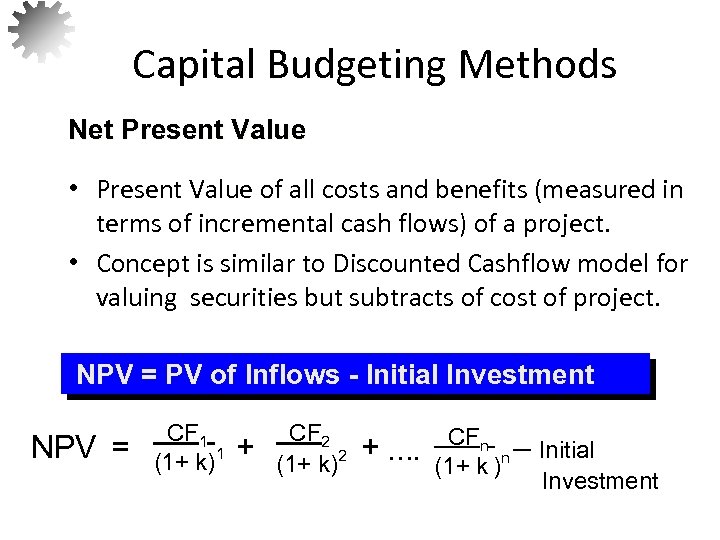 Capital Budgeting Methods Net Present Value • Present Value of all costs and benefits (measured in terms of incremental cash flows) of a project. • Concept is similar to Discounted Cashflow model for valuing securities but subtracts of cost of project. NPV = PV of Inflows - Initial Investment NPV = CF 1 (1+ k)1 + CF 2 (1+ k)2 + …. CFn n – Initial (1+ k ) Investment 13
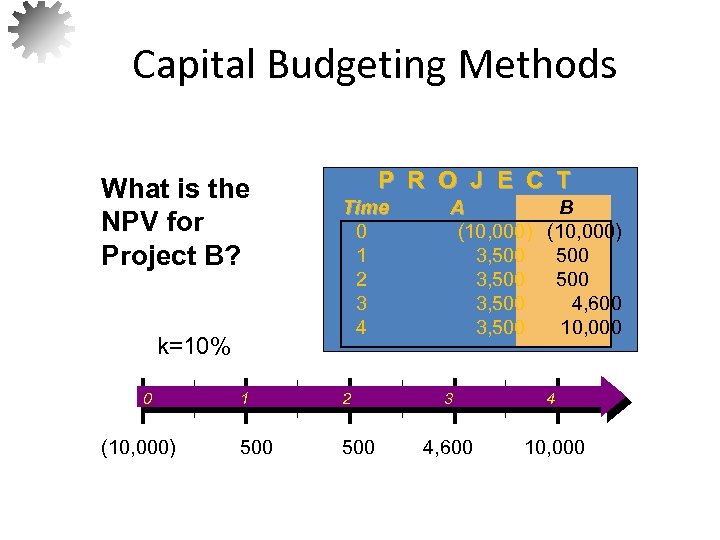 Capital Budgeting Methods What is the NPV for Project B? k=10% 0 (10, 000) P R O J E C T Time 0 1 2 3 4 1 2 500 A B (10, 000) 3, 500 500 3, 500 4, 600 3, 500 10, 000 3 4 4, 600 10, 000 14
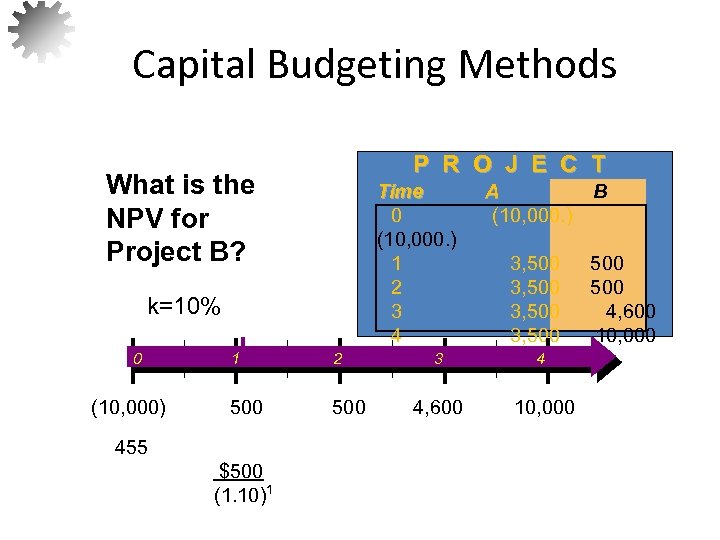 Capital Budgeting Methods P R O J E C T What is the NPV for Project B? Time 0 (10, 000. ) 1 2 3 4 k=10% 0 (10, 000) 1 2 500 A (10, 000. ) 3, 500 3 500 4, 600 10, 000 4 4, 600 B 10, 000 455 $500 (1. 10)1 15
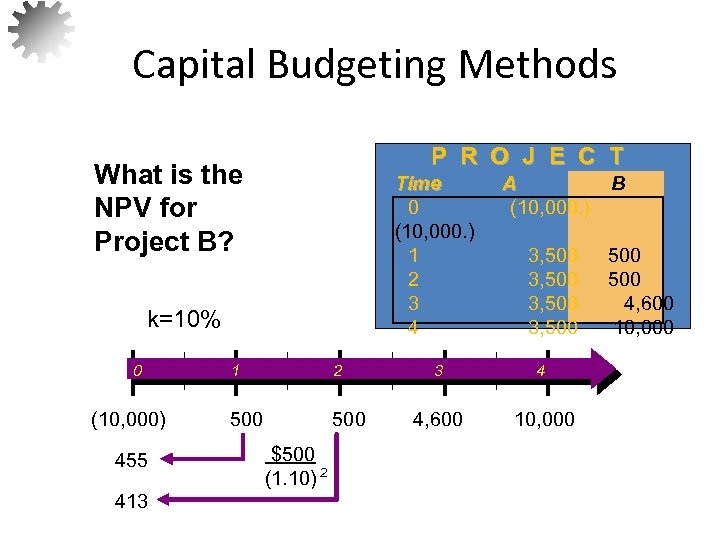 Capital Budgeting Methods P R O J E C T What is the NPV for Project B? Time 0 (10, 000. ) 1 2 3 4 k=10% 0 (10, 000) 455 413 1 2 500 $500 (1. 10) 2 A (10, 000. ) 3, 500 3 500 4, 600 10, 000 4 4, 600 B 10, 000 16
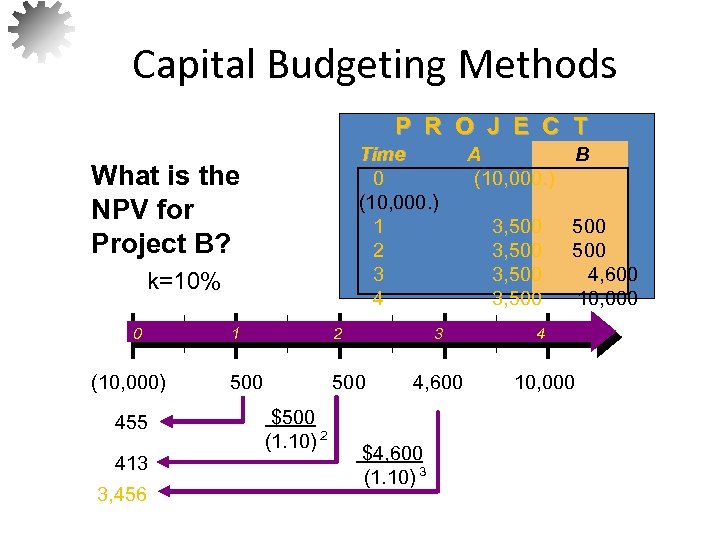 Capital Budgeting Methods P R O J E C T Time 0 (10, 000. ) 1 2 3 4 What is the NPV for Project B? k=10% 0 (10, 000) 455 413 3, 456 1 2 500 $500 (1. 10) 2 A (10, 000. ) 3, 500 B 500 4, 600 10, 000 3 4 4, 600 10, 000 $4, 600 (1. 10) 3 17
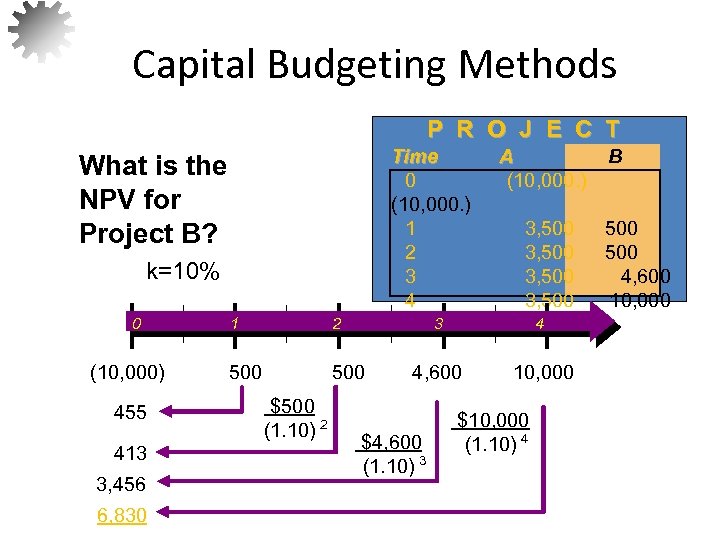 Capital Budgeting Methods P R O J E C T Time 0 (10, 000. ) 1 2 3 4 What is the NPV for Project B? k=10% 0 (10, 000) 455 413 3, 456 6, 830 1 2 500 $500 (1. 10) 2 A (10, 000. ) 3, 500 3 500 4, 600 10, 000 4 4, 600 B 10, 000 $4, 600 (1. 10) 3 $10, 000 (1. 10) 4 18
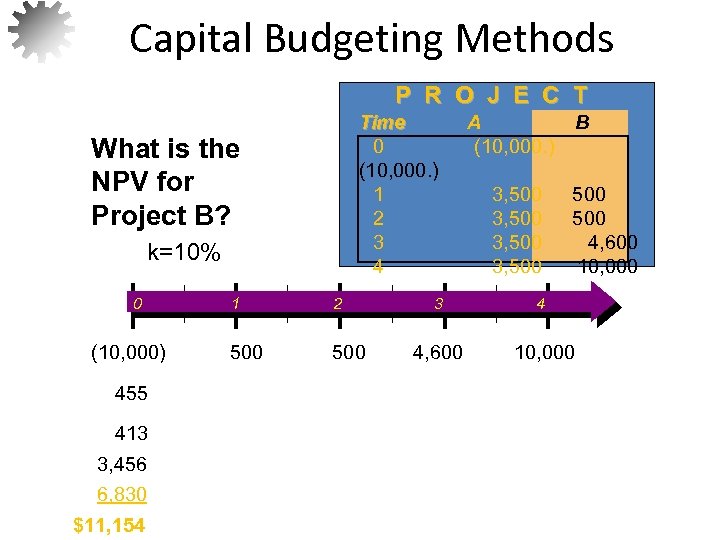 Capital Budgeting Methods P R O J E C T Time 0 (10, 000. ) 1 2 3 4 What is the NPV for Project B? k=10% 0 (10, 000) 1 2 500 A (10, 000. ) 3, 500 B 500 4, 600 10, 000 3 4 4, 600 10, 000 455 413 3, 456 6, 830 $11, 154 19
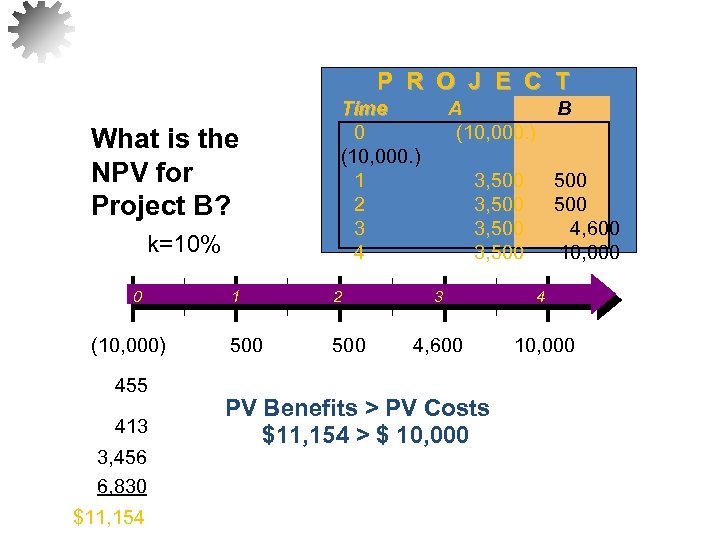 P R O J E C T What is the NPV for Project B? k=10% 0 (10, 000) 455 413 3, 456 6, 830 $11, 154 Time 0 (10, 000. ) 1 2 3 4 1 2 500 A (10, 000. ) B 3, 500 500 4, 600 10, 000 3 4 4, 600 10, 000 PV Benefits > PV Costs $11, 154 > $ 10, 000 20
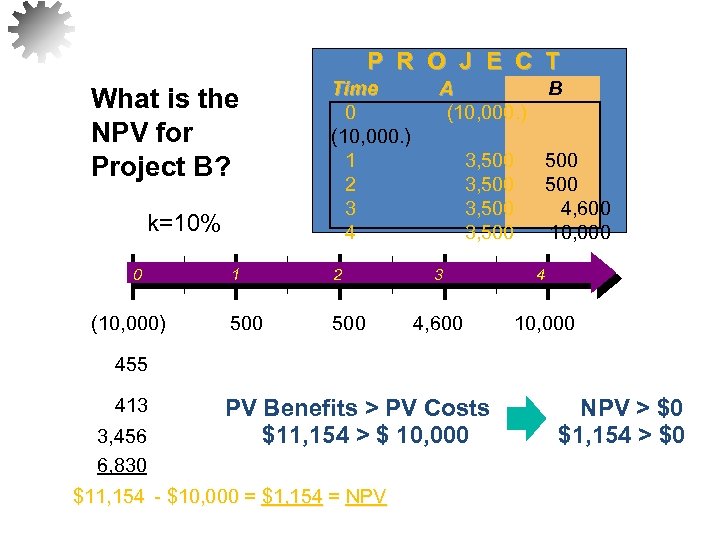 P R O J E C T Time 0 (10, 000. ) 1 2 3 4 A (10, 000. ) 1 2 3 4 500 4, 600 10, 000 What is the NPV for Project B? k=10% 0 (10, 000) 3, 500 B 500 4, 600 10, 000 455 413 3, 456 6, 830 PV Benefits > PV Costs $11, 154 > $ 10, 000 $11, 154 - $10, 000 = $1, 154 = NPV > $0 $1, 154 > $0 21
 Financial Calculator: • Additional Keys used to enter Cash Flows and compute the Net Present Value (NPV) 22
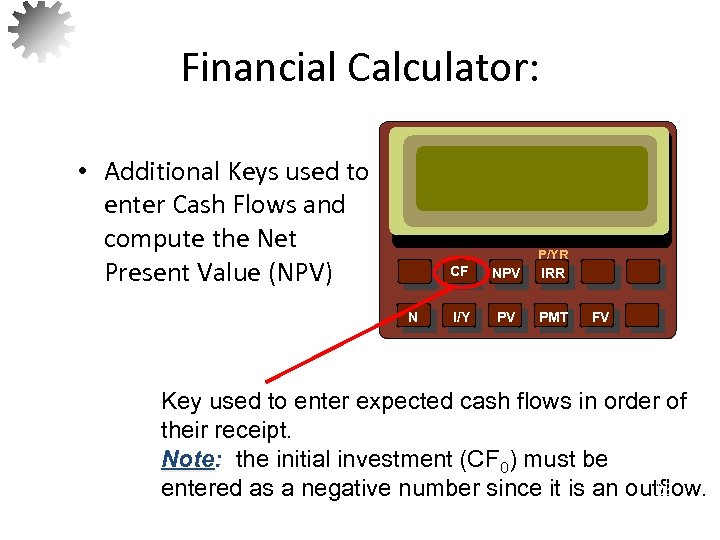 Financial Calculator: • Additional Keys used to enter Cash Flows and compute the Net Present Value (NPV) P/YR CF N NPV IRR I/Y PV PMT FV Key used to enter expected cash flows in order of their receipt. Note: the initial investment (CF 0) must be 23 entered as a negative number since it is an outflow.
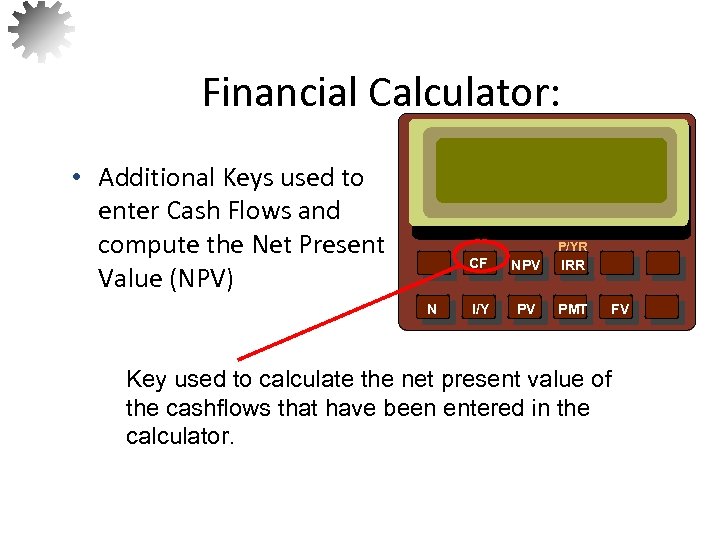 Financial Calculator: • Additional Keys used to enter Cash Flows and compute the Net Present Value (NPV) P/YR CF N NPV IRR I/Y PV PMT FV Key used to calculate the net present value of the cashflows that have been entered in the calculator. 24
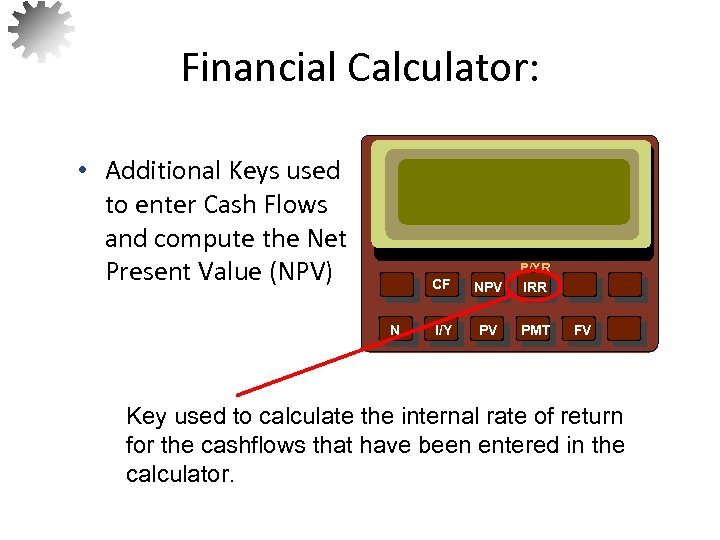 Financial Calculator: • Additional Keys used to enter Cash Flows and compute the Net Present Value (NPV) P/YR CF N NPV IRR I/Y PV PMT FV Key used to calculate the internal rate of return for the cashflows that have been entered in the calculator. 25
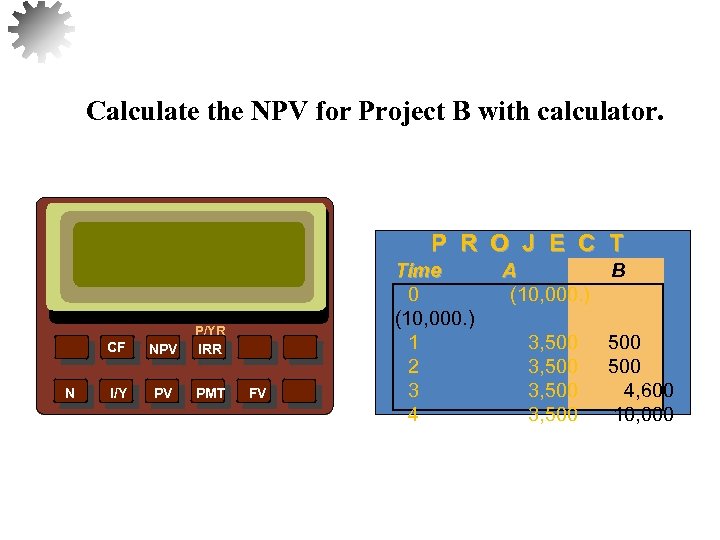 Calculate the NPV for Project B with calculator. P R O J E C T P/YR CF N NPV IRR I/Y PV PMT FV Time 0 (10, 000. ) 1 2 3 4 A (10, 000. ) 3, 500 B 500 4, 600 10, 000 26
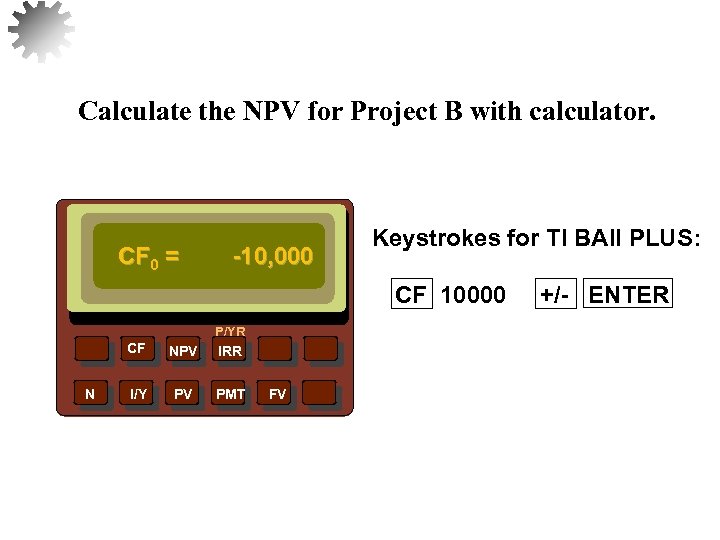 Calculate the NPV for Project B with calculator. CF 0 = -10, 000 Keystrokes for TI BAII PLUS: CF 10000 +/- ENTER P/YR CF N NPV IRR I/Y PV PMT FV 27
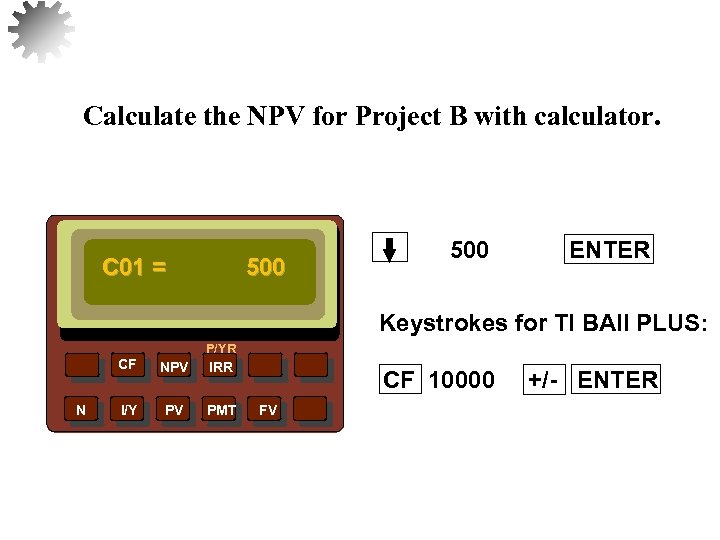 Calculate the NPV for Project B with calculator. C 01 = 500 ENTER Keystrokes for TI BAII PLUS: P/YR CF N NPV IRR I/Y PV PMT CF 10000 +/- ENTER FV 28
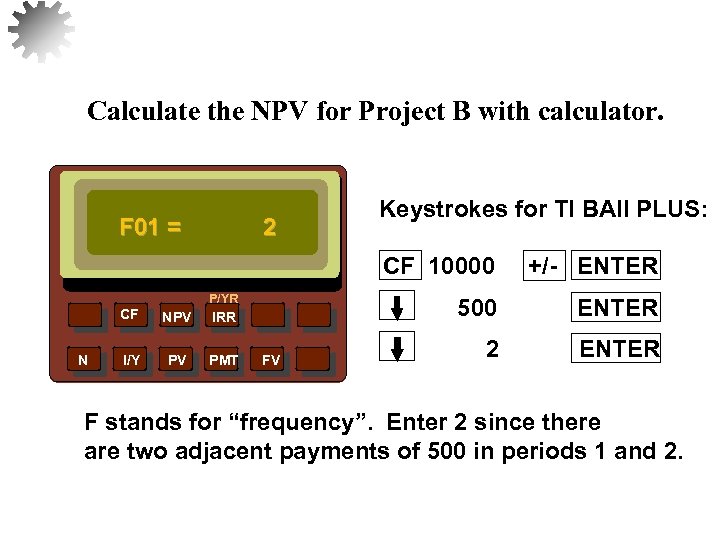 Calculate the NPV for Project B with calculator. F 01 = 2 Keystrokes for TI BAII PLUS: CF 10000 500 P/YR CF N NPV IRR I/Y PV PMT FV +/- ENTER 2 ENTER F stands for “frequency”. Enter 2 since there are two adjacent payments of 500 in periods 1 and 2. 29
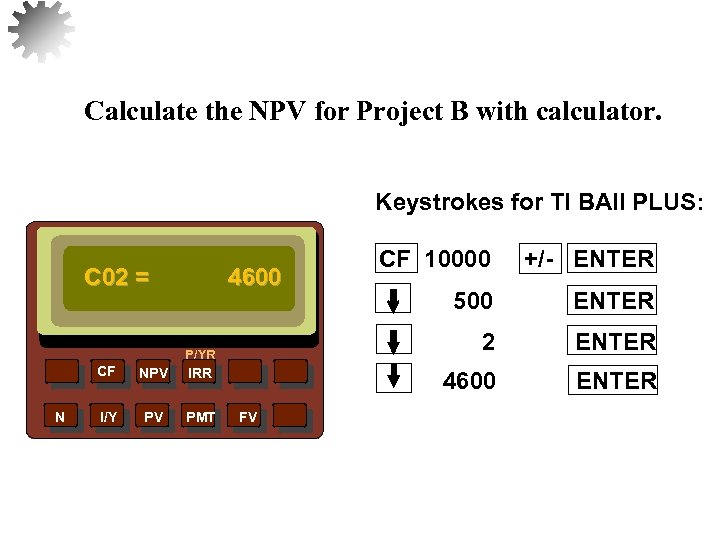 Calculate the NPV for Project B with calculator. Keystrokes for TI BAII PLUS: C 02 = CF N NPV IRR I/Y PV PMT 500 ENTER 4600 P/YR +/- ENTER 2 4600 CF 10000 ENTER FV 30
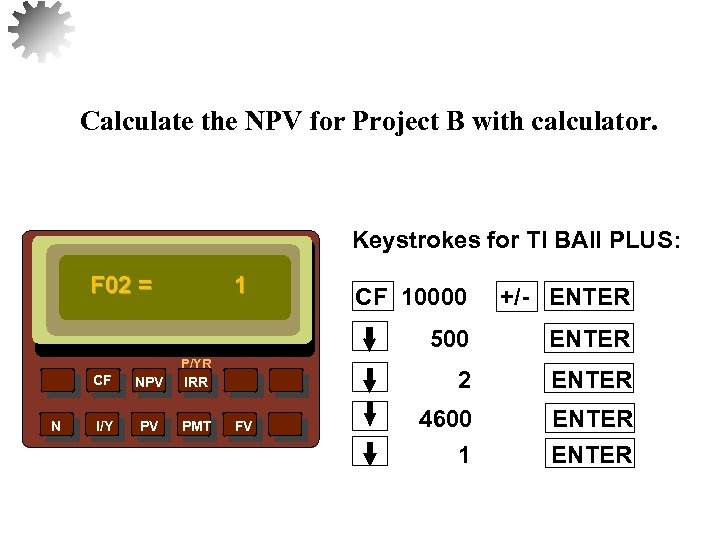 Calculate the NPV for Project B with calculator. Keystrokes for TI BAII PLUS: F 02 = 1 CF N NPV I/Y PV PMT FV ENTER 2 IRR +/- ENTER 500 P/YR CF 10000 ENTER 4600 1 ENTER 31
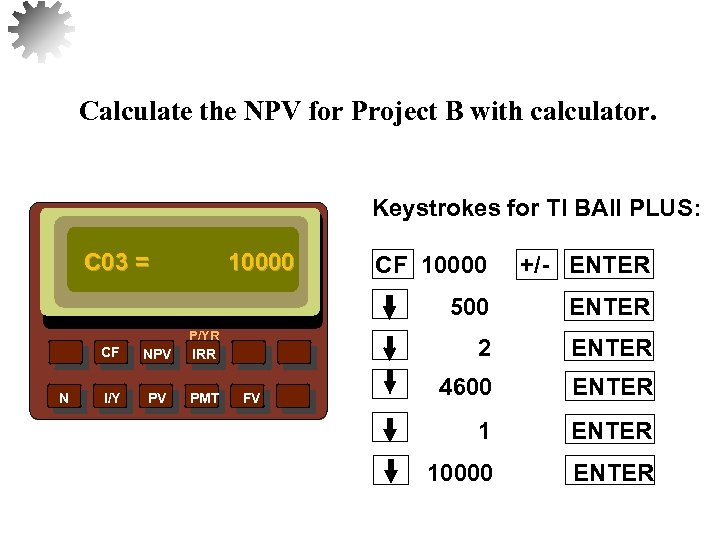 Calculate the NPV for Project B with calculator. Keystrokes for TI BAII PLUS: C 03 = 10000 CF N NPV I/Y PV PMT FV ENTER 2 IRR +/- ENTER 500 P/YR CF 10000 ENTER 4600 ENTER 10000 ENTER 32
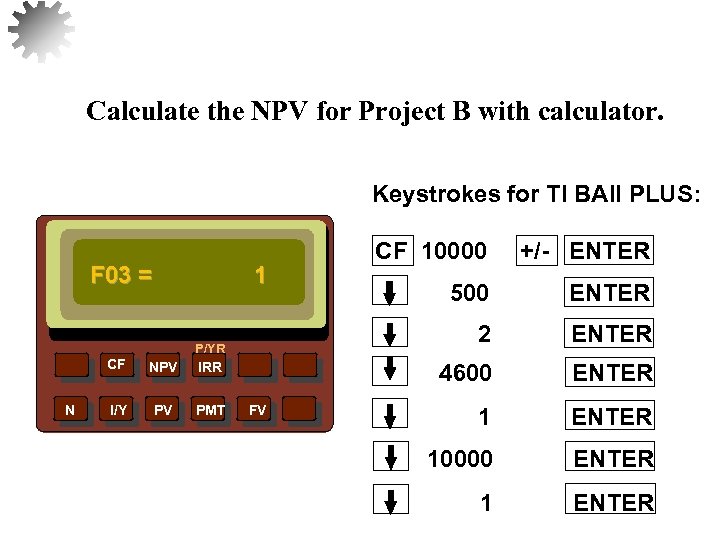 Calculate the NPV for Project B with calculator. Keystrokes for TI BAII PLUS: F 03 = CF N NPV IRR I/Y PV PMT FV 500 ENTER 4600 P/YR +/- ENTER 2 1 CF 10000 ENTER 1 ENTER 33
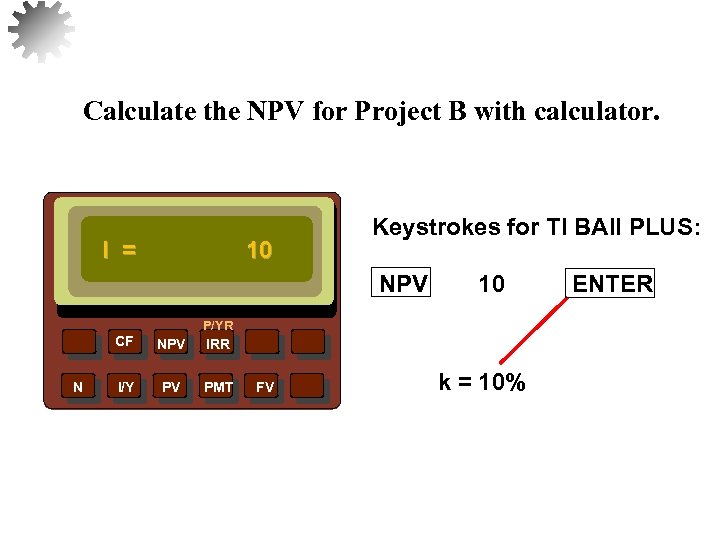 Calculate the NPV for Project B with calculator. I = 10 Keystrokes for TI BAII PLUS: NPV 10 ENTER P/YR CF N NPV IRR I/Y PV PMT FV k = 10% 34
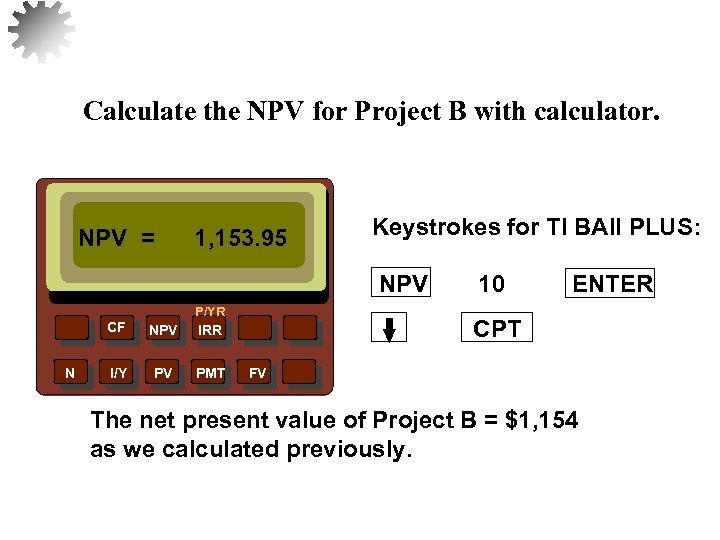 Calculate the NPV for Project B with calculator. NPV = 1, 153. 95 Keystrokes for TI BAII PLUS: NPV P/YR CF N NPV PV PMT ENTER CPT IRR I/Y 10 FV The net present value of Project B = $1, 154 as we calculated previously. 35
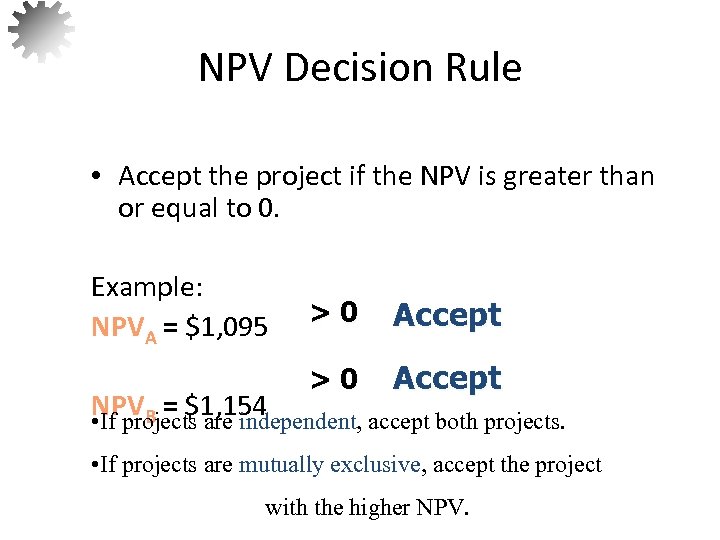 NPV Decision Rule • Accept the project if the NPV is greater than or equal to 0. Example: NPVA = $1, 095 >0 Accept NPVB = $1, 154 • If projects are independent, accept both projects. • If projects are mutually exclusive, accept the project with the higher NPV. 36
 Capital Budgeting Methods • IRR (Internal Rate of Return) – IRR is the discount rate that forces the NPV to equal zero. – It is the rate of return on the project given its initial investment and future cash flows. • The IRR is the rate earned only if all CFs are reinvested at the IRR rate. 37
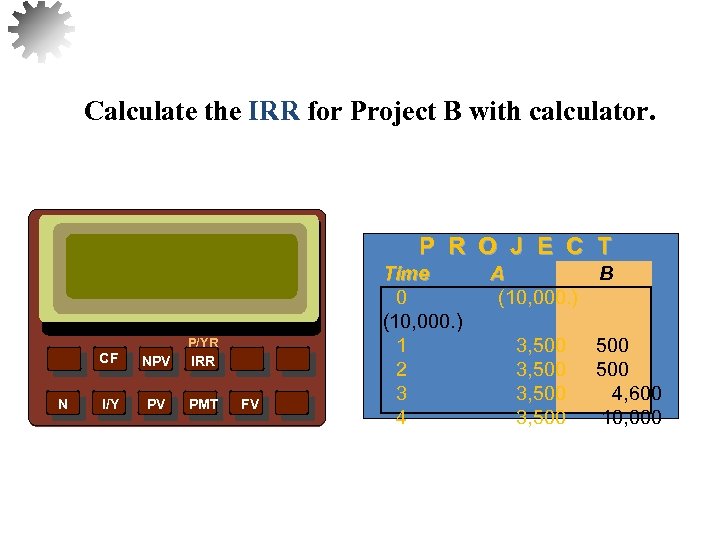 Calculate the IRR for Project B with calculator. P R O J E C T P/YR CF N NPV IRR I/Y PV PMT FV Time 0 (10, 000. ) 1 2 3 4 A (10, 000. ) 3, 500 B 500 4, 600 10, 000 39
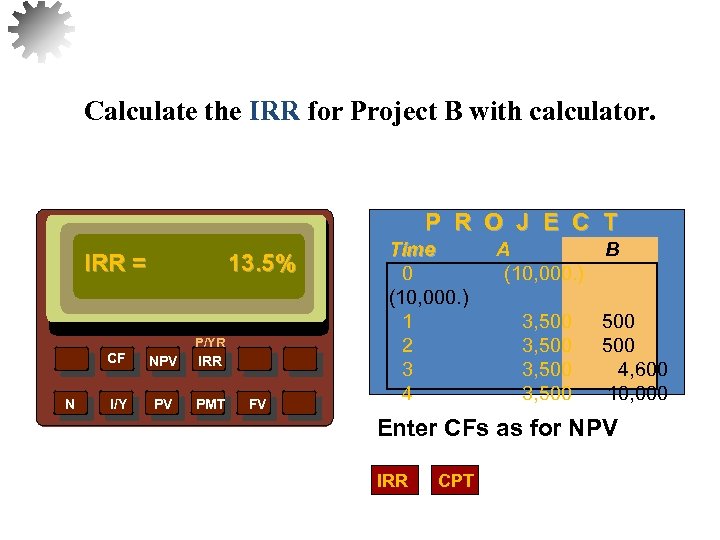 Calculate the IRR for Project B with calculator. P R O J E C T IRR = 13. 5% P/YR CF N NPV IRR I/Y PV PMT FV Time 0 (10, 000. ) 1 2 3 4 A (10, 000. ) 3, 500 B 500 4, 600 10, 000 Enter CFs as for NPV IRR CPT 40
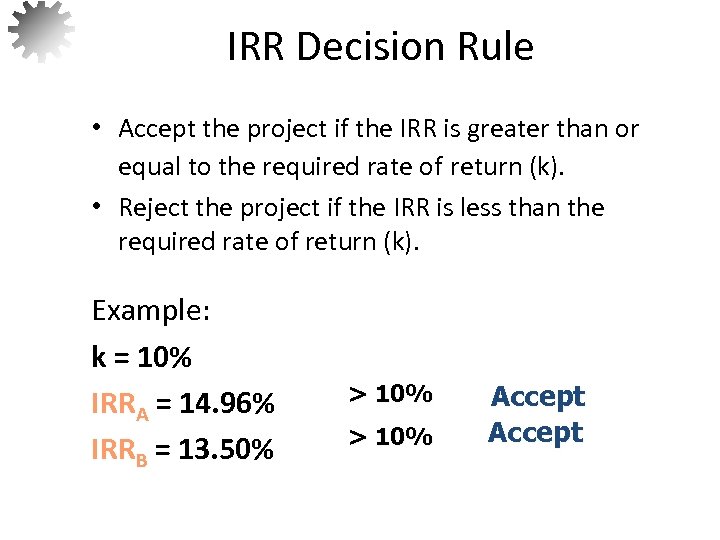 IRR Decision Rule • Accept the project if the IRR is greater than or equal to the required rate of return (k). • Reject the project if the IRR is less than the required rate of return (k). Example: k = 10% IRRA = 14. 96% IRRB = 13. 50% > 10% Accept 41
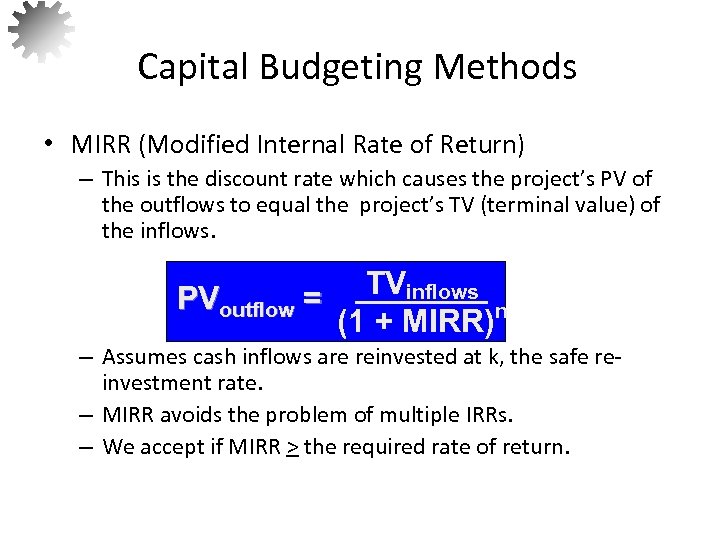 Capital Budgeting Methods • MIRR (Modified Internal Rate of Return) – This is the discount rate which causes the project’s PV of the outflows to equal the project’s TV (terminal value) of the inflows. TVinflows PVoutflow = (1 + MIRR)n – Assumes cash inflows are reinvested at k, the safe reinvestment rate. – MIRR avoids the problem of multiple IRRs. – We accept if MIRR > the required rate of return. 42
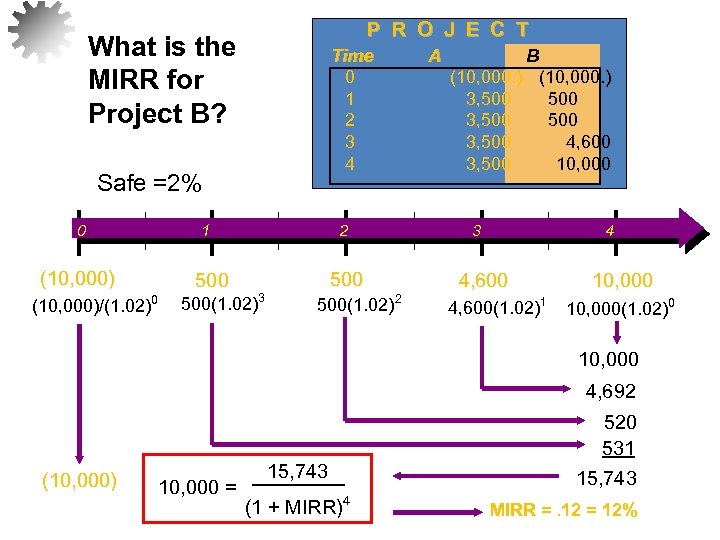 P R O J E C T What is the MIRR for Project B? Time 0 1 2 3 4 Safe =2% 0 (10, 000)/(1. 02)0 1 2 500 500(1. 02)3 500(1. 02)2 A B (10, 000. ) 3, 500 500 3, 500 4, 600 3, 500 10, 000 3 4 4, 600(1. 02)1 10, 000(1. 02)0 10, 000 4, 692 520 531 (10, 000) 10, 000 = 15, 743 (1 + MIRR)4 15, 743 43 MIRR =. 12 = 12%
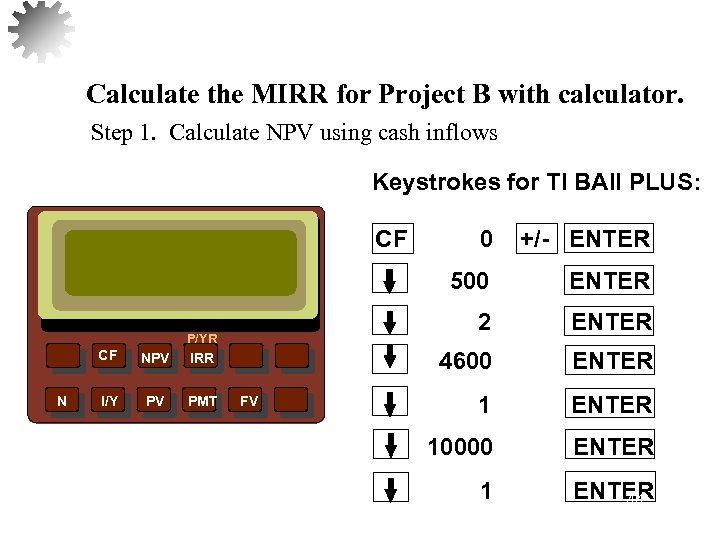 Calculate the MIRR for Project B with calculator. Step 1. Calculate NPV using cash inflows Keystrokes for TI BAII PLUS: CF CF N NPV I/Y PV PMT ENTER 4600 FV ENTER 2 IRR +/- ENTER 500 P/YR 0 ENTER 10000 ENTER 1 ENTER 44
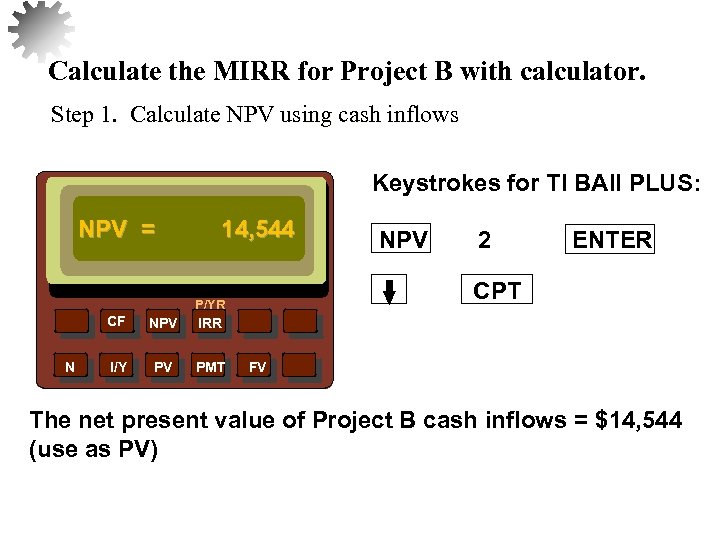 Calculate the MIRR for Project B with calculator. Step 1. Calculate NPV using cash inflows Keystrokes for TI BAII PLUS: NPV = 14, 544 N NPV PV PMT ENTER IRR I/Y 2 CPT P/YR CF NPV FV The net present value of Project B cash inflows = $14, 544 (use as PV) 45
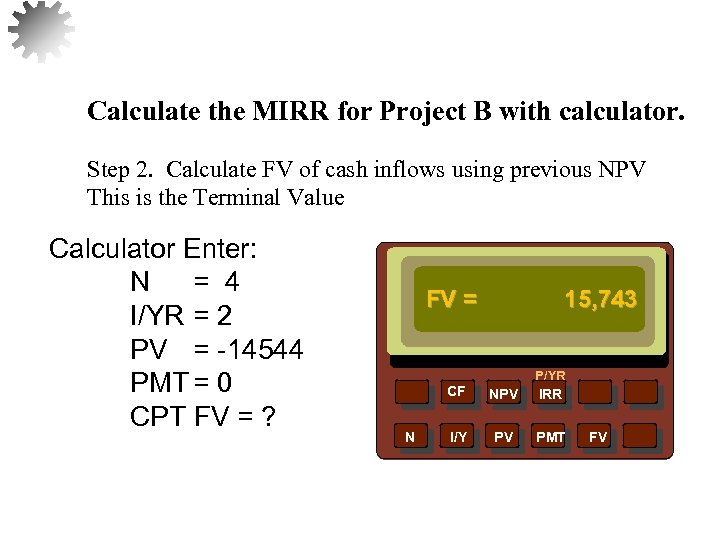 Calculate the MIRR for Project B with calculator. Step 2. Calculate FV of cash inflows using previous NPV This is the Terminal Value Calculator Enter: N = 4 I/YR = 2 PV = -14544 PMT = 0 CPT FV = ? FV = 15, 743 P/YR CF N NPV IRR I/Y PV PMT FV 46
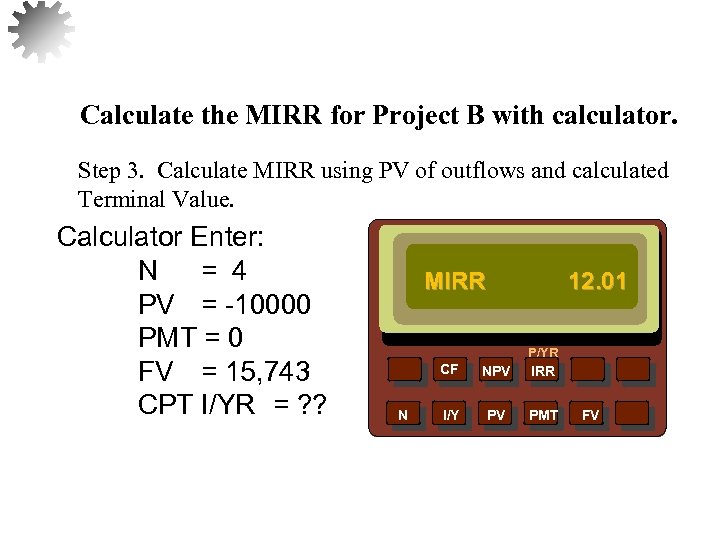 Calculate the MIRR for Project B with calculator. Step 3. Calculate MIRR using PV of outflows and calculated Terminal Value. Calculator Enter: N = 4 PV = -10000 PMT = 0 FV = 15, 743 CPT I/YR = ? ? MIRR 12. 01 P/YR CF N NPV IRR I/Y PV PMT FV 47
 What is capital rationing? • Capital rationing is the practice of placing a dollar limit on the total size of the capital budget. • This practice may not be consistent with maximizing shareholder value but may be necessary for other reasons. • Choose between projects by selecting the combination of projects that yields the highest total NPV without exceeding the capital budget limit. 54
 Measurement of Project Risk • Calculate the coefficient of variation of returns of the firm’s asset portfolio with the project and without it. • This can be done by following a five step process. Observe the following example. 55
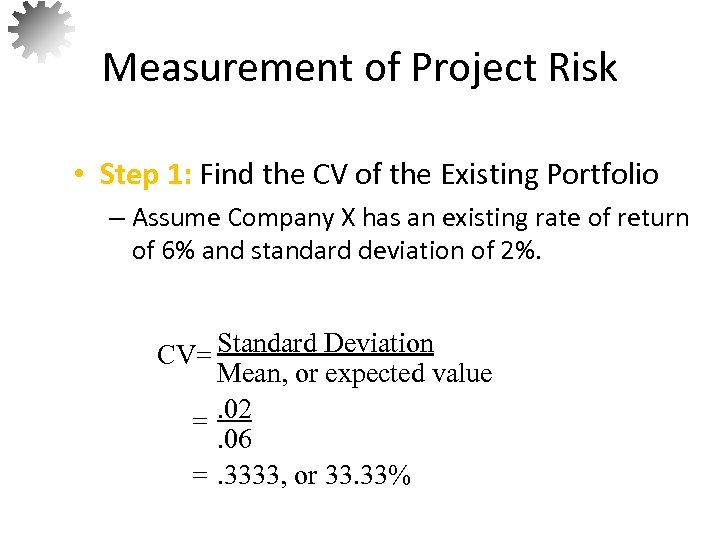 Measurement of Project Risk • Step 1: Find the CV of the Existing Portfolio – Assume Company X has an existing rate of return of 6% and standard deviation of 2%. CV= Standard Deviation Mean, or expected value =. 02. 06 =. 3333, or 33. 33% 56
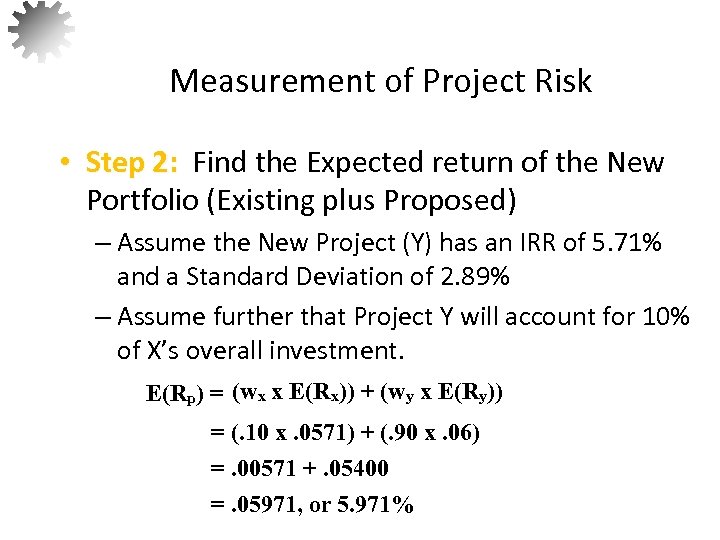 Measurement of Project Risk • Step 2: Find the Expected return of the New Portfolio (Existing plus Proposed) – Assume the New Project (Y) has an IRR of 5. 71% and a Standard Deviation of 2. 89% – Assume further that Project Y will account for 10% of X’s overall investment. E(Rp) = (wx x E(Rx)) + (wy x E(Ry)) = (. 10 x. 0571) + (. 90 x. 06) =. 00571 +. 05400 =. 05971, or 5. 971% 57
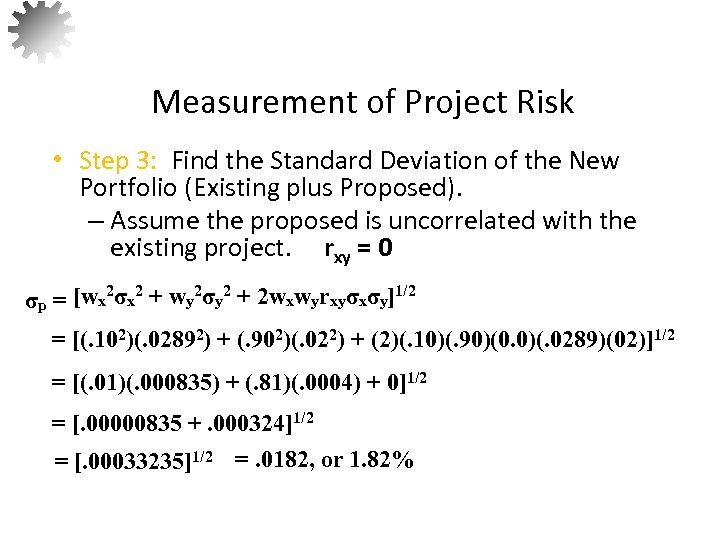 Measurement of Project Risk • Step 3: Find the Standard Deviation of the New Portfolio (Existing plus Proposed). – Assume the proposed is uncorrelated with the existing project. rxy = 0 σp = [wx 2σx 2 + wy 2σy 2 + 2 wxwyrxyσxσy]1/2 = [(. 102)(. 02892) + (. 902)(. 022) + (2)(. 10)(. 90)(0. 0)(. 0289)(02)]1/2 = [(. 01)(. 000835) + (. 81)(. 0004) + 0]1/2 = [. 00000835 +. 000324]1/2 = [. 00033235]1/2 =. 0182, or 1. 82% 58
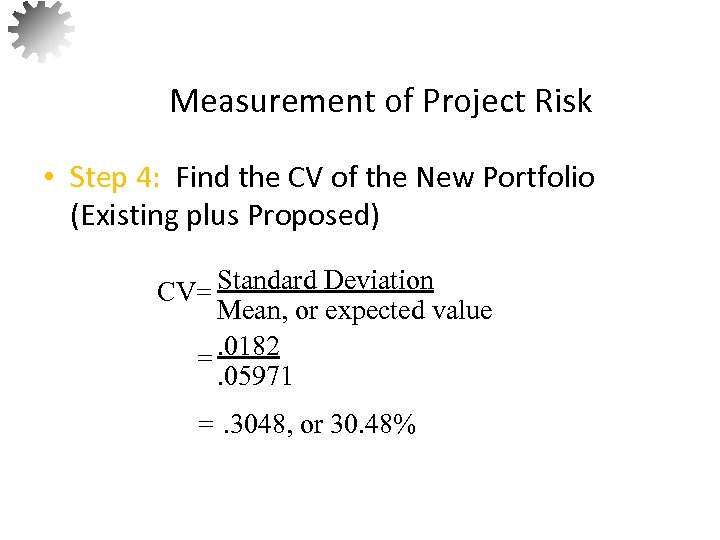 Measurement of Project Risk • Step 4: Find the CV of the New Portfolio (Existing plus Proposed) CV= Standard Deviation Mean, or expected value =. 0182. 05971 =. 3048, or 30. 48% 59
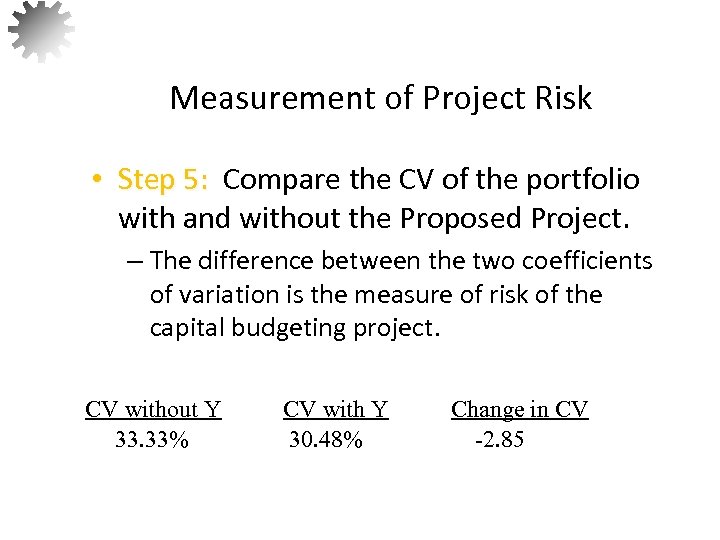 Measurement of Project Risk • Step 5: Compare the CV of the portfolio with and without the Proposed Project. – The difference between the two coefficients of variation is the measure of risk of the capital budgeting project. CV without Y 33. 33% CV with Y 30. 48% Change in CV -2. 85 60
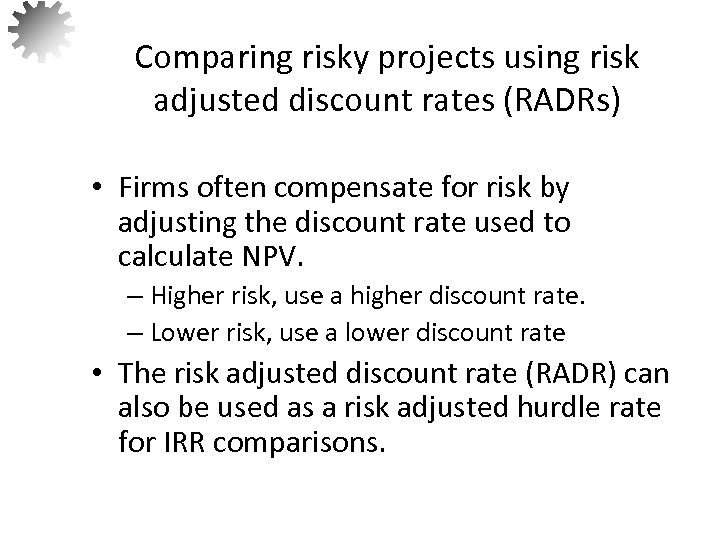 Comparing risky projects using risk adjusted discount rates (RADRs) • Firms often compensate for risk by adjusting the discount rate used to calculate NPV. – Higher risk, use a higher discount rate. – Lower risk, use a lower discount rate • The risk adjusted discount rate (RADR) can also be used as a risk adjusted hurdle rate for IRR comparisons. 61
 Non-simple Projects • Non-simple projects have one or more negative future cash flows after the initial investment. 62
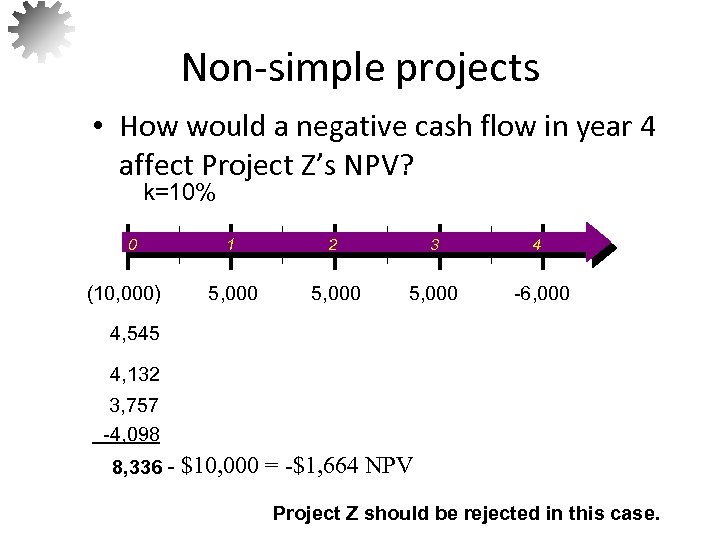 Non-simple projects • How would a negative cash flow in year 4 affect Project Z’s NPV? k=10% 0 (10, 000) 1 2 3 5, 000 4 -6, 000 4, 545 4, 132 3, 757 -4, 098 8, 336 - $10, 000 = -$1, 664 NPV 63 Project Z should be rejected in this case.
 Mutually Exclusive Projects With Unequal Lives • Mutually exclusive projects with unequal project lives can be compared by using two methods: – Replacement Chain – Equivalent Annual Annuity 68
 Replacement Chain Approach • Assumes each project can be replicated until a common period of time has passed, allowing the projects to be compared. • Example – Project Cheap Talk has a 3 -year life, with an NPV of $4, 424. – Project Rolles Voice has a 12 -year life, with an NPV of $4, 510. 69
 Replacement Chain Approach • Project Cheap Talk could be repeated four times during the life of Project Rolles Voice. • The NPVs of Project Cheap Talk, in years t 3, t 6, and t 9, are discounted back to year t 0. 70
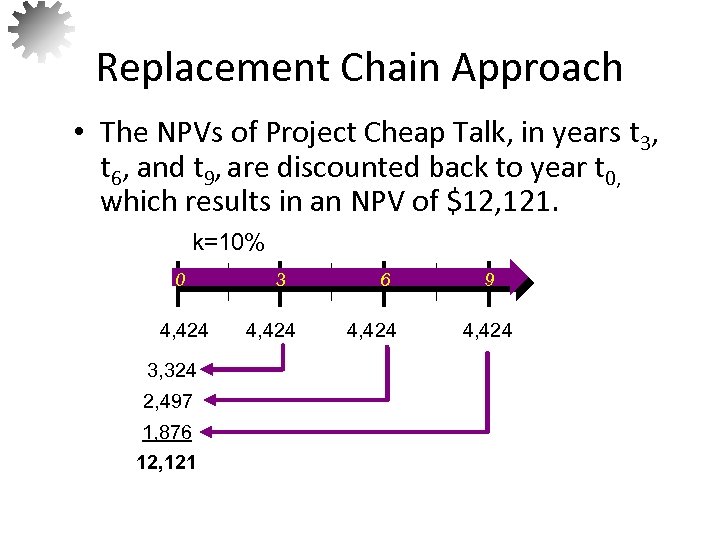 Replacement Chain Approach • The NPVs of Project Cheap Talk, in years t 3, t 6, and t 9, are discounted back to year t 0, which results in an NPV of $12, 121. k=10% 0 4, 424 3 4, 424 6 4, 424 9 4, 424 3, 324 2, 497 1, 876 12, 121 71
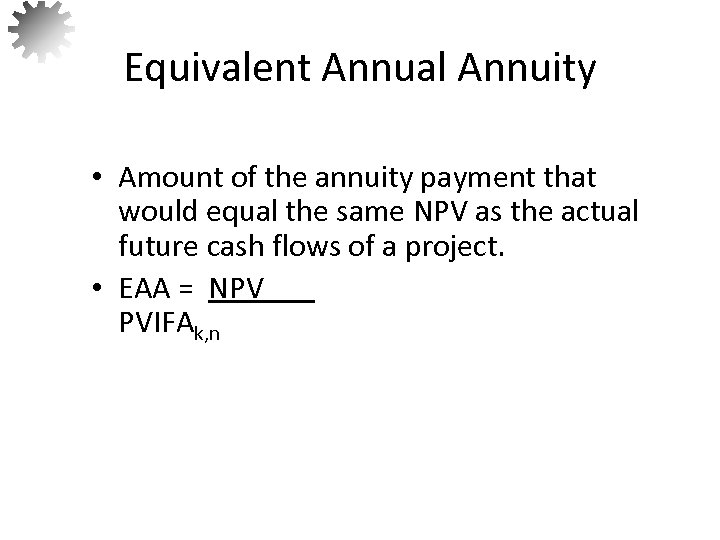 Equivalent Annual Annuity • Amount of the annuity payment that would equal the same NPV as the actual future cash flows of a project. • EAA = NPV PVIFAk, n 72
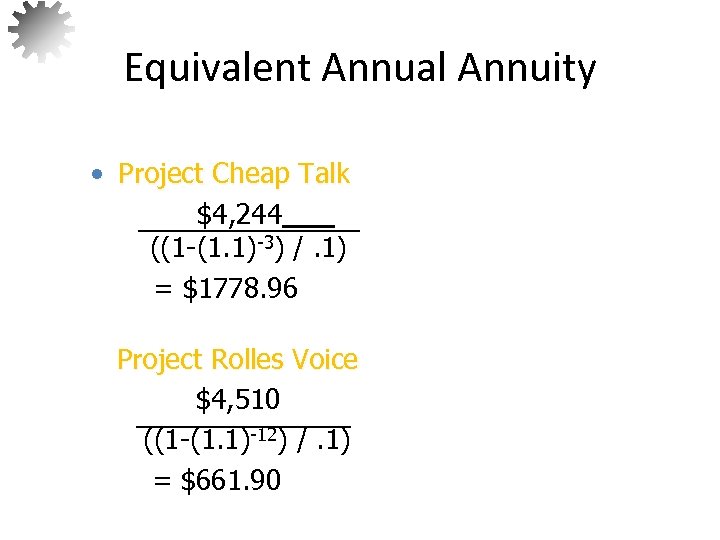 Equivalent Annual Annuity • Project Cheap Talk $4, 244 ((1 -(1. 1)-3) /. 1) = $1778. 96 Project Rolles Voice $4, 510 ((1 -(1. 1)-12) /. 1) = $661. 90 73
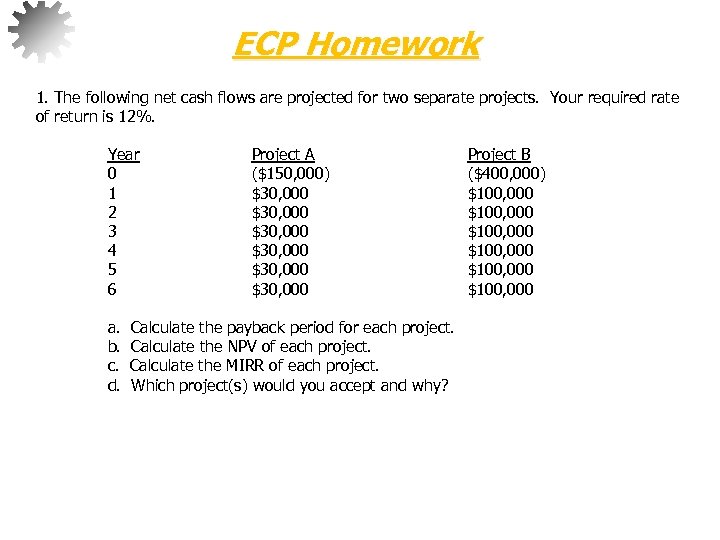 ECP Homework 1. The following net cash flows are projected for two separate projects. Your required rate of return is 12%. Year Project A Project B 0 ($150, 000) ($400, 000) 1 $30, 000 $100, 000 2 $30, 000 $100, 000 3 $30, 000 $100, 000 4 $30, 000 $100, 000 5 $30, 000 $100, 000 6 $30, 000 $100, 000 a. Calculate the payback period for each project. b. Calculate the NPV of each project. c. Calculate the MIRR of each project. d. Which project(s) would you accept and why?
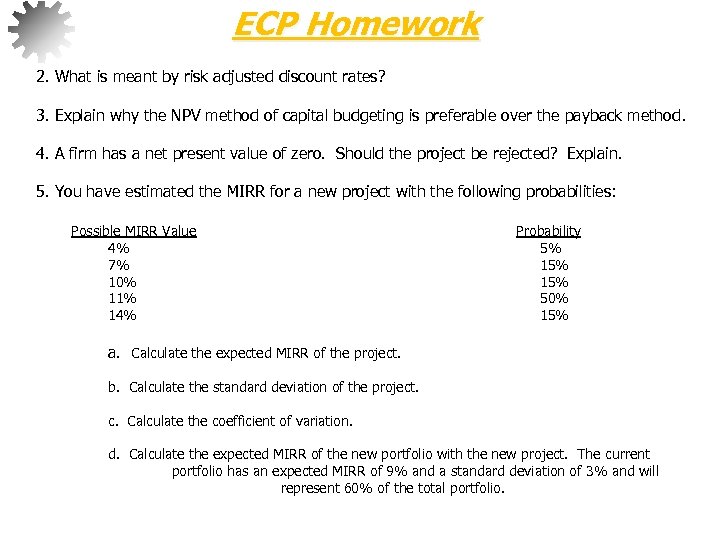 ECP Homework 2. What is meant by risk adjusted discount rates? 3. Explain why the NPV method of capital budgeting is preferable over the payback method. 4. A firm has a net present value of zero. Should the project be rejected? Explain. 5. You have estimated the MIRR for a new project with the following probabilities: Possible MIRR Value Probability 4% 7% 10% 11% 14% 5% 15% 50% 15% a. Calculate the expected MIRR of the project. b. Calculate the standard deviation of the project. c. Calculate the coefficient of variation. d. Calculate the expected MIRR of the new portfolio with the new project. The current portfolio has an expected MIRR of 9% and a standard deviation of 3% and will represent 60% of the total portfolio.
 Business Valuation 98
 Learning Objectives • Understand the importance of business valuation. • Understand the importance of stock and bond valuation. • Learn to compute the value and yield to maturity of bonds. • Learn to compute the value and expected yield on preferred stock and common stock. • Learn to compute the value of a complete business. 99
 General Valuation Model • To develop a general model for valuing a business, we consider three factors that affect future earnings: – Size of cash flows – Timing of cash flows – Risk • We then apply the factors to the Discounted Cash Flow (DCF) Model (Equation 12 -1) 100
 Bond Valuation Model • Bond Valuation is an application of time value model introduced in chapter 8. • The value of the bond is the present value of the cash flows the investor expects to receive. • What are the cashflows from a bond investment? 101
 Bond Valuation Model • 3 Types of Cash Flows – Amount paid to buy the bond (PV) – Coupon interest payments made to the bondholders (PMT) – Repayment of Par value at end of Bond’s life (FV). 102
 Bond Valuation Model • 3 Types of Cash Flows – Amount paid to buy the bond (PV) – Coupon interest payments made to the bondholders (PMT) – Repayment of Par value at end of Bond’s life (FV). • Bond’s time to maturity (N) Discount rate (I/YR) 103
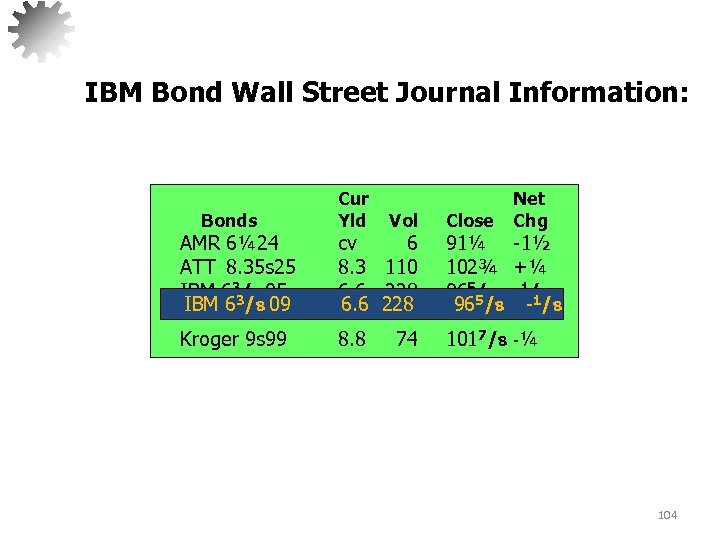 IBM Bond Wall Street Journal Information: Bonds Cur Yld Vol Kroger 9 s 99 8. 8 74 AMR 6¼ 24 cv 6 ATT 8. 35 s 25 8. 3 110 IBM 63/8 05 6. 6 228 IBM 63/8 09 6. 6 228 Close Net Chg 91¼ -1½ 102¾ +¼ 9655 8 -1/8 / 96 /8 -1/8 1017/8 -¼ 104
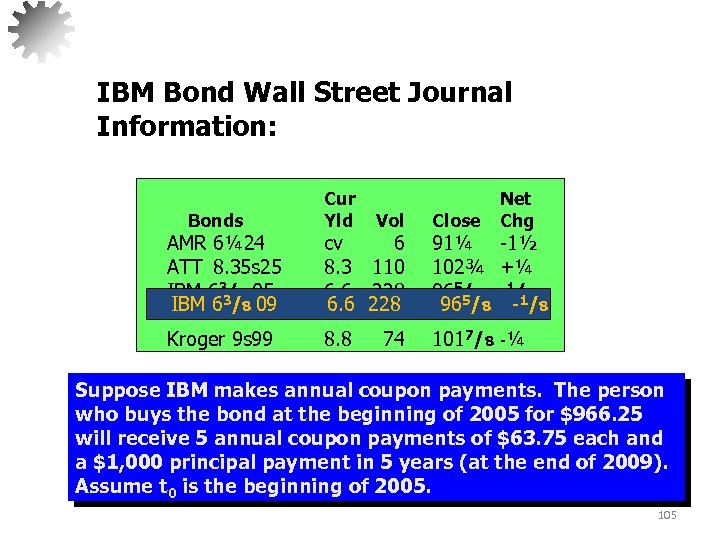 IBM Bond Wall Street Journal Information: Bonds Cur Yld Vol Kroger 9 s 99 8. 8 74 AMR 6¼ 24 cv 6 ATT 8. 35 s 25 8. 3 110 IBM 63/8 05 6. 6 228 IBM 63/8 09 6. 6 228 Close Net Chg 91¼ -1½ 102¾ +¼ 9655 8 -1/8 / 96 /8 -1/8 1017/8 -¼ Suppose IBM makes annual coupon payments. The person who buys the bond at the beginning of 2005 for $966. 25 will receive 5 annual coupon payments of $63. 75 each and a $1, 000 principal payment in 5 years (at the end of 2009). Assume t 0 is the beginning of 2005. 105
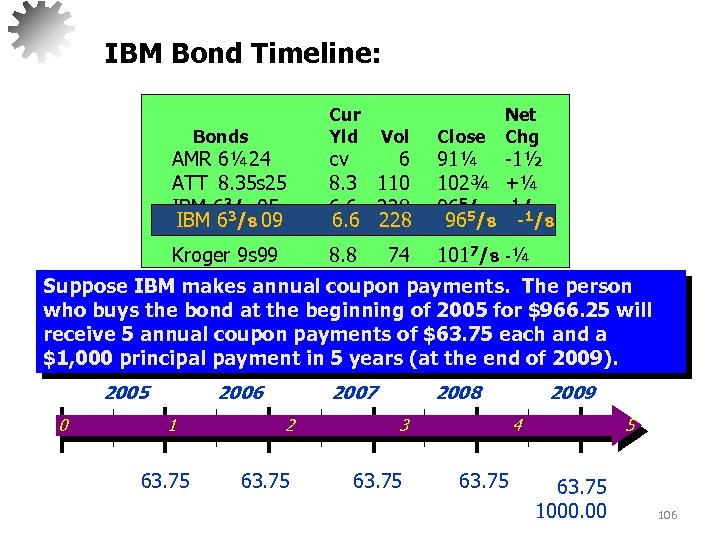 IBM Bond Timeline: Bonds Cur Yld Vol Kroger 9 s 99 8. 8 74 AMR 6¼ 24 cv 6 ATT 8. 35 s 25 8. 3 110 IBM 63/8 05 6. 6 228 IBM 63/8 09 6. 6 228 Close Net Chg 91¼ -1½ 102¾ +¼ 9655 8 -1/8 / 96 /8 -1/8 1017/8 -¼ Suppose IBM makes annual coupon payments. The person who buys the bond at the beginning of 2005 for $966. 25 will receive 5 annual coupon payments of $63. 75 each and a $1, 000 principal payment in 5 years (at the end of 2009). 2005 0 2006 1 63. 75 2007 2 63. 75 2008 3 63. 75 2009 4 63. 75 5 63. 75 1000. 00 106
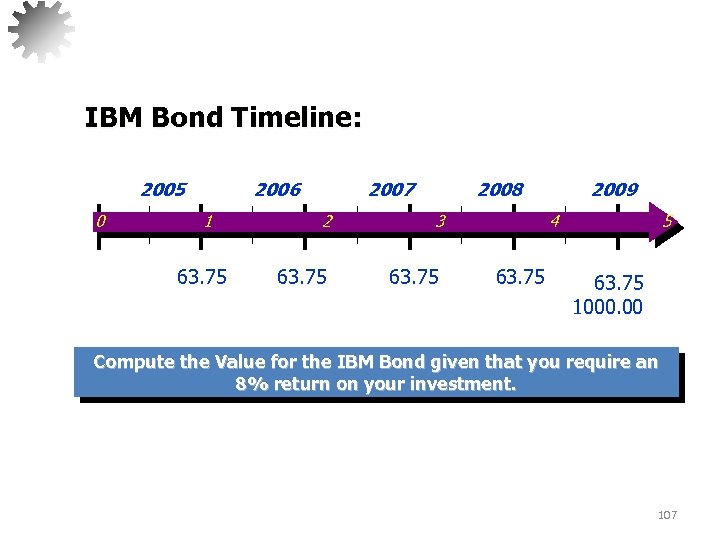 IBM Bond Timeline: 2005 0 2006 1 63. 75 2007 2 63. 75 2008 3 63. 75 2009 4 63. 75 5 63. 75 1000. 00 Compute the Value for the IBM Bond given that you require an 8% return on your investment. 107
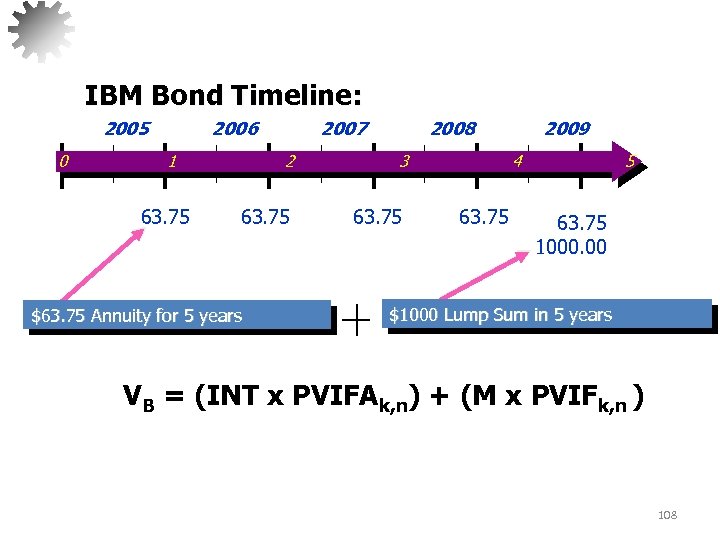 IBM Bond Timeline: 2005 0 2006 1 63. 75 2007 2 63. 75 $63. 75 Annuity for 5 years 2008 3 63. 75 2009 4 63. 75 5 63. 75 1000. 00 $1000 Lump Sum in 5 years VB = (INT x PVIFAk, n) + (M x PVIFk, n ) 108
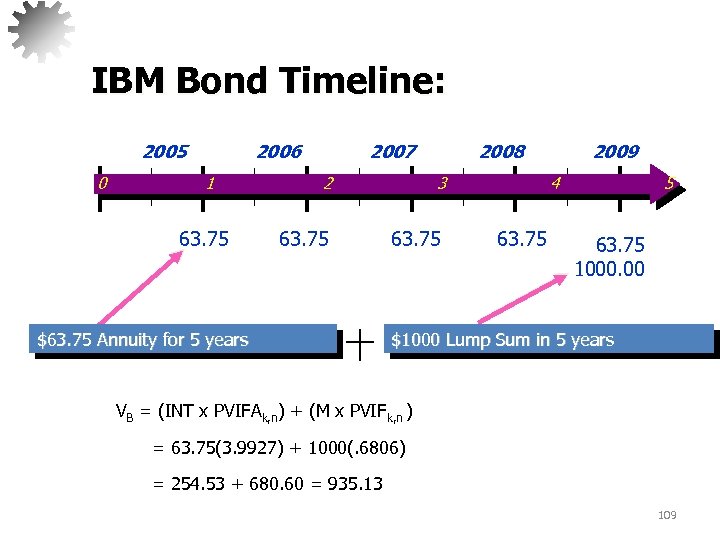 IBM Bond Timeline: 2005 0 2006 1 63. 75 2007 2 63. 75 $63. 75 Annuity for 5 years 2008 3 63. 75 2009 4 63. 75 5 63. 75 1000. 00 $1000 Lump Sum in 5 years VB = (INT x PVIFAk, n) + (M x PVIFk, n ) = 63. 75(3. 9927) + 1000(. 6806) = 254. 53 + 680. 60 = 935. 13 109
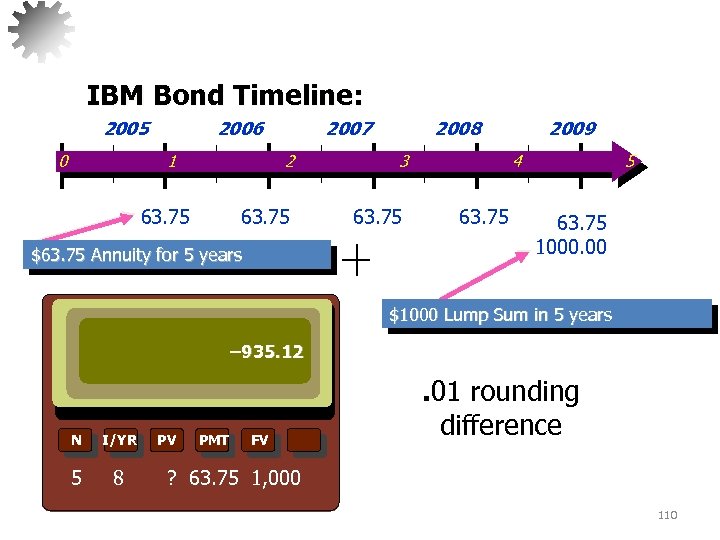 IBM Bond Timeline: 2005 0 2006 1 2007 2 63. 75 $63. 75 Annuity for 5 years 2008 3 63. 75 2009 4 63. 75 5 63. 75 1000. 00 $1000 Lump Sum in 5 years – 935. 12 N I/YR PV PMT FV . 01 rounding difference 5 8 ? 63. 75 1, 000 110
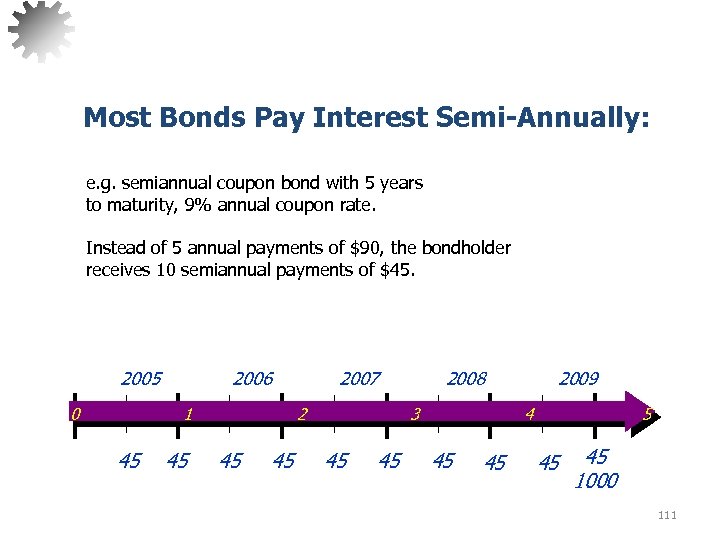 Most Bonds Pay Interest Semi-Annually: e. g. semiannual coupon bond with 5 years to maturity, 9% annual coupon rate. Instead of 5 annual payments of $90, the bondholder receives 10 semiannual payments of $45. 2005 0 2006 1 45 45 2007 2 45 45 2008 3 45 45 2009 4 45 45 45 1000 111
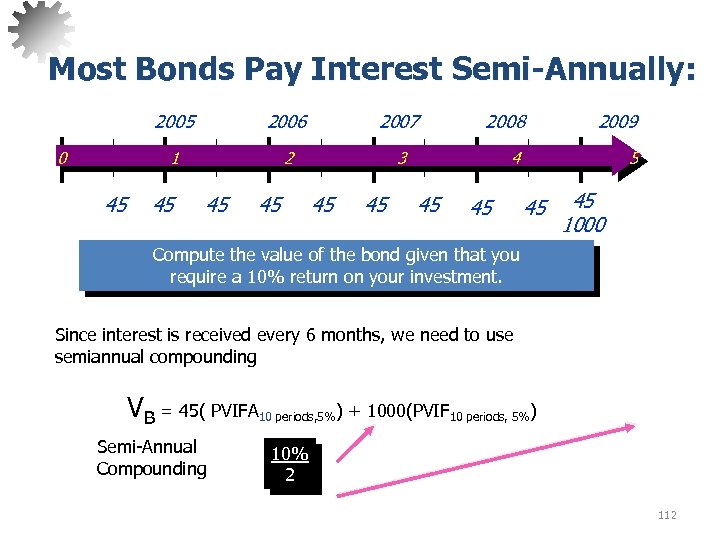 Most Bonds Pay Interest Semi-Annually: 2005 0 2006 2007 2 3 1 45 45 45 2008 2009 4 45 45 45 1000 Compute the value of the bond given that you require a 10% return on your investment. Since interest is received every 6 months, we need to use semiannual compounding VB = 45( PVIFA 10 periods, 5%) + 1000(PVIF 10 periods, 5%) Semi-Annual Compounding 10% 2 112
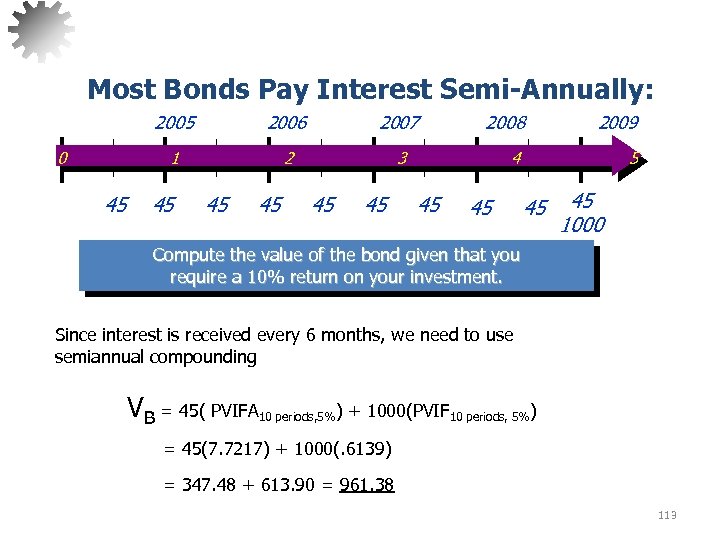 Most Bonds Pay Interest Semi-Annually: 2005 0 2006 2007 2 3 1 45 45 45 2008 2009 4 45 45 45 1000 Compute the value of the bond given that you require a 10% return on your investment. Since interest is received every 6 months, we need to use semiannual compounding VB = 45( PVIFA 10 periods, 5%) + 1000(PVIF 10 periods, 5%) = 45(7. 7217) + 1000(. 6139) = 347. 48 + 613. 90 = 961. 38 113
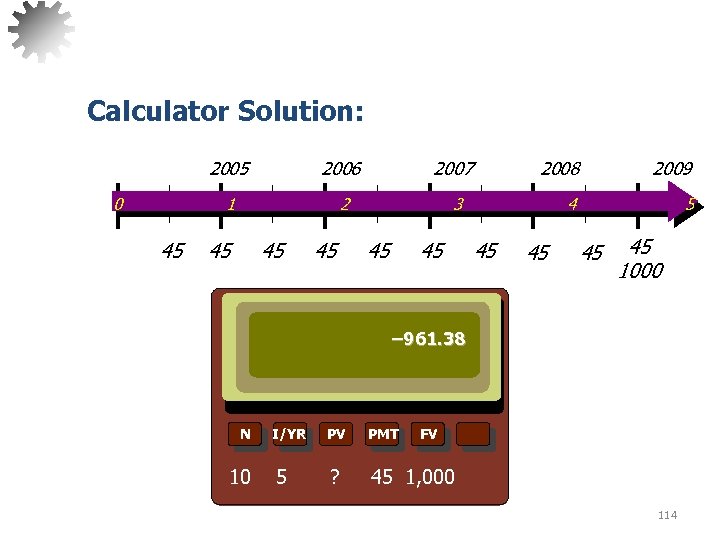 Calculator Solution: 2005 0 2006 1 45 2007 2 45 45 45 2008 2009 4 5 3 45 45 45 1000 – 961. 38 N I/YR PV PMT FV 10 5 ? 45 1, 000 114
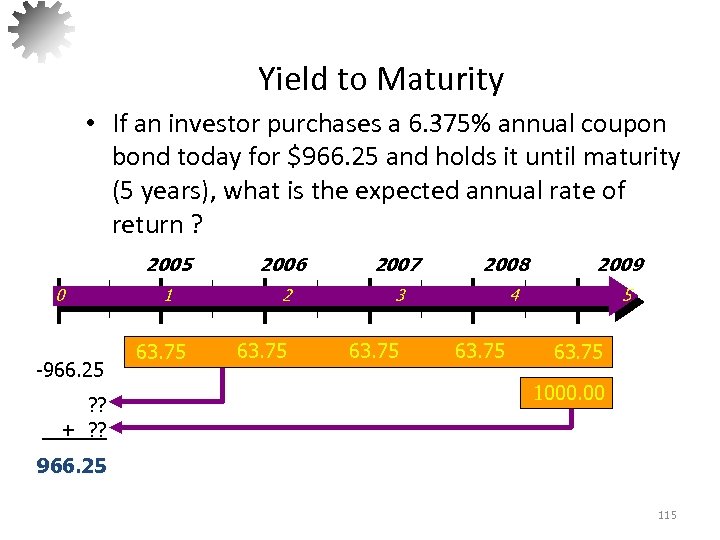 Yield to Maturity • If an investor purchases a 6. 375% annual coupon bond today for $966. 25 and holds it until maturity (5 years), what is the expected annual rate of return ? 2005 0 -966. 25 ? ? + ? ? 2006 2007 1 2 3 63. 75 2008 2009 4 63. 75 5 63. 75 1000. 00 966. 25 115
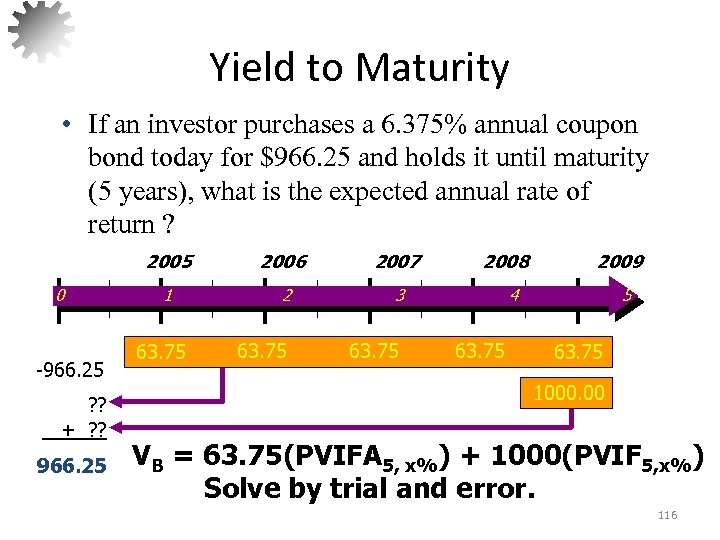 Yield to Maturity • If an investor purchases a 6. 375% annual coupon bond today for $966. 25 and holds it until maturity (5 years), what is the expected annual rate of return ? 2005 0 -966. 25 ? ? + ? ? 966. 25 2006 2007 1 2 3 63. 75 2008 2009 4 63. 75 5 63. 75 1000. 00 VB = 63. 75(PVIFA 5, x%) + 1000(PVIF 5, x%) Solve by trial and error. 116
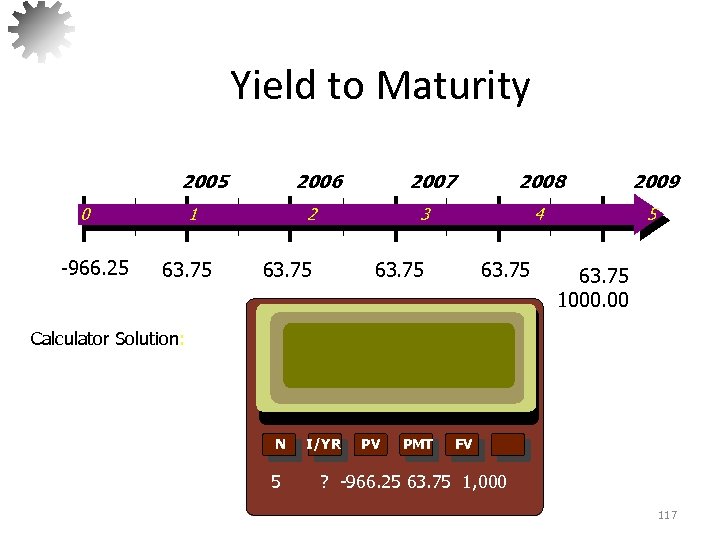 Yield to Maturity 2005 0 -966. 25 2006 1 63. 75 2007 2 63. 75 2008 2009 4 5 3 63. 75 Calculator Solution: 63. 75 1000. 00 7. 203% N I/YR PV PMT FV 5 ? -966. 25 63. 75 1, 000 117
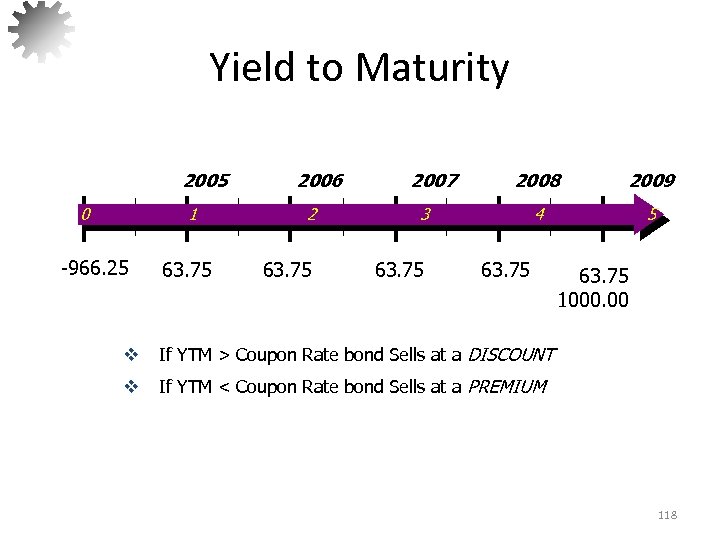 Yield to Maturity 2005 0 1 -966. 25 63. 75 2006 2 63. 75 2007 2008 2009 4 5 3 63. 75 v If YTM > Coupon Rate bond Sells at a DISCOUNT v 63. 75 1000. 00 If YTM < Coupon Rate bond Sells at a PREMIUM 118
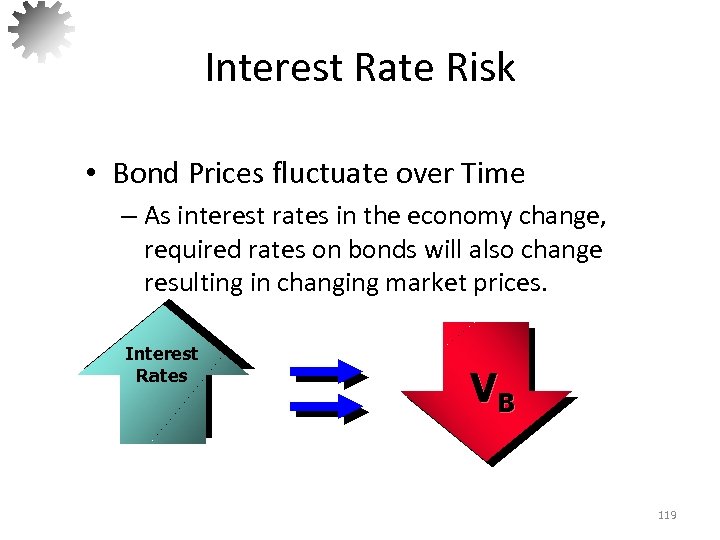 Interest Rate Risk • Bond Prices fluctuate over Time – As interest rates in the economy change, required rates on bonds will also change resulting in changing market prices. Interest Rates VB 119
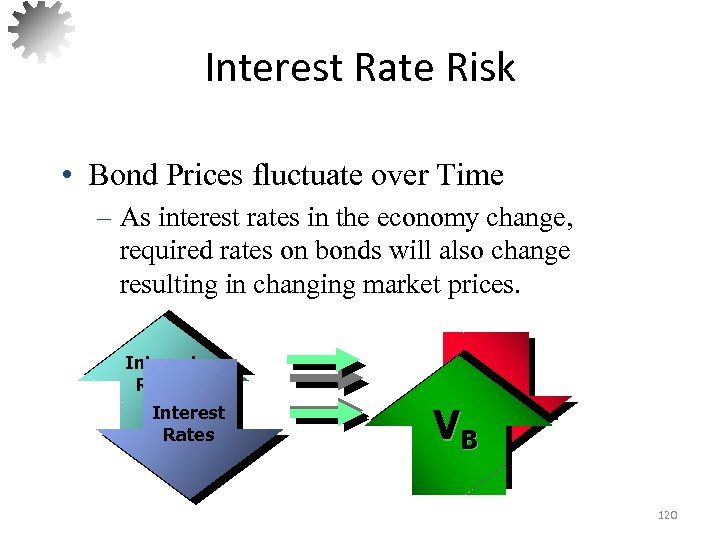 Interest Rate Risk • Bond Prices fluctuate over Time – As interest rates in the economy change, required rates on bonds will also change resulting in changing market prices. Interest Rates VB VB 120
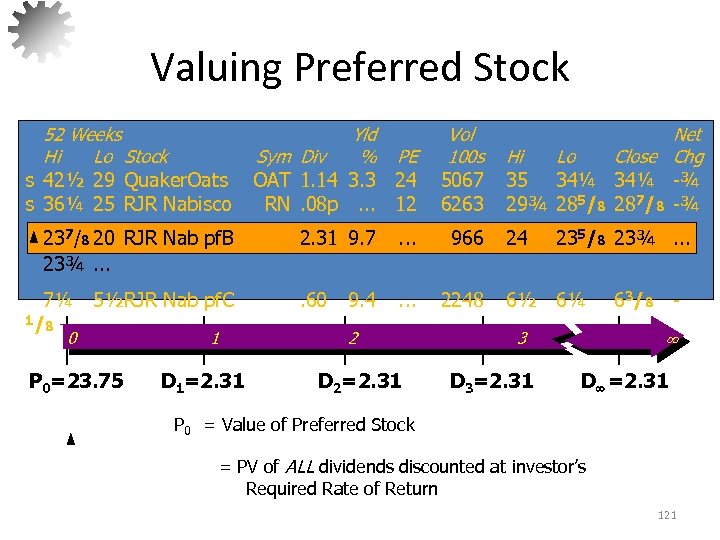 Valuing Preferred Stock 52 Weeks Hi Lo Stock s 42½ 29 Quaker. Oats s 36¼ 25 RJR Nabisco Yld Sym Div % PE OAT 1. 14 3. 3 24 RN. 08 p. . . 12 Vol 100 s 5067 6263 /8 RJR Nab pf. B 9. 7. . . 237/8 20 20 RJR Nab pf. B 2. 31 9. 7 23¾. . . 966. . . 7¼ 5½RJR Nab pf. C 1/8 0 P 0=23. 75 1 D 1=2. 31 . 60 9. 4 . . . 2 D 2=2. 31 2248 Net Hi Lo Close Chg 35 34¼ -¾ 29¾ 285/8 287/8 -¾ 24 23 23¾ 966 245/8 235/8 . . . 6½ 6¼ 3 D 3=2. 31 63/8 - D =2. 31 P 0 = Value of Preferred Stock = PV of ALL dividends discounted at investor’s Required Rate of Return 121
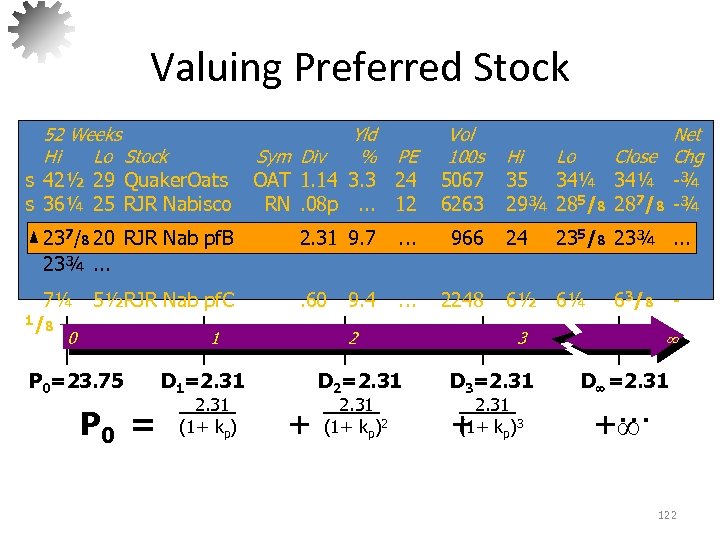 Valuing Preferred Stock 52 Weeks Hi Lo Stock s 42½ 29 Quaker. Oats s 36¼ 25 RJR Nabisco Yld Sym Div % PE OAT 1. 14 3. 3 24 RN. 08 p. . . 12 Vol 100 s 5067 6263 /8 RJR Nab pf. B 9. 7. . . 237/8 20 20 RJR Nab pf. B 2. 31 9. 7 23¾. . . 966. . . 7¼ 5½RJR Nab pf. C 1/8 0 1 P 0=23. 75 P 0 = D 1=2. 31 (1+ kp) . 60 9. 4 . . . 2 D 2=2. 31 (1+ kp)2 2248 Net Hi Lo Close Chg 35 34¼ -¾ 29¾ 285/8 287/8 -¾ 24 23 23¾ 966 245/8 235/8 . . . 6½ 6¼ 63/8 3 D 3=2. 31 (1+ kp)3 D =2. 31 + +··· 122
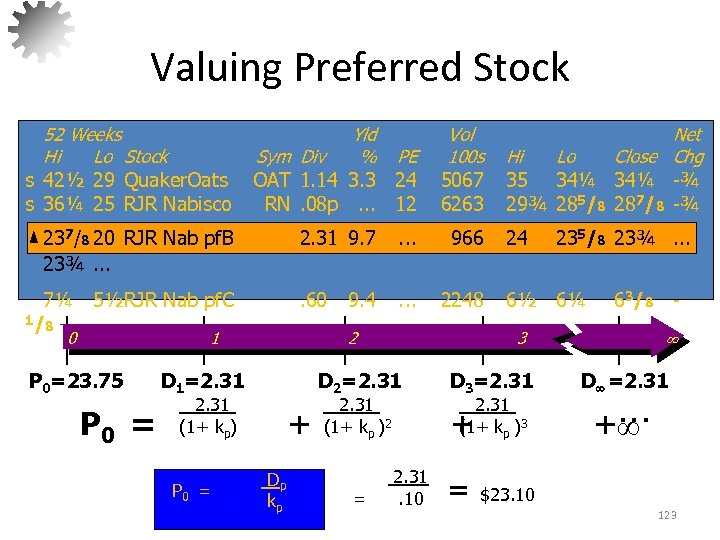 Valuing Preferred Stock 52 Weeks Hi Lo Stock s 42½ 29 Quaker. Oats s 36¼ 25 RJR Nabisco Yld Sym Div % PE OAT 1. 14 3. 3 24 RN. 08 p. . . 12 Vol 100 s 5067 6263 /8 RJR Nab pf. B 9. 7. . . 237/8 20 20 RJR Nab pf. B 2. 31 9. 7 23¾. . . 966. . . 7¼ 5½RJR Nab pf. C 1/8 0 . 60 1 P 0=23. 75 P 0 = . . . 2 D 1=2. 31 (1+ kp) 9. 4 2248 Net Hi Lo Close Chg 35 34¼ -¾ 29¾ 285/8 287/8 -¾ 24 23 23¾ 966 245/8 235/8 . . . 6½ 6¼ 63/8 3 D 2=2. 31 (1+ kp )2 D 3=2. 31 (1+ kp )3 D =2. 31 + +··· Dp kp = 2. 31 . 10 = $23. 10 123
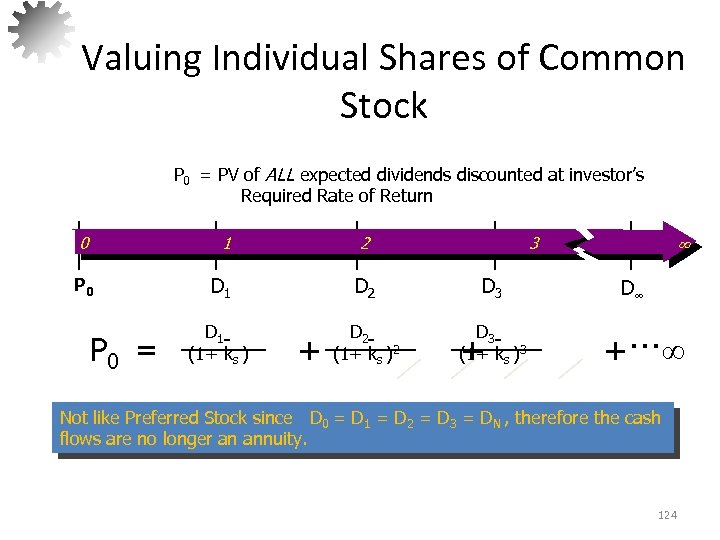 Valuing Individual Shares of Common Stock P 0 = PV of ALL expected dividends discounted at investor’s Required Rate of Return 0 1 2 D 1 D 2 D 3 D 1 (1+ ks ) P 0 3 D 2 (1+ ks )2 D 3 (1+ ks )3 D P 0 = + +··· Not like Preferred Stock since D 0 = D 1 = D 2 = D 3 = DN , therefore the cash flows are no longer an annuity. 124
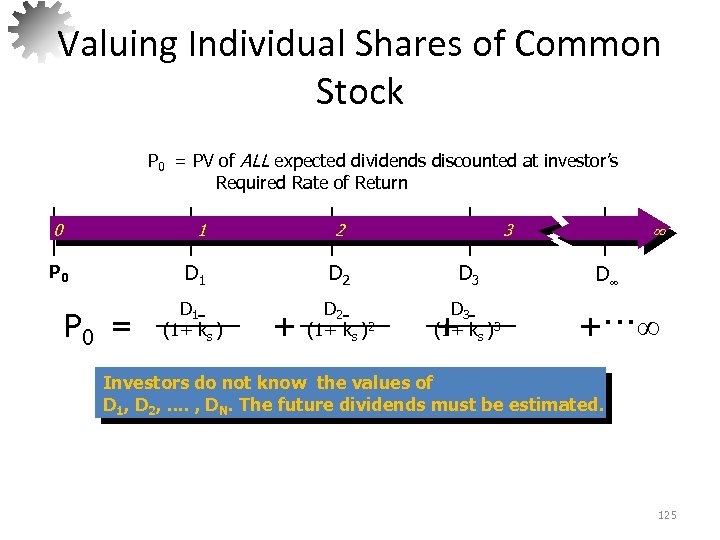 Valuing Individual Shares of Common Stock P 0 = PV of ALL expected dividends discounted at investor’s Required Rate of Return 0 1 P 0 2 3 D 1 D 2 D 3 D 1 (1+ ks ) D 2 (1+ ks )2 D 3 (1+ ks )3 D P 0 = + +··· Investors do not know the values of D 1, D 2, . . , DN. The future dividends must be estimated. 125
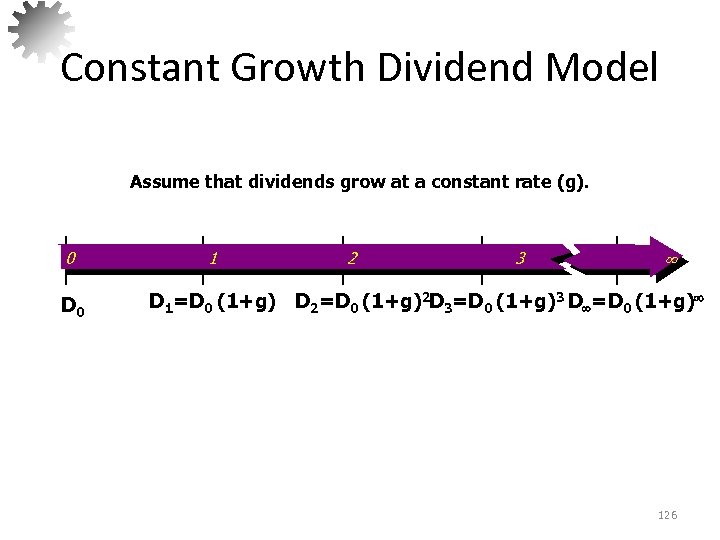 Constant Growth Dividend Model Assume that dividends grow at a constant rate (g). 0 D 0 1 2 3 D 1=D 0 (1+g) D 2=D 0 (1+g)2 D 3=D 0 (1+g)3 D =D 0 (1+g) 126
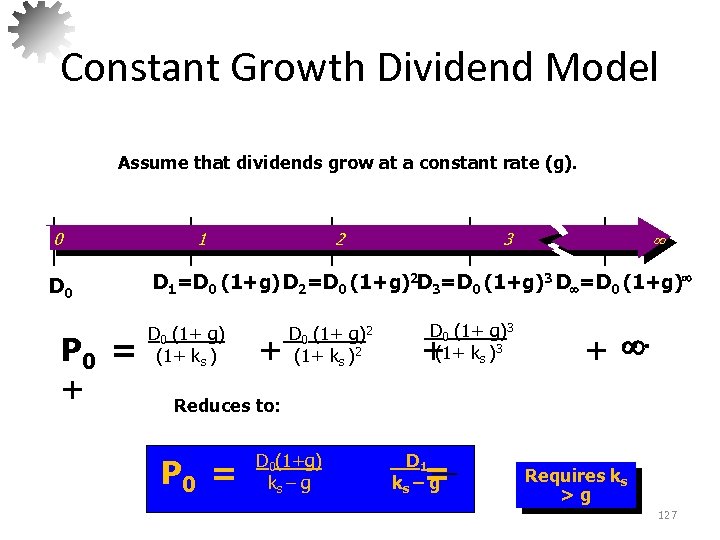 Constant Growth Dividend Model Assume that dividends grow at a constant rate (g). 0 D 0 P 0 = + 1 2 3 D 1=D 0 (1+g) D 2=D 0 (1+g)2 D 3=D 0 (1+g)3 D =D 0 (1+g) D 0 (1+ g) (1+ ks ) D 0 (1+ g)2 (1+ ks )2 D 0 (1+ g)3 (1+ ks )3 + + ··· Reduces to: P 0 = D 0(1+g) ks – g D 1 ks – g = Requires ks >g 127
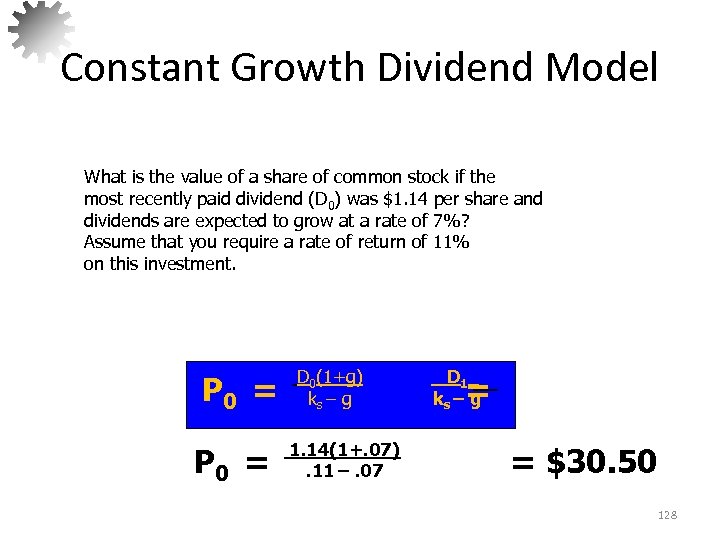 Constant Growth Dividend Model What is the value of a share of common stock if the most recently paid dividend (D 0) was $1. 14 per share and dividends are expected to grow at a rate of 7%? Assume that you require a rate of return of 11% on this investment. P 0 = D 0(1+g) ks – g 1. 14(1+. 07). 11 –. 07 D 1 ks – g = = $30. 50 128
 Valuing Total Stockholders’ Equity • The Investor’s Cash Flow DCF Model – Investor’s Cash Flow is the amount that is “free” to be distributed to debt holders, preferred stockholders and common stockholders. – Cash remaining after accounting for expenses, taxes, capital expenditures and new net working capital. 129
 Calculating Intrinsic Value Coca Cola Example 130
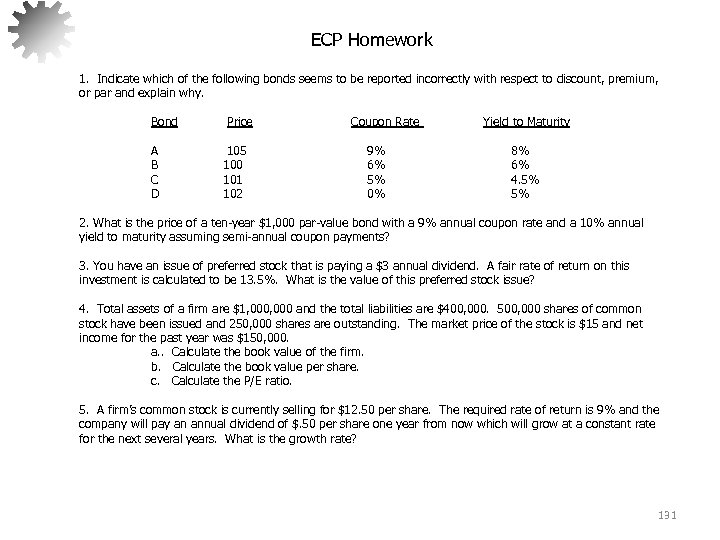 ECP Homework 1. Indicate which of the following bonds seems to be reported incorrectly with respect to discount, premium, or par and explain why. Bond Price Coupon Rate Yield to Maturity A 105 9% 8% B 100 6% 6% C 101 5% 4. 5% D 102 0% 5% 2. What is the price of a ten-year $1, 000 par-value bond with a 9% annual coupon rate and a 10% annual yield to maturity assuming semi-annual coupon payments? 3. You have an issue of preferred stock that is paying a $3 annual dividend. A fair rate of return on this investment is calculated to be 13. 5%. What is the value of this preferred stock issue? 4. Total assets of a firm are $1, 000 and the total liabilities are $400, 000. 500, 000 shares of common stock have been issued and 250, 000 shares are outstanding. The market price of the stock is $15 and net income for the past year was $150, 000. a. . Calculate the book value of the firm. b. Calculate the book value per share. c. Calculate the P/E ratio. 5. A firm’s common stock is currently selling for $12. 50 per share. The required rate of return is 9% and the company will pay an annual dividend of $. 50 per share one year from now which will grow at a constant rate for the next several years. What is the growth rate? 131