 Скачать презентацию The Cossic Art Writing Algebra with Symbols Nate
385b978b4d71846b76ba14ea5c0d528f.ppt
- Количество слайдов: 21



The Cossic Art Writing Algebra with Symbols Nate Jones & Chelsea Landis
n The English called the study “ the Cossic Art” which means “the Art of Things”. n Algebraists were called cossists, and algebra the cossic art, for many years. n 3 stages of Algebra ¨ ¨ ¨ 1. Rhetorical Stage 2. Syncopated Stage 3. Symbolic Stage
Egyptian Algebra n 1850 B. C, Rhind Papyrus ¨ Solved problems equivalent to a linear equation with one unknown. n 300 B. C. , Cairo Papyrus ¨ Solved problems equivalent to a system of two second degree equations with two unknowns.
Babylonian Algebra n 1800 - 1600 B. C. ¨ Solved quadratic equations ¨ Very little use of symbols ¨ Rhetorical teachings, taught through examples.
Greek Algebra n Didn’t add much to Algebra over what Babylonians already had. n Their achievement was applying deductive reasoning and describing general procedures.
Diophantine Algebra n n n 250 A. D. He accepted only positive rational roots When a quadratic equation had two positive rational roots he only gave one as the solution. There was no structure to his work. Had no general methods. Each of the 185 problems in Arithmetica was solved a different way.
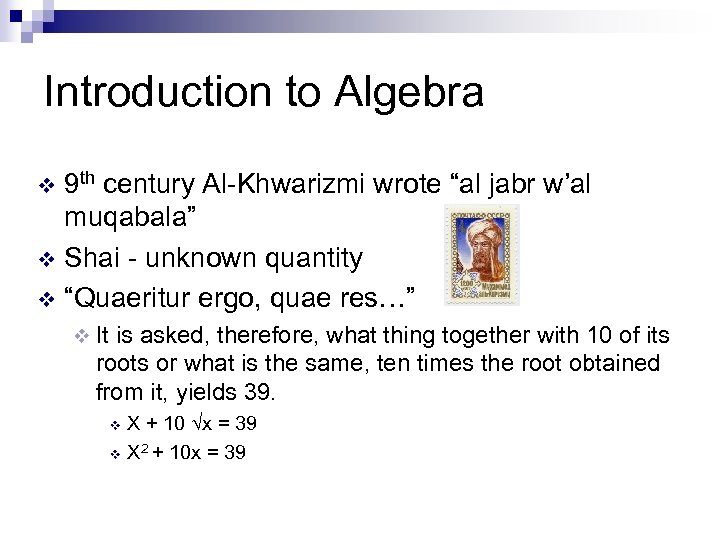
Introduction to Algebra 9 th century Al-Khwarizmi wrote “al jabr w’al muqabala” v Shai - unknown quantity v “Quaeritur ergo, quae res…” v v It is asked, therefore, what thing together with 10 of its roots or what is the same, ten times the root obtained from it, yields 39. X + 10 √x = 39 v X 2 + 10 x = 39 v
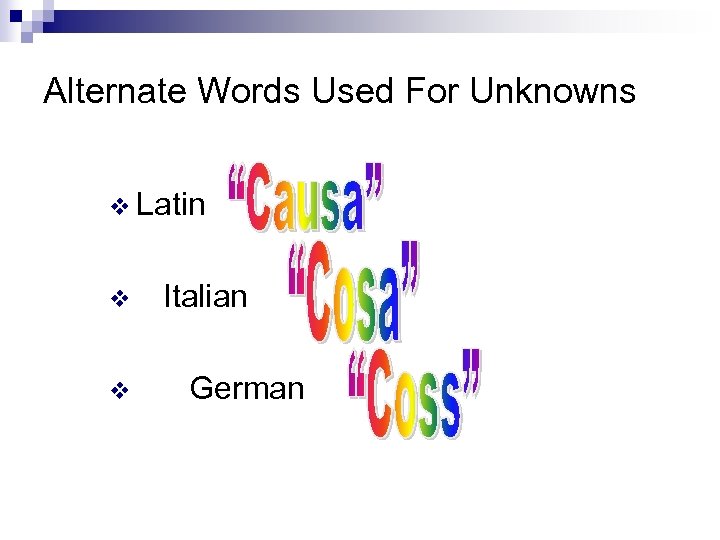
Alternate Words Used For Unknowns v Latin v v Italian German
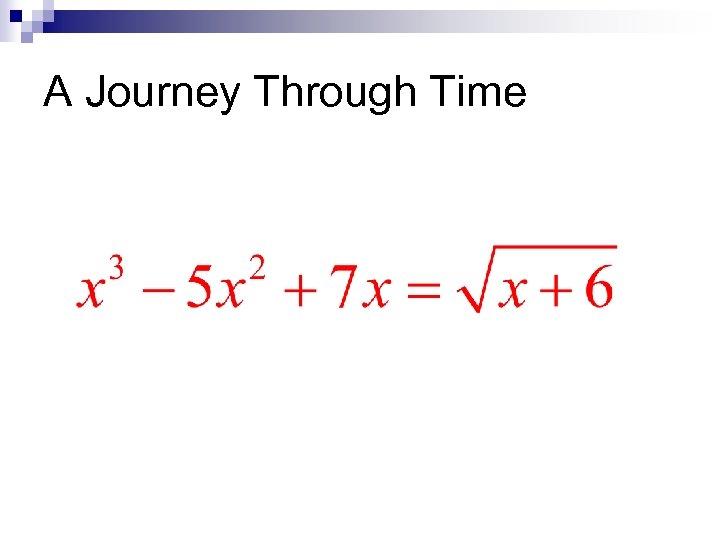
A Journey Through Time
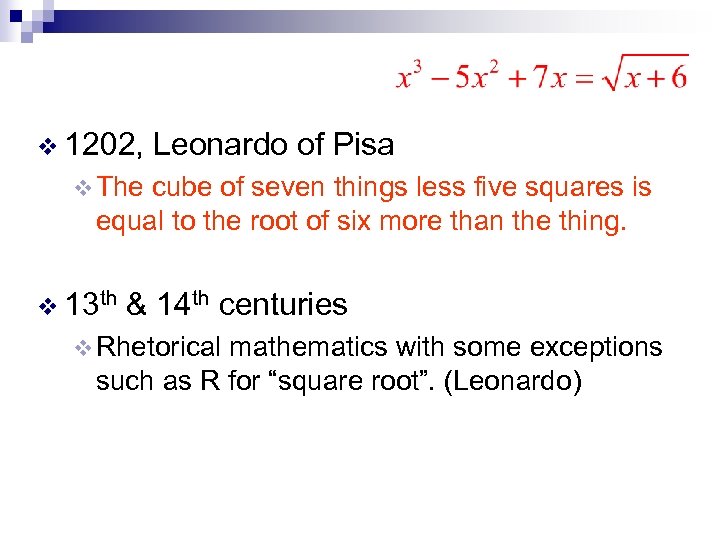
v 1202, Leonardo of Pisa v The cube of seven things less five squares is equal to the root of six more than the thing. v 13 th & 14 th centuries v Rhetorical mathematics with some exceptions such as R for “square root”. (Leonardo)
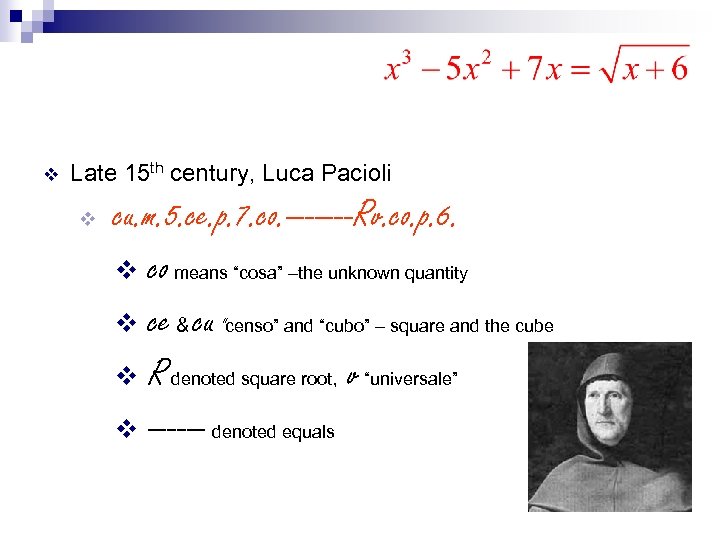
v Late 15 th century, Luca Pacioli v cu. m. 5. ce. p. 7. co. -------Rv. co. p. 6. v co means “cosa” –the unknown quantity v ce & cu “censo” and “cubo” – square and the cube v R denoted square root v “universale” v ------ denoted equals ,
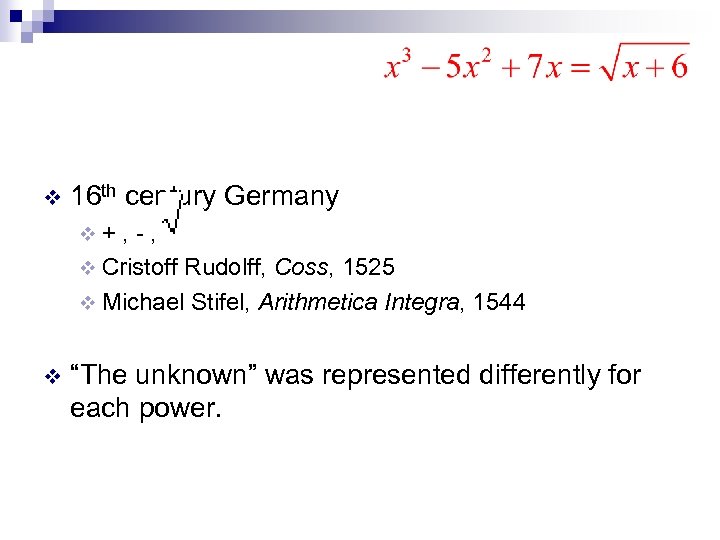
v 16 th century Germany v+ , -, v Cristoff Rudolff, Coss, 1525 v Michael Stifel, Arithmetica Integra, 1544 v “The unknown” was represented differently for each power.
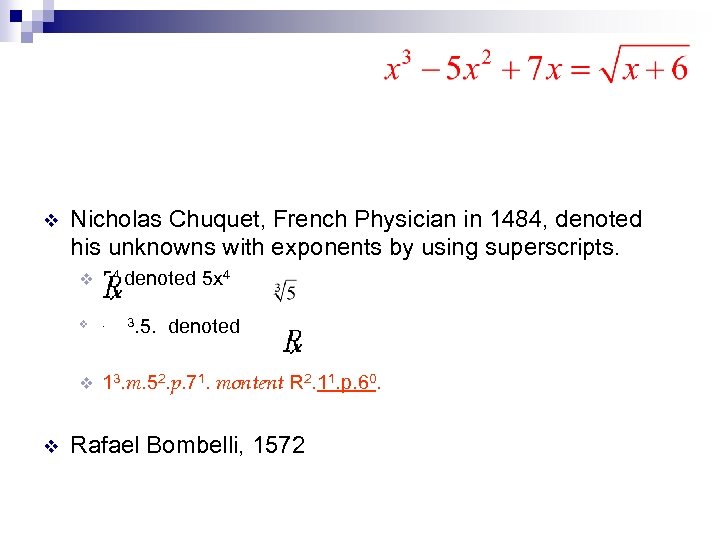
v Nicholas Chuquet, French Physician in 1484, denoted his unknowns with exponents by using superscripts. v v 54 denoted 5 x 4 13. m. 52. p. 71. montent R 2. 11. p. 60. 3. 5. denoted Rafael Bombelli, 1572
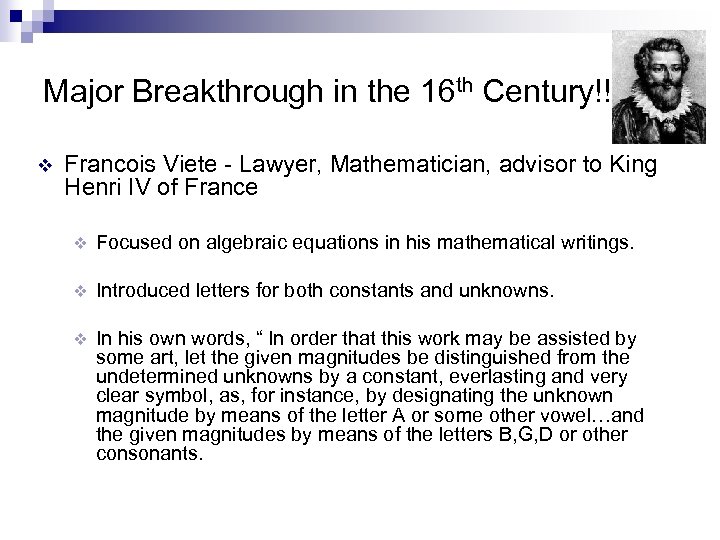
Major Breakthrough in the 16 th Century!! v Francois Viete - Lawyer, Mathematician, advisor to King Henri IV of France v Focused on algebraic equations in his mathematical writings. v Introduced letters for both constants and unknowns. v In his own words, “ In order that this work may be assisted by some art, let the given magnitudes be distinguished from the undetermined unknowns by a constant, everlasting and very clear symbol, as, for instance, by designating the unknown magnitude by means of the letter A or some other vowel…and the given magnitudes by means of the letters B, G, D or other consonants.
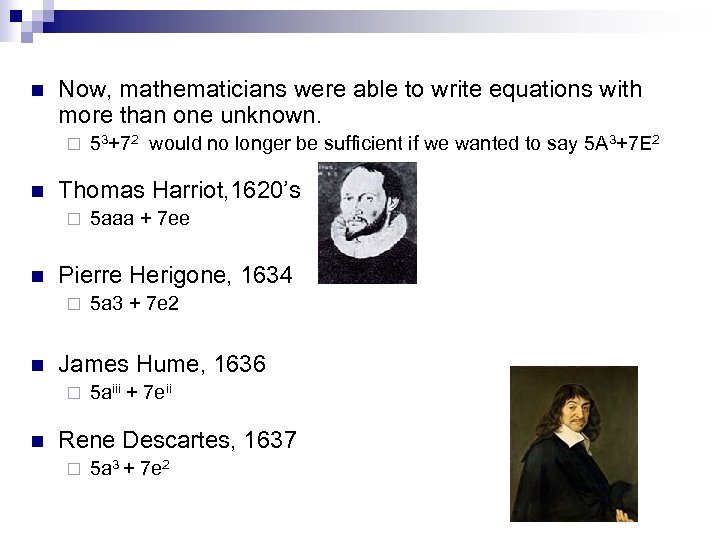
n Now, mathematicians were able to write equations with more than one unknown. ¨ n Thomas Harriot, 1620’s ¨ n 5 a 3 + 7 e 2 James Hume, 1636 ¨ n 5 aaa + 7 ee Pierre Herigone, 1634 ¨ n 53+72 would no longer be sufficient if we wanted to say 5 A 3+7 E 2 5 aiii + 7 eii Rene Descartes, 1637 ¨ 5 a 3 + 7 e 2
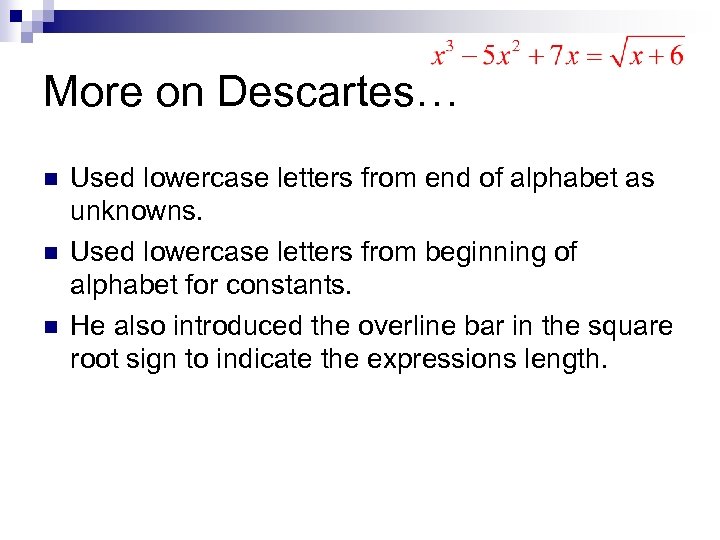
More on Descartes… n n n Used lowercase letters from end of alphabet as unknowns. Used lowercase letters from beginning of alphabet for constants. He also introduced the overline bar in the square root sign to indicate the expressions length.
Abstract Algebra n 19 th Century ¨ n Gibbs (American, 1839 -1903) ¨ n Developed vectors in three dimensional space. Cayley (British, 1821 -1895) ¨ n British mathematicians looked at vectors, matrices, transformations, etc. Developed an algebra of matrices Galois (French, 1811 -1832) ¨ Helped develop the concept of a group (a set of operations with a single operation which satisfies three axioms)
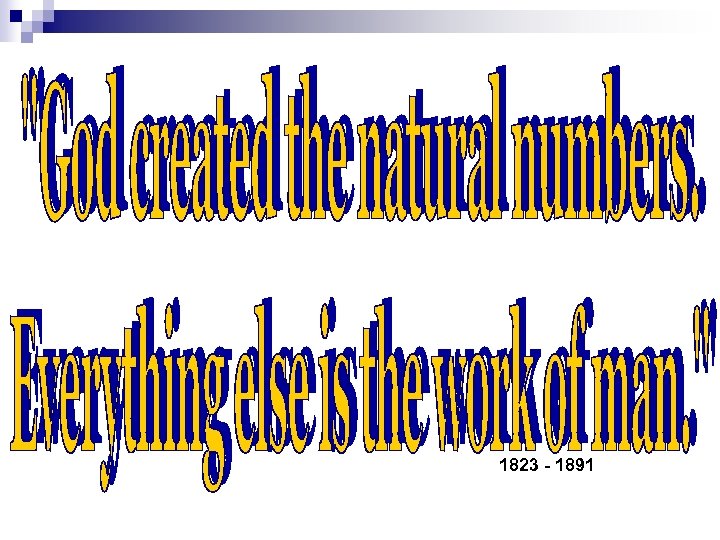
1823 - 1891
Timeline v 1850 B. C, Egyptians solved problems equivalent to a linear equation with one unknown. v 1800 - 1600 B. C. Babylonians solved quadratic equations v 300 B. C, Egyptians solved problems equivalent to a system of two second degree equations in two unknowns. v 9 th Century- Al-Khwarizmi wrote “aljabr w’al muqabala (source of the word algebra) v 1202, Leonard of Pisa, used rhetorical writing to express algebra equations v 13 th & 14 th centuries, introduced R for square root, along with other occasional abbreviations. v 15 th century, Luca Pacioli introduced symbolic algebra v Nicholas Chuquet, 1484, introduced exponents written as superscripts v Cristoff Rudolff wrote Coss, 1525 v Michael Stifel, Arithmetica Integra, 1544
Timeline Continued… v v v v 16 th century Germany, “The unknown” was represented differently for each power Rafael Bombelli, 1572, started reusing Chuquet’s system of exponents Francois Viete, 16 th century, Introduced letters for both constants and unknowns Thomas Harriot, 1620’s, Pierre Herigone, 1634, James Hume, 1636, Rene Descartes, 1637; introduced different ways of writing equations with exponents and unknowns. Gibbs (American, 1839 -1903); Developed vectors in three dimensional space. Cayley (British, 1821 -1895) ; introduced matrices. Galois (French, 1811 -1832) ; introduced concept of a group
References n n n Christoff Rudolff, <http: //www. gapsystem. org/~history/Printonly/Rudolff. html> Berlinghoff, William P. , and Fernando Q. Gouvêa. Math Through the Ages: a Gentle History for Teachers and Others. Farmington: Oxton House, 2002. pp 95 -100 The History of Algebra, <http: //www. ucs. louisiana. edu/~sxw 8045/history. htm>
Скачать презентацию The Cossic Art Writing Algebra with Symbols Nate
385b978b4d71846b76ba14ea5c0d528f.ppt