


 Скачать презентацию The Corporation en genomgång 730 g 32 HT
31ee9e5c3f3310ee59d4127adbc7c489.ppt
- Количество слайдов: 61
 The Corporation: en genomgång 730 g 32 HT 2012 Fundamentals of Corporate Finance BMM Lecture 4: Chap. 1, 2, 3 & 4: Financial decisions, Financial institutions, and performance measures
 LEARNING OBJECTIVES • • Chapter 1 Understand the definition of a corporation The role of the financial manager in a corporation. Functions of financial markets. Principal-agent problems, agency costs and information asymmetries. 2
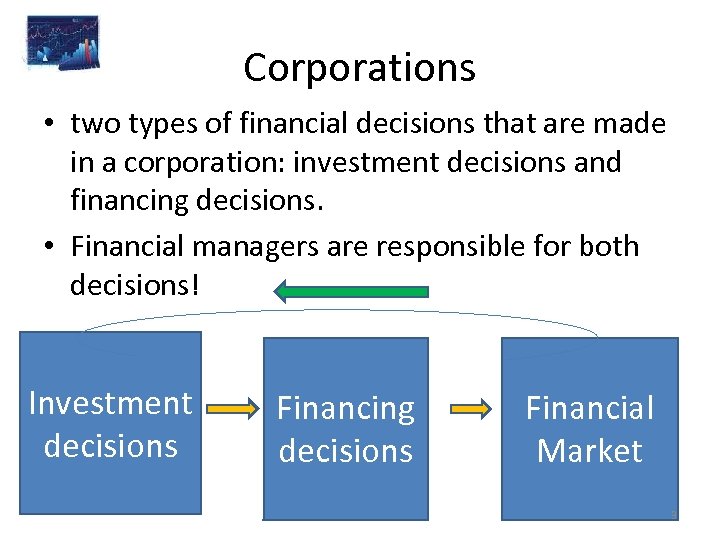 Corporations • two types of financial decisions that are made in a corporation: investment decisions and financing decisions. • Financial managers are responsible for both decisions! Investment decisions Financing decisions Financial Market 3
 Corporation • Corporation – A business organized as a separate legal entity owned by stockholders. – Or a nexus of contract between legal entities. • Types of Corporations – Public Companies – Private Corporations, sole proprietorships – Partnerships – Etc. 4
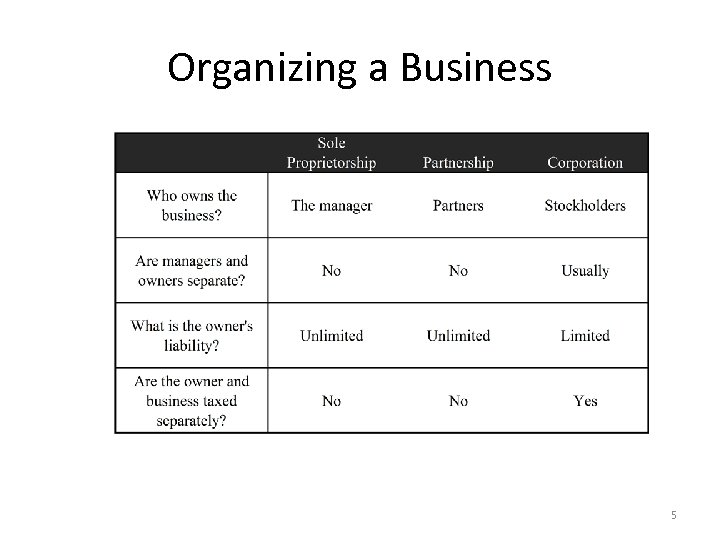 Organizing a Business 5
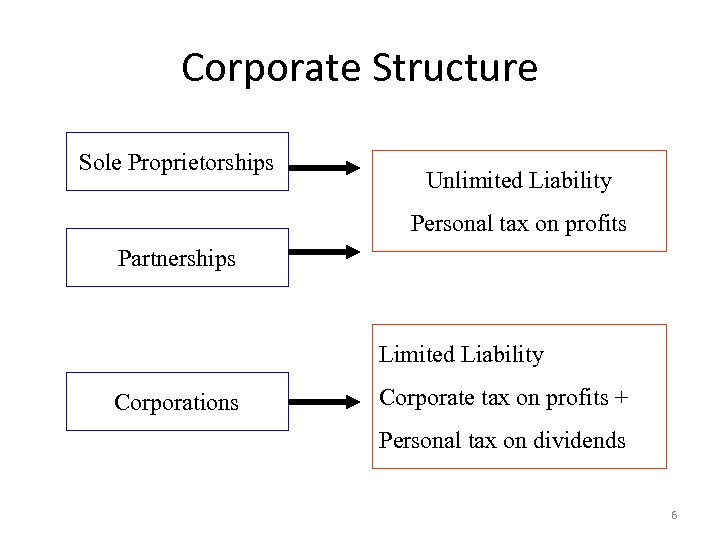 Corporate Structure Sole Proprietorships Unlimited Liability Personal tax on profits Partnerships Limited Liability Corporations Corporate tax on profits + Personal tax on dividends 6
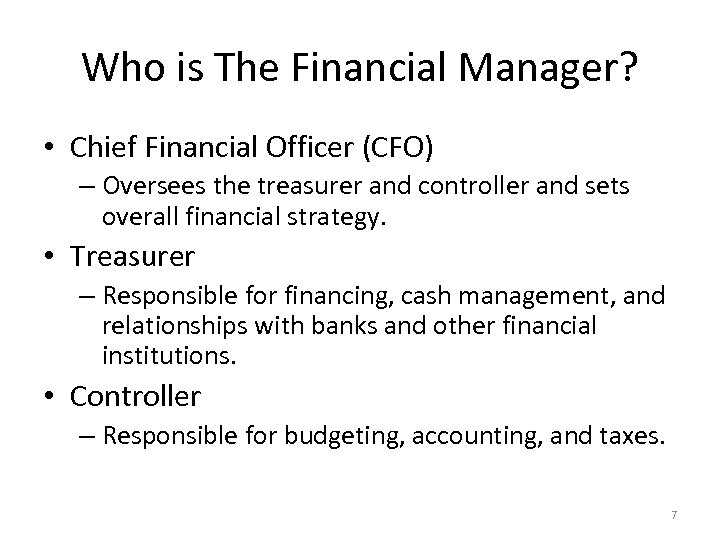 Who is The Financial Manager? • Chief Financial Officer (CFO) – Oversees the treasurer and controller and sets overall financial strategy. • Treasurer – Responsible for financing, cash management, and relationships with banks and other financial institutions. • Controller – Responsible for budgeting, accounting, and taxes. 7
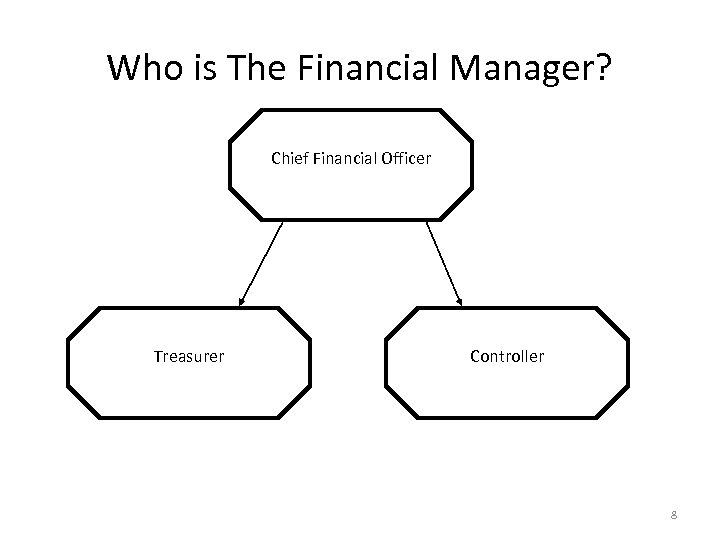 Who is The Financial Manager? Chief Financial Officer Treasurer Controller 8
 Definitions Capital Budgeting Decision – Decision to invest in tangible or intangible assets. …also called the Investment Decision Financing Decision – The form and amount of financing of a firm’s investments. 9
 Capital Structure (D/E ratio) • Capital Structure The proportion of debt vs. equity financing. 1. Debt/Equity ratio, a multiple of debt over equity. Can be tricky when equity becomes small. 2. D/(E+D) debt asset ratio measures the indebtedness of the company. ranging from 0 to 100%. Market capitalization: the company´s total amount of shares outstanding times the share price. 10
 Distinguishing Real Assets and Financial Assets • Real Assets – Assets used to produce goods and services. – examples: Patents, Machines, a new pipeline, etc • Financial Assets – Financial claims to the income generated by the firm’s real assets. – Examples: stocks, bonds, bank loans 11
 The Goals of the corporation • Firm Value maximization: I. II. Anglo-America model: shareholder interests Continental European model: Stakeholder interests which include all claimants who has a vested interest in the company, for example, the supplier, the workers union, the local government, tax authority, etc. Is it just a conceptual dispute? Most firms do maximize Firm value taken into consideration of the stakeholder interests: That is to say, Corporate Social Responsibilities, ethics of corporation add value to the firm. 12
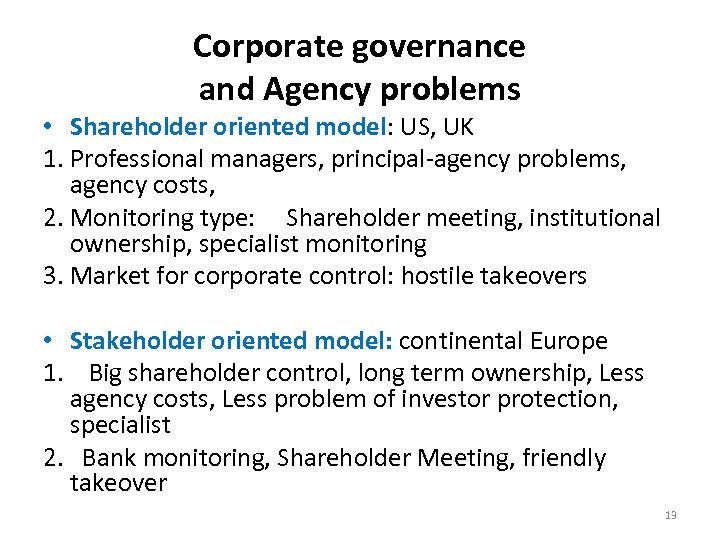 Corporate governance and Agency problems • Shareholder oriented model: US, UK 1. Professional managers, principal-agency problems, agency costs, 2. Monitoring type: Shareholder meeting, institutional ownership, specialist monitoring 3. Market for corporate control: hostile takeovers • Stakeholder oriented model: continental Europe 1. Big shareholder control, long term ownership, Less agency costs, Less problem of investor protection, specialist 2. Bank monitoring, Shareholder Meeting, friendly takeover 13
 Asymmetric information and Principal agency problem Managers know more about the corporation including: • Stock price movement and returns • Issues of shares and other securities • Dividends decision • Financing Managers may have their own goals other than shareholders´. 14
 Agency Problem Solutions 1 – Management Compensation plans 2 - Board of Directors 3 – Market for corporate control: Takeovers 4 - Specialist Monitoring 5 - Legal and Regulatory Requirements 15
 Chap 2. Financial Markets and Institutions Learning objectives • The Importance of Financial Markets and Institutions • The Flow of Savings to Corporations • Functions of Financial Markets and of Financial Intermediaries • Value Maximization and the Cost of Capital 16
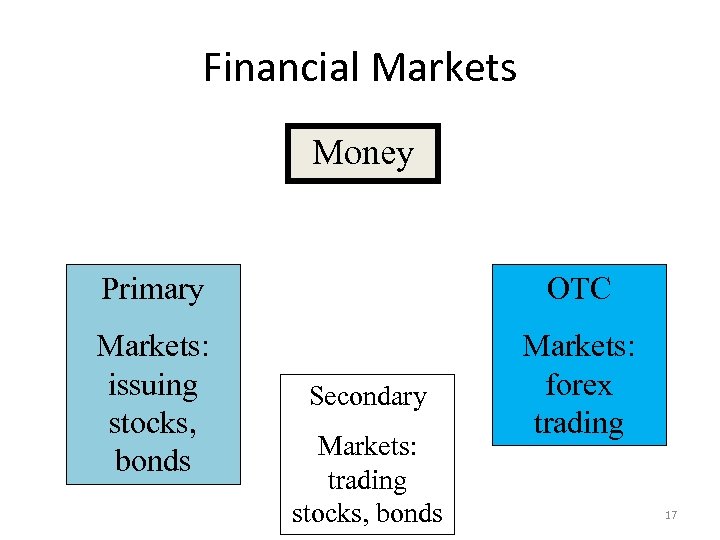 Financial Markets Money Primary OTC Markets: issuing stocks, bonds Markets: forex trading Secondary Markets: trading stocks, bonds 17
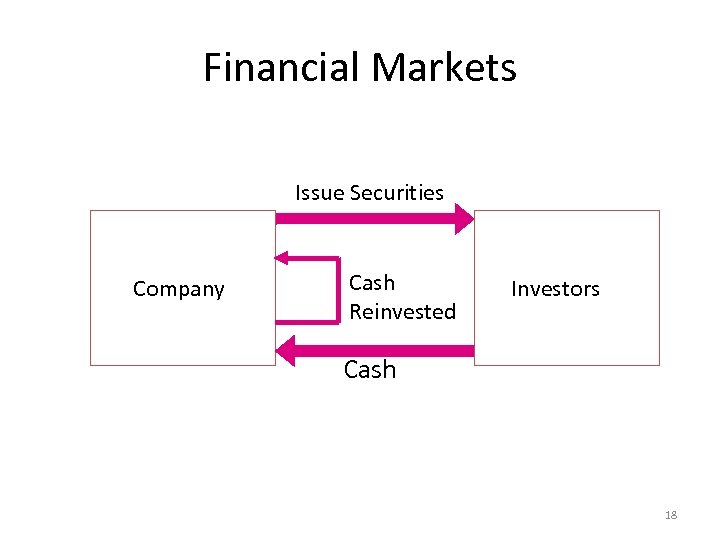 Financial Markets Issue Securities Company Cash Reinvested Investors Cash 18
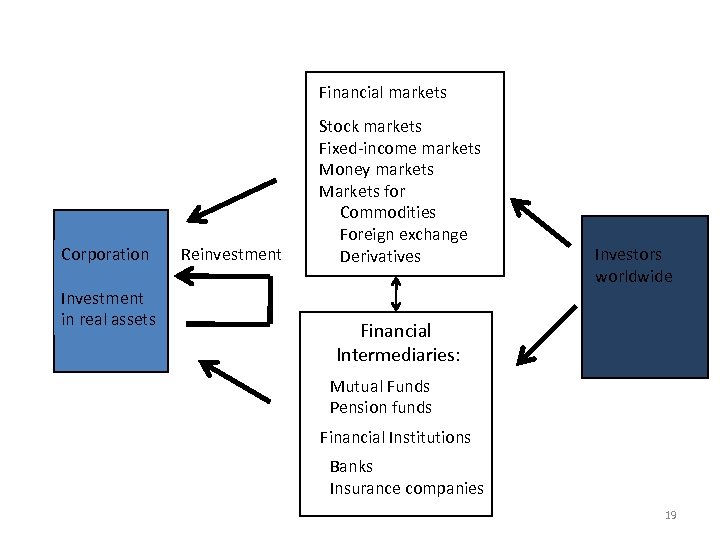 Financial Markets Financial markets Corporation Investment in real assets Reinvestment Stock markets Fixed-income markets Money markets Markets for Commodities Foreign exchange Derivatives Investors worldwide Financial Intermediaries: Mutual Funds Pension funds Financial Institutions Banks Insurance companies 19
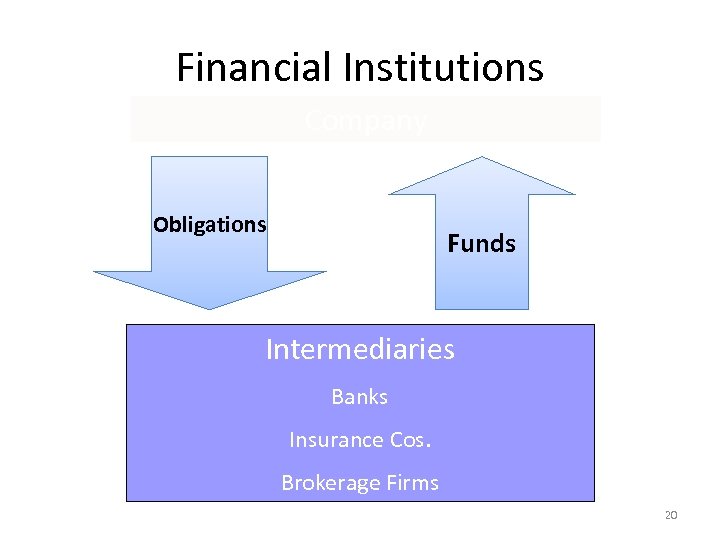 Financial Institutions Company Obligations Funds Intermediaries Banks Insurance Cos. Brokerage Firms 20
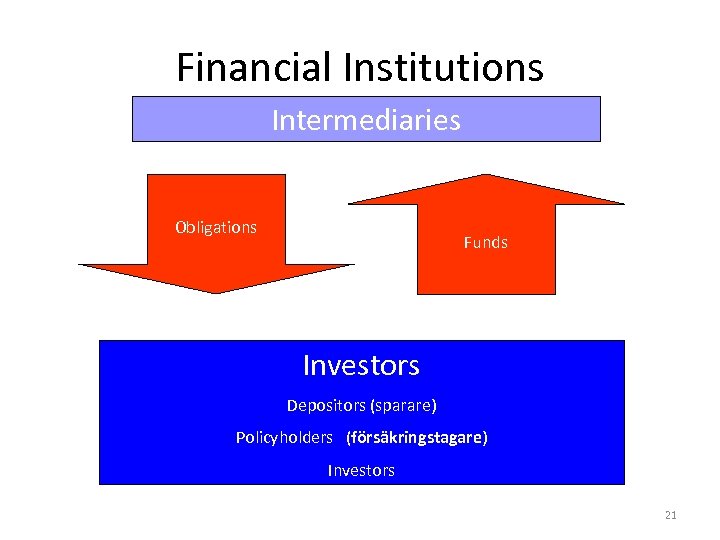 Financial Institutions Intermediaries Obligations Funds Investors Depositors (sparare) Policyholders (försäkringstagare) Investors 21
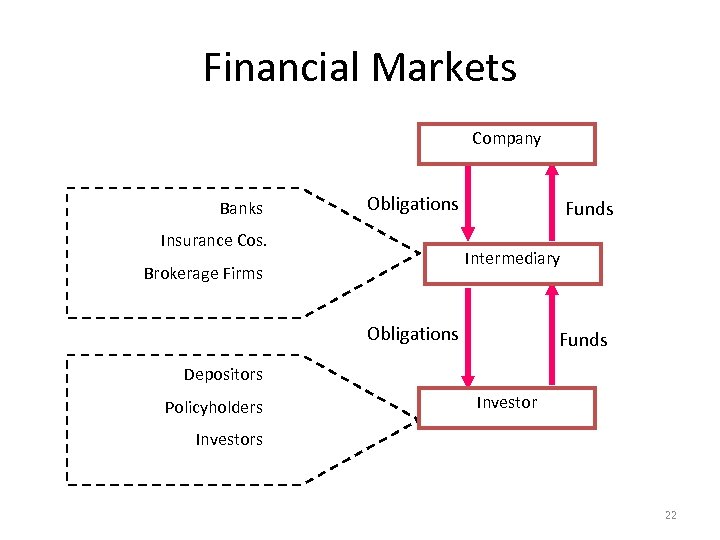 Financial Markets Company Banks Obligations Insurance Cos. Funds Intermediary Brokerage Firms Obligations Funds Depositors Policyholders Investors 22
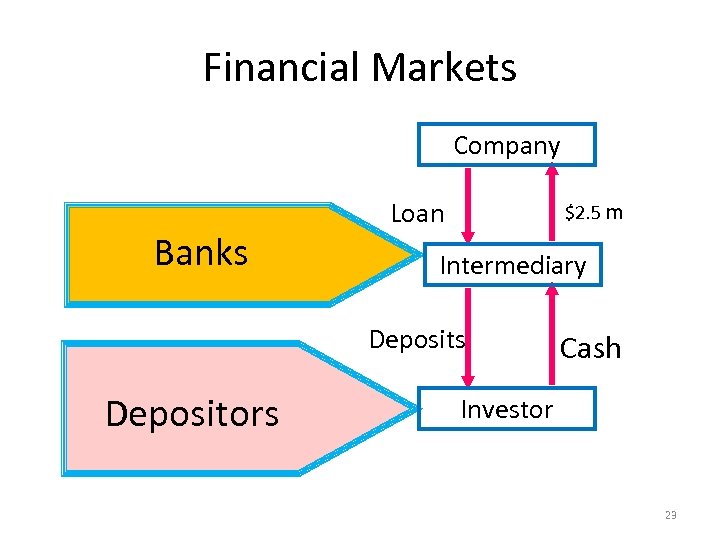 Financial Markets Company Banks Loan $2. 5 m Intermediary Deposits Depositors Cash Investor 23
 Financial Market: some definitions • Financial Market is a market where securities are issued and traded. • A security is a traded financial asset. Shares, bonds, asset backed securities, options, etc. • Fixed income market: market for debt securities, for example, treasury bills, corporate bond, etc. • Capital market: market for long term financing, e. g. stocks, long term bonds, etc. • Money market: market for short term financing, less than 1 year. 24
 Function of Financial Markets • • • Transporting cash across time Risk transfer and diversification provide Liquidity Payment mechanism Provide useful information for all: commodity price, cost of capital, interest rate, exchange rate, share price, etc. 25
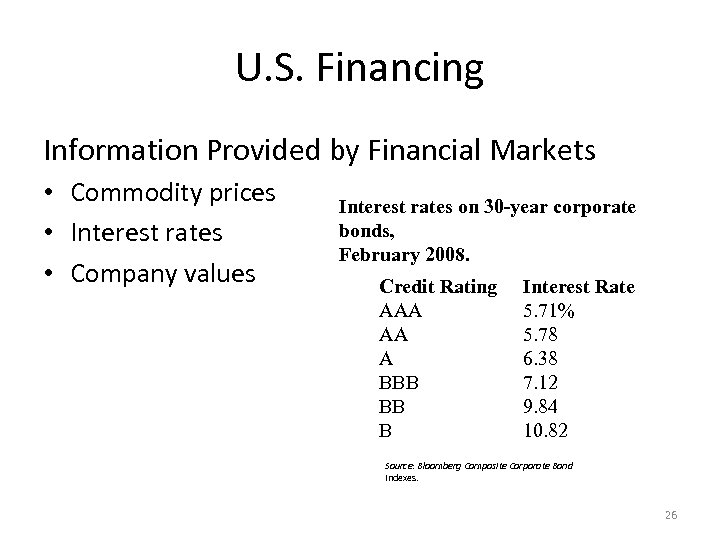 U. S. Financing Information Provided by Financial Markets • Commodity prices • Interest rates • Company values Interest rates on 30 -year corporate bonds, February 2008. Credit Rating AAA AA A BBB BB B Interest Rate 5. 71% 5. 78 6. 38 7. 12 9. 84 10. 82 Source: Bloomberg Composite Corporate Bond Indexes. 26
 Opportunity cost of capital (alternativ kapitalkostnad) • Opportunity cost of capital: the best possible investment forego by the investor is the opportunity cost of capital for the firm. • Cost of capital: minimum acceptable rate of return on capital investment for the investor. • The investors can invest in financial market and get expected rate of return on the investment at a similar risk level. This expected rate of return in the market determines the firm´s cost of capital. 27
 Chapter 4 Measuring corporate performance Important issues! Very relevant for business lawyers. • Measuring Profitability • Measuring Efficiency • Analyzing the Return on Assets: The Du Pont System • Measuring Leverage • Measuring Liquidity • Interpreting Financial Ratios 28
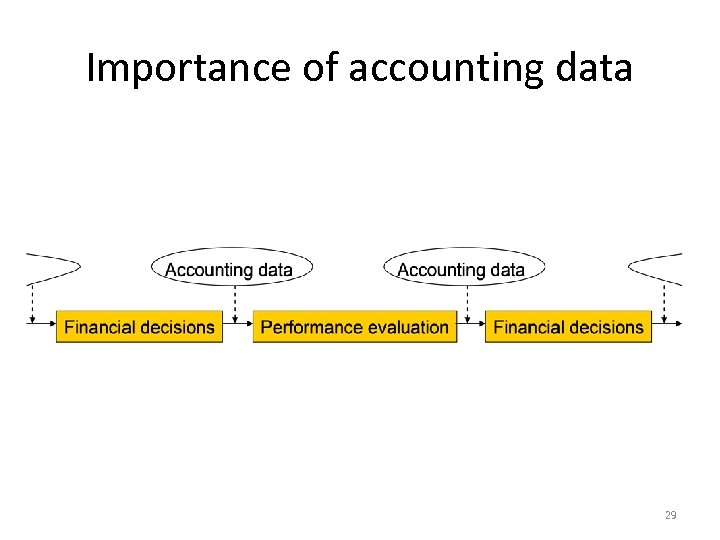 Importance of accounting data 29
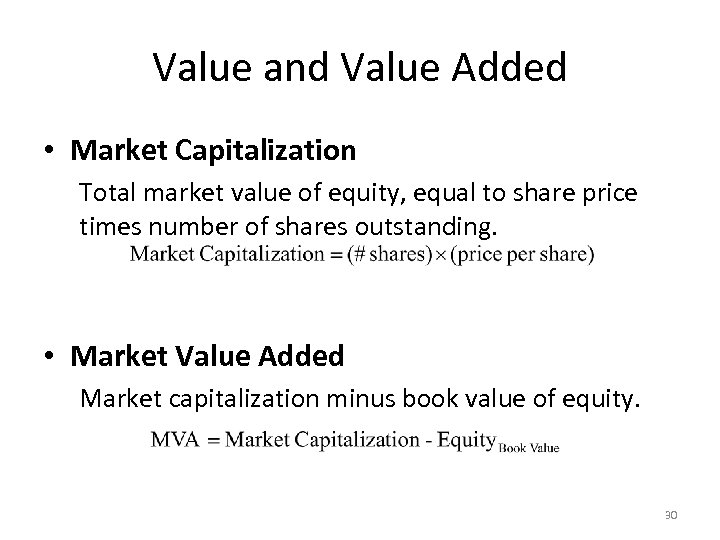 Value and Value Added • Market Capitalization Total market value of equity, equal to share price times number of shares outstanding. • Market Value Added Market capitalization minus book value of equity. 30
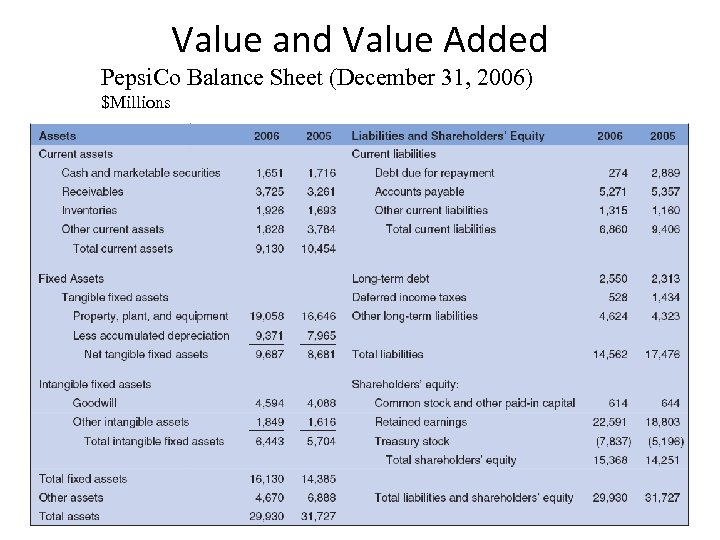 Value and Value Added Pepsi. Co Balance Sheet (December 31, 2006) $Millions
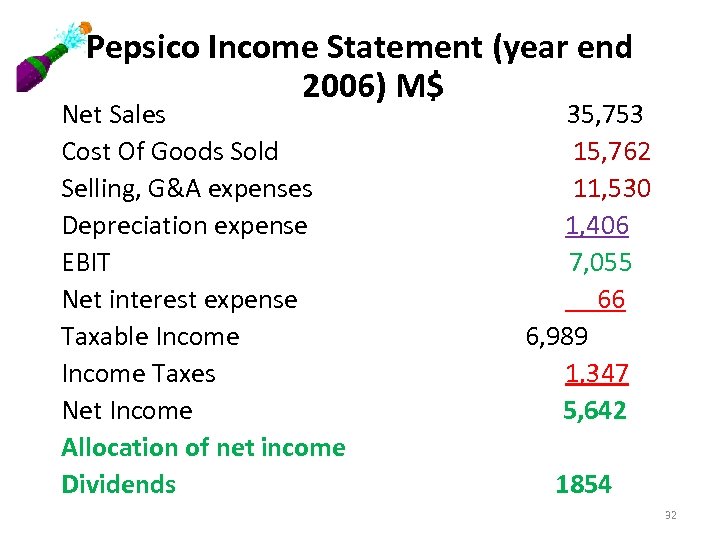 Pepsico Income Statement (year end 2006) M$ Net Sales 35, 753 Cost Of Goods Sold 15, 762 Selling, G&A expenses 11, 530 Depreciation expense 1, 406 EBIT 7, 055 Net interest expense 66 Taxable Income 6, 989 Income Taxes 1, 347 Net Income 5, 642 Allocation of net income Dividends 1854 32
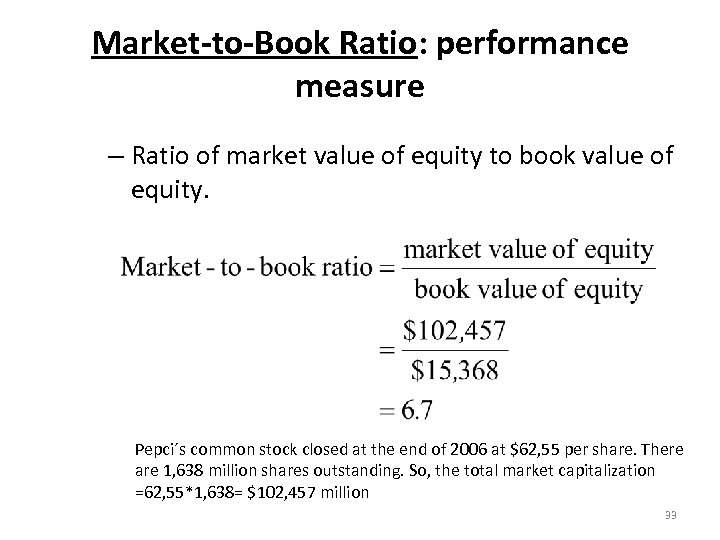 Market-to-Book Ratio: performance measure – Ratio of market value of equity to book value of equity. Pepci´s common stock closed at the end of 2006 at $62, 55 per share. There are 1, 638 million shares outstanding. So, the total market capitalization =62, 55*1, 638= $102, 457 million 33
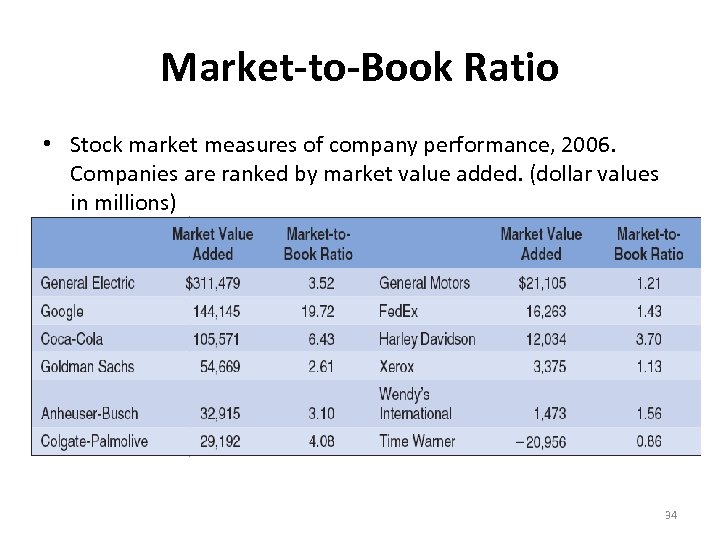 Market-to-Book Ratio • Stock market measures of company performance, 2006. Companies are ranked by market value added. (dollar values in millions) 34
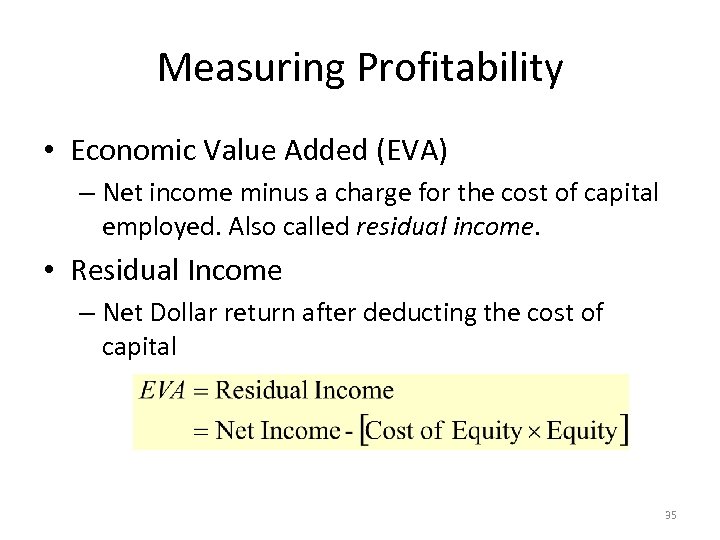 Measuring Profitability • Economic Value Added (EVA) – Net income minus a charge for the cost of capital employed. Also called residual income. • Residual Income – Net Dollar return after deducting the cost of capital 35
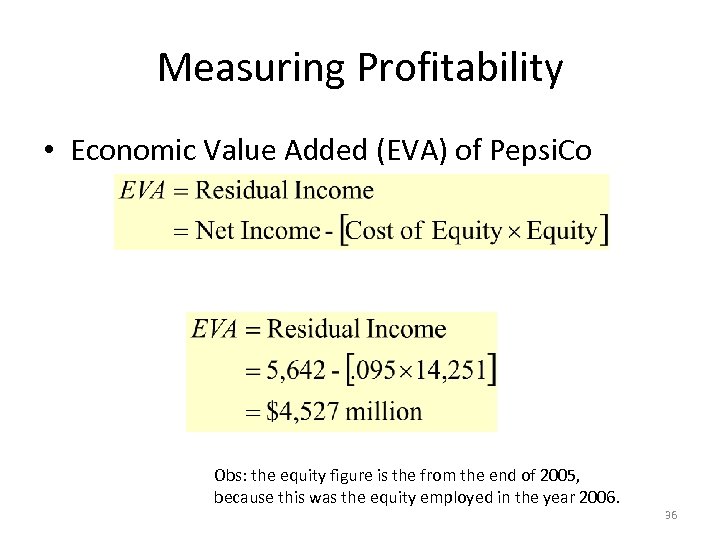 Measuring Profitability • Economic Value Added (EVA) of Pepsi. Co Obs: the equity figure is the from the end of 2005, because this was the equity employed in the year 2006. 36
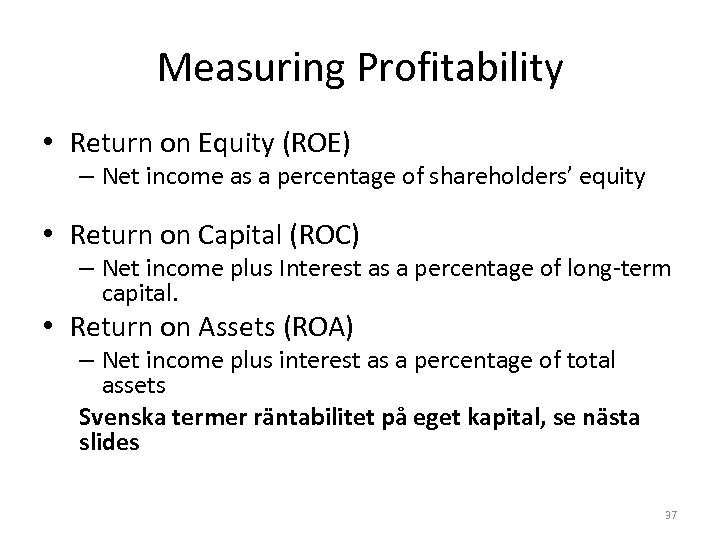 Measuring Profitability • Return on Equity (ROE) – Net income as a percentage of shareholders’ equity • Return on Capital (ROC) – Net income plus Interest as a percentage of long-term capital. • Return on Assets (ROA) – Net income plus interest as a percentage of total assets Svenska termer räntabilitet på eget kapital, se nästa slides 37
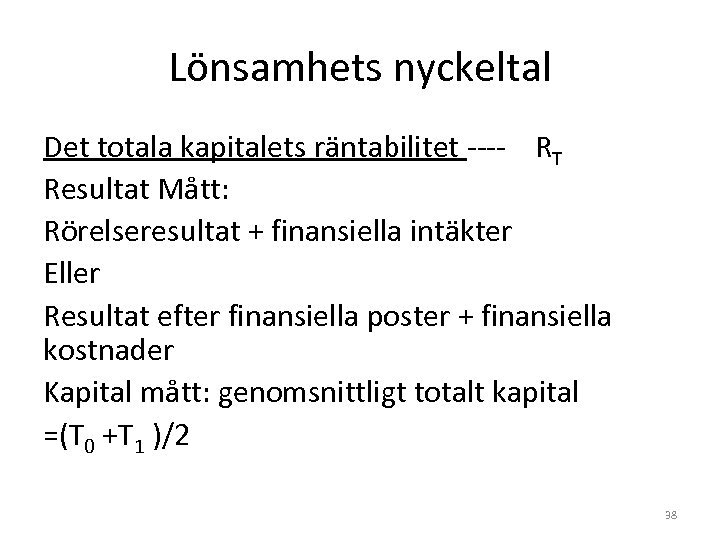 Lönsamhets nyckeltal Det totala kapitalets räntabilitet ---- RT Resultat Mått: Rörelseresultat + finansiella intäkter Eller Resultat efter finansiella poster + finansiella kostnader Kapital mått: genomsnittligt totalt kapital =(T 0 +T 1 )/2 38
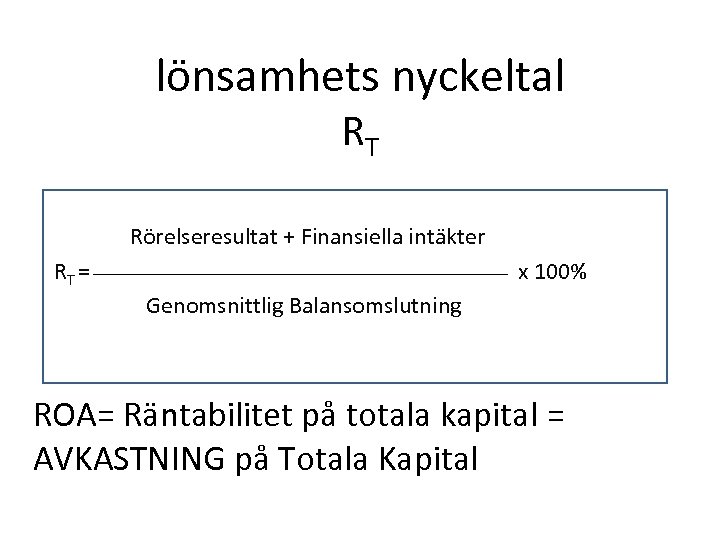 lönsamhets nyckeltal RT Rörelseresultat + Finansiella intäkter RT = x 100% Genomsnittlig Balansomslutning ROA= Räntabilitet på totala kapital = AVKASTNING på Totala Kapital
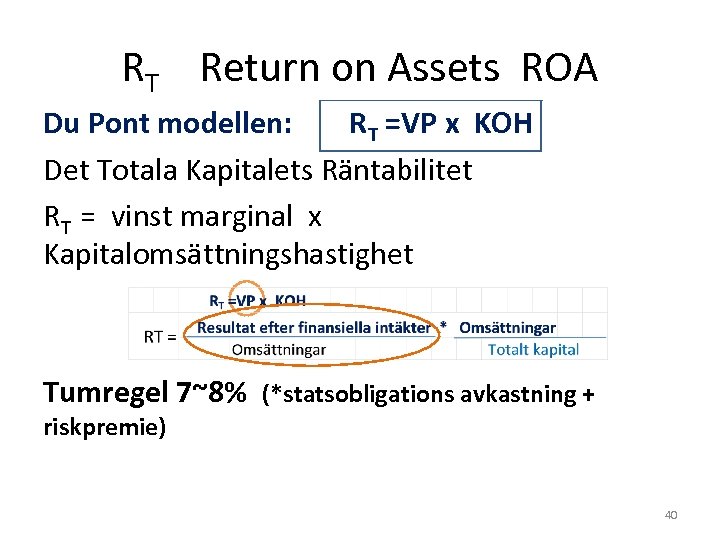 RT Return on Assets ROA Du Pont modellen: RT =VP x KOH Det Totala Kapitalets Räntabilitet RT = vinst marginal x Kapitalomsättningshastighet Tumregel 7~8% (*statsobligations avkastning + riskpremie) 40
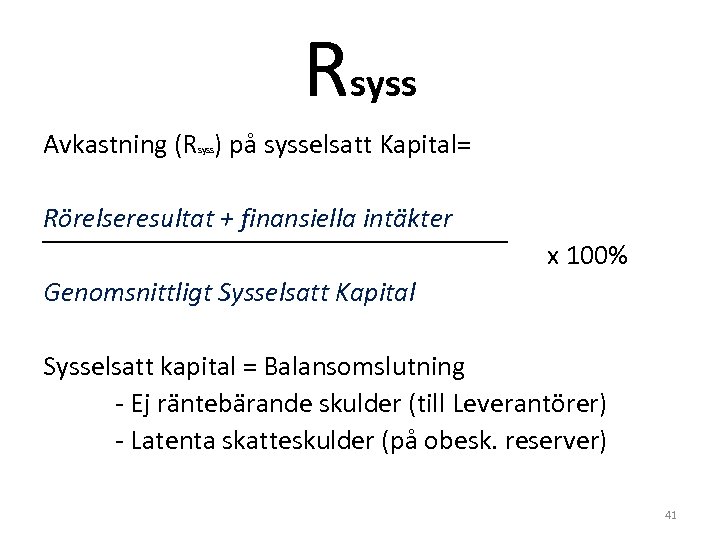 Rsyss Avkastning (R ) på sysselsatt Kapital= syss Rörelseresultat + finansiella intäkter x 100% Genomsnittligt Sysselsatt Kapital Sysselsatt kapital = Balansomslutning - Ej räntebärande skulder (till Leverantörer) - Latenta skatteskulder (på obesk. reserver) 41
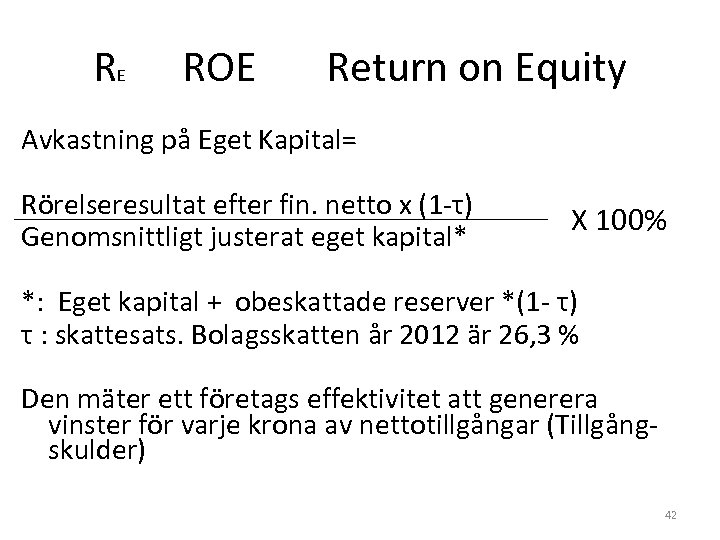 RE ROE Return on Equity Avkastning på Eget Kapital= Rörelseresultat efter fin. netto x (1 -τ) Genomsnittligt justerat eget kapital* X 100% *: Eget kapital + obeskattade reserver *(1 - τ) τ : skattesats. Bolagsskatten år 2012 är 26, 3 % Den mäter ett företags effektivitet att generera vinster för varje krona av nettotillgångar (Tillgångskulder) 42
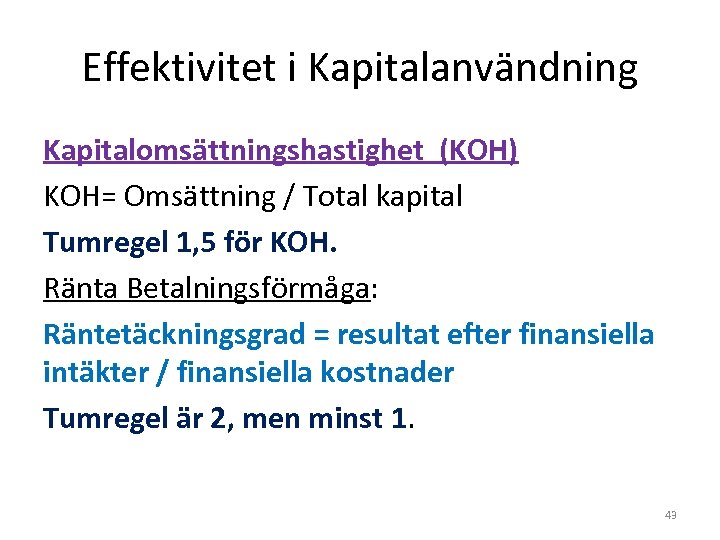 Effektivitet i Kapitalanvändning Kapitalomsättningshastighet (KOH) KOH= Omsättning / Total kapital Tumregel 1, 5 för KOH. Ränta Betalningsförmåga: Räntetäckningsgrad = resultat efter finansiella intäkter / finansiella kostnader Tumregel är 2, men minst 1. 43
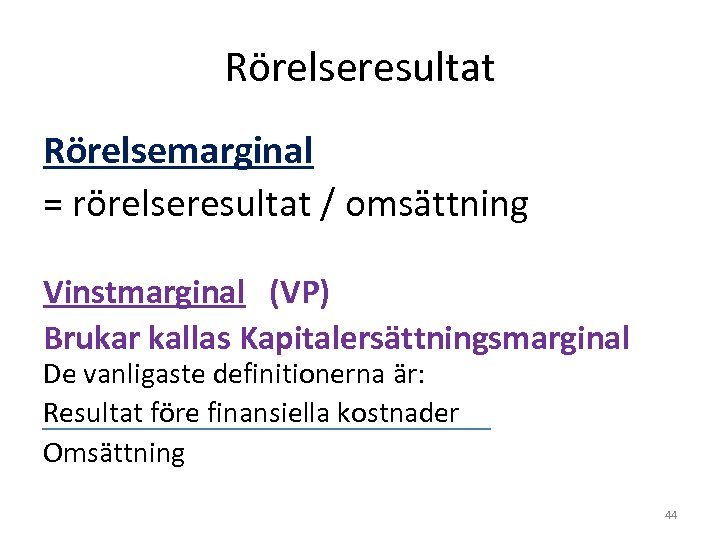 Rörelseresultat Rörelsemarginal = rörelseresultat / omsättning Vinstmarginal (VP) Brukar kallas Kapitalersättningsmarginal De vanligaste definitionerna är: Resultat före finansiella kostnader Omsättning 44
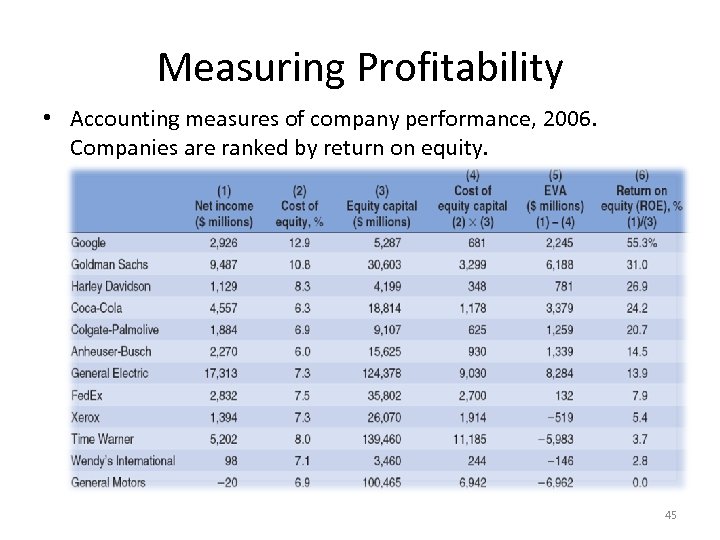 Measuring Profitability • Accounting measures of company performance, 2006. Companies are ranked by return on equity. 45
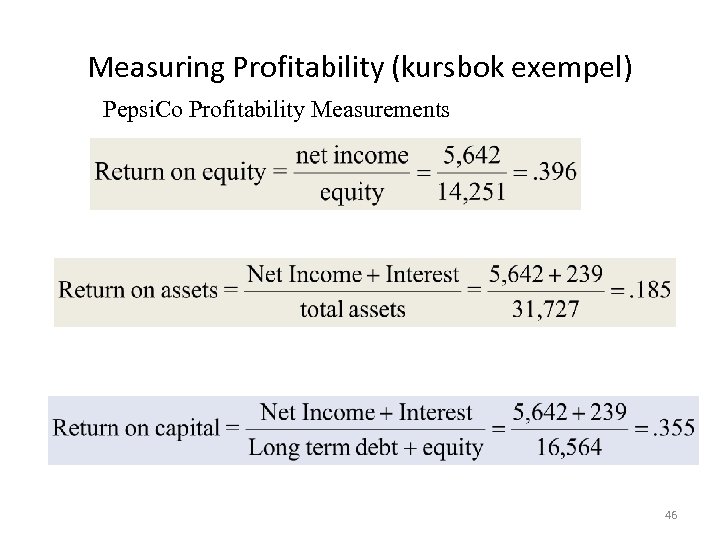 Measuring Profitability (kursbok exempel) Pepsi. Co Profitability Measurements 46
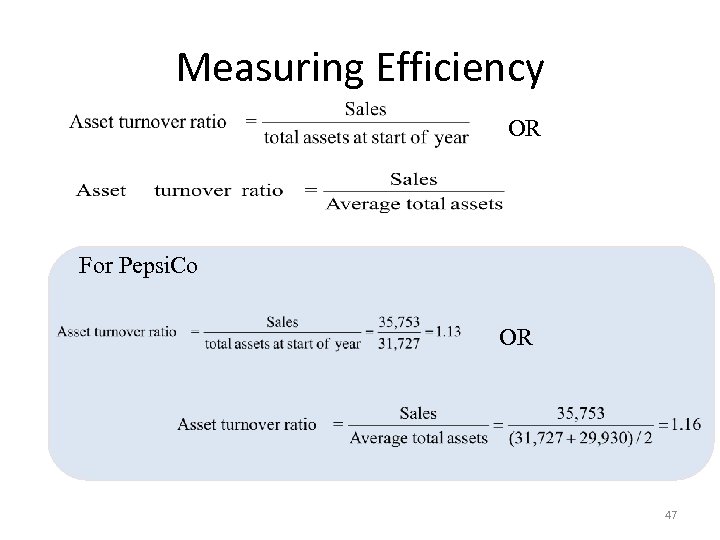 Measuring Efficiency OR For Pepsi. Co OR 47
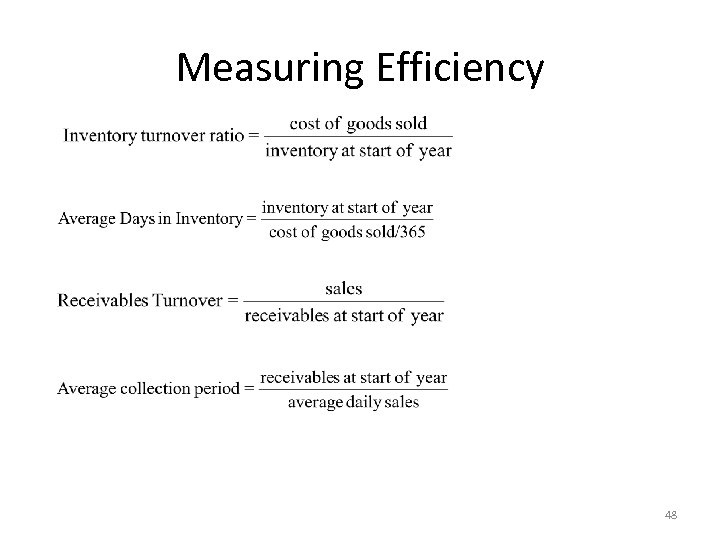 Measuring Efficiency 48
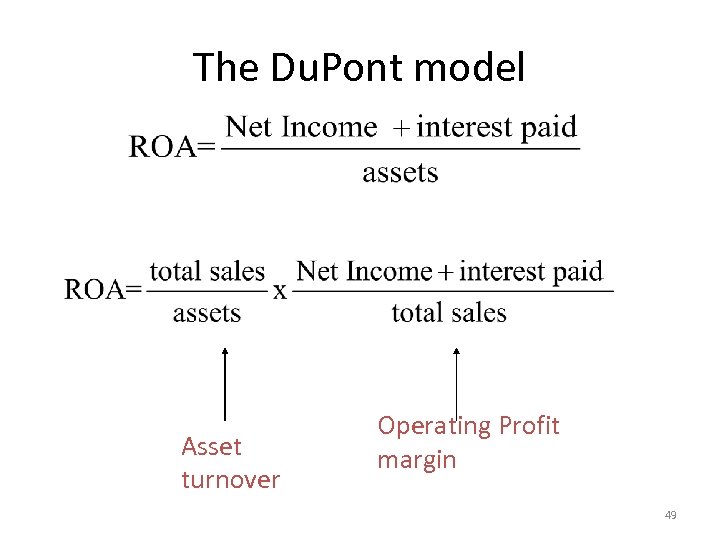 The Du. Pont model Asset turnover Operating Profit margin 49
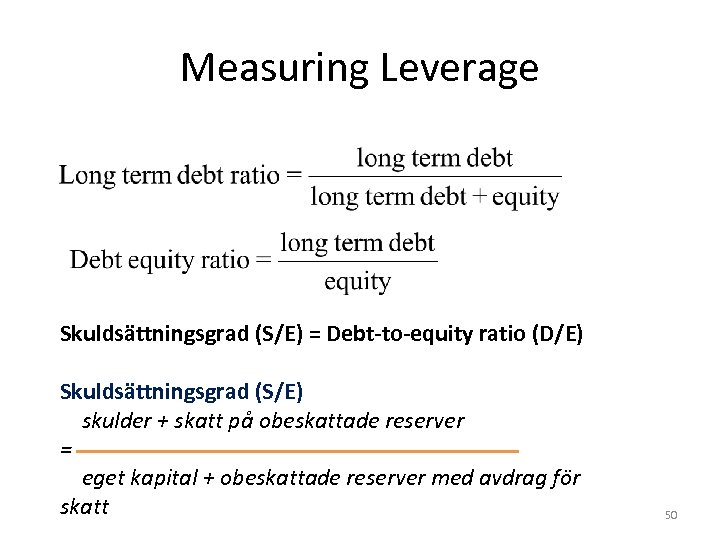 Measuring Leverage Skuldsättningsgrad (S/E) = Debt-to-equity ratio (D/E) Skuldsättningsgrad (S/E) skulder + skatt på obeskattade reserver = eget kapital + obeskattade reserver med avdrag för skatt 50
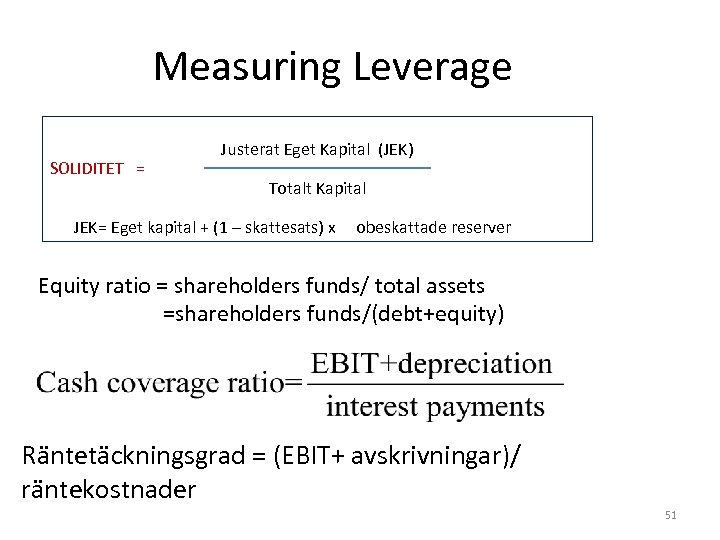 Measuring Leverage SOLIDITET = Justerat Eget Kapital (JEK) Totalt Kapital JEK= Eget kapital + (1 – skattesats) x obeskattade reserver Equity ratio = shareholders funds/ total assets =shareholders funds/(debt+equity) Räntetäckningsgrad = (EBIT+ avskrivningar)/ räntekostnader 51
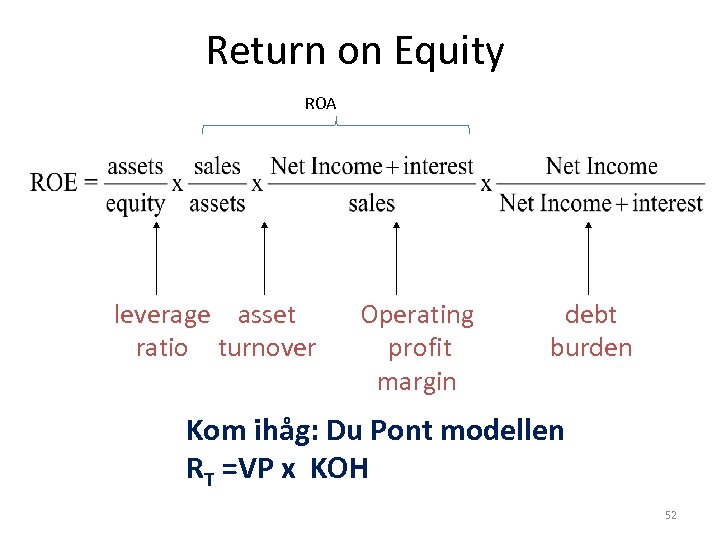 Return on Equity ROA leverage asset ratio turnover Operating profit margin debt burden Kom ihåg: Du Pont modellen RT =VP x KOH 52
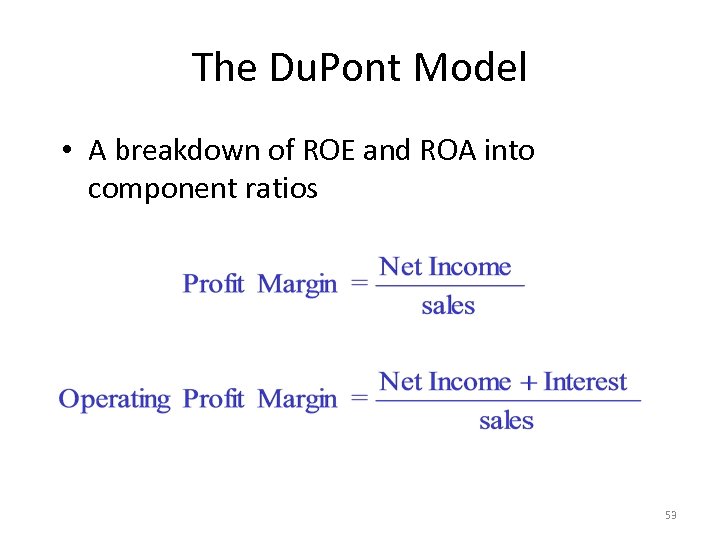 The Du. Pont Model • A breakdown of ROE and ROA into component ratios 53
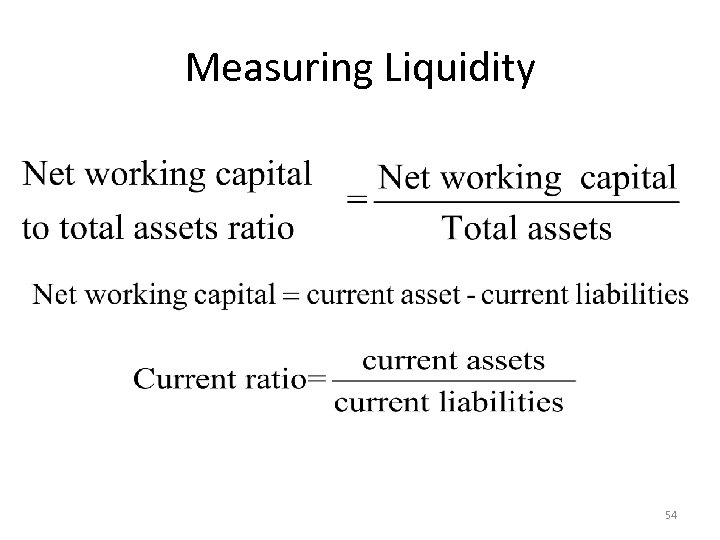 Measuring Liquidity 54
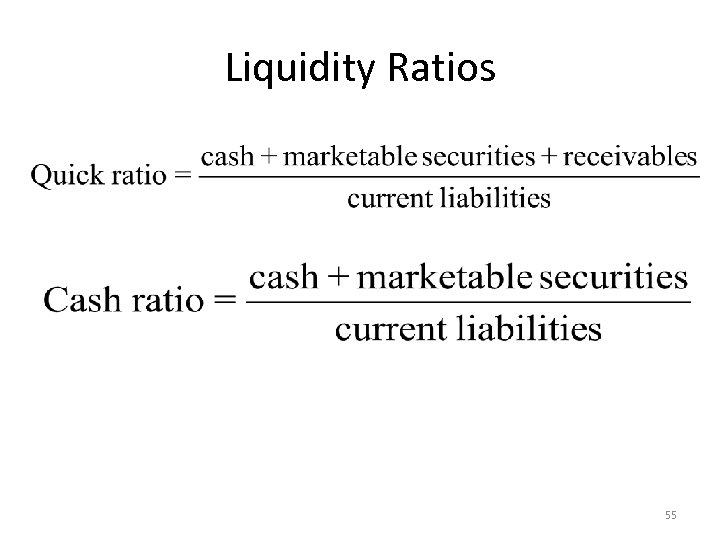 Liquidity Ratios 55
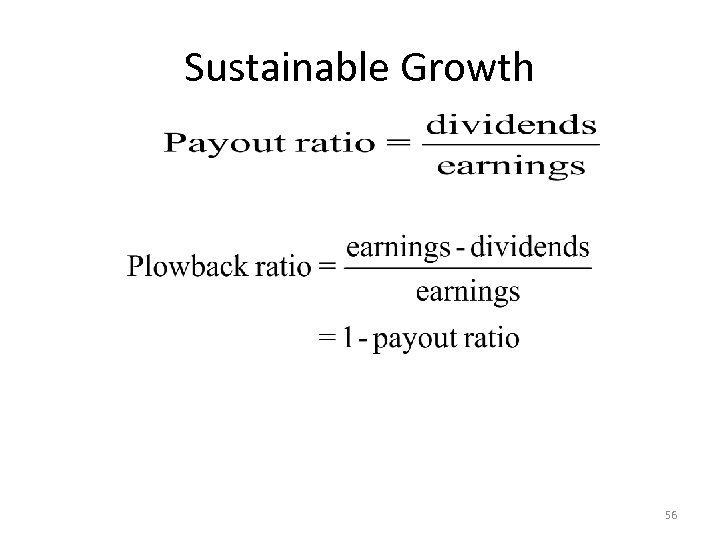 Sustainable Growth 56
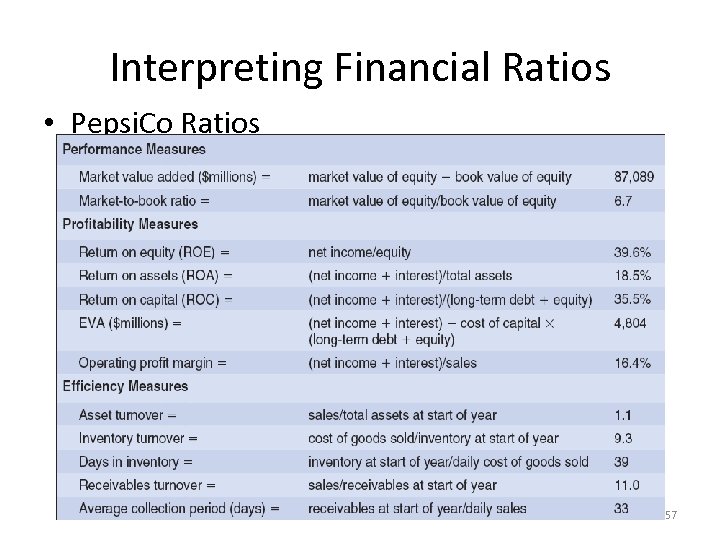 Interpreting Financial Ratios • Pepsi. Co Ratios 57
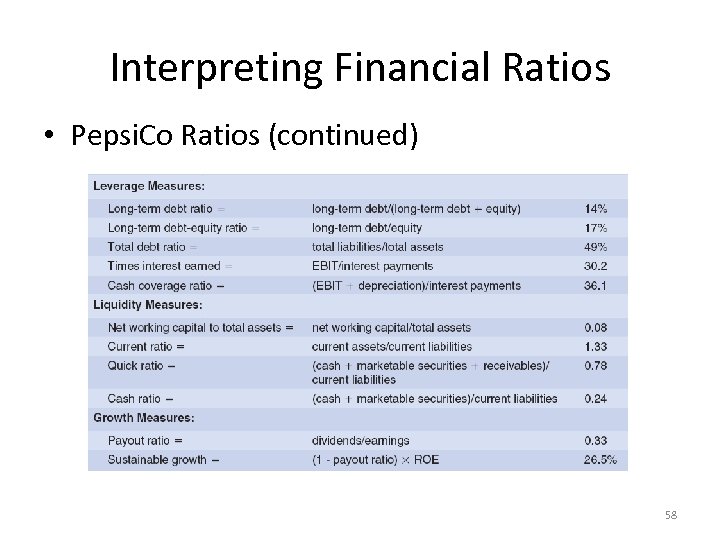 Interpreting Financial Ratios • Pepsi. Co Ratios (continued) 58
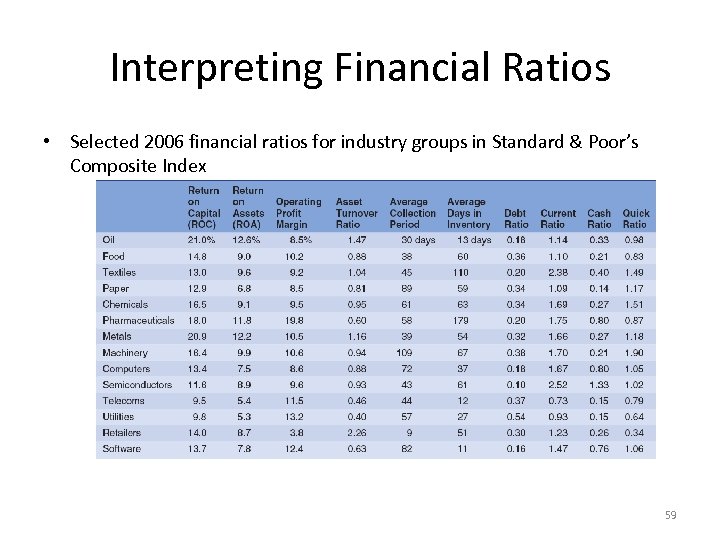 Interpreting Financial Ratios • Selected 2006 financial ratios for industry groups in Standard & Poor’s Composite Index 59
 Accounting information and market information are important • The market demand transparency of company information! • this is to ensure fairness for all the market participants to make informed decision. • Efficient market is characterized of efficient information revealing. 60
 Next topic: Valuing stocks! Thank you for coming! 61