 Скачать презентацию THE CONTINUUM CONTINUES A Broad Look at Barriers
956eae2e20b60b06684f6b9d8038fd09.ppt
- Количество слайдов: 17



THE CONTINUUM CONTINUES A Broad Look at Barriers to Internet Access and Use Among American Adolescents Cyberworld Unlimited? Digital Inequality & News Spaces of Informal Education for Young People February 9, 2006 Universität Bielefeld, Germany
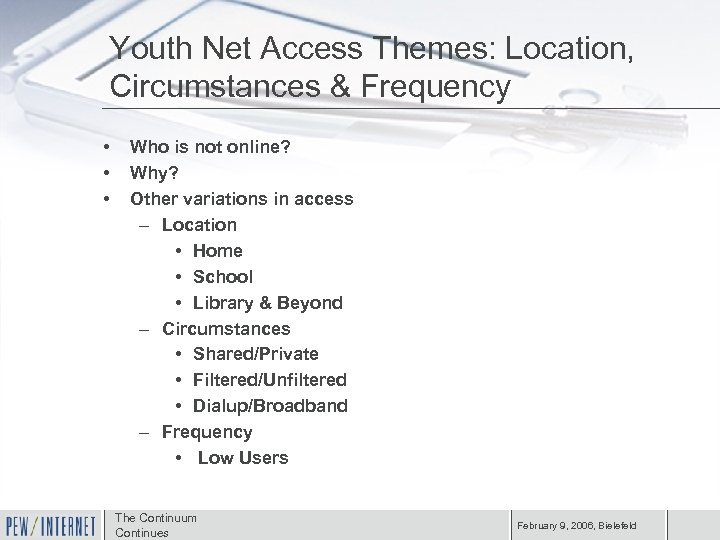
Youth Net Access Themes: Location, Circumstances & Frequency • • • Who is not online? Why? Other variations in access – Location • Home • School • Library & Beyond – Circumstances • Shared/Private • Filtered/Unfiltered • Dialup/Broadband – Frequency • Low Users The Continuum Continues February 9, 2006, Bielefeld
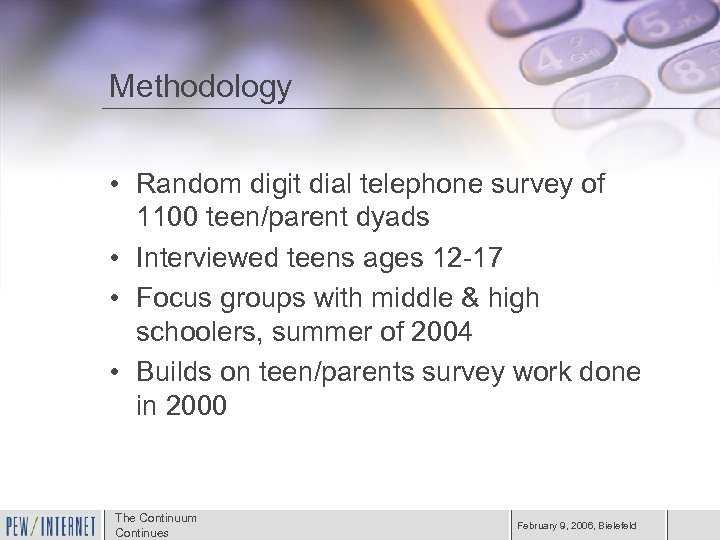
Methodology • Random digit dial telephone survey of 1100 teen/parent dyads • Interviewed teens ages 12 -17 • Focus groups with middle & high schoolers, summer of 2004 • Builds on teen/parents survey work done in 2000 The Continuum Continues February 9, 2006, Bielefeld
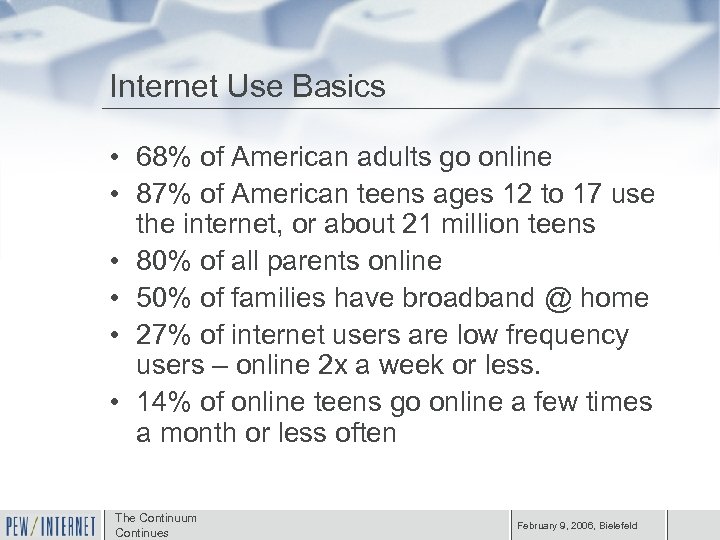
Internet Use Basics • 68% of American adults go online • 87% of American teens ages 12 to 17 use the internet, or about 21 million teens • 80% of all parents online • 50% of families have broadband @ home • 27% of internet users are low frequency users – online 2 x a week or less. • 14% of online teens go online a few times a month or less often The Continuum Continues February 9, 2006, Bielefeld
Who is Not Online? • 13% of teens 12 -17 don’t go online • 47% of offline teens once went online • 52% of offline teens say they would like to go online • 7% of all teens have never been online The Continuum Continues February 9, 2006, Bielefeld
Demographics of Offline teens • Close to 7 in 10 teens who don’t go online are younger (12 -14); remaining 30% are older (1517). • One third (1/3) are non-white, two thirds (2/3) are white. • One third (35%) live in households earning less than $30, 000 annually; two-thirds live in households that earn more. • One quarter live in urban areas, about 2 in 5 live in the suburbs, and the remaining third live in rural areas. The Continuum Continues February 9, 2006, Bielefeld
Why Not Online? • Themes: Access, Time and Desire • Major reasons not online: – Not interested – Too busy – No access – Too frustrating • 1 in 10 say that fears, bad experiences, or their parents keep them offline The Continuum Continues February 9, 2006, Bielefeld
Location: Where do teens go online? • • • 87% of online teens have access at home 78% have internet access at school 74% go online from a friend’s or relative’s house 54% have gone online from a library 9% go online from a community center or house of worship • 93% of online teens have multiple points of access—home AND school AND the library AND a friend’s house… The Continuum Continues February 9, 2006, Bielefeld
Circumstances of Internet Use • 90% of online teens share the computer with other family members • 73% of teens with home internet access use a computer in a public space in the home • 54% of teens use computers with filters or monitoring software • More 60% of parents report monitoring their child’s internet use, including setting rules about how long a child can go online • 83% of all teens say that most of the other people they know go online; 10% say some, 6% say very few. The Continuum Continues February 9, 2006, Bielefeld
Broadband vs. Dialup Users • Teen broadband users go online more often and engage in a wider array of activities than dial up users • 51% of all online teens with home access have high speed internet at home. • More dial up teens are likely to be low users (online less than 3 times a week) • More on low-frequency users… The Continuum Continues February 9, 2006, Bielefeld
Broadband vs. Dialup (2) • More dial up teens (21%) report that they’d like to go online more than they currently do; only 11% of bbd users say the same. • Why aren’t they online more often – Too many other responsibilities – No time – No access – Not allowed The Continuum Continues February 9, 2006, Bielefeld
Frequency of Use: Basics • 51% of online teens go online daily – 24% several times a day – 27% about once a day • 21% go online 3 to 5 days a week • 13% go online 1 to 2 days a week • 14% go online less often The Continuum Continues February 9, 2006, Bielefeld
Low Users: Teens online less than 3 x a week • About ¼ of online teens are low users: online or two times a week or less. • More likely to be boys • Younger, 12 -13 years old • Offline parents • Dial up users • 34% do NOT have desktop computer (vs. 18% of higher frequency users), and another 15% have a desktop that is not net connected. The Continuum Continues February 9, 2006, Bielefeld
Low Users (2) • More likely to say they’d like to go online more than they do • Smaller universe of known ‘net users for low users: 75% say most of the people they know are online, compared to 93% of high frequency users • Lack of “personal” internet opportunities: Less to go online from home, friend’s house • Hint of lagging skills; more likely to need help with computer-related activities The Continuum Continues February 9, 2006, Bielefeld
Continuum Continues • • • High Frequency Users – 3 days a week or more – Broadband, Access at home, No time limits, Low Frequency Users – 2 times a week or less – Dial up or non-home access – Younger, Boys – Limited skills – Many would like to go online more Non-Users – Previous Users: access problems – Never Used: no interest in using The Continuum Continues February 9, 2006, Bielefeld
Questions remain • Is it ok to be a low user or non-user by choice? • Or are non-users and low-users at a significant disadvantage in opportunities for learning, job skill acquisition, social development and participation in civic discourse? • Or are they better managing an enormous flow of information and the expectation of constant contact? • What does it mean that low levels of use appear to be related to lack of home use? The Continuum Continues February 9, 2006, Bielefeld
Thank You! Danke! • • • Amanda Lenhart Pew Internet & American Life Project http: //www. pewinternet. org
Скачать презентацию THE CONTINUUM CONTINUES A Broad Look at Barriers
956eae2e20b60b06684f6b9d8038fd09.ppt