 Скачать презентацию The Constitutional Convention Shay s Rebellion showed the
102602ea71932e65d44f754fcdf15e84.ppt
- Количество слайдов: 13



The Constitutional Convention
Shay’s Rebellion showed the weaknesses of the Articles of Confederation Can’t pay back Revolutionary War debt Soldiers can’t be paid No power in AOC for Congress to tax Are the accomplishments of the Revolutionary War in jeopardy?
Annapolis Convention Annapolis, MD September 1786 Delegates from only 6 states attend Meet again in Philadelphia in May 1787
Philadelphia Convention Constitutional Convention Delegates decided to “rip up” AOC and create a new government Why was this against the law? Four important “acts” from the convention to the final state ratifying The Constitution Plans to change AOC The Great Compromise Ratification (NY, Virginia, Massachusetts) The Bill of Rights
Virginia and New Jersey Plans Virginia Plan James Madison 2 house legislature (bicameral) State’s population determined representation in each house Small states fear big states like Virginia, Massachusetts, and Pennsylvania would dominate New Jersey Plan William Patterson One house Congress (unicameral) States cast one vote This issue threatened to ruin the convention. Many delegates ready to walk out. Solution is Great Compromise
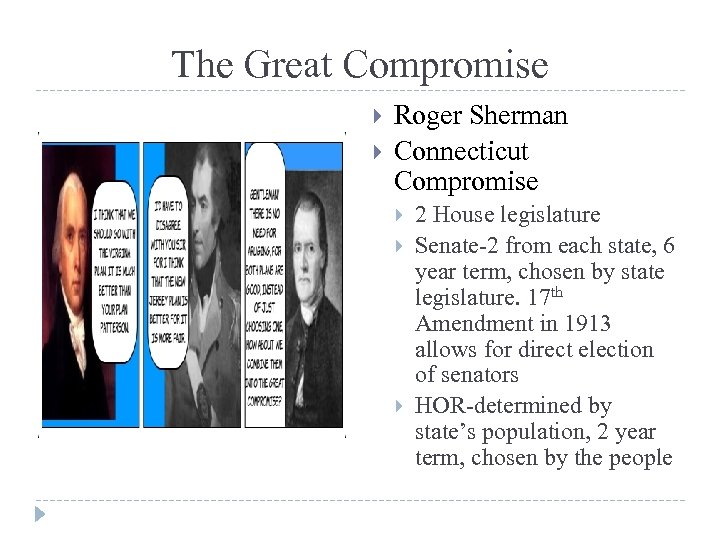
The Great Compromise Roger Sherman Connecticut Compromise 2 House legislature Senate-2 from each state, 6 year term, chosen by state legislature. 17 th Amendment in 1913 allows for direct election of senators HOR-determined by state’s population, 2 year term, chosen by the people
Electing the President Electoral College Number of electors determined by a state’s number in the HOR plus 2 senators Today- 270 Electoral Votes out of 538 needed to elect the President Originally, electors cast two ballots- 1 st place-President, 2 nd place-Vice President 12 th Amendment makes President and VP a ticket If no candidate received a majority of votes, HOR votes for President Senate would vote for VP Is it possible for a candidate to win the popular vote but lose in the EC? Yes, has happened five times in our history
270 to Win http: //www. 270 towin. com/
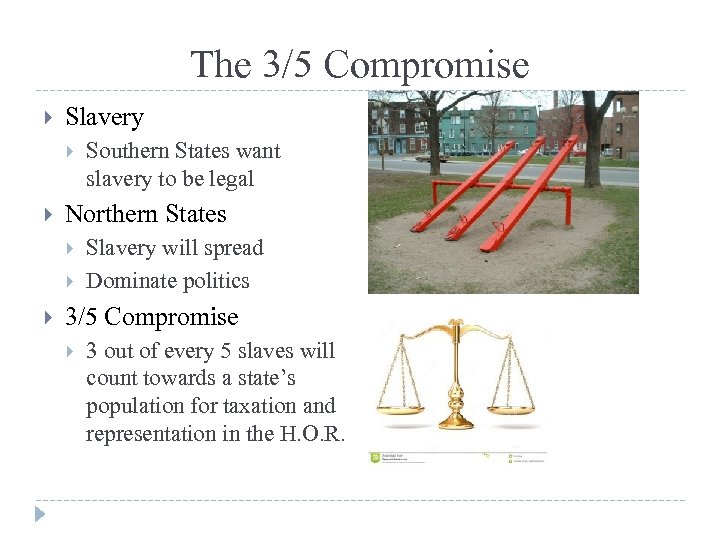
The 3/5 Compromise Slavery Northern States Southern States want slavery to be legal Slavery will spread Dominate politics 3/5 Compromise 3 out of every 5 slaves will count towards a state’s population for taxation and representation in the H. O. R.
Commerce Compromise The Southern states… Favored state control over the regulation of trade Feared a federal ban on the slave trade Feared a federal duty (payment) on agricultural exports The Northern states… Favored federal regulation of all trade Wanted the federal government to collect duties and tariffs (payment on imports/exports)
The two sides reached the following compromise… Federal regulation of interstate (between states) and international trade State regulation of intrastate (within a state) trade No export duties to be passed for 20 years No ban on the slave trade until 1808
Federalism Power divided between national, state, and local governments. However…. Supremacy Clause of the Constitution This Constitution, and the Laws of the United States which shall be made in pursuance thereof; and all treaties made, or which shall be made, under the authority of the United States, shall be the supreme law of the land; and the judges in every state shall be bound thereby, anything in the constitution or laws of any state to the contrary notwithstanding.
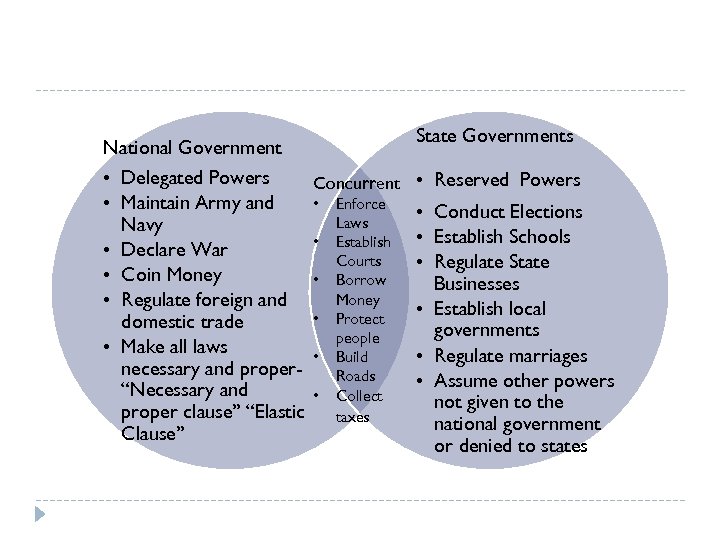
National Government • Delegated Powers • Maintain Army and Navy • Declare War • Coin Money • Regulate foreign and domestic trade • Make all laws necessary and proper“Necessary and proper clause” “Elastic Clause” State Governments Concurrent • Reserved Powers • • • Enforce Laws Establish Courts Borrow Money Protect people Build Roads Collect taxes • Conduct Elections • Establish Schools • Regulate State Businesses • Establish local governments • Regulate marriages • Assume other powers not given to the national government or denied to states
Скачать презентацию The Constitutional Convention Shay s Rebellion showed the
102602ea71932e65d44f754fcdf15e84.ppt