


 Скачать презентацию The Constitution Drill 9 2 n Define the
31099dd9ee89e5b738fbaee91a3bb2ed.ppt
- Количество слайдов: 52
 The Constitution
 Drill 9/2 n Define the following ¡ Democracy n ¡ Oligarchy n ¡ Rule of the people Rule of a small group of people Unitary Government n System of government where the power is held by an individual or small council
 Volunteers please… n For this exercise I need three Volunteers willing to stand perform in front of the class n Complete the chart and accompanying exercises before we move on.
 Objective: SWBAT n Identify and analyze the laws set forth in the Constitution
 The MOTHER of all Constitution Assignments n n n You may work alone or with a partner Using the yellow Constitution books Each assignment will be 20 questions long Today we will begin with questions 1 -20, tomorrow we will complete the next 20 etc. This will also be assigned for homework this week The entire assignment will be due MONDAY 9/8
 The Preamble We the People of the United States, in Order to form a more perfect Union, establish Justice, insure domestic Tranquility, provide for the common defence, promote the general Welfare, and secure the Blessings of Liberty to ourselves and our Posterity, do ordain and establish this Constitution for the United States of America.
 The Preamble n n n in Order to form a more perfect Union establish Justice insure domestic Tranquility provide for the common defence promote the general Welfare and secure the Blessings of Liberty to ourselves and our Posterity
 Article One Section 1. All legislative powers herein granted shall be vested in a Congress of the United States, which shall consist of a Senate and House of Representatives.
 Drill 9/3 n Article I of the Constitution outlines the powers and structure of what body? ¡ The Congress
 Objective: SWBAT n Identify and analyze the laws set forth in the Constitution
 Article One Section 1. All legislative powers herein granted shall be vested in a Congress of the United States, which shall consist of a Senate and House of Representatives. What specific body does Section 2 outline?
 n ARTICLE I ¡ ¡ n Section 1 – The Congress Section 2 – The house Section 3 – Senate And so on Each section of the constitution is dedicated to a certain part and function of the Government
 CW – T’Mocha n Finish 1 -20, Begin the next 20 n HW tonight 21 -40
 Drill 9/4 n What is impeachment? ¡ ¡ ¡ Who has the sole power of impeachment? Who tries the case? Who presides over the trial?
 Drill 9/4 n Impeachment ¡ n The House of Representatives ¡ n 1. 2 The Senate ¡ n The legal statement of charges 1. 3 The Chief Justice ¡ 1. 3
 Objective: SWBAT n Identify and analyze the laws set forth in the Constitution
 Drill 9/5 n Given the power give the Article and the section ¡ ¡ ¡ Congress Senate Presidency House of Representatives President/ Vice President Removal from office
 Objective: SWBAT n Identify and analyze the laws set forth in the Constitution
 Article II n The executive Power shall be vested in a President of the United States of America. He shall hold his Office during the Term of four Years, and, together with the Vice-President chosen for the same Term, be elected, as follows: . . .
 Question n Why did the framers of the Constitution feel it was necessary to put IN WRITING that the executives could be removed from office?
 Objective: SWBAT n Analyze the intentions and effects of the Bill Of Rights
 CW: 9/8 n n n Take your pocket Constitutions, turn to page 21 Of the first 10 amendments pick the one that you feel is most important On a separate sheet of paper, restate the amendment and below explain WHY you feel this is the most important in a short paragraph.
 Setting the scene n n n 1787 The Constitutional debate is raging Between two factions ¡ ¡ Federalists Anti-federalists
 Federalists n n n Madison, John Adams, Hamilton Desired a strong central government with subordinate states Driving forces behind the Constitution
 Drill 9/9 n Identify the following ¡ ¡ Federalists Anti-Federalists
 Federalists n n n Madison, John Adams, Hamilton Desired a strong central government with subordinate states Driving forces behind the Constitution
 ANTI-Federalists n n Samuel Adams, Patrick Henry Feared that a strong centralized force would be a return to the monarchy ¡ ¡ Wanted the states to have more control Driving force behind the Articles of Confederation
 Reception to the Constitution n Most people in every state disliked the constitution at the start The nine states that ratify it first do it with relative ease Rhode Island North Carolina are hold outs
 Ensuring Ratification n n To ensure final ratification the federalist powers buckle James Madison in the first Congress (1797) introduces the first ten amendments ¡ They pass with ¾ of the vote
 Objective: SWBAT n Analyze the Amendments I and II of the Constitution
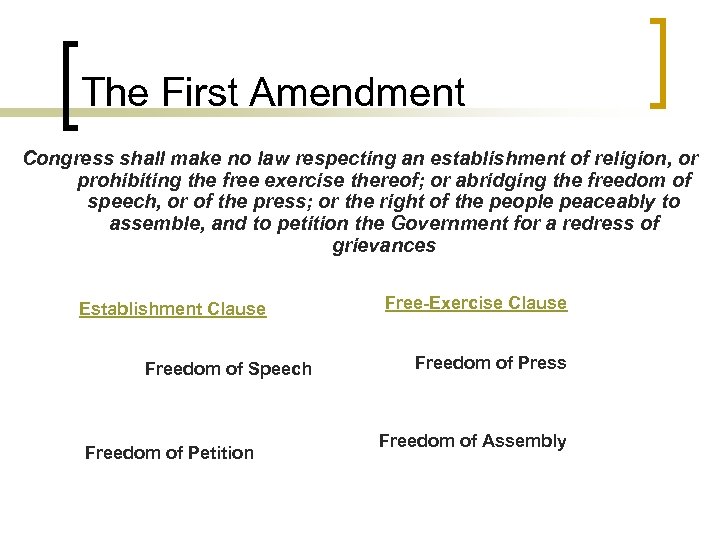 The First Amendment Congress shall make no law respecting an establishment of religion, or prohibiting the free exercise thereof; or abridging the freedom of speech, or of the press; or the right of the people peaceably to assemble, and to petition the Government for a redress of grievances Establishment Clause Freedom of Speech Freedom of Petition Free-Exercise Clause Freedom of Press Freedom of Assembly
 Establishment clause n Congress shall make no law respecting an establishment of religion There is NO official religion of the United States. The United States can not promote one religion over another.
 Free Exercise clause n or prohibiting the free exercise thereof The United States government cannot prohibit anyone from practicing their religion, so long as it stays within the laws of the country
 The Second Amendment A well regulated Militia, being necessary to the security of a free State, the right of the people to keep and bear Arms, shall not be infringed. THE DEBATE: Does this mean that EVERYONE has the right to bear arms (A) or does this mean that a police force has the right to bear arms (B)?
 Drill 9/10 n List the freedoms guaranteed by the first amendment ¡ ¡ ¡ Religion Speech Press Petition Assembly
 The Second Amendment A well regulated Militia, being necessary to the security of a free State, the right of the people to keep and bear Arms, shall not be infringed. THE DEBATE: Does this mean that EVERYONE has the right to bear arms (A) or does this mean that a police force has the right to bear arms (B)?
 Objective: SWBAT n Analyze the IV and V amendments of the Bill of Rights
 Fourth Amendment The right of the people to be secure in their persons, houses, papers, and effects, against unreasonable searches and seizures, shall not be violated, and no Warrants shall issue, but upon probable cause, supported by Oath or affirmation, and particularly describing the place to be searched, and the persons or things to be seized. Freedom from unwarranted search + seizures Warrants need PROBABLE CAUSE, local judges decide that Warrants must be specific in WHAT is searched and WHAT they are looking for
 With a Partner… n n n Read through the episodes of “The case of the vanishing sub machinegun” After each episode decide whether or not you apply for a search warrant after each episode and explain why. Remember – What am I looking for? Why am I looking for it?
 Drill 9/11 n Identify the rights protected by the following amendments ¡ ¡ ¡ II IV
 The Fifth Amendment No person shall be held to answer for a capital, or otherwise infamous crime, unless on a presentment or indictment of a Grand Jury, except in cases arising in the land or naval forces, or in the Militia, when in actual service in time of War or public danger; nor shall any person be subject for the same offense to be twice put in jeopardy of life or limb; nor shall be compelled in any criminal case to be a witness against himself, nor be deprived of life, liberty, or property, without due process of law; nor shall private property be taken for public use, without just compensation
 Fifth Amendment n Self incrimination ¡ n Double Jeopardy ¡ n You can not be tried for the same crime twice Eminent Domain ¡ n “You have the right to remain silent” The Government can not take your land without your agreement and just compensation Due Process
 Due Process n The principle of government that states that ALL of a person’s legal rights must be followed ¡ No short-cuts
 Due Process n Guaranteed by the V, VI, and VII amendments ¡ Later by the XIV amendment
 Sixth amendment In all criminal prosecutions, the accused shall enjoy the right to a speedy and public trial, by an impartial jury of the State and district where in the crime shall have been committed, which district shall have been previously ascertained by law, and to be informed of the nature and cause of the accusation; to be confronted with the witnesses against him; to have compulsory process for obtaining witnesses in his favor, and to have the Assistance of Counsel for his defense. Speedy and public trial by jury Confront witnesses Provide witnesses in your defense Right to a lawyer Tried in the state where the crime was committed
 With a partner… n Read through the background information of the case of Ms. Mary Toka n Using the information create a legal brief illustrating how her rights were violated n Use the template on page four and make on your own paper, ¡ do not write on these copies please.
 Drill 9/12 n Identify the rights given in the following amendments ¡ ¡ ¡ V VI VII
 The Eighth Amendment Excessive bail shall not be required, nor excessive fines imposed, nor cruel and unusual punishments inflicted. What constitutes “Cruel and Unusual”? Is the death penalty “Cruel and Unusual”?
 CW: The 8 th Amendment n Use the chart to decide whether or not the you think the punishment sentenced is in violation of the eighth amendment
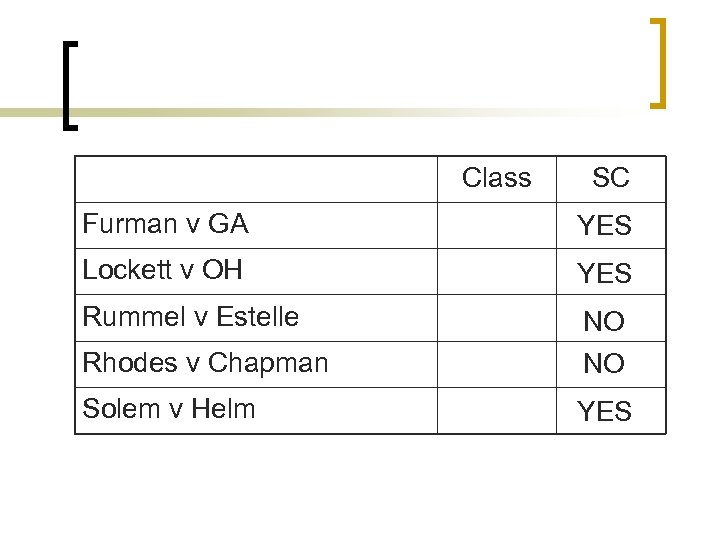 Class SC Furman v GA YES Lockett v OH YES Rummel v Estelle Rhodes v Chapman NO NO Solem v Helm YES
 The Ninth and Tenth Amednments n The enumeration in the Constitution, of certain rights, shall not be construed to deny or disparage others retained by the people. n The powers not delegated to the United States by the Constitution, nor prohibited by it to the States, are reserved to the States respectively, or to the people.
 CW: IN BCR form n Why does