


 Скачать презентацию The Congress of Vienna Student Handouts Inc
a29ddaddd4ca8e2546f62be380c1ae4d.ppt
- Количество слайдов: 15
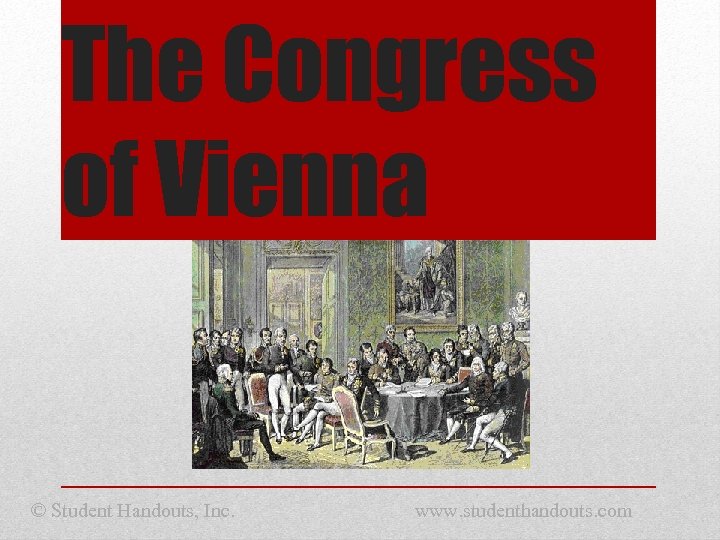 The Congress of Vienna © Student Handouts, Inc. www. studenthandouts. com
 Congress of Vienna (1814 -1815) • European monarchs sought to turn back the clock to 1789 and restore Europe’s Old Regime • Members included the “Big Four” and France – – – Austria – Prince Metternich England – Duke of Wellington and Lord Castlereagh France – Talleyrand Prussia – Frederick William III, Hardenberg, and Humboldt Russia – Tsar Alexander I
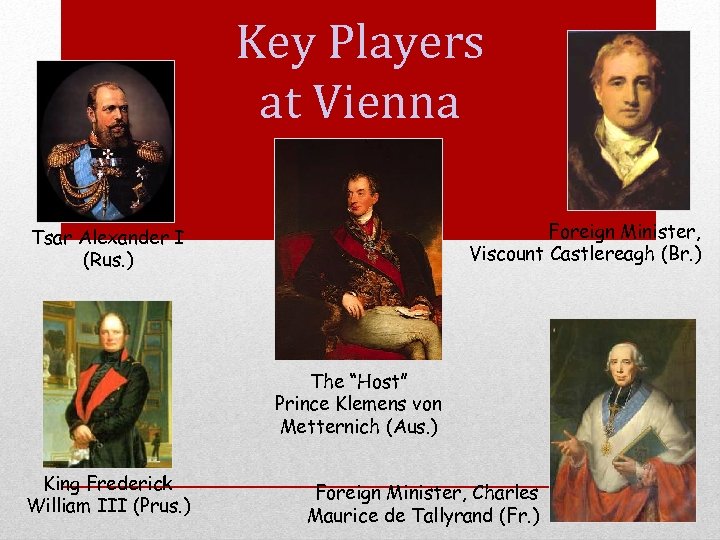 Key Players at Vienna Foreign Minister, Viscount Castlereagh (Br. ) Tsar Alexander I (Rus. ) The “Host” Prince Klemens von Metternich (Aus. ) King Frederick William III (Prus. ) Foreign Minister, Charles Maurice de Tallyrand (Fr. )
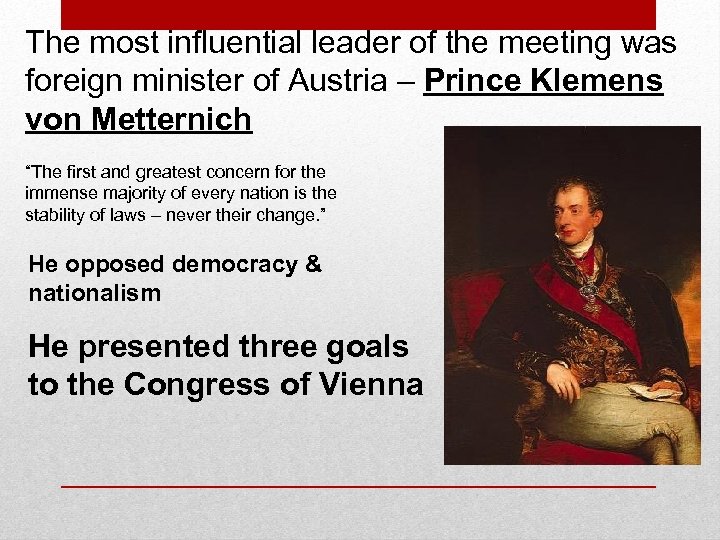 The most influential leader of the meeting was foreign minister of Austria – Prince Klemens von Metternich “The first and greatest concern for the immense majority of every nation is the stability of laws – never their change. ” He opposed democracy & nationalism He presented three goals to the Congress of Vienna
 Goal 1 – Containment of France Prevent French aggression by surrounding the country with strong countries. ØCreated the Kingdom of the Netherlands ØCombined 39 German states into the German Confederation (dominated by Austria) ØSwitzerland now independent nation ØKingdom of Sardinia (in Italy) adds Genoa ØPrussia given land in the Rhineland to keep an eye on France ØCoalition forces would occupy France for 3 -5 years.
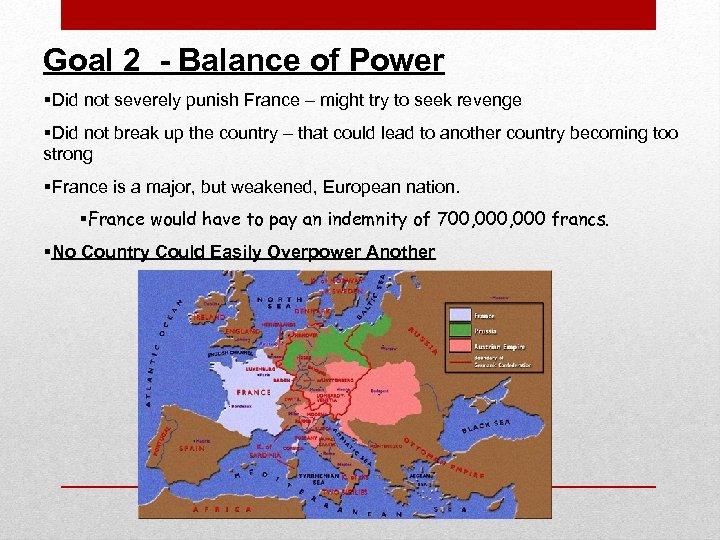 Goal 2 - Balance of Power §Did not severely punish France – might try to seek revenge §Did not break up the country – that could lead to another country becoming too strong §France is a major, but weakened, European nation. §France would have to pay an indemnity of 700, 000 francs. §No Country Could Easily Overpower Another
 Goal 3 – Compensation & Legitimacy Compensate countries who had land taken or had fought against Napoleon Return the monarchs to power in the countries in which Napoleon drove them out. The members of the Congress believed this would stabilize political relations among nations • Legitimacy –Restoration of pre-Napoleon rulers –House of Bourbon – France, Spain, and the two Sicilies –House of Braganza – Portugal –House of Orange – Netherlands –House of Savoy – Sardinia –German princes – territories in the Confederation of the Rhine –Pope and Catholic Church – Papal States
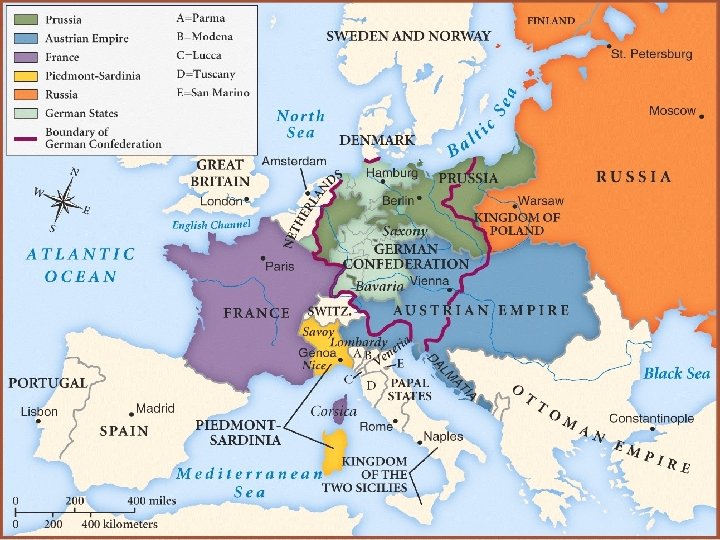
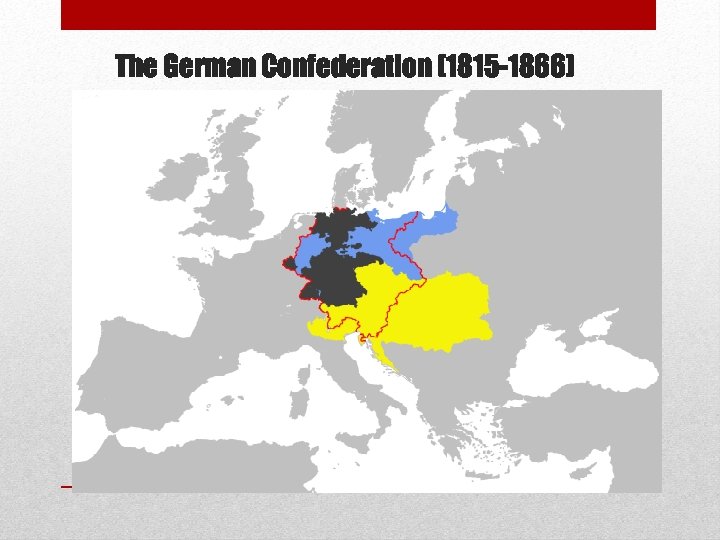 The German Confederation (1815 -1866)
 Territorial Changes • Austria gained Lombardy, Modena, Parma, Tuscany, and Venetia (all areas in Italy) • England gained Cape Colony, Ceylon, Heligoland, Guiana, and Malta (areas in Africa, the Americas, and Asia) • Holland gained Austrian Netherlands (Belgium) • Prussia gained part of Poland, land along the Rhine River, 40% of Saxony, Swedish Pomerania, and Westphalia • Russia gained Finland part of Poland • Sweden gained Norway
 Louis XVIII of France • No more divine right of kings • Charter (Constitution) granted in 1814 • Could not restore feudalism and serfdom • Continuing religious toleration guaranteed
 Fate of Nationalism • People had no say over territorial changes • Language, nationality, and religion weren’t taken into consideration • Ideas of democracy and self-government were rejected by European leadership • But those ideals lived on in underground movements and erupted in revolt over the course of the next 50 years.
 Quadruple and Holy Alliances • Metternich desired to maintain the status quo and make the Vienna treaties permanent • Quadruple Alliance of 1815 – Austria, England, Prussia, and Russia – France joined in 1818 – Pledged to put down democratic or nationalistic revolts • Holy Alliance – Organized by Tsar Alexander I of Russia – Most European monarchs joined – Pledged to govern with charity, justice, and peace • But none of them did so
 Results of the Congress of Vienna • Concert of Europe – group of leading nations which periodically met to discuss issues regarding stability; goal was to maintain the Balance of Power • Temporary suppression of democratic and nationalistic ideals • Monarchs remain in control • Absolute – Central and Eastern Europe • Constitutional – Britain and France • International peace – no general war in Europe until World War I a hundred years later. The wars below were considered small regional affairs: – Crimean War (1854 -1856) – Austro-Prussian War (1866) – Franco-Prussian War (1870 -1871)
 With which of these statements about the Congress of Vienna would you most agree? Explain your answer. “ 1815 is the one and only time in European history when statesmen sat down to construct a peaceful international system after a great war and succeeded. This astonishing accomplishment in international politics made possible much of the change and progress in 19 th century European society” -Paul Schroeder, The Transformation of European Politics “[T]here was certainly no lack of awareness of the strength of national feeling in Germany, Poland Italy, and by failing to take it into account in their arrangements the architects of the settlement defeated their own purpose and sowed the seeds of untold problems in the future. ” -Adam Zamoyski, The Rites of Peace: The Fall of Napoleon and the Congress of Vienna