


THE COMPUTER AND IT INDUSTRIES By Team 2
INTRODUCTION History of computer industry Differences between computer and IT industries Companies which are included in IT industries Significance of Silicon Valley How has the IT industry affected the economy Key Success Factors How do computer companies stack up against each other Conclusion
THE INDUSTRIES: that supply computer goods and services are continualstate of change as new product appear and oldproducts are discontinued. The term computer industry is used in a variety of ways. Narrowly defined, the computer industry encompasses those companies that manufacture computers.
HISTORY OF COMPUTER INDUSTRY The computer industry was born with construction of the ENIAC in 1946. Even so, the term goes back farther than 1946. It was coined during World War II to describe workers, mostly women, who used cumbersome mechanical calculators to determine the trajectories of artillery shells. Since their jobs were to "compute" the shell trajectories, they came to be called "computers. "When the first machine that could perform such calculations came along, ENIAC, it naturally was called a computer as well. Built at the University of Pennsylvania's Moore School of Electrical Engineering, ENIAC stood for "Electronic Numerical Integrator and Computer, " but its birth lay in World War II as a classified military project known as Project PX. The ENIAC laid the foundations for the modern electronic computing industry. More than any other machine, the ENIAC demonstrated that high-speed digital computing was possible using then-available vacuum tube technology. Microcomputers, what virtually everyone has on their desks in the late 1990 s, were born a short time later through the invention of the transistor at Bell Laboratories in 1947. The first transistorized computer is completed in 1956. It's called the TX-O (Transistorized Experimental computer), and is built at the Massachusetts Institute of Technology.
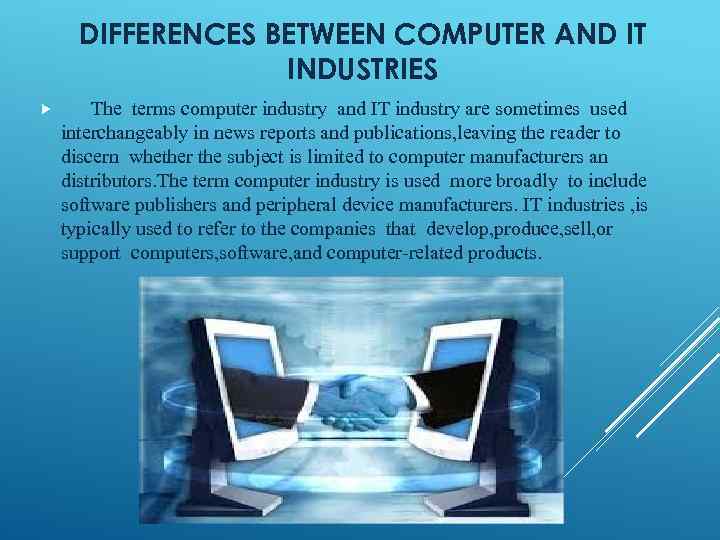
DIFFERENCES BETWEEN COMPUTER AND IT INDUSTRIES The terms computer industry and IT industry are sometimes used interchangeably in news reports and publications, leaving the reader to discern whether the subject is limited to computer manufacturers an distributors. The term computer industry is used more broadly to include software publishers and peripheral device manufacturers. IT industries , is typically used to refer to the companies that develop, produce, sell, or support computers, software, and computer-related products.
COMPANIES WHICH ARE INCLUDED IN IT INDUSTRIES Companies in the IT industry can be seperated into several broad categories, sometimes referred to as sectors or segments, including equipment manufacturers, chipmakers, software publishers, service companies, and retailers. Equipment manufacturers design and manufacture computer hardware and communication products, PDAs, mice, monitors, storage devices, routers, scanners, and printers. Chipmakers design and manufacture computer chips and circuit boards, including microprocessors, RAM, system boards, sound graphics cards. Software publishers create computer software, including applications, operating systems, and programming languages. Service companies provide computer-related services, including businnes consulting. Computer retailers include companies that sell computer products through retail stores, direct sales representatives, mail-order cataalogs and, and Web sites.
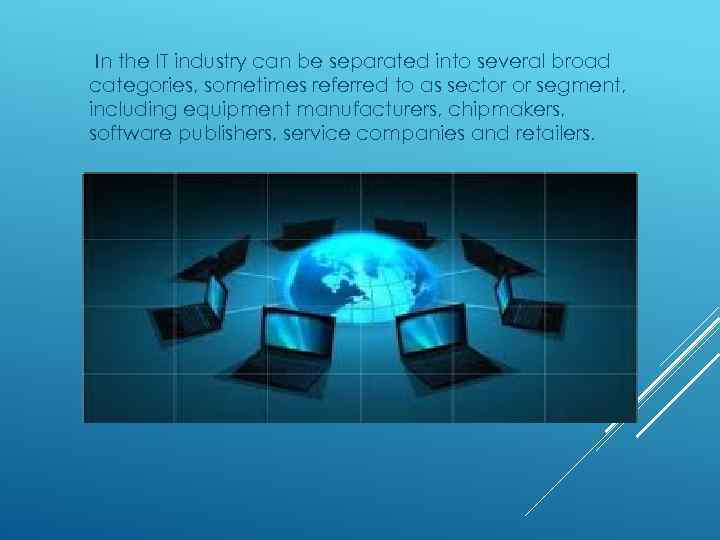
In the IT industry can be separated into several broad categories, sometimes referred to as sector or segment, including equipment manufacturers, chipmakers, software publishers, service companies and retailers.
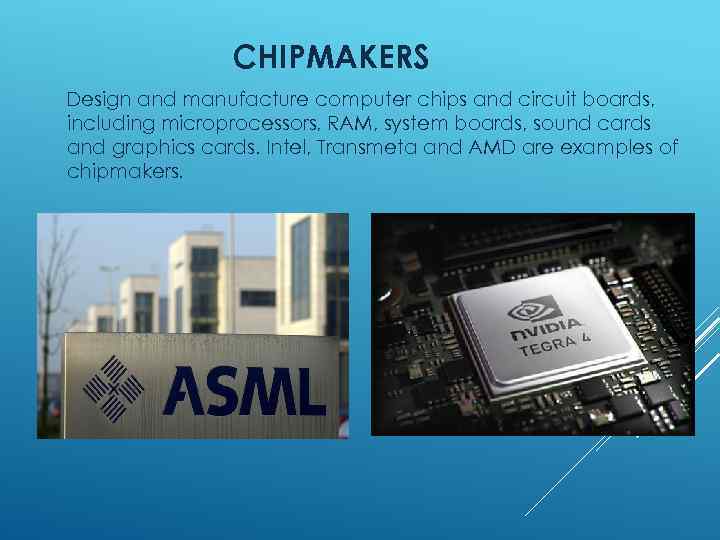
CHIPMAKERS Design and manufacture computer chips and circuit boards, including microprocessors, RAM, system boards, sound cards and graphics cards. Intel, Transmeta and AMD are examples of chipmakers.
SOFTWARE PUBLISHERS Create computer software, including applications, operating system and programming languages. Example of software companies include Microsoft, Adobe systems, Electronic Arts(EA) and Computer Associates(CA)
SERVICE COMPANIES Provide computer-related services, including business consulting, Web site design, Web hosting, Internet hosting, network security and product support. Examples of service companies include AOL and the computer consulting giant, EDS(Electronic data system)
COMPUTER RETAILERS Include companies that sell computer products through retail stores, direct sales representatives and Web sites.
• Dell - The world's #1 direct-sale computer vendor provides a broad range of computer and entertainment products for the consumer and enterprise markets. • Sony - Sony has refocused its approach to selling computers: Instead of appealing primarily to consumers, it is now targeting business customers (mostly small and medium-sized companies). • HP - HP's Personal Systems Group (PSG) markets desktop and notebook PCs to consumer, businesses, government agencies, and schools. • Apple - Once the world's top PC maker, Apple Computer has been relegated to niche status in a market dominated by "Wintel" machines (computers using Microsoft Windows software and Intel processors). • Gateway - Perhaps the purest PC play among the leading computer makers, Gateway has been hit particularly hard by slowing sales in that industry. NUMBER OF COMPANIES WITHIN THE INDUSTRY
Dell Inc. : § Founded in 1984 § Mission Statement: “To be the most successful computer company in the world at delivering the best customer experience in markets we serve. ” § Next day delivery § No middlemen or intermediate retailers Current Situation: § Revenue over $56 billion § Net income of $3. 4 billion DELL INC.
Hewlett-Packard: § Founded in 1939 § HP’s mission: “To invent technologies and services that drive business value, create social benefit and improve the lives of customers—with a focus on affecting the greatest number of people possible. ” § First product was an audio oscillator § Multi component system model Current Situation: § $86 billion in revenue § net income of almost $2. 4 billion HEWLETT-PACKARD
Apple: § Founded in 1976 § Mission statement of Apple is as follows: “Apple will be a leader in providing simple, powerful, high-quality information products and services for people who learn, communicate, and create. ” § Stylish product innovation § Entrepreneurial Current Situation: § $14 billion in revenue § Net income of almost $1. 3 billion APPLE COMPUTER
Gateway: § Founded in 1985 § Mission statement of Gateway Inc. is, “To invest in our communities and future by providing state-of-the-art technology and technical support. ” § 3 rd largest personal computer company in the United States § Ranked in the top ten worldwide § Profit pyramid model Current Situation: § $4 billion in revenue § Net income of almost $6 million GATEWAY INC.
Soyo Group Inc. : § Founded in 1999 § The mission statement of Soyo is, “To capitalize on Soyo’s market position as a leading distributor of computer and networking products by increasing penetration of existing markets through acquisitions and expanding into new markets. ” § Computer peripheral devices Current Situation: § $38 million in revenue § Net income of almost $540 thousand SOYO GROUP INC.
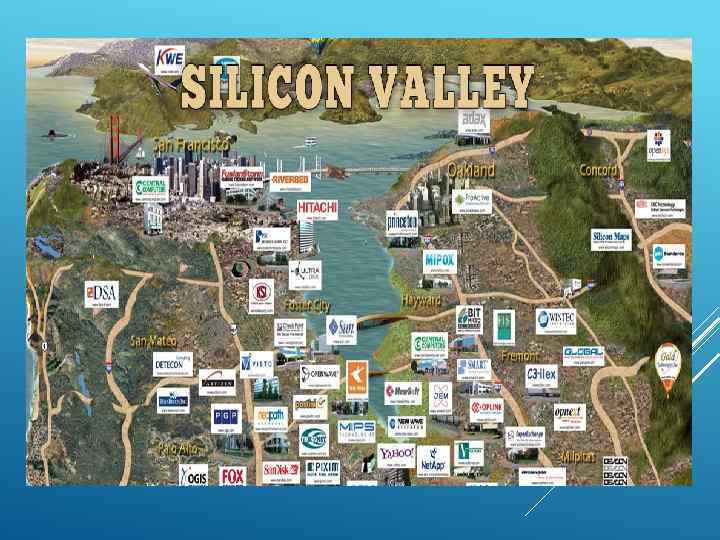
SIGNIFICANCE OF SILICON VALLEY The area of California called Silicon Valley that stretches south and east from San Francisco s Golden Gate bridge was the birthplace of integrated circuits, microprocessors and PC. Silicon Valley has a reputation as the home of the IT players are located elsewhere. Microsoft is located near Seattle. Today, well-known companies, such as Cisco Systems, Sun Microsystems, Oracle, Hewlett-Packard, AMD, Silicon Graphics, all have headquarters in or near California’s Silicon Valley
ECONOMIC FACTORS The IT industry has been described as the most dynamic, most prosperous, most economically beneficial industry the world has ever known. Worldwide consumers spend more than U. S. $1 trillion on information technology each year. The majority of IT workers are in the U. S.
Intel and Microsoft are the two most dominate suppliers in the PC industry. Suppliers: Intel’s microprocessor chips are used in approximately 80% of personal computers. Microsoft operating systems are used in 90% of computers, giving it substantial bargaining power. Given that Microsoft and Intel control the majority of the PC supplier market of major component parts, the business world has named the two “Wintel. ” Buyers: The strength of the PC buyer has basically evolved from the personal computer becoming a commodity-like item. Backward integration is also a factor in the strengthening of the PC buyers bargaining Power because more and more people are building their own computer systems SUPPLIERS/BUYERS
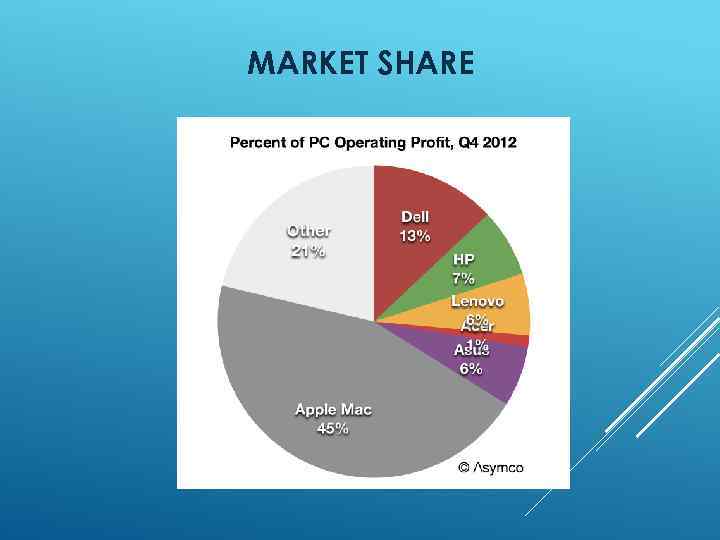
MARKET SHARE
The fact remains that the PC industry doesn’t produce only PC’s. Every company that creates PC’s also has its hand in other industries and markets. An important question to ask is how profitable is the industry. And the answer is billions upon billions of dollars. The industry is constantly redefining itself as well as every other business on the world due to its deep routes within every industry. As for what company ranks the highest in profit at the moment is Apple, but the numbers are skewed due to other hardware Apple provides. The industry is extremely competitive and profitable. INDUSTRY PROFITABILITY
The capital required to enter and actually compete with the big names in the computer industry are ridiculous. Taking into account that HP spent 3. 9 billion on research and development last year alone makes a person think twice about embarking in the industry. New components and ideas are always being developed by the large companies, which few can compete. Furthermore, the brand name products distributed by Apple, Dell and HP are household names. However, if a person is technologically savvy and creates new language or some sort of new innovation they could sell the idea to the large companies. This would be the most probable situation when attempting to create a profit within the PC business. CAPITAL REQUIREMENTS
Involving interests of the PC community can be described as diverse. Advantages consist across the board for the PC user. Ranging from music manipulation, video enhancement, money management, research, school, science and a myriad of others; there are many uses for the PC. Therefore this means the customers that buy the computers are diverse and use their machines in a variety of ways. The computer offers an efficient way of running a business, playing a game or managing your calendar. The bottom line is that any person can find a useful attribute for a computer: which provides the industry with revenue higher than the auto and chemical industries combined. CUSTOMERS
Technologies as well as innovation are advancing every year, therefore making the industry fiercer. Ten years from now chances are there will be few computers in home. Instead, people will be wearing computers -implanted, for example, in eyeglasses, with the retina as the screen -- according to IT pioneer and futurist Raymond Kurzweil. TECHNOLOGY/INNOVATION
KEY SUCCESS FACTORS PC Industry Services Technology Services Consulting and Integration Managed Services A with many situations involving the economy, the factors that account for the success of the IT industry cannot be pinpointed with certainty. It is likely, however, that population growth and business globalization are two important factors that contribute to huge investments in IT.
HOW DO COMPUTER COMPANIES STACK UP AGAINST EACH OTHER Industry analysts often use market share as a gauge of a company’s success. Market share refers to a company’s share, or percentage, of the total market. For example, Microsoft’s share of the total personal computer operating system marcet is about 90%. The remaining 10% share is distributed among Apple and several Linux vendors. In worldwide hardware sales , Hewlett-Packard leads the pack with more than 18% market share, followed closely by Dell. Since 1981, hundreds of companies have produced personal computers. Industry analysyts have classified these companies into market tiers, or categories. The top tier in any segment of the computer industry consists of large companies that have been in the computer businness for many years, and have an identifiable share-usually more than 2% of total computer sales. IBM, Hewlett-Packard, and Dell are three venerable members of the top tier of the computer industry.
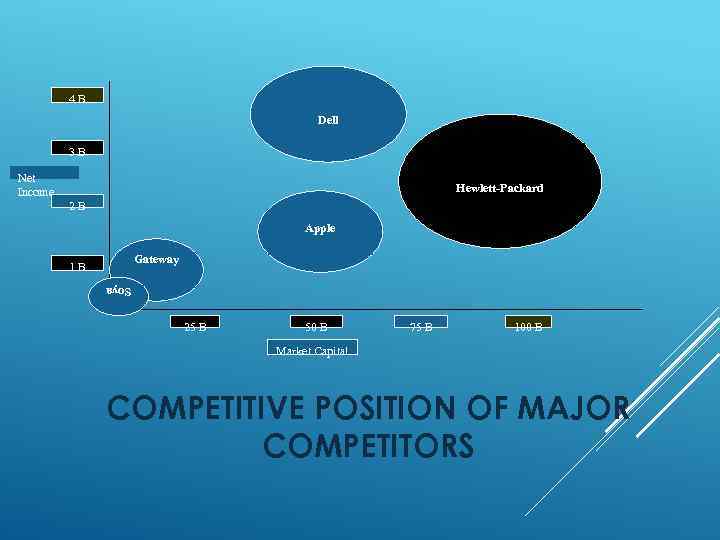
4 B Dell 3 B Hewlett-Packard 2 B Apple Gateway 1 B Soya Net Income 25 B 50 B 75 B 100 B Market Capital COMPETITIVE POSITION OF MAJOR COMPETITORS
The competition within the PC industry is extraordinarily cutthroat. The top companies consist of Dell, HP, Apple, Gateway and Sony. A few factors of competitive edge: • New technology • Custom built PCs • Reliability • Customer Service SCOPE OF COMPETITIVE RIVALRY
The competition the personal computer industry is also an industry that resembles ‘follow the leader. ’ Follow the leader occurs when industry leaders are mimicked by competitors; and those competitors that do not follow will fall off by the wayside. Price Wars: Ex. In 1999 the average PC cost $ 1, 699. Now the average price of a PC is under a thousand dollars. RIVALRY AMONG EXISTING FIRMS
The stage of the PC industry life cycle can be described as mature. However, the growth of PC sales has not decreased due to the globalization trend taking place within the multinational corporations. STAGE IN LIFE CYCLE
CONCLUSION Some aspects of the It industry are regulated by government agencies but many aspects are self regulated by agencies such as the Federal Aviation Authority (FAA), most countries do not have a singe government agency dedicated to regulating the IT industry encompasses many activities, however, and consequently it is subject to regulation from variety of broad-based government agencies, such as the FCC and FTC. In many countries, export restrictions affect the type of technology that can be sold to foreign governments are individuals. Most IT industry leaders oppose further regulation of their industry. They remain skeptical of government regulations that might limit their ability to explore new technologies and offer them to the public.

Thanks for your attention
