


 Скачать презентацию THE COMMONWEALTH FUND Closing the Quality Chasm Opportunities
87986da67e8d365fb45ac98761aed0d8.ppt
- Количество слайдов: 61
 THE COMMONWEALTH FUND Closing the Quality Chasm: Opportunities and Strategies for Moving Toward a High Performance Health System Karen Davis President The Commonwealth Fund kd@cmwf. org Invited Testimony Senate Committee on Health, Education, Labor, and Pensions Hearing on “Crossing the Quality Chasm in Health Care Reform” January 29, 2009
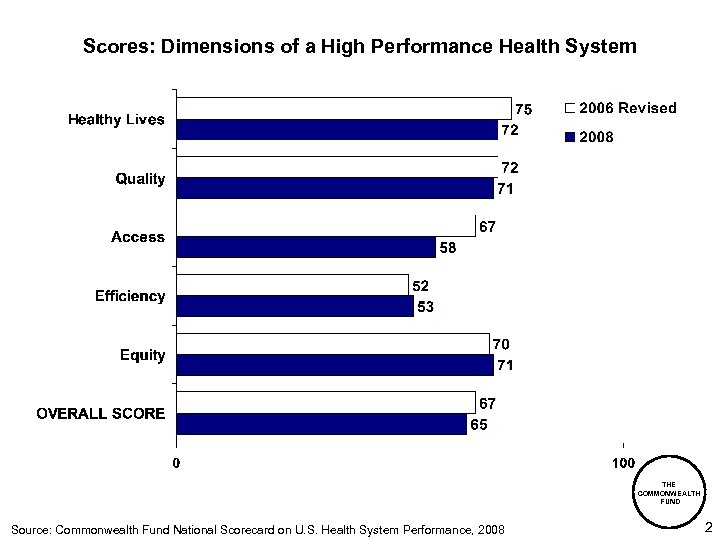 Scores: Dimensions of a High Performance Health System THE COMMONWEALTH FUND Source: Commonwealth Fund National Scorecard on U. S. Health System Performance, 2008 2
 Headed in the Wrong Direction: Evidence of a Deepening Quality Chasm
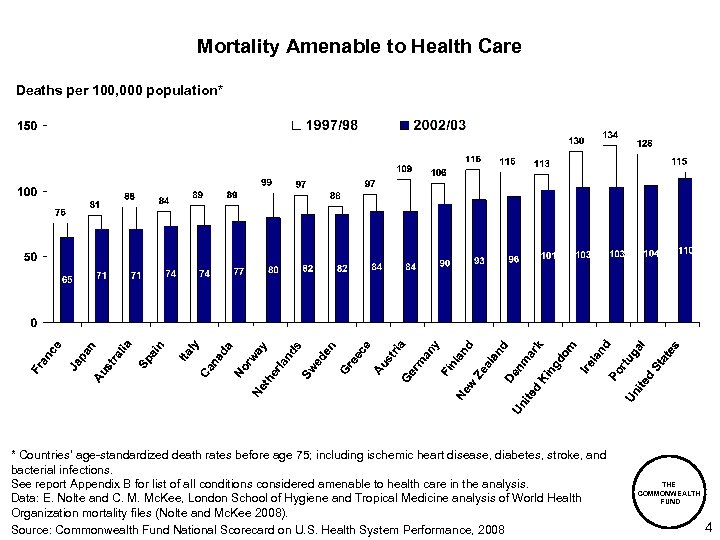 Mortality Amenable to Health Care Deaths per 100, 000 population* * Countries’ age-standardized death rates before age 75; including ischemic heart disease, diabetes, stroke, and bacterial infections. See report Appendix B for list of all conditions considered amenable to health care in the analysis. Data: E. Nolte and C. M. Mc. Kee, London School of Hygiene and Tropical Medicine analysis of World Health Organization mortality files (Nolte and Mc. Kee 2008). Source: Commonwealth Fund National Scorecard on U. S. Health System Performance, 2008 THE COMMONWEALTH FUND 4
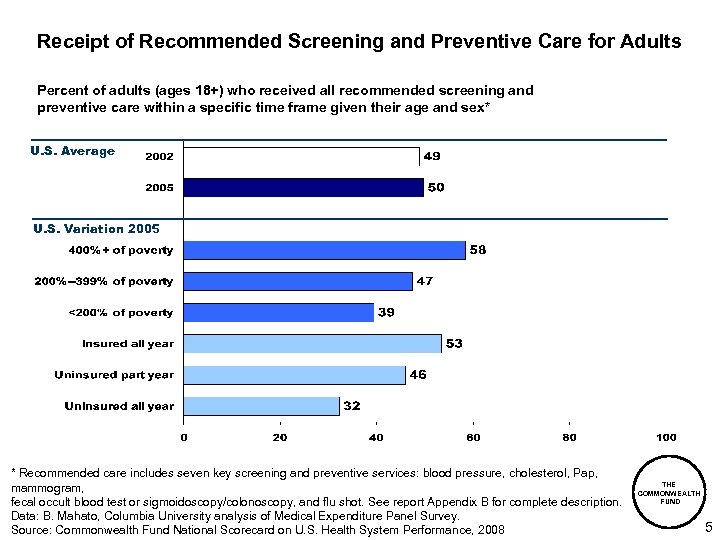 Receipt of Recommended Screening and Preventive Care for Adults Percent of adults (ages 18+) who received all recommended screening and preventive care within a specific time frame given their age and sex* U. S. Average U. S. Variation 2005 * Recommended care includes seven key screening and preventive services: blood pressure, cholesterol, Pap, mammogram, fecal occult blood test or sigmoidoscopy/colonoscopy, and flu shot. See report Appendix B for complete description. Data: B. Mahato, Columbia University analysis of Medical Expenditure Panel Survey. Source: Commonwealth Fund National Scorecard on U. S. Health System Performance, 2008 THE COMMONWEALTH FUND 5
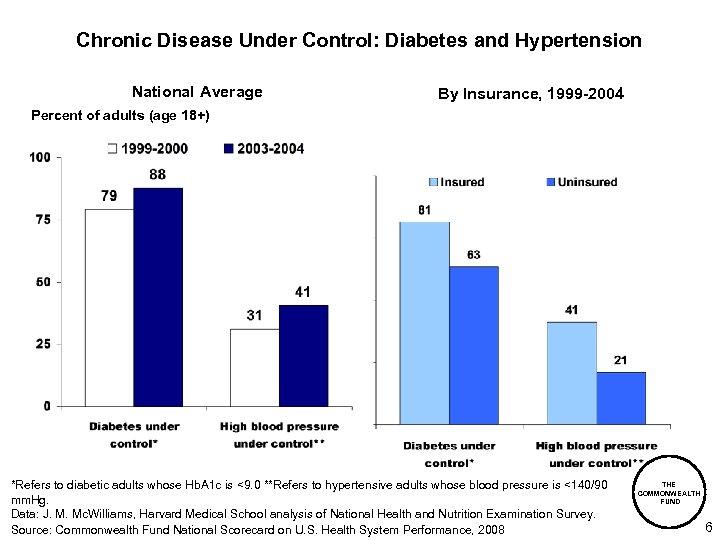 Chronic Disease Under Control: Diabetes and Hypertension National Average By Insurance, 1999 -2004 Percent of adults (age 18+) *Refers to diabetic adults whose Hb. A 1 c is <9. 0 **Refers to hypertensive adults whose blood pressure is <140/90 mm. Hg. Data: J. M. Mc. Williams, Harvard Medical School analysis of National Health and Nutrition Examination Survey. Source: Commonwealth Fund National Scorecard on U. S. Health System Performance, 2008 THE COMMONWEALTH FUND 6
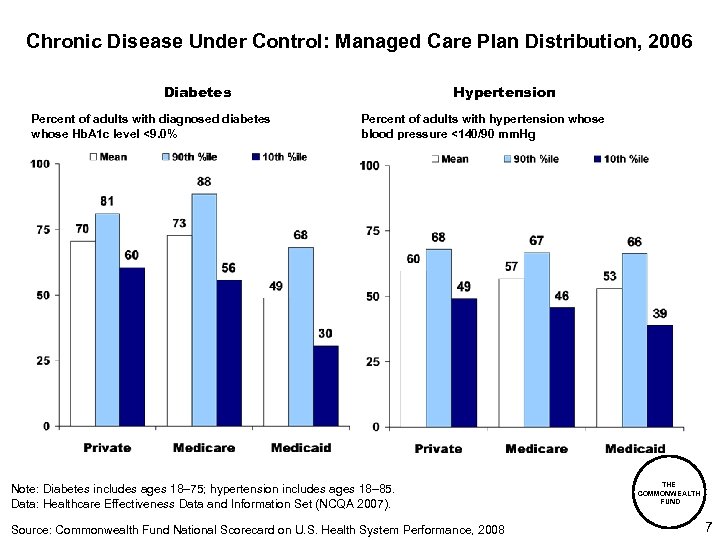 Chronic Disease Under Control: Managed Care Plan Distribution, 2006 Diabetes Percent of adults with diagnosed diabetes whose Hb. A 1 c level <9. 0% Hypertension Percent of adults with hypertension whose blood pressure <140/90 mm. Hg Note: Diabetes includes ages 18– 75; hypertension includes ages 18– 85. Data: Healthcare Effectiveness Data and Information Set (NCQA 2007). Source: Commonwealth Fund National Scorecard on U. S. Health System Performance, 2008 THE COMMONWEALTH FUND 7
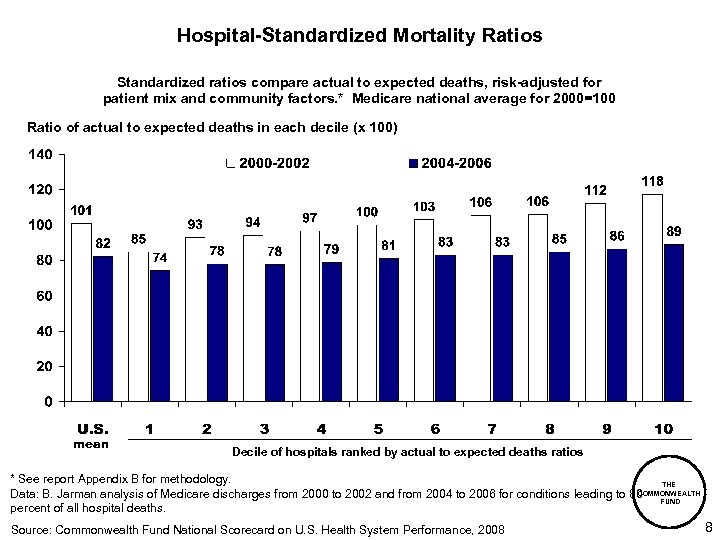 Hospital-Standardized Mortality Ratios Standardized ratios compare actual to expected deaths, risk-adjusted for patient mix and community factors. * Medicare national average for 2000=100 Ratio of actual to expected deaths in each decile (x 100) mean Decile of hospitals ranked by actual to expected deaths ratios * See report Appendix B for methodology. THE COMMONWEALTH Data: B. Jarman analysis of Medicare discharges from 2000 to 2002 and from 2004 to 2006 for conditions leading to 80 FUND percent of all hospital deaths. Source: Commonwealth Fund National Scorecard on U. S. Health System Performance, 2008 8
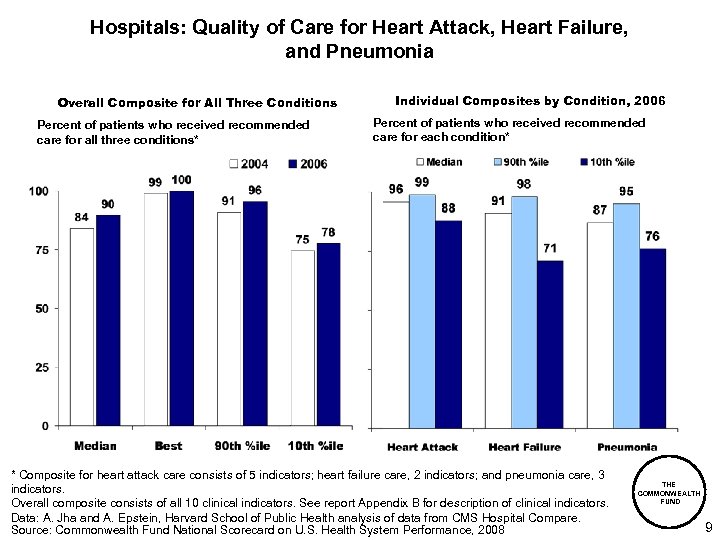 Hospitals: Quality of Care for Heart Attack, Heart Failure, and Pneumonia Overall Composite for All Three Conditions Percent of patients who received recommended care for all three conditions* Individual Composites by Condition, 2006 Percent of patients who received recommended care for each condition* * Composite for heart attack care consists of 5 indicators; heart failure care, 2 indicators; and pneumonia care, 3 indicators. Overall composite consists of all 10 clinical indicators. See report Appendix B for description of clinical indicators. Data: A. Jha and A. Epstein, Harvard School of Public Health analysis of data from CMS Hospital Compare. Source: Commonwealth Fund National Scorecard on U. S. Health System Performance, 2008 THE COMMONWEALTH FUND 9
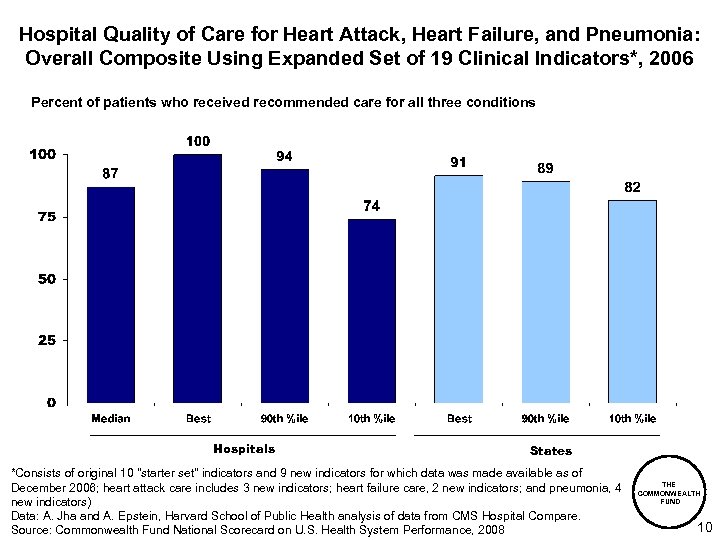 Hospital Quality of Care for Heart Attack, Heart Failure, and Pneumonia: Overall Composite Using Expanded Set of 19 Clinical Indicators*, 2006 Percent of patients who received recommended care for all three conditions Hospitals States *Consists of original 10 "starter set" indicators and 9 new indicators for which data was made available as of December 2006; heart attack care includes 3 new indicators; heart failure care, 2 new indicators; and pneumonia, 4 new indicators) Data: A. Jha and A. Epstein, Harvard School of Public Health analysis of data from CMS Hospital Compare. Source: Commonwealth Fund National Scorecard on U. S. Health System Performance, 2008 THE COMMONWEALTH FUND 10
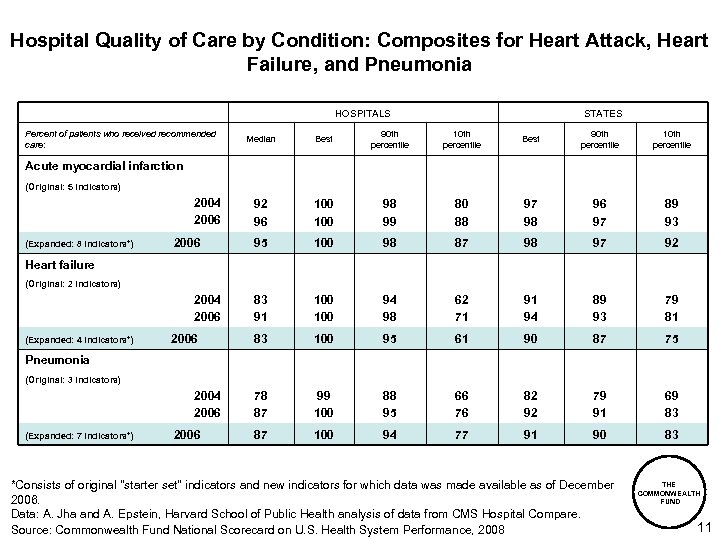 Hospital Quality of Care by Condition: Composites for Heart Attack, Heart Failure, and Pneumonia HOSPITALS Percent of patients who received recommended care: STATES Median Best 90 th percentile 10 th percentile 92 96 100 98 99 80 88 97 98 96 97 89 93 95 100 98 87 98 97 92 83 91 100 94 98 62 71 91 94 89 93 79 81 83 100 95 61 90 87 75 78 87 99 100 88 95 66 76 82 92 79 91 69 83 87 100 94 77 91 90 83 Acute myocardial infarction (Original: 5 indicators) 2004 2006 (Expanded: 8 indicators*) 2006 Heart failure (Original: 2 indicators) 2004 2006 (Expanded: 4 indicators*) 2006 Pneumonia (Original: 3 indicators) 2004 2006 (Expanded: 7 indicators*) 2006 *Consists of original "starter set" indicators and new indicators for which data was made available as of December 2006. Data: A. Jha and A. Epstein, Harvard School of Public Health analysis of data from CMS Hospital Compare. Source: Commonwealth Fund National Scorecard on U. S. Health System Performance, 2008 THE COMMONWEALTH FUND 11
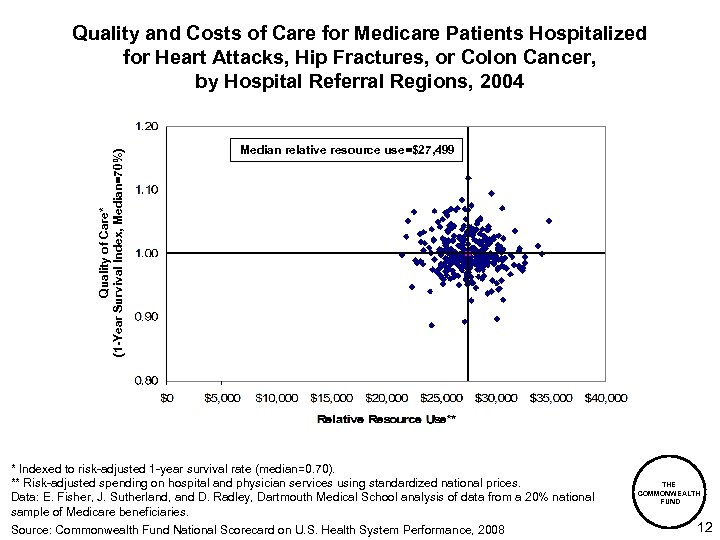 Quality of Care* (1 -Year Survival Index, Median=70%) Quality and Costs of Care for Medicare Patients Hospitalized for Heart Attacks, Hip Fractures, or Colon Cancer, by Hospital Referral Regions, 2004 Median relative resource use=$27, 499 * Indexed to risk-adjusted 1 -year survival rate (median=0. 70). ** Risk-adjusted spending on hospital and physician services using standardized national prices. Data: E. Fisher, J. Sutherland, and D. Radley, Dartmouth Medical School analysis of data from a 20% national sample of Medicare beneficiaries. Source: Commonwealth Fund National Scorecard on U. S. Health System Performance, 2008 THE COMMONWEALTH FUND 12
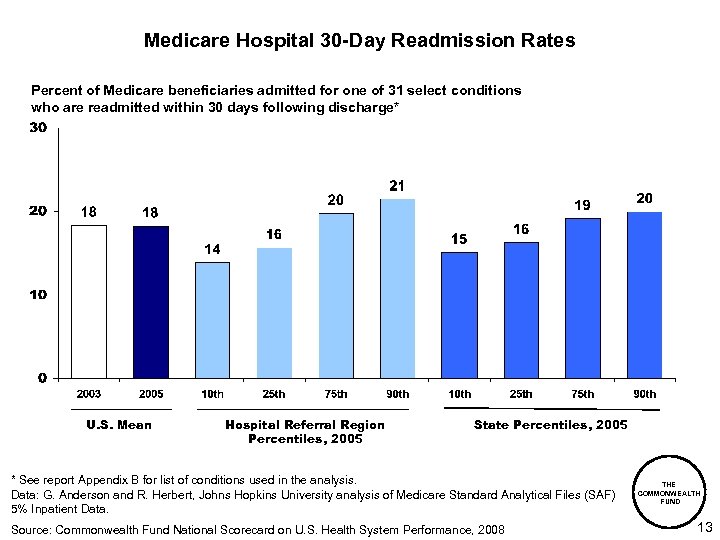 Medicare Hospital 30 -Day Readmission Rates Percent of Medicare beneficiaries admitted for one of 31 select conditions who are readmitted within 30 days following discharge* U. S. Mean Hospital Referral Region Percentiles, 2005 State Percentiles, 2005 * See report Appendix B for list of conditions used in the analysis. Data: G. Anderson and R. Herbert, Johns Hopkins University analysis of Medicare Standard Analytical Files (SAF) 5% Inpatient Data. Source: Commonwealth Fund National Scorecard on U. S. Health System Performance, 2008 THE COMMONWEALTH FUND 13
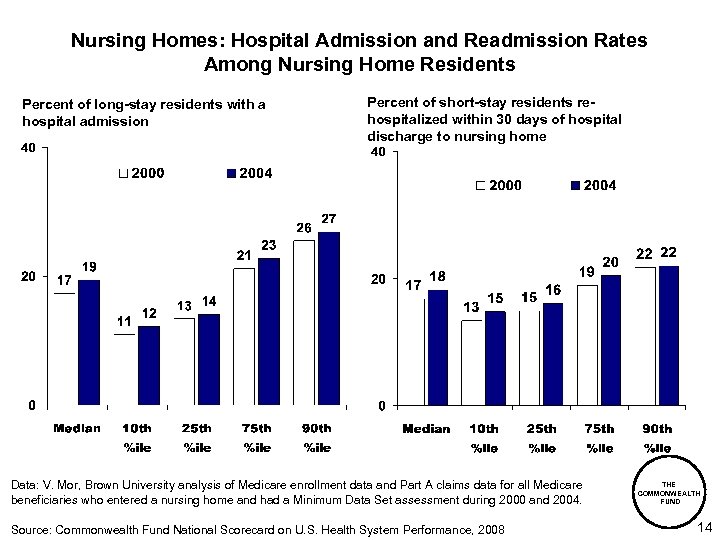 Nursing Homes: Hospital Admission and Readmission Rates Among Nursing Home Residents Percent of long-stay residents with a hospital admission Percent of short-stay residents rehospitalized within 30 days of hospital discharge to nursing home Data: V. Mor, Brown University analysis of Medicare enrollment data and Part A claims data for all Medicare beneficiaries who entered a nursing home and had a Minimum Data Set assessment during 2000 and 2004. Source: Commonwealth Fund National Scorecard on U. S. Health System Performance, 2008 THE COMMONWEALTH FUND 14
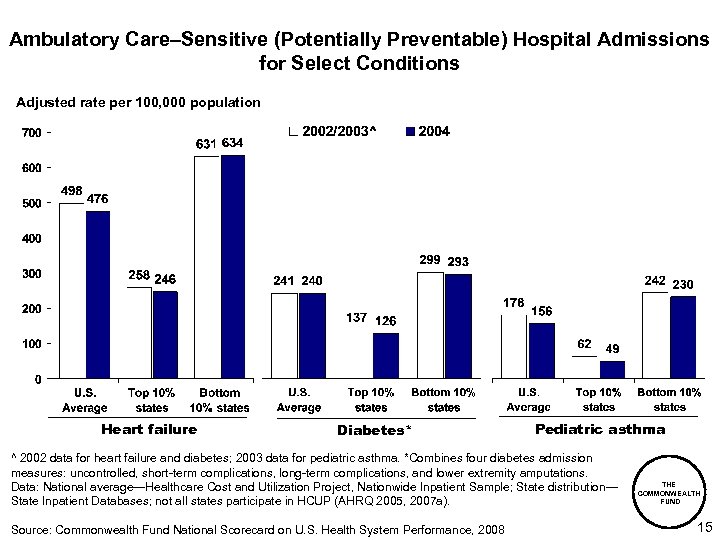 Ambulatory Care–Sensitive (Potentially Preventable) Hospital Admissions for Select Conditions Adjusted rate per 100, 000 population Heart failure Diabetes* Pediatric asthma ^ 2002 data for heart failure and diabetes; 2003 data for pediatric asthma. *Combines four diabetes admission measures: uncontrolled, short-term complications, long-term complications, and lower extremity amputations. Data: National average—Healthcare Cost and Utilization Project, Nationwide Inpatient Sample; State distribution— State Inpatient Databases; not all states participate in HCUP (AHRQ 2005, 2007 a). Source: Commonwealth Fund National Scorecard on U. S. Health System Performance, 2008 THE COMMONWEALTH FUND 15
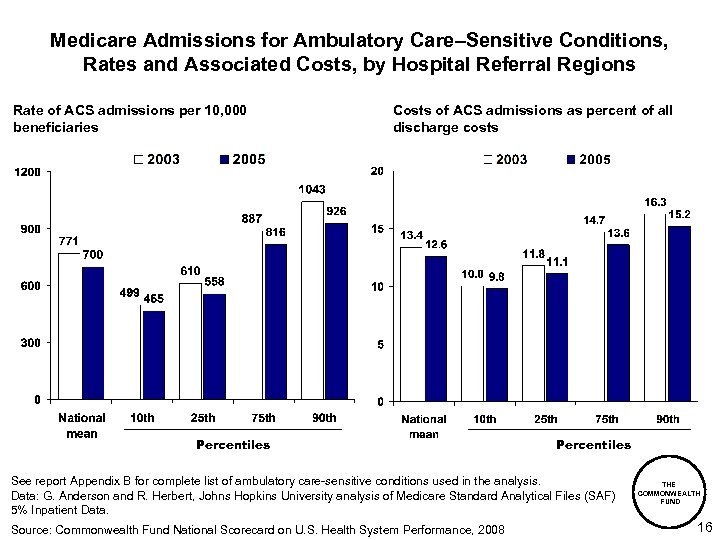 Medicare Admissions for Ambulatory Care–Sensitive Conditions, Rates and Associated Costs, by Hospital Referral Regions Rate of ACS admissions per 10, 000 beneficiaries Costs of ACS admissions as percent of all discharge costs Percentiles See report Appendix B for complete list of ambulatory care-sensitive conditions used in the analysis. Data: G. Anderson and R. Herbert, Johns Hopkins University analysis of Medicare Standard Analytical Files (SAF) 5% Inpatient Data. Source: Commonwealth Fund National Scorecard on U. S. Health System Performance, 2008 THE COMMONWEALTH FUND 16
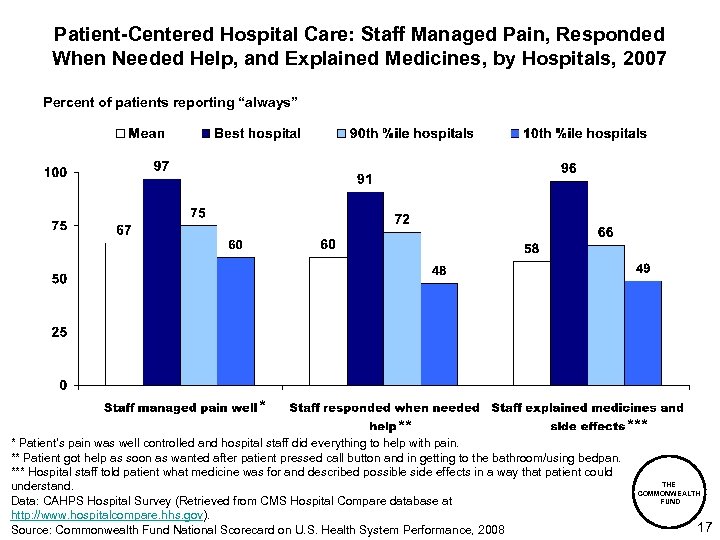 Patient-Centered Hospital Care: Staff Managed Pain, Responded When Needed Help, and Explained Medicines, by Hospitals, 2007 Percent of patients reporting “always” * ** * Patient’s pain was well controlled and hospital staff did everything to help with pain. ** Patient got help as soon as wanted after patient pressed call button and in getting to the bathroom/using bedpan. *** Hospital staff told patient what medicine was for and described possible side effects in a way that patient could understand. Data: CAHPS Hospital Survey (Retrieved from CMS Hospital Compare database at http: //www. hospitalcompare. hhs. gov). Source: Commonwealth Fund National Scorecard on U. S. Health System Performance, 2008 *** THE COMMONWEALTH FUND 17
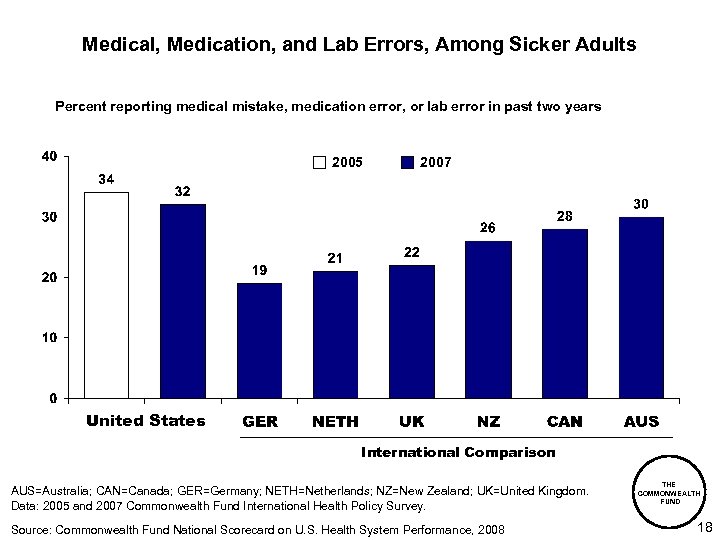 Medical, Medication, and Lab Errors, Among Sicker Adults Percent reporting medical mistake, medication error, or lab error in past two years 2005 2007 United States International Comparison AUS=Australia; CAN=Canada; GER=Germany; NETH=Netherlands; NZ=New Zealand; UK=United Kingdom. Data: 2005 and 2007 Commonwealth Fund International Health Policy Survey. Source: Commonwealth Fund National Scorecard on U. S. Health System Performance, 2008 THE COMMONWEALTH FUND 18
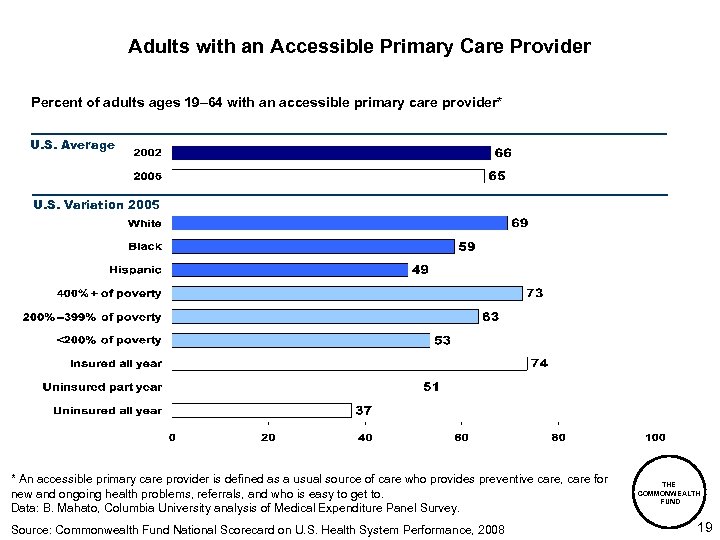 Adults with an Accessible Primary Care Provider Percent of adults ages 19– 64 with an accessible primary care provider* U. S. Average U. S. Variation 2005 * An accessible primary care provider is defined as a usual source of care who provides preventive care, care for new and ongoing health problems, referrals, and who is easy to get to. Data: B. Mahato, Columbia University analysis of Medical Expenditure Panel Survey. Source: Commonwealth Fund National Scorecard on U. S. Health System Performance, 2008 THE COMMONWEALTH FUND 19
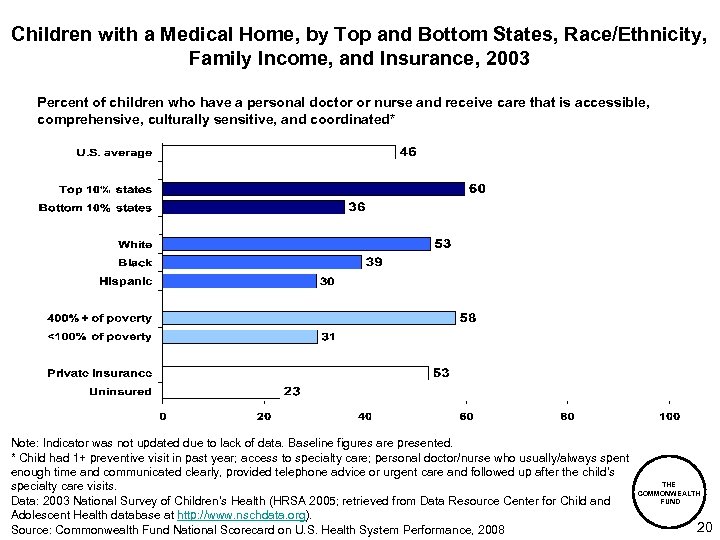 Children with a Medical Home, by Top and Bottom States, Race/Ethnicity, Family Income, and Insurance, 2003 Percent of children who have a personal doctor or nurse and receive care that is accessible, comprehensive, culturally sensitive, and coordinated* Note: Indicator was not updated due to lack of data. Baseline figures are presented. * Child had 1+ preventive visit in past year; access to specialty care; personal doctor/nurse who usually/always spent enough time and communicated clearly, provided telephone advice or urgent care and followed up after the child’s specialty care visits. Data: 2003 National Survey of Children’s Health (HRSA 2005; retrieved from Data Resource Center for Child and Adolescent Health database at http: //www. nschdata. org). Source: Commonwealth Fund National Scorecard on U. S. Health System Performance, 2008 THE COMMONWEALTH FUND 20
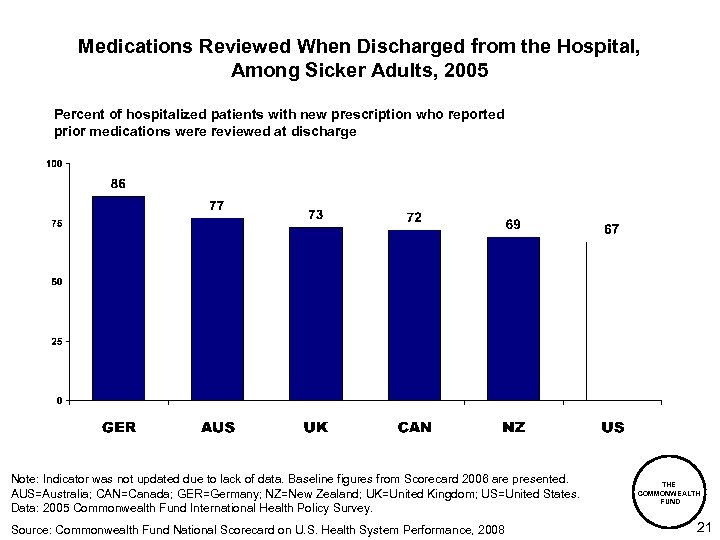 Medications Reviewed When Discharged from the Hospital, Among Sicker Adults, 2005 Percent of hospitalized patients with new prescription who reported prior medications were reviewed at discharge Note: Indicator was not updated due to lack of data. Baseline figures from Scorecard 2006 are presented. AUS=Australia; CAN=Canada; GER=Germany; NZ=New Zealand; UK=United Kingdom; US=United States. Data: 2005 Commonwealth Fund International Health Policy Survey. Source: Commonwealth Fund National Scorecard on U. S. Health System Performance, 2008 THE COMMONWEALTH FUND 21
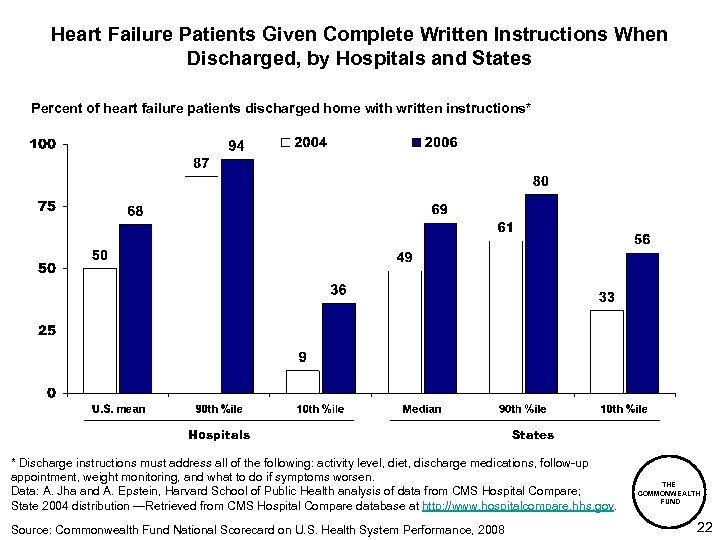 Heart Failure Patients Given Complete Written Instructions When Discharged, by Hospitals and States Percent of heart failure patients discharged home with written instructions* Hospitals States * Discharge instructions must address all of the following: activity level, diet, discharge medications, follow-up appointment, weight monitoring, and what to do if symptoms worsen. Data: A. Jha and A. Epstein, Harvard School of Public Health analysis of data from CMS Hospital Compare; State 2004 distribution —Retrieved from CMS Hospital Compare database at http: //www. hospitalcompare. hhs. gov. Source: Commonwealth Fund National Scorecard on U. S. Health System Performance, 2008 THE COMMONWEALTH FUND 22
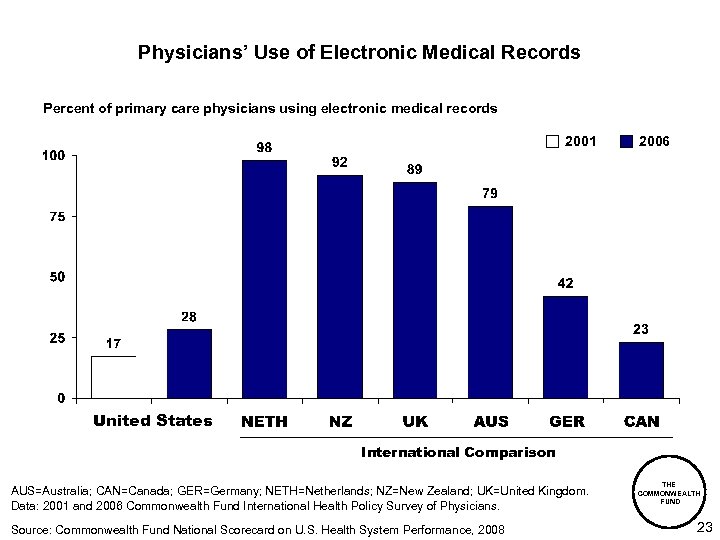 Physicians’ Use of Electronic Medical Records Percent of primary care physicians using electronic medical records 2001 2006 United States International Comparison AUS=Australia; CAN=Canada; GER=Germany; NETH=Netherlands; NZ=New Zealand; UK=United Kingdom. Data: 2001 and 2006 Commonwealth Fund International Health Policy Survey of Physicians. Source: Commonwealth Fund National Scorecard on U. S. Health System Performance, 2008 THE COMMONWEALTH FUND 23
 Impediments in the Current System
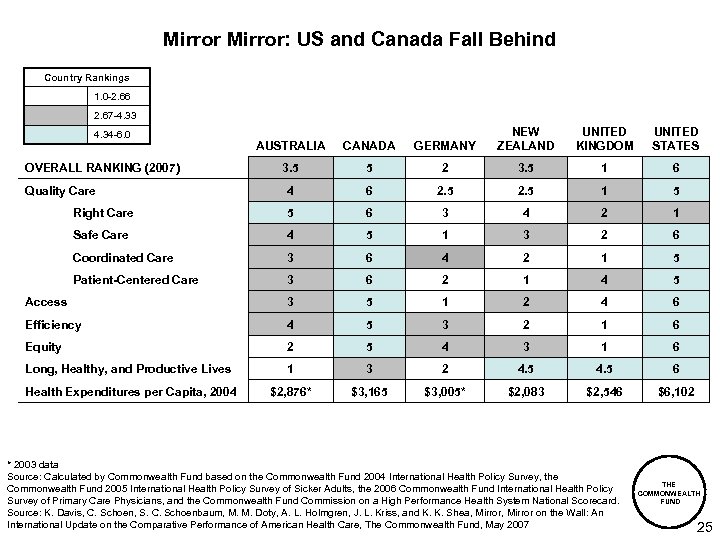 Mirror: US and Canada Fall Behind Country Rankings 1. 0 -2. 66 2. 67 -4. 33 AUSTRALIA CANADA GERMANY NEW ZEALAND 3. 5 5 2 3. 5 1 6 4 6 2. 5 1 5 Right Care 5 6 3 4 2 1 Safe Care 4 5 1 3 2 6 Coordinated Care 3 6 4 2 1 5 Patient-Centered Care 3 6 2 1 4 5 Access 3 5 1 2 4 6 Efficiency 4 5 3 2 1 6 Equity 2 5 4 3 1 6 Long, Healthy, and Productive Lives 1 3 2 4. 5 6 Health Expenditures per Capita, 2004 $2, 876* $3, 165 $3, 005* $2, 083 $2, 546 $6, 102 4. 34 -6. 0 OVERALL RANKING (2007) Quality Care UNITED KINGDOM UNITED STATES * 2003 data Source: Calculated by Commonwealth Fund based on the Commonwealth Fund 2004 International Health Policy Survey, the Commonwealth Fund 2005 International Health Policy Survey of Sicker Adults, the 2006 Commonwealth Fund International Health Policy Survey of Primary Care Physicians, and the Commonwealth Fund Commission on a High Performance Health System National Scorecard. Source: K. Davis, C. Schoen, S. C. Schoenbaum, M. M. Doty, A. L. Holmgren, J. L. Kriss, and K. K. Shea, Mirror on the Wall: An International Update on the Comparative Performance of American Health Care, The Commonwealth Fund, May 2007 THE COMMONWEALTH FUND 25
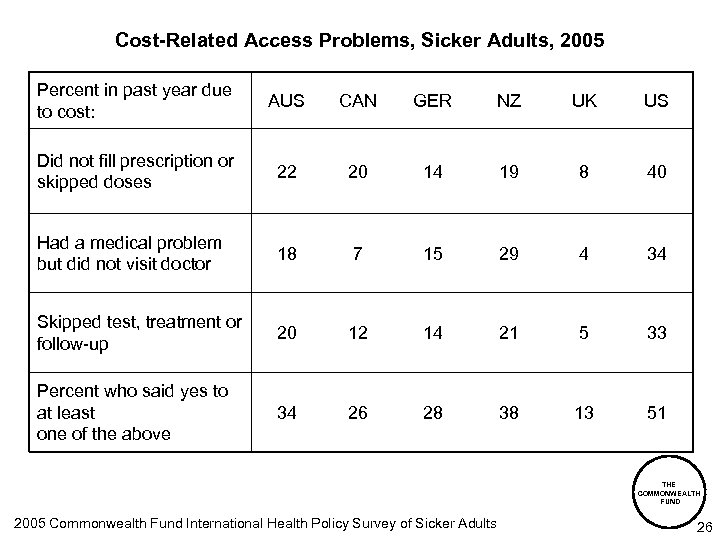 Cost-Related Access Problems, Sicker Adults, 2005 Percent in past year due to cost: AUS CAN GER NZ UK US Did not fill prescription or skipped doses 22 20 14 19 8 40 Had a medical problem but did not visit doctor 18 7 15 29 4 34 Skipped test, treatment or follow-up 20 12 14 21 5 33 Percent who said yes to at least one of the above 34 26 28 38 13 51 THE COMMONWEALTH FUND 2005 Commonwealth Fund International Health Policy Survey of Sicker Adults 26
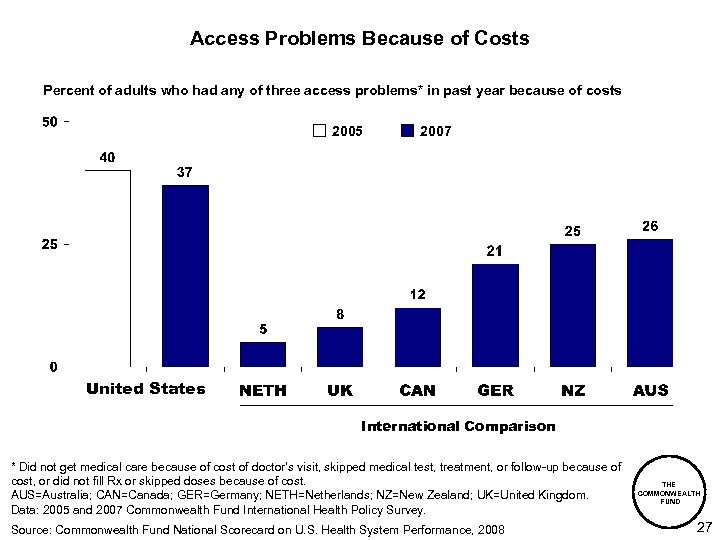 Access Problems Because of Costs Percent of adults who had any of three access problems* in past year because of costs 2005 2007 United States International Comparison * Did not get medical care because of cost of doctor’s visit, skipped medical test, treatment, or follow-up because of cost, or did not fill Rx or skipped doses because of cost. AUS=Australia; CAN=Canada; GER=Germany; NETH=Netherlands; NZ=New Zealand; UK=United Kingdom. Data: 2005 and 2007 Commonwealth Fund International Health Policy Survey. Source: Commonwealth Fund National Scorecard on U. S. Health System Performance, 2008 THE COMMONWEALTH FUND 27
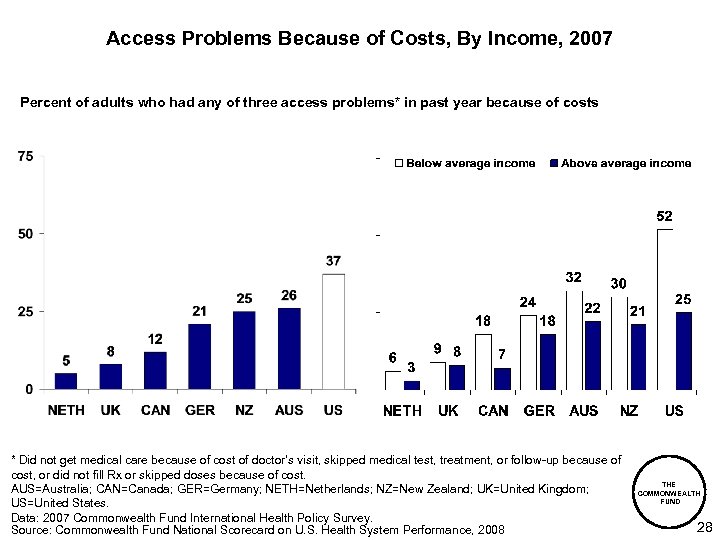 Access Problems Because of Costs, By Income, 2007 Percent of adults who had any of three access problems* in past year because of costs * Did not get medical care because of cost of doctor’s visit, skipped medical test, treatment, or follow-up because of cost, or did not fill Rx or skipped doses because of cost. AUS=Australia; CAN=Canada; GER=Germany; NETH=Netherlands; NZ=New Zealand; UK=United Kingdom; US=United States. Data: 2007 Commonwealth Fund International Health Policy Survey. Source: Commonwealth Fund National Scorecard on U. S. Health System Performance, 2008 THE COMMONWEALTH FUND 28
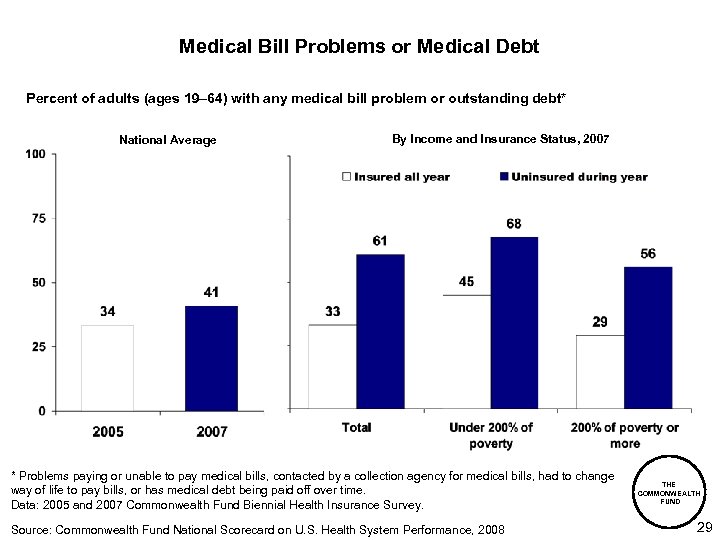 Medical Bill Problems or Medical Debt Percent of adults (ages 19– 64) with any medical bill problem or outstanding debt* National Average By Income and Insurance Status, 2007 * Problems paying or unable to pay medical bills, contacted by a collection agency for medical bills, had to change way of life to pay bills, or has medical debt being paid off over time. Data: 2005 and 2007 Commonwealth Fund Biennial Health Insurance Survey. Source: Commonwealth Fund National Scorecard on U. S. Health System Performance, 2008 THE COMMONWEALTH FUND 29
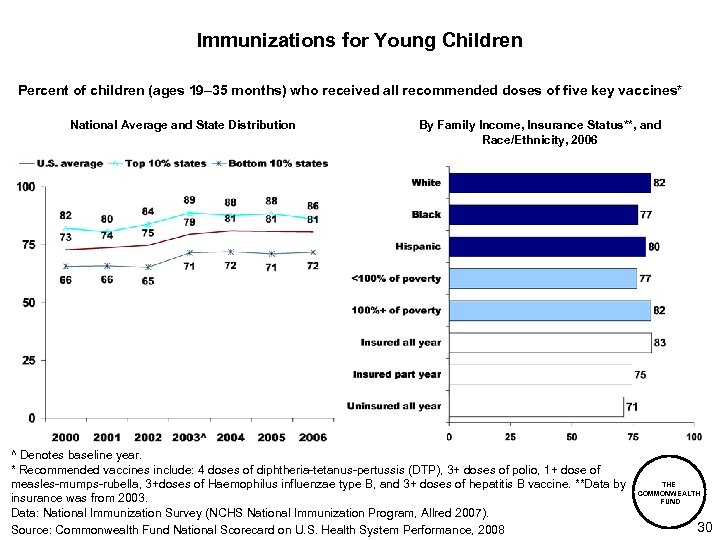 Immunizations for Young Children Percent of children (ages 19– 35 months) who received all recommended doses of five key vaccines* National Average and State Distribution By Family Income, Insurance Status**, and Race/Ethnicity, 2006 ^ Denotes baseline year. * Recommended vaccines include: 4 doses of diphtheria-tetanus-pertussis (DTP), 3+ doses of polio, 1+ dose of measles-mumps-rubella, 3+doses of Haemophilus influenzae type B, and 3+ doses of hepatitis B vaccine. **Data by insurance was from 2003. Data: National Immunization Survey (NCHS National Immunization Program, Allred 2007). Source: Commonwealth Fund National Scorecard on U. S. Health System Performance, 2008 THE COMMONWEALTH FUND 30
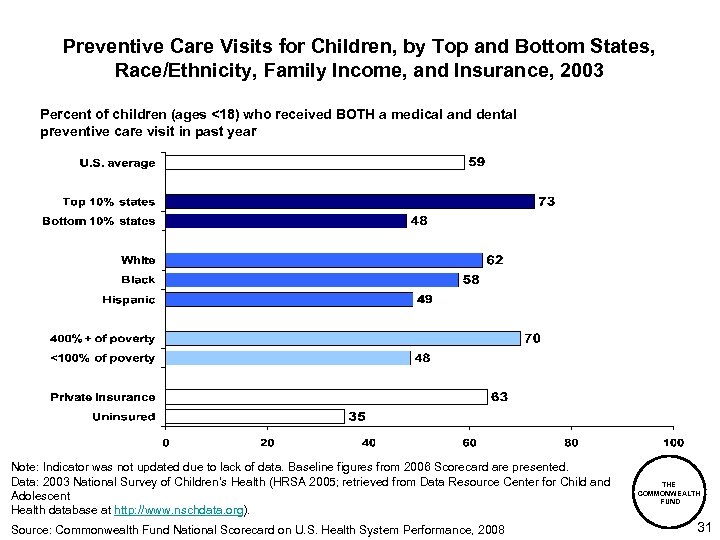 Preventive Care Visits for Children, by Top and Bottom States, Race/Ethnicity, Family Income, and Insurance, 2003 Percent of children (ages <18) who received BOTH a medical and dental preventive care visit in past year Note: Indicator was not updated due to lack of data. Baseline figures from 2006 Scorecard are presented. Data: 2003 National Survey of Children’s Health (HRSA 2005; retrieved from Data Resource Center for Child and Adolescent Health database at http: //www. nschdata. org). Source: Commonwealth Fund National Scorecard on U. S. Health System Performance, 2008 THE COMMONWEALTH FUND 31
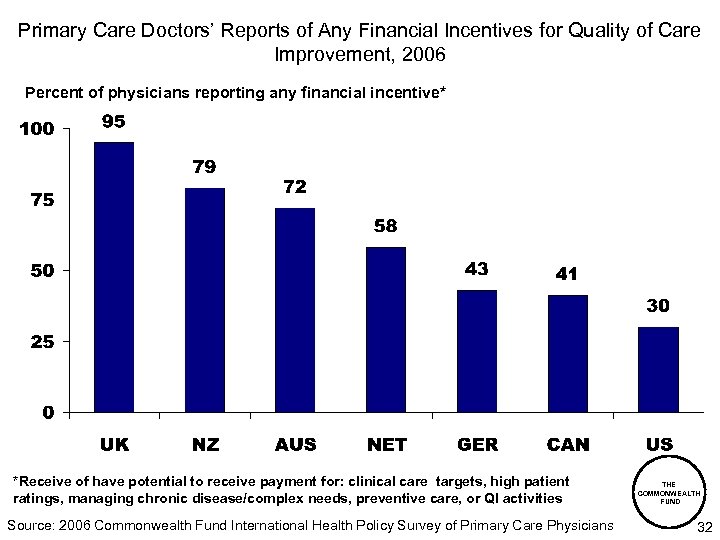 Primary Care Doctors’ Reports of Any Financial Incentives for Quality of Care Improvement, 2006 Percent of physicians reporting any financial incentive* *Receive of have potential to receive payment for: clinical care targets, high patient ratings, managing chronic disease/complex needs, preventive care, or QI activities Source: 2006 Commonwealth Fund International Health Policy Survey of Primary Care Physicians THE COMMONWEALTH FUND 32
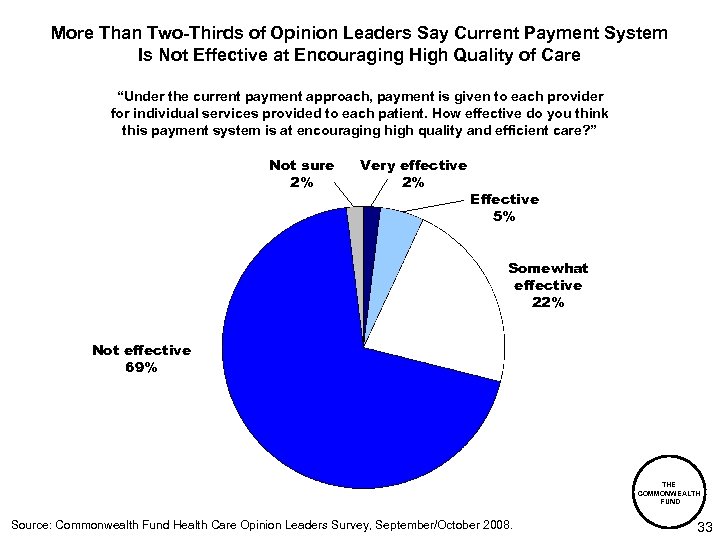 More Than Two-Thirds of Opinion Leaders Say Current Payment System Is Not Effective at Encouraging High Quality of Care “Under the current payment approach, payment is given to each provider for individual services provided to each patient. How effective do you think this payment system is at encouraging high quality and efficient care? ” Not sure 2% Very effective 2% Effective 5% Somewhat effective 22% Not effective 69% THE COMMONWEALTH FUND Source: Commonwealth Fund Health Care Opinion Leaders Survey, September/October 2008. 33
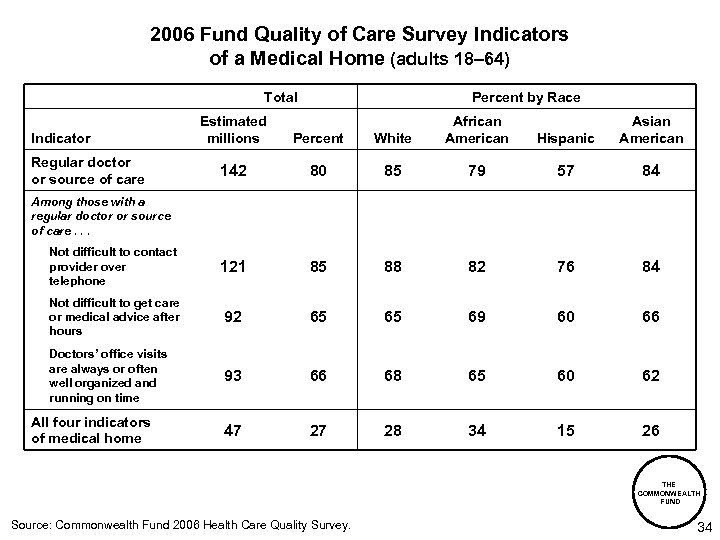 2006 Fund Quality of Care Survey Indicators of a Medical Home (adults 18– 64) Total Percent by Race Estimated millions White African American Hispanic Asian American Percent 142 80 85 79 57 84 Not difficult to contact provider over telephone 121 85 88 82 76 84 Not difficult to get care or medical advice after hours 92 65 65 69 60 66 Doctors’ office visits are always or often well organized and running on time 93 66 68 65 60 62 47 27 28 34 15 26 Indicator Regular doctor or source of care Among those with a regular doctor or source of care. . . All four indicators of medical home THE COMMONWEALTH FUND Source: Commonwealth Fund 2006 Health Care Quality Survey. 34
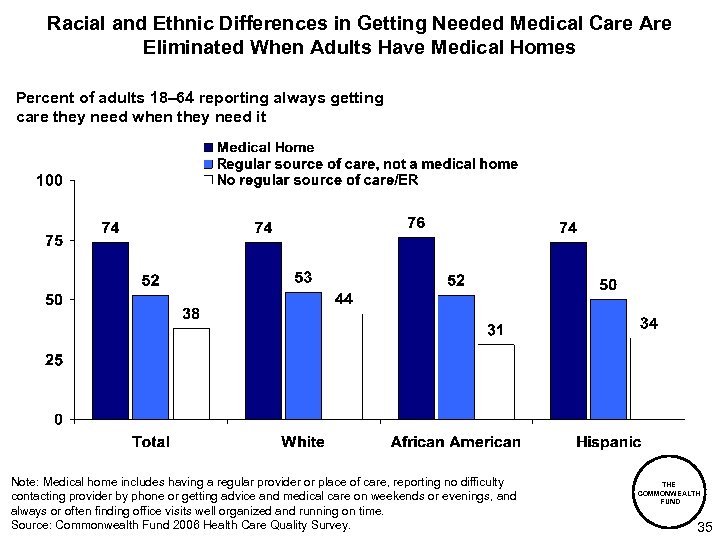 Racial and Ethnic Differences in Getting Needed Medical Care Are Eliminated When Adults Have Medical Homes Percent of adults 18– 64 reporting always getting care they need when they need it Note: Medical home includes having a regular provider or place of care, reporting no difficulty contacting provider by phone or getting advice and medical care on weekends or evenings, and always or often finding office visits well organized and running on time. Source: Commonwealth Fund 2006 Health Care Quality Survey. THE COMMONWEALTH FUND 35
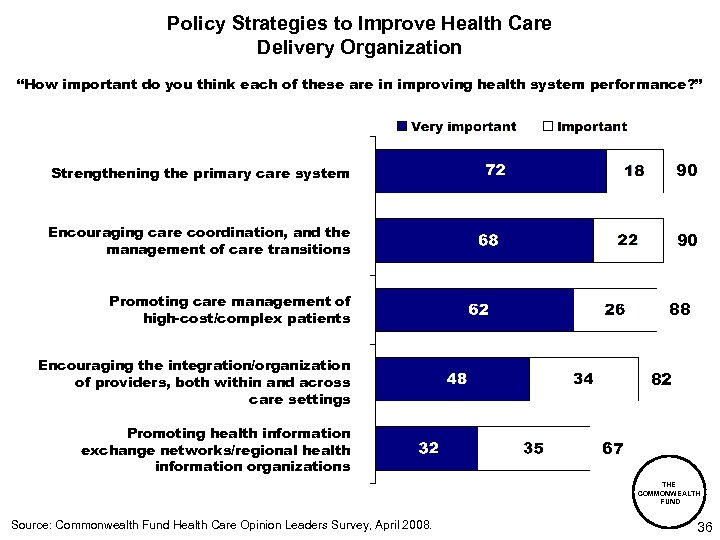 Policy Strategies to Improve Health Care Delivery Organization “How important do you think each of these are in improving health system performance? ” Strengthening the primary care system 90 Encouraging care coordination, and the management of care transitions 90 Promoting care management of high-cost/complex patients 88 Encouraging the integration/organization of providers, both within and across care settings Promoting health information exchange networks/regional health information organizations 82 67 THE COMMONWEALTH FUND Source: Commonwealth Fund Health Care Opinion Leaders Survey, April 2008. 36
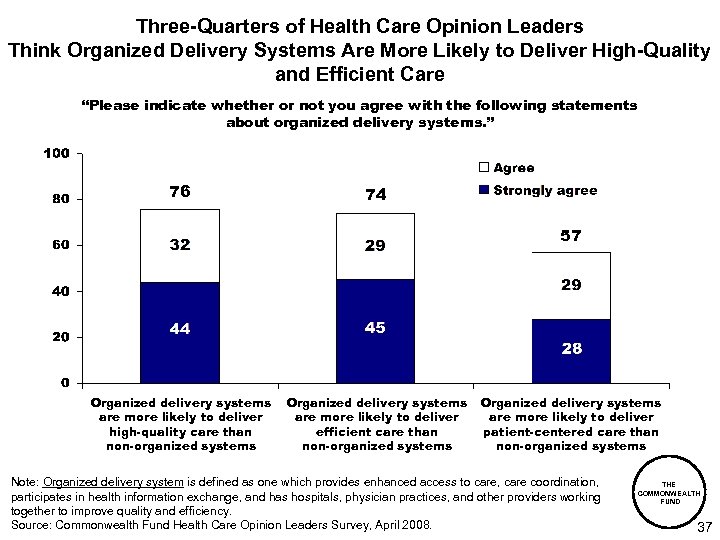 Three-Quarters of Health Care Opinion Leaders Think Organized Delivery Systems Are More Likely to Deliver High-Quality and Efficient Care “Please indicate whether or not you agree with the following statements about organized delivery systems. ” 76 74 57 Organized delivery systems are more likely to deliver high-quality care than non-organized systems Organized delivery systems are more likely to deliver efficient care than non-organized systems Organized delivery systems are more likely to deliver patient-centered care than non-organized systems Note: Organized delivery system is defined as one which provides enhanced access to care, care coordination, participates in health information exchange, and has hospitals, physician practices, and other providers working together to improve quality and efficiency. Source: Commonwealth Fund Health Care Opinion Leaders Survey, April 2008. THE COMMONWEALTH FUND 37
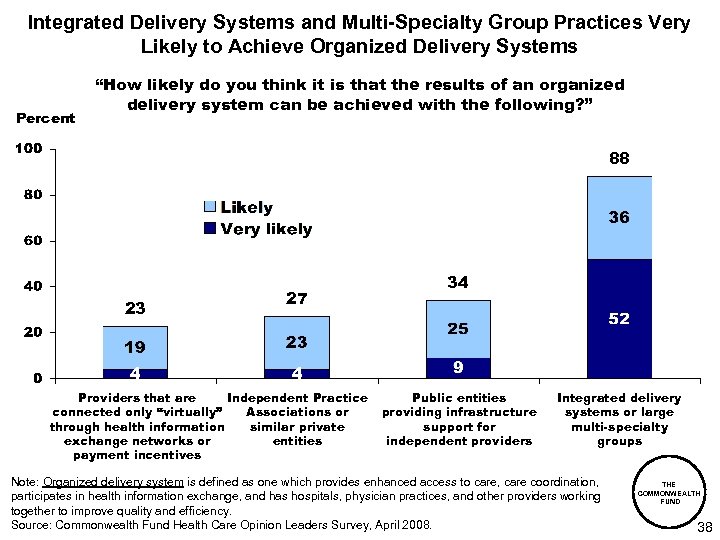 Integrated Delivery Systems and Multi-Specialty Group Practices Very Likely to Achieve Organized Delivery Systems Percent “How likely do you think it is that the results of an organized delivery system can be achieved with the following? ” 88 23 27 Providers that are Independent Practice connected only “virtually” Associations or through health information similar private exchange networks or entities payment incentives 34 Public entities providing infrastructure support for independent providers Integrated delivery systems or large multi-specialty groups Note: Organized delivery system is defined as one which provides enhanced access to care, care coordination, participates in health information exchange, and has hospitals, physician practices, and other providers working together to improve quality and efficiency. Source: Commonwealth Fund Health Care Opinion Leaders Survey, April 2008. THE COMMONWEALTH FUND 38
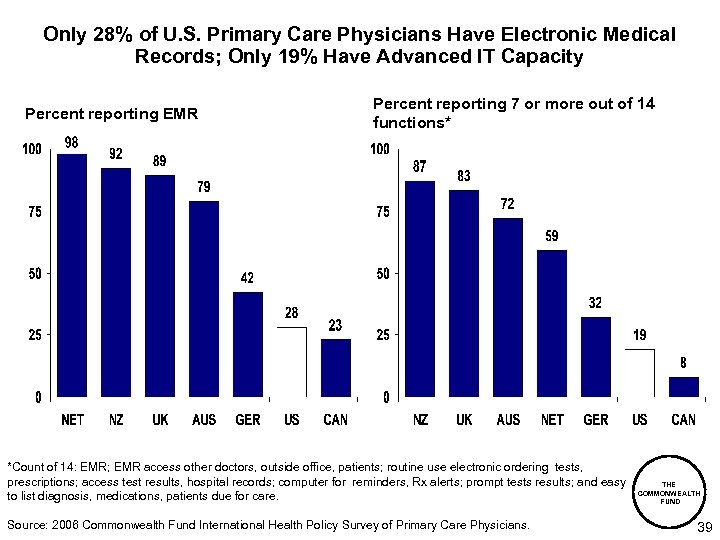 Only 28% of U. S. Primary Care Physicians Have Electronic Medical Records; Only 19% Have Advanced IT Capacity Percent reporting EMR Percent reporting 7 or more out of 14 functions* *Count of 14: EMR; EMR access other doctors, outside office, patients; routine use electronic ordering tests, prescriptions; access test results, hospital records; computer for reminders, Rx alerts; prompt tests results; and easy to list diagnosis, medications, patients due for care. Source: 2006 Commonwealth Fund International Health Policy Survey of Primary Care Physicians. THE COMMONWEALTH FUND 39
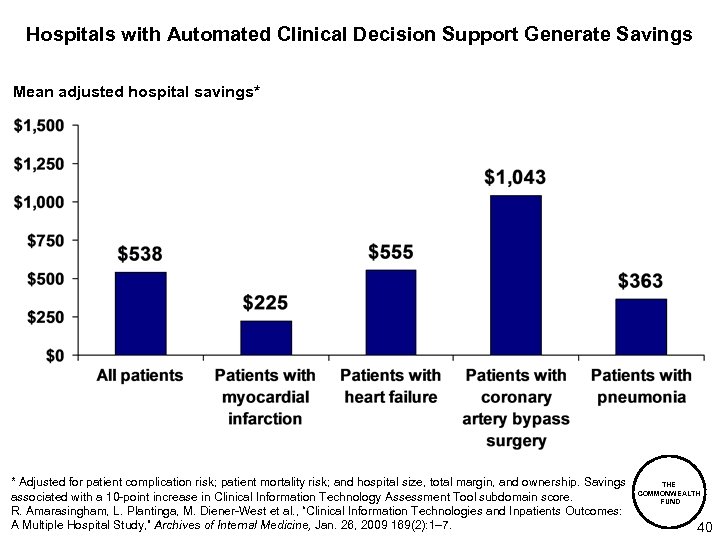 Hospitals with Automated Clinical Decision Support Generate Savings Mean adjusted hospital savings* * Adjusted for patient complication risk; patient mortality risk; and hospital size, total margin, and ownership. Savings associated with a 10 -point increase in Clinical Information Technology Assessment Tool subdomain score. R. Amarasingham, L. Plantinga, M. Diener-West et al. , “Clinical Information Technologies and Inpatients Outcomes: A Multiple Hospital Study, ” Archives of Internal Medicine, Jan. 26, 2009 169(2): 1– 7. THE COMMONWEALTH FUND 40
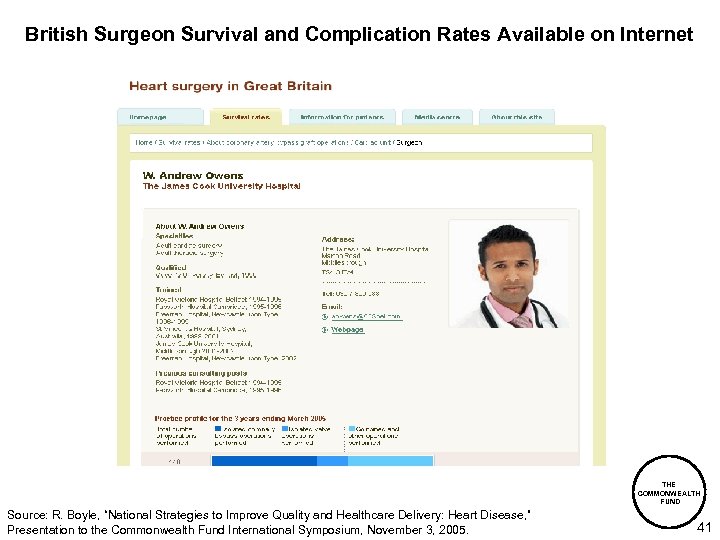 British Surgeon Survival and Complication Rates Available on Internet THE COMMONWEALTH FUND Source: R. Boyle, “National Strategies to Improve Quality and Healthcare Delivery: Heart Disease, ” Presentation to the Commonwealth Fund International Symposium, November 3, 2005. 41
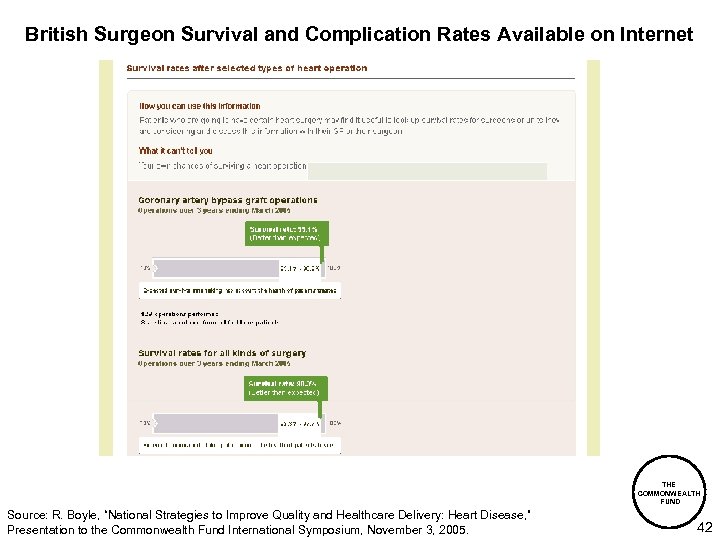 British Surgeon Survival and Complication Rates Available on Internet THE COMMONWEALTH FUND Source: R. Boyle, “National Strategies to Improve Quality and Healthcare Delivery: Heart Disease, ” Presentation to the Commonwealth Fund International Symposium, November 3, 2005. 42
 Opportunities and Progress
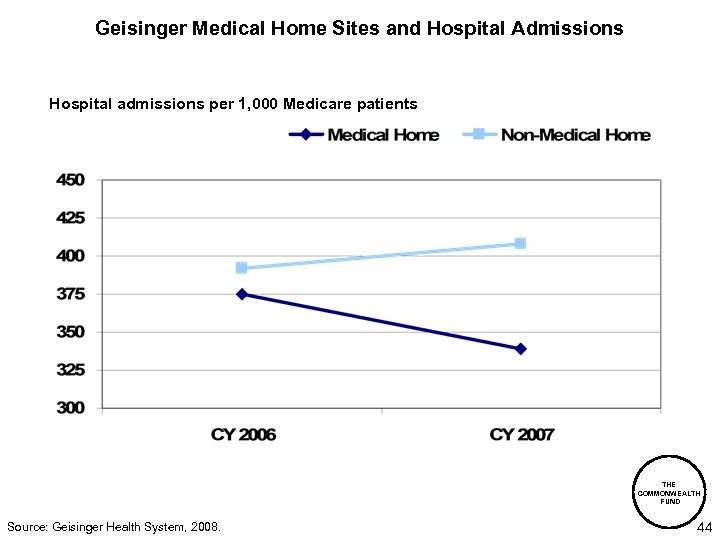 Geisinger Medical Home Sites and Hospital Admissions Hospital admissions per 1, 000 Medicare patients THE COMMONWEALTH FUND Source: Geisinger Health System, 2008. 44
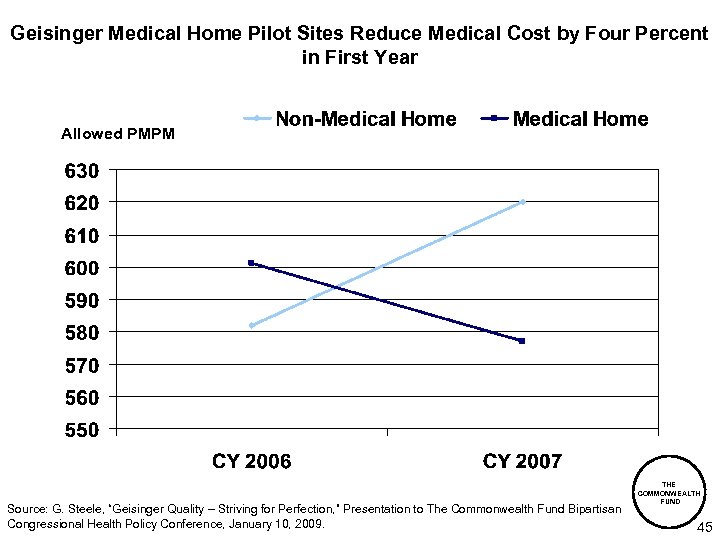 Geisinger Medical Home Pilot Sites Reduce Medical Cost by Four Percent in First Year Allowed PMPM Source: G. Steele, “Geisinger Quality – Striving for Perfection, ” Presentation to The Commonwealth Fund Bipartisan Congressional Health Policy Conference, January 10, 2009. THE COMMONWEALTH FUND 45
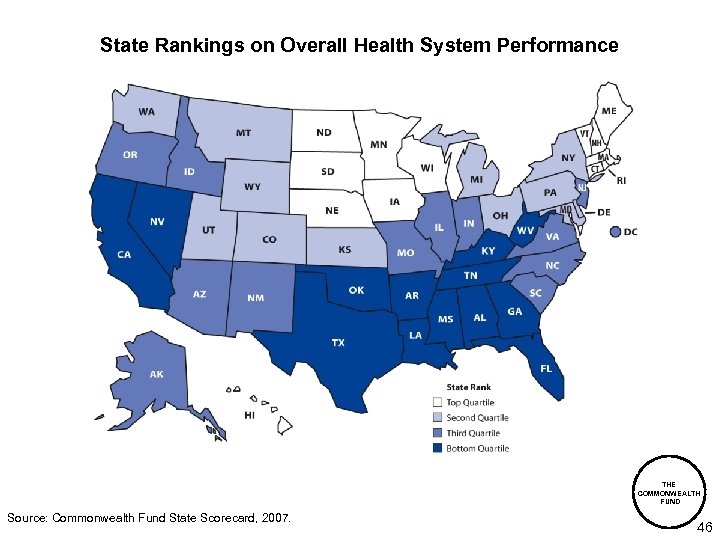 State Rankings on Overall Health System Performance THE COMMONWEALTH FUND Source: Commonwealth Fund State Scorecard, 2007. 46
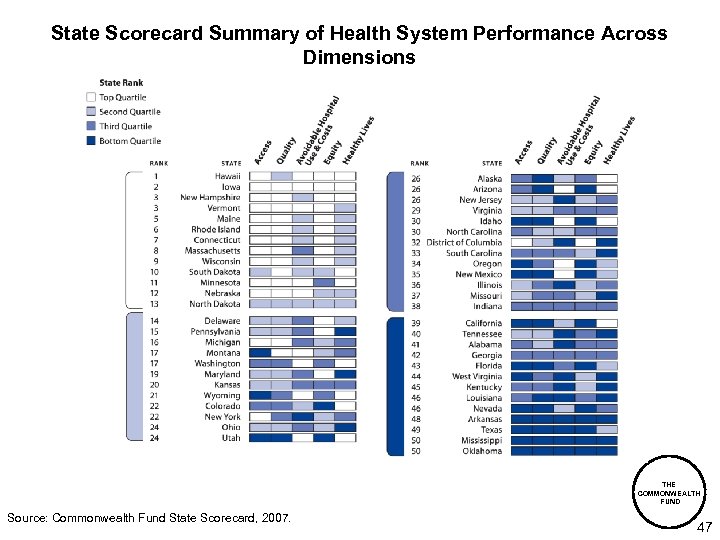 State Scorecard Summary of Health System Performance Across Dimensions THE COMMONWEALTH FUND Source: Commonwealth Fund State Scorecard, 2007. 47
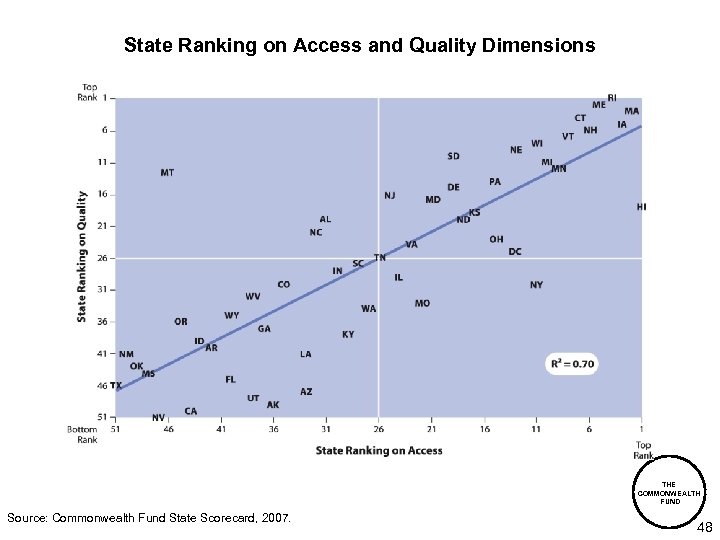 State Ranking on Access and Quality Dimensions THE COMMONWEALTH FUND Source: Commonwealth Fund State Scorecard, 2007. 48
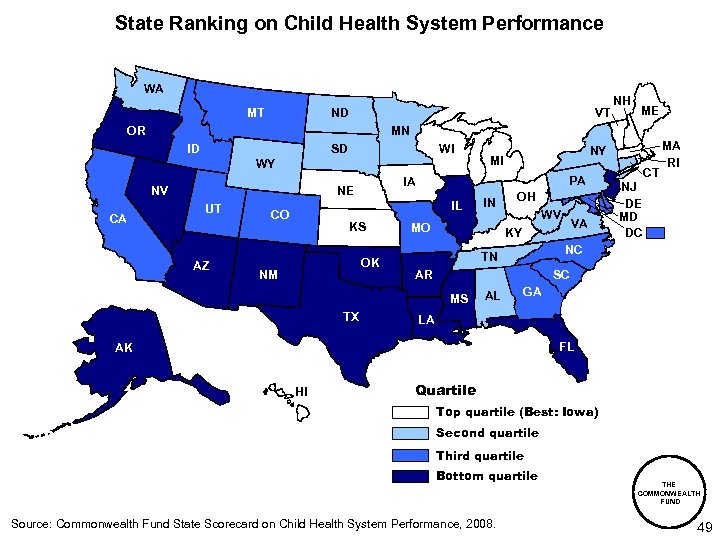 State Ranking on Child Health System Performance WA MT VT ND OR ME MN ID SD WI WY NV CA NH AZ PA IL CO KS OK NM IN MO OH WV VA KY CT MA RI NJ DE MD DC NC TN AR SC MS TX MI IA NE UT NY AL GA LA FL AK HI Quartile Top quartile (Best: Iowa) Second quartile Third quartile Bottom quartile Source: Commonwealth Fund State Scorecard on Child Health System Performance, 2008. THE COMMONWEALTH FUND 49
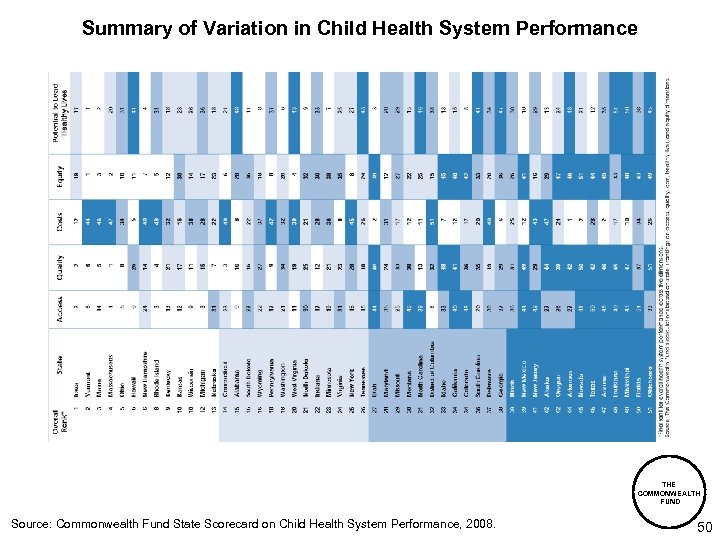 Summary of Variation in Child Health System Performance THE COMMONWEALTH FUND Source: Commonwealth Fund State Scorecard on Child Health System Performance, 2008. 50
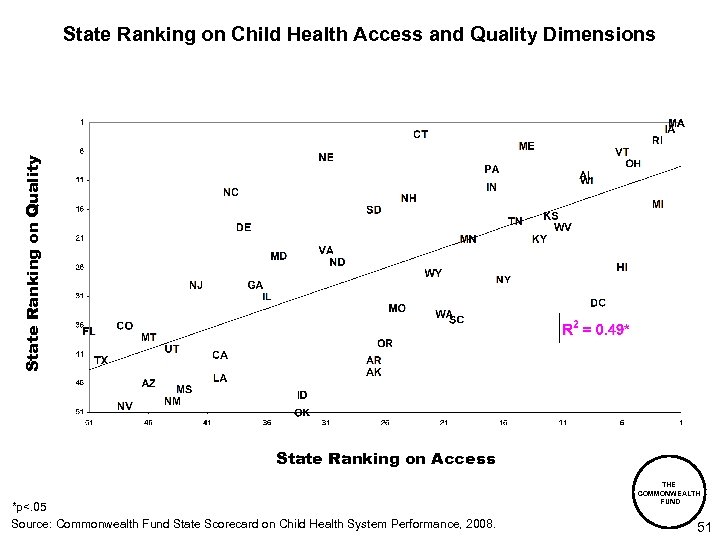 State Ranking on Quality State Ranking on Child Health Access and Quality Dimensions State Ranking on Access *p<. 05 Source: Commonwealth Fund State Scorecard on Child Health System Performance, 2008. THE COMMONWEALTH FUND 51
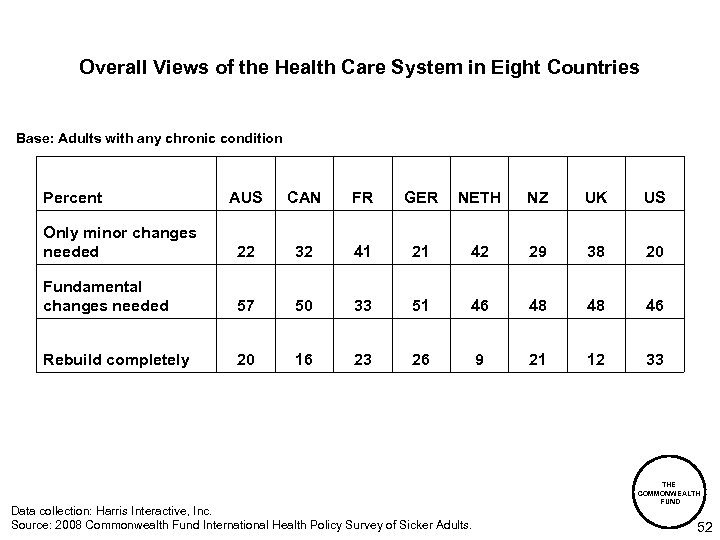 Overall Views of the Health Care System in Eight Countries Base: Adults with any chronic condition Percent AUS CAN FR GER NETH NZ UK US Only minor changes needed 22 32 41 21 42 29 38 20 Fundamental changes needed 57 50 33 51 46 48 48 46 Rebuild completely 20 16 23 26 9 21 12 33 Data collection: Harris Interactive, Inc. Source: 2008 Commonwealth Fund International Health Policy Survey of Sicker Adults. THE COMMONWEALTH FUND 52
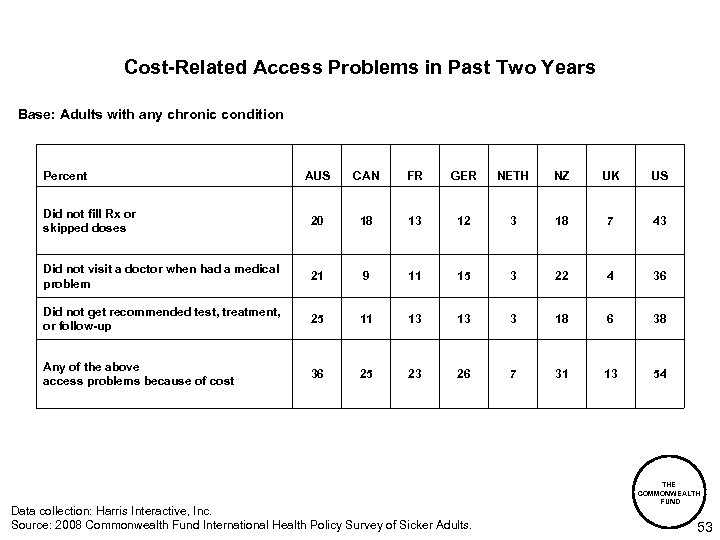 Cost-Related Access Problems in Past Two Years Base: Adults with any chronic condition Percent AUS CAN FR GER NETH NZ UK US Did not fill Rx or skipped doses 20 18 13 12 3 18 7 43 Did not visit a doctor when had a medical problem 21 9 11 15 3 22 4 36 Did not get recommended test, treatment, or follow-up 25 11 13 13 3 18 6 38 Any of the above access problems because of cost 36 25 23 26 7 31 13 54 Data collection: Harris Interactive, Inc. Source: 2008 Commonwealth Fund International Health Policy Survey of Sicker Adults. THE COMMONWEALTH FUND 53
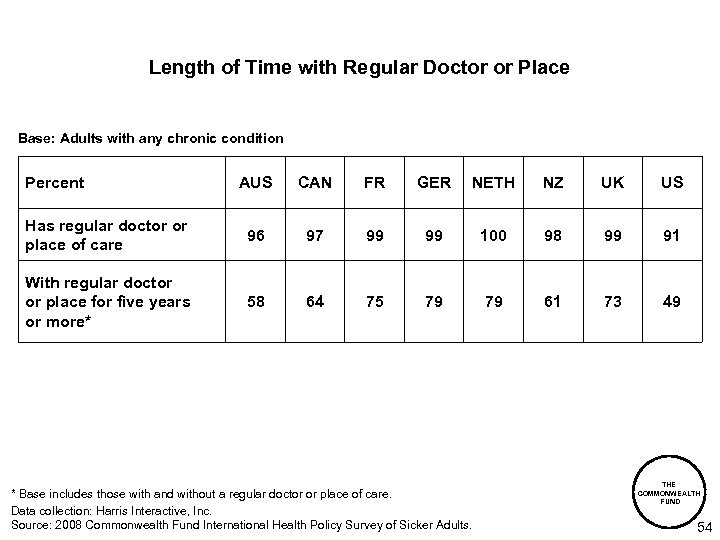 Length of Time with Regular Doctor or Place Base: Adults with any chronic condition Percent AUS CAN FR GER NETH NZ UK US Has regular doctor or place of care 96 97 99 99 100 98 99 91 With regular doctor or place for five years or more* 58 64 75 79 79 61 73 49 * Base includes those with and without a regular doctor or place of care. Data collection: Harris Interactive, Inc. Source: 2008 Commonwealth Fund International Health Policy Survey of Sicker Adults. THE COMMONWEALTH FUND 54
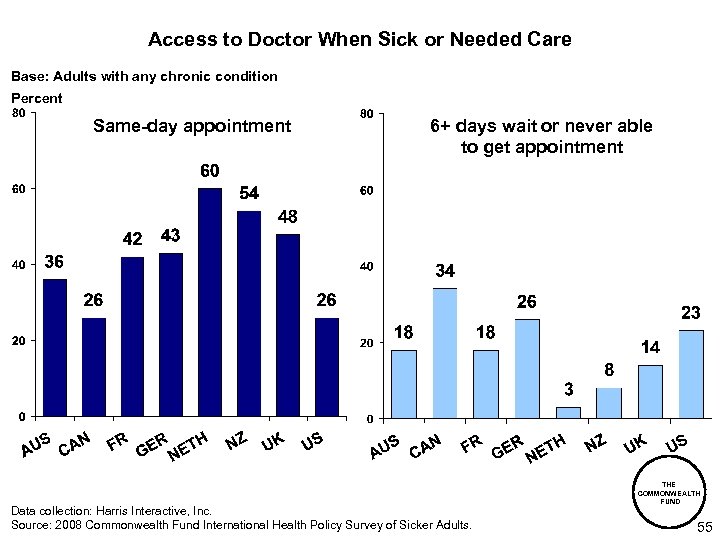 Access to Doctor When Sick or Needed Care Base: Adults with any chronic condition Percent Same-day appointment 6+ days wait or never able to get appointment Data collection: Harris Interactive, Inc. Source: 2008 Commonwealth Fund International Health Policy Survey of Sicker Adults. THE COMMONWEALTH FUND 55
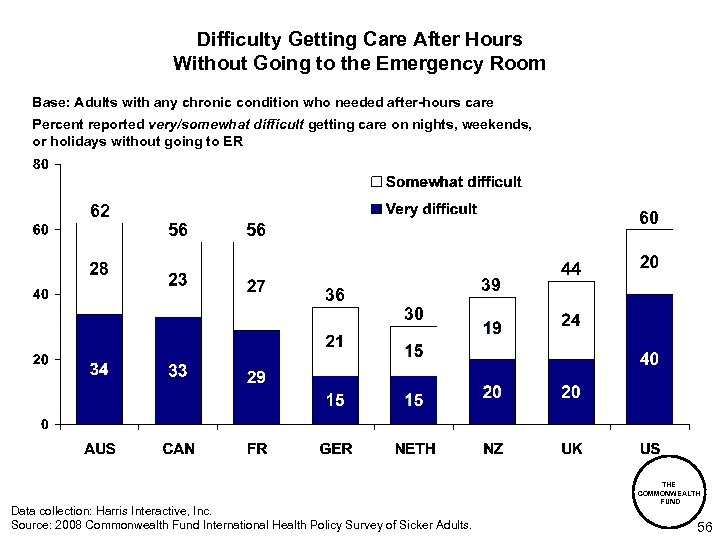 Difficulty Getting Care After Hours Without Going to the Emergency Room Base: Adults with any chronic condition who needed after-hours care Percent reported very/somewhat difficult getting care on nights, weekends, or holidays without going to ER 62 56 60 56 36 39 44 30 Data collection: Harris Interactive, Inc. Source: 2008 Commonwealth Fund International Health Policy Survey of Sicker Adults. THE COMMONWEALTH FUND 56
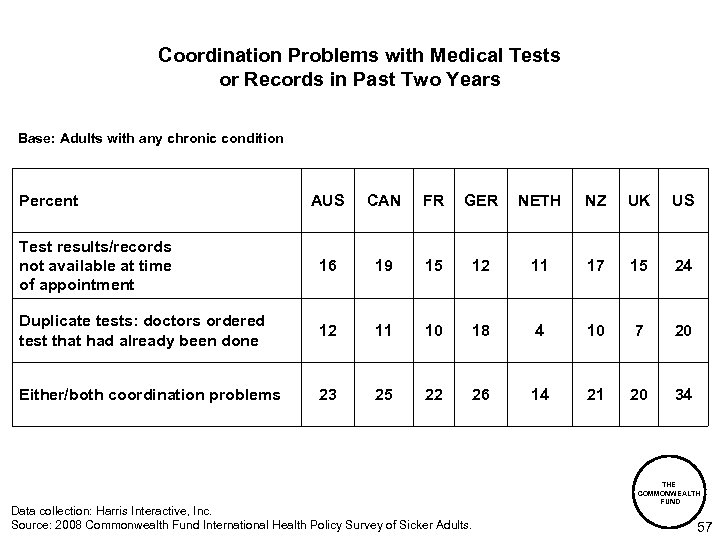 Coordination Problems with Medical Tests or Records in Past Two Years Base: Adults with any chronic condition Percent AUS CAN FR GER NETH NZ UK US Test results/records not available at time of appointment 16 19 15 12 11 17 15 24 Duplicate tests: doctors ordered test that had already been done 12 11 10 18 4 10 7 20 Either/both coordination problems 23 25 22 26 14 21 20 34 Data collection: Harris Interactive, Inc. Source: 2008 Commonwealth Fund International Health Policy Survey of Sicker Adults. THE COMMONWEALTH FUND 57
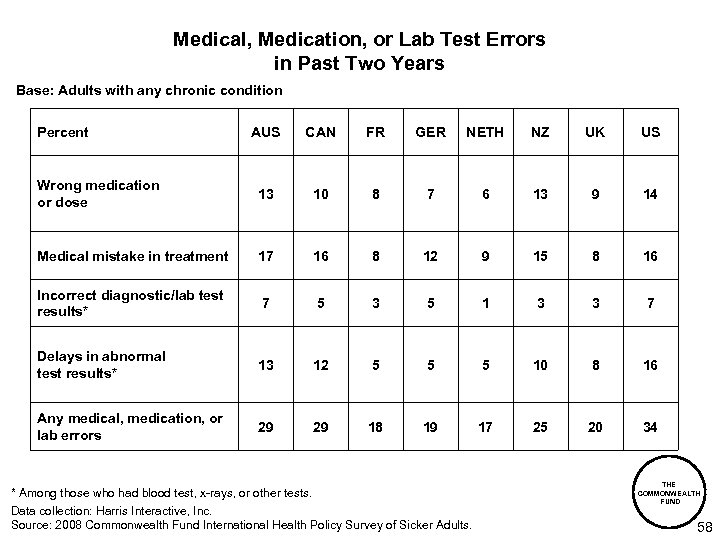 Medical, Medication, or Lab Test Errors in Past Two Years Base: Adults with any chronic condition Percent AUS CAN FR GER NETH NZ UK US Wrong medication or dose 13 10 8 7 6 13 9 14 Medical mistake in treatment 17 16 8 12 9 15 8 16 Incorrect diagnostic/lab test results* 7 5 3 5 1 3 3 7 Delays in abnormal test results* 13 12 5 5 5 10 8 16 Any medical, medication, or lab errors 29 29 18 19 17 25 20 34 * Among those who had blood test, x-rays, or other tests. Data collection: Harris Interactive, Inc. Source: 2008 Commonwealth Fund International Health Policy Survey of Sicker Adults. THE COMMONWEALTH FUND 58
 Policy Solutions
 Bending the Curve: Fifteen Options that Achieve Savings Cumulative 10 -Year Savings Producing and Using Better Information • • • Promoting Health Information Technology Center for Medical Effectiveness and Health Care Decision-Making Patient Shared Decision-Making -$88 billion -$368 billion -$9 billion Promoting Health and Disease Prevention • • • Public Health: Reducing Tobacco Use Public Health: Reducing Obesity Positive Incentives for Health -$191 billion -$283 billion -$19 billion Aligning Incentives with Quality and Efficiency • • Hospital Pay-for-Performance Episode-of-Care Payment Strengthening Primary Care and Care Coordination Limit Federal Tax Exemptions for Premium Contributions -$34 billion -$229 billion -$194 billion -$131 billion Correcting Price Signals in the Health Care Market • • • Reset Benchmark Rates for Medicare Advantage Plans Competitive Bidding Negotiated Prescription Drug Prices All-Payer Provider Payment Methods and Rates Limit Payment Updates in High-Cost Areas -$50 billion -$104 billion -$43 billion -$122 billion -$158 billion THE COMMONWEALTH FUND Source: C. Schoen et al. , Bending the Curve: Options for Achieving Savings and Improving Value in U. S. Health Spending Commonwealth , Fund, December 2007. 60
 Five Key Strategies for High Performance 1. Extending affordable health insurance to all 2. Organizing care around the patient 3. Aligning financial incentives to enhance value and achieve savings 4. Meeting and raising benchmarks for high-quality, efficient care 5. Ensuring accountable national leadership and public/private collaboration Source: Commission on a High Performance Health System, A High Performance Health System for the United States: An Ambitious Agenda for the Next President, The Commonwealth Fund, November 2007 THE COMMONWEALTH FUND 61