 Скачать презентацию The common of drugs Student s name Kenjebaeva A
The common of drugs.pptx
- Количество слайдов: 18



The common of drugs Student’s name: Kenjebaeva A. FA-213 -001 -02 Teacher’s name: Omarova A.
Plan: O What is a drug? O Solids forms of drugs. O Semisolids forms of drugs. O Liquids forms of drugs. O Literature.
O A drug is, in the broadest of terms, a chemical substance that has known biological effects on humans or other animals. Foods are generally excluded from this definition, in spite of their physiological effects on animal species. O In pharmacology, a drug is "a chemical substance used in the treatment, cure, prevention, or diagnosis of disease or used to otherwise enhance physical or mental well-being. " Pharmaceutical drugs may be used for a limited duration, or on a regular basis for chronic disorders.
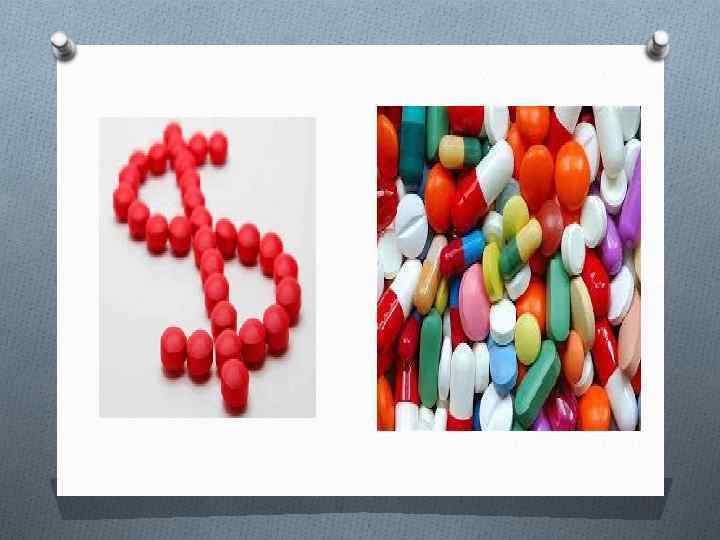
O A pill was originally defined as a small, round, solid pharmaceutical oral dosage form of medication that was in use before the advent of tablets and capsules. Pills were made by mixing the active ingredients with an excipient such as glucose syrup in a mortar and pestle to form a paste, then rolling the mass into a long cylindrical shape , and dividing it into equal portions, which were then rolled into balls, and often coated with sugar to make them more palatable.
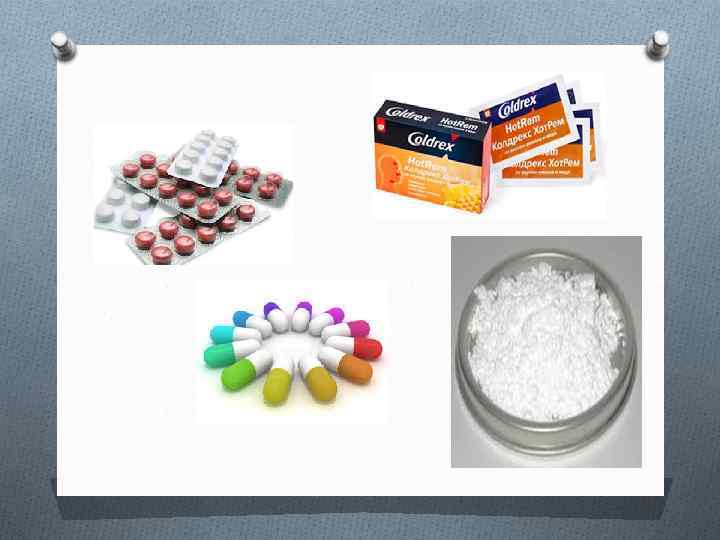
O In the manufacture of pharmaceuticals, encapsulation refers to a range of dosage forms— techniques used to enclose medicines—in a relatively stable shell known as a capsule, allowing them to, for example, be taken orally or be used as suppositories. The two main types of capsules are: O Hard-shelled capsules, which are typically made using gelatin and contain dry, powdered ingredients or miniature pellets made by e. g. processes of extrusion or spheronisation. These are made in two halves: a lower-diameter "body" that is filled and then sealed using a higher-diameter "cap". O Soft-shelled capsules, primarily used for oils and for active ingredients that are dissolved or suspended in oil.
O A powder is a dry, bulk solid composed of a large number of very fine particles that may flow freely when shaken or tilted. Powders are a special sub-class of granular materials, although the terms powder and granular are sometimes used to distinguish separate classes of material. In particular, powders refer to those granular materials that have the finer grain sizes, and that therefore have a greater tendency to form clumps when flowing. Granulars refers to the coarser granular materials that do not tend to form clumps except when wet.
O A cream is a topical preparation usually for application to the skin. Creams for application to mucous membranes such as those of the rectum or vagina are also used. Creams may be considered pharmaceutical products as even cosmetic creams are based on techniques developed by pharmacy and unmedicated creams are highly used in a variety of skin conditions. The use of the Finger tip unit concept may be helpful in guiding how much topical cream is required to cover different areas.
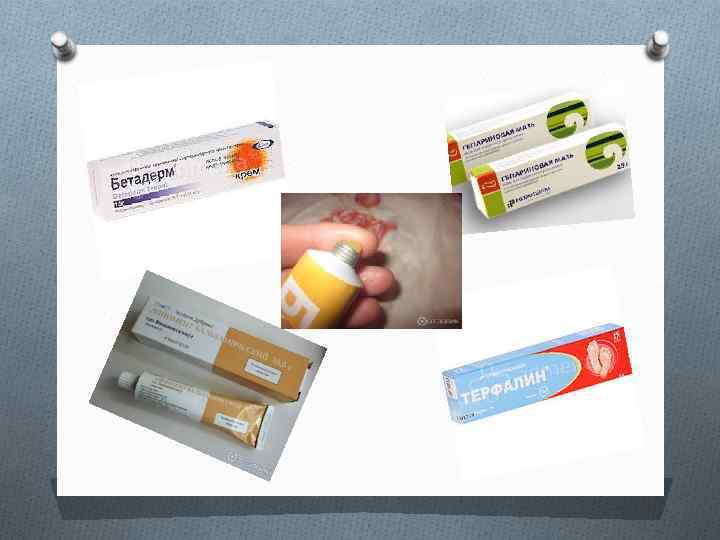
O An ointment is a homogeneous, viscous, semi-solid preparation, most commonly a greasy, thick oil (oil 80% - water 20%) with a high viscosity, that is intended for external application to the skin or mucous membranes. Ointments have a water number that defines the maximum amount of water that it can contain. They are used as emollients or for the application of active ingredients to the skin for protective, therapeutic, or prophylactic purposes and where a degree of occlusion is desired. O Ointments are used topically on a variety of body surfaces. These include the skin and the mucous membranes of the eye, chest, vulva, anus, and nose. An ointment may or may not be medicated.
O A gel is a solid, jelly-like material that can have properties ranging from soft and weak to hard and tough. Gels are defined as a substantially dilute cross-linked system, which exhibits no flow when in the steady-state. By weight, gels are mostly liquid, yet they behave like solids due to a three-dimensional cross-linked network within the liquid. It is the crosslinking within the fluid that give a gel its structure and contribute to the adhesive stick. In this way gels are a dispersion of molecules of a liquid within a solid in which the solid is the continuous phase and the liquid is the discontinuous phase.
O Liniment from the Latin linere, to anoint, is a medicated topical preparation for application to the skin. Sometimes called balms, liniments are of a similar or lesser viscosity than lotions and are rubbed in to create friction, unlike lotions, ointments or creams. O Liniments are typically sold to relieve pain and stiffness, such as from sore muscles or arthritis. These are typically formulated from alcohol, acetone, or similar quickly evaporating solvents and contain counterirritant aromatic chemical compounds such as methyl salicilate, benzoin resin, or capsaicin.
O In chemistry, a suspension is a heterogeneous mixture containing solid particles that are sufficiently large for sedimentation. Usually they must be larger than one micrometer. The internal phase is dispersed throughout the external phase through mechanical agitation, with the use of certain excipients or suspending agents. Unlike colloids, suspensions will eventually settle. An example of a suspension would be sand in water. The suspended particles are visible under a microscope and will settle over time if left undisturbed. This distinguishes a suspension from a colloid, in which the suspended particles are smaller and do not settle. Colloids and suspensions are different from solutions, in which the dissolved substance does not exist as a solid, and solvent and solute are homogeneously mixed.
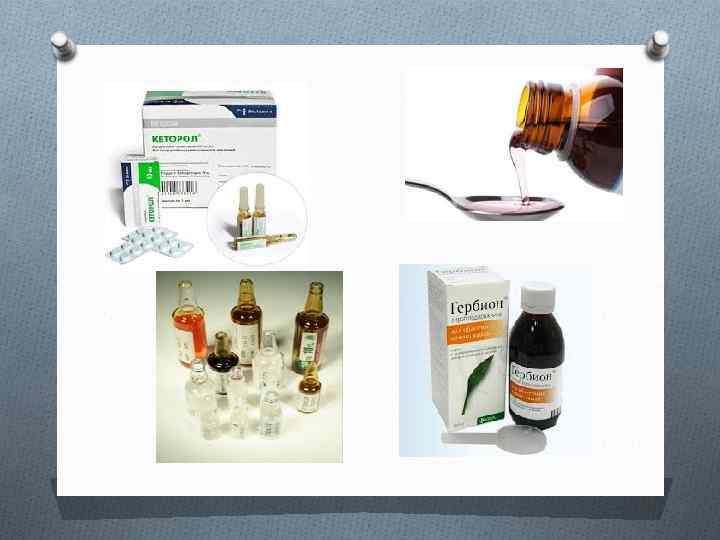
O In cooking, a syrup or sirup is a thick, viscous liquid consisting primarily of a solution of sugar in water, containing a large amount of dissolved sugars but showing little tendency to deposit crystals. The viscosity arises from the multiple hydrogen bonds between the dissolved sugar, which has many hydroxyl groups, and the water. Syrups can be made by dissolving sugar in water or by reducing naturally sweet juices such as cane juice, sorghum juice, or maple sap. Corn syrup is made from corn starch using an enzymatic process that converts it to sugars. Technically and scientifically, the term syrup is also employed to denote viscous, generally residual, liquids, containing substances other than sugars in solution.
O An ampoule is a small sealed vial which is used to contain and preserve a sample, usually a solid or liquid. Ampoules are commonly made of glass, although plastic ampoules do exist. O Modern ampoules are most commonly used to contain pharmaceuticals and chemicals that must be protected from air and contaminants. They are hermetically sealed by melting the thin top with an open flame, and usually opened by snapping off the neck. If properly done, this last operation creates a clean break without any extra glass shards or slivers; but the liquid or solution may be filtered for greater assurance. The space above the chemical may be filled with an inert gas before sealing. The walls of glass ampoules are usually sufficiently strong to be brought into a glovebox without any difficulty.
Literature: O http: //en. wikipedia. org/wiki/Drug O http: //en. wikipedia. org/wiki/Pill_(pharmacy) O http: //en. wikipedia. org/wiki/Dosage_form
Скачать презентацию The common of drugs Student s name Kenjebaeva A
The common of drugs.pptx