 Скачать презентацию The Commodity Adoption Paradox Dr Brad Poulson Business
84f224053ab937d59bd262e5dc90ded0.ppt
- Количество слайдов: 30



“The Commodity Adoption Paradox” Dr. Brad Poulson Business Systems Director, Retail Operations - Store Systems, Boots The Chemists brad. poulson@boots. co. uk
Agenda • Introduction • Share findings from research I did in a major UK retailer • Background to the research • Findings • Conclusions
Introduction • My background • Questions and timing
Background to the research • Who architects the business? • If a process is truly a commodity then why don’t companies just adopt it? • The research examines the ability (logic) of organisations to adopt commodity work business processes
Overview of the cases Four case studies taken from within one major UK retailer and contain the call centres business process as the focus of the research. They were chosen for their contrasting approaches to the business problem and diversity of the final outcomes thus encouraging theoretical replication. The ventures were approached as independent activities and were launched during a thirteen-month period between March 1997 and April 1998. The four cases are: Loyalty scheme (LS), Mail order (MO), Insurance (INS), Customer service (CS).
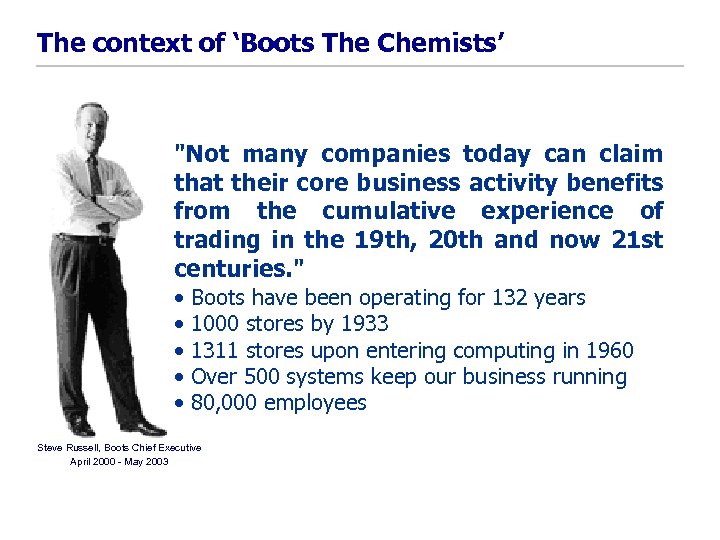
The context of ‘Boots The Chemists’ "Not many companies today can claim that their core business activity benefits from the cumulative experience of trading in the 19 th, 20 th and now 21 st centuries. " • • • Boots have been operating for 132 years 1000 stores by 1933 1311 stores upon entering computing in 1960 Over 500 systems keep our business running 80, 000 employees Steve Russell, Boots Chief Executive April 2000 - May 2003
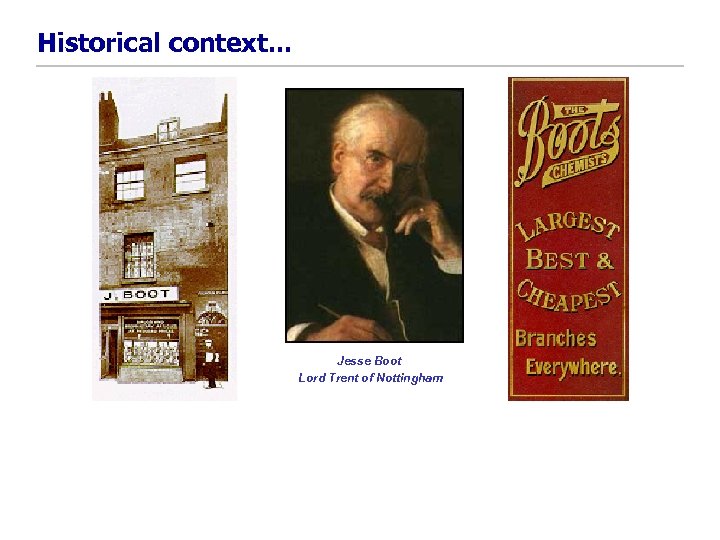
Historical context. . . Jesse Boot Lord Trent of Nottingham
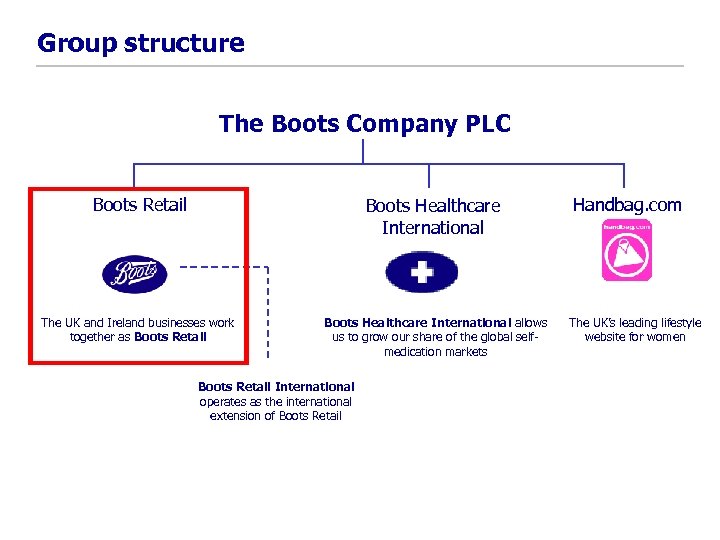
Group structure The Boots Company PLC Boots Retail Boots Healthcare International The UK and Ireland businesses work together as Boots Retail Boots Healthcare International allows us to grow our share of the global selfmedication markets Boots Retail International operates as the international extension of Boots Retail Handbag. com The UK’s leading lifestyle website for women
Case Study 1: Customer Service (CS) The first of these, Customer Service, is a redesigned internal venture That developed and implemented a new in-house call centre capability. Boots Customer Services: • Launched March 1997 • Effective management of customer complaint handling • Development of a customer relationship strategy • Centralised facility handling 1, 000 calls and 500 letters, faxes, and emails daily
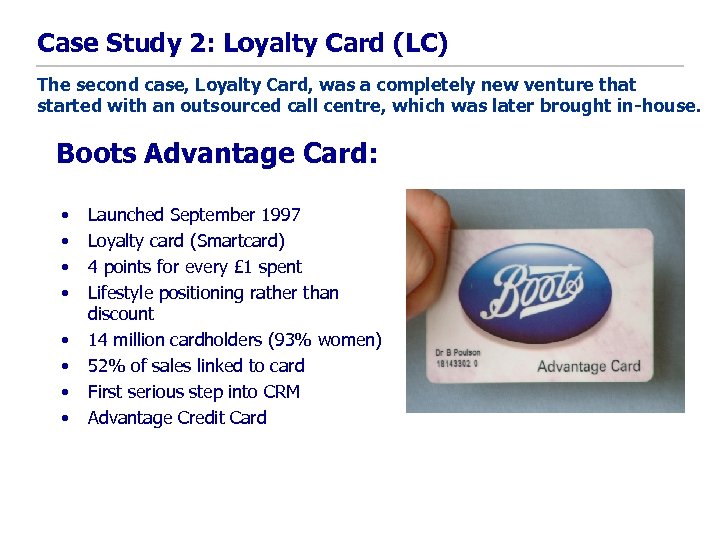
Case Study 2: Loyalty Card (LC) The second case, Loyalty Card, was a completely new venture that started with an outsourced call centre, which was later brought in-house. Boots Advantage Card: • • Launched September 1997 Loyalty card (Smartcard) 4 points for every £ 1 spent Lifestyle positioning rather than discount 14 million cardholders (93% women) 52% of sales linked to card First serious step into CRM Advantage Credit Card
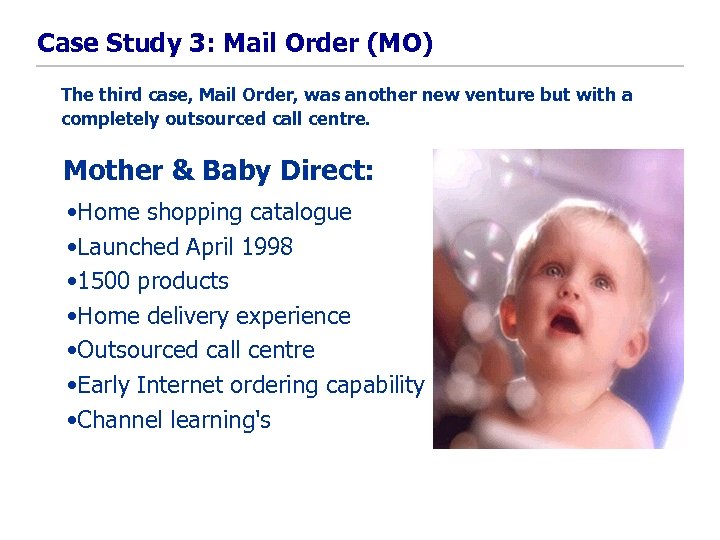
Case Study 3: Mail Order (MO) The third case, Mail Order, was another new venture but with a completely outsourced call centre. Mother & Baby Direct: • Home shopping catalogue • Launched April 1998 • 1500 products • Home delivery experience • Outsourced call centre • Early Internet ordering capability • Channel learning's
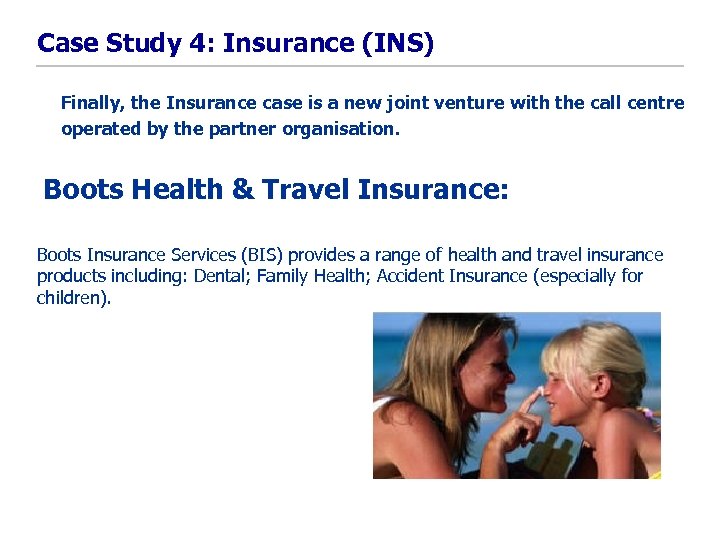
Case Study 4: Insurance (INS) Finally, the Insurance case is a new joint venture with the call centre operated by the partner organisation. Boots Health & Travel Insurance: Boots Insurance Services (BIS) provides a range of health and travel insurance products including: Dental; Family Health; Accident Insurance (especially for children).
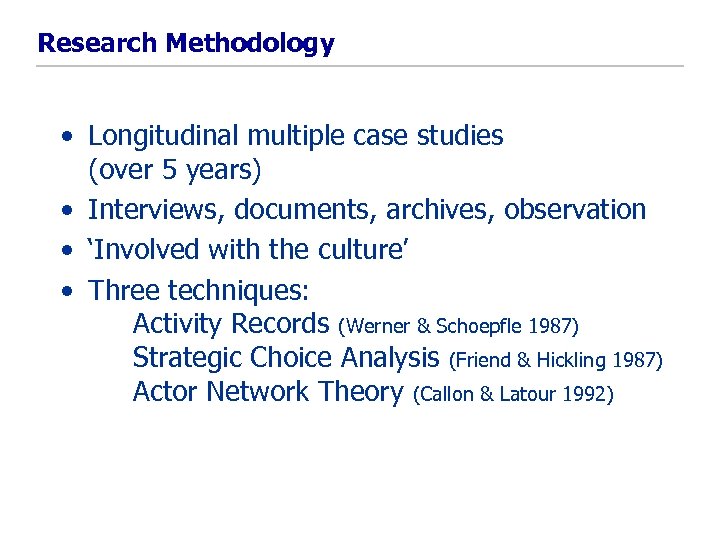
Research Methodology • Longitudinal multiple case studies (over 5 years) • Interviews, documents, archives, observation • ‘Involved with the culture’ • Three techniques: Activity Records (Werner & Schoepfle 1987) Strategic Choice Analysis (Friend & Hickling 1987) Actor Network Theory (Callon & Latour 1992)
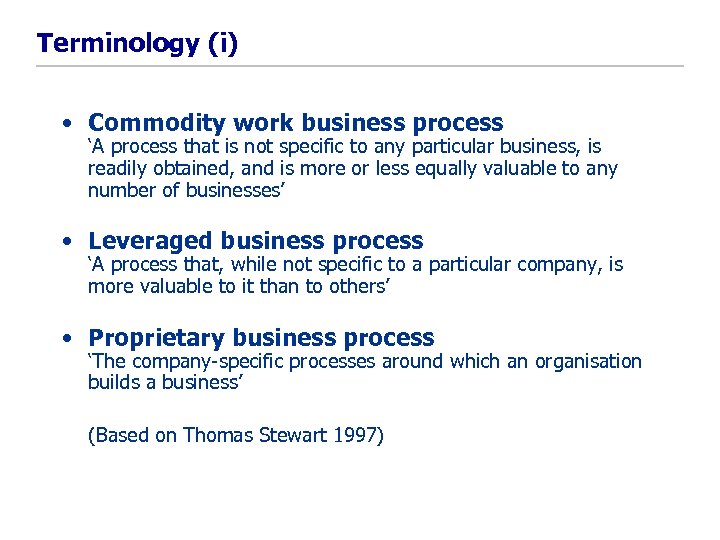
Terminology (i) • Commodity work business process ‘A process that is not specific to any particular business, is readily obtained, and is more or less equally valuable to any number of businesses’ • Leveraged business process ‘A process that, while not specific to a particular company, is more valuable to it than to others’ • Proprietary business process ‘The company-specific processes around which an organisation builds a business’ (Based on Thomas Stewart 1997)
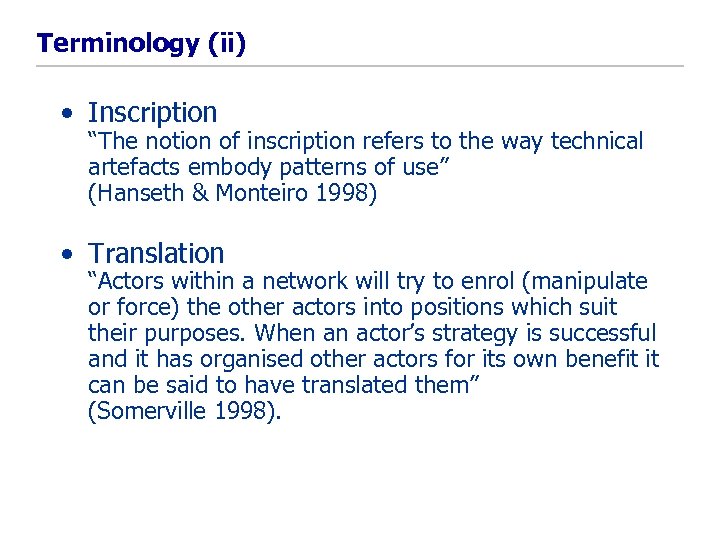
Terminology (ii) • Inscription “The notion of inscription refers to the way technical artefacts embody patterns of use” (Hanseth & Monteiro 1998) • Translation “Actors within a network will try to enrol (manipulate or force) the other actors into positions which suit their purposes. When an actor’s strategy is successful and it has organised other actors for its own benefit it can be said to have translated them” (Somerville 1998).
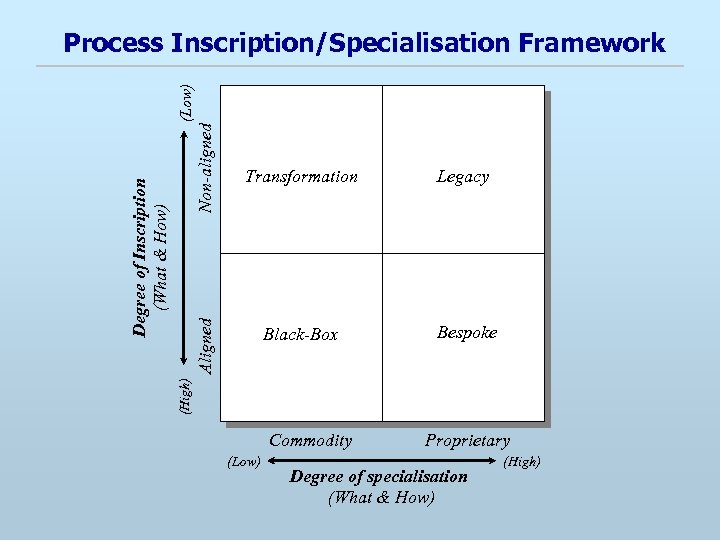
Transformation Legacy Black-Box Bespoke (High) Aligned Degree of Inscription (What & How) Non-aligned (Low) Process Inscription/Specialisation Framework Commodity (Low) Proprietary Degree of specialisation (What & How) (High)
Findings (i) • It was concluded that while the core processes were the same across the cases: (i) the detail of the process, (ii) the variation in the contexts, (iii) the logic of the decision process as they evolved, and (iv) the view of the actors involved, combined together to lead to quite different approaches in each case.
Findings (ii) • Confirmed that no established body of common language exists (Keen & Knapp 1996) – A ‘complaint handling’ process (CS) – An ‘account servicing’ process (LC) – An ‘order taking’ process (MO & INS)
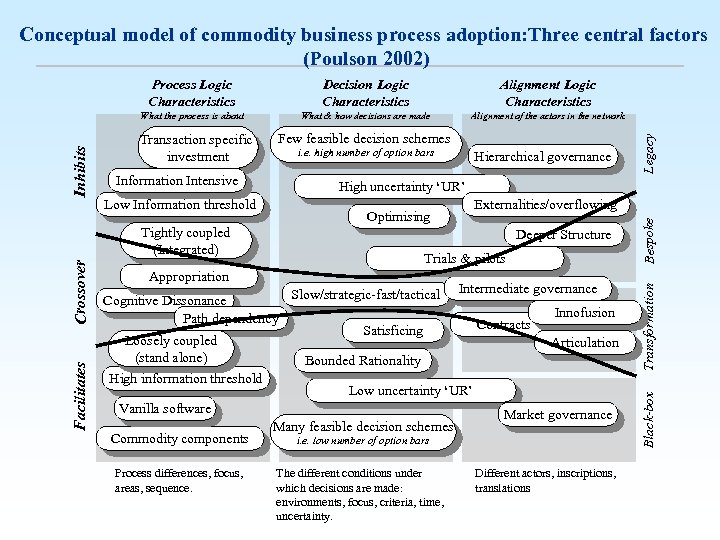
Findings (iii) • The research identified that there is a need to understand the closely coupled relationship between process logic, decision logic, and alignment logic. • Processes are similar in the core but have a surround that is specific to a process, in a particular situation, at a particular time.
Findings (iv) • A commodity process has to be seen to be a commodity by the actors in the network. • The mix and variety of the decisions taken compounds the difference between processes. • Decisions take place at multiple levels within a business.
Findings (v) • As time progressed and experience was gained and the situation evolved, actors changed their views (alignment) resulting in changes to the business process • There appeared to be little transfer of knowledge across different parts of the organisation
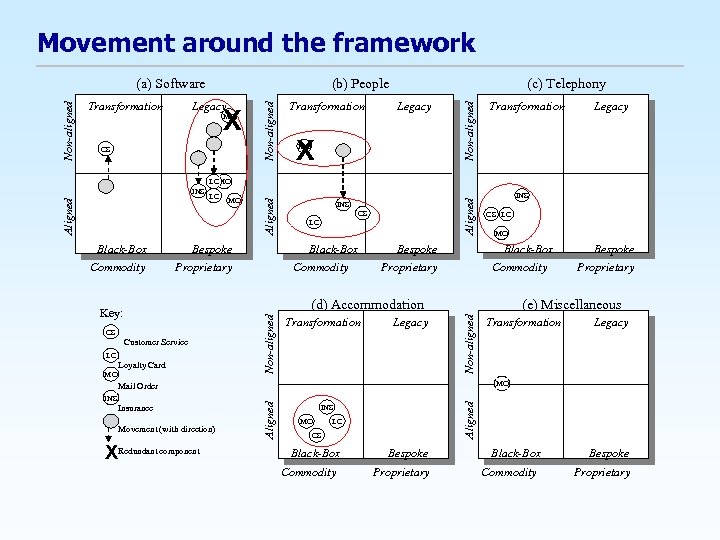
Movement around the framework Legacy X MO CS Transformation (c) Telephony Legacy X MO Non-aligned Transformation (b) People Non-aligned (a) Software Transformation Legacy Bespoke INS CS LC Black-Box Commodity Proprietary INS CS LC MO Black-Box Commodity Bespoke Proprietary Customer Service Loyalty Card MO Transformation Legacy XRedundant component Legacy Aligned Movement (with direction) Aligned Insurance Transformation MO Mail Order INS Bespoke Proprietary (e) Miscellaneous Non-aligned CS Non-aligned (d) Accommodation Key: LC MO Aligned Black-Box Commodity LC Aligned LCMO INS MO LC CS Black-Box Commodity Bespoke Proprietary
Findings (vi) • The three logic's (process, decision, and alignment) all have to mutually support a commodity approach for it to be successful and sustainable
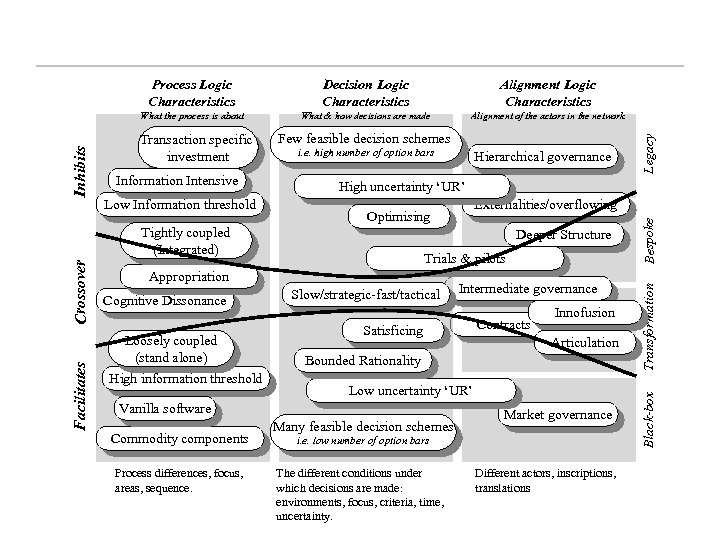
Alignment Logic Characteristics What & how decisions are made Alignment of the actors in the network High uncertainty ‘UR’ Crossover Facilitates Deeper Structure Trials & pilots Appropriation Loosely coupled (stand alone) High information threshold Slow/strategic-fast/tactical Process differences, focus, areas, sequence. Intermediate governance Satisficing Contracts Innofusion Articulation Bounded Rationality Low uncertainty ‘UR’ Vanilla software Commodity components Externalities/overflowing Optimising Tightly coupled (Integrated) Cognitive Dissonance Hierarchical governance Many feasible decision schemes Market governance i. e. low number of option bars The different conditions under which decisions are made: environments, focus, criteria, time, uncertainty. Different actors, inscriptions, translations Bespoke Low Information threshold i. e. high number of option bars Transformation Intensive Few feasible decision schemes Black-box Transaction specific investment Legacy Decision Logic Characteristics What the process is about Inhibits Process Logic Characteristics
Conceptual model of commodity business process adoption: Three central factors (Poulson 2002) Alignment Logic Characteristics What & how decisions are made Alignment of the actors in the network Facilitates Crossover Tightly coupled (Integrated) Hierarchical governance High uncertainty ‘UR’ Optimising Externalities/overflowing Deeper Structure Trials & pilots Appropriation Slow/strategic-fast/tactical Intermediate governance Cognitive Dissonance Innofusion Path dependency Contracts Satisficing Loosely coupled Articulation (stand alone) Bounded Rationality High information threshold Low uncertainty ‘UR’ Vanilla software Market governance Many feasible decision schemes Commodity components i. e. low number of option bars Process differences, focus, areas, sequence. The different conditions under which decisions are made: environments, focus, criteria, time, uncertainty. Different actors, inscriptions, translations Bespoke Low Information threshold i. e. high number of option bars Transformation Intensive Few feasible decision schemes Black-box Transaction specific investment Legacy Decision Logic Characteristics What the process is about Inhibits Process Logic Characteristics
So why is this important? • Why wouldn’t broadly similar processes located in the same overall business context adopt similar solutions in terms of commoditisation, governance, and resourcing (architecture)? • The closely-coupled relationship between BPR and Information Technology • Move away from in-house developments to outsourcing
So why is this important? (ii) • The increase in use of package software within businesses • The growth in Application Service Providers (ASP’s)
Case study key events and timescales
Any Questions
2 e-think ‘Improving capability through research; consultancy; coaching, and personal development’ email: brad. poulson@e-think 2. com +44 (0)115 959 2630
Скачать презентацию The Commodity Adoption Paradox Dr Brad Poulson Business
84f224053ab937d59bd262e5dc90ded0.ppt