


 Скачать презентацию The Comatose Patient Hans House MD FACEP Professor
904818bec19706e74b88b1aad403c90d.ppt
- Количество слайдов: 44
 The Comatose Patient Hans House, MD, FACEP Professor Department of Emergency Medicine University of Iowa
 Objective § Outline the general approach to the patient with stupor or coma, including the use of clinical, laboratory, and imaging investigations
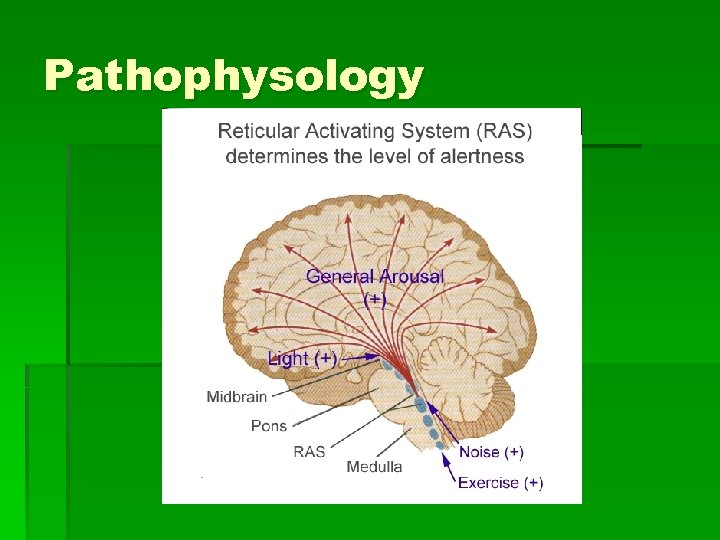 Pathophysology
 Initial Management § § A: Airway control if needed B: Assist ventilations, 100% O 2 C: Volume if hypotensive D: Dextrose § Consider: glucose, thiamine, nalaxone
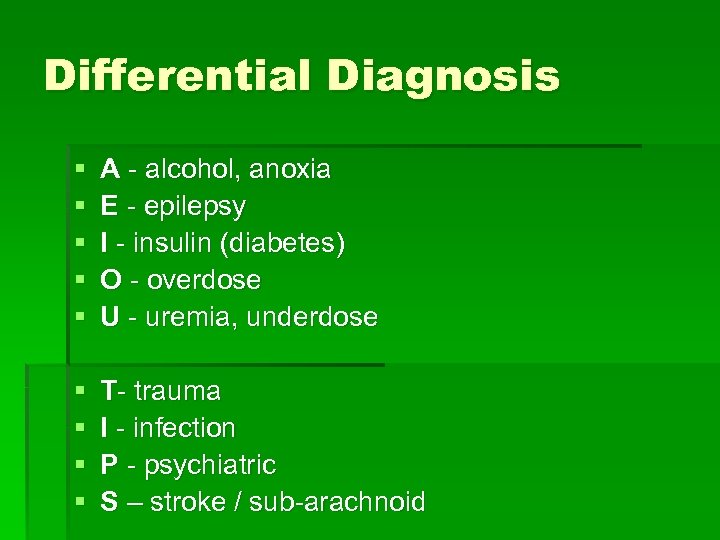 Differential Diagnosis § § § A - alcohol, anoxia E - epilepsy I - insulin (diabetes) O - overdose U - uremia, underdose T- trauma I - infection P - psychiatric S – stroke / sub-arachnoid
 Differential Diagnosis Most common ED diagnosis: § Trauma § CVA § Intoxications § Metabolic § Post- ictal state § Post- cardiopulmonary arrest
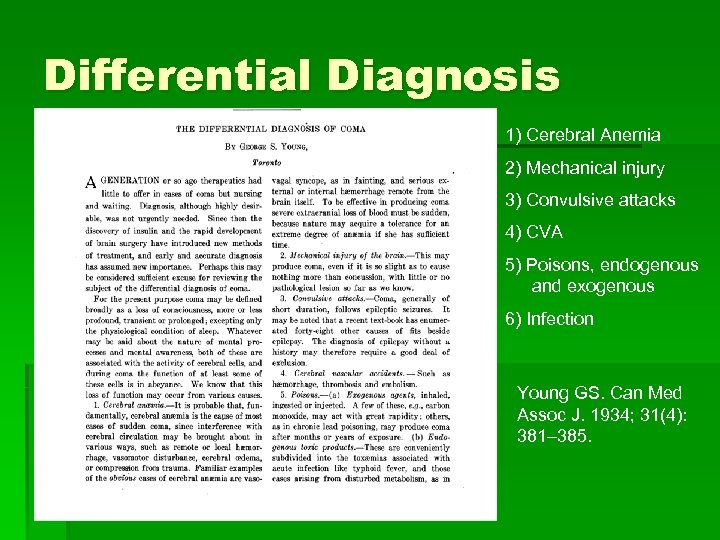 Differential Diagnosis 1) Cerebral Anemia 2) Mechanical injury 3) Convulsive attacks 4) CVA 5) Poisons, endogenous and exogenous 6) Infection Young GS. Can Med Assoc J. 1934; 31(4): 381– 385.
 General Approach: History “Further history limited to patient’s medical condition”
 General Approach: History Ask family, EMS, chart: § Time course of onset § Duration of symptoms § Focal signs § Past Medical History § Medications § Alcohol or drug use
 General Approach: Physical § § § PE normal in 85% of all patients Vital signs are vital! Elevated or lowered temp may be helpful Need a core temp! Ventilatory patterns not helpful
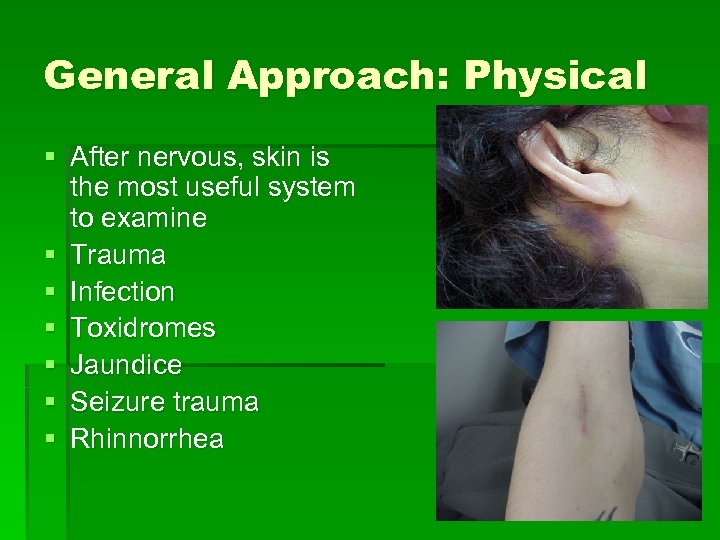 General Approach: Physical § After nervous, skin is the most useful system to examine § Trauma § Infection § Toxidromes § Jaundice § Seizure trauma § Rhinnorrhea
 General Approach: Physical § § § Nervous System Assess and document level of arousal Useful for prognosis, not diagnosis Use GCS “Less than eight, in-tu-bate!”
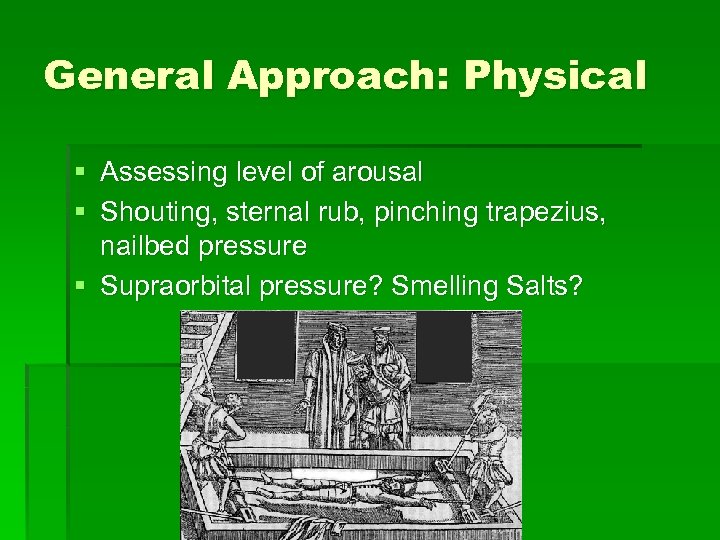 General Approach: Physical § Assessing level of arousal § Shouting, sternal rub, pinching trapezius, nailbed pressure § Supraorbital pressure? Smelling Salts?
 General Approach: Physical § § Motor function Unable to do routine oppositional force Use reflexes Look for asymmerty
 General Approach: physical Cranial nerves: Pupils § Supertentorial mass/ hemorrhage or primary brainstem lesion § Disruption of 3 rd CN or brainstem nuclei § Transtentorial herniation: § First dilation/ loss of light reflex § Later, midrange (4 -5 mm) and fixed § May be mimicked in severe sedative O/D
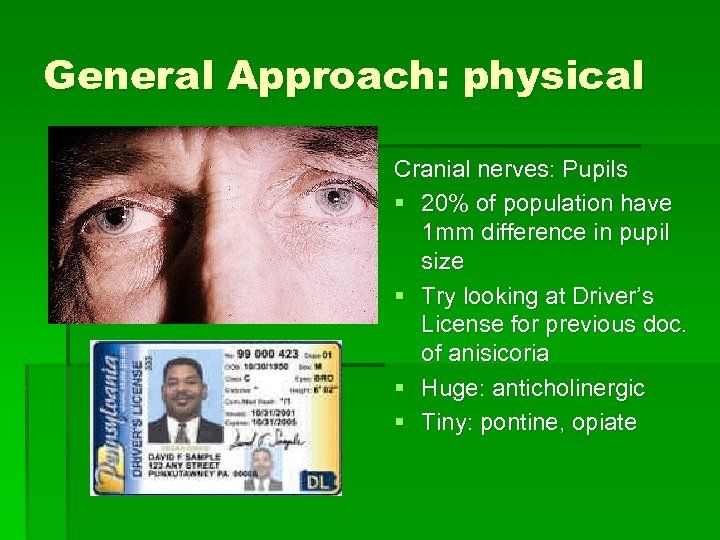 General Approach: physical Cranial nerves: Pupils § 20% of population have 1 mm difference in pupil size § Try looking at Driver’s License for previous doc. of anisicoria § Huge: anticholinergic § Tiny: pontine, opiate
 General Approach: Physical Cranial Nerves: eye movements § Large cerebral mass lesions cause deviation toward side of lesion § Seizure focus (irritable inflammation or blood) causes deviation away from lesion § Vestibuloocular reflexes § Oculocephalic (doll’s eyes) § Oculovestibular (caloric testing)
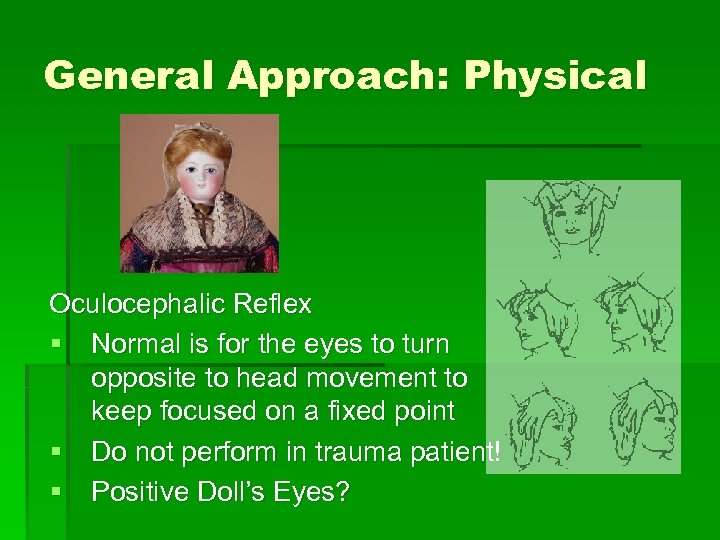 General Approach: Physical Oculocephalic Reflex § Normal is for the eyes to turn opposite to head movement to keep focused on a fixed point § Do not perform in trauma patient! § Positive Doll’s Eyes?
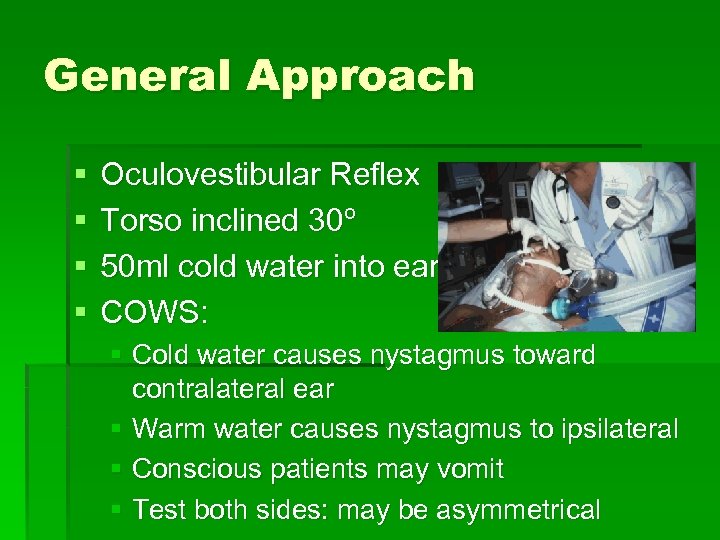 General Approach § § Oculovestibular Reflex Torso inclined 30º 50 ml cold water into ear COWS: § Cold water causes nystagmus toward contralateral ear § Warm water causes nystagmus to ipsilateral § Conscious patients may vomit § Test both sides: may be asymmetrical
 General Approach: Physical Cranial Nerves: Corneal reflexes § Indicative of depth of metabolic coma § Absent 24 hours after trauma / cardiac arrest indicates poor prognosis § May be diminished in conscious elderly, diabetic, or optho patients due to loss of sensation of cornea
 Toxidromes § Pinpoint pupils, decreased respiratory effort and rate, hypothermia, AC scars § Widely dilated pupils, moderate tachycardia (120’s), flushed skin, dry skin § Hyperthermia, tachycardia, tremor, myoclonus, rigidity § Miosis, salivation, lacrimation, urination, defecation, emesis, bradycardia
 Toxidromes § Pinpoint pupils, decreased respiratory effort and rate, hypothermia, AC scars § Widely dilated pupils, moderate tachycardia (120’s), flushed skin, dry skin § Hyperthermia, tachycardia, tremor, myoclonus, rigidity § Miosis, salivation, lacrimation, urination, defecation, emesis, bradycardia
 Toxidromes § Pinpoint pupils, decreased respiratory effort and rate, hypothermia, AC scars § Widely dilated pupils, moderate tachycardia (120’s), flushed skin, dry skin § Hyperthermia, tachycardia, tremor, myoclonus, rigidity § Miosis, salivation, lacrimation, urination, defecation, emesis, bradycardia
 Toxidromes § Pinpoint pupils, decreased respiratory effort and rate, hypothermia, AC scars § Widely dilated pupils, moderate tachycardia (120’s), flushed skin, dry skin § Hyperthermia, tachycardia, tremor, myoclonus, rigidity § Miosis, salivation, lacrimation, urination, defecation, emesis, bradycardia
 Toxidromes § Pinpoint pupils, decreased respiratory effort and rate, hypothermia, AC scars § Widely dilated pupils, moderate tachycardia (120’s), flushed skin, dry skin § Hyperthermia, tachycardia, tremor, myoclonus, rigidity § Miosis, salivation, lacrimation, urination, defecation, emesis, bradycardia
 Laboratory Testing § § Serum labs Radiography (Head CT) Lumbar Puncture EEG
 Laboratory Testing: Serum § Accu-check is part of the ABCD’s! § Electrolytes essential to r/o metabolic § Na, BUN/Cr, anion gap § Consider § UA, urine and blood cultures § TSH § Carboxyhemoglobin § Drug Screen and Et. OH level
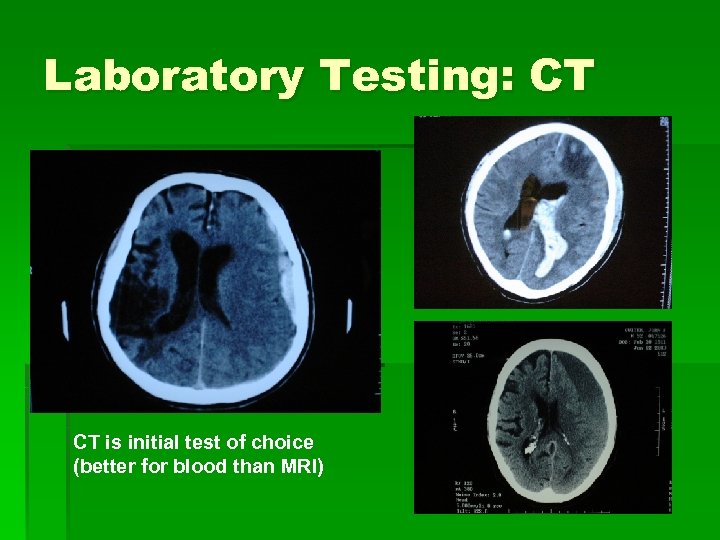 Laboratory Testing: CT CT is initial test of choice (better for blood than MRI)
 Laboratory Testing: LP § Head CT before LP recommended for possible mass lesions § DO NOT DELAY ANTIBIOTICS/ STEROIDS! (you have the blood cultures. . . ) § LP after CT if SAH suspected
 Laboratory Testing: EEG § Indications: § Status epilepticus (SE) with paralysis § Suspected non-convulsive SE (NCSE) § Aid in diagnosis of unknown case § 8 of 236 patients without overt seziure activity in coma had NCSE § Pattern may indicate cause of coma (metabolic, structural, seizure, anoxic)
 Case #1 § 78 yo male BIB RA from SNF for fever and altered mental status § Temp 40º, HR 110, BP 95/60, R 20 § PE: dry mucous membranes, poor tugor § Minimally responsive, groans when neck flexed, hot to touch § UA normal
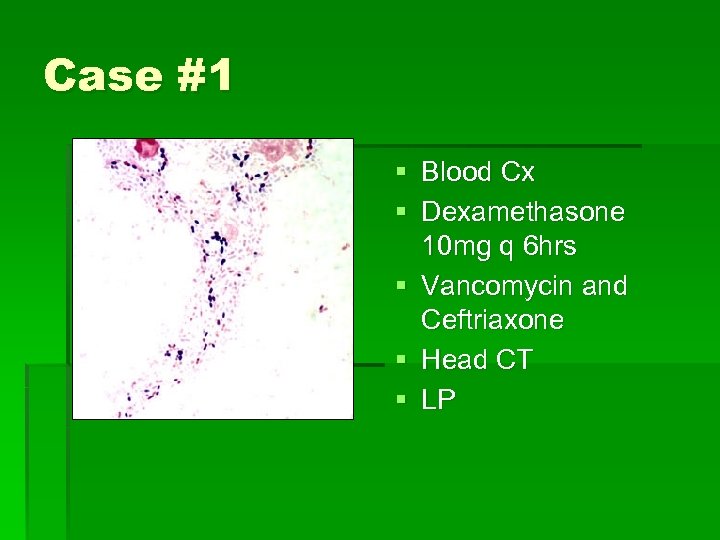 Case #1 § Blood Cx § Dexamethasone 10 mg q 6 hrs § Vancomycin and Ceftriaxone § Head CT § LP
 Case #2 § 42 yo male of “no fixed abode” BIB police after found down in street § Pt is “well known to service” § Vitals normal except mild hypothermia § GCS 9 (withdraws and moans to pain) § Odor of Et. OH on breath
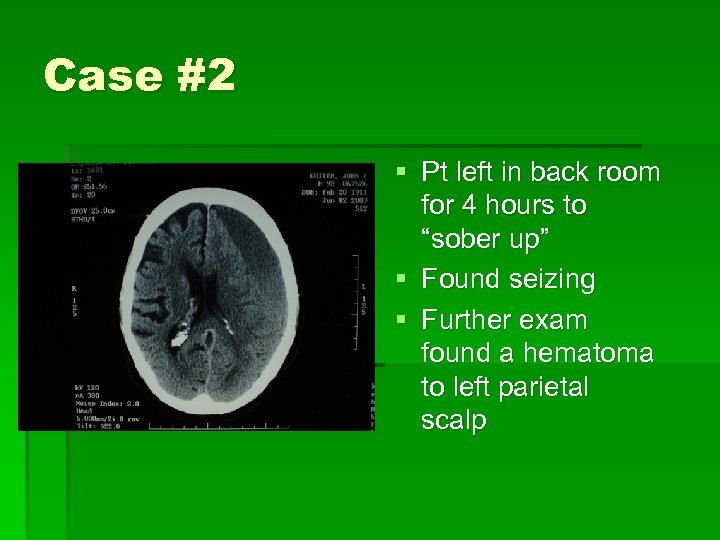 Case #2 § Pt left in back room for 4 hours to “sober up” § Found seizing § Further exam found a hematoma to left parietal scalp
 Case #3 § 46 yo male alcoholic BIB family for decreased consciousness § He moans in response to stimulation, withdraws from pain, eye remain shut § Skin is jaundiced, sclera icteric § Foul breath (fetor hepaticus) § Abdomen: swollen, caput medusae
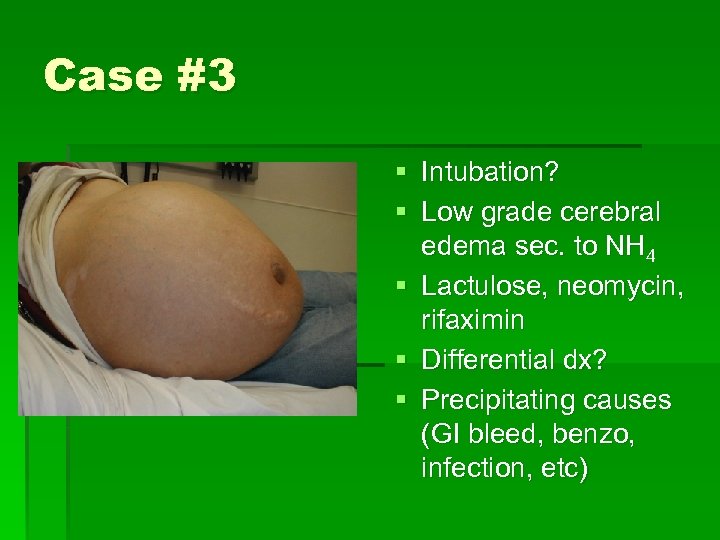 Case #3 § Intubation? § Low grade cerebral edema sec. to NH 4 § Lactulose, neomycin, rifaximin § Differential dx? § Precipitating causes (GI bleed, benzo, infection, etc)
 Case #4 § § § 22 yo male BIB police for odd behavior He was found in the street yelling Agitated, combative, anxious BP 184/97, HR 140, R 22, T 38 Eyes open to pain, moves all 4’s, incomprehensible sounds § Eyes have rotatory nystagmus
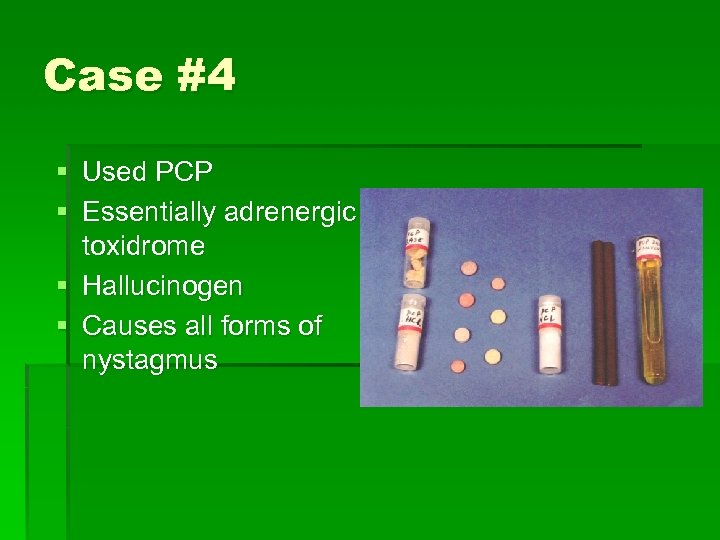 Case #4 § Used PCP § Essentially adrenergic toxidrome § Hallucinogen § Causes all forms of nystagmus
 Case #5 § § § 39 yo female found down by husband Had complained of a headache earlier PMH: Htn FHx: polycystic kidney disease BP 150/90, HR 65, T 37 Eyes closed, withdraws to pain, no verbal
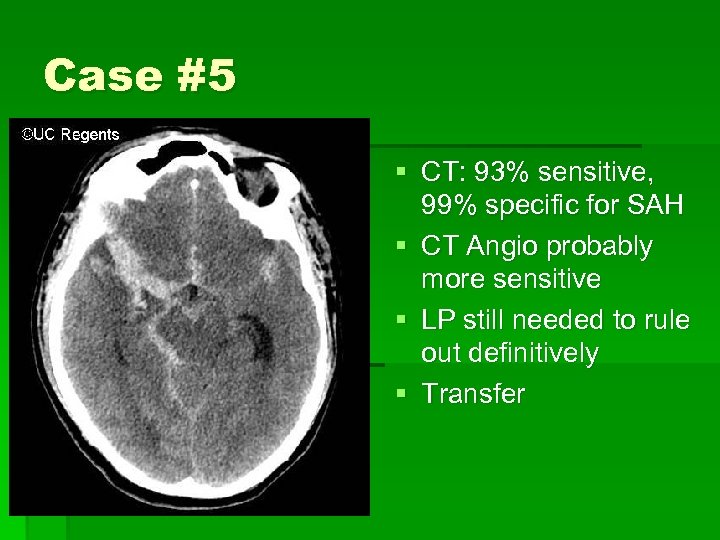 Case #5 § CT: 93% sensitive, 99% specific for SAH § CT Angio probably more sensitive § LP still needed to rule out definitively § Transfer
 Case #6 § § § 27 yo female BIB family for odd behavior Previous history of bipolar d/o Now not responsive No signs of trauma or intoxication Exam normal except for intermittent nystagmus and eye deviation § All labs, including head CT and drug screen WNL
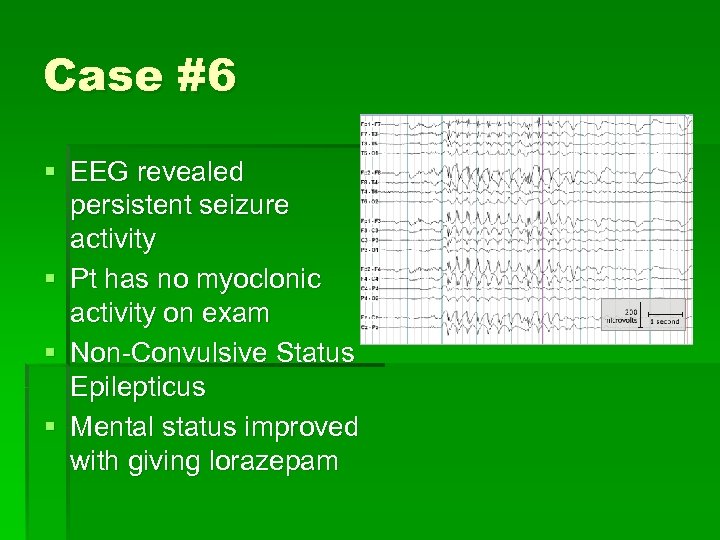 Case #6 § EEG revealed persistent seizure activity § Pt has no myoclonic activity on exam § Non-Convulsive Status Epilepticus § Mental status improved with giving lorazepam
 Conclusions § ABC-D (D is for Dextrose) § If elevated or low Temp would change your management, get a core temp § Less than 8, in-tu-bate! § For meningitis: IV, then blood cultures, then steroids, then Abx, then CT, then LP § Beware of occult trauma in the intoxicated
 Any Questions?