


 Скачать презентацию The Cold War in the 1960 s APUSH
a2c560bdaa3101e6e2089a023761f28c.ppt
- Количество слайдов: 13
 The Cold War in the 1960 s APUSH 3/22/07 Ms. Weston
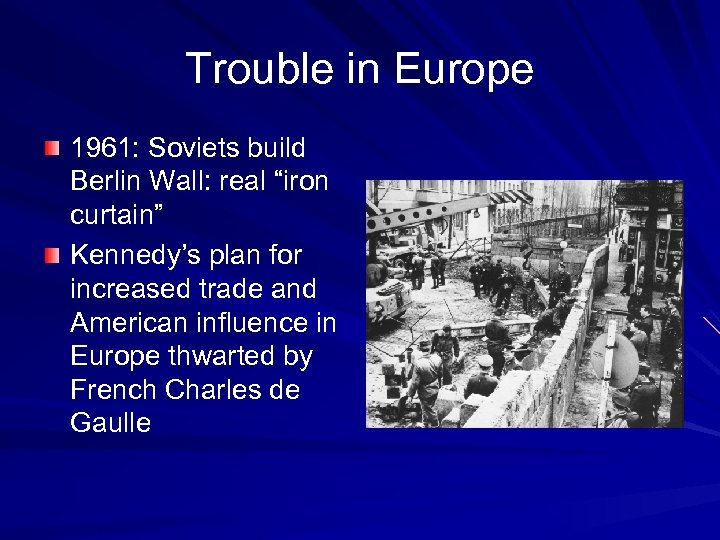 Trouble in Europe 1961: Soviets build Berlin Wall: real “iron curtain” Kennedy’s plan for increased trade and American influence in Europe thwarted by French Charles de Gaulle
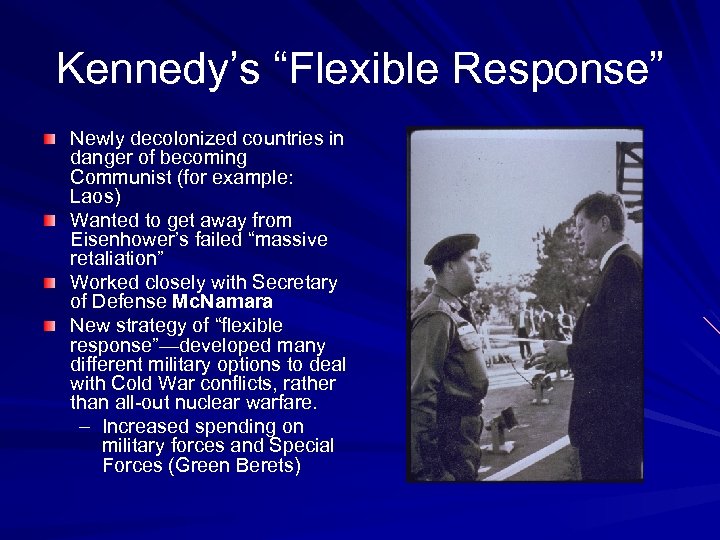 Kennedy’s “Flexible Response” Newly decolonized countries in danger of becoming Communist (for example: Laos) Wanted to get away from Eisenhower’s failed “massive retaliation” Worked closely with Secretary of Defense Mc. Namara New strategy of “flexible response”—developed many different military options to deal with Cold War conflicts, rather than all-out nuclear warfare. – Increased spending on military forces and Special Forces (Green Berets)
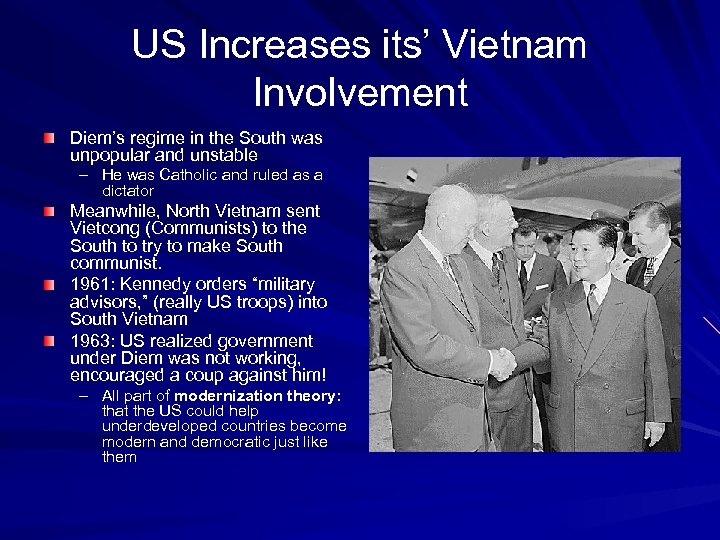 US Increases its’ Vietnam Involvement Diem’s regime in the South was unpopular and unstable – He was Catholic and ruled as a dictator Meanwhile, North Vietnam sent Vietcong (Communists) to the South to try to make South communist. 1961: Kennedy orders “military advisors, ” (really US troops) into South Vietnam 1963: US realized government under Diem was not working, encouraged a coup against him! – All part of modernization theory: that the US could help underdeveloped countries become modern and democratic just like them
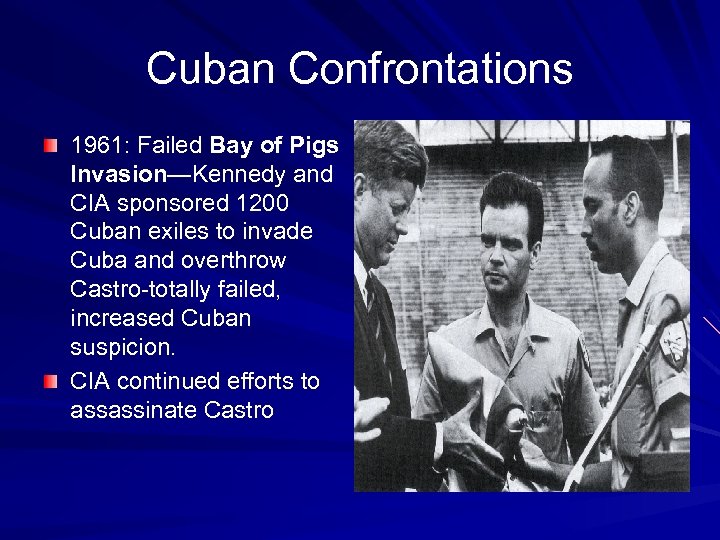 Cuban Confrontations 1961: Failed Bay of Pigs Invasion—Kennedy and CIA sponsored 1200 Cuban exiles to invade Cuba and overthrow Castro-totally failed, increased Cuban suspicion. CIA continued efforts to assassinate Castro
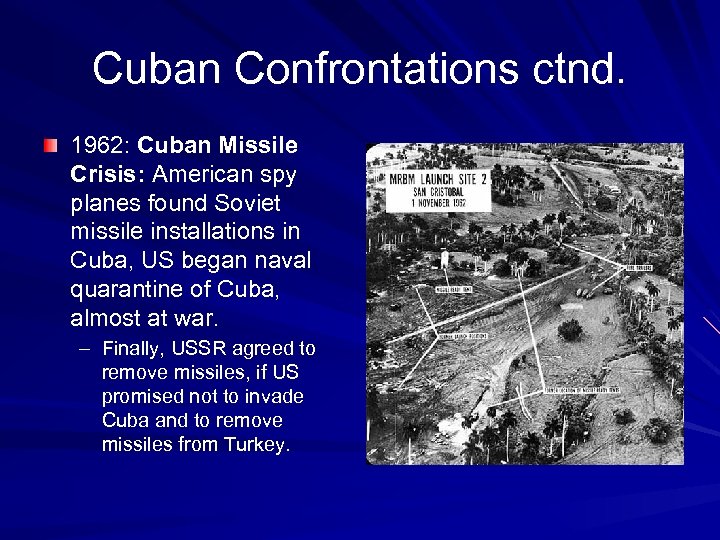 Cuban Confrontations ctnd. 1962: Cuban Missile Crisis: American spy planes found Soviet missile installations in Cuba, US began naval quarantine of Cuba, almost at war. – Finally, USSR agreed to remove missiles, if US promised not to invade Cuba and to remove missiles from Turkey.
 Implications of Cuban Missile Crisis Khrushchev discredited in USSR Countries do begin to “cool down”— entered into negotiations prohibiting nuclear test explosions. Kennedy began to speak of “peaceful coexistence” Beginnings of détente (relaxing of tensions)
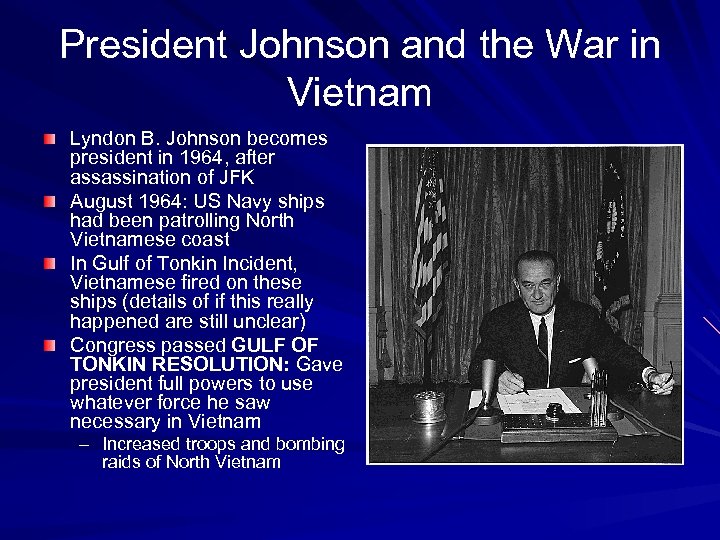 President Johnson and the War in Vietnam Lyndon B. Johnson becomes president in 1964, after assassination of JFK August 1964: US Navy ships had been patrolling North Vietnamese coast In Gulf of Tonkin Incident, Vietnamese fired on these ships (details of if this really happened are still unclear) Congress passed GULF OF TONKIN RESOLUTION: Gave president full powers to use whatever force he saw necessary in Vietnam – Increased troops and bombing raids of North Vietnam
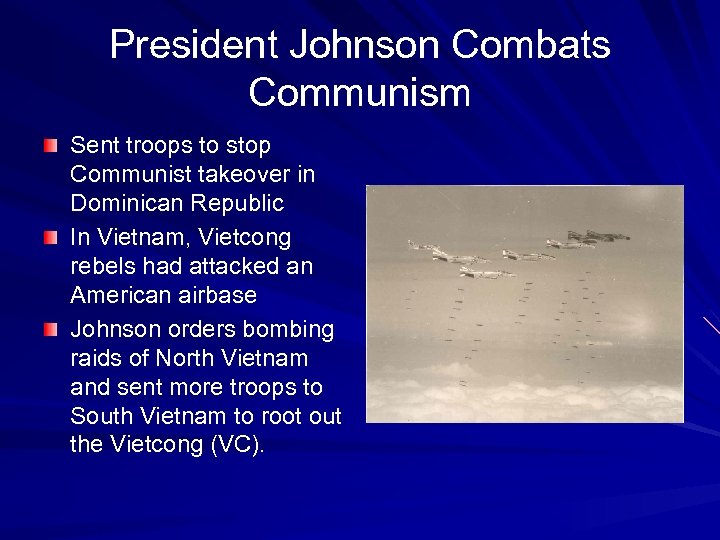 President Johnson Combats Communism Sent troops to stop Communist takeover in Dominican Republic In Vietnam, Vietcong rebels had attacked an American airbase Johnson orders bombing raids of North Vietnam and sent more troops to South Vietnam to root out the Vietcong (VC).
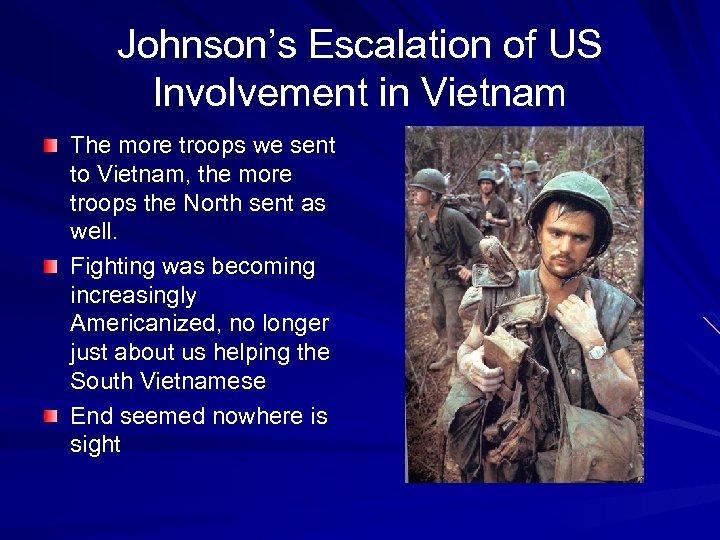 Johnson’s Escalation of US Involvement in Vietnam The more troops we sent to Vietnam, the more troops the North sent as well. Fighting was becoming increasingly Americanized, no longer just about us helping the South Vietnamese End seemed nowhere is sight
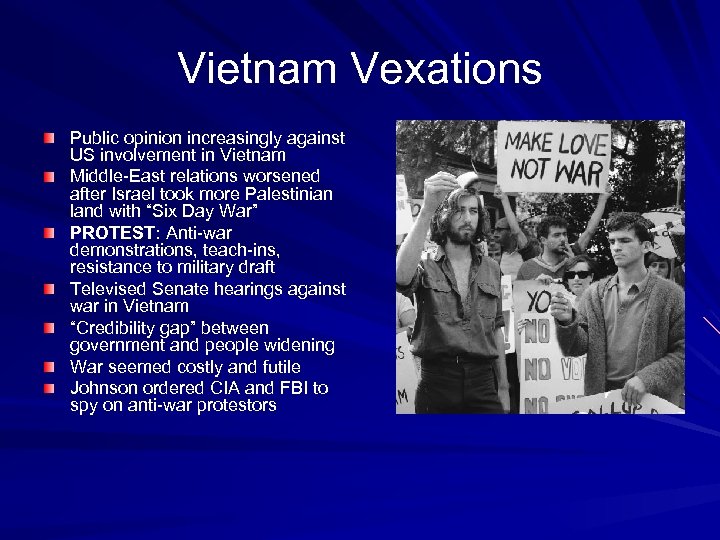 Vietnam Vexations Public opinion increasingly against US involvement in Vietnam Middle-East relations worsened after Israel took more Palestinian land with “Six Day War” PROTEST: Anti-war demonstrations, teach-ins, resistance to military draft Televised Senate hearings against war in Vietnam “Credibility gap” between government and people widening War seemed costly and futile Johnson ordered CIA and FBI to spy on anti-war protestors
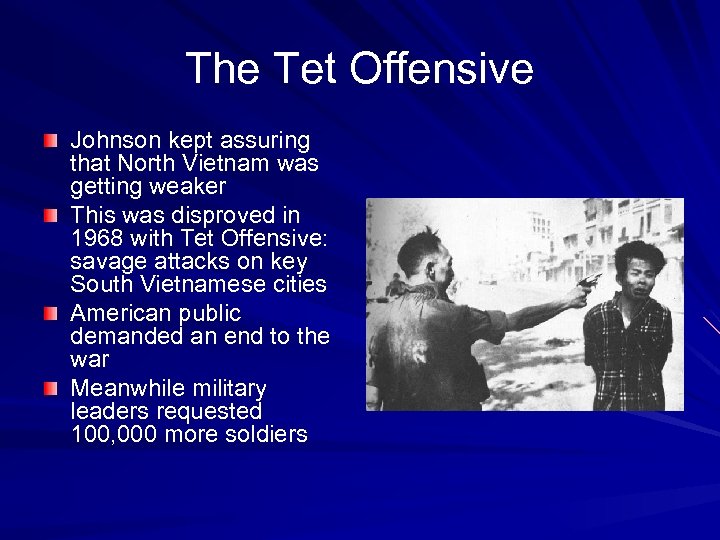 The Tet Offensive Johnson kept assuring that North Vietnam was getting weaker This was disproved in 1968 with Tet Offensive: savage attacks on key South Vietnamese cities American public demanded an end to the war Meanwhile military leaders requested 100, 000 more soldiers
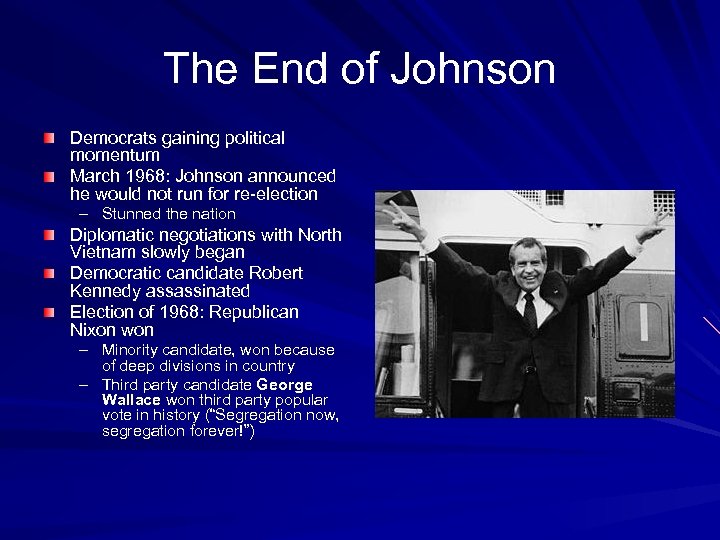 The End of Johnson Democrats gaining political momentum March 1968: Johnson announced he would not run for re-election – Stunned the nation Diplomatic negotiations with North Vietnam slowly began Democratic candidate Robert Kennedy assassinated Election of 1968: Republican Nixon won – Minority candidate, won because of deep divisions in country – Third party candidate George Wallace won third party popular vote in history (“Segregation now, segregation forever!”)