


 Скачать презентацию The Cold War Era Emergence of the
98edd75cffde89122fea7ebe8f776acd.ppt
- Количество слайдов: 66
 The Cold War Era
 Emergence of the Cold War • Initially blamed on the tensions created by Roosevelt/Truman, Churchill and Stalin at the end of WWII • Disagreements between Allies over previous agreements – Russia wanting permanent control over Poland Romania – US over German reparations to Russia
 US Inaction • US took no action to stop Soviets at the end of WWII – Reflected US peacetime plans and goals • • Self determination Autonomy Democracy Open Door Policy regarding economics – US Goals did create tension with the UK and France, but mostly the USSR • France saw rise of large Communist groups
 Soviet Perspective – Extending borders would give extra protection – Compensation for losses in WWII – Saw American resistance as a threat to their goals • Feb 1946 - Stalin and Molotov publicly declared the Western Democracies-enemies – Churchill responded with “Iron Curtain” speech • Warned against Communist threat • Urged unity in the West
 Containment 1947 - American policy of resisting the expansion of Soviet influence • Hope that the Soviet system would collapse – Forced America into overseas alliances • Supported anti-communist governments • Expend funds on military • Foreign Aid – Truman Doctrine • Support free peoples resisting communism – Funds to support Greece and Turkey
 Marshall Plan • Economic Aid plan to rebuild Western Europe – Created by George C Marshall – Only requirement to work together for mutual benefit • Invited the USSR and other communist governments • Finland, Czechoslovakia- willing to join • Poland, Hungary interested- USSR forbid them
 Soviet Domination • Soviets wanted control over E. Europe due to historical and ideological reasons – Napoleon and Crimean Wars – WWI and WWII • Tsars – controlled Poland until 19 th century – Crushed the Hungarian revolution in 1849 – Long history of desiring the Black sea region
 Stalin – Post WWII • 1947 - International meeting of all communist parties – Formed the Communist Information Bureau (Cominform) • Dedicated to spreading Communism world wide • Officially ended cooperation with noncommunist parties • February 1948 - Stalin expelled Democratic members of Hungary’s government – Included Jan Masaryk- son of Czech founder – President Benes forced to resign – Hungary completely controlled by Soviets • Required other E. Europe countries to follow – Caused by Josip Tito freeing Yugoslavia from the Soviets – Stalin wanted to stop other countries from following
 Post-War Germany • West and Soviets differed on postwar treatment and economic policy – Russia dismantled German industry in the East – Americans rebuilt industry in the West • Didn’t want to economically support Germany • No rebuild- chaos and communism – Soviets feared a strong Germany
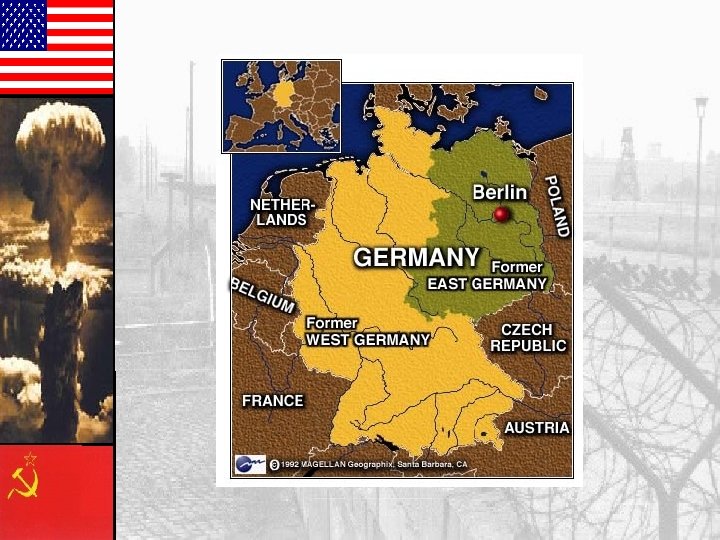
 Berlin Blockade • Feb 1948 - Soviets left joint Allied Control Commission • Summer 1948 - Allies issue new currency in western Berlin – Stronger than East German currency • Soviets seal off city access – Intent- drive Allies out of Berlin – US responded with 11 month airlift of supplies into Berlin • Incident increased tensions – Sped up official separation of Germany • West- German Federal Republic • East- German Democratic Republic • Berlin remained split between two sides
 NATO and Warsaw Pact • Marshall plan drew nations closer together – April 1949 - Western Europe, Canada, and US formed the North Atlantic Treaty Organization • Mutual assistance organization • US committed to defend allies outside of Western Hemisphere – 1949 Soviets and Eastern Europe • Form Council of Mutual Assistance (COMECON)integrate economies – May 1955 - Warsaw Pact • Formal recognition of Soviet control of Eastern Europe • Dominated by Red Army
 Creation of Israel • Middle East became hot spot during the Cold War – Controlled by Great Britain after WWI – Zionist groups • Originally created by Theodor Herzl – Arab Nationalists challenged British authorities • Balfour Declaration – 1917 - Arthur Balfour declared Britain favored creating a nation for Jews in Palestine – Between WWI- WWII- Jews immigrated to British-ruled Palestine • (Yishuv) – Created its own political, labor and education system • Arabs considered Jews intruders – WWII and the Holocaust- united Jews behind the Zionist cause
 Israel- U. N and Independence • 1947 - U. N. inherited Israel problem from the British – Divided Palestine- Jewish and Arab states – Arab states resisted • May 1948 – British withdrew from Palestine – May 14 - Israel declares independence • David Ben Gurion made first P. M. – Arab states invade • 1948 -49: Fighting between Arab-Israel – Israel expanded territory – Jerusalem divided – Peace = Armed Truce • Conflict drew in Superpowers – US made Israel ally – Soviets supported Arab nations
 Korean War • 1910 -1945: Korea controlled by Japan – US and USSR divided Korea at 38 th parallel, but eventually would be united • 1948 - Two separate states – Democratic People’s Republic- Supported by USSR – Republic supported by US • June 1950: N. Korea invades S. Korea – US intervened, U. N sent other nations (Soviets boycotted the UN during the key vote) • Seen as another attempt at containment • Late 1950 - Chinese sent troops to support N. Korea – US retreated – US saw Chinese as Soviet controlled, not independent nation (1949 - China became communist under Mao Tse Tung) • June 1953 - Eisenhower administration – Signed Armistice- ended fighting, not war
 Shifting Times • 1953 - Stalin dies, replaced by Nikita Khrushchev • 1955 - Soviets leave Austria- Austria declares neutrality
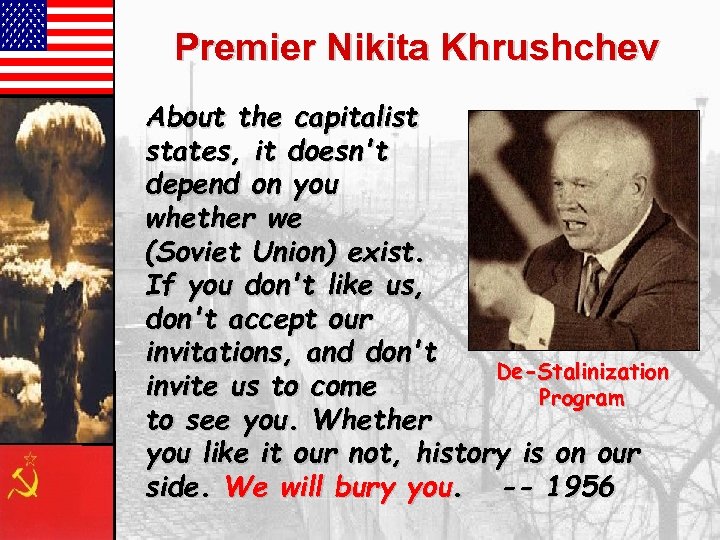 Premier Nikita Khrushchev About the capitalist states, it doesn't depend on you whether we (Soviet Union) exist. If you don't like us, don't accept our invitations, and don't De-Stalinization invite us to come Program to see you. Whether you like it our not, history is on our side. We will bury you. -- 1956
 Khrushchev Domestic Policies • 1953 -64 - retreat from Stalinism – Wanted to reform Soviet system – Intellectuals freer • Solzhenitsyn (One Day in the Life of Ivan Denisovich) – Reformed economy • More consumer goods, • Removed restrictions on agriculture – Reforms caused grain shortage • 1956 - Secret Speech – Attacked policies of Stalin and the crimes of purges – Started to remove Stalinist officials – Seen by E. European leaders as easing of restrictions
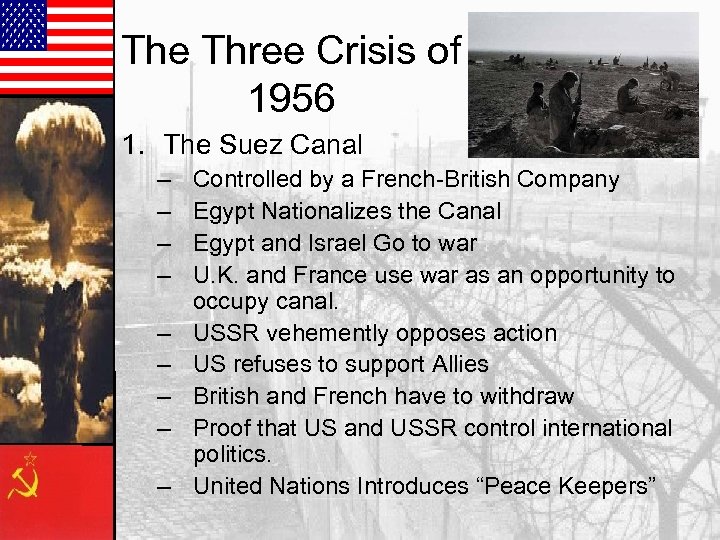 The Three Crisis of 1956 1. The Suez Canal – – – – – Controlled by a French-British Company Egypt Nationalizes the Canal Egypt and Israel Go to war U. K. and France use war as an opportunity to occupy canal. USSR vehemently opposes action US refuses to support Allies British and French have to withdraw Proof that US and USSR control international politics. United Nations Introduces “Peace Keepers”
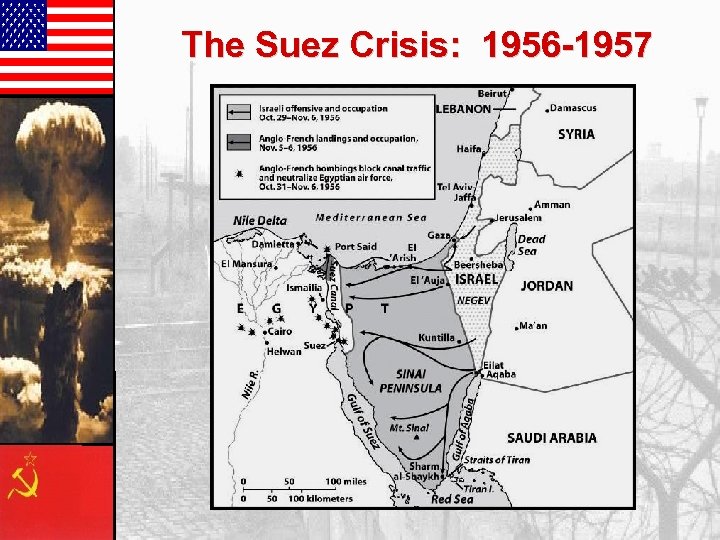 The Suez Crisis: 1956 -1957
 2. Poland Strives for Independence 1956 • • • Puppet Prime Minister Dies Lack of consumer goods lead to uprisings Poland refuses to ascend Soviet nominee Poland elect their own candidate, Gomulka Soviets approve after Gomulka agrees to cooperate with USSR • Maintained military alliances but modifies economic policy • Improves Relationship with R. C. C. • Russia mobilizes troops at the boarder but Gomulka reassures Khrushchev of his good intentions
 Hungarian Uprising 1956 • Gomulkan Reforms Spread to Hungary • Student Demonstration in Budapest escalates into revolution • Imre Nagy put in power, wants more independence for Hungary • Soviets invade and execute Nagy • The USSR and USA are the Hegemonic powers of the world.
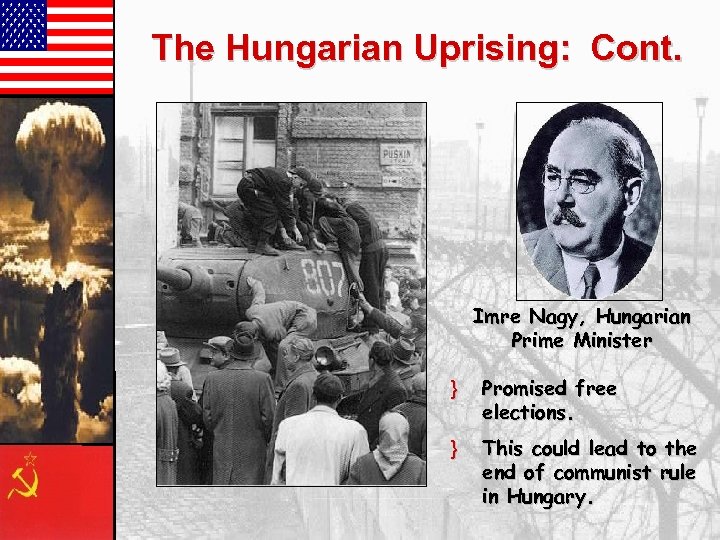 The Hungarian Uprising: Cont. Imre Nagy, Hungarian Prime Minister } Promised free elections. } This could lead to the end of communist rule in Hungary.
 Space Race • United States and The Soviet Union compete to explore space – Origins in Military Rockets (German V 2) – The ability to deliver Nuclear Warheads drive the race (Intercontinental Ballistic Missiles) ICBM – Also opportunity for espionage • Russians take the early Lead
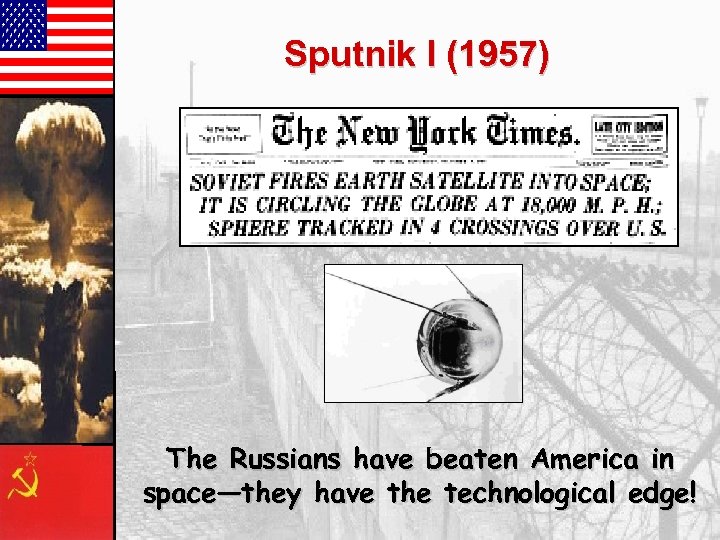 Sputnik I (1957) The Russians have beaten America in space—they have the technological edge!
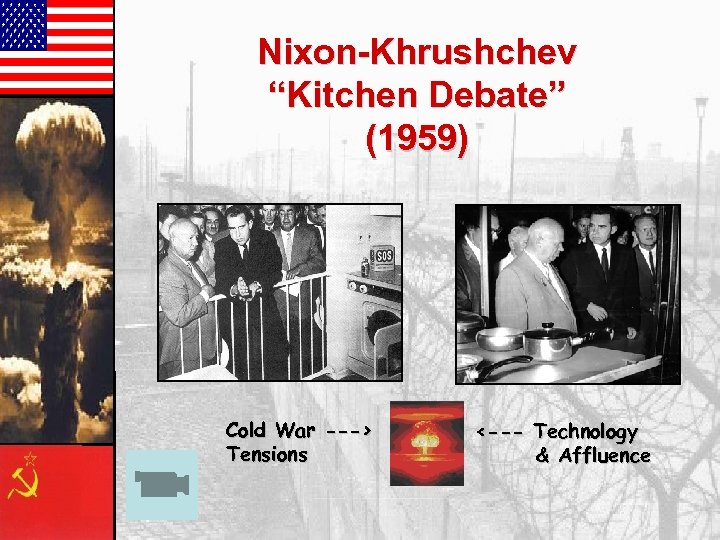 Nixon-Khrushchev “Kitchen Debate” (1959) Cold War ---> Tensions <--- Technology & Affluence
 1959 • Cuba falls to Communism – Rebels under Fidel Castro overthrew Batista’s government – Seen as a failure in containment of Communism
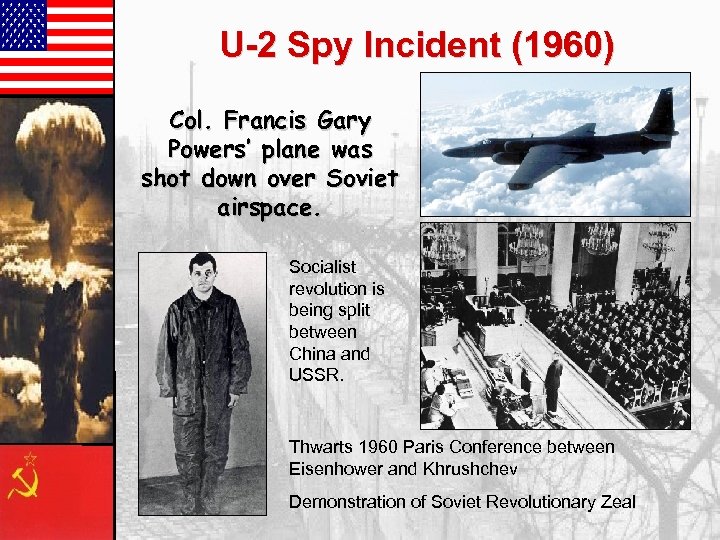 U-2 Spy Incident (1960) Col. Francis Gary Powers’ plane was shot down over Soviet airspace. Socialist revolution is being split between China and USSR. Thwarts 1960 Paris Conference between Eisenhower and Khrushchev Demonstration of Soviet Revolutionary Zeal
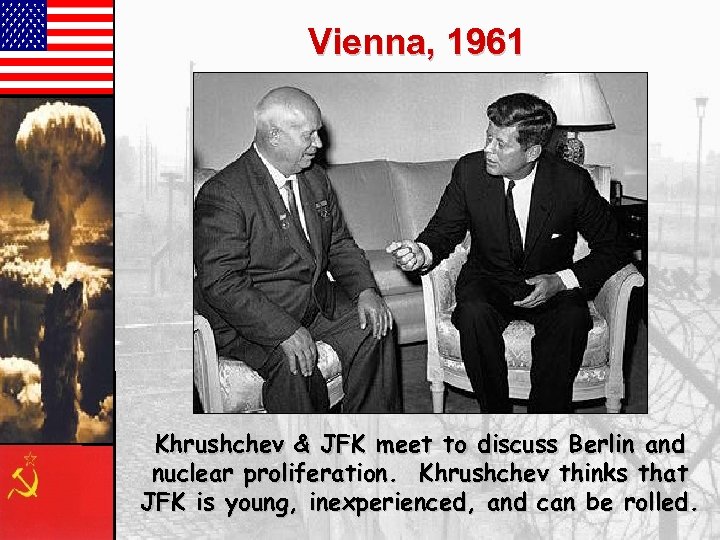 Vienna, 1961 Khrushchev & JFK meet to discuss Berlin and nuclear proliferation. Khrushchev thinks that JFK is young, inexperienced, and can be rolled.
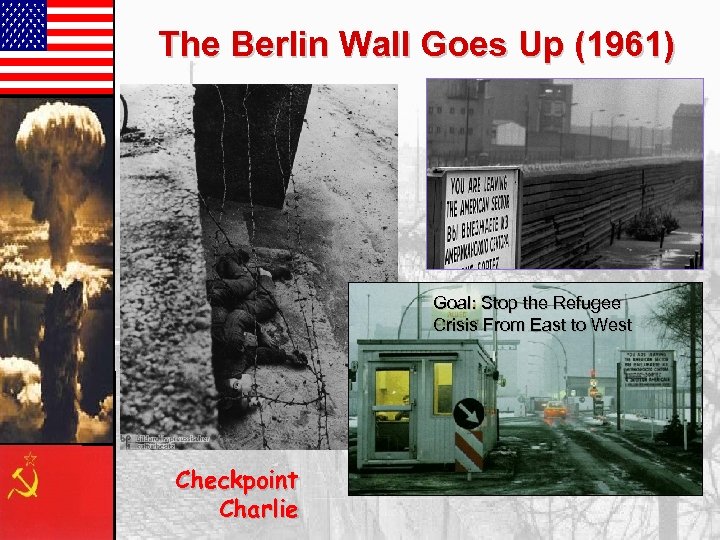 The Berlin Wall Goes Up (1961) Goal: Stop the Refugee Crisis From East to West Checkpoint Charlie
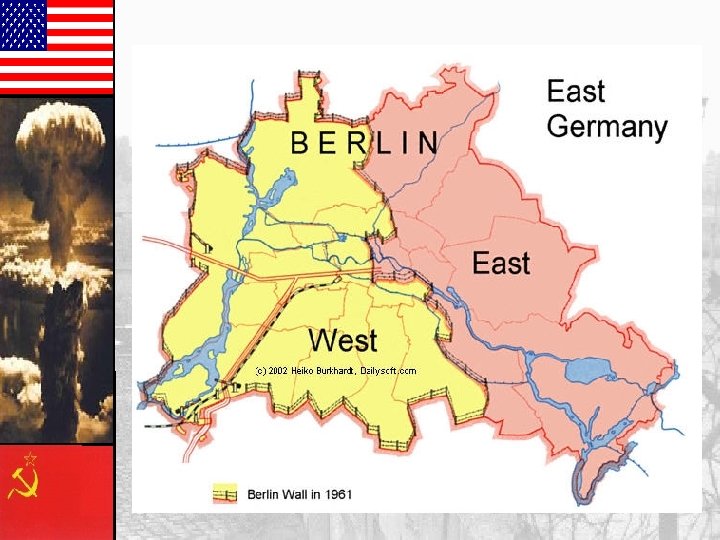
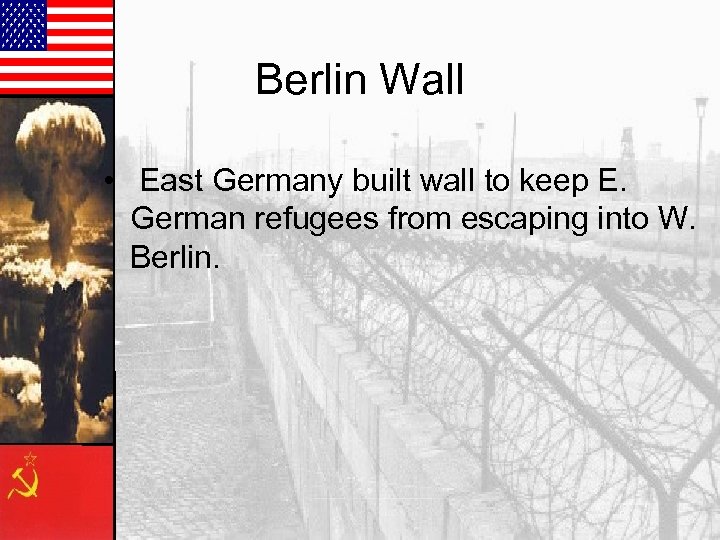 Berlin Wall • East Germany built wall to keep E. German refugees from escaping into W. Berlin.
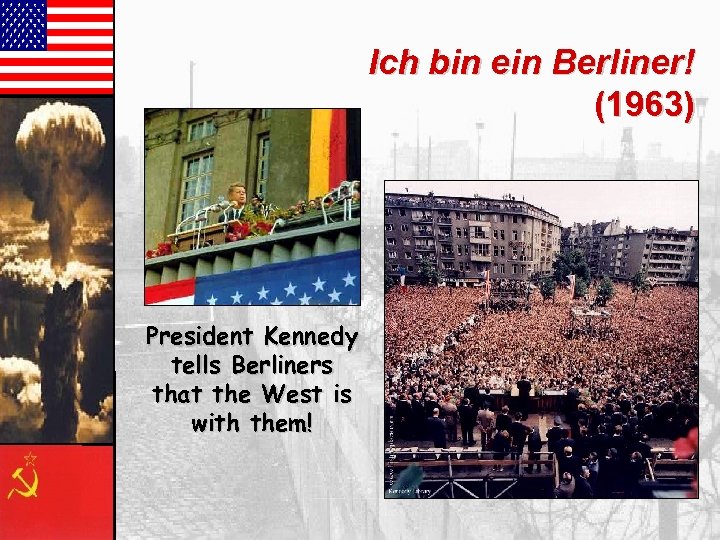 Ich bin ein Berliner! (1963) President Kennedy tells Berliners that the West is with them!
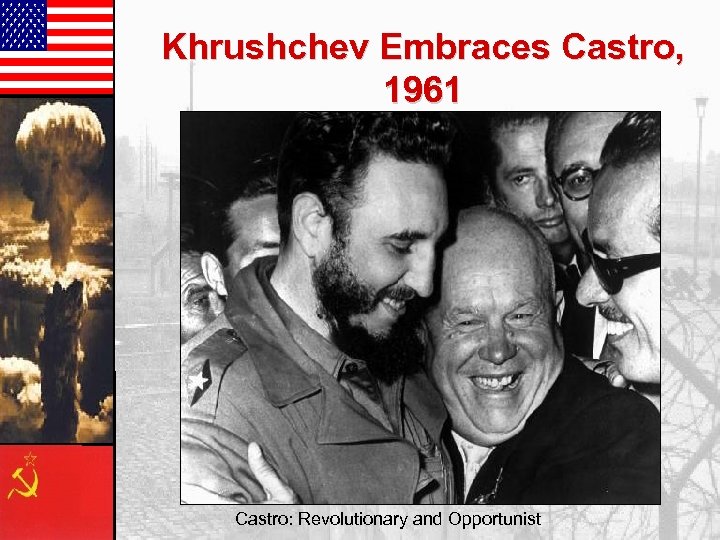 Khrushchev Embraces Castro, 1961 Castro: Revolutionary and Opportunist
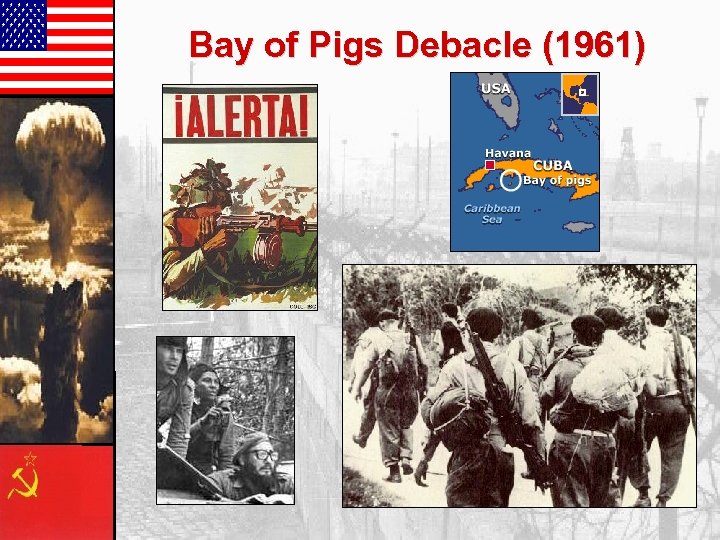 Bay of Pigs Debacle (1961)
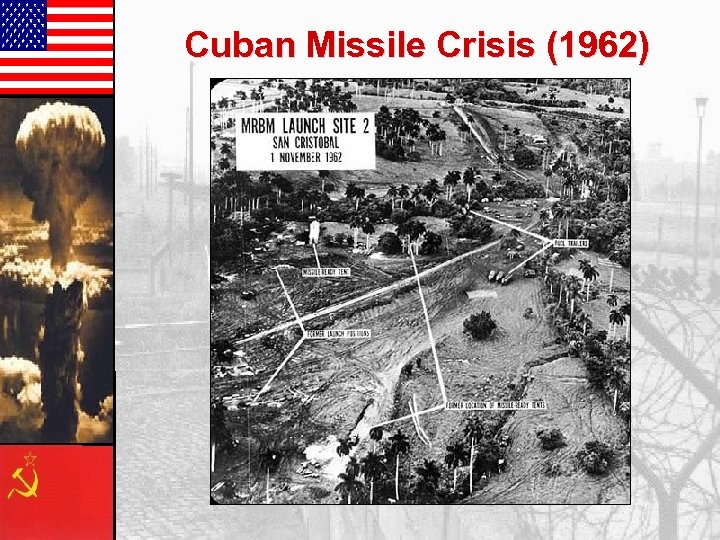 Cuban Missile Crisis (1962)
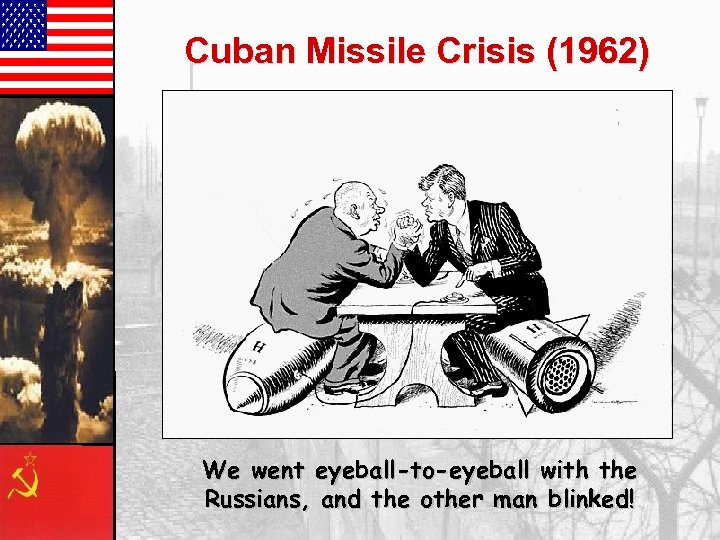 Cuban Missile Crisis (1962) We went eyeball-to-eyeball with the Russians, and the other man blinked!
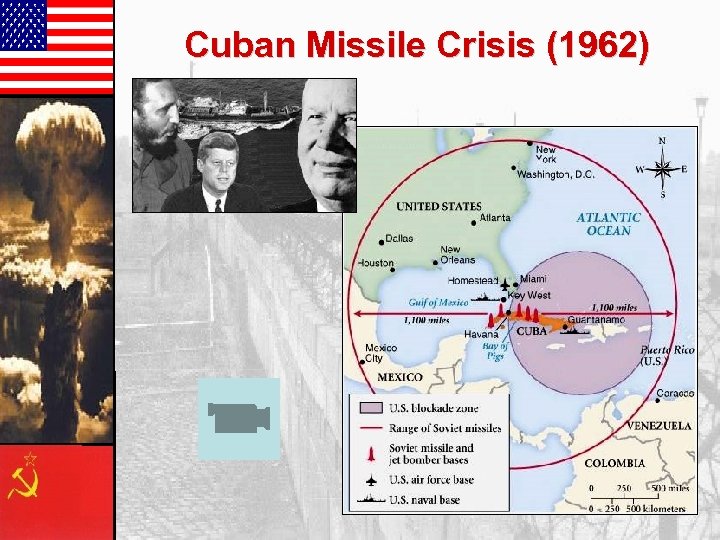
 Cuban Missile Crisis • 1962 - Soviets secretly began placing missiles in Cuba – Kennedy blockaded Cuba, demanded missiles removed • Closest two nations came to nuclear war • Soviets backed down – Undermined Khrushchev’s administration • Increased China’s status among other Communist countries • Last major Cold War threat to Europe • 1963 - US and Soviets sign nuclear test ban treaty
 Cuban Missile Crisis (1962)
 Radio Free Europe/Radio Liberty
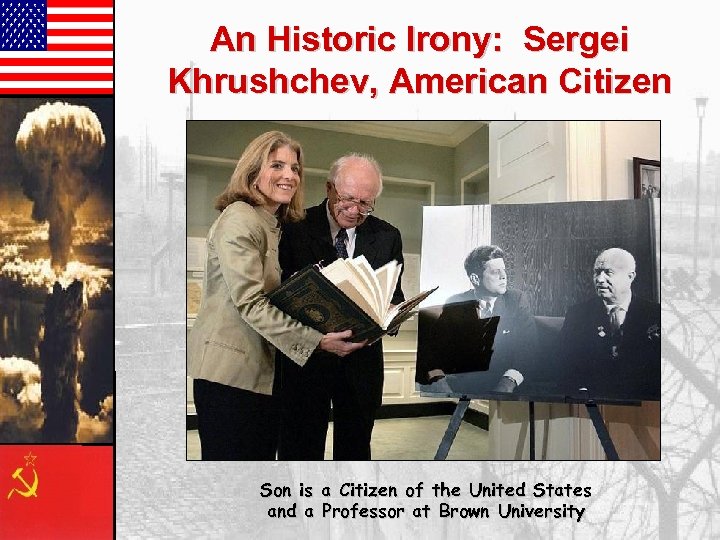 An Historic Irony: Sergei Khrushchev, American Citizen Son is a Citizen of the United States and a Professor at Brown University
 Cold War: Brezhnev and Gorbachev • Supreme Soviet from 1964 -1982 • Invasion of Czechoslovakia 1968 – Remembered as the Prague Spring – Dubcek experiments with liberal communism – USSR and allies invade an promote the pro-Moscow Husak – He reversed all of Ducek’s reforms • The Brezhnev Doctrine: USSR will intervene in all communist countries in the name of preserving the revolution • Brezhnev Stagnation: Economic Recession, Ignored
 US Soviet Relations: Détente 1964 -1980 • Brezhnev attempts to reach out to Americans, while promoting socialist expansion • Period characterized by a reduction in arms and the understanding of spheres of influence • Helsinki Accords: Supported by NATO, recognized Human Rights • USSR and US continue to promote their agendas around the world • Arms Race Continues • USSR has largest military force in the world, and nuclear parity with the US • Relations deteriorate after USSR invades Afghanistan. • US Boycotts Soviet Olympics(1980), provides aid and arms to the Taliban.
 Poland Solidarity • Country suffered under Soviets – Food shortages – Economic mismanagement • 1978 - Pope John Paul II- advocate of Polish resistance, • 1980 - Food prices raised – Causes strikes • August 14 - Shipyard strike in Gdansk – Led by Lech Walesa, strikers refused to negotiate • Wanted independent union (Solidarity) • By Sept- Head of Communist party replaced – Solidarity made independent • 1981 - Secret elections allowed with real choices for party congress, allowed debate – New freedoms crushed by General Wojciech Jaruzelski • Martial law declared- until 1983 • Solidarity leaders arrested
 Reagan and Gorbachev • Reagan puts pressure on the Soviets • Increases defense spending and develops “Star Wars” • Communist economic problems plague the eastern bloc (Poland) • Gorbachev and Perestroika – – – Attempt at Economic Revival Glasnost: A Communist Debate Easing of political and economic restrictions 1989 New Constitution and Elections Gorbachev’s economic policies fail but he opens the door future democracy. – Brandenburg Gate Speech
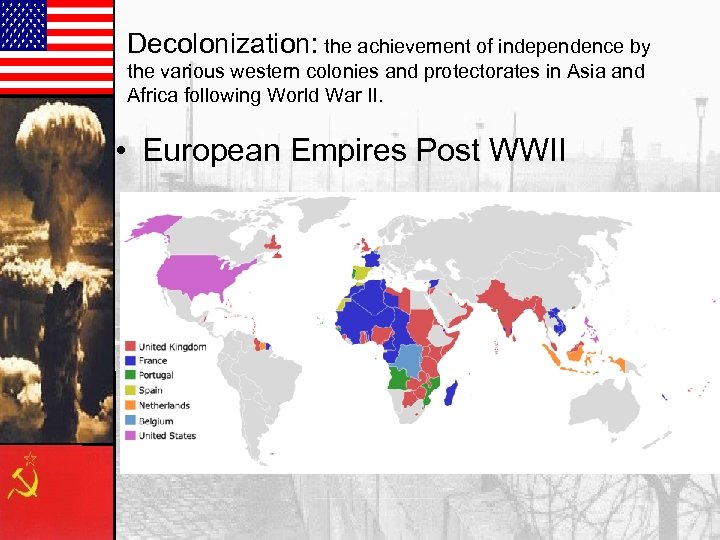 Decolonization: the achievement of independence by the various western colonies and protectorates in Asia and Africa following World War II. • European Empires Post WWII
 India • British had controlled India directly since 1858 – Required Indians to pay for British rule – Indian cotton went to British textile mills, to be sold back to India – Caused widespread Indian migration to other parts of the British Empire • 1885 - Indian National Congress (Hindu) – Goals- modernize India, liberalize British policy • 1887 - Muslim League – Wanted independent Muslim nation • Indian nationalism grew after WWI
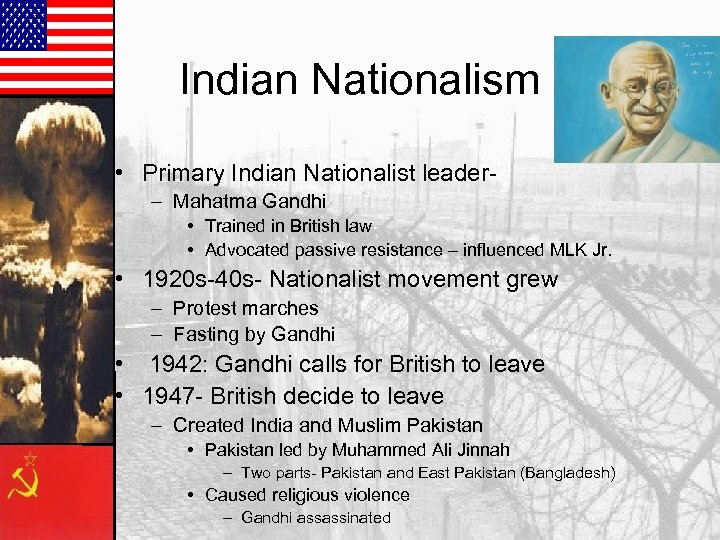 Indian Nationalism • Primary Indian Nationalist leader– Mahatma Gandhi • Trained in British law • Advocated passive resistance – influenced MLK Jr. • 1920 s-40 s- Nationalist movement grew – Protest marches – Fasting by Gandhi • 1942: Gandhi calls for British to leave • 1947 - British decide to leave – Created India and Muslim Pakistan • Pakistan led by Muhammed Ali Jinnah – Two parts- Pakistan and East Pakistan (Bangladesh) • Caused religious violence – Gandhi assassinated
 British Empire shrinks • Costs of Empire too high • Wanted to create self-government in former colonies – 1948 - Burma and Sri Lanka became independent – 1950 s- British prepared African colonies for independence • Ghana first • Some peaceful withdrawals, others under nationalist pressure – Cyprus, Kenya and Yemen
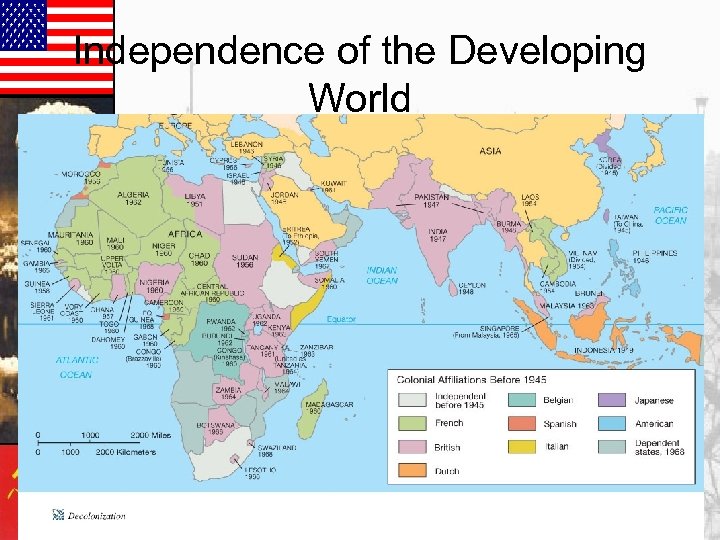 Independence of the Developing World
 France and Algeria • France in Algeria since 1830 under Charles X – 1848 - made part of France – Thousands of French settled in Algeria – Government rigged to give French settlers as much power as natives • WWI- France gives Algerians full citizenship • WWII- Free France controlled Algeria – Bloody riot at the end of the war, led France to repress Muslims – Seen as Algerian “Bloody Sunday” – Start of pro-Algerian independence movement • After WWII – France attempted to give more representation to Muslims • 1954 - National Liberation Front founded – Fighting and civil war broke out until 1962 – Divided France
 De Gaulle and Algeria • 1958 – De Gaulle becomes President – End of 4 th Republic – New constitution – Start of 5 th Republic • Started retreat from Algeria – Long process, lots of violence • 1962 - Algeria becomes independent – FLN takes over- led by Mohammed Ben Bella • French settlers and Pro-French Muslims fled Algeria – Those who stayed- massacred
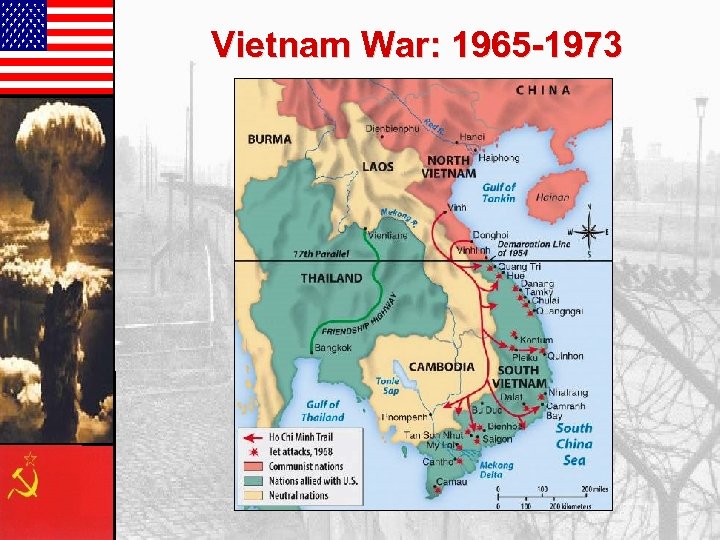 Vietnam War: 1965 -1973
 Vietnam War 1959 -1973 • French – Second Indochina War – Democratic Republic of Vietnam (Communist) v. Republic of Vietnam (US Supported) – French ask for US support in finance and small arms – French are defeated at the Battle of Dien Bien Phu. – As part of the Geneva Convention, Laos Cambodia and Vietnam are given independence. – Vietnam was partitioned temporarily at the 17 th parallel. – Political turmoil ensues
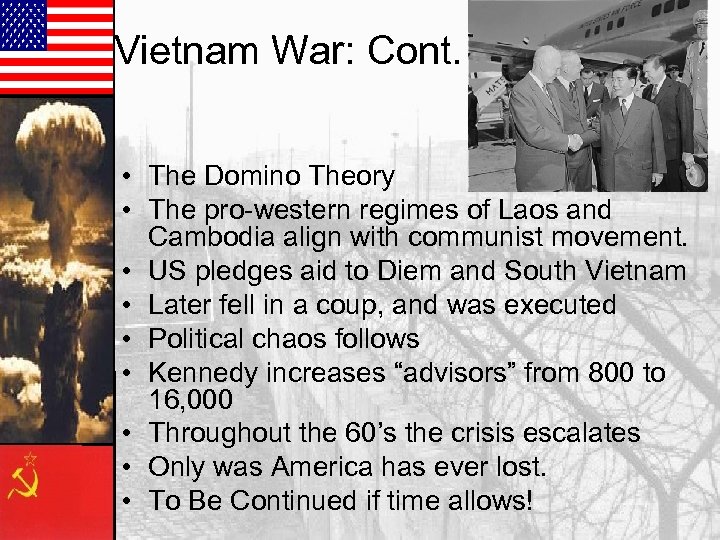 Vietnam War: Cont. • The Domino Theory • The pro-western regimes of Laos and Cambodia align with communist movement. • US pledges aid to Diem and South Vietnam • Later fell in a coup, and was executed • Political chaos follows • Kennedy increases “advisors” from 800 to 16, 000 • Throughout the 60’s the crisis escalates • Only was America has ever lost. • To Be Continued if time allows!
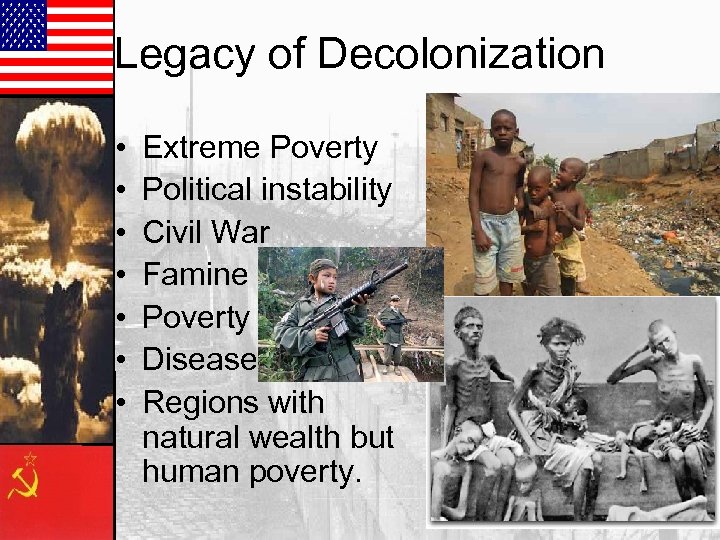 Legacy of Decolonization • • Extreme Poverty Political instability Civil War Famine Poverty Disease Regions with natural wealth but human poverty.
 The World’s Most Underdeveloped Nations
 The End of The Cold War: Revolutions in Eastern Europe • Poland: – The Elections of 1989 end the dominance of the Communist Party – Gorbachev approves the Solidarity Parties nominee
 • Hungary: 1989, opened its border with Austria – Mass exodus of East Germans – Democratic elections by October • Romania: 1989 Violent Revolution • Gorbachev Renounces the Brezhnev Doctrine
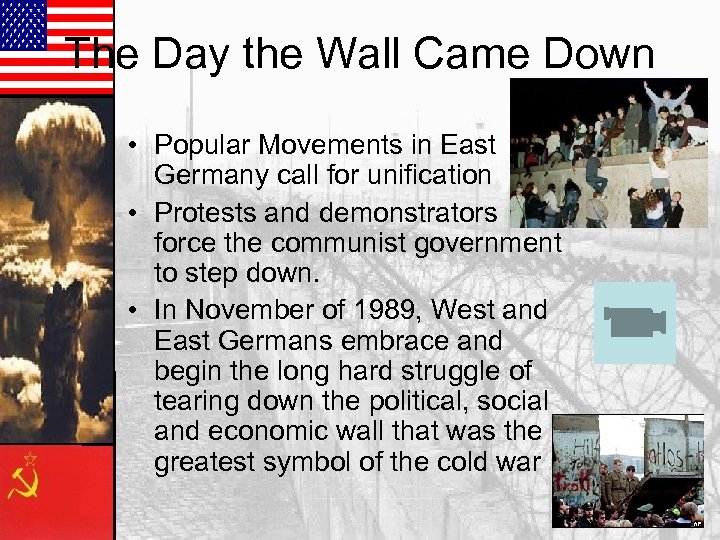 The Day the Wall Came Down • Popular Movements in East Germany call for unification • Protests and demonstrators force the communist government to step down. • In November of 1989, West and East Germans embrace and begin the long hard struggle of tearing down the political, social and economic wall that was the greatest symbol of the cold war
 The Fall of the USSR • • Gorbachev recognizes the need for reform Eliminates the Single Party State Republics wage a “War of Laws” Gorbachev allies with the conservatives, Bad Move! August 1991 the Conservatives attempt a coup and place Gorbachev under house arrest. The People Speak: the largest protest in the History of Russia, The Communist Party disintegrates Yeltsin gains favor December 1991, under a revised constitution the Soviet Union ceases to exist: The Cold War is Over!
 Yeltsin and Putin • Yeltsin- First president of Russia – Opposed by Parliament • 1993 -He suspended it – Parliament tried to lead uprisings – Military supported Yeltsin • Oct 4 1993 - Yeltsin ordered tanks to stop rioters- established his authority – West supported him • December 1993 - New constitution • 1994 - War with Islamic province of Chechnya • 1990 s – Process of dismantling Soviet economy and government – Created small groups of very rich individuals • 1998 - Yeltsin replaced by Vladimir Putin – Renewed war on Chechnya – Supported US in Afghanistan in 2001 – Has sought to regain central control over independent states
 End of Yugoslavia • Created after WWI as a multi-ethnic nation • Controlled by Josif Tito from 1940 s to 1980 – Dictator, cult of personality – After death, country fell into civil war • 1980 s- Ethnic tensions erupted – Milosevic- Serbian leader – Tudjman- Croatian leader – Both nations declared independence in 1990 • Ethnic violence increased, especially over Bosnia-Hezegovina – Serbs practiced “ethnic cleansing” • 1995 - NATO forces carried out air strikes to end the war – Bosnia declared independent • 1999 - NATO sent in troops to protect Kosovo to protect ethnic Albanians • 2000 - Milosevic overthrown and arrested
 Radical Political Islam • Sept 11 2001 - Terrorist Attack – Beginning of “War on Terror” by US – Radical Islam- Interpretation of Islam with a radical anti-Western perspective
 Arab Nationalism • Add your own notes – What is Arab Nationalism? – Where did it begin? – Who supports it now?
 Iranian Revolution and Afghanistan • Group Notes in Class- In Theory