


 Скачать презентацию The Cold War A 28 7 4 2
461656d56933274426d580a615a02708.ppt
- Количество слайдов: 47
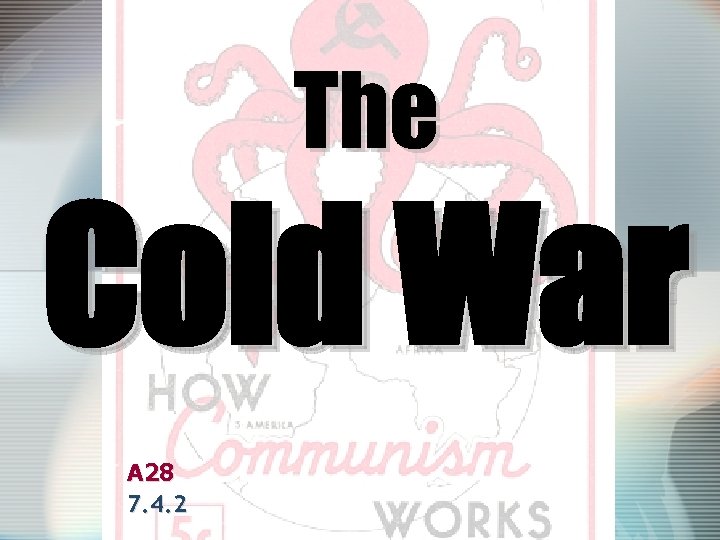 The Cold War A 28 7. 4. 2
 GUIDING QUESTION Why did relations between the United States and the Soviet Union devolve into a Cold War after the Second World War?
 GUIDING QUESTION Analyze the success and failures of the United States Cold War policy of containment during the period 1945 -1953 in the following: l Europe, Asia, Middle East, Latin America.
 ORIGINS OF THE COLD WAR War Aims and Postwar Diplomacy
 ORIGINS OF THE COLD WAR l Basic incompatibility of economic and political systems l History of discord and mistrust l l l Western response to Bolshevik Revolution US recognition of the Soviet Union Nazi-Soviet Nonaggression Pact
 ORIGINS OF THE COLD WAR l WWII Alliance of Britain and U. S. with Soviet Union was pragmatic “marriage of convenience” to defeat Germany 1. Lack of trust of Stalin. l l unified wartime command atomic bomb 2. Soviets believed western allies not sharing load 3. Soviet mistreatment of eastern Europeans during WWII
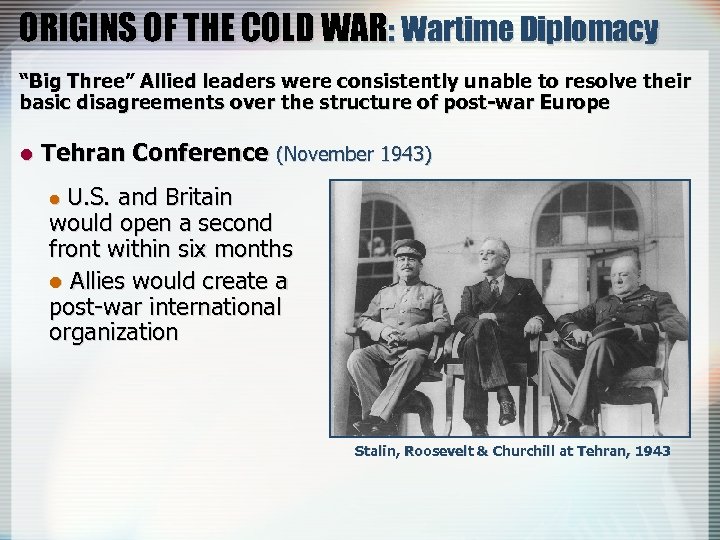 ORIGINS OF THE COLD WAR: Wartime Diplomacy “Big Three” Allied leaders were consistently unable to resolve their basic disagreements over the structure of post-war Europe l Tehran Conference (November 1943) U. S. and Britain would open a second front within six months l Allies would create a post-war international organization l Stalin, Roosevelt & Churchill at Tehran, 1943
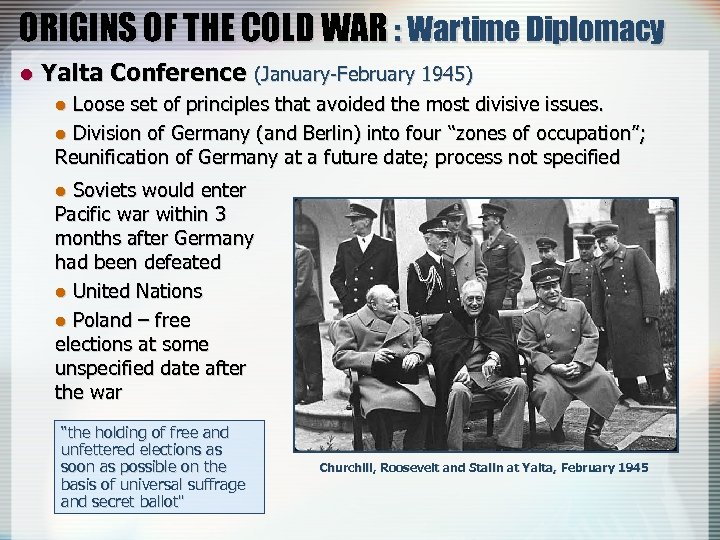 ORIGINS OF THE COLD WAR : Wartime Diplomacy l Yalta Conference (January-February 1945) l Loose set of principles that avoided the most divisive issues. l Division of Germany (and Berlin) into four “zones of occupation”; Reunification of Germany at a future date; process not specified Soviets would enter Pacific war within 3 months after Germany had been defeated l United Nations l Poland – free elections at some unspecified date after the war l “the holding of free and unfettered elections as soon as possible on the basis of universal suffrage and secret ballot" Churchill, Roosevelt and Stalin at Yalta, February 1945
 ORIGINS OF THE COLD WAR : Wartime Diplomacy l San Francisco Conference - United Nations Formed (April 1945) l Security Council l l 11 members Permanent seats with veto power for U. S. , Britain, France, China and USSR l General Assembly l Secretariat l Secretary-General l International Court of Justice
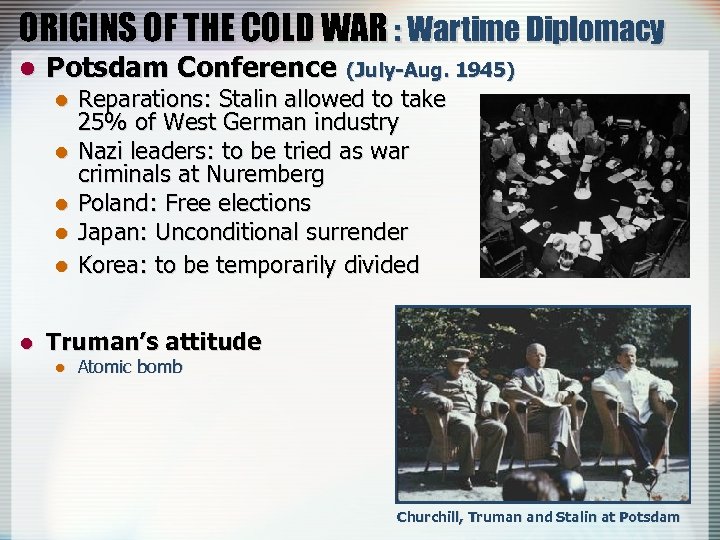 ORIGINS OF THE COLD WAR : Wartime Diplomacy l Potsdam Conference (July-Aug. 1945) l l l Reparations: Stalin allowed to take 25% of West German industry Nazi leaders: to be tried as war criminals at Nuremberg Poland: Free elections Japan: Unconditional surrender Korea: to be temporarily divided Truman’s attitude l Atomic bomb Churchill, Truman and Stalin at Potsdam
 ORIGINS OF THE COLD WAR: Causes of Cold War l Soviets the main cause (Original U. S. view) l l Aggressive policies of expansion (in eastern Europe) and violation of Yalta agreements U. S. the main cause (Revisionist interpretation) l By insisting that entire world be open to American trade and influence (capitalist expansionism & internationalism) l Neither/Both the cause (post-revisionist l Could the Cold War have been avoided? How? interpretation) l Two most powerful nations in world bound to clash l Through ignorance and misconceptions, both countries helped to create an atmosphere of tension and suspicion that touched off the Cold War
 TRUMAN AND CONTAINMENT IN EUROPE
 GUIDING QUESTION Analyze the success and failures of the United States Cold War policy of containment during the period 1945 -1953 in Europe.
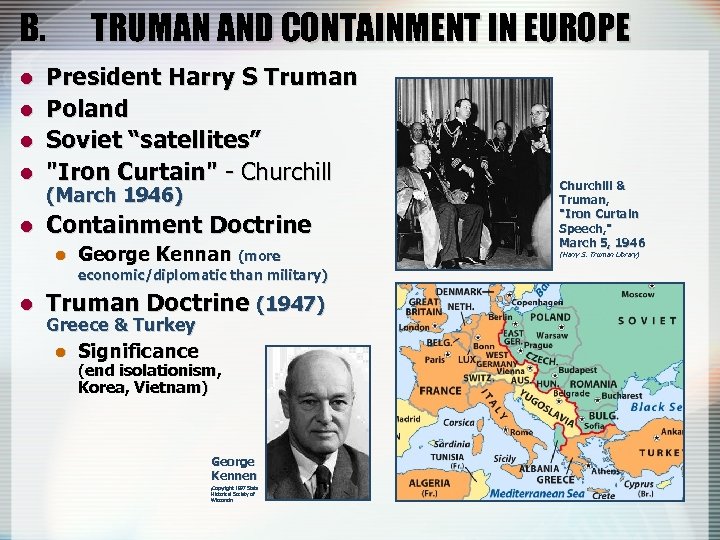 B. TRUMAN AND CONTAINMENT IN EUROPE President Harry S Truman l Poland l Soviet “satellites” l "Iron Curtain" - Churchill l (March 1946) l Containment Doctrine l l George Kennan (more economic/diplomatic than military) Truman Doctrine (1947) Greece & Turkey l Significance (end isolationism, Korea, Vietnam) George Kennen Copyright 1997 State Historical Society of Wisconsin ( Churchill & Truman, "Iron Curtain Speech, " March 5, 1946 (Harry S. Truman Library)
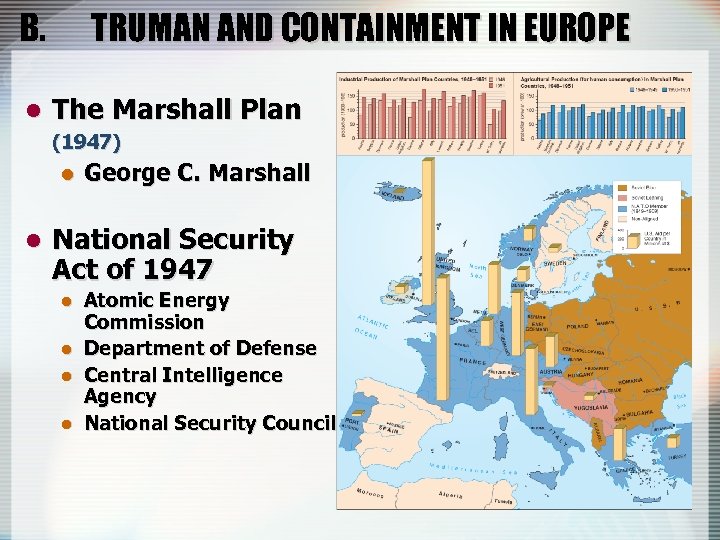 B. l TRUMAN AND CONTAINMENT IN EUROPE The Marshall Plan (1947) l l George C. Marshall National Security Act of 1947 l l Atomic Energy Commission Department of Defense Central Intelligence Agency National Security Council
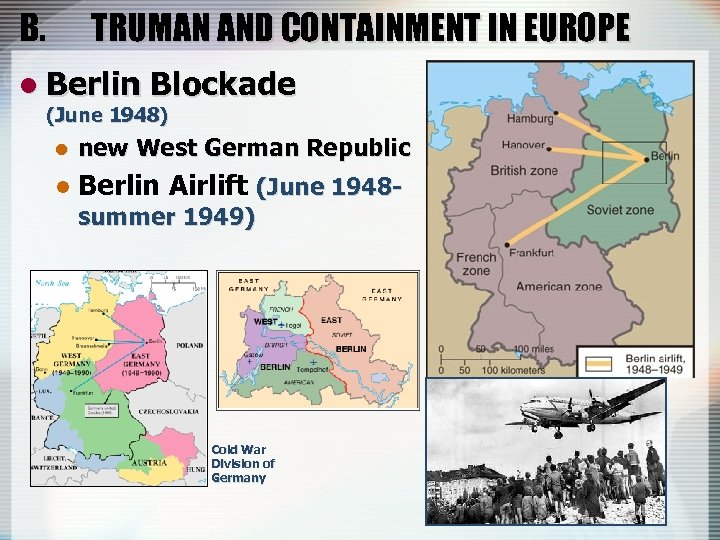 B. TRUMAN AND CONTAINMENT IN EUROPE l Berlin Blockade (June 1948) l new West German Republic l Berlin Airlift (June 1948 summer 1949) Cold War Division of Germany
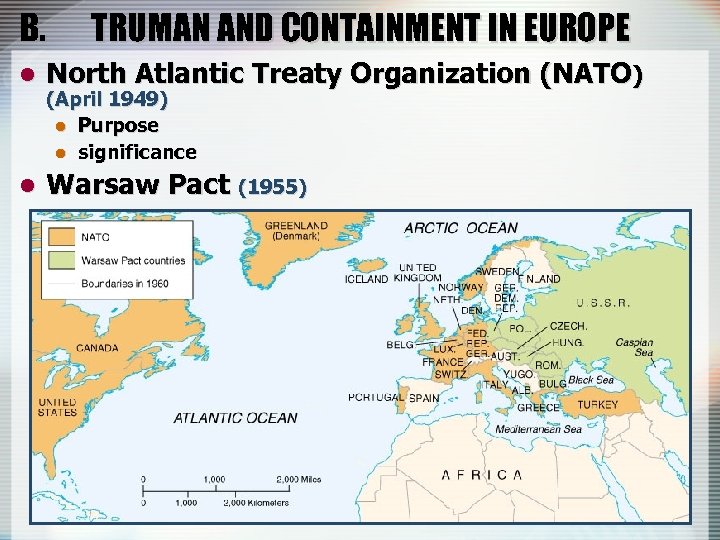 B. TRUMAN AND CONTAINMENT IN EUROPE l North Atlantic Treaty Organization (NATO) l Warsaw Pact (1955) (April 1949) l Purpose l significance
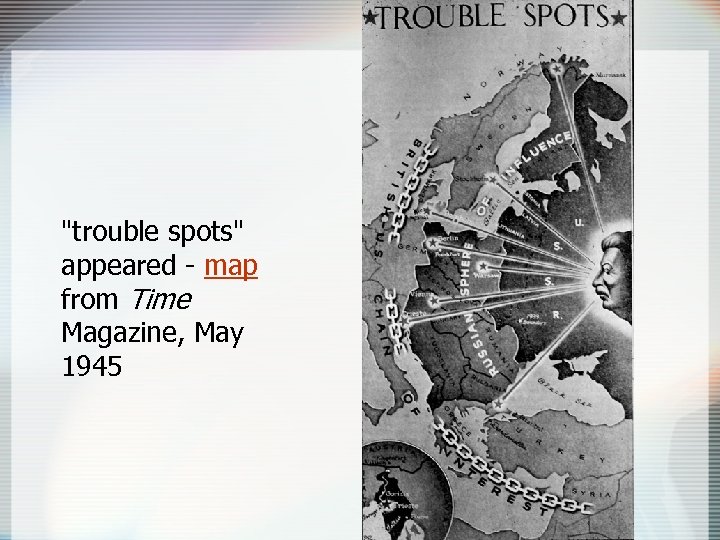 "trouble spots" appeared - map from Time Magazine, May 1945
 THE COLD WAR IN ASIA 1949 -1954
 GUIDING QUESTION Analyze the success and failures of the United States Cold War policy of containment during the period 1945 -1953 in Asia.
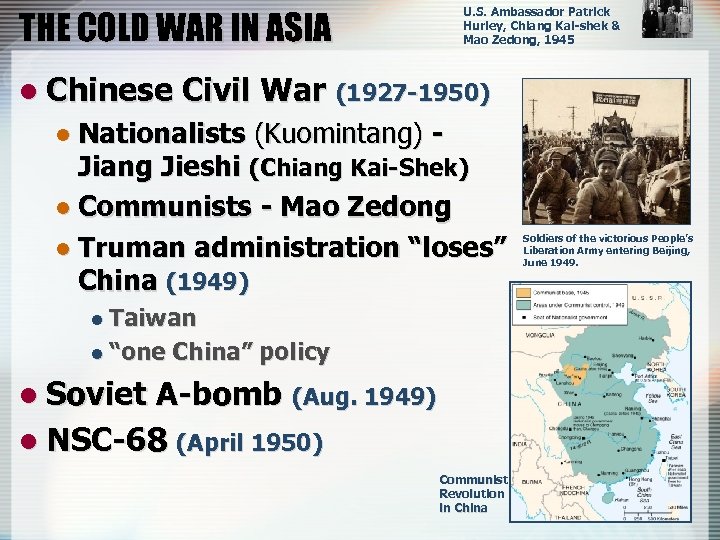 U. S. Ambassador Patrick Hurley, Chiang Kai-shek & Mao Zedong, 1945 THE COLD WAR IN ASIA l Chinese Civil War (1927 -1950) l Nationalists (Kuomintang) - Jiang Jieshi (Chiang Kai-Shek) l Communists - Mao Zedong l Truman administration “loses” China (1949) l Taiwan l “one China” policy l Soviet A-bomb (Aug. 1949) l NSC-68 (April 1950) Communist Revolution in China Soldiers of the victorious People’s Liberation Army entering Beijing, June 1949.
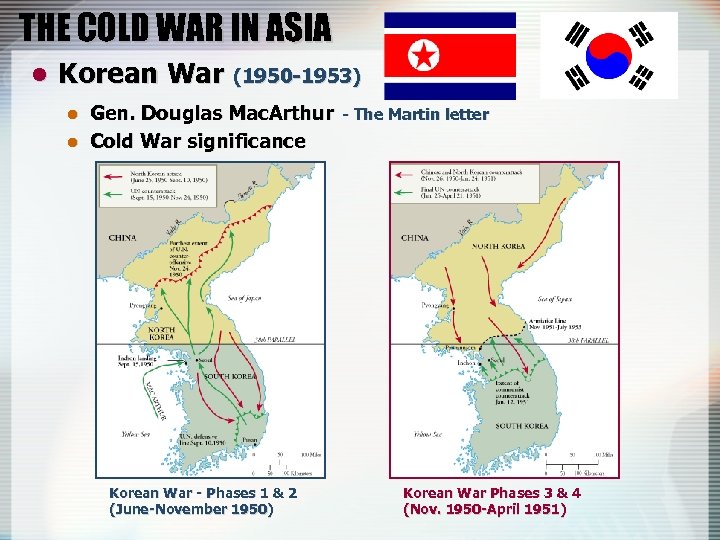 THE COLD WAR IN ASIA l Korean War (1950 -1953) l Gen. Douglas Mac. Arthur - The Martin letter l Cold War significance Korean War - Phases 1 & 2 (June-November 1950) Korean War Phases 3 & 4 (Nov. 1950 -April 1951)
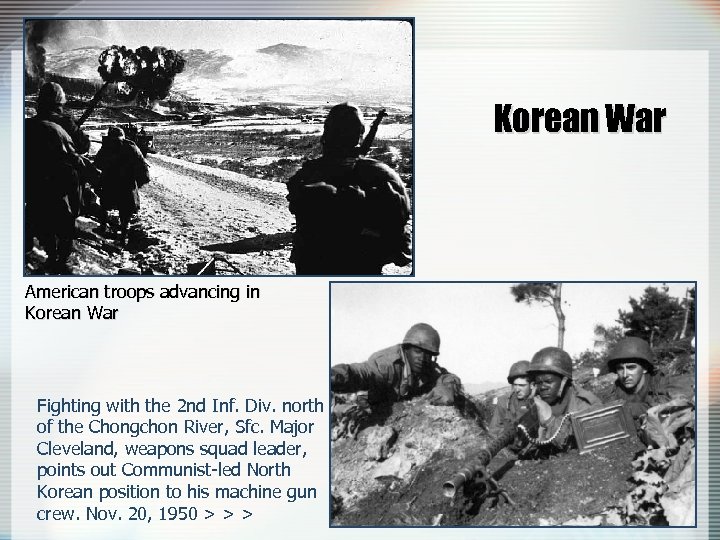 Korean War American troops advancing in Korean War Fighting with the 2 nd Inf. Div. north of the Chongchon River, Sfc. Major Cleveland, weapons squad leader, points out Communist-led North Korean position to his machine gun crew. Nov. 20, 1950 > > >
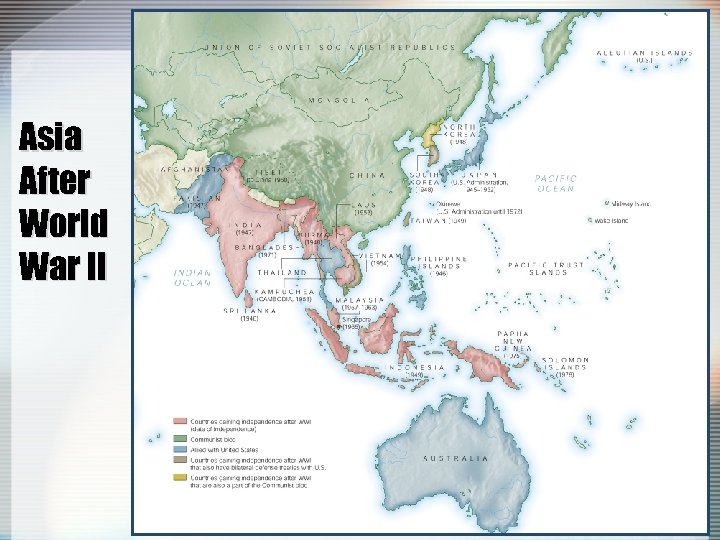 Asia After World War II
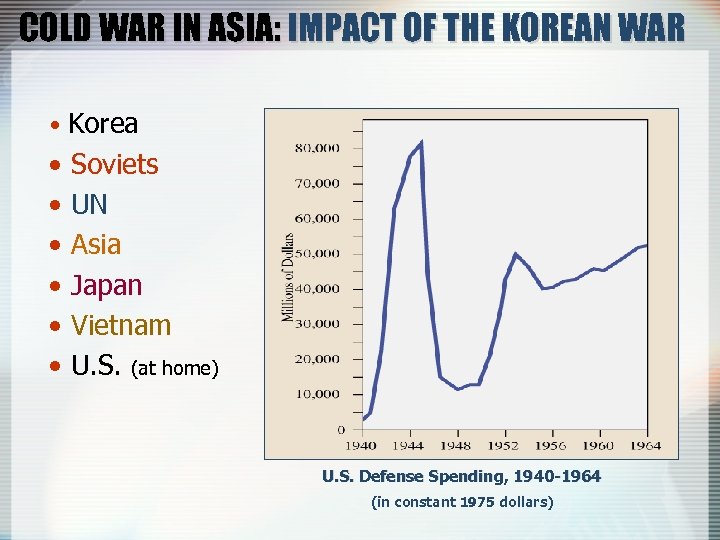 COLD WAR IN ASIA: IMPACT OF THE KOREAN WAR • Korea • • • Soviets UN Asia Japan Vietnam U. S. (at home) U. S. Defense Spending, 1940 -1964 (in constant 1975 dollars)
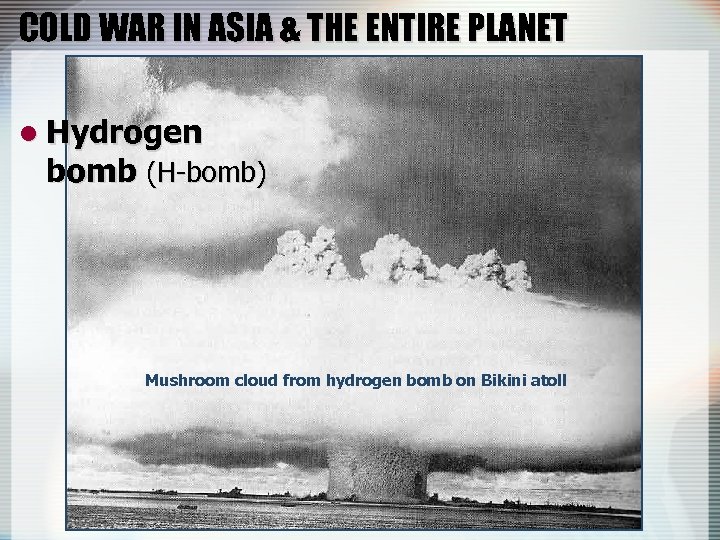 COLD WAR IN ASIA & THE ENTIRE PLANET l Hydrogen bomb (H-bomb) Mushroom cloud from hydrogen bomb on Bikini atoll
 DOMESTIC POST -WAR ADJUSTMENTS
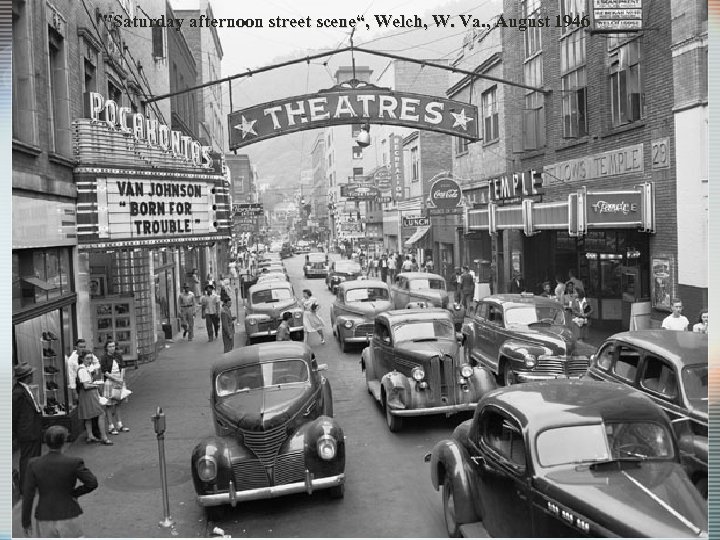 "Saturday afternoon street scene"Va. , August 1946 "Saturday afternoon street scene“, Welch, W.
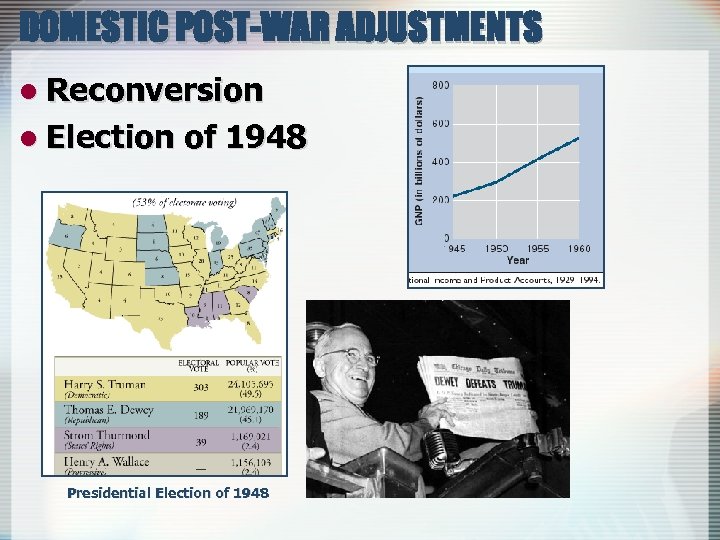 DOMESTIC POST-WAR ADJUSTMENTS l Reconversion l Election of 1948 Presidential Election of 1948
 FIGHTING COMMUNISM AT HOME The Red Scare and Mc. Carthyism
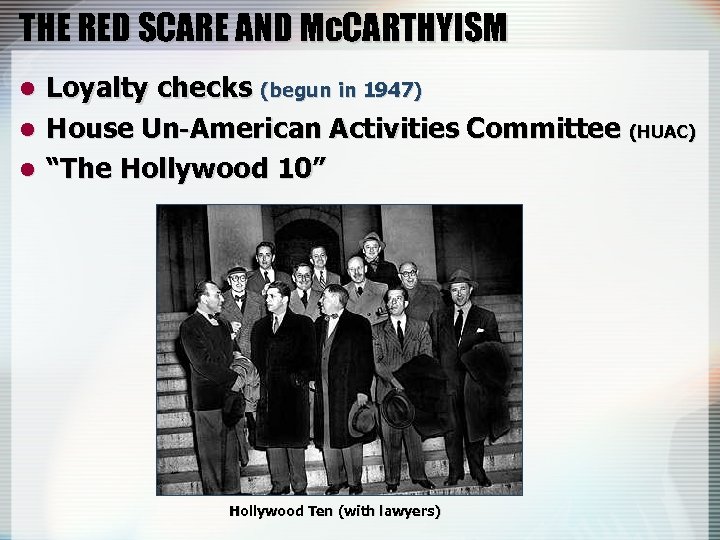 THE RED SCARE AND Mc. CARTHYISM Loyalty checks (begun in 1947) l House Un-American Activities Committee (HUAC) l “The Hollywood 10” l Hollywood Ten (with lawyers)
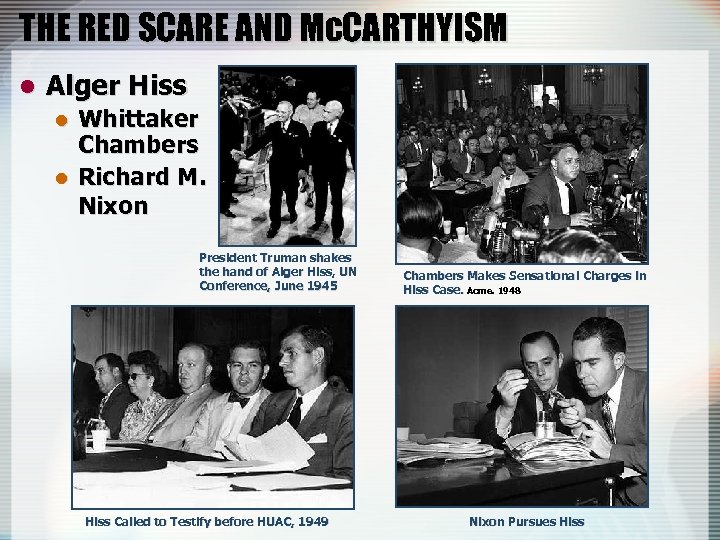 THE RED SCARE AND Mc. CARTHYISM l Alger Hiss l l Whittaker Chambers Richard M. Nixon President Truman shakes the hand of Alger Hiss, UN Conference, June 1945 Hiss Called to Testify before HUAC, 1949 Chambers Makes Sensational Charges in Hiss Case. Acme. 1948 Hiss Case. Nixon Pursues Hiss
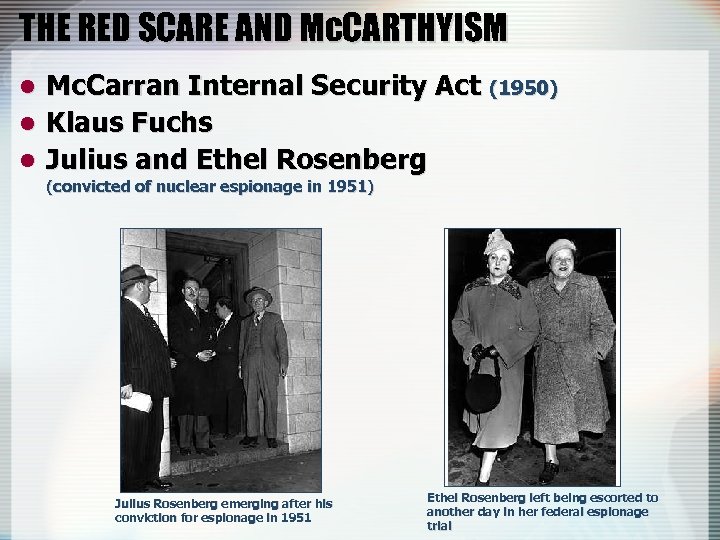 THE RED SCARE AND Mc. CARTHYISM Mc. Carran Internal Security Act (1950) l Klaus Fuchs l Julius and Ethel Rosenberg l (convicted of nuclear espionage in 1951) Julius Rosenberg emerging after his conviction for espionage in 1951 Ethel Rosenberg left being escorted to another day in her federal espionage trial
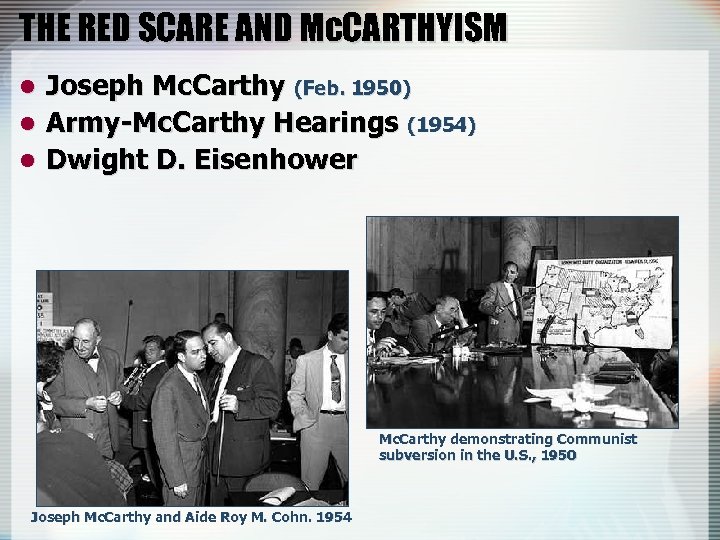 THE RED SCARE AND Mc. CARTHYISM Joseph Mc. Carthy (Feb. 1950) l Army-Mc. Carthy Hearings (1954) l Dwight D. Eisenhower l Mc. Carthy demonstrating Communist subversion in the U. S. , 1950 Joseph Mc. Carthy and Aide Roy M. Cohn. 1954
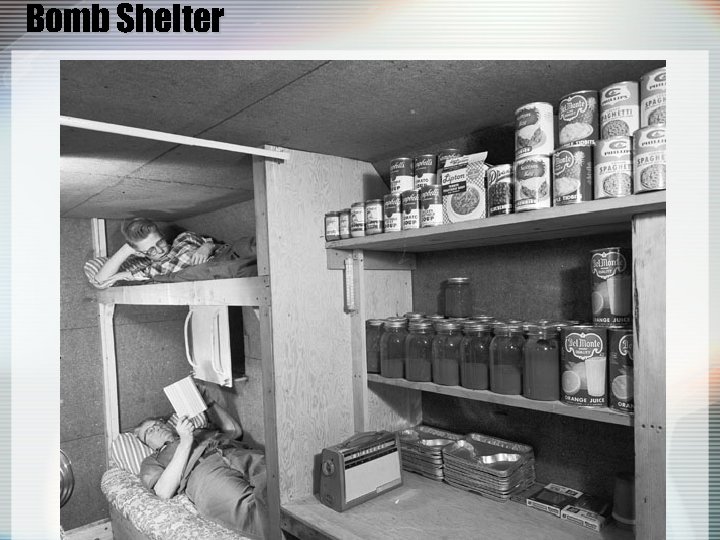 Bomb Shelter
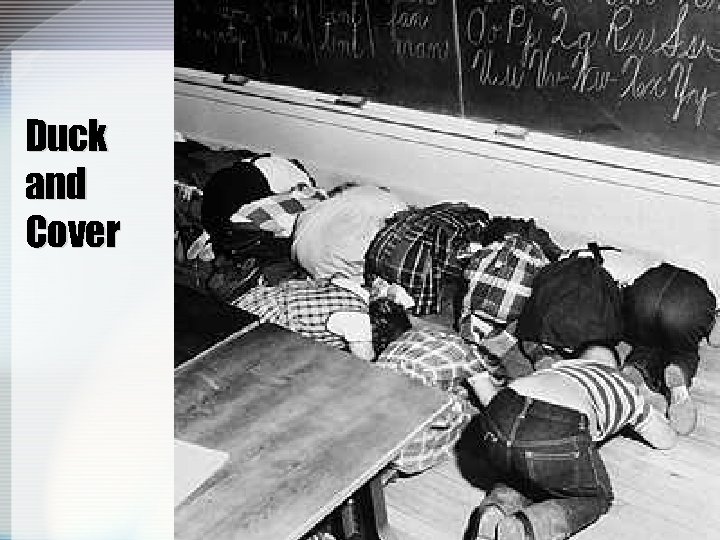 Duck and Cover
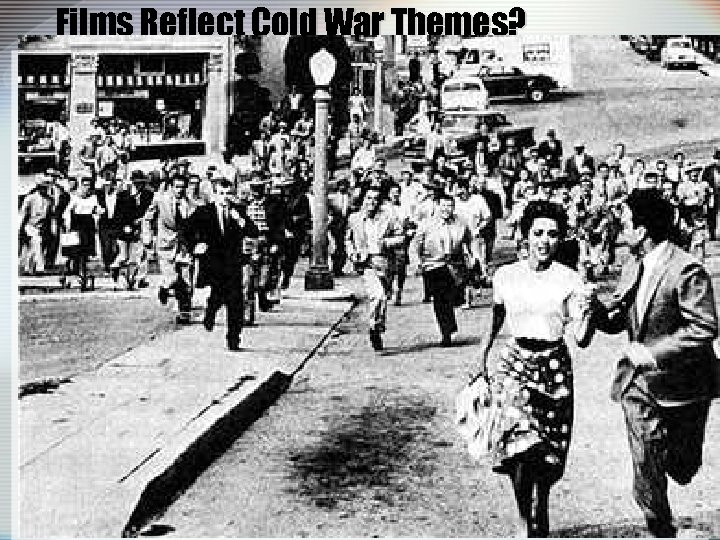 Films Reflect Cold War Themes?
 FOREIGN AFFAIRS UNDER EISENHOWER
 FOREIGN AFFAIRS in the 50 s: CONTAINMENT WITH AN AWARENESS OF LIMITATIONS l John Foster Dulles l l “roll back” massive retaliation l l brinkmanship “more bang for the buck” Eisenhower and Dulles Confer. 1954
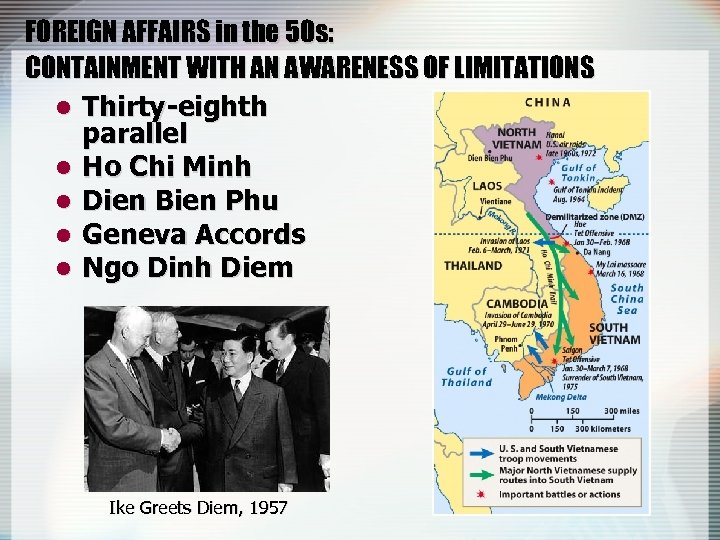 FOREIGN AFFAIRS in the 50 s: CONTAINMENT WITH AN AWARENESS OF LIMITATIONS l Thirty-eighth parallel l Ho Chi Minh l Dien Bien Phu l Geneva Accords l Ngo Dinh Diem Ike Greets Diem, 1957
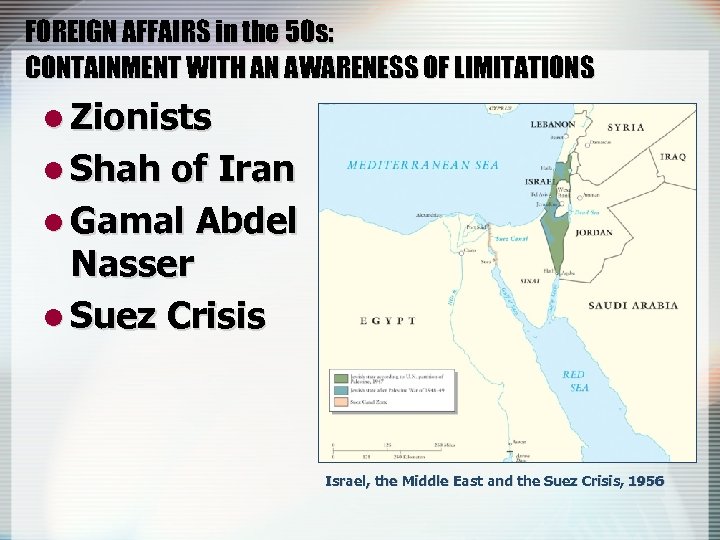 FOREIGN AFFAIRS in the 50 s: CONTAINMENT WITH AN AWARENESS OF LIMITATIONS l Zionists l Shah of Iran l Gamal Abdel Nasser l Suez Crisis Israel, the Middle East and the Suez Crisis, 1956
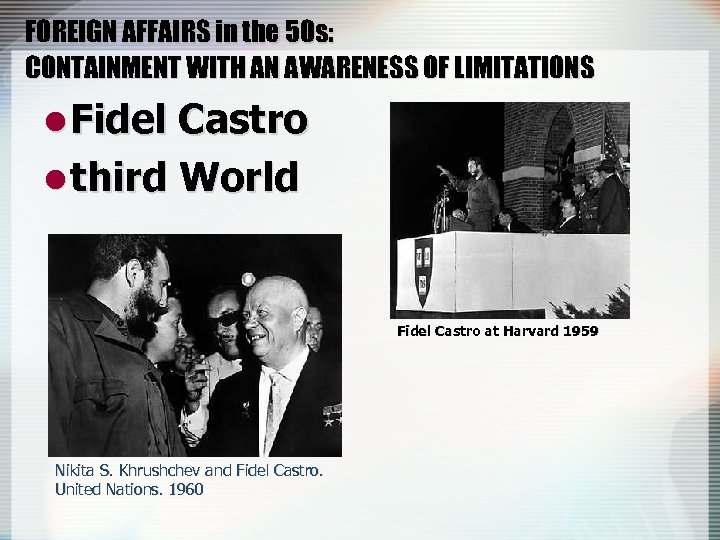 FOREIGN AFFAIRS in the 50 s: CONTAINMENT WITH AN AWARENESS OF LIMITATIONS l Fidel Castro l third World Fidel Castro at Harvard 1959 Nikita S. Khrushchev and Fidel Castro. United Nations. 1960
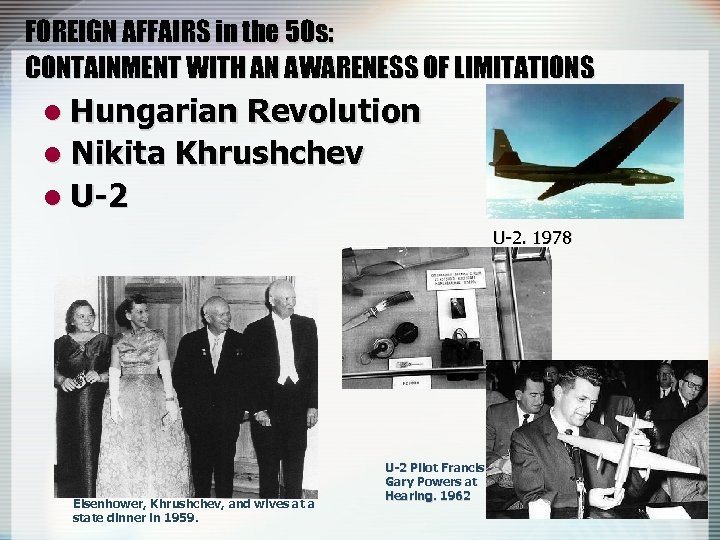 FOREIGN AFFAIRS in the 50 s: CONTAINMENT WITH AN AWARENESS OF LIMITATIONS l Hungarian Revolution l Nikita Khrushchev l U-2. 1978 Eisenhower, Khrushchev, and wives at a state dinner in 1959. U-2 Pilot Francis Gary Powers at Hearing. 1962
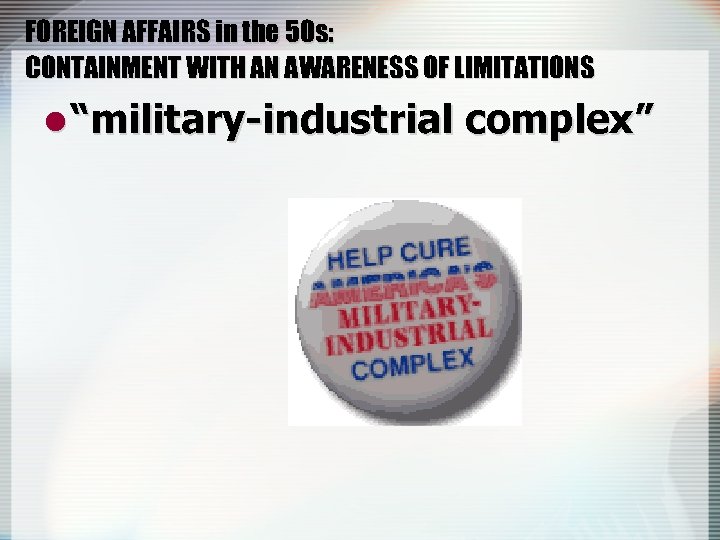 FOREIGN AFFAIRS in the 50 s: CONTAINMENT WITH AN AWARENESS OF LIMITATIONS l “military-industrial complex”
 GUIDING QUESTION ● How and for what reasons did U. S. foreign policy change between 1920 and 1941? (To what extent did the United States adopt an isolationist policy in the 1920 s and 1930 s? )
 GUIDING QUESTION µTo what extent did the Second World War bring about lasting change in the American society, economy and government?
 l l l Sources National Archives and Records Administration American Journey Online l http: //www. wadsworth. com/history_d/special_features/image _bank_US/1946_1954. html Teaching Politics–Rutgers U. http: //teachpol. tcnj. edu/amer_pol_hist/_browse 1950. htm & http: //teachpol. tcnj. edu/amer_pol_hist/_browse 2000. htm http: //us. history. wisc. edu/hist 102/photos/html/sindex. html Brinkley, American History: A Survey 10 e & 11 e [Instructors Resource] Faragher, Out of Many, 3 rd Ed. ; http: //wps. prenhall. com/hss_faragher_outofmany_ap/ Divine, America Past and Present Revd 7 th Ed. Cayton, America: Pathways to the Present (2003) Nash, The American People 6 e, http: //wps. ablongman. com/long_nash_ap_6/0, 7361, 592970, 00. html Roark, American Promise 3 e from http: //www. bedfordstmartins. com/mapcentral J. Jones, P. Wood, et al, Created Equal: , l Kennedy, American Pageant 13 e [History Companion CD] l l l l http: //wps. ablongman. com/long_jones_ce_1/0, 7283, 494555 -, 00. html