 Скачать презентацию The Code for Sustainable Homes Les Fothergill Sustainable
69a99e5d99b8982e1d3528db73bf04f8.ppt
- Количество слайдов: 33



The Code for Sustainable Homes Les Fothergill Sustainable Buildings Division
Content of presentation Overview of Code for Sustainable Homes Discussion on proposed section on sound insulation The content of the Code has not yet been finalised and so is subject to change 2
Background to the Code: Main Drivers • • • Climate change agenda and CO 2 targets Rising energy costs Security of supply of energy Water conservation Signals future direction of Building Regulations 3
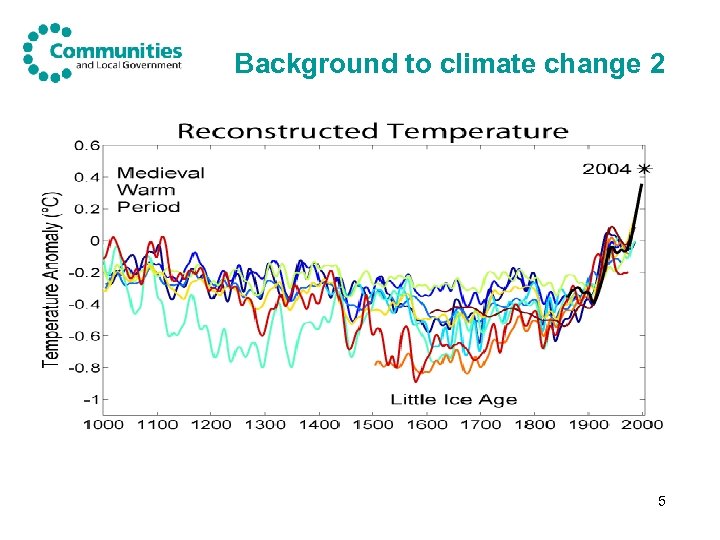
Background to climate change 1 Climate change is already happening. The ten hottest summers on record have occurred since the beginning of the 1990 s Models predict that global temperature could rise from between 1. 4 to 5. 8 degrees over the next 100 years 4
Background to climate change 2 5
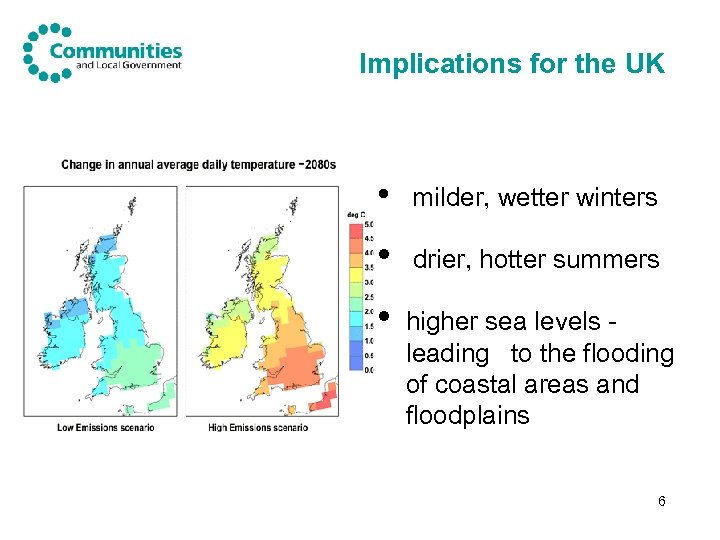
Implications for the UK • milder, wetter winters • drier, hotter summers • higher sea levels leading to the flooding of coastal areas and floodplains 6
UK policy commitments • Kyoto Protocol of 1997: ratified by over 150 countries – set legally binding reduction targets of 5. 2% below 1990 levels by 2008 -2012 • The UK has set itself challenging targets to reduce carbon emissions by: Ø 20% below 1990 levels by 2010, and Ø 60% below 1990 levels by 2050 • Energy supply – to produce 12% UK electricity from renewable sources by 2010 7
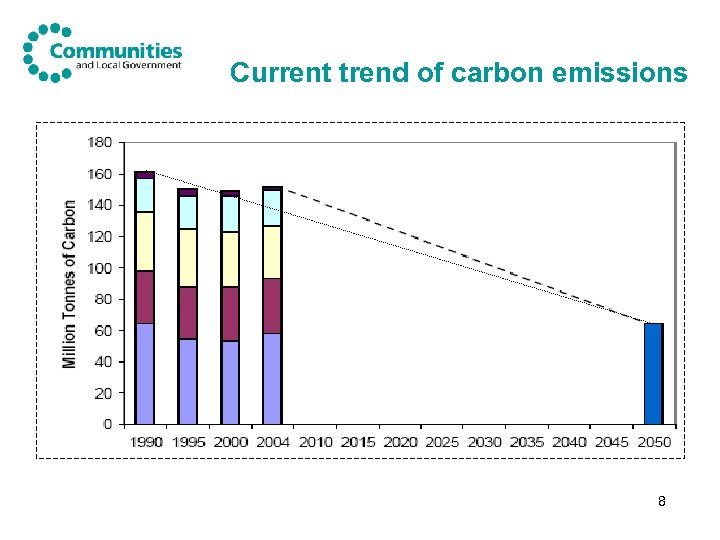
Current trend of carbon emissions 2010 target = 129 mt. C 8
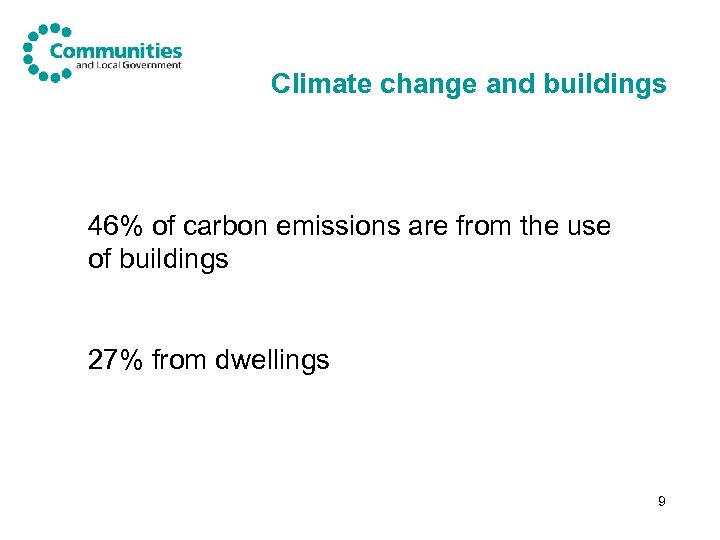
Climate change and buildings 46% of carbon emissions are from the use of buildings 27% from dwellings 9
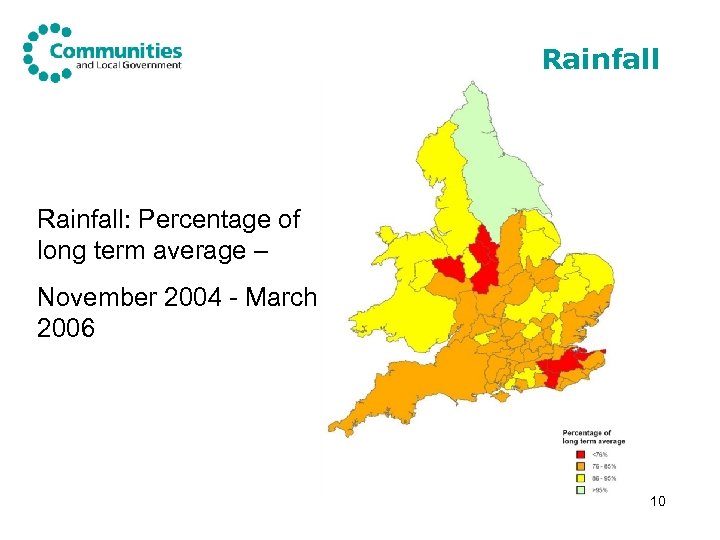
Rainfall: Percentage of long term average – November 2004 - March 2006 10
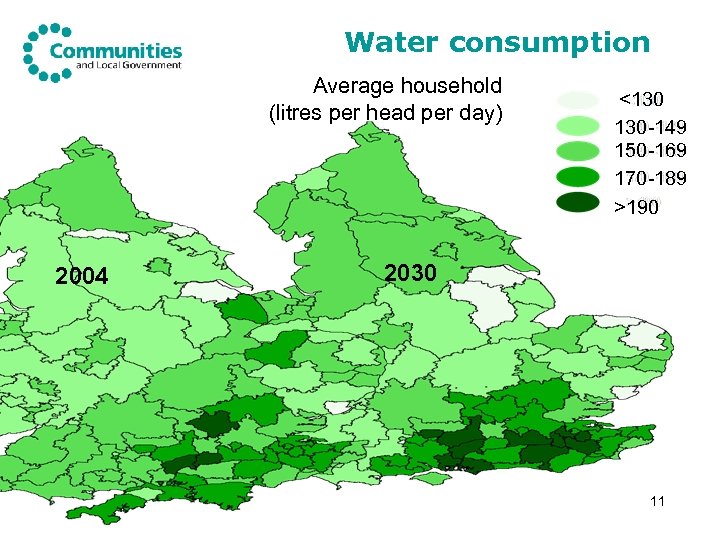
Water consumption Average household (litres per head per day) 2004 <130 130 -149 150 -169 170 -189 >190 2030 11
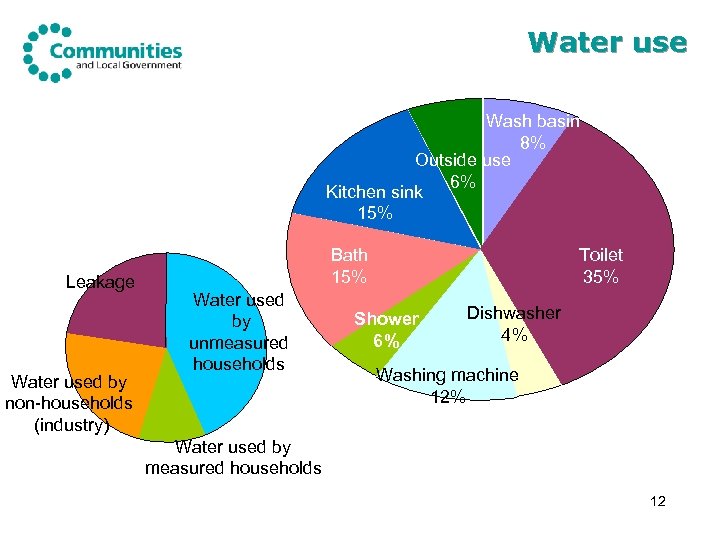
Water use 6 Wash basin 8% Outside use 6% Kitchen sink 15% Leakage Water used by non-households (industry) Bath 15% Water used by unmeasured households Toilet 35% Shower 6% Dishwasher 4% Washing machine 12% Water used by measured households 12
Why a Code for Sustainable Homes? Sustainable Buildings Task Group report recommended a single Code for England Wales - with minimum standards for key resources: energy, water, waste, materials. Fresh approach to achieve outcomes: • Encourage developers to offer more innovative solutions • Empower homebuyers. 13
Advantages of a Code over Regulation: • Encourage aspirations above the regulatory base, in measured steps. • Point the way to future regulations and give certainty. 14
The consultation document 1 Voluntary Code comprising essential and optional elements A transparent rating system to inform home-buyers how sustainable the home they are buying is compared to another Out to consultation (closed 6 March 2006) over 2100 responses 15
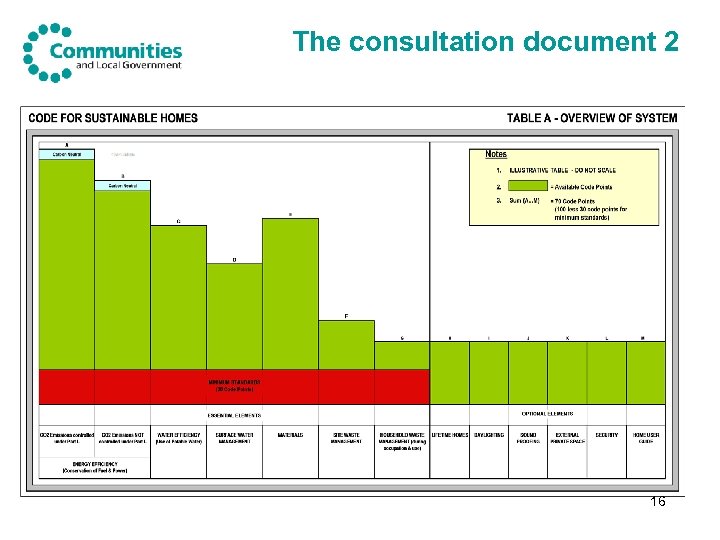
The consultation document 2 16
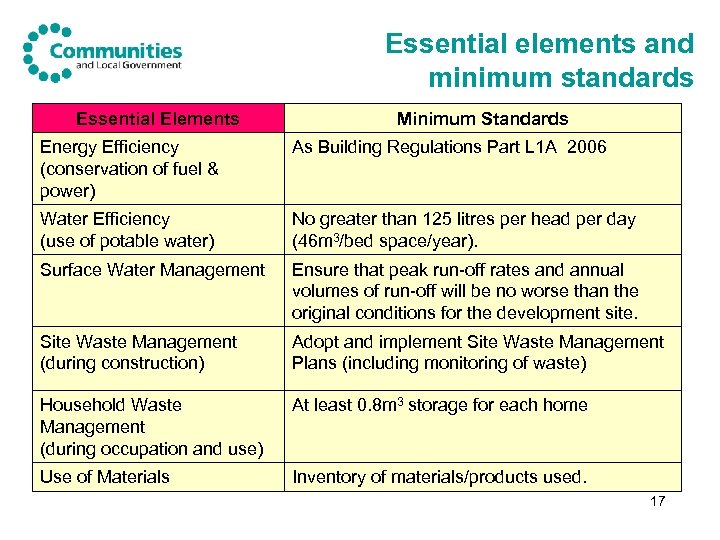
Essential elements and minimum standards Essential Elements Minimum Standards Energy Efficiency (conservation of fuel & power) As Building Regulations Part L 1 A 2006 Water Efficiency (use of potable water) No greater than 125 litres per head per day (46 m 3/bed space/year). Surface Water Management Ensure that peak run-off rates and annual volumes of run-off will be no worse than the original conditions for the development site. Site Waste Management (during construction) Adopt and implement Site Waste Management Plans (including monitoring of waste) Household Waste Management (during occupation and use) At least 0. 8 m 3 storage for each home Use of Materials Inventory of materials/products used. 17
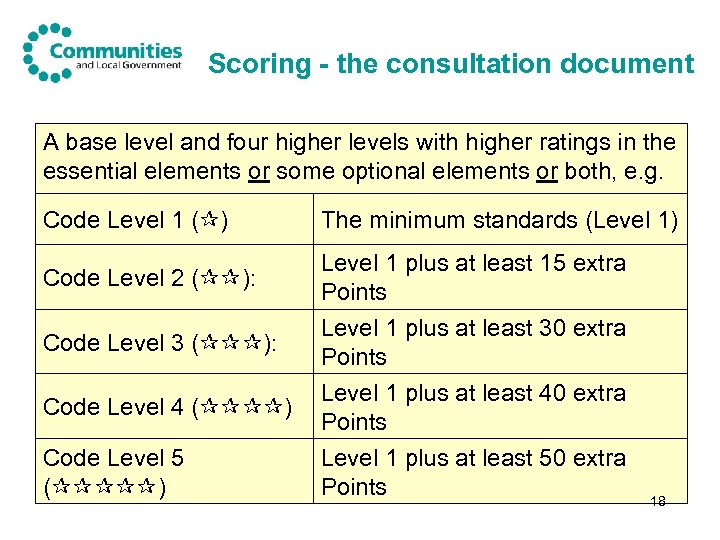
Scoring - the consultation document A base level and four higher levels with higher ratings in the essential elements or some optional elements or both, e. g. Code Level 1 ( ) The minimum standards (Level 1) Code Level 2 ( ): Level 1 plus at least 15 extra Points Code Level 3 ( ): Code Level 4 ( ) Code Level 5 ( ) Level 1 plus at least 30 extra Points Level 1 plus at least 40 extra Points Level 1 plus at least 50 extra Points 18
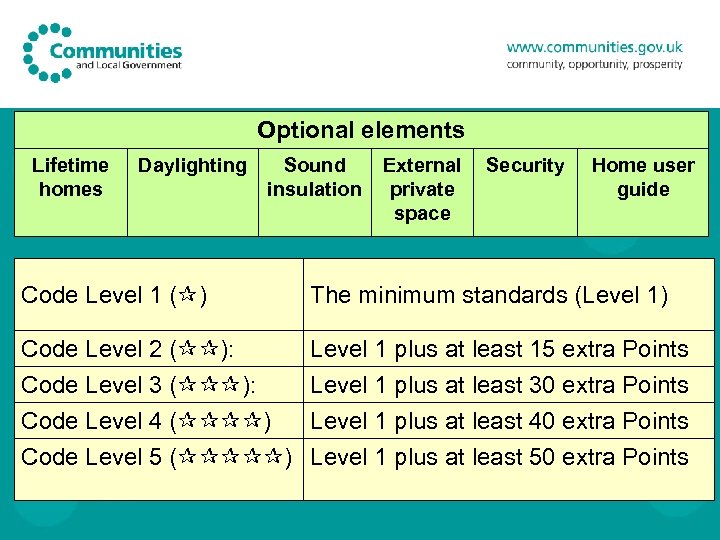
Optional elements Lifetime homes Daylighting Sound insulation External private space Security Home user guide Code Level 1 ( ) The minimum standards (Level 1) Code Level 2 ( ): Code Level 3 ( ): Level 1 plus at least 15 extra Points Level 1 plus at least 30 extra Points Code Level 4 ( ) Level 1 plus at least 40 extra Points Code Level 5 ( ) Level 1 plus at least 50 extra Points
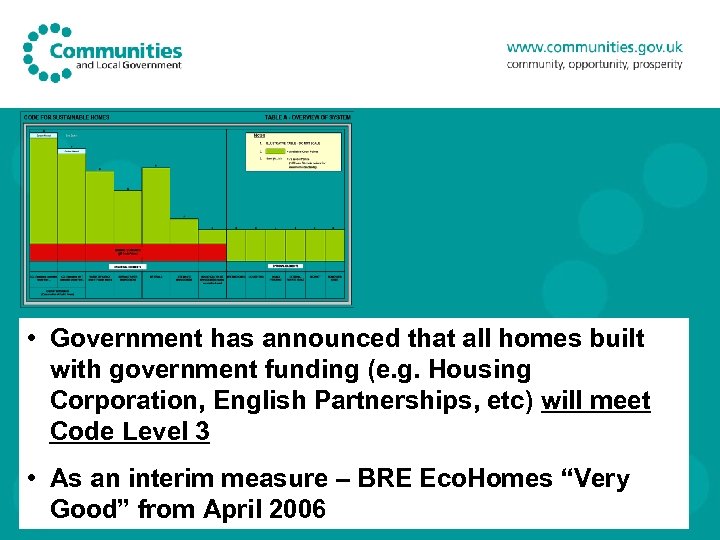
• Government has announced that all homes built with government funding (e. g. Housing Corporation, English Partnerships, etc) will meet Code Level 3 • As an interim measure – BRE Eco. Homes “Very Good” from April 2006
Strengthening the Code 1 ODPM (DCLG) Press Notice issued 9 March 2006 signalled proposals to “Strengthen The Code”; Based on an initial analysis of consultation returns Main options: • • Make assessment to the code mandatory Widen coverage of the Code Encourage micro renewables Use the Code to signal the future direction of Building Regulations 21
Strengthening the Code 2: Make assessment mandatory All new homes and those sold or let will already have an energy performance certificate (a requirement of the Energy Performance of Buildings Directive); Ministers are considering mandatory assessments against the whole Code - a sustainability rating. 22
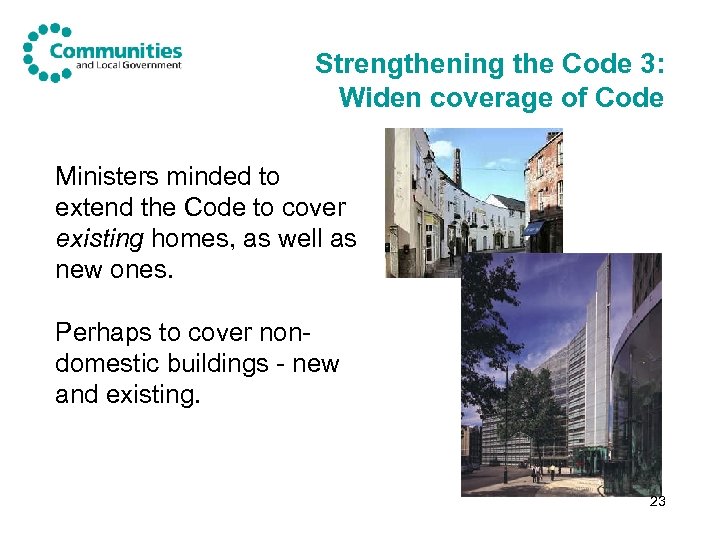
Strengthening the Code 3: Widen coverage of Code Ministers minded to extend the Code to cover existing homes, as well as new ones. Perhaps to cover nondomestic buildings - new and existing. 23
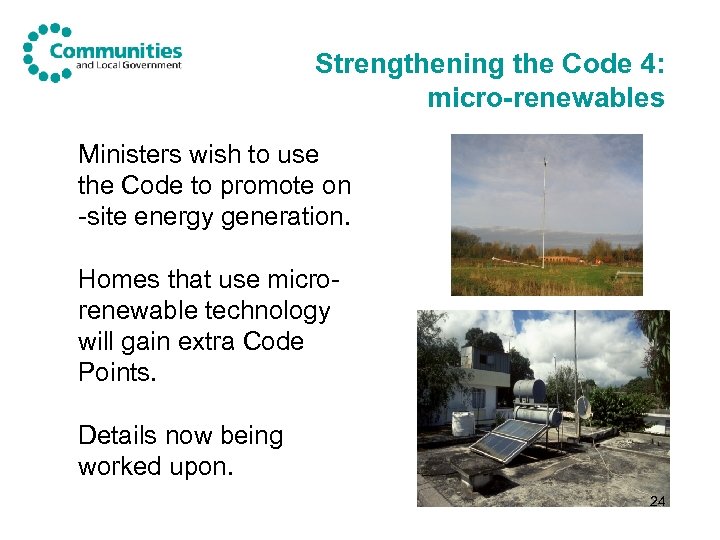
Strengthening the Code 4: micro-renewables Ministers wish to use the Code to promote on -site energy generation. Homes that use microrenewable technology will gain extra Code Points. Details now being worked upon. 24
Strengthening the Code 5: Signal future direction of Building Regulations Code should form the basis for the next wave of improvements to the Building Regulations. It should indicate where the Building Regulations could be in 5, 10, 15 years time. 25
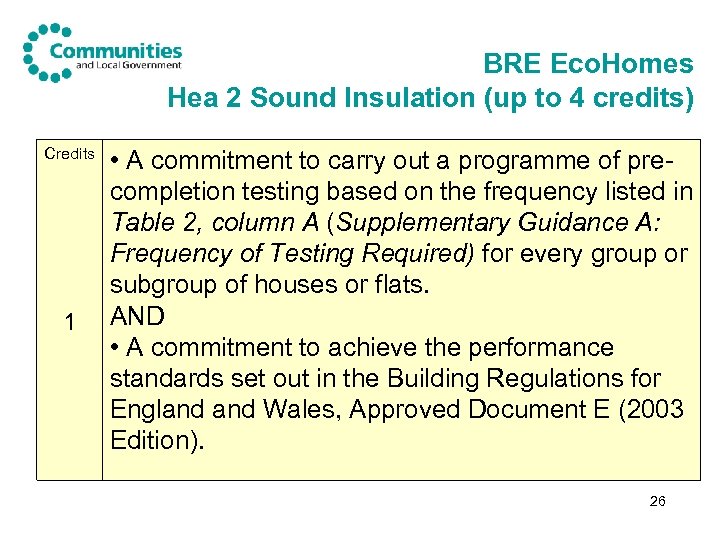
BRE Eco. Homes Hea 2 Sound Insulation (up to 4 credits) Credits 1 • A commitment to carry out a programme of precompletion testing based on the frequency listed in Table 2, column A (Supplementary Guidance A: Frequency of Testing Required) for every group or subgroup of houses or flats. AND • A commitment to achieve the performance standards set out in the Building Regulations for England Wales, Approved Document E (2003 Edition). 26
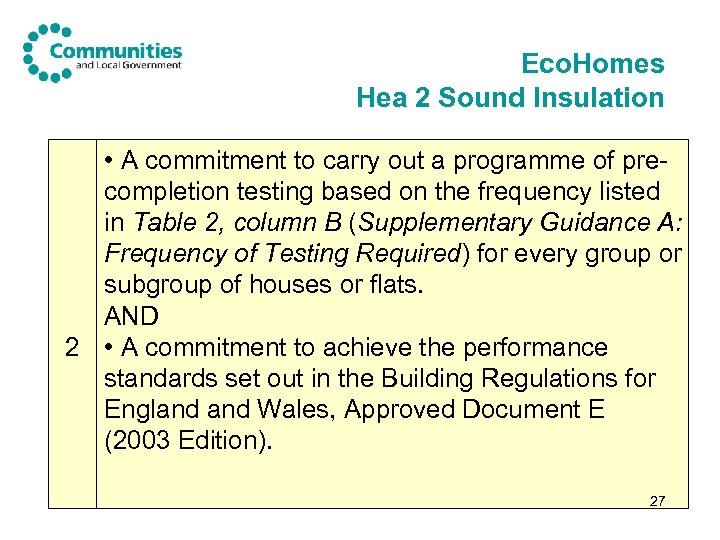
Eco. Homes Hea 2 Sound Insulation • A commitment to carry out a programme of precompletion testing based on the frequency listed in Table 2, column B (Supplementary Guidance A: Frequency of Testing Required) for every group or subgroup of houses or flats. AND 2 • A commitment to achieve the performance standards set out in the Building Regulations for England Wales, Approved Document E (2003 Edition). 27
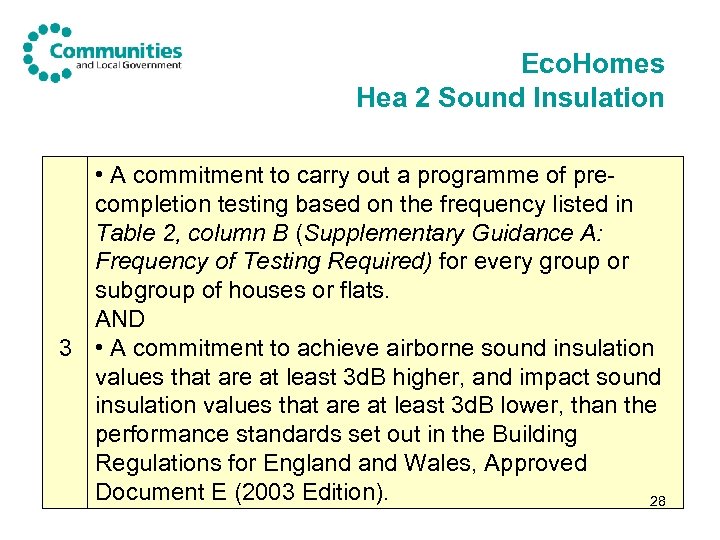
Eco. Homes Hea 2 Sound Insulation • A commitment to carry out a programme of precompletion testing based on the frequency listed in Table 2, column B (Supplementary Guidance A: Frequency of Testing Required) for every group or subgroup of houses or flats. AND 3 • A commitment to achieve airborne sound insulation values that are at least 3 d. B higher, and impact sound insulation values that are at least 3 d. B lower, than the performance standards set out in the Building Regulations for England Wales, Approved Document E (2003 Edition). 28
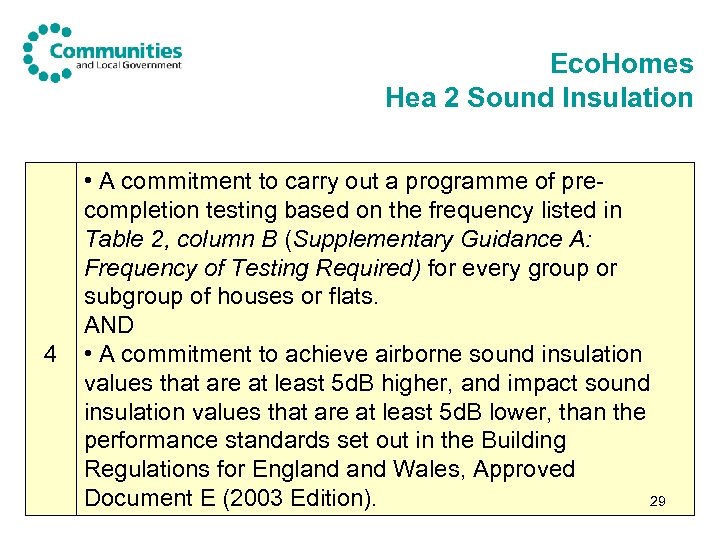
Eco. Homes Hea 2 Sound Insulation 4 • A commitment to carry out a programme of precompletion testing based on the frequency listed in Table 2, column B (Supplementary Guidance A: Frequency of Testing Required) for every group or subgroup of houses or flats. AND • A commitment to achieve airborne sound insulation values that are at least 5 d. B higher, and impact sound insulation values that are at least 5 d. B lower, than the performance standards set out in the Building Regulations for England Wales, Approved 29 Document E (2003 Edition).
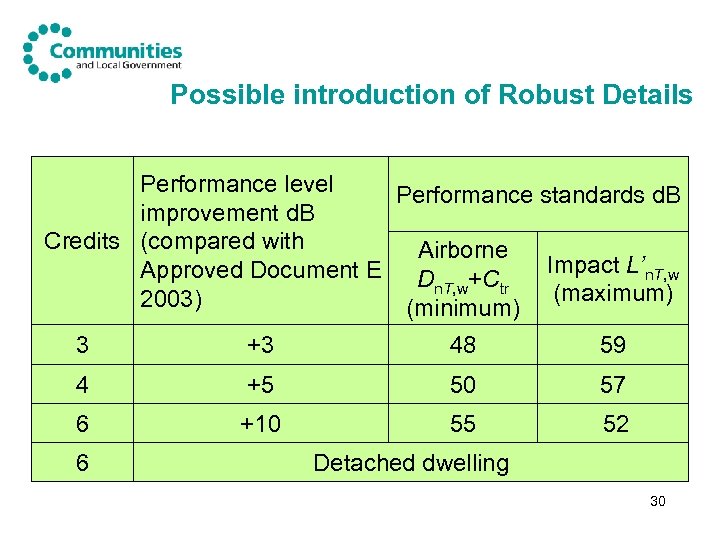
Possible introduction of Robust Details Performance level Performance standards d. B improvement d. B Credits (compared with Airborne Impact L’n. T, w Approved Document E D +C n. T, w tr (maximum) 2003) (minimum) 3 +3 48 59 4 +5 50 57 6 +10 55 52 6 Detached dwelling 30
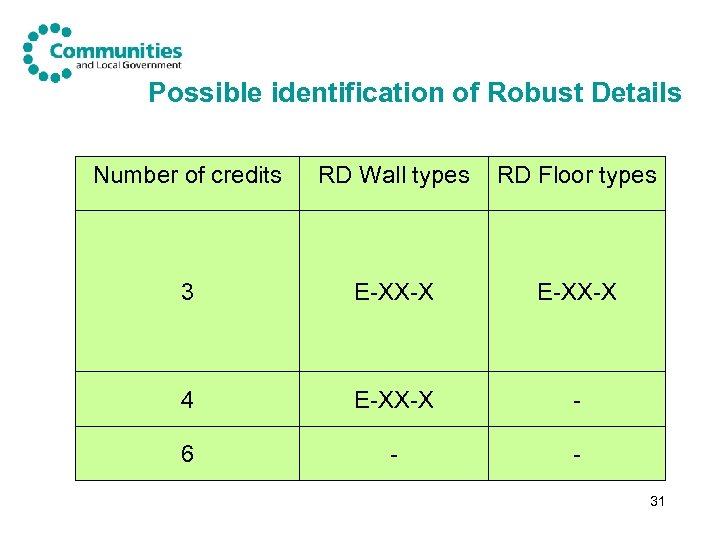
Possible identification of Robust Details Number of credits RD Wall types RD Floor types 3 E-XX-X 4 E-XX-X - 6 - 31
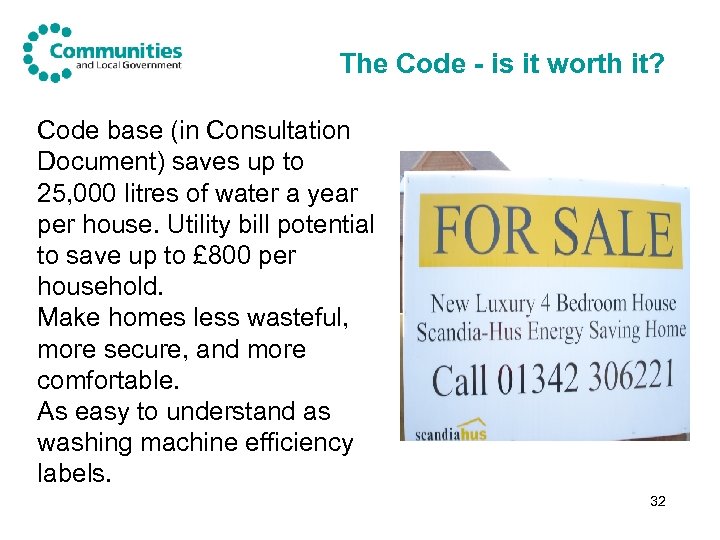
The Code - is it worth it? Code base (in Consultation Document) saves up to 25, 000 litres of water a year per house. Utility bill potential to save up to £ 800 per household. Make homes less wasteful, more secure, and more comfortable. As easy to understand as washing machine efficiency labels. 32
Thank you
Скачать презентацию The Code for Sustainable Homes Les Fothergill Sustainable
69a99e5d99b8982e1d3528db73bf04f8.ppt