 Скачать презентацию The Code for Sustainable Homes Climate Change
f2c6fd66c1776741c2f080b735fa5300.ppt
- Количество слайдов: 25



The Code for Sustainable Homes
Climate Change Stern review • Climate change is real • Strong and early action is needed • Economic impact – Acting now outweighs cost of not acting • Environmental impact – Reduced risk at stabilized levels of CO 2 e
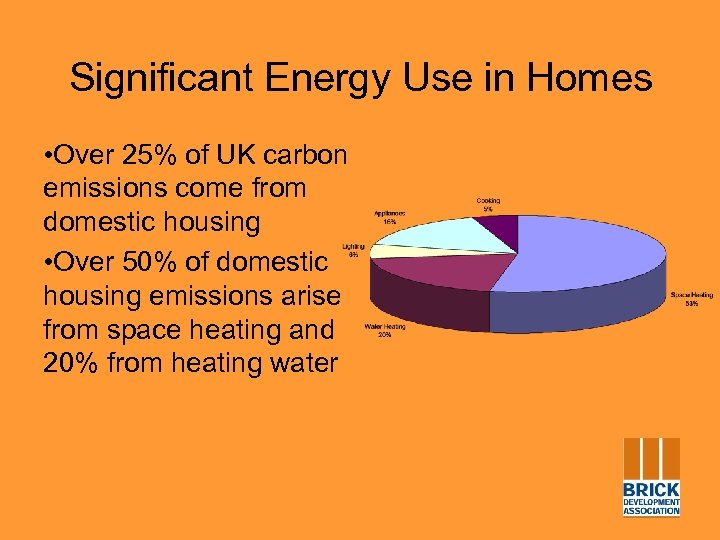
Significant Energy Use in Homes • Over 25% of UK carbon emissions come from domestic housing • Over 50% of domestic housing emissions arise from space heating and 20% from heating water
Regulations • Up to now – Control of emission through Part L • 25% reduction in CO 2 in 2002 revision • Further 20% reduction in 2006 revision • Sets minimum standards • Ideal scheme – – To set environmental performance standards better than regulations To encourage voluntary compliance – a marketing advantage To provide a clear roadmap and timetable To work in conjunction with Building Regulations
The Code • Based on ‘environmental impact’ of nine categories • Proposes a system with six levels – Code level 1 – one star –… –… – Code level 6 – six stars
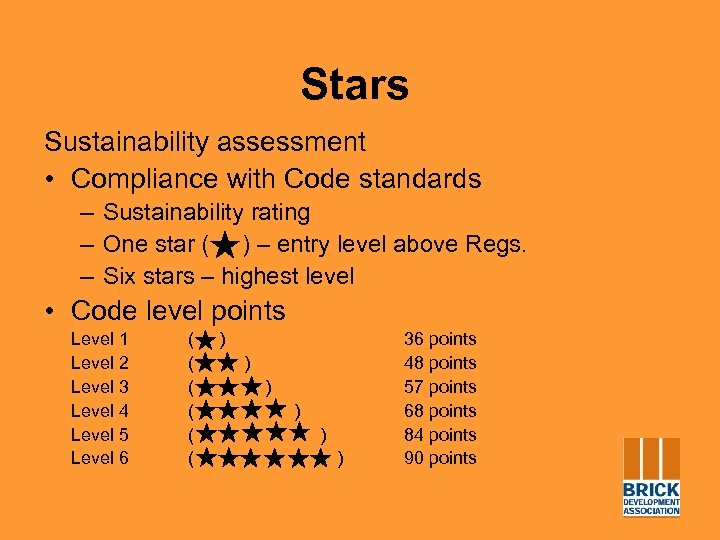
Stars Sustainability assessment • Compliance with Code standards – Sustainability rating – One star ( ) – entry level above Regs. – Six stars – highest level • Code level points Level 1 Level 2 Level 3 Level 4 Level 5 Level 6 ( ( ( ) ) ) 36 points 48 points 57 points 68 points 84 points 90 points
Environmental Categories Nine Categories • • • Energy and CO 2 – min. mandatory standard at all levels Water – min. mandatory standards at all levels Materials Surface water run-off Waste Pollution Health and wellbeing Management Ecology
Credits and Points • Credits must be converted to points • Credits do not have the same value between categories • Environmental weighting factors – Represent environmental impact of categories – Used to convert credits to points
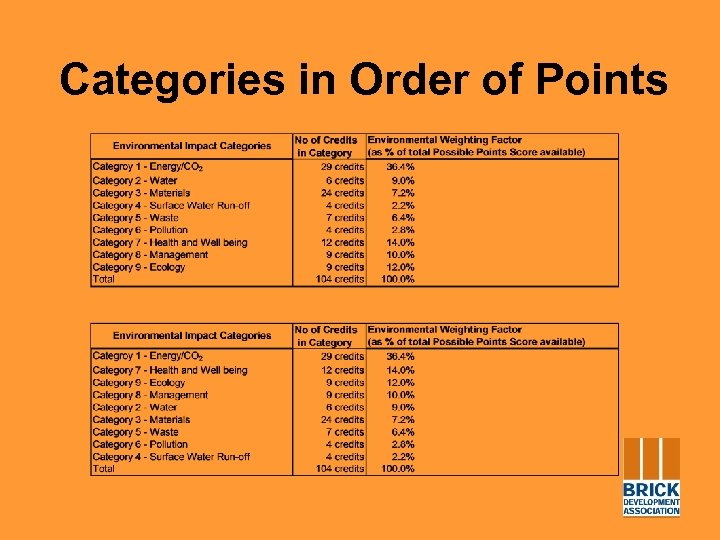
Categories in Order of Points
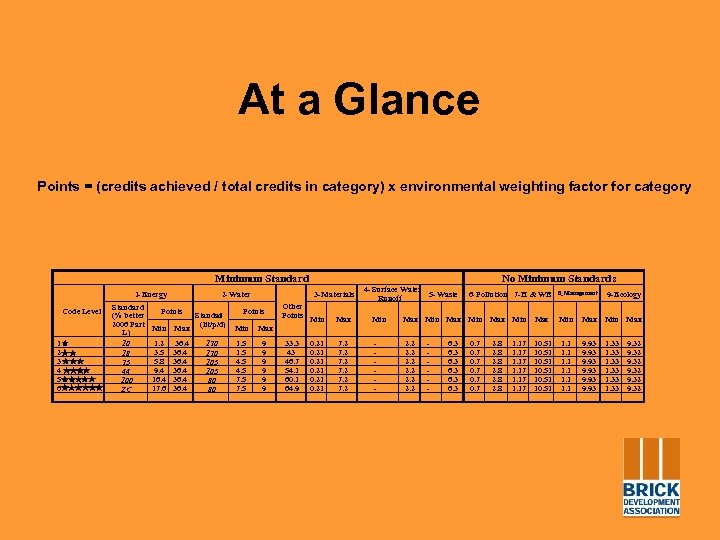
At a Glance Points = (credits achieved / total credits in category) x environmental weighting factor for category Minimum Standard 1 - Energy Code Level 1 2 3 4 5 6 2 - Water Standard Points (% better Standar d 2006 Part (lit/p/d) Min Max L) 1. 2 36. 4 10 120 3. 5 36. 4 18 120 5. 8 36. 4 25 105 9. 4 36. 4 44 105 16. 4 36. 4 100 80 17. 6 36. 4 ZC 80 No Minimum Standards 3 - Materials Points Min 9 9 9 6 - Pollution 7 - H & WB 8 - Management 9 - Ecology Min Max Min Ma x Min Max 0. 21 7. 2 7. 2 - 2. 2 2. 2 10. 51 1. 1 1. 1 9. 93 Max 1. 5 4. 5 7. 5 Other Points 4 - Surface Water 5 - Waste Run -off 33. 3 43 46. 7 54. 1 60. 1 64. 9 - 6. 3 6. 3 0. 7 0. 7 2. 8 2. 8 1. 17 1. 33 9. 32
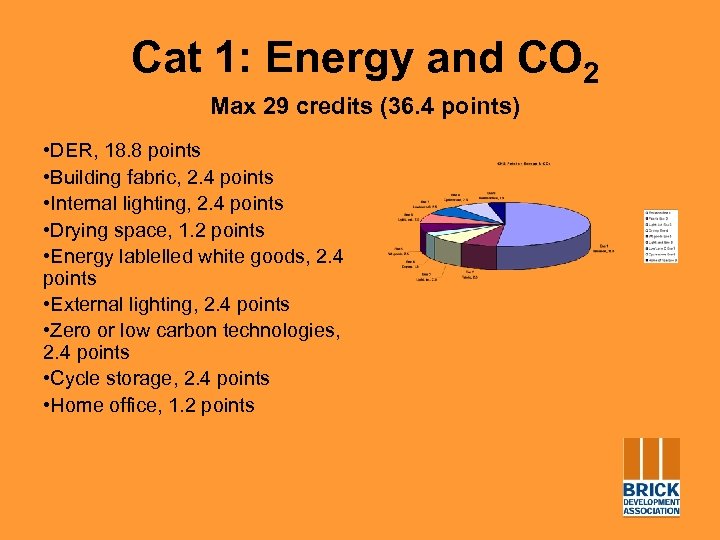
Cat 1: Energy and CO 2 Max 29 credits (36. 4 points) • DER, 18. 8 points • Building fabric, 2. 4 points • Internal lighting, 2. 4 points • Drying space, 1. 2 points • Energy lablelled white goods, 2. 4 points • External lighting, 2. 4 points • Zero or low carbon technologies, 2. 4 points • Cycle storage, 2. 4 points • Home office, 1. 2 points
Cat 2: Water Max 5 credits (9 points) • Internal potable water use, mandatory, maximum 7. 5 points – ≤ 120 lit/p/day ≡ 1. 5 points – ≤ 80 lit/p/day ≡ 7. 5 points • • • Dual flush WCs Flow regulated taps Low flow showers Small baths Water efficient appliances • External potable water, not mandatory, 1. 5 points – Greywater harvesting – Rainwater harvesting
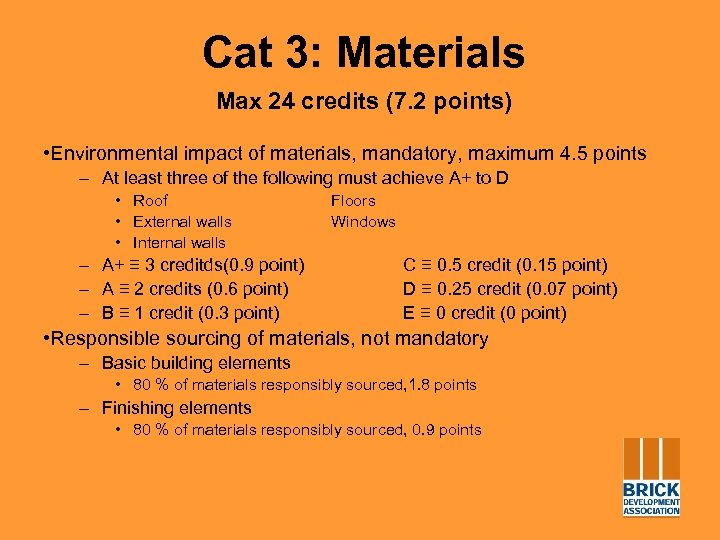
Cat 3: Materials Max 24 credits (7. 2 points) • Environmental impact of materials, mandatory, maximum 4. 5 points – At least three of the following must achieve A+ to D • Roof • External walls • Internal walls – A+ ≡ 3 creditds(0. 9 point) – A ≡ 2 credits (0. 6 point) – B ≡ 1 credit (0. 3 point) Floors Windows C ≡ 0. 5 credit (0. 15 point) D ≡ 0. 25 credit (0. 07 point) E ≡ 0 credit (0 point) • Responsible sourcing of materials, not mandatory – Basic building elements • 80 % of materials responsibly sourced, 1. 8 points – Finishing elements • 80 % of materials responsibly sourced, 0. 9 points
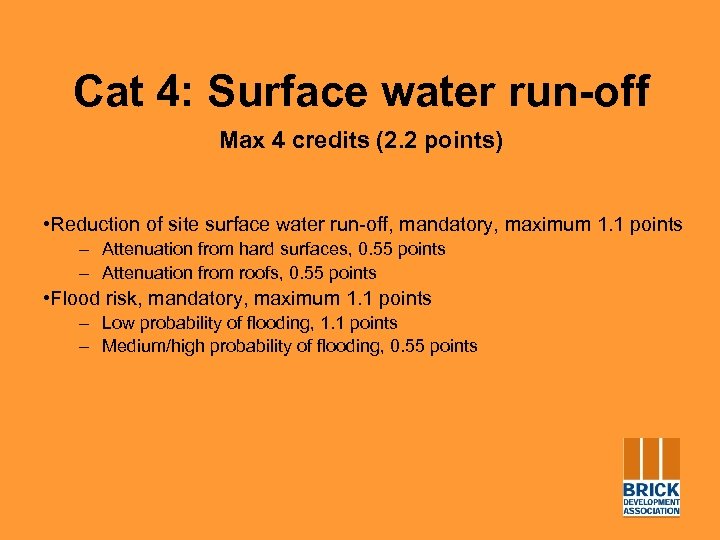
Cat 4: Surface water run-off Max 4 credits (2. 2 points) • Reduction of site surface water run-off, mandatory, maximum 1. 1 points – Attenuation from hard surfaces, 0. 55 points – Attenuation from roofs, 0. 55 points • Flood risk, mandatory, maximum 1. 1 points – Low probability of flooding, 1. 1 points – Medium/high probability of flooding, 0. 55 points
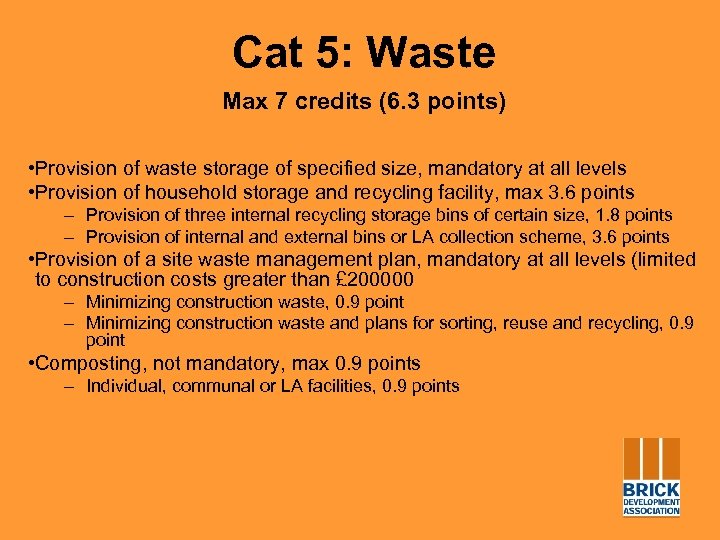
Cat 5: Waste Max 7 credits (6. 3 points) • Provision of waste storage of specified size, mandatory at all levels • Provision of household storage and recycling facility, max 3. 6 points – Provision of three internal recycling storage bins of certain size, 1. 8 points – Provision of internal and external bins or LA collection scheme, 3. 6 points • Provision of a site waste management plan, mandatory at all levels (limited to construction costs greater than £ 200000 – Minimizing construction waste, 0. 9 point – Minimizing construction waste and plans for sorting, reuse and recycling, 0. 9 point • Composting, not mandatory, max 0. 9 points – Individual, communal or LA facilities, 0. 9 points
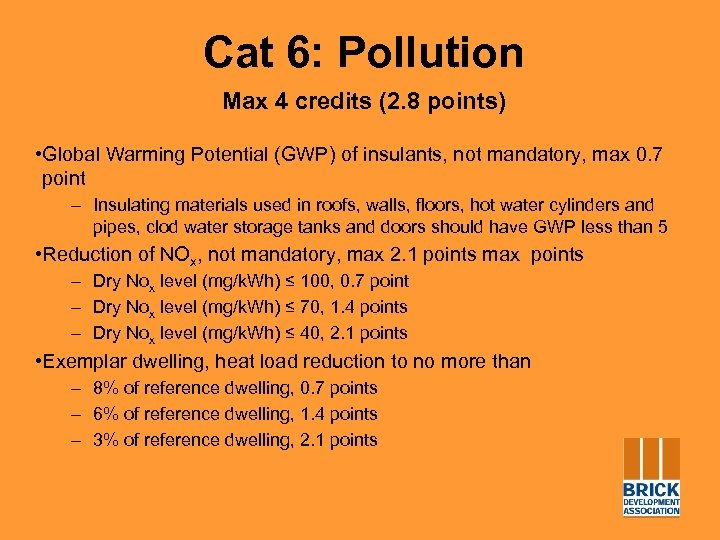
Cat 6: Pollution Max 4 credits (2. 8 points) • Global Warming Potential (GWP) of insulants, not mandatory, max 0. 7 point – Insulating materials used in roofs, walls, floors, hot water cylinders and pipes, clod water storage tanks and doors should have GWP less than 5 • Reduction of NOx, not mandatory, max 2. 1 points max points – Dry Nox level (mg/k. Wh) ≤ 100, 0. 7 point – Dry Nox level (mg/k. Wh) ≤ 70, 1. 4 points – Dry Nox level (mg/k. Wh) ≤ 40, 2. 1 points • Exemplar dwelling, heat load reduction to no more than – 8% of reference dwelling, 0. 7 points – 6% of reference dwelling, 1. 4 points – 3% of reference dwelling, 2. 1 points
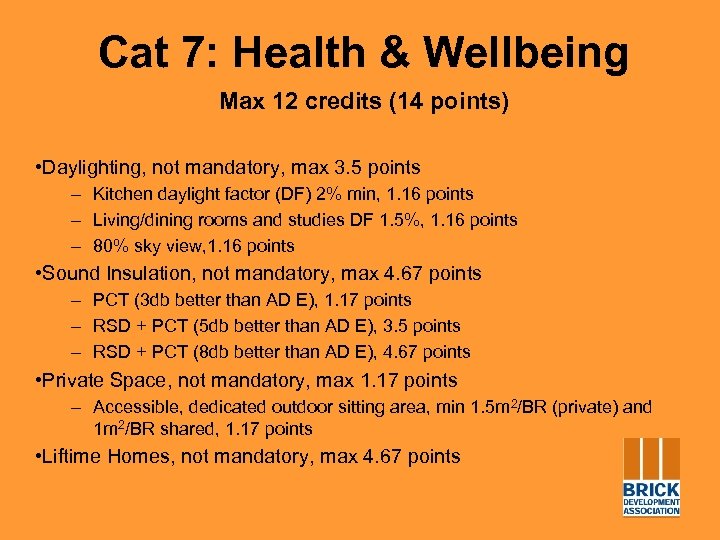
Cat 7: Health & Wellbeing Max 12 credits (14 points) • Daylighting, not mandatory, max 3. 5 points – Kitchen daylight factor (DF) 2% min, 1. 16 points – Living/dining rooms and studies DF 1. 5%, 1. 16 points – 80% sky view, 1. 16 points • Sound Insulation, not mandatory, max 4. 67 points – PCT (3 db better than AD E), 1. 17 points – RSD + PCT (5 db better than AD E), 3. 5 points – RSD + PCT (8 db better than AD E), 4. 67 points • Private Space, not mandatory, max 1. 17 points – Accessible, dedicated outdoor sitting area, min 1. 5 m 2/BR (private) and 1 m 2/BR shared, 1. 17 points • Liftime Homes, not mandatory, max 4. 67 points
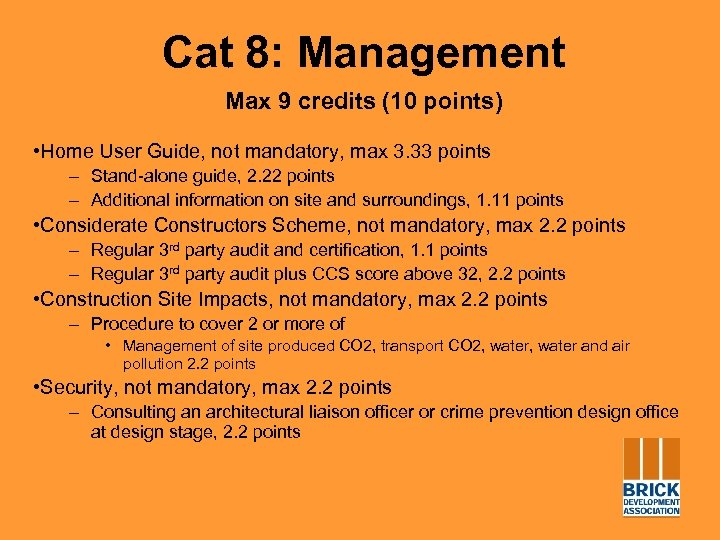
Cat 8: Management Max 9 credits (10 points) • Home User Guide, not mandatory, max 3. 33 points – Stand-alone guide, 2. 22 points – Additional information on site and surroundings, 1. 11 points • Considerate Constructors Scheme, not mandatory, max 2. 2 points – Regular 3 rd party audit and certification, 1. 1 points – Regular 3 rd party audit plus CCS score above 32, 2. 2 points • Construction Site Impacts, not mandatory, max 2. 2 points – Procedure to cover 2 or more of • Management of site produced CO 2, transport CO 2, water and air pollution 2. 2 points • Security, not mandatory, max 2. 2 points – Consulting an architectural liaison officer or crime prevention design office at design stage, 2. 2 points
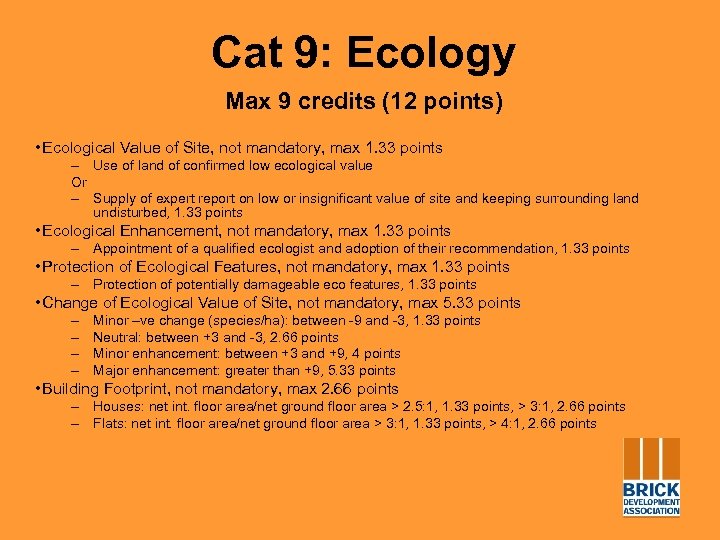
Cat 9: Ecology Max 9 credits (12 points) • Ecological Value of Site, not mandatory, max 1. 33 points – Use of land of confirmed low ecological value Or – Supply of expert report on low or insignificant value of site and keeping surrounding land undisturbed, 1. 33 points • Ecological Enhancement, not mandatory, max 1. 33 points – Appointment of a qualified ecologist and adoption of their recommendation, 1. 33 points • Protection of Ecological Features, not mandatory, max 1. 33 points – Protection of potentially damageable eco features, 1. 33 points • Change of Ecological Value of Site, not mandatory, max 5. 33 points – – Minor –ve change (species/ha): between -9 and -3, 1. 33 points Neutral: between +3 and -3, 2. 66 points Minor enhancement: between +3 and +9, 4 points Major enhancement: greater than +9, 5. 33 points • Building Footprint, not mandatory, max 2. 66 points – Houses: net int. floor area/net ground floor area > 2. 5: 1, 1. 33 points, > 3: 1, 2. 66 points – Flats: net int. floor area/net ground floor area > 3: 1, 1. 33 points, > 4: 1, 2. 66 points
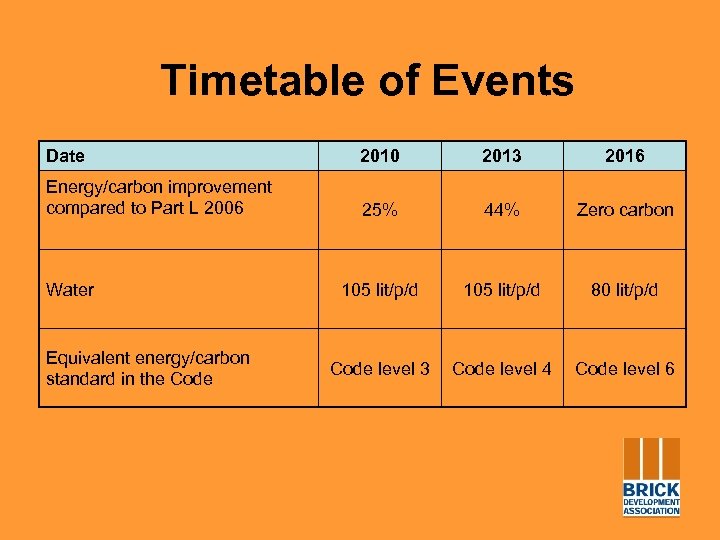
Timetable of Events Date 2010 2013 2016 Energy/carbon improvement compared to Part L 2006 25% 44% Zero carbon 105 lit/p/d 80 lit/p/d Code level 3 Code level 4 Code level 6 Water Equivalent energy/carbon standard in the Code
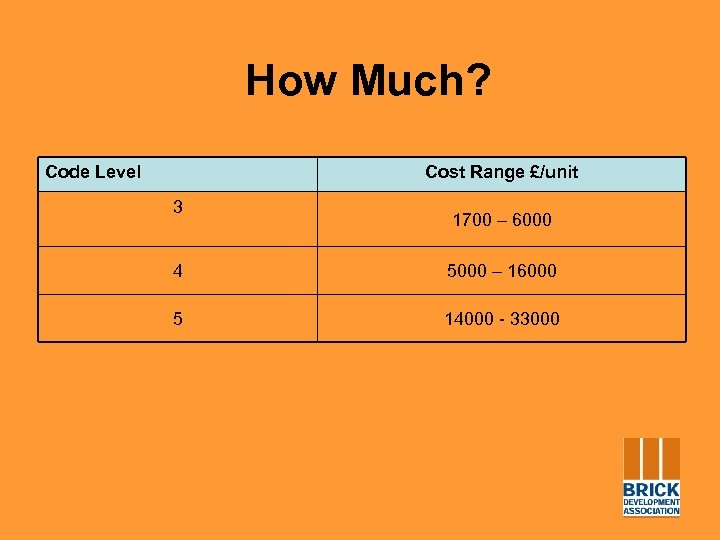
How Much? Code Level Cost Range £/unit 3 1700 – 6000 4 5000 – 16000 5 14000 - 33000
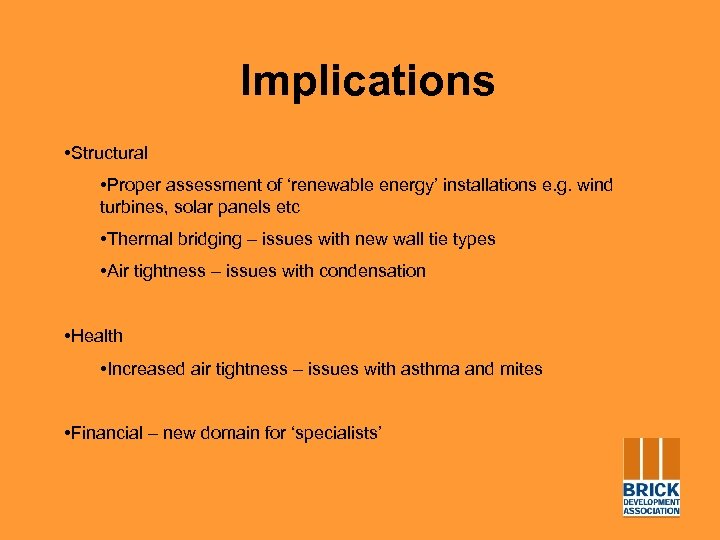
Implications • Structural • Proper assessment of ‘renewable energy’ installations e. g. wind turbines, solar panels etc • Thermal bridging – issues with new wall tie types • Air tightness – issues with condensation • Health • Increased air tightness – issues with asthma and mites • Financial – new domain for ‘specialists’
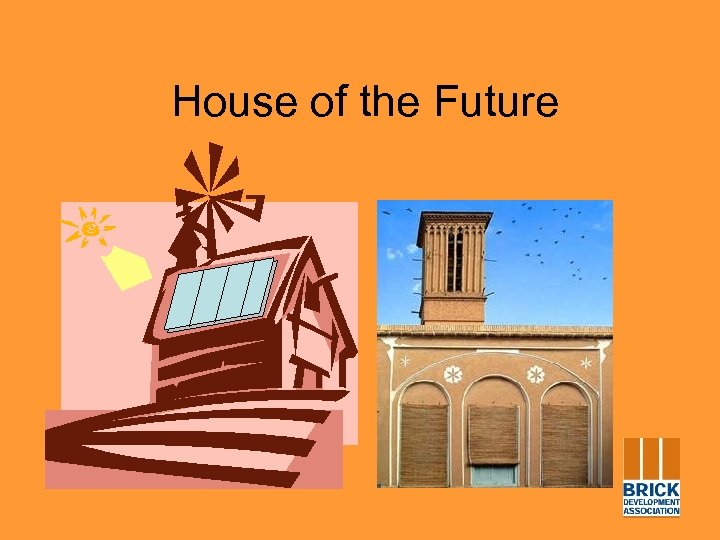
House of the Future
Thank you for your time.
Скачать презентацию The Code for Sustainable Homes Climate Change
f2c6fd66c1776741c2f080b735fa5300.ppt