


 Скачать презентацию THE COCKCROFT INSTITUTE of ACCELERATOR SCIENCE AND TECHNOLOGY
82a853030439a1f685e5208036452220.ppt
- Количество слайдов: 59
 THE COCKCROFT INSTITUTE of ACCELERATOR SCIENCE AND TECHNOLOGY Research and Development for Future Accelerators Swapan Chattopadhyay Presentation at the Io. P Particle Physics Conference at Lancaster University March 31, 2008
 THE COCKCROFT INSTITUTE of ACCELERATOR SCIENCE AND TECHNOLOGY Outline Hadron Colliders (LHC upgrade) * Electron-Hadron Colliders (LHe. C) Electron-Positron Colliders (B-factories/LC)* Neutrino Factory & Beta-beams* Muon Colliders Advanced Concepts
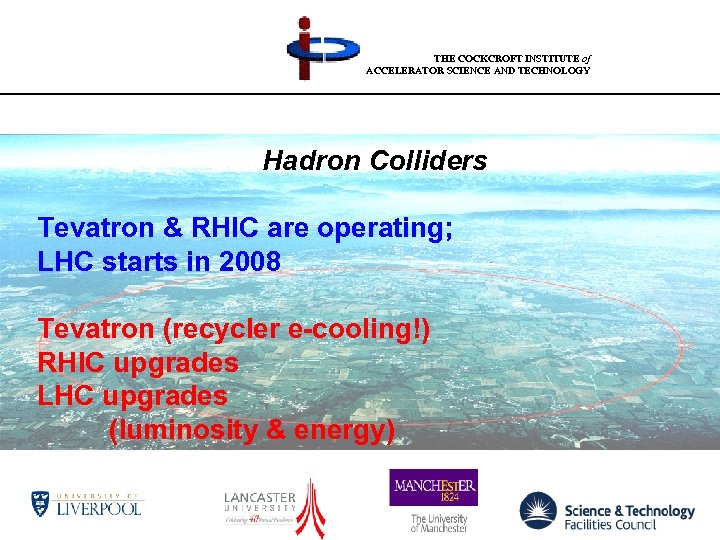 THE COCKCROFT INSTITUTE of ACCELERATOR SCIENCE AND TECHNOLOGY Hadron Colliders Tevatron & RHIC are operating; LHC starts in 2008 Tevatron (recycler e-cooling!) RHIC upgrades LHC upgrades (luminosity & energy)
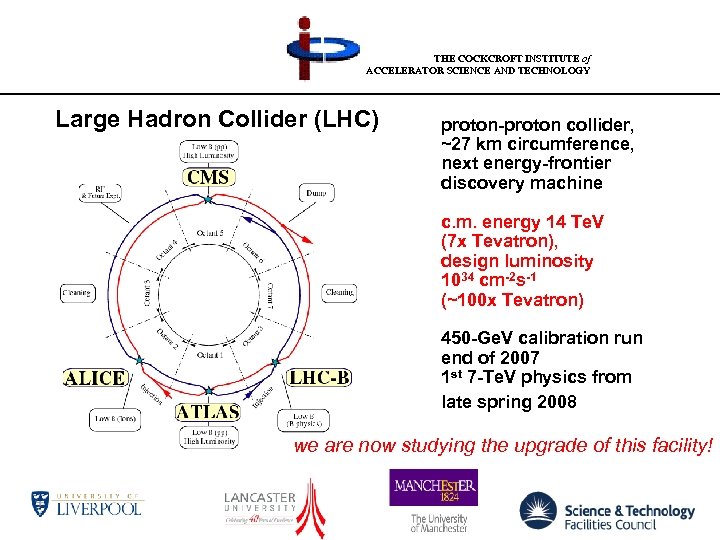 THE COCKCROFT INSTITUTE of ACCELERATOR SCIENCE AND TECHNOLOGY Large Hadron Collider (LHC) proton-proton collider, ~27 km circumference, next energy-frontier discovery machine c. m. energy 14 Te. V (7 x Tevatron), design luminosity 1034 cm-2 s-1 (~100 x Tevatron) 450 -Ge. V calibration run end of 2007 1 st 7 -Te. V physics from late spring 2008 we are now studying the upgrade of this facility!
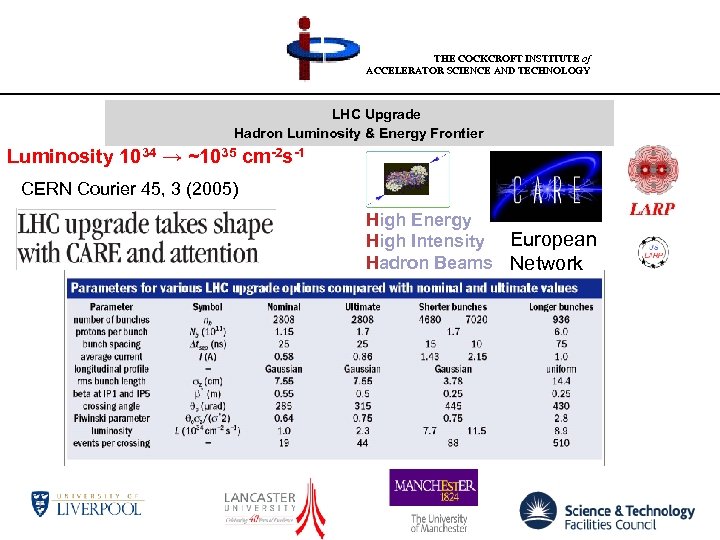 THE COCKCROFT INSTITUTE of ACCELERATOR SCIENCE AND TECHNOLOGY LHC Upgrade Hadron Luminosity & Energy Frontier Luminosity 1034 → ~1035 cm-2 s-1 CERN Courier 45, 3 (2005) High Energy High Intensity European Hadron Beams Network
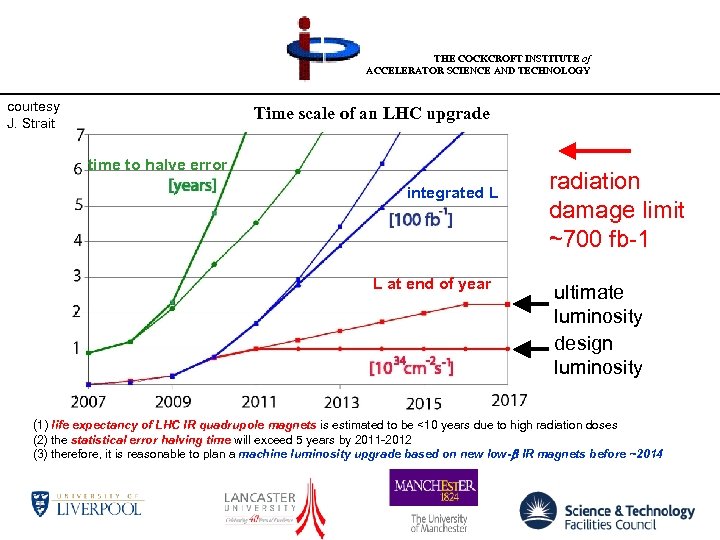 THE COCKCROFT INSTITUTE of ACCELERATOR SCIENCE AND TECHNOLOGY courtesy J. Strait Time scale of an LHC upgrade time to halve error integrated L L at end of year radiation damage limit ~700 fb-1 ultimate luminosity design luminosity (1) life expectancy of LHC IR quadrupole magnets is estimated to be <10 years due to high radiation doses (2) the statistical error halving time will exceed 5 years by 2011 -2012 (3) therefore, it is reasonable to plan a machine luminosity upgrade based on new low- b IR magnets before ~2014
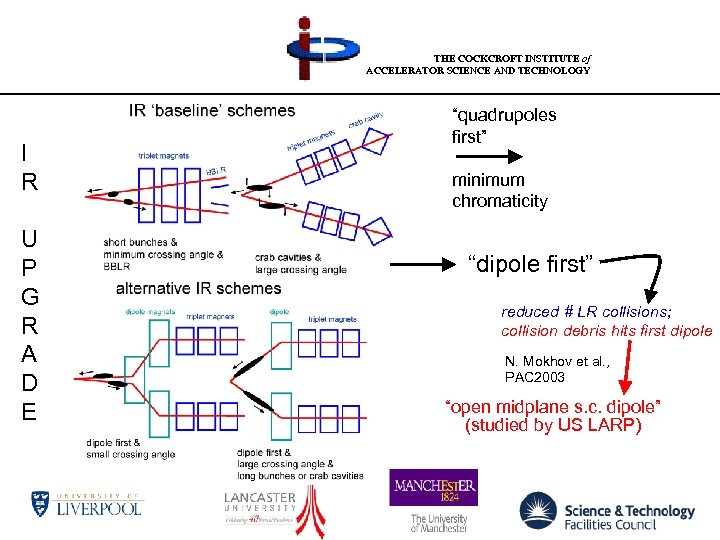 THE COCKCROFT INSTITUTE of ACCELERATOR SCIENCE AND TECHNOLOGY I R U P G R A D E “quadrupoles first” minimum chromaticity “dipole first” reduced # LR collisions; collision debris hits first dipole N. Mokhov et al. , PAC 2003 “open midplane s. c. dipole” (studied by US LARP)
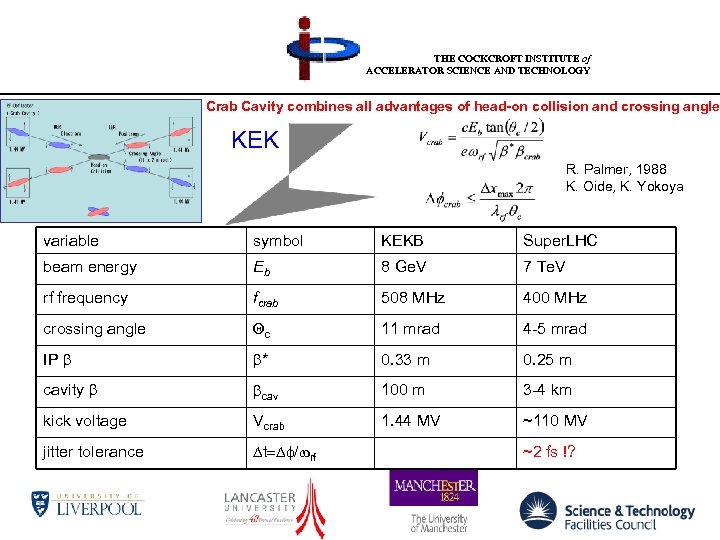 THE COCKCROFT INSTITUTE of ACCELERATOR SCIENCE AND TECHNOLOGY Crab Cavity combines all advantages of head-on collision and crossing angle KEK R. Palmer, 1988 K. Oide, K. Yokoya variable symbol KEKB Super. LHC beam energy Eb 8 Ge. V 7 Te. V rf frequency fcrab 508 MHz 400 MHz crossing angle Qc 11 mrad 4 -5 mrad IP b b* 0. 33 m 0. 25 m cavity b bcav 100 m 3 -4 km kick voltage Vcrab 1. 44 MV ~110 MV jitter tolerance Dt=Df/wrf ~2 fs !?
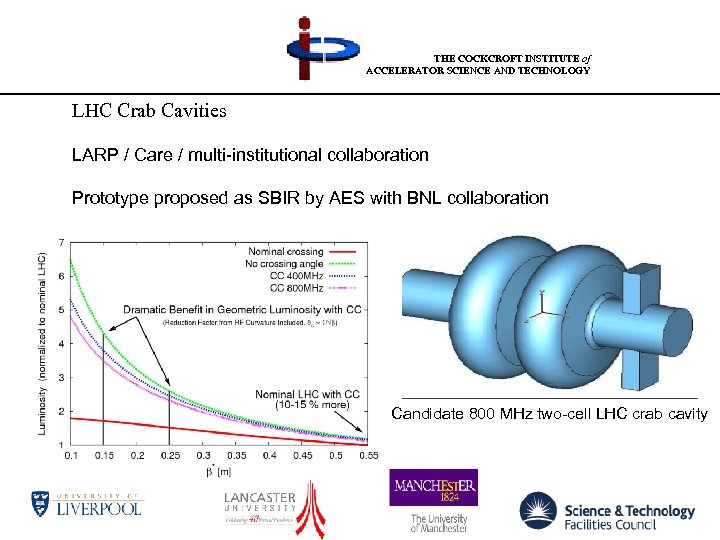 THE COCKCROFT INSTITUTE of ACCELERATOR SCIENCE AND TECHNOLOGY LHC Crab Cavities LARP / Care / multi-institutional collaboration Prototype proposed as SBIR by AES with BNL collaboration Candidate 800 MHz two-cell LHC crab cavity
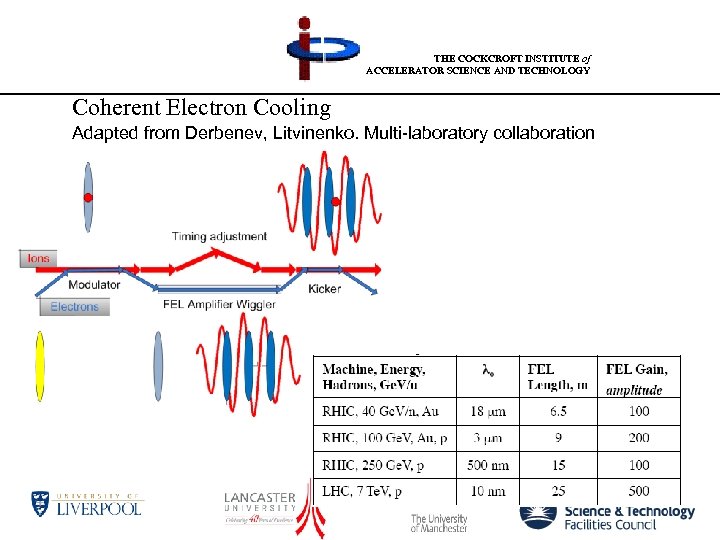 THE COCKCROFT INSTITUTE of ACCELERATOR SCIENCE AND TECHNOLOGY Coherent Electron Cooling Adapted from Derbenev, Litvinenko. Multi-laboratory collaboration
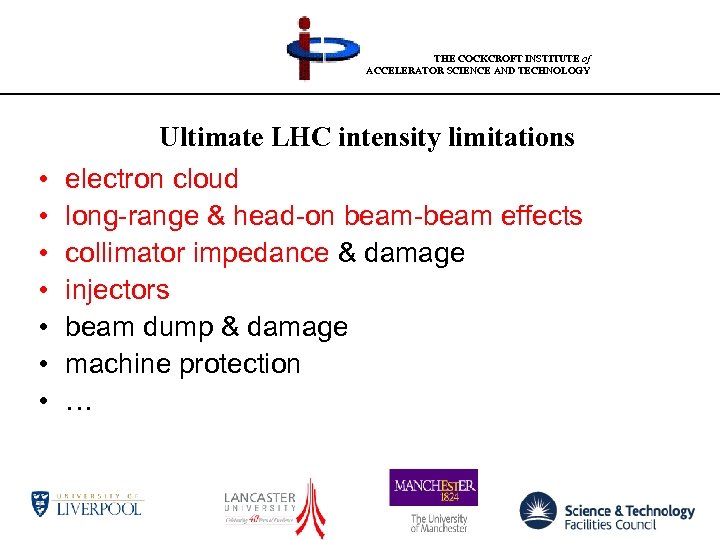 THE COCKCROFT INSTITUTE of ACCELERATOR SCIENCE AND TECHNOLOGY • • Ultimate LHC intensity limitations electron cloud long-range & head-on beam-beam effects collimator impedance & damage injectors beam dump & damage machine protection …
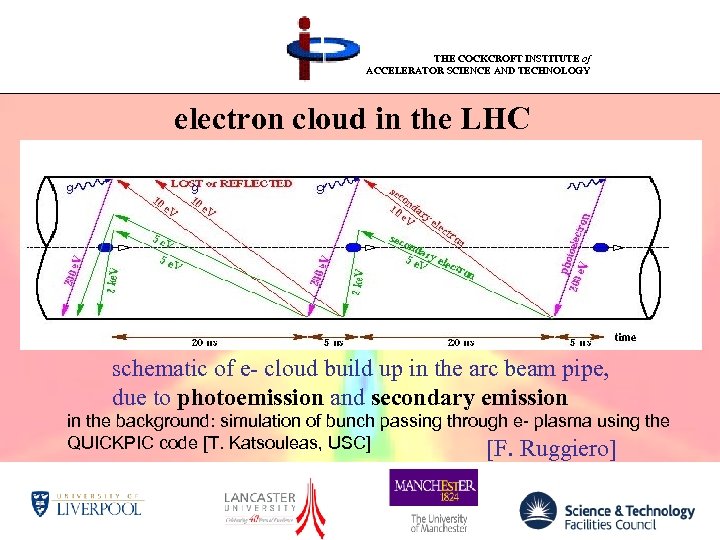 THE COCKCROFT INSTITUTE of ACCELERATOR SCIENCE AND TECHNOLOGY electron cloud in the LHC schematic of e- cloud build up in the arc beam pipe, due to photoemission and secondary emission in the background: simulation of bunch passing through e- plasma using the QUICKPIC code [T. Katsouleas, USC] [F. Ruggiero]
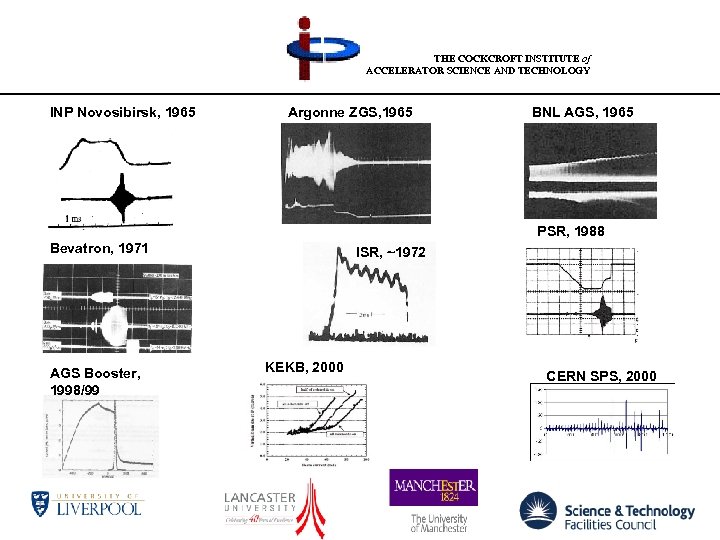 THE COCKCROFT INSTITUTE of ACCELERATOR SCIENCE AND TECHNOLOGY INP Novosibirsk, 1965 Argonne ZGS, 1965 BNL AGS, 1965 PSR, 1988 Bevatron, 1971 AGS Booster, 1998/99 ISR, ~1972 KEKB, 2000 CERN SPS, 2000
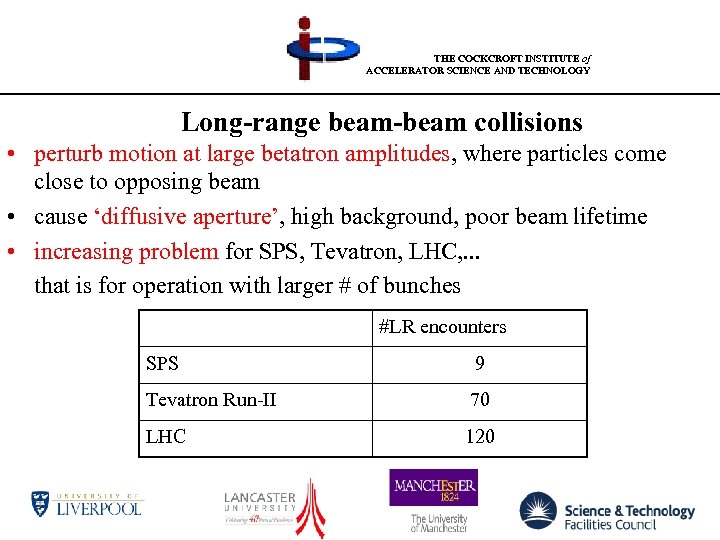 THE COCKCROFT INSTITUTE of ACCELERATOR SCIENCE AND TECHNOLOGY Long-range beam-beam collisions • perturb motion at large betatron amplitudes, where particles come close to opposing beam • cause ‘diffusive aperture’, high background, poor beam lifetime • increasing problem for SPS, Tevatron, LHC, . . . that is for operation with larger # of bunches #LR encounters SPS 9 Tevatron Run-II 70 LHC 120
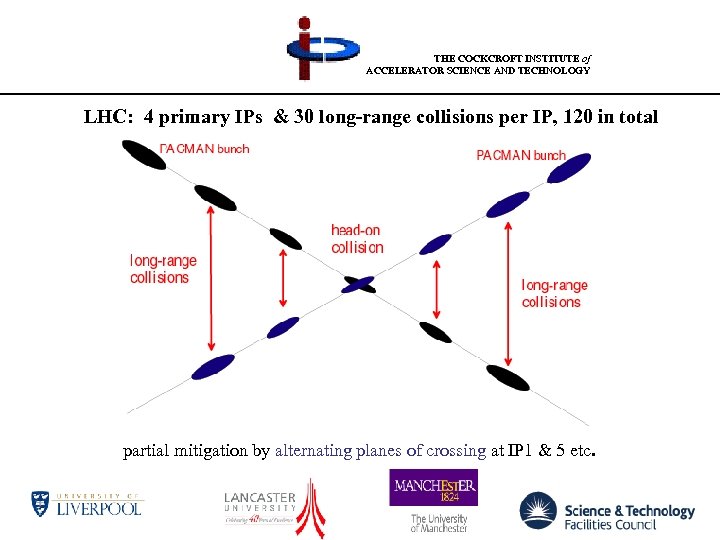 THE COCKCROFT INSTITUTE of ACCELERATOR SCIENCE AND TECHNOLOGY LHC: 4 primary IPs & 30 long-range collisions per IP, 120 in total partial mitigation by alternating planes of crossing at IP 1 & 5 etc.
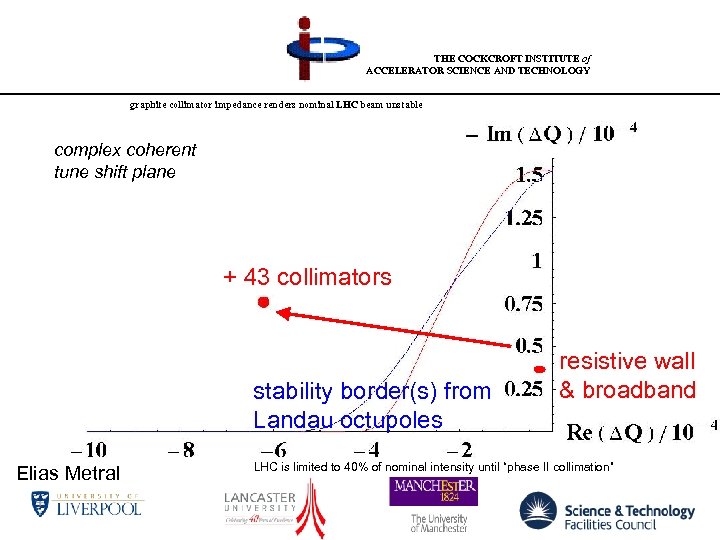 THE COCKCROFT INSTITUTE of ACCELERATOR SCIENCE AND TECHNOLOGY graphite collimator impedance renders nominal LHC beam unstable complex coherent tune shift plane + 43 collimators stability border(s) from Landau octupoles Elias Metral resistive wall & broadband LHC is limited to 40% of nominal intensity until “phase II collimation”
 THE COCKCROFT INSTITUTE of ACCELERATOR SCIENCE AND TECHNOLOGY LHC phase-2 collimation options • consumable low-impedance collimators (rotating metal wheels; prototype from US LARP / SLAC to be installed in 2008) • nonlinear collimation; pairs of sextupoles to deflect halo particles to larger amplitudes & open collimator gaps • use crystals to bend halo particles to larger amplitudes & open collimator gaps
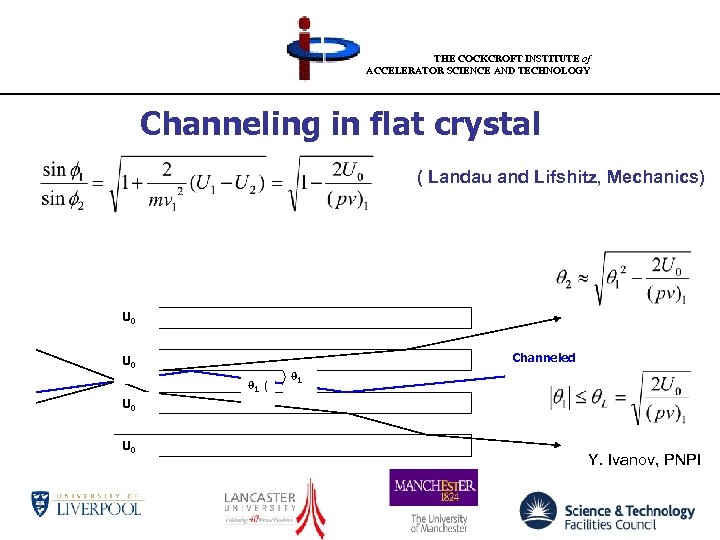 THE COCKCROFT INSTITUTE of ACCELERATOR SCIENCE AND TECHNOLOGY Channeling in flat crystal ( Landau and Lifshitz, Mechanics) U 0 Channeled U 0 θ 1 U 0 Y. Ivanov, PNPI
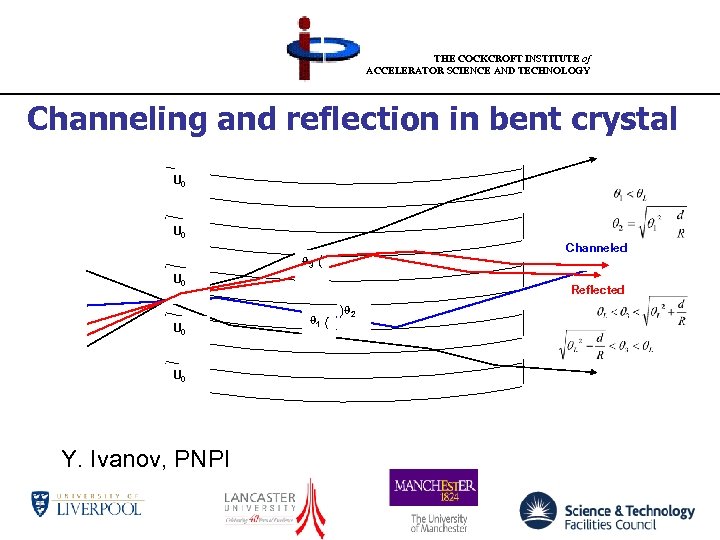 THE COCKCROFT INSTITUTE of ACCELERATOR SCIENCE AND TECHNOLOGY Channeling and reflection in bent crystal U 0 Channeled θ 3 U 0 U 0 Y. Ivanov, PNPI Reflected θ 1 θ 2
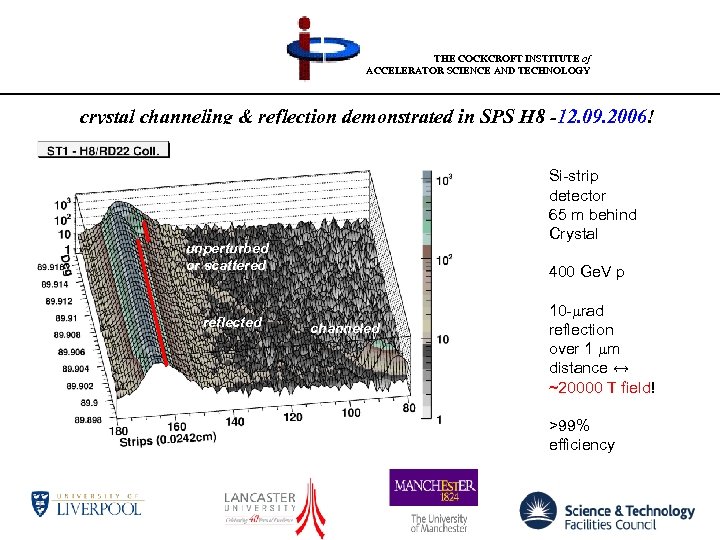 THE COCKCROFT INSTITUTE of ACCELERATOR SCIENCE AND TECHNOLOGY crystal channeling & reflection demonstrated in SPS H 8 -12. 09. 2006! Si-strip detector 65 m behind Crystal unperturbed or scattered reflected 400 Ge. V p channeled 10 -mrad reflection over 1 mm distance ↔ ~20000 T field! >99% efficiency
 THE COCKCROFT INSTITUTE of ACCELERATOR SCIENCE AND TECHNOLOGY ultimate LHC “upgrade”: higher beam energy 7 Te. V→ 14 (21) Te. V? R&D on stronger magnets
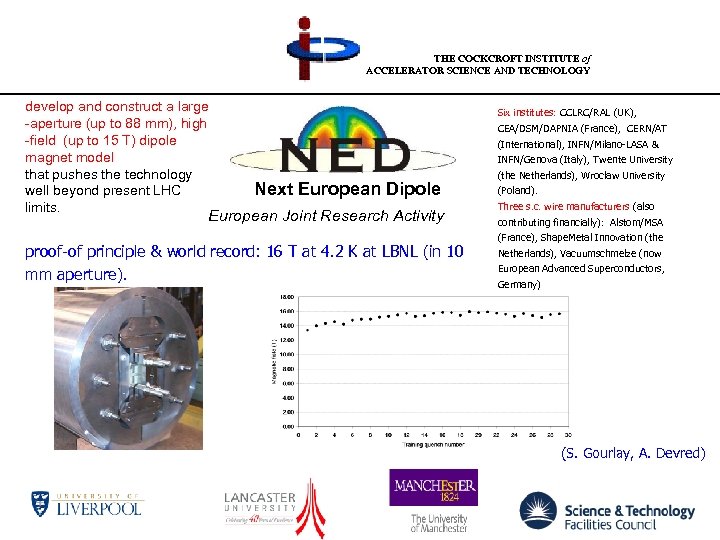 THE COCKCROFT INSTITUTE of ACCELERATOR SCIENCE AND TECHNOLOGY develop and construct a large -aperture (up to 88 mm), high -field (up to 15 T) dipole magnet model that pushes the technology well beyond present LHC limits. Six institutes: CCLRC/RAL (UK), CEA/DSM/DAPNIA (France), CERN/AT (International), INFN/Milano-LASA & INFN/Genova (Italy), Twente University Next European Dipole European Joint Research Activity proof-of principle & world record: 16 T at 4. 2 K at LBNL (in 10 mm aperture). (the Netherlands), Wroclaw University (Poland). Three s. c. wire manufacturers (also contributing financially): Alstom/MSA (France), Shape. Metal Innovation (the Netherlands), Vacuumschmelze (now European Advanced Superconductors, Germany) (S. Gourlay, A. Devred)
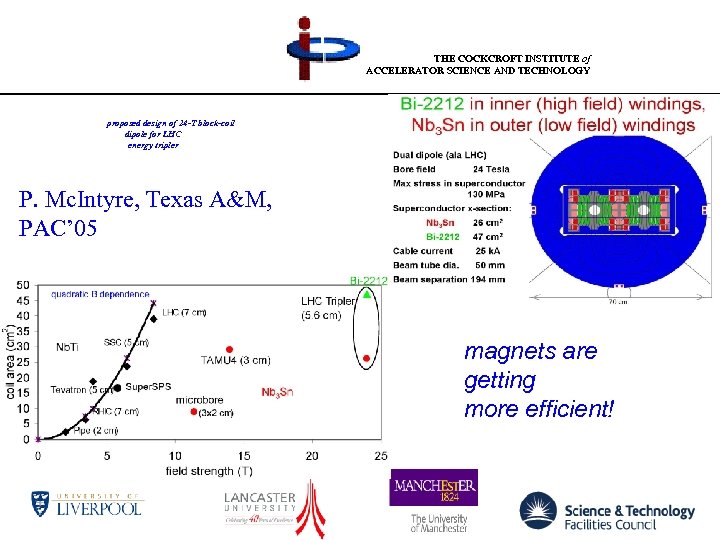 THE COCKCROFT INSTITUTE of ACCELERATOR SCIENCE AND TECHNOLOGY proposed design of 24 -T block-coil dipole for LHC energy tripler P. Mc. Intyre, Texas A&M, PAC’ 05 magnets are getting more efficient!
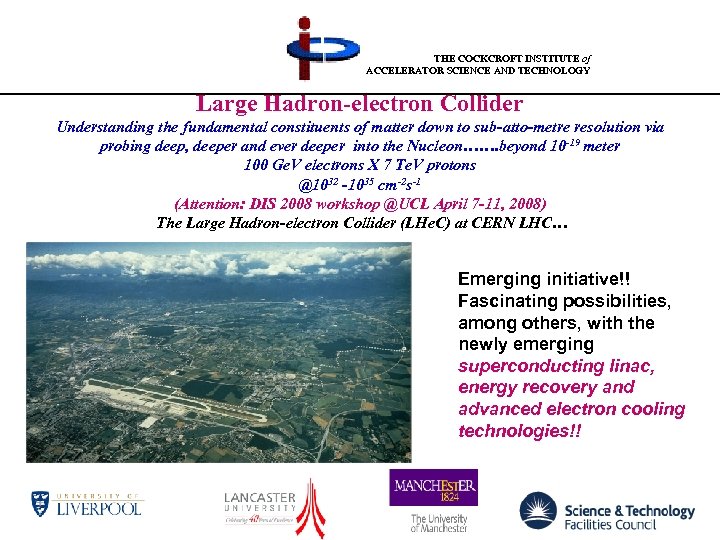 THE COCKCROFT INSTITUTE of ACCELERATOR SCIENCE AND TECHNOLOGY Large Hadron-electron Collider Understanding the fundamental constituents of matter down to sub-atto-metre resolution via probing deep, deeper and ever deeper into the Nucleon……. beyond 10 -19 meter 100 Ge. V electrons X 7 Te. V protons @1032 -1035 cm-2 s-1 (Attention: DIS 2008 workshop @UCL April 7 -11, 2008) The Large Hadron-electron Collider (LHe. C) at CERN LHC… Emerging initiative!! Fascinating possibilities, among others, with the newly emerging superconducting linac, energy recovery and advanced electron cooling technologies!!
 THE COCKCROFT INSTITUTE of ACCELERATOR SCIENCE AND TECHNOLOGY e+e- colliders • • KEK-B → Super KEK-B, 3. 5 x 8 Ge. V, ~2010 Super-B, 4 x 7 Ge. V, ~2010 ILC, 0. 25 x 0. 25 Te. V, ~2016? CLIC, 0. 5 x 0. 5 Te. V→ 2. 5 x 2. 5 Te. V, ~2020?
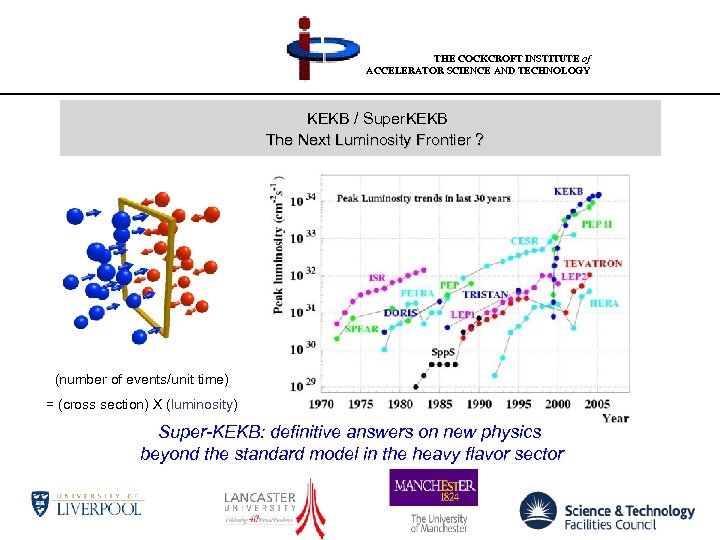 THE COCKCROFT INSTITUTE of ACCELERATOR SCIENCE AND TECHNOLOGY KEKB / Super. KEKB The Next Luminosity Frontier ? (number of events/unit time) = (cross section) X (luminosity) Super-KEKB: definitive answers on new physics beyond the standard model in the heavy flavor sector
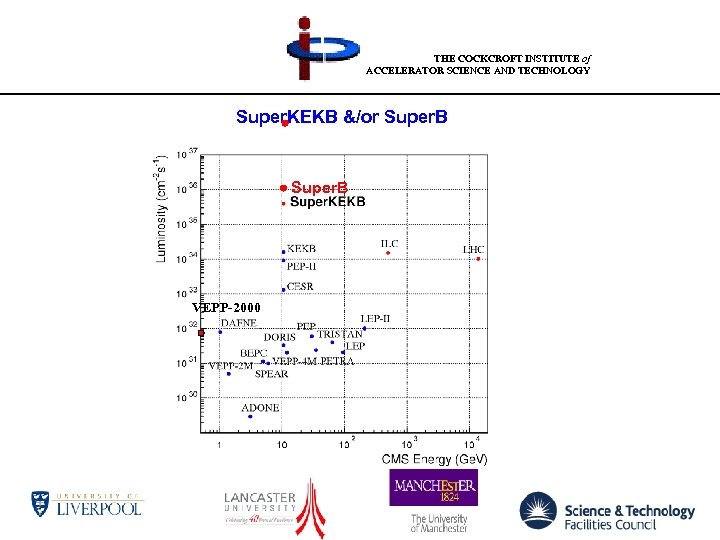 THE COCKCROFT INSTITUTE of ACCELERATOR SCIENCE AND TECHNOLOGY Super. KEKB &/or Super. B VEPP-2000
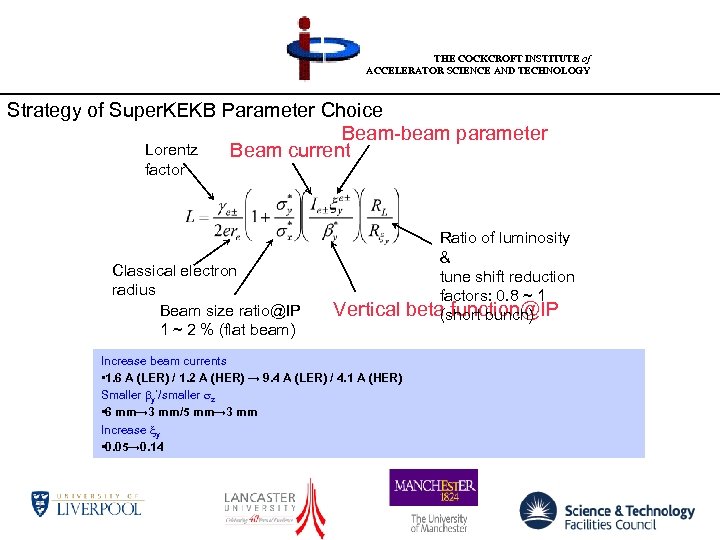 THE COCKCROFT INSTITUTE of ACCELERATOR SCIENCE AND TECHNOLOGY Strategy of Super. KEKB Parameter Choice Beam-beam parameter Lorentz Beam current factor Classical electron radius Beam size ratio@IP 1 ~ 2 % (flat beam) Vertical Increase beam currents • 1. 6 A (LER) / 1. 2 A (HER) → 9. 4 A (LER) / 4. 1 A (HER) Smaller by*/smaller sz • 6 mm→ 3 mm/5 mm→ 3 mm Increase xy • 0. 05→ 0. 14 Ratio of luminosity & tune shift reduction factors: 0. 8 ~ 1 beta function@IP (short bunch)
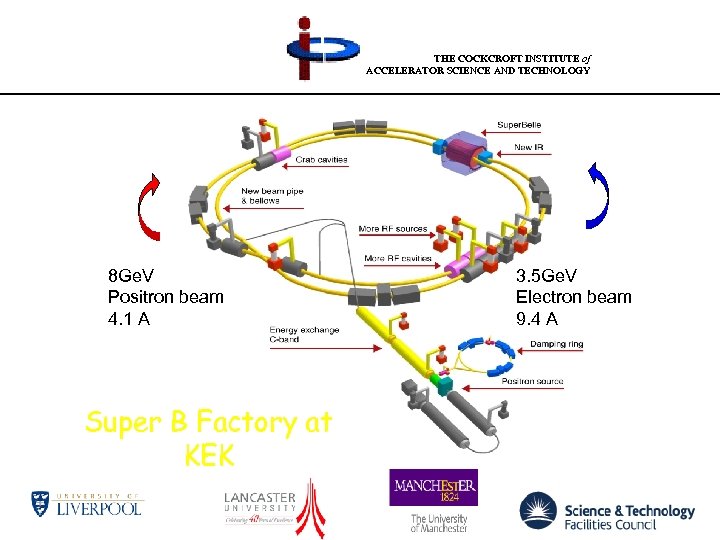 THE COCKCROFT INSTITUTE of ACCELERATOR SCIENCE AND TECHNOLOGY 8 Ge. V Positron beam 4. 1 A Super B Factory at KEK 3. 5 Ge. V Electron beam 9. 4 A
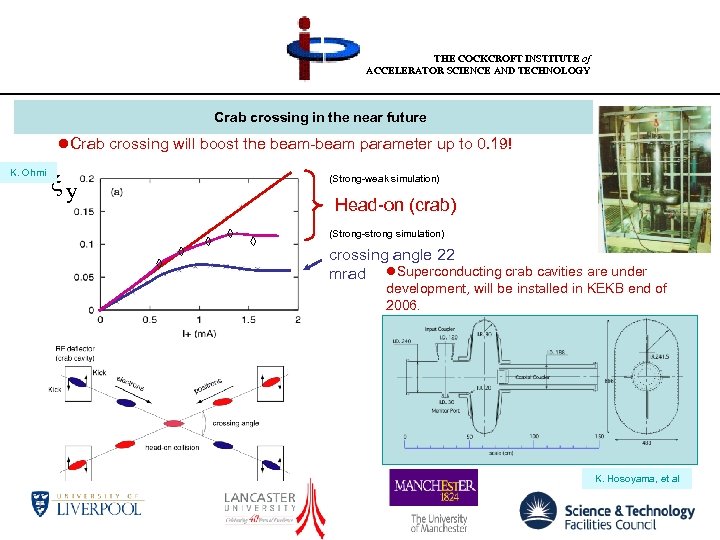 THE COCKCROFT INSTITUTE of ACCELERATOR SCIENCE AND TECHNOLOGY Crab crossing in the near future Crab crossing will boost the beam-beam parameter up to 0. 19! K. Ohmi ξy (Strong-weak simulation) Head-on (crab) ◊ ◊ ◊ (Strong-strong simulation) crossing angle 22 mrad Superconducting crab cavities are under development, will be installed in KEKB end of 2006. K. Hosoyama, et al
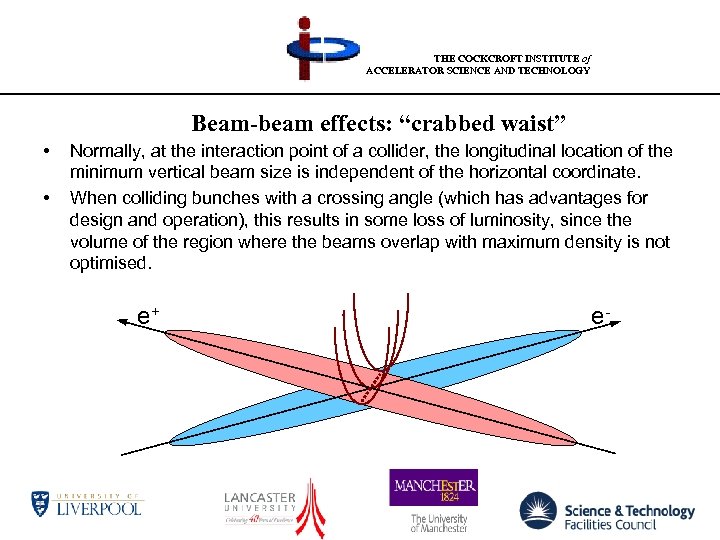 THE COCKCROFT INSTITUTE of ACCELERATOR SCIENCE AND TECHNOLOGY Beam-beam effects: “crabbed waist” • • Normally, at the interaction point of a collider, the longitudinal location of the minimum vertical beam size is independent of the horizontal coordinate. When colliding bunches with a crossing angle (which has advantages for design and operation), this results in some loss of luminosity, since the volume of the region where the beams overlap with maximum density is not optimised. e+ e-
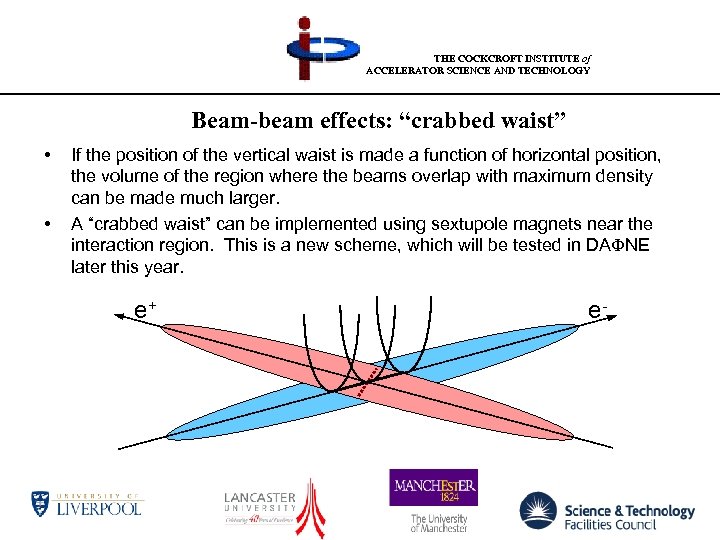 THE COCKCROFT INSTITUTE of ACCELERATOR SCIENCE AND TECHNOLOGY Beam-beam effects: “crabbed waist” • • If the position of the vertical waist is made a function of horizontal position, the volume of the region where the beams overlap with maximum density can be made much larger. A “crabbed waist” can be implemented using sextupole magnets near the interaction region. This is a new scheme, which will be tested in DA NE later this year. e+ e-
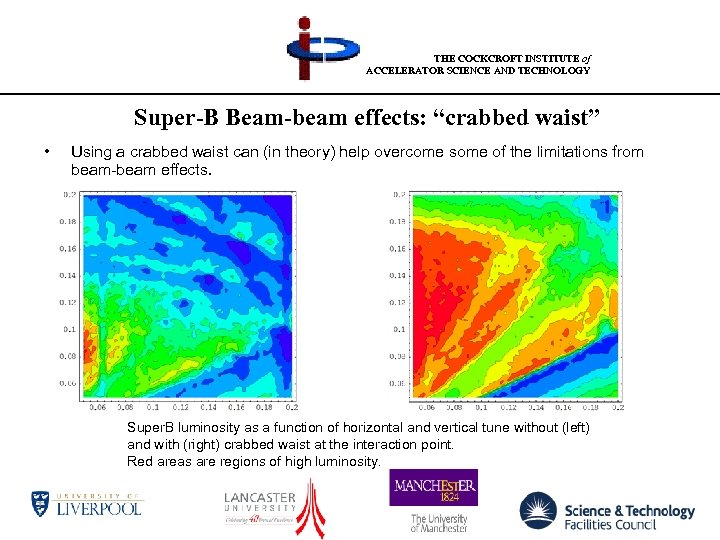 THE COCKCROFT INSTITUTE of ACCELERATOR SCIENCE AND TECHNOLOGY Super-B Beam-beam effects: “crabbed waist” • Using a crabbed waist can (in theory) help overcome some of the limitations from beam-beam effects. Super. B luminosity as a function of horizontal and vertical tune without (left) and with (right) crabbed waist at the interaction point. Red areas are regions of high luminosity.
 THE COCKCROFT INSTITUTE of ACCELERATOR SCIENCE AND TECHNOLOGY CLIC Compact Linear Collider • physics: probing beyond the standard model: origin of mass, unification of forces, origin of flavors • complementary with LHC • key features of CLIC: Ø high gradient ~100 MV/m→high frequency ~11. 6 GHz Ø two-beam acceleration: energy stored in drive beam, transport over long distances with small losses, rf power generated locally where required Ø drive beam produced in central injector; fully loaded normal conducting linac (~96% efficient) followed by rf multiplication and power compression
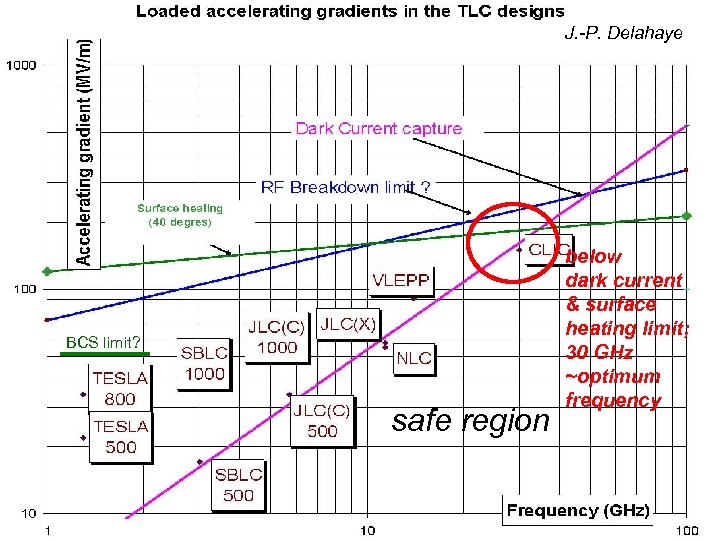 J. -P. Delahaye THE COCKCROFT INSTITUTE of ACCELERATOR SCIENCE AND TECHNOLOGY BCS limit? safe region below dark current & surface heating limit; 30 GHz ~optimum frequency
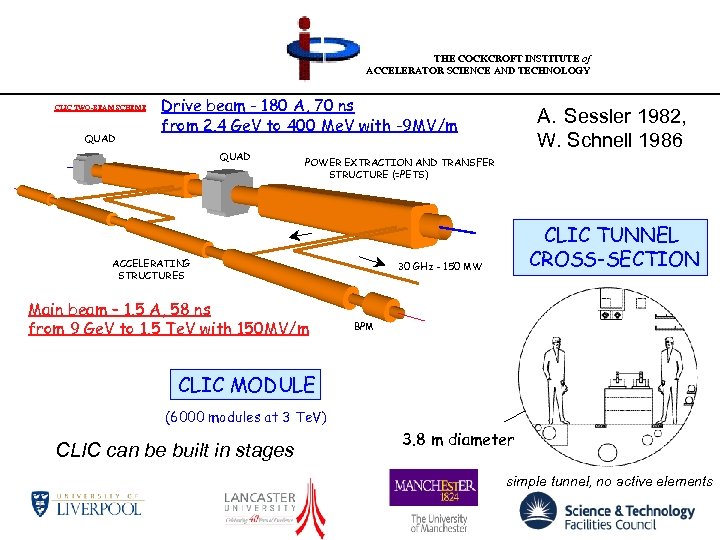 THE COCKCROFT INSTITUTE of ACCELERATOR SCIENCE AND TECHNOLOGY CLIC TWO-BEAM SCHEME QUAD Drive beam - 180 A, 70 ns from 2. 4 Ge. V to 400 Me. V with -9 MV/m QUAD A. Sessler 1982, W. Schnell 1986 POWER EXTRACTION AND TRANSFER STRUCTURE (=PETS) ACCELERATING STRUCTURES Main beam – 1. 5 A, 58 ns from 9 Ge. V to 1. 5 Te. V with 150 MV/m CLIC TUNNEL CROSS-SECTION 30 GHz - 150 MW BPM CLIC MODULE (6000 modules at 3 Te. V) CLIC can be built in stages 3. 8 m diameter simple tunnel, no active elements
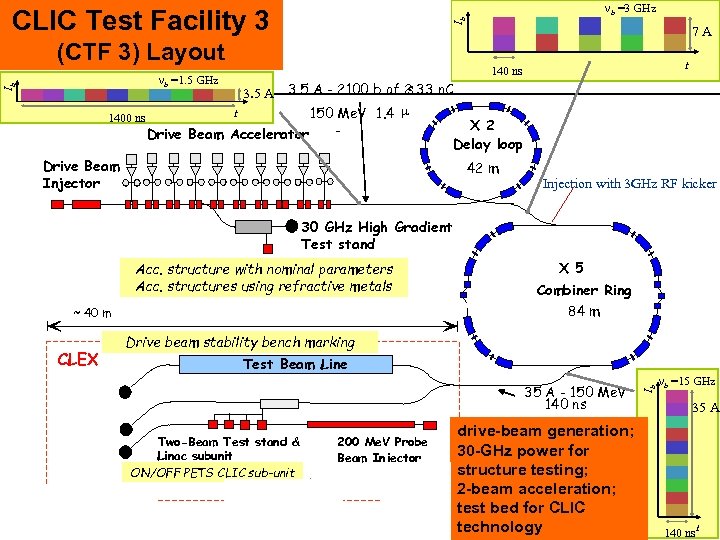 nb =3 GHz Ib CLIC Test Facility 3 (CTF 3) Layout 7 A THE COCKCROFT INSTITUTE of ACCELERATOR SCIENCE 140 ns AND TECHNOLOGY nb =1. 5 GHz t Ib s 3. 5 A - 2100 b of 2. 33 n. C t 150 Me. V 1. 4 m 1400 ns X 2 Drive Beam Accelerator Delay loop Drive Beam Injector 42 m Injection with 3 GHz RF kicker 30 GHz High Gradient Test stand Acc. structure with nominal parameters Acc. structures using refractive metals Combiner Ring 84 m ~ 40 m Drive beam stability bench marking Test Beam Line 35 A - 150 Me. V 140 ns Two-Beam Test stand & Linac subunit ON/OFF PETS CLIC sub-unit 200 Me. V Probe Beam Injector drive-beam generation; 30 -GHz power for structure testing; 2 -beam acceleration; test bed for CLIC technology Ib CLEX X 5 nb =15 GHz 35 A 140 ns t
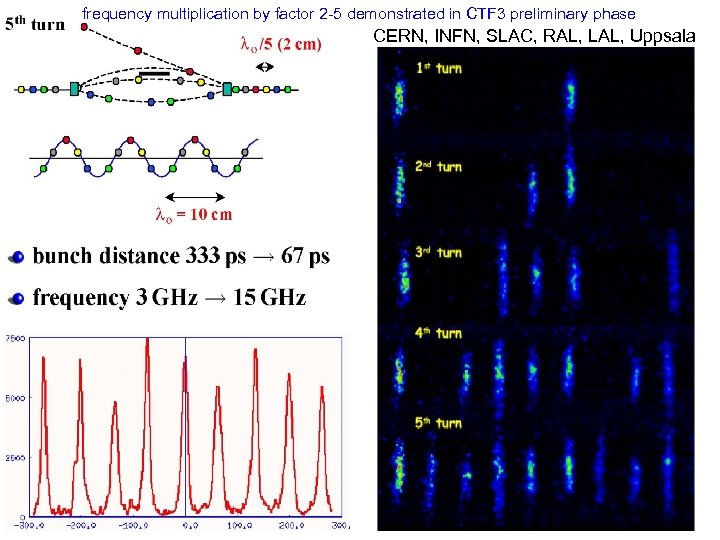 frequency multiplication by factor 2 -5 demonstrated in CTF 3 preliminary phase CERN, INFN, SLAC, RAL, LAL, Uppsala THE COCKCROFT INSTITUTE of ACCELERATOR SCIENCE AND TECHNOLOGY
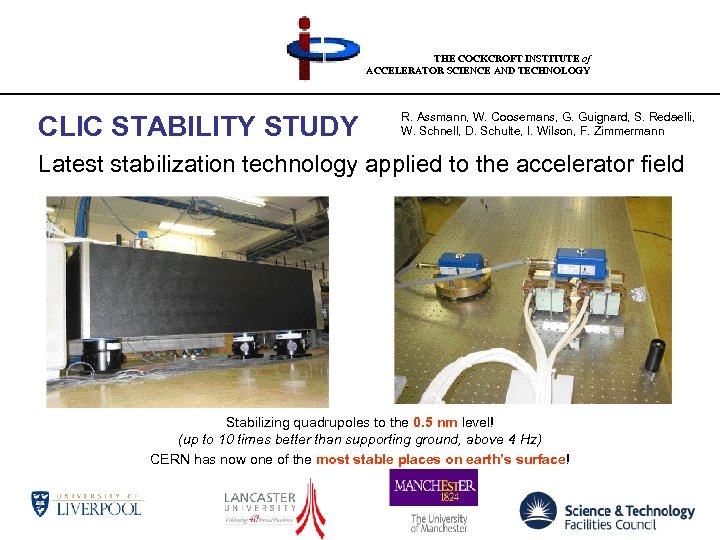 THE COCKCROFT INSTITUTE of ACCELERATOR SCIENCE AND TECHNOLOGY CLIC STABILITY STUDY R. Assmann, W. Coosemans, G. Guignard, S. Redaelli, W. Schnell, D. Schulte, I. Wilson, F. Zimmermann Latest stabilization technology applied to the accelerator field Stabilizing quadrupoles to the 0. 5 nm level! (up to 10 times better than supporting ground, above 4 Hz) CERN has now one of the most stable places on earth’s surface!
 THE COCKCROFT INSTITUTE of ACCELERATOR SCIENCE AND TECHNOLOGY International Linear Collider R&D v damping-ring prototype v final focus ATF-2 v polarized e+ source To date, ILC R&D has helped in a generic way future developments for linear colliders in general such as demonstrating achievement of low emittance, small spot -size, nanometer collisions, etc.
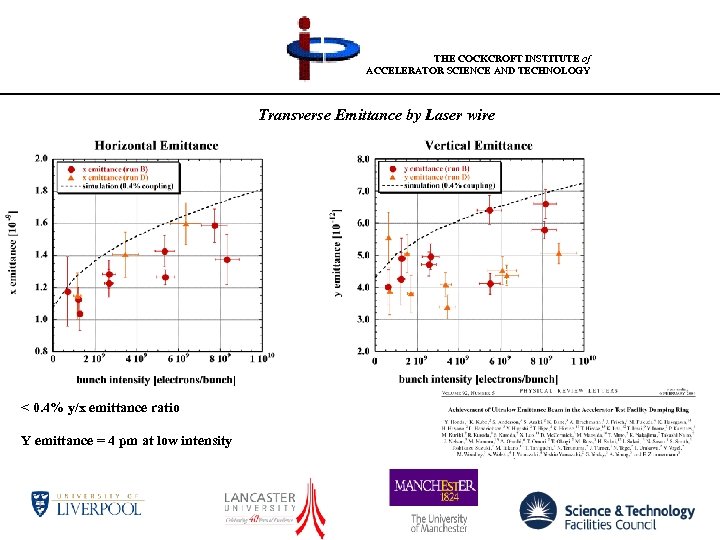 THE COCKCROFT INSTITUTE of ACCELERATOR SCIENCE AND TECHNOLOGY Transverse Emittance by Laser wire < 0. 4% y/x emittance ratio Y emittance = 4 pm at low intensity
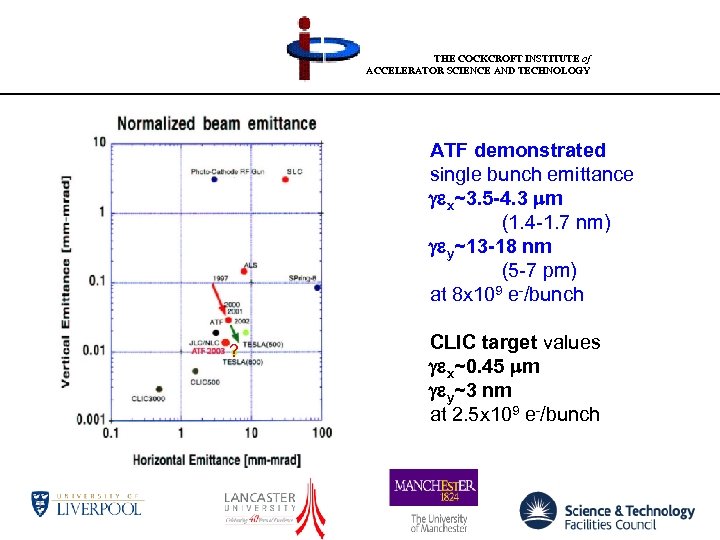 THE COCKCROFT INSTITUTE of ACCELERATOR SCIENCE AND TECHNOLOGY ATF demonstrated single bunch emittance gex~3. 5 -4. 3 mm (1. 4 -1. 7 nm) gey~13 -18 nm (5 -7 pm) at 8 x 10⁹ e-/bunch ? CLIC target values gex~0. 45 mm gey~3 nm at 2. 5 x 10⁹ e-/bunch
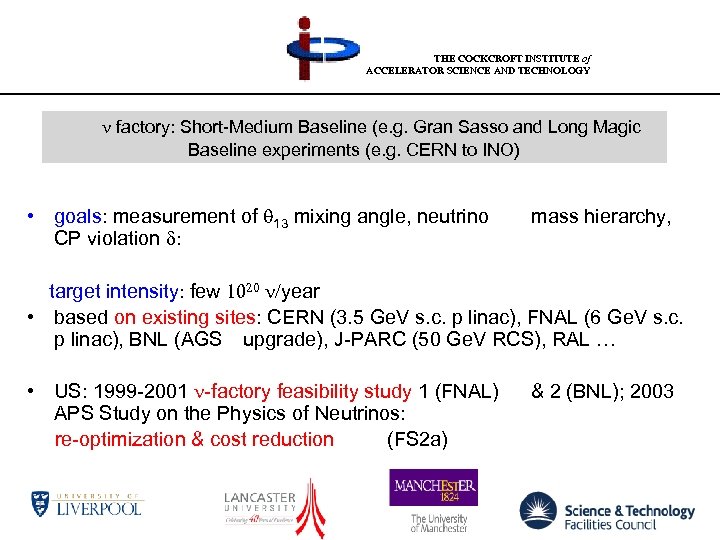 THE COCKCROFT INSTITUTE of ACCELERATOR SCIENCE AND TECHNOLOGY n factory: Short-Medium Baseline (e. g. Gran Sasso and Long Magic Baseline experiments (e. g. CERN to INO) • goals: measurement of q 13 mixing angle, neutrino CP violation d: mass hierarchy, target intensity: few 1020 n/year • based on existing sites: CERN (3. 5 Ge. V s. c. p linac), FNAL (6 Ge. V s. c. p linac), BNL (AGS upgrade), J-PARC (50 Ge. V RCS), RAL … • US: 1999 -2001 n-factory feasibility study 1 (FNAL) APS Study on the Physics of Neutrinos: re-optimization & cost reduction (FS 2 a) & 2 (BNL); 2003
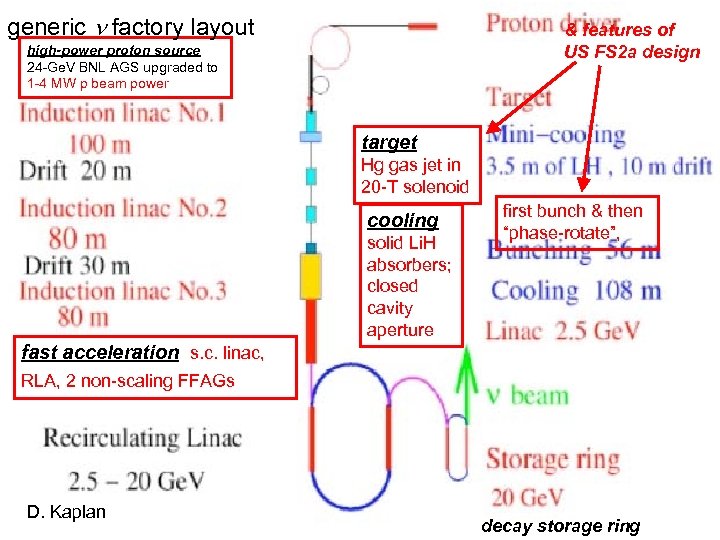 generic n factory layout high-power proton source 24 -Ge. V BNL AGS upgraded to 1 -4 MW p beam power & features of US THE COCKCROFT INSTITUTE of FS 2 a design ACCELERATOR SCIENCE AND TECHNOLOGY target Hg gas jet in 20 -T solenoid cooling solid Li. H absorbers; closed cavity aperture first bunch & then “phase-rotate”, fast acceleration s. c. linac, RLA, 2 non-scaling FFAGs D. Kaplan decay storage ring
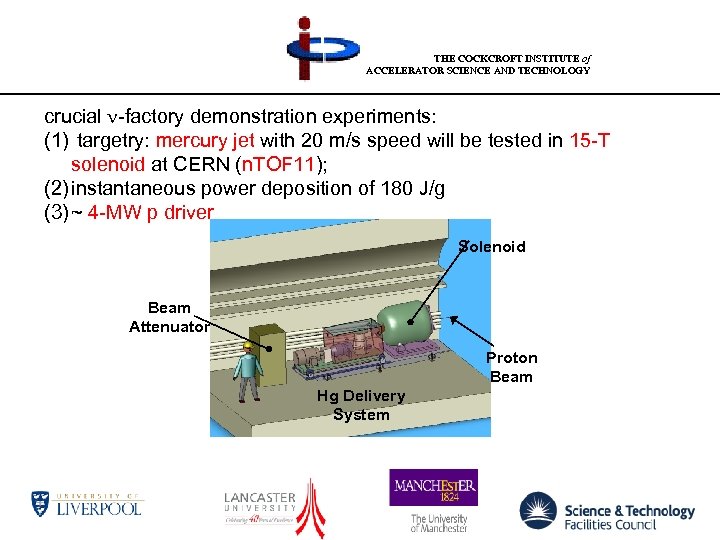 THE COCKCROFT INSTITUTE of ACCELERATOR SCIENCE AND TECHNOLOGY crucial n-factory demonstration experiments: (1) targetry: mercury jet with 20 m/s speed will be tested in 15 -T solenoid at CERN (n. TOF 11); (2) instantaneous power deposition of 180 J/g (3) ~ 4 -MW p driver Solenoid Beam Attenuator Proton Beam Hg Delivery System
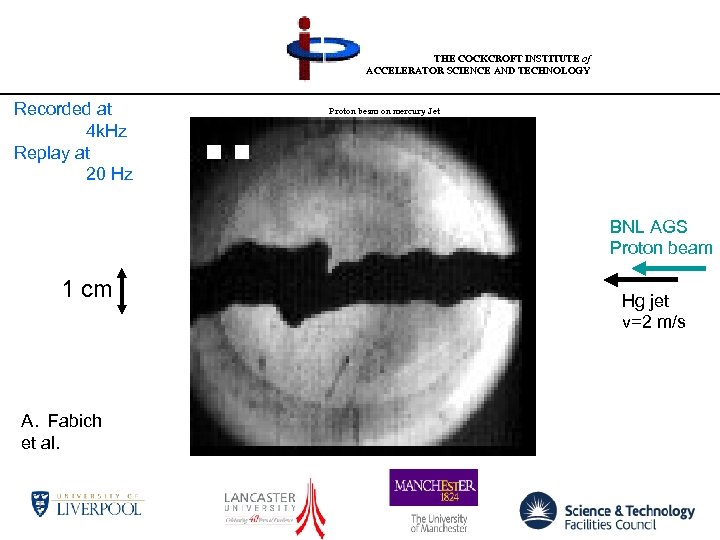 THE COCKCROFT INSTITUTE of ACCELERATOR SCIENCE AND TECHNOLOGY Recorded at 4 k. Hz Replay at 20 Hz Proton beam on mercury Jet BNL AGS Proton beam 1 cm A. Fabich et al. Hg jet v=2 m/s
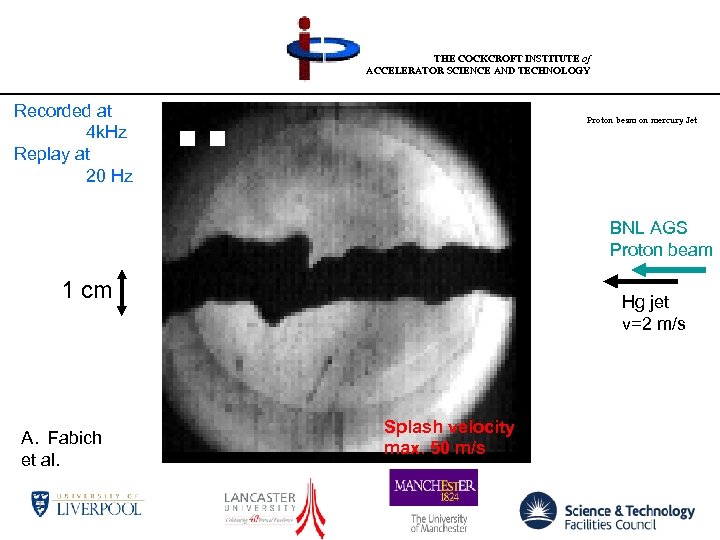 THE COCKCROFT INSTITUTE of ACCELERATOR SCIENCE AND TECHNOLOGY Recorded at 4 k. Hz Replay at 20 Hz Proton beam on mercury Jet BNL AGS Proton beam 1 cm A. Fabich et al. Hg jet v=2 m/s Splash velocity max. 50 m/s
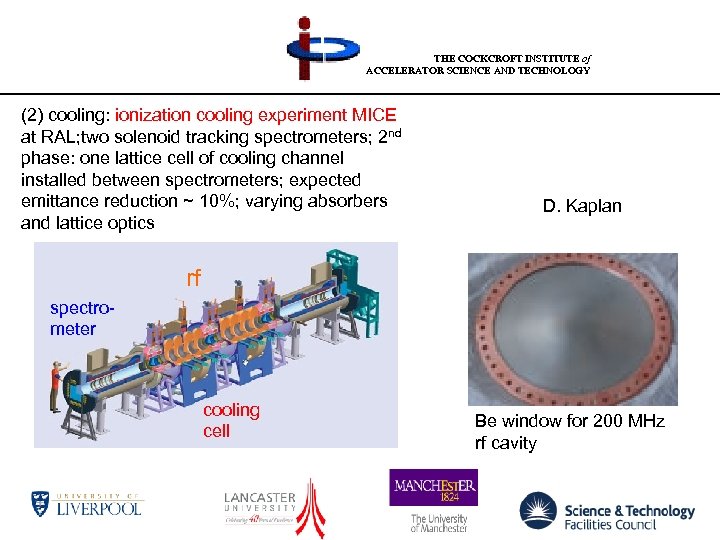 THE COCKCROFT INSTITUTE of ACCELERATOR SCIENCE AND TECHNOLOGY (2) cooling: ionization cooling experiment MICE at RAL; two solenoid tracking spectrometers; 2 nd phase: one lattice cell of cooling channel installed between spectrometers; expected emittance reduction ~ 10%; varying absorbers and lattice optics D. Kaplan rf spectrometer cooling cell Be window for 200 MHz rf cavity
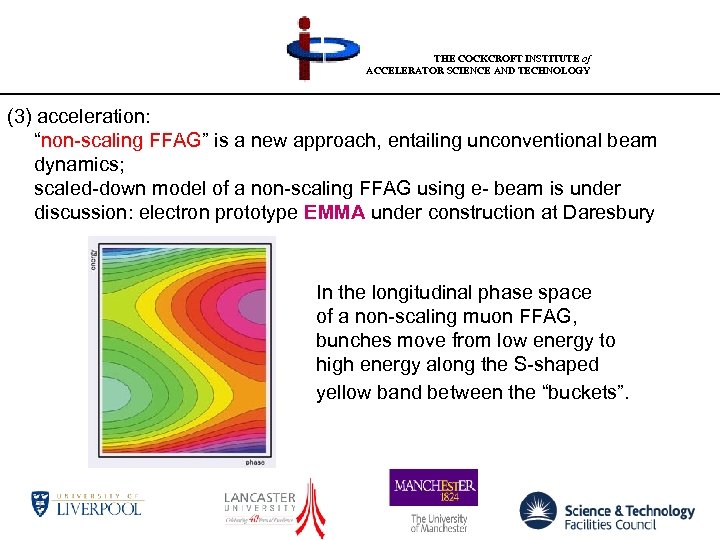 THE COCKCROFT INSTITUTE of ACCELERATOR SCIENCE AND TECHNOLOGY (3) acceleration: “non-scaling FFAG” is a new approach, entailing unconventional beam dynamics; scaled-down model of a non-scaling FFAG using e- beam is under discussion: electron prototype EMMA under construction at Daresbury In the longitudinal phase space of a non-scaling muon FFAG, bunches move from low energy to high energy along the S-shaped yellow band between the “buckets”.
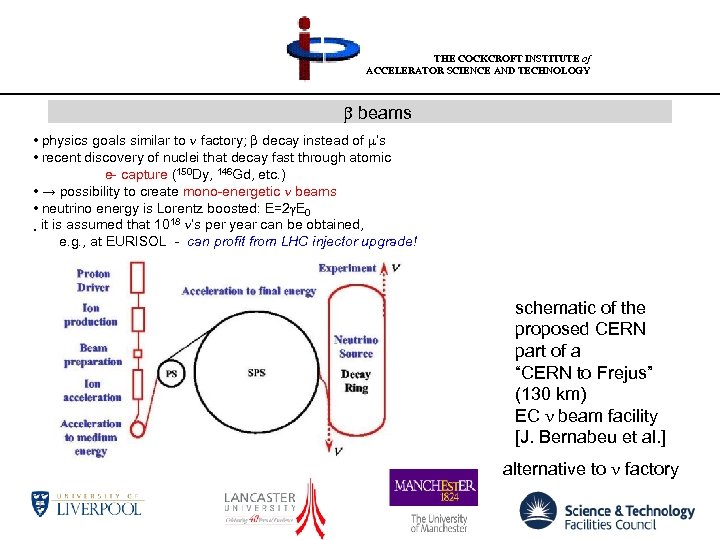 THE COCKCROFT INSTITUTE of ACCELERATOR SCIENCE AND TECHNOLOGY b beams • physics goals similar to n factory; b decay instead of m’s • recent discovery of nuclei that decay fast through atomic e- capture (150 Dy, 146 Gd, etc. ) • → possibility to create mono-energetic n beams • neutrino energy is Lorentz boosted: E=2 g. E 0 18 • it is assumed that 10 n’s per year can be obtained, e. g. , at EURISOL - can profit from LHC injector upgrade! schematic of the proposed CERN part of a “CERN to Frejus” (130 km) EC n beam facility [J. Bernabeu et al. ] alternative to n factory
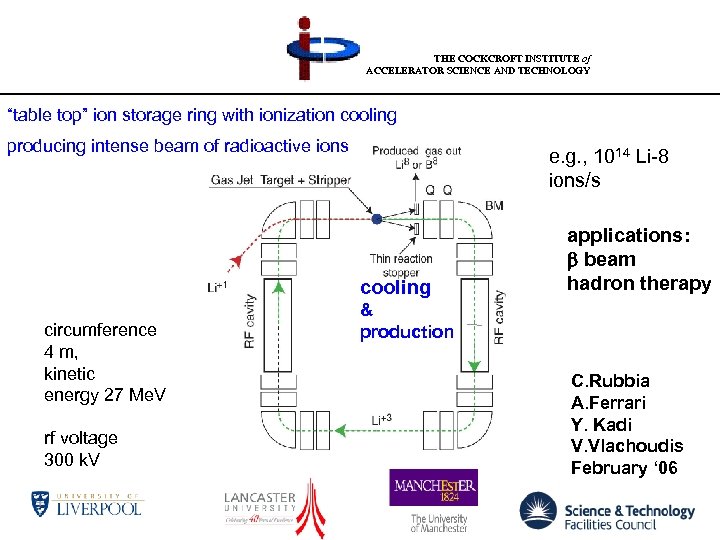 THE COCKCROFT INSTITUTE of ACCELERATOR SCIENCE AND TECHNOLOGY “table top” ion storage ring with ionization cooling producing intense beam of radioactive ions e. g. , 1014 Li-8 ions/s cooling circumference 4 m, kinetic energy 27 Me. V rf voltage 300 k. V applications: b beam hadron therapy & production C. Rubbia A. Ferrari Y. Kadi V. Vlachoudis February ‘ 06
 THE COCKCROFT INSTITUTE of ACCELERATOR SCIENCE AND TECHNOLOGY m collider “New ideas for producing Bright Beams for High Luminosity Muon Colliders” Muons, IIT, FNAL, JLAB Inc. H 2 -Pressurized RF Cavities Continuous Absorber for Emittance Exchange Helical Cooling Channel Parametric-resonance Ionization Cooling (PIC) Reverse Emittance Exchange R. Johnson, Y. Derbenev et al.
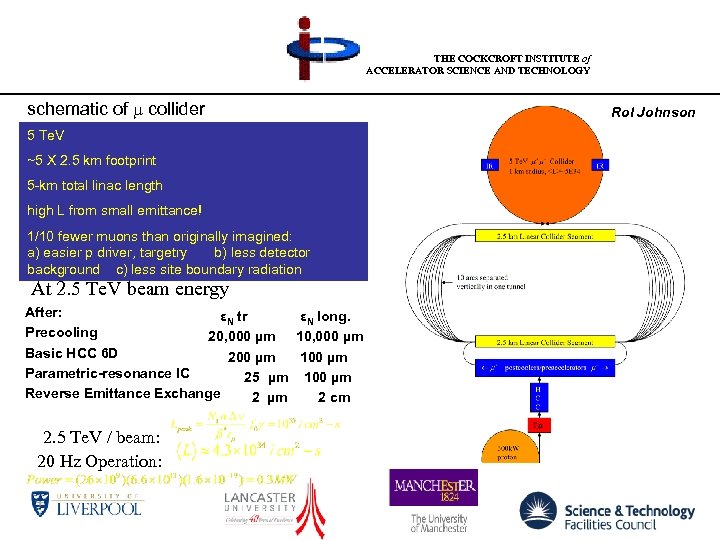 THE COCKCROFT INSTITUTE of ACCELERATOR SCIENCE AND TECHNOLOGY schematic of m collider 5 Te. V ~5 X 2. 5 km footprint 5 -km total linac length high L from small emittance! 1/10 fewer muons than originally imagined: a) easier p driver, targetry b) less detector background c) less site boundary radiation At 2. 5 Te. V beam energy After: εN tr εN long. Precooling 20, 000 µm 10, 000 µm Basic HCC 6 D 200 µm 100 µm Parametric-resonance IC 25 µm 100 µm Reverse Emittance Exchange 2 µm 2 cm 2. 5 Te. V / beam: 20 Hz Operation: Rol Johnson
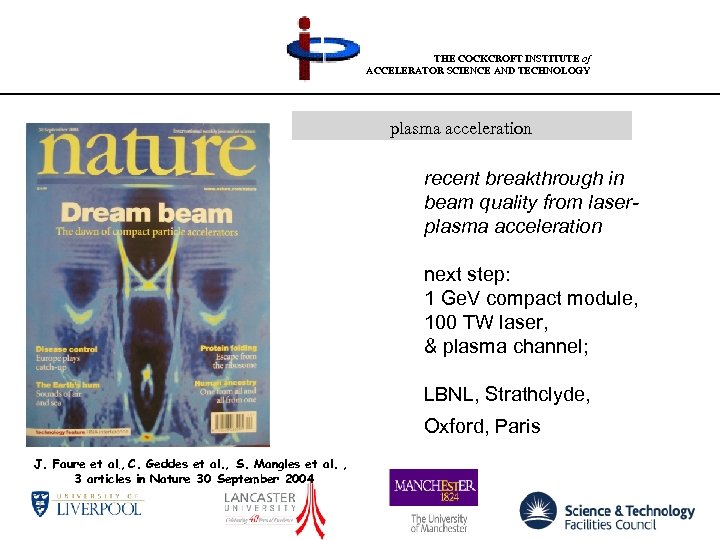 THE COCKCROFT INSTITUTE of ACCELERATOR SCIENCE AND TECHNOLOGY plasma acceleration recent breakthrough in beam quality from laserplasma acceleration next step: 1 Ge. V compact module, 100 TW laser, & plasma channel; LBNL, Strathclyde, Oxford, Paris J. Faure et al. , C. Geddes et al. , S. Mangles et al. , 3 articles in Nature 30 September 2004
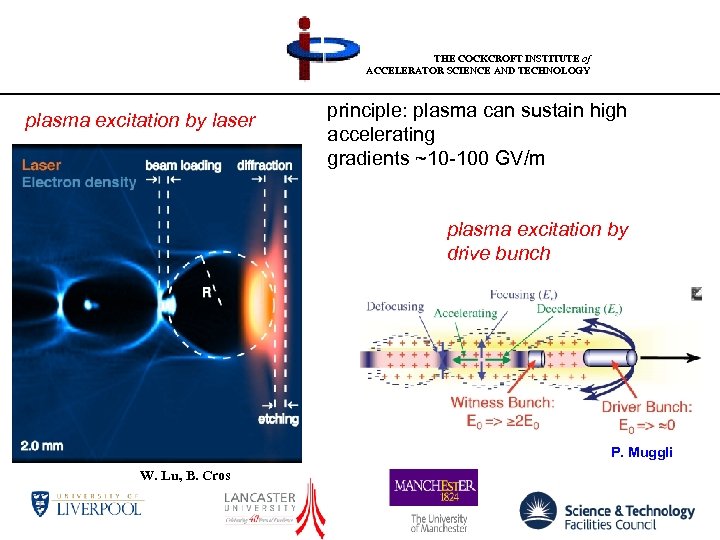 THE COCKCROFT INSTITUTE of ACCELERATOR SCIENCE AND TECHNOLOGY plasma excitation by laser principle: plasma can sustain high accelerating gradients ~10 -100 GV/m plasma excitation by drive bunch P. Muggli W. Lu, B. Cros
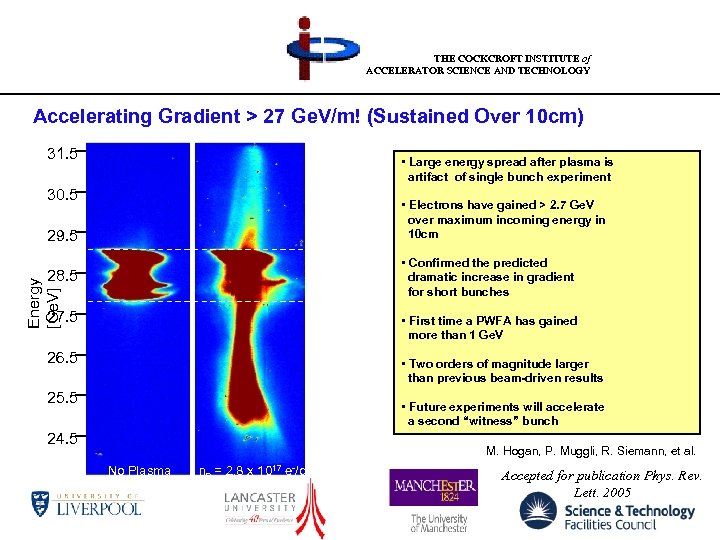 THE COCKCROFT INSTITUTE of ACCELERATOR SCIENCE AND TECHNOLOGY Accelerating Gradient > 27 Ge. V/m! (Sustained Over 10 cm) 31. 5 • Large energy spread after plasma is artifact of single bunch experiment 30. 5 • Electrons have gained > 2. 7 Ge. V over maximum incoming energy in 10 cm 29. 5 2. 7 Ge. V Energy [Ge. V] 28. 5 27. 5 • Confirmed the predicted dramatic increase in gradient for short bunches • First time a PWFA has gained more than 1 Ge. V 26. 5 • Two orders of magnitude larger than previous beam-driven results 25. 5 • Future experiments will accelerate a second “witness” bunch 24. 5 M. Hogan, P. Muggli, R. Siemann, et al. No Plasma np = 2. 8 x 10¹⁷ e-/cm 3 Accepted for publication Phys. Rev. Lett. 2005
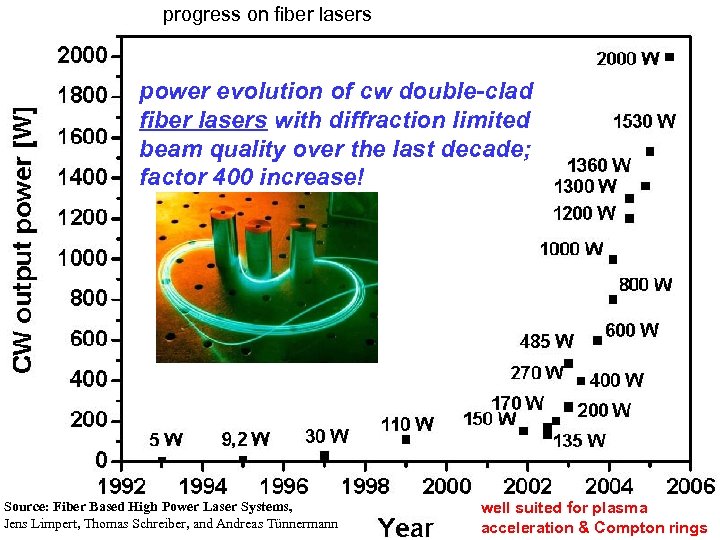 progress on fiber lasers THE COCKCROFT INSTITUTE of ACCELERATOR SCIENCE AND TECHNOLOGY power evolution of cw double-clad fiber lasers with diffraction limited beam quality over the last decade; factor 400 increase! Source: Fiber High Power Laser Systems, Source: Fiber Based High Power Laser Systems, well suited for plasma Jens Limpert, Thomas Schreiber, and Andreas Tünnermann Jens Limpert, Thomas and Andreas Tünnermann acceleration & Compton rings
 THE COCKCROFT INSTITUTE of ACCELERATOR SCIENCE AND TECHNOLOGY conclusions OUTLOOK • we need new technologies and methods to further push the frontiers of energy and luminosity • luckily there are many novel ideas and great progress everywhere • we may be heading towards a bright future
 THE COCKCROFT INSTITUTE of ACCELERATOR SCIENCE AND TECHNOLOGY Thanks to Hans Braun, Oliver Brunig Helmut Burkhardt, Rolland Johnson, Mats Lindroos, Thomas Roser, Vladimir Shiltsev, Junji Urakawa and Frank Zimmerman for helpful discussions and providing much of the material!