


 Скачать презентацию The Cockcroft Institute Education Programme Neil Marks The
98a77f5de097bf7cb31c384223a43b91.ppt
- Количество слайдов: 17
 The Cockcroft Institute Education Programme Neil Marks, The Cockcroft Institute, ASTe. C and The University of Liverpool Department of Physics.
 Overview of presentation 1. Governance. 2. 3. 4. 3. Objectives: 4. 5. 6. i) goals; ii) route-map. Delivery: i) overview; ii) statistics; iii) lectures and lecturers; iv) dissemination. External Links: i) John Adams Institute (JAI); ii) CERN Accelerator School (CAS); iii) U. S. Particle Accelerator School (USPAS). Administration: i) attendance records; ii) student feed-back; Future: i) review of previous 3 years and plans for advancing.
 Governance • The head of education and training reports to the CI director; and • attends the Cockcroft Institute Management Committee (CIMC), when required, to report/consult; and • is advised by the ‘Cockcroft Institute Education and training Committee’ (CIETC); which is composed of: • senior academics from Liverpool, Manchester and Lancaster universities; • senior accelerator physicists from ASTe. C; • and meets 3 to 4 times a year.
 Objectives - goals 1. To provide our post-graduate students over the three years of their degree with a comprehensive education in accelerator science and technology – irrespective of their area of specialisation; 2. To provide each new cohort of post-grad students, early in their academic course, with a sound introduction to the basics of accelerator physics and technology: 3. i) a basic outline of accelerator development; 4. ii) longitudinal and transverse single particle and collective beam dynamics; 5. iii) basic magnet and rf technology.
 Objectives – route-map. Cockcroft-06 -01 ‘CI Lecture programme - Syllabus and long term aims’ (approved by CIETC in March 2006) defines: i) the physics and mathematics learning and ability expected of post-graduate students; ii) the topics and syllabi for basic accelerator physics and technology courses, with an aim to cover these topics frequently (each year if possible); iii) a syllabus for advanced accelerator physics and technology, aimed for each subject to be delivered at least once in a three year period.
 Delivery – overview. • July 09 will end of the first complete 3 year cycle; • most of the principle subjects identified in Cockcroft 06 -01 will have been delivered; • the physics and technology courses have been supplemented by: • short revision courses at the beginning of each year; • maths courses relevant to acc. phys. ; • a loose sequence has been developed and lecturers identified; • coverage of the basic accelerator physics and technology has been aided by students attending the introductory CERN Accelerator School (CAS) (even years).
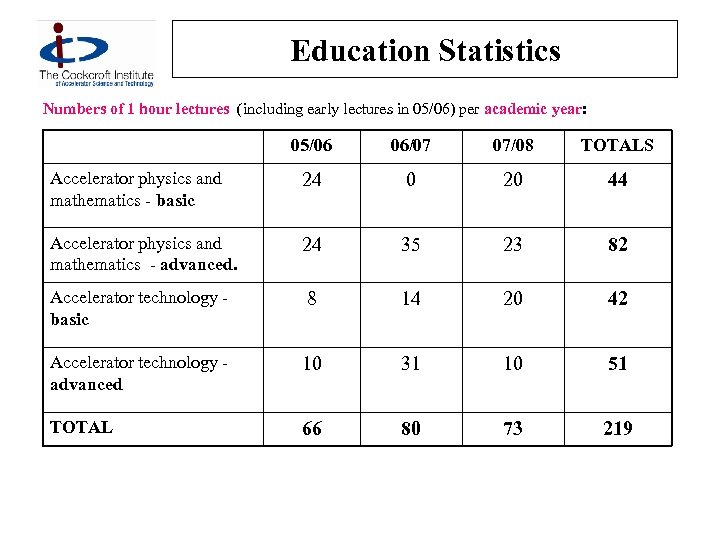 Education Statistics Numbers of 1 hour lectures (including early lectures in 05/06) per academic year: 05/06 06/07 07/08 TOTALS Accelerator physics and mathematics - basic 24 0 20 44 Accelerator physics and mathematics - advanced. 24 35 23 82 Accelerator technology basic 8 14 20 42 Accelerator technology advanced 10 31 10 51 TOTAL 66 80 73 219
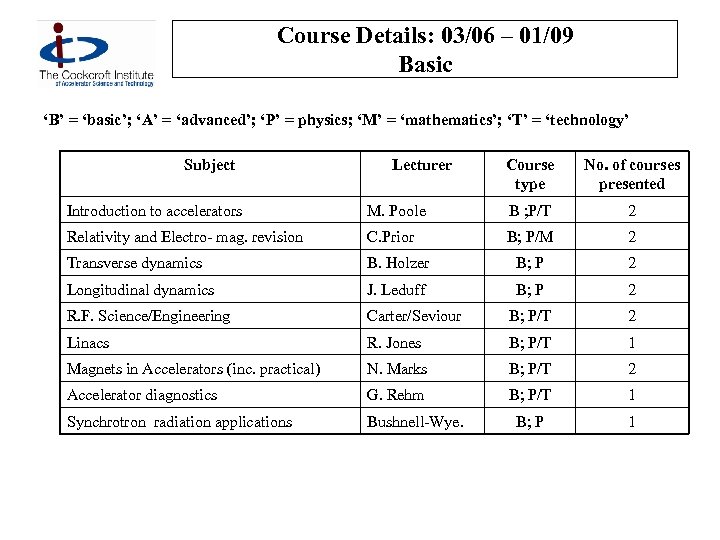 Course Details: 03/06 – 01/09 Basic ‘B’ = ‘basic’; ‘A’ = ‘advanced’; ‘P’ = physics; ‘M’ = ‘mathematics’; ‘T’ = ‘technology’ Subject Lecturer Course type No. of courses presented Introduction to accelerators M. Poole B ; P/T 2 Relativity and Electro- mag. revision C. Prior B; P/M 2 Transverse dynamics B. Holzer B; P 2 Longitudinal dynamics J. Leduff B; P 2 R. F. Science/Engineering Carter/Seviour B; P/T 2 Linacs R. Jones B; P/T 1 Magnets in Accelerators (inc. practical) N. Marks B; P/T 2 Accelerator diagnostics G. Rehm B; P/T 1 Synchrotron radiation applications Bushnell-Wye. B; P 1
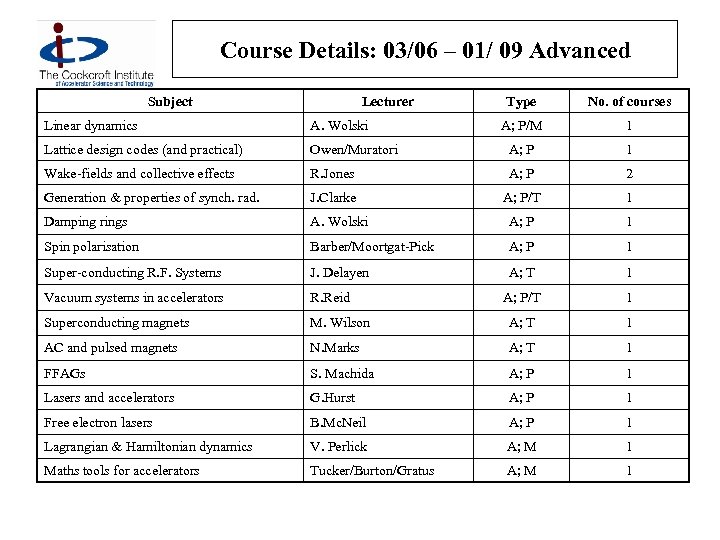 Course Details: 03/06 – 01/ 09 Advanced Subject Lecturer Type No. of courses A; P/M 1 Linear dynamics A. Wolski Lattice design codes (and practical) Owen/Muratori A; P 1 Wake-fields and collective effects R. Jones A; P 2 Generation & properties of synch. rad. J. Clarke A; P/T 1 Damping rings A. Wolski A; P 1 Spin polarisation Barber/Moortgat-Pick A; P 1 Super-conducting R. F. Systems J. Delayen A; T 1 Vacuum systems in accelerators R. Reid A; P/T 1 Superconducting magnets M. Wilson A; T 1 AC and pulsed magnets N. Marks A; T 1 FFAGs S. Machida A; P 1 Lasers and accelerators G. Hurst A; P 1 Free electron lasers B. Mc. Neil A; P 1 Lagrangian & Hamiltonian dynamics V. Perlick A; M 1 Maths tools for accelerators Tucker/Burton/Gratus A; M 1
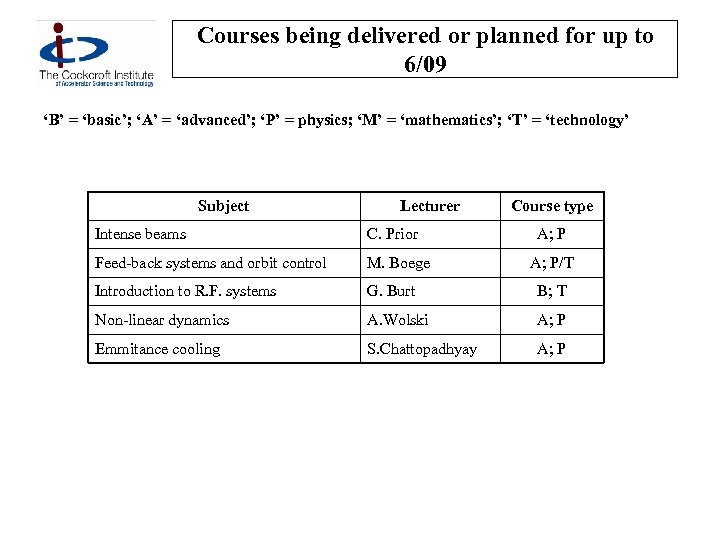 Courses being delivered or planned for up to 6/09 ‘B’ = ‘basic’; ‘A’ = ‘advanced’; ‘P’ = physics; ‘M’ = ‘mathematics’; ‘T’ = ‘technology’ Subject Lecturer Course type Intense beams C. Prior A; P Feed-back systems and orbit control M. Boege Introduction to R. F. systems G. Burt B; T Non-linear dynamics A. Wolski A; P Emmitance cooling S. Chattopadhyay A; P/T
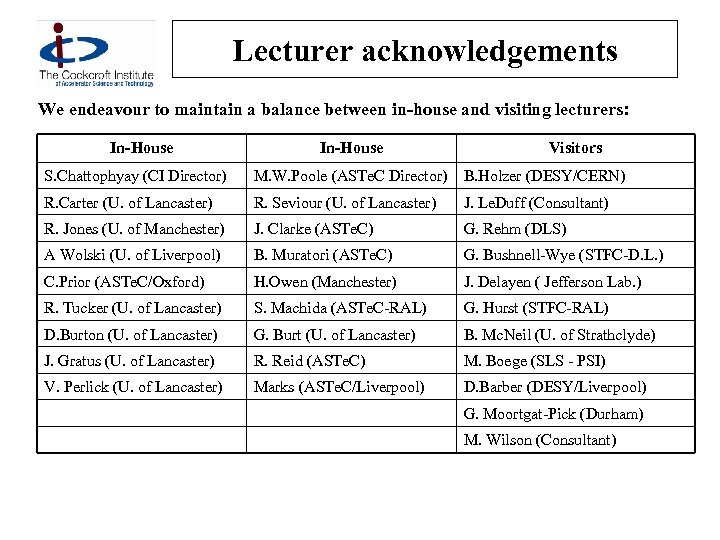 Lecturer acknowledgements We endeavour to maintain a balance between in-house and visiting lecturers: In-House Visitors S. Chattophyay (CI Director) M. W. Poole (ASTe. C Director) B. Holzer (DESY/CERN) R. Carter (U. of Lancaster) R. Seviour (U. of Lancaster) J. Le. Duff (Consultant) R. Jones (U. of Manchester) J. Clarke (ASTe. C) G. Rehm (DLS) A Wolski (U. of Liverpool) B. Muratori (ASTe. C) G. Bushnell-Wye (STFC-D. L. ) C. Prior (ASTe. C/Oxford) H. Owen (Manchester) J. Delayen ( Jefferson Lab. ) R. Tucker (U. of Lancaster) S. Machida (ASTe. C-RAL) G. Hurst (STFC-RAL) D. Burton (U. of Lancaster) G. Burt (U. of Lancaster) B. Mc. Neil (U. of Strathclyde) J. Gratus (U. of Lancaster) R. Reid (ASTe. C) M. Boege (SLS - PSI) V. Perlick (U. of Lancaster) Marks (ASTe. C/Liverpool) D. Barber (DESY/Liverpool) G. Moortgat-Pick (Durham) M. Wilson (Consultant)
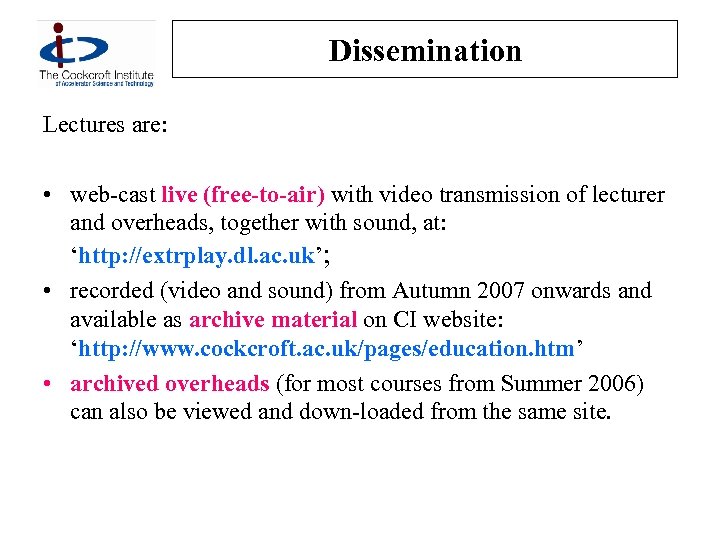 Dissemination Lectures are: • web-cast live (free-to-air) with video transmission of lecturer and overheads, together with sound, at: ‘http: //extrplay. dl. ac. uk’; • recorded (video and sound) from Autumn 2007 onwards and available as archive material on CI website: ‘http: //www. cockcroft. ac. uk/pages/education. htm’ • archived overheads (for most courses from Summer 2006) can also be viewed and down-loaded from the same site.
 External Links - JAI Close contact is maintained with the John Adams Institute (JAI) through: • the JAI director (Prof. Ken Peach); • the JAI head of education (Prof. Ted Wilson); • exchange of lecturers: • Chris Prior (JAI); • Shinji Machida (JAI); • Andy Wolski (CI); • Neil Marks (CI).
 External Links - CAS Members of the CI participate significantly in CERN Accelerator School (CAS) activities: • organising and programme committees: • A. Wolski; N. Marks; • lecturing/tutoring at CAS schools: • A. Wolski, J. A. Clarke; B. Muratori; J. Jones; N. Marks. The CI sponsored and hosted an Intermediate CAS, in September 2007: • 2 weeks in length; • 85 students from internationally located institutes; • CI staff and students were able to attend plenary sessions and interact with lecturers and CAS students.
 External Links - USPAS Cockcroft Institute members have also developed links and lectured at U. S. Particle Accelerator Schools: Andy Wolski, Roger Jones, James Jones, and Deepa Angal-Kalinin (at the International School on Linear Colliders). Now a proposal from W. A. Barletta (Director of USPAS)* to explore the possibility for the CI to: with: ‘join forces’ ‘USPAS, CERN, KEK and INP (Novosibirsk)’ ‘to hold a topical international school in the UK, Europe or USA’. This is now being further discussed. * mail to S. Chattopadhyay, 3/2/09.
 Administration • attendees sign-in for each lecture; statistics on a term-by-term basis are available to CI management, NWDA and the university supervisors of the post-grad students; • at the end of each lecture course, students are invited to complete a feed-back pro-forma anonymously, commenting on • level; • content; • presentation; and can provide general comment.
 The Future The autumn 09 programme will follow the pattern of providing an introduction to basic accelerator physics & technology for the new cohort of post-grad students; BUT: An ‘extraordinary’ (enlarged) meeting of the CIETC is envisaged during summer 2009, with student representation as well as the CI professional staff, to: • review the previous 3 year’s programme; • examine the programme in the light of the 3 year old ‘route-plan’ (Cockcroft-06 -01); • consider how the education programme can be further broadened and advanced; • develop a new ‘route-plan’ for re-issue and delivery.