


 Скачать презентацию The CMU Trans Tac 2007 Eyes-free and Hands-free
750ceda22eb78395d92e8343c326feb3.ppt
- Количество слайдов: 32
 The CMU Trans. Tac 2007 Eyes-free and Hands-free Two-way Speech-to-Speech Translation System Thilo Köhler and Stephan Vogel Nguyen Bach, Matthias Eck, Paisarn Charoenpornsawat, Sebastian Stüker, Thuy. Linh Nguyen, Roger Hsiao, Alex Waibel, Tanja Schultz, Alan W Black Carnegie Mellon University, USA IWSLT 2007 – Trento, Italy, Oct 2007
 Outline • Introduction & Challenges • System Architecture & Design • Automatic Speech Recognition • Machine Translation • Speech Synthesis • Practical Issues • Demo
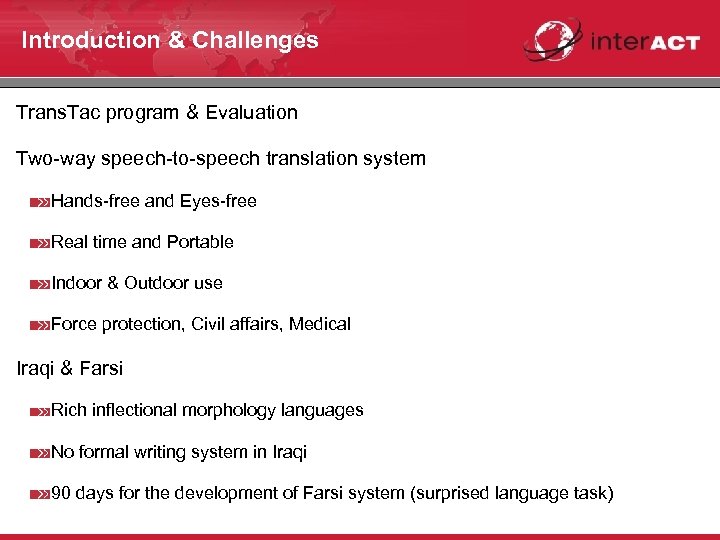 Introduction & Challenges Trans. Tac program & Evaluation Two-way speech-to-speech translation system Hands-free and Eyes-free Real time and Portable Indoor & Outdoor use Force protection, Civil affairs, Medical Iraqi & Farsi Rich inflectional morphology languages No formal writing system in Iraqi 90 days for the development of Farsi system (surprised language task)
 Outline • Introduction & challenges • System Architecture & Design • Automatic Speech Recognition • Machine Translation • Speech Synthesis • Practical Issues • Demo
 System Designs Eyes-free/hands-free use No display or any other visual feedback, only speech is used for a feedback Using speech to control the system • “transtac listen” : turn translation on • “transtac say translation”: say the back-translation of the last utterance Two user modes Automatic mode: automatically detect speech, make a segment then recognize and translate it Manual mode: providing a push-to-talk button for each speaker
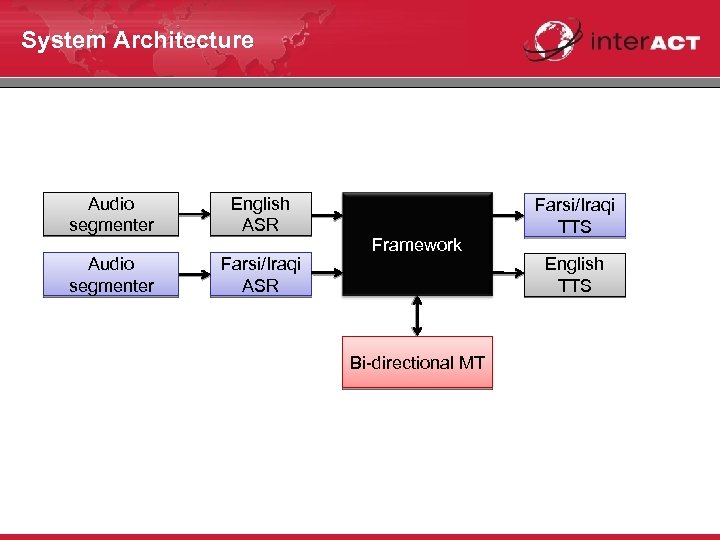 System Architecture Audio segmenter English ASR Audio segmenter Farsi/Iraqi ASR Framework Bi-directional MT Farsi/Iraqi TTS English TTS
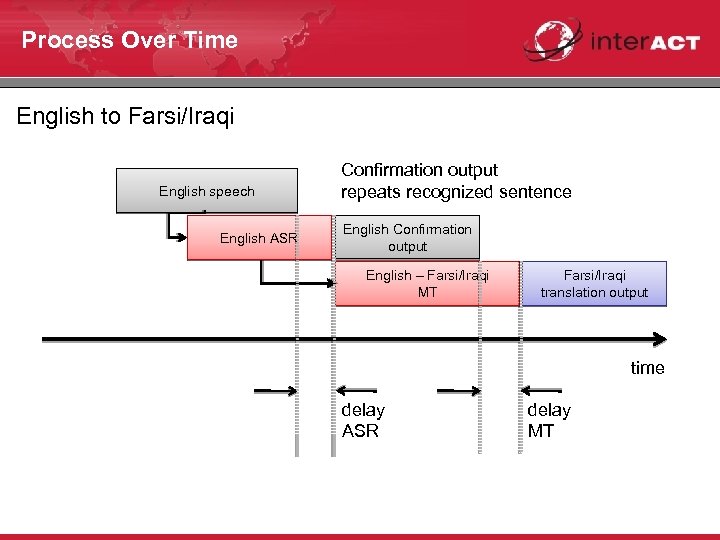 Process Over Time English to Farsi/Iraqi English speech English ASR Confirmation output repeats recognized sentence English Confirmation output English – Farsi/Iraqi MT Farsi/Iraqi translation output time delay ASR delay MT
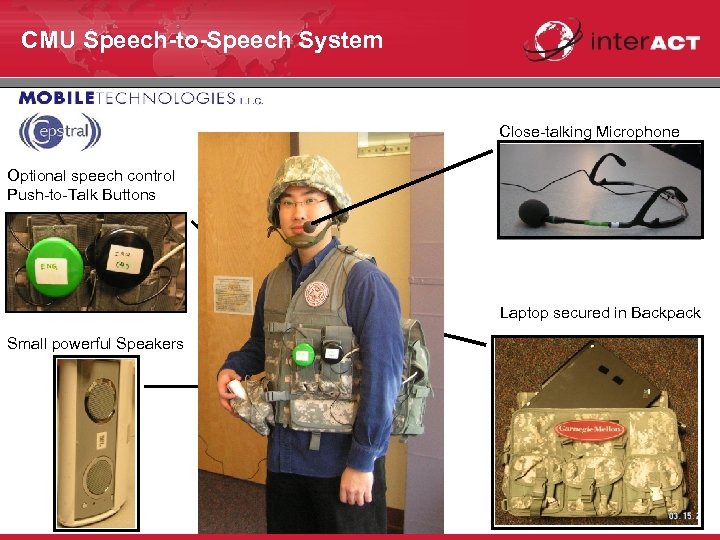 CMU Speech-to-Speech System Close-talking Microphone Optional speech control Push-to-Talk Buttons Laptop secured in Backpack Small powerful Speakers
 Outline • Introduction & challenges • System Architecture & Design • Automatic Speech Recognition • Machine Translation • Speech Synthesis • Practical Issues • Demo
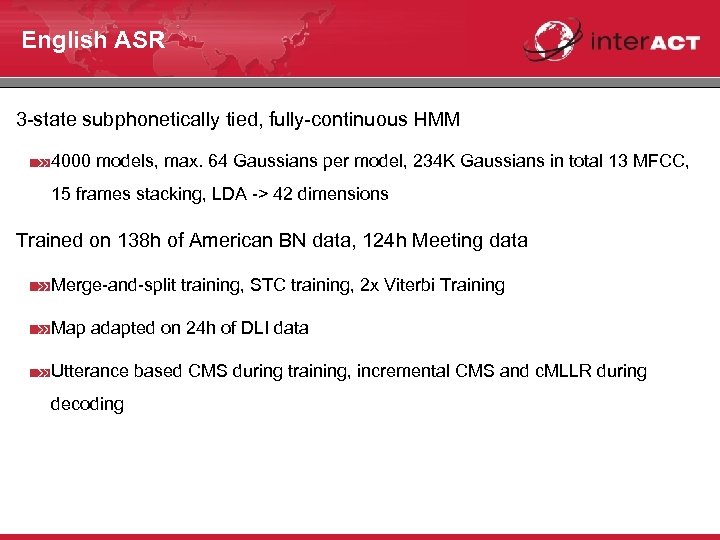 English ASR 3 -state subphonetically tied, fully-continuous HMM 4000 models, max. 64 Gaussians per model, 234 K Gaussians in total 13 MFCC, 15 frames stacking, LDA -> 42 dimensions Trained on 138 h of American BN data, 124 h Meeting data Merge-and-split training, STC training, 2 x Viterbi Training Map adapted on 24 h of DLI data Utterance based CMS during training, incremental CMS and c. MLLR during decoding
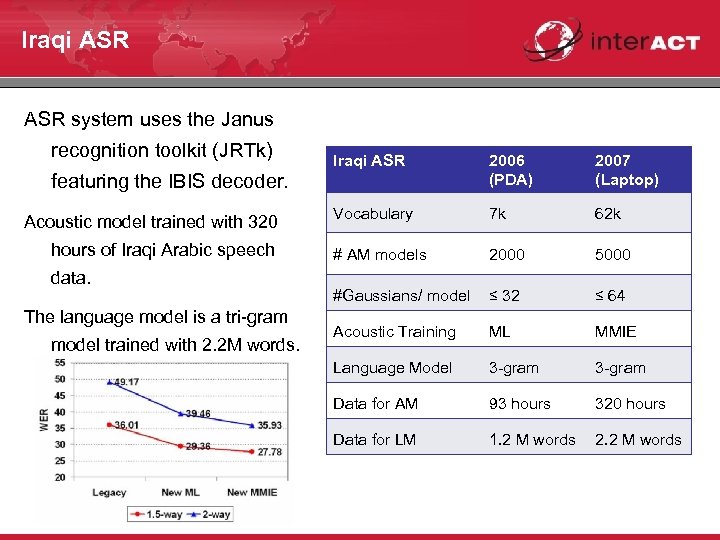 Iraqi ASR system uses the Janus recognition toolkit (JRTk) Iraqi ASR 2006 (PDA) 2007 (Laptop) Vocabulary 7 k 62 k # AM models 2000 5000 #Gaussians/ model ≤ 32 ≤ 64 Acoustic Training ML MMIE Language Model 3 -gram Data for AM 93 hours 320 hours Data for LM 1. 2 M words 2. 2 M words featuring the IBIS decoder. Acoustic model trained with 320 hours of Iraqi Arabic speech data. The language model is a tri-gram model trained with 2. 2 M words.
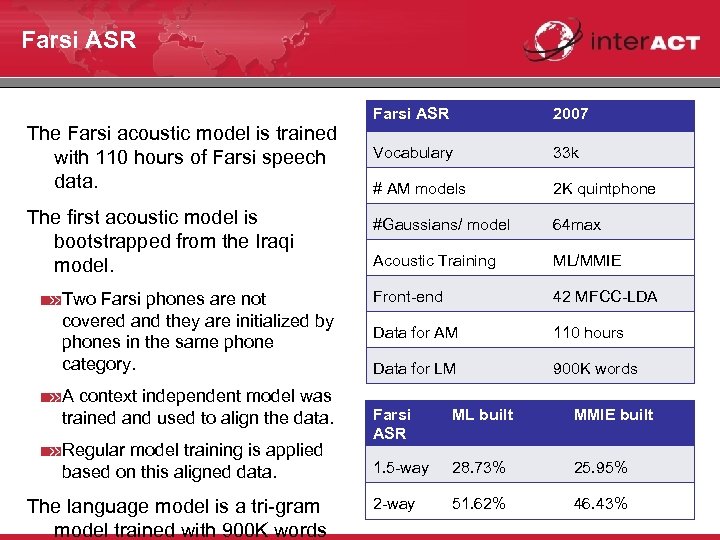 Farsi ASR The Farsi acoustic model is trained with 110 hours of Farsi speech data. The first acoustic model is bootstrapped from the Iraqi model. Two Farsi phones are not covered and they are initialized by phones in the same phone category. A context independent model was trained and used to align the data. Regular model training is applied based on this aligned data. The language model is a tri-gram model trained with 900 K words Farsi ASR 2007 Vocabulary 33 k # AM models 2 K quintphone #Gaussians/ model 64 max Acoustic Training ML/MMIE Front-end 42 MFCC-LDA Data for AM 110 hours Data for LM 900 K words Farsi ASR ML built MMIE built 1. 5 -way 28. 73% 25. 95% 2 -way 51. 62% 46. 43%
 Outline • Introduction & challenges • System Architecture & Design • Automatic Speech Recognition • Machine Translation • Speech Synthesis • Practical Issues • Demo
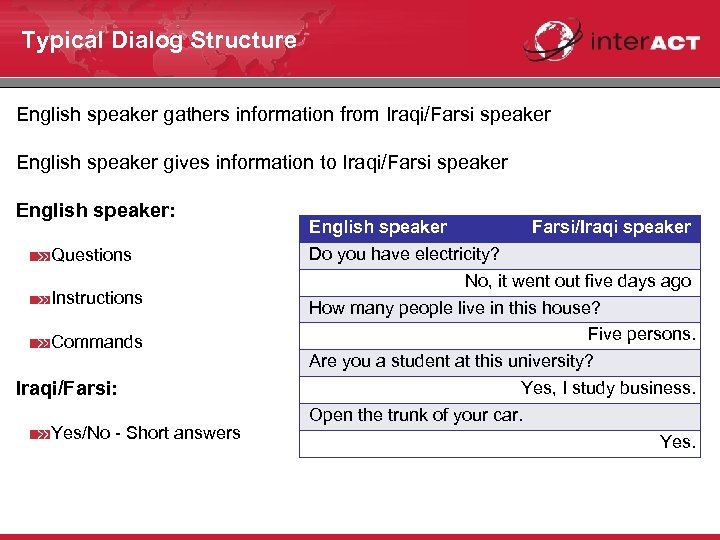 Typical Dialog Structure English speaker gathers information from Iraqi/Farsi speaker English speaker gives information to Iraqi/Farsi speaker English speaker: Questions Instructions Commands Iraqi/Farsi: Yes/No - Short answers English speaker Farsi/Iraqi speaker Do you have electricity? No, it went out five days ago How many people live in this house? Five persons. Are you a student at this university? Yes, I study business. Open the trunk of your car. Yes.
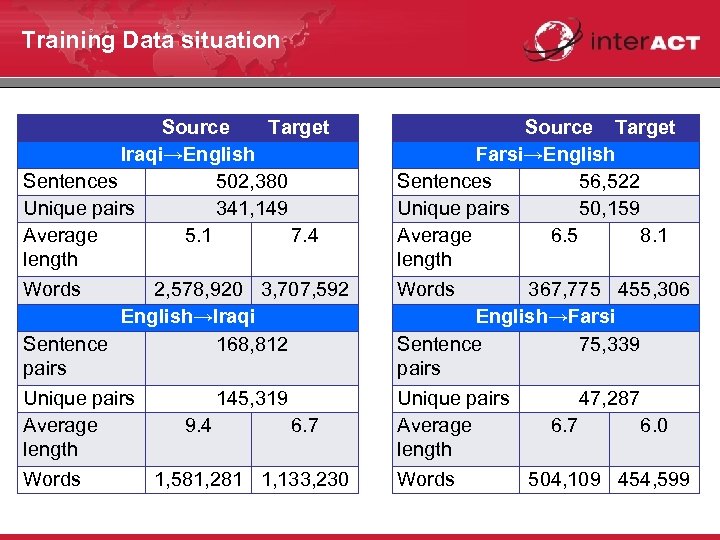 Training Data situation Source Target Iraqi→English Sentences 502, 380 Unique pairs 341, 149 Average 5. 1 7. 4 length Source Target Farsi→English Sentences 56, 522 Unique pairs 50, 159 Average 6. 5 8. 1 length Words 2, 578, 920 3, 707, 592 English→Iraqi Sentence 168, 812 pairs Words Unique pairs Average length Words 145, 319 9. 4 6. 7 1, 581, 281 1, 133, 230 367, 775 455, 306 English→Farsi Sentence 75, 339 pairs Words 47, 287 6. 0 504, 109 454, 599
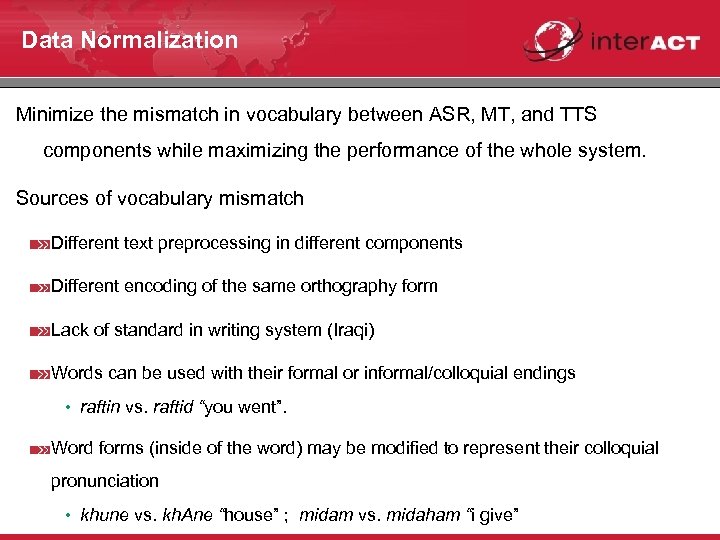 Data Normalization Minimize the mismatch in vocabulary between ASR, MT, and TTS components while maximizing the performance of the whole system. Sources of vocabulary mismatch Different text preprocessing in different components Different encoding of the same orthography form Lack of standard in writing system (Iraqi) Words can be used with their formal or informal/colloquial endings • raftin vs. raftid “you went”. Word forms (inside of the word) may be modified to represent their colloquial pronunciation • khune vs. kh. Ane “house” ; midam vs. midaham “i give”
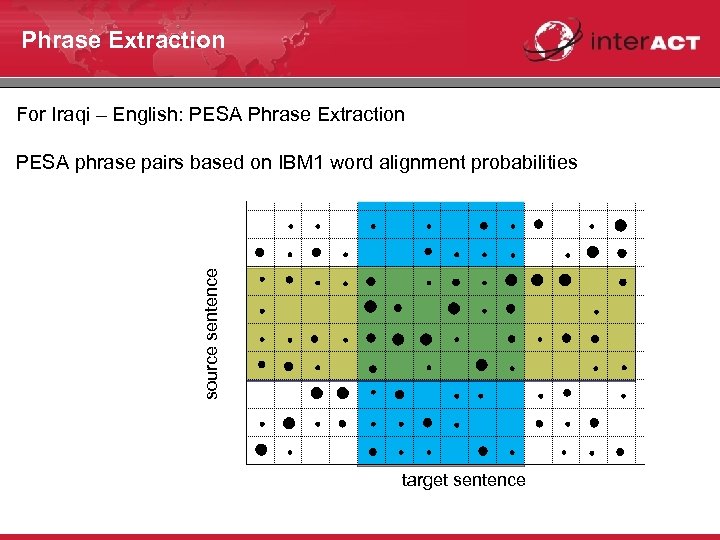 Phrase Extraction For Iraqi – English: PESA Phrase Extraction source sentence PESA phrase pairs based on IBM 1 word alignment probabilities target sentence
 PESA Phrase Extraction Online Phrase Extraction Phrases are extracted as needed from the bilingual corpus Advantage Long matching phrases are possible especially prevalent in the Trans. Tac scenarios: “Open the trunk!”, “I need to see your ID!”, “What is your name? ” Disadvantage Slow speed: Up to 20 seconds/sentence
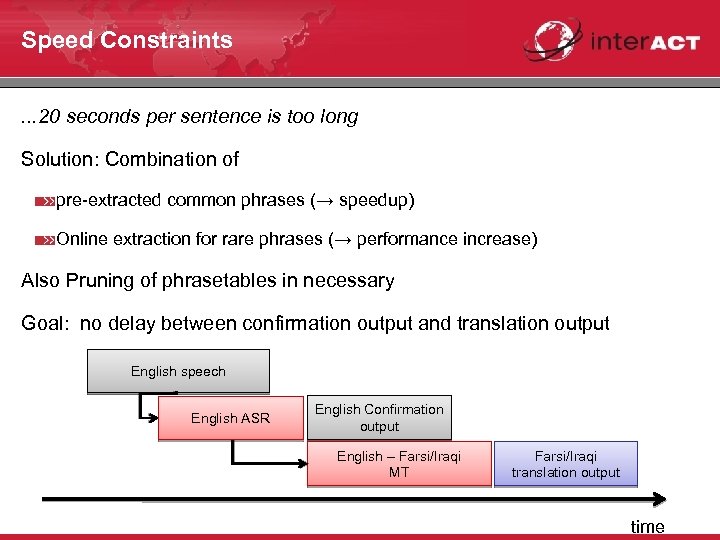 Speed Constraints. . . 20 seconds per sentence is too long Solution: Combination of pre-extracted common phrases (→ speedup) Online extraction for rare phrases (→ performance increase) Also Pruning of phrasetables in necessary Goal: no delay between confirmation output and translation output English speech English ASR English Confirmation output English – Farsi/Iraqi MT Farsi/Iraqi translation output time
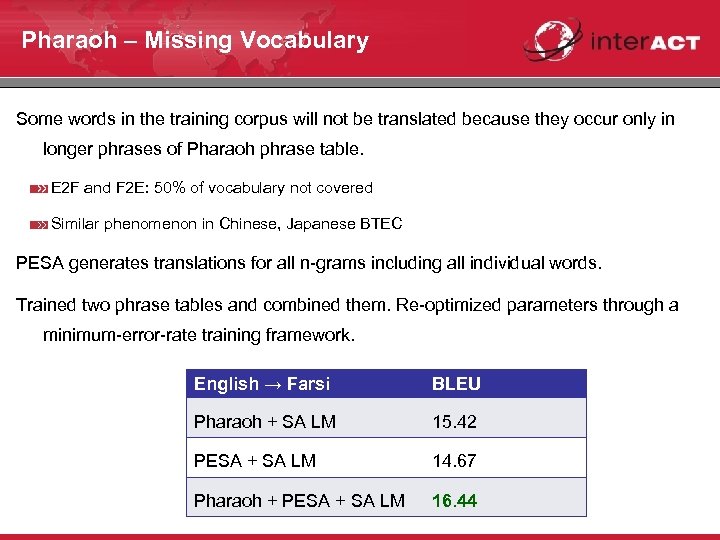 Pharaoh – Missing Vocabulary Some words in the training corpus will not be translated because they occur only in longer phrases of Pharaoh phrase table. E 2 F and F 2 E: 50% of vocabulary not covered Similar phenomenon in Chinese, Japanese BTEC PESA generates translations for all n-grams including all individual words. Trained two phrase tables and combined them. Re-optimized parameters through a minimum-error-rate training framework. English → Farsi BLEU Pharaoh + SA LM 15. 42 PESA + SA LM 14. 67 Pharaoh + PESA + SA LM 16. 44
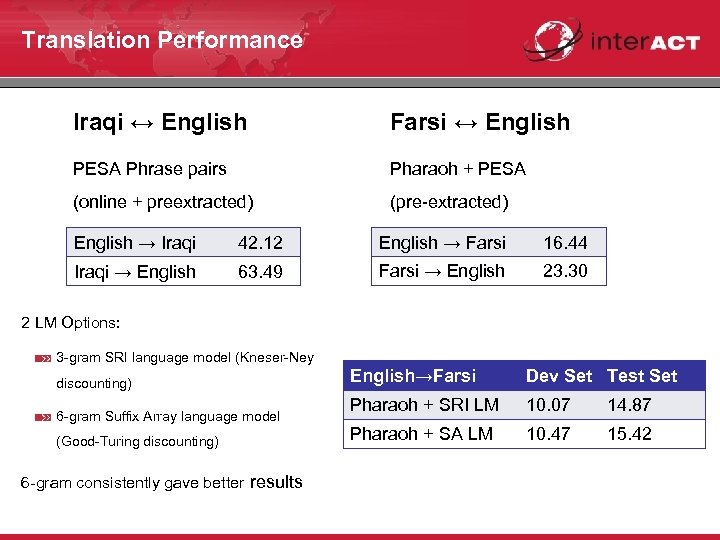 Translation Performance Iraqi ↔ English Farsi ↔ English PESA Phrase pairs Pharaoh + PESA (online + preextracted) (pre-extracted) English → Iraqi 42. 12 English → Farsi 16. 44 Iraqi → English 63. 49 Farsi → English 23. 30 2 LM Options: 3 -gram SRI language model (Kneser-Ney discounting) 6 -gram Suffix Array language model (Good-Turing discounting) 6 -gram consistently gave better results English→Farsi Dev Set Test Set Pharaoh + SRI LM 10. 07 14. 87 Pharaoh + SA LM 10. 47 15. 42
 Outline • Introduction & challenges • System Architecture & Design • Automatic Speech Recognition • Machine Translation • Speech Synthesis • Practical Issues • Demo
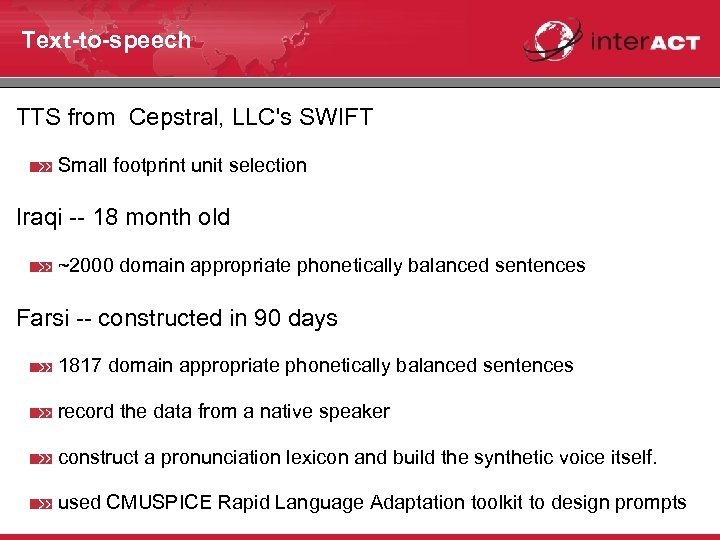 Text-to-speech TTS from Cepstral, LLC's SWIFT Small footprint unit selection Iraqi -- 18 month old ~2000 domain appropriate phonetically balanced sentences Farsi -- constructed in 90 days 1817 domain appropriate phonetically balanced sentences record the data from a native speaker construct a pronunciation lexicon and build the synthetic voice itself. used CMUSPICE Rapid Language Adaptation toolkit to design prompts
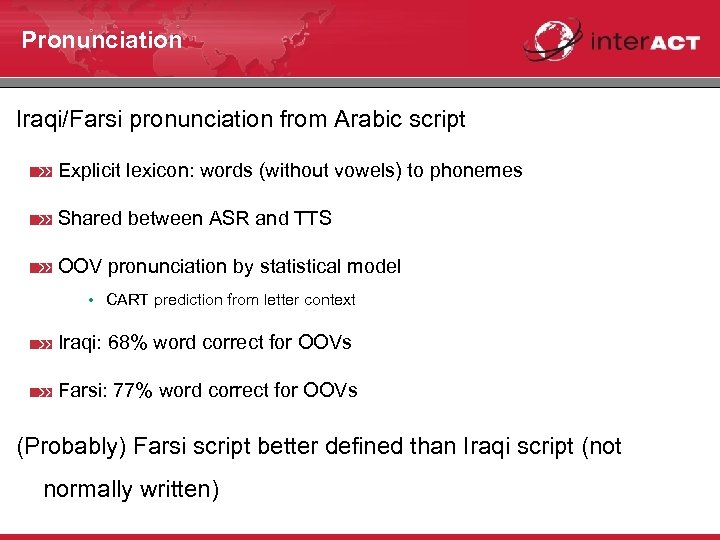 Pronunciation Iraqi/Farsi pronunciation from Arabic script Explicit lexicon: words (without vowels) to phonemes Shared between ASR and TTS OOV pronunciation by statistical model • CART prediction from letter context Iraqi: 68% word correct for OOVs Farsi: 77% word correct for OOVs (Probably) Farsi script better defined than Iraqi script (not normally written)
 Outline • Introduction & challenges • System Architecture & Design • Automatic Speech Recognition • Machine Translation • Speech Synthesis • Practical Issues • Demo
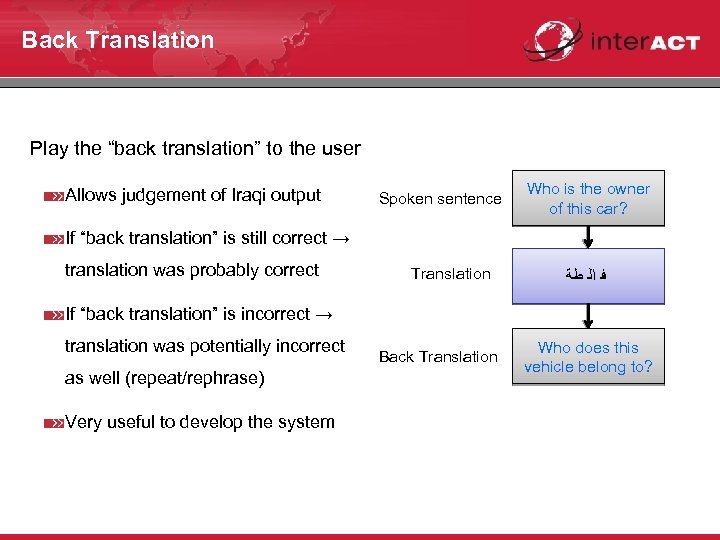 Back Translation Play the “back translation” to the user Allows judgement of Iraqi output Spoken sentence Who is the owner of this car? If “back translation” is still correct → translation was probably correct Translation ﻓ ﺍﻟ ﻃﺔ If “back translation” is incorrect → translation was potentially incorrect as well (repeat/rephrase) Very useful to develop the system Back Translation Who does this vehicle belong to?
 Back Translation But the users… Confused by back translation “is that the same meaning? ” Interpret it just as a repetition of their sentence mimic the non-grammatical output resulting from translating twice Also: Underestimates system performance: Translation might be correct/understandable but back translation loses some information → User repeats but it would not have been necessary
 Automatic Mode Automatic mode translation mode was offered Completely hands-free translation System notices speech activity and translates everything But the users… Do not like this loss of control Not everything should be translated, e. g. Discussions among the soldiers: “Do you think he is lying? ” Definitely prefer “push-to-talk” manual mode
 Other Issues Some users: “TTS is too fast to understand” Speech synthesizers are designed to speak fluent speech, but output of an MT system may not be fully grammatical Phrase breaks in the speech could help listener to understand it How to use language expertise efficiently and effectively when working on rapid development of speech translation components We had no Iraqi speaker and only 1 Farsi part timer How do you best use the limited time of the Farsi speaker? Check data, translate new data, fix errors, explain errors, use the system. . ?
 Other Issues User interface Needs to be as simple as possible Only short time to train English speaker No training of the Iraqi/Farsi speaker Over-heating Outside temperatures during Evaluation reached 95 Fahrenheit (35° Centigrade) System cooling is necessary via added fans
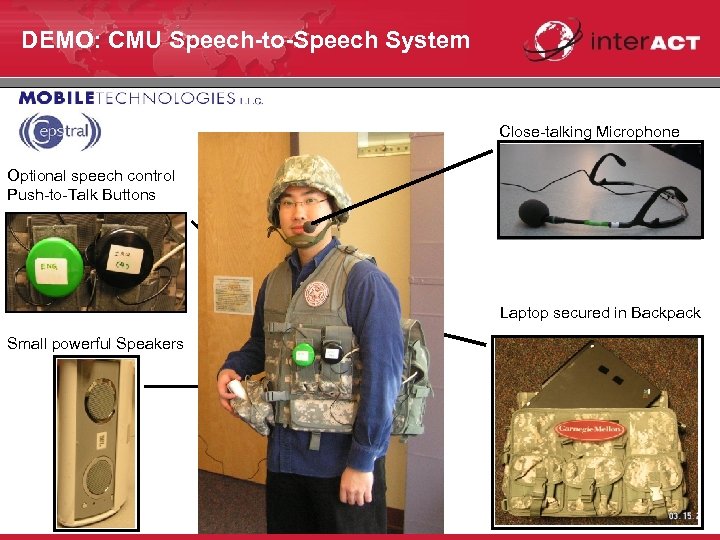 DEMO: CMU Speech-to-Speech System Close-talking Microphone Optional speech control Push-to-Talk Buttons Laptop secured in Backpack Small powerful Speakers
 DEMO
DEMO