


 Скачать презентацию The CLOCKWORK Project Overview of the ELOTHERM and
b86e79ff41a3ac7389ed2de28054b726.ppt
- Количество слайдов: 20
 The CLOCKWORK Project* Overview of the ELOTHERM and DFKI Perspectives Harold Boley, Ansgar Bernardi Detlev Stahl, Robert Jürgens, Andreas Seitzer {boley, bernardi}@dfki. uni-kl. de {d. stahl, r. juergens, a. seitzer}@elotherm. de Clockwork Meeting, July 12 th, 2000 *Creating Learning Organisations with Contextualised Knowledge-rich WORK artefacts DFKI/IM&DA-00 S. 1
 Basic Data • Topic: • • • Web-based knowledge management for collaborative engineering Funded by EU (5 th Framework) Three years (1 July 2000 - 30 June 2003) European Partners (Coordinator: Open University, KMI): – Five research centres – Two engineering companies • Homepage: http: //kmi. open. ac. uk/projects/clockwork/ CLOCKWORK Preparation S. 2
 Objectives 1 Support teams in sharing knowledge-enriched simulation 2 3 models of dynamical systems Support reuse of simulation and modelling knowledge across the organisation Support cautious knowledge sharing between engineering companies CLOCKWORK Preparation S. 3
 Objective 1 • Product development teams collaboratively create, test, and • • modify simulation models of designs Often distributed, for example between centrally located staff and product testers in the field Existing support mechanisms often separated from tools of work, but knowledge can only be fully/efficiently expressed within its context ==> Support team-level knowledge sharing by integrating work tools (in our case dynamical system simulation tools) with formal documents, informal discussions, and knowledge models CLOCKWORK Preparation S. 4
 Objective 2 • Knowledge to be shared is contained in formal/informal • • documents and the dynamical system simulations themselves Contextual reuse from vast archives of previous designs requires retrieval tools to deliver the right knowledge at the right time Surface criteria (text phrases, simulation components) enriched by knowledge-level representation of the reusable design’s domain ==> Support effective knowledge reuse by retrieving rich representations of a design according to knowledge-level models of the domain and the design process CLOCKWORK Preparation S. 5
 Objective 3 • Companies need methods/tools to negotiate, trade, and • • collaborate, thus sharing community knowledge and hiding private knowledge Cautious, selective sharing of knowledge is vital for business-tobusiness collaboration Facilitation of these processes also supports continuous innovation in participating companies ==> Support cautious knowledge sharing via knowledge interfacing between “competitive-collaborating” companies CLOCKWORK Preparation S. 6
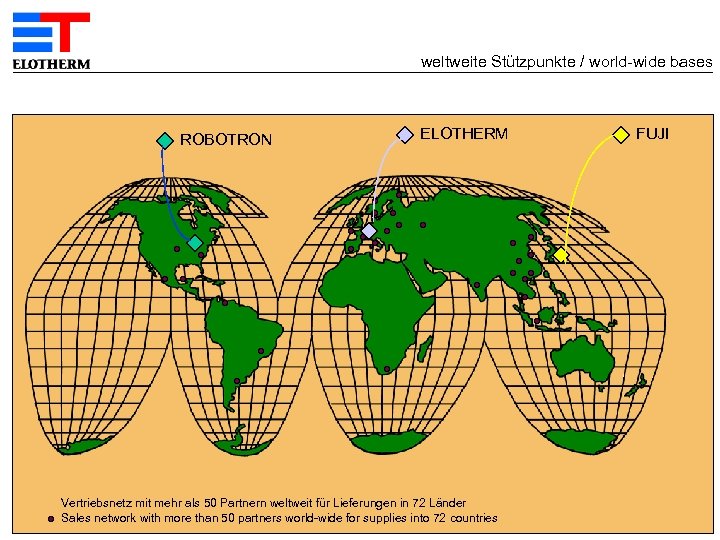 weltweite Stützpunkte / world-wide bases ROBOTRON ELOTHERM Vertriebsnetz mit mehr als 50 Partnern weltweit für Lieferungen in 72 Länder Sales network with more than 50 partners world-wide for supplies into 72 countries FUJI
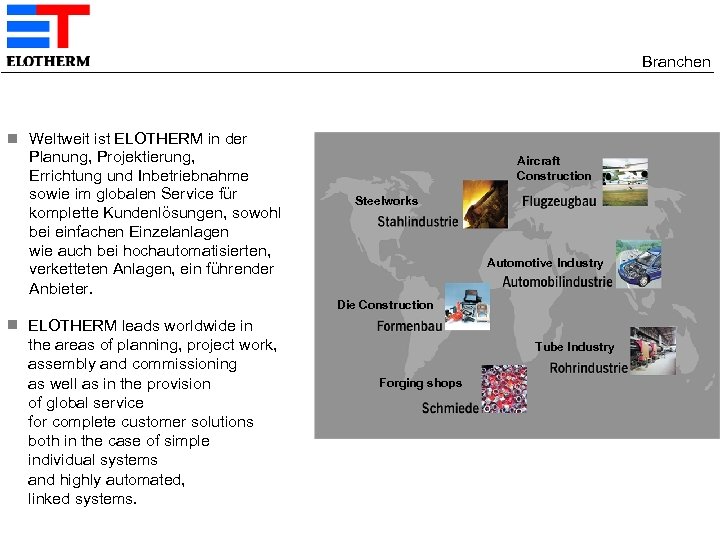 Branchen Weltweit ist ELOTHERM in der Planung, Projektierung, Errichtung und Inbetriebnahme sowie im globalen Service für komplette Kundenlösungen, sowohl bei einfachen Einzelanlagen wie auch bei hochautomatisierten, verketteten Anlagen, ein führender Anbieter. Aircraft Construction Steelworks Automotive Industry Die Construction ELOTHERM leads worldwide in the areas of planning, project work, assembly and commissioning as well as in the provision of global service for complete customer solutions both in the case of simple individual systems and highly automated, linked systems. Tube Industry Forging shops
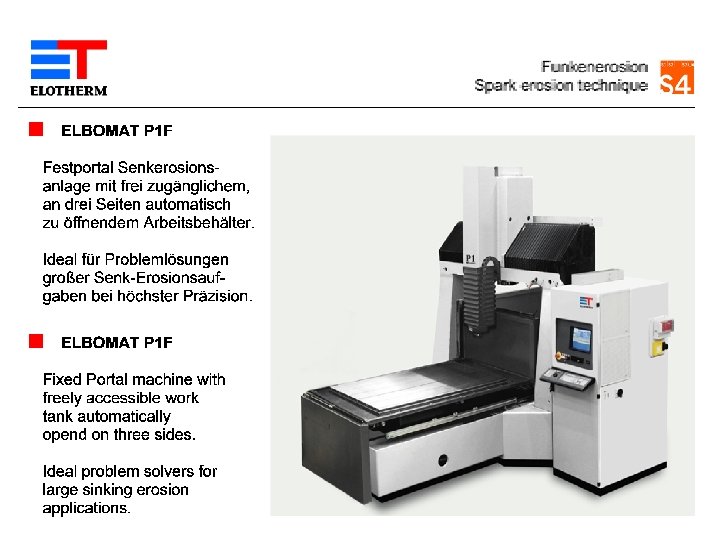
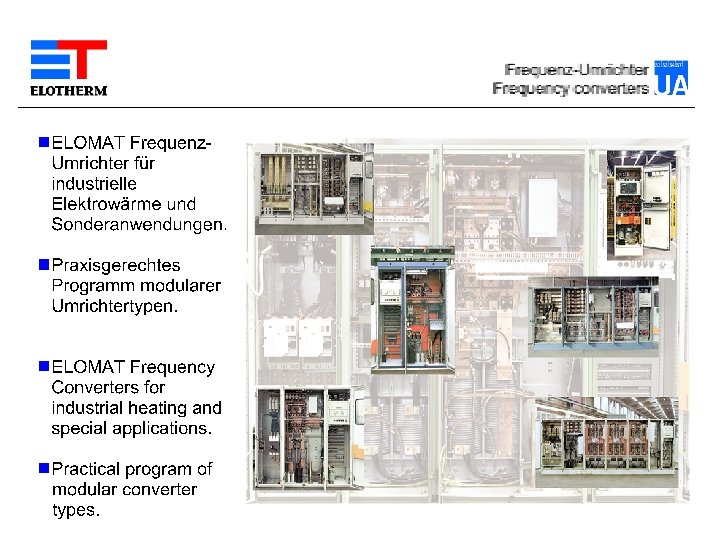
 Kunden / Customers Härte-und Vergütungstechnik Umschmelz-Härtetechnik Inductive hardening and quenching & tempering technology Induktions. Erwärmungstechnik Induction-heating technology Induktions. Schweiß-, Glüh und Sondertechnik Annealing, welding and special application Funkenerosionstechnik Spark erosion technology
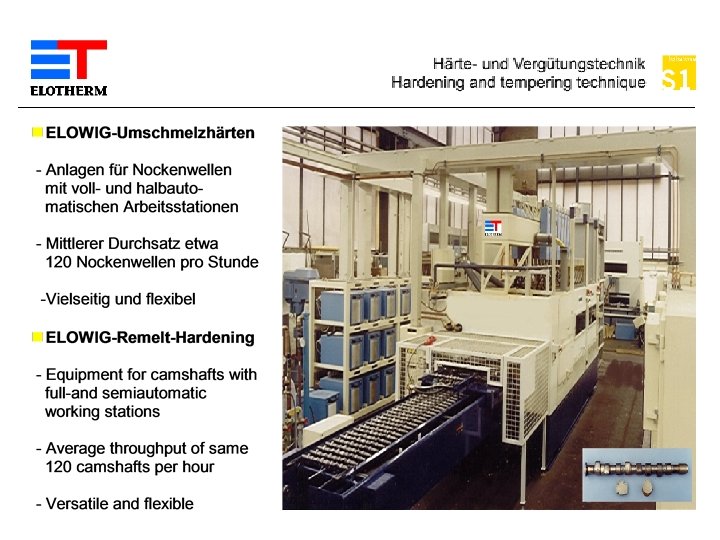
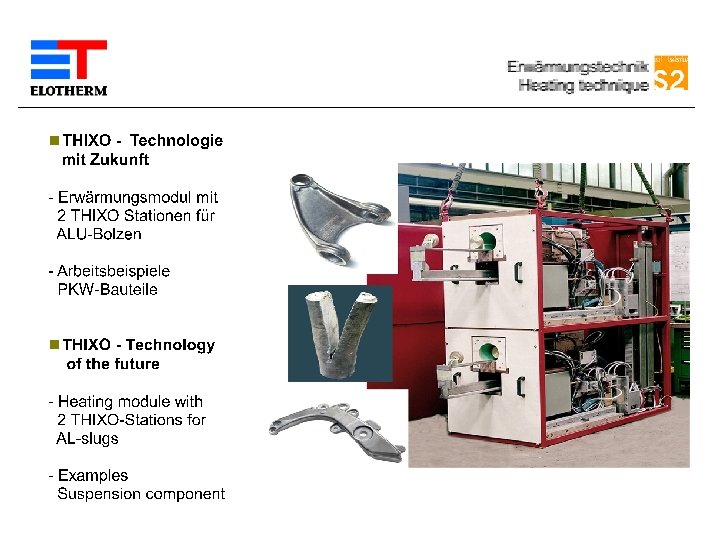
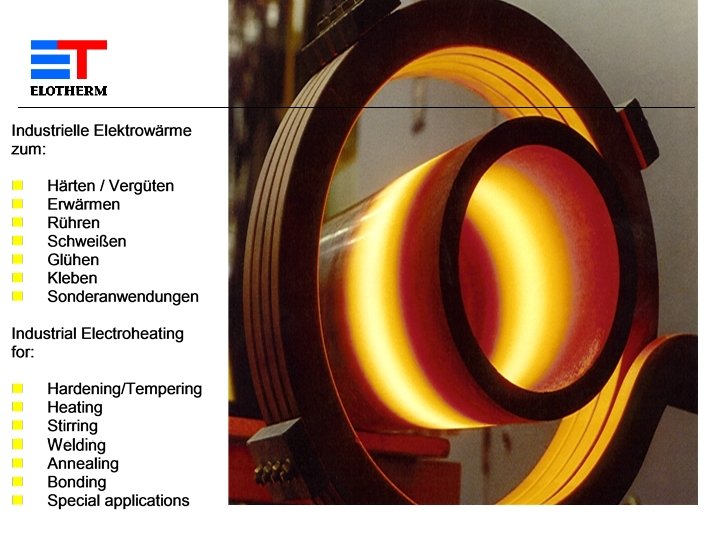
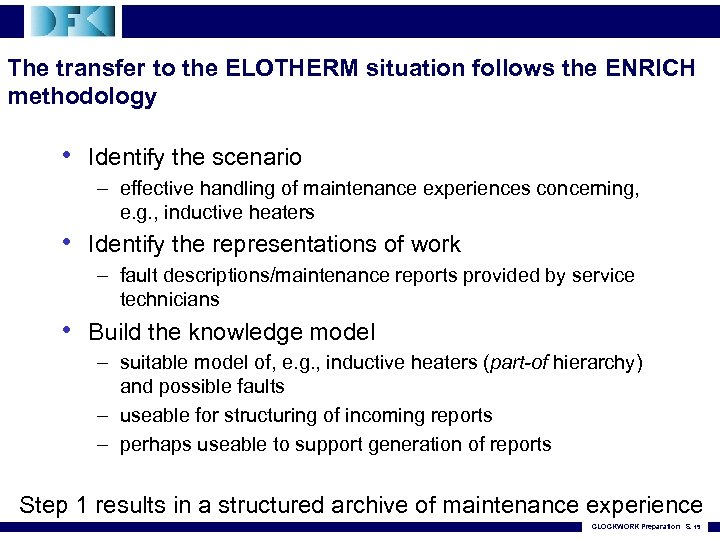 The transfer to the ELOTHERM situation follows the ENRICH methodology • Identify the scenario – effective handling of maintenance experiences concerning, e. g. , inductive heaters • Identify the representations of work – fault descriptions/maintenance reports provided by service technicians • Build the knowledge model – suitable model of, e. g. , inductive heaters (part-of hierarchy) and possible faults – useable for structuring of incoming reports – perhaps useable to support generation of reports Step 1 results in a structured archive of maintenance experience CLOCKWORK Preparation S. 15
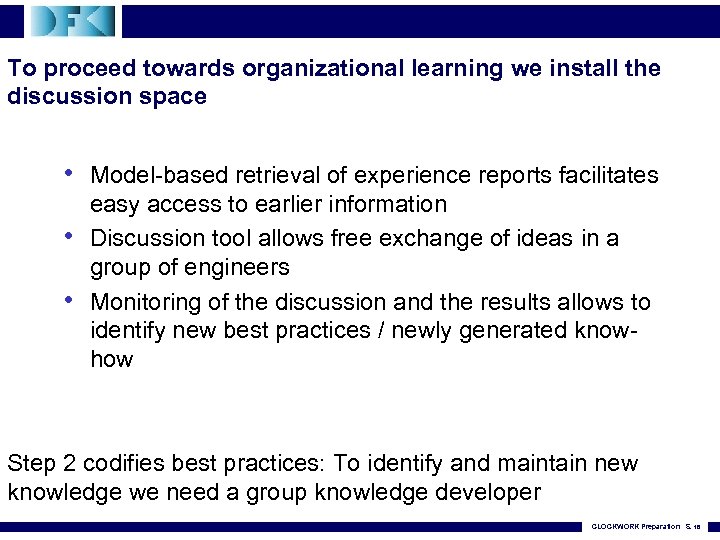 To proceed towards organizational learning we install the discussion space • Model-based retrieval of experience reports facilitates • • easy access to earlier information Discussion tool allows free exchange of ideas in a group of engineers Monitoring of the discussion and the results allows to identify new best practices / newly generated knowhow Step 2 codifies best practices: To identify and maintain new knowledge we need a group knowledge developer CLOCKWORK Preparation S. 16
 Integration with suitable simulation tools enhances the discussion capability • Suitable simulation modules can be added to the • • machine model Experience reports that are linked to a particular machine component can be augmented by the appropriate simulation component The integrated simulation/discussion tool will facilitate a realistic test of the new ideas Step 3 will test in practice a main result of the CLOCKWORK development CLOCKWORK Preparation S. 17
 Knowledge created in the CLOCKWORK environment might be useful for customers and partners • Define a model of knowledge confidentiality to • • describe what may be shared Define classes of sharing partners (e. g. customer, other departments, development group) Realise filter modules and active information distribution Step 4 (possible result): Automatic feedback of suitable knowledge to the (remote) maintenance people CLOCKWORK Preparation S. 18
 Using the CLOCKWORK knowledge-management tool at ELOTHERM: „Engineer (diagnosis/maintenance) reports“ The current situation: • ELOTHERM „Engineer Reports“ in heterogeneous • formats: Excel tables, Word documents, notes, etc. Since reporting guidelines are not enforced, there are variations in precision and detail Improving the situation: • Interactively develop a small set of forms capturing • • the required Engineer-Report content (cf. Step 1) Develop human-readable form annotations and indexes managed by CLOCKWORK tool (cf. Step 1) Introduce these forms at ELOTHERM together with the added-value of the discussion space (cf. Step 2) CLOCKWORK Preparation S. 19
 Using the CLOCKWORK knowledge-management tool at ELOTHERM: „Simulation data modelling and exchange“ • Selected experimental data (ELOTHERM) and • simulation data (INTEC) could be exchanged between the CLOCKWORK partners for validation and modelling (cf. Step 3) Improve the simulation models and integrate with Engineer Reports for better future constructions, respecting knowledge confidentiality (cf. Step 4) Experiment --> Real parameters + Induced formulas <--> Simulation --> Derived parameters (linear? . . . discontinuous? ) CLOCKWORK Preparation S. 20