


 Скачать презентацию THE CLINICAL CONSEQUENCES OF FREQUENT INTRADIALYTIC HYPOTENSION Susannah
8aa7c64bb112a28aaca31eb81f4b816f.ppt
- Количество слайдов: 1
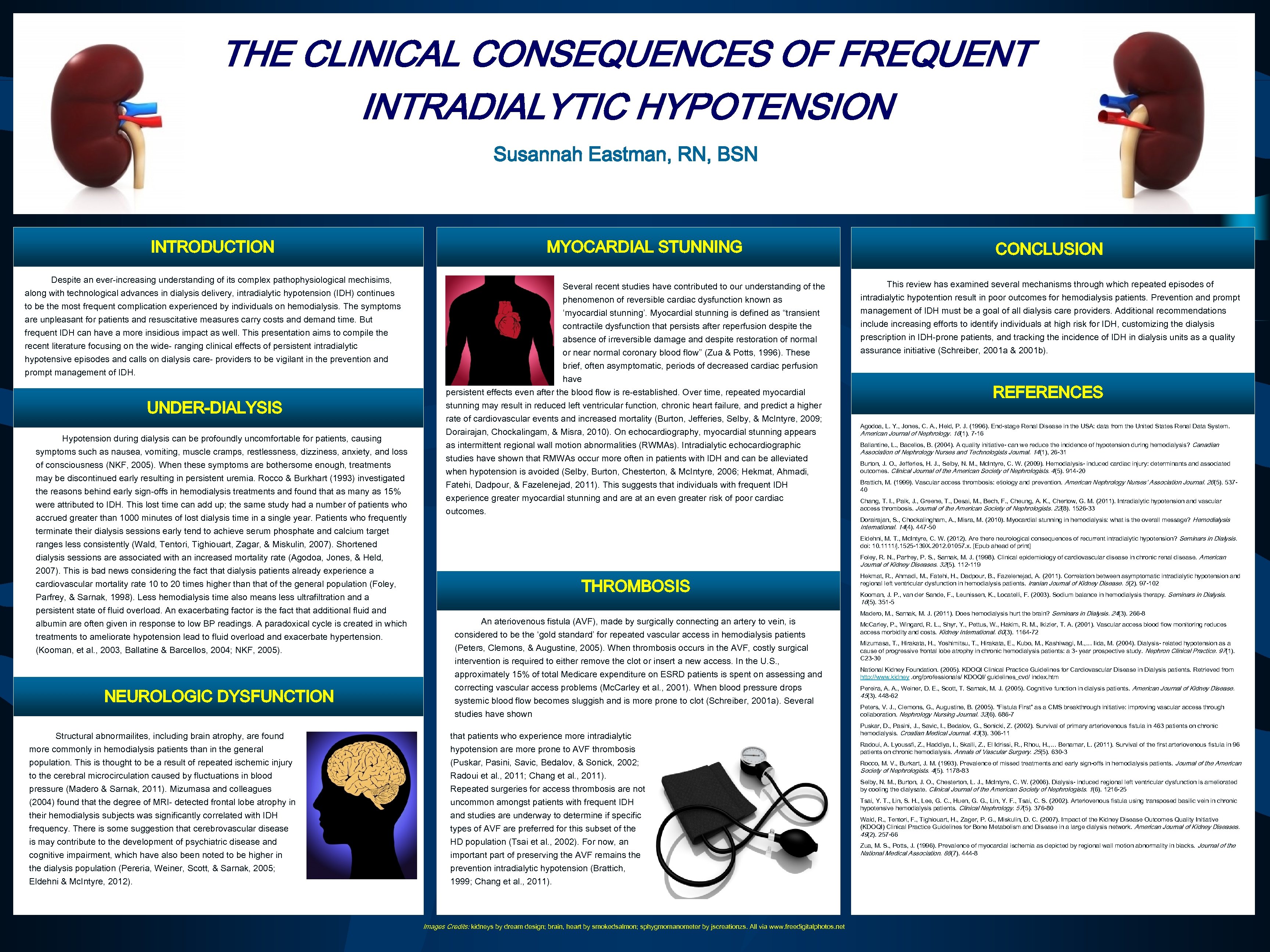 THE CLINICAL CONSEQUENCES OF FREQUENT INTRADIALYTIC HYPOTENSION Susannah Eastman, RN, BSN INTRODUCTION Despite an ever-increasing understanding of its complex pathophysiological mechisims, along with technological advances in dialysis delivery, intradialytic hypotension (IDH) continues to be the most frequent complication experienced by individuals on hemodialysis. The symptoms are unpleasant for patients and resuscitative measures carry costs and demand time. But frequent IDH can have a more insidious impact as well. This presentation aims to compile the recent literature focusing on the wide- ranging clinical effects of persistent intradialytic hypotensive episodes and calls on dialysis care- providers to be vigilant in the prevention and prompt management of IDH. UNDER-DIALYSIS Hypotension during dialysis can be profoundly uncomfortable for patients, causing symptoms such as nausea, vomiting, muscle cramps, restlessness, dizziness, anxiety, and loss of consciousness (NKF, 2005). When these symptoms are bothersome enough, treatments may be discontinued early resulting in persistent uremia. Rocco & Burkhart (1993) investigated the reasons behind early sign-offs in hemodialysis treatments and found that as many as 15% were attributed to IDH. This lost time can add up; the same study had a number of patients who accrued greater than 1000 minutes of lost dialysis time in a single year. Patients who frequently terminate their dialysis sessions early tend to achieve serum phosphate and calcium target ranges less consistently (Wald, Tentori, Tighiouart, Zagar, & Miskulin, 2007). Shortened dialysis sessions are associated with an increased mortality rate (Agodoa, Jones, & Held, 2007). This is bad news considering the fact that dialysis patients already experience a cardiovascular mortality rate 10 to 20 times higher than that of the general population (Foley, Parfrey, & Sarnak, 1998). Less hemodialysis time also means less ultrafiltration and a persistent state of fluid overload. An exacerbating factor is the fact that additional fluid and albumin are often given in response to low BP readings. A paradoxical cycle is created in which treatments to ameliorate hypotension lead to fluid overload and exacerbate hypertension. (Kooman, et al. , 2003, Ballatine & Barcellos, 2004; NKF, 2005). NEUROLOGIC DYSFUNCTION Structural abnormailites, including brain atrophy, are found more commonly in hemodialysis patients than in the general population. This is thought to be a result of repeated ischemic injury to the cerebral microcirculation caused by fluctuations in blood pressure (Madero & Sarnak, 2011). Mizumasa and colleagues (2004) found that the degree of MRI- detected frontal lobe atrophy in their hemodialysis subjects was significantly correlated with IDH frequency. There is some suggestion that cerebrovascular disease is may contribute to the development of psychiatric disease and cognitive impairment, which have also been noted to be higher in the dialysis population (Pereria, Weiner, Scott, & Sarnak, 2005; Eldehni & Mc. Intyre, 2012). MYOCARDIAL STUNNING Several recent studies have contributed to our understanding of the phenomenon of reversible cardiac dysfunction known as ‘myocardial stunning’. Myocardial stunning is defined as “transient contractile dysfunction that persists after reperfusion despite the absence of irreversible damage and despite restoration of normal or near normal coronary blood flow” (Zua & Potts, 1996). These brief, often asymptomatic, periods of decreased cardiac perfusion have persistent effects even after the blood flow is re-established. Over time, repeated myocardial stunning may result in reduced left ventricular function, chronic heart failure, and predict a higher rate of cardiovascular events and increased mortality (Burton, Jefferies, Selby, & Mc. Intyre, 2009; Dorairajan, Chockalingam, & Misra, 2010). On echocardiography, myocardial stunning appears as intermittent regional wall motion abnormalities (RWMAs). Intradialytic echocardiographic studies have shown that RMWAs occur more often in patients with IDH and can be alleviated when hypotension is avoided (Selby, Burton, Chesterton, & Mc. Intyre, 2006; Hekmat, Ahmadi, Fatehi, Dadpour, & Fazelenejad, 2011). This suggests that individuals with frequent IDH experience greater myocardial stunning and are at an even greater risk of poor cardiac outcomes. CONCLUSION This review has examined several mechanisms through which repeated episodes of intradialytic hypotention result in poor outcomes for hemodialysis patients. Prevention and prompt management of IDH must be a goal of all dialysis care providers. Additional recommendations include increasing efforts to identify individuals at high risk for IDH, customizing the dialysis prescription in IDH-prone patients, and tracking the incidence of IDH in dialysis units as a quality assurance initiative (Schreiber, 2001 a & 2001 b). REFERENCES Agodoa, L. Y. , Jones, C. A. , Held, P. J. (1996). End-stage Renal Disease in the USA: data from the United States Renal Data System. American Journal of Nephrology. 16(1). 7 -16 Ballantine, L. , Bacellos, B. (2004). A quality initiative- can we reduce the incidence of hypotension during hemodialysis? Canadian Association of Nephrology Nurses and Technologists Journal. 14(1), 26 -31 Burton, J. O. , Jefferies, H. J. , Selby, N. M. , Mc. Intyre, C. W. (2009). Hemodialysis- induced cardiac injury: determinants and associated outcomes. Clinical Journal of the American Society of Nephrologists. 4(5). 914 -20 Brattich, M. (1999). Vascular access thrombosis: etiology and prevention. American Nephrology Nurses’ Association Journal. 26(5). 53740 Chang, T. I. , Paik, J. , Greene, T. , Desai, M. , Bech, F. , Cheung, A. K. , Chertow, G. M. (2011). Intradialytic hypotension and vascular access thrombosis. Journal of the American Society of Nephrologists. 22(8). 1526 -33 Dorairajan, S. , Chockalingham, A. , Misra, M. (2010). Myocardial stunning in hemodialysis: what is the overall message? Hemodialysis International. 14(4). 447 -50 Eldehni, M. T. , Mc. Intyre, C. W. (2012). Are there neurological consequences of recurrent intradialytic hypotension? Seminars in Dialysis. doi: 10. 1111/j. 1525 -139 X. 2012. 01057. x. [Epub ahead of print] Foley, R. N. , Parfrey, P. S. , Sarnak, M. J. (1998). Clinical epidemiology of cardiovascular disease in chronic renal disease. American Journal of Kidney Diseases. 32(5). 112 -119 THROMBOSIS An ateriovenous fistula (AVF), made by surgically connecting an artery to vein, is considered to be the ‘gold standard’ for repeated vascular access in hemodialysis patients (Peters, Clemons, & Augustine, 2005). When thrombosis occurs in the AVF, costly surgical intervention is required to either remove the clot or insert a new access. In the U. S. , approximately 15% of total Medicare expenditure on ESRD patients is spent on assessing and correcting vascular access problems (Mc. Carley et al. , 2001). When blood pressure drops systemic blood flow becomes sluggish and is more prone to clot (Schreiber, 2001 a). Several studies have shown that patients who experience more intradialytic hypotension are more prone to AVF thrombosis (Puskar, Pasini, Savic, Bedalov, & Sonick, 2002; Radoui et al. , 2011; Chang et al. , 2011). Repeated surgeries for access thrombosis are not uncommon amongst patients with frequent IDH and studies are underway to determine if specific types of AVF are preferred for this subset of the HD population (Tsai et al. , 2002). For now, an important part of preserving the AVF remains the prevention intradialytic hypotension (Brattich, 1999; Chang et al. , 2011). Images Credits: kidneys by dream design; brain, heart by smokedsalmon; sphygmomanometer by jscreationzs. All via www. freedigitalphotos. net Hekmat, R. , Ahmadi, M. , Fatehi, H. , Dadpour, B. , Fazelenejad, A. (2011). Correlation between asymptomatic intradialytic hypotension and regional left ventricular dysfunction in hemodialysis patients. Iranian Journal of Kidney Disease. 5(2). 97 -102 Kooman, J. P. , van der Sande, F. , Leunissen, K. , Locatelli, F. (2003). Sodium balance in hemodialysis therapy. Seminars in Dialysis. 16(5). 351 -5 Madero, M. , Sarnak, M. J. (2011). Does hemodialysis hurt the brain? Seminars in Dialysis. 24(3). 266 -8 Mc. Carley, P. , Wingard, R. L. , Shyr, Y. , Pettus, W. , Hakim, R. M. , Ikizler, T. A. (2001). Vascular access blood flow monitoring reduces access morbidity and costs. Kidney International. 60(3). 1164 -72 Mizumasa, T. , Hirakata, H. , Yoshimitsu, T. , Hirakata, E. , Kubo, M. , Kashiwagi, M. , … Iida, M. (2004). Dialysis- related hypotension as a cause of progressive frontal lobe atrophy in chronic hemodialysis patients: a 3 - year prospective study. Nephron Clinical Practice. 97(1). C 23 -30 National Kidney Foundation. (2005). KDOQI Clinical Practice Guidelines for Cardiovascular Disease in Dialysis patients. Retrieved from http: //www. kidney. org/professionals/ KDOQI/ guidelines_cvd/ index. htm Pereira, A. A. , Weiner, D. E. , Scott, T. Sarnak, M. J. (2005). Cognitive function in dialysis patients. American Journal of Kidney Disease. 45(3). 448 -62 Peters, V. J. , Clemons, G. , Augustine, B. (2005). “Fistula First” as a CMS breakthrough initiative: improving vascular access through collaboration. Nephrology Nursing Journal. 32(6). 686 -7 Puskar, D. , Pasini, J. , Savic, I. , Bedalov, G. , Sonicki, Z. (2002). Survival of primary arteriovenous fistula in 463 patients on chronic hemodialysis. Croatian Medical Journal. 43(3). 306 -11 Radoui, A. Lyoussfi, Z. , Haddiya, I. , Skalli, Z. , El Idrissi, R. , Rhou, H. , … Benamar, L. (2011). Survival of the first arteriovenous fistula in 96 patients on chronic hemodialysis. Annals of Vascular Surgery. 25(5). 630 -3 Rocco, M. V. , Burkart, J. M. (1993). Prevalence of missed treatments and early sign-offs in hemodialysis patients. Journal of the American Society of Nephrologists. 4(5). 1178 -83 Selby, N. M. , Burton, J. O. , Chesterton, L. J. , Mc. Intyre, C. W. (2006). Dialysis- induced regional left ventricular dysfunction is ameliorated by cooling the dialysate. Clinical Journal of the American Society of Nephrologists. 1(6). 1216 -25 Tsai, Y. T. , Lin, S. H. , Lee, G. C. , Huen, G. G. , Lin, Y. F. , Tsai, C. S. (2002). Arteriovenous fistula using transposed basilic vein in chronic hypotensive hemodialysis patients. Clinical Nephrology. 57(5). 376 -80 Wald, R. , Tentori, F. , Tighiouart, H. , Zager, P. G. , Miskulin, D. C. (2007). Impact of the Kidney Disease Outcomes Quality Initiative (KDOQI) Clinical Practice Guidelines for Bone Metabolism and Disease in a large dialysis network. American Journal of Kidney Diseases. 49(2). 257 -66 Zua, M. S. , Potts, J. (1996). Prevalence of myocardial ischemia as depicted by regional wall motion abnormality in blacks. Journal of the National Medical Association. 88(7). 444 -8