


 Скачать презентацию The clinical case of RENAL CELL CARCINOMA Prepared
renal_cell_v2.pptx
- Количество слайдов: 19
 The clinical case of RENAL CELL CARCINOMA Prepared by Alina Lyaskovik
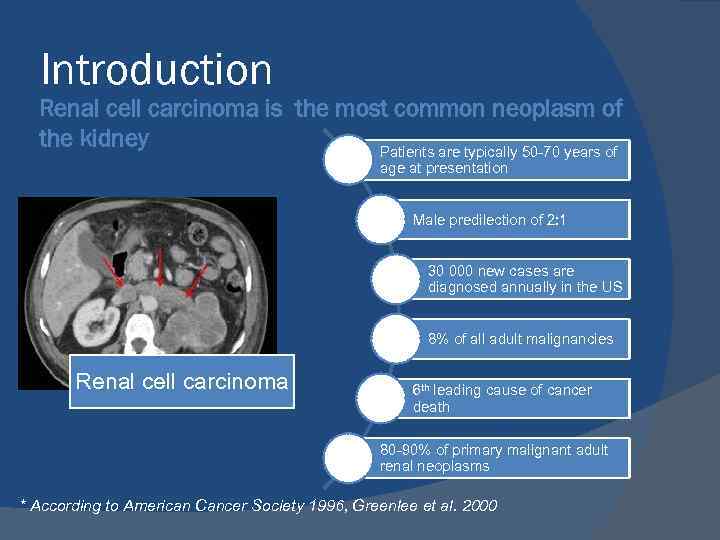 Introduction Renal cell carcinoma is the most common neoplasm of the kidney Patients are typically 50 -70 years of age at presentation Male predilection of 2: 1 30 000 new cases are diagnosed annually in the US 8% of all adult malignancies Renal cell carcinoma 6 th leading cause of cancer death 80 -90% of primary malignant adult renal neoplasms * According to American Cancer Society 1996, Greenlee et al. 2000
 Risk Factors Obesity Dialysisrelated cystic disease Cigarette smoking Treatment with cyclophosp hamide Heavy analgesic use
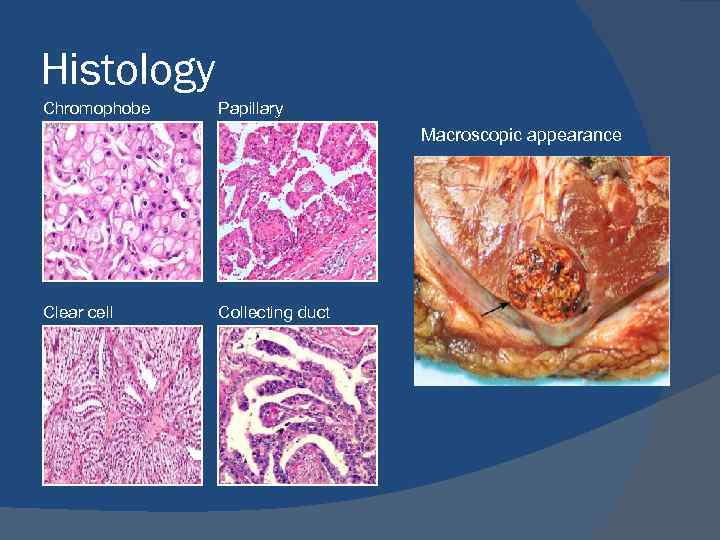 Histology Chromophobe Papillary Macroscopic appearance ДОБАВЬ ТЕКСТ Clear cell Collecting duct
 Clinical Presentation Macroscopic haematuria: 60% Hypercalcaemia (20%) Hypertension (20%) Palpable flank mass: 30 -40% Stauffer syndrome: hepatic dysfunction not related to metastases Feminisation Flank pain: 40% * According to Motzer et al. 1996 Limbic encephalitis
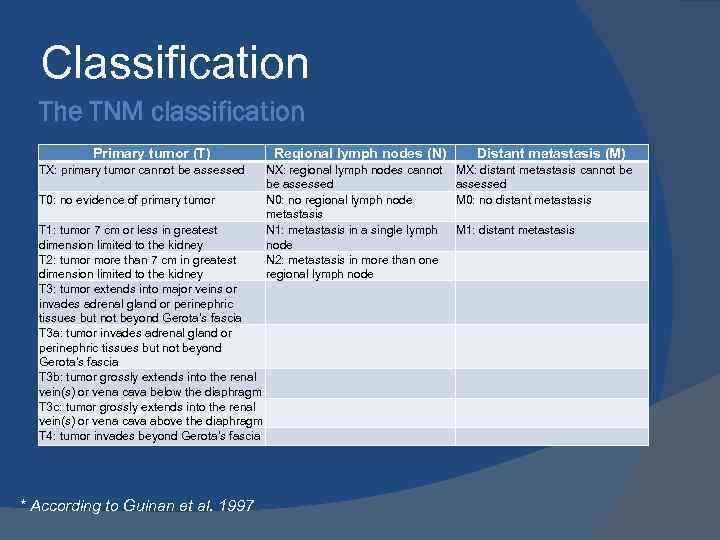 Classification The TNM classification Primary tumor (T) TX: primary tumor cannot be assessed T 0: no evidence of primary tumor Regional lymph nodes (N) NX: regional lymph nodes cannot be assessed N 0: no regional lymph node metastasis N 1: metastasis in a single lymph node N 2: metastasis in more than one regional lymph node T 1: tumor 7 cm or less in greatest dimension limited to the kidney T 2: tumor more than 7 cm in greatest dimension limited to the kidney T 3: tumor extends into major veins or invades adrenal gland or perinephric tissues but not beyond Gerota's fascia T 3 a: tumor invades adrenal gland or perinephric tissues but not beyond Gerota's fascia T 3 b: tumor grossly extends into the renal vein(s) or vena cava below the diaphragm T 3 c: tumor grossly extends into the renal vein(s) or vena cava above the diaphragm T 4: tumor invades beyond Gerota's fascia * According to Guinan et al. 1997 Distant metastasis (M) MX: distant metastasis cannot be assessed M 0: no distant metastasis M 1: distant metastasis
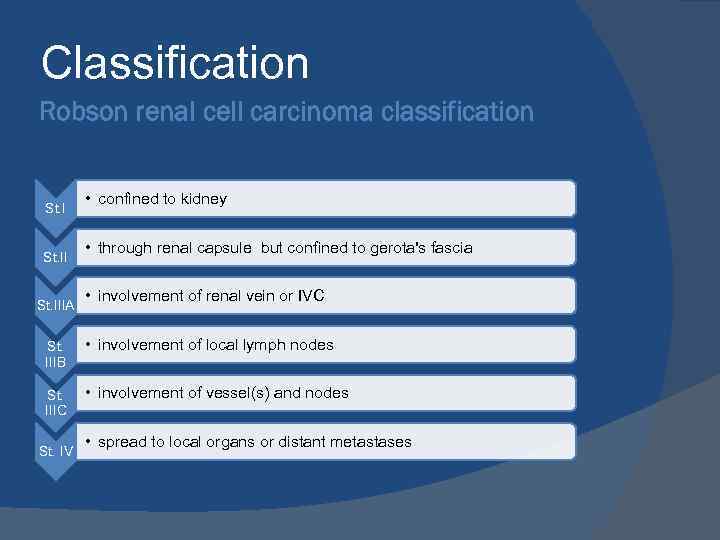 Classification Robson renal cell carcinoma classification St. IIIA • confined to kidney • through renal capsule but confined to gerota's fascia • involvement of renal vein or IVC St. IIIB • involvement of local lymph nodes St. IIIC • involvement of vessel(s) and nodes St. IV • spread to local organs or distant metastases
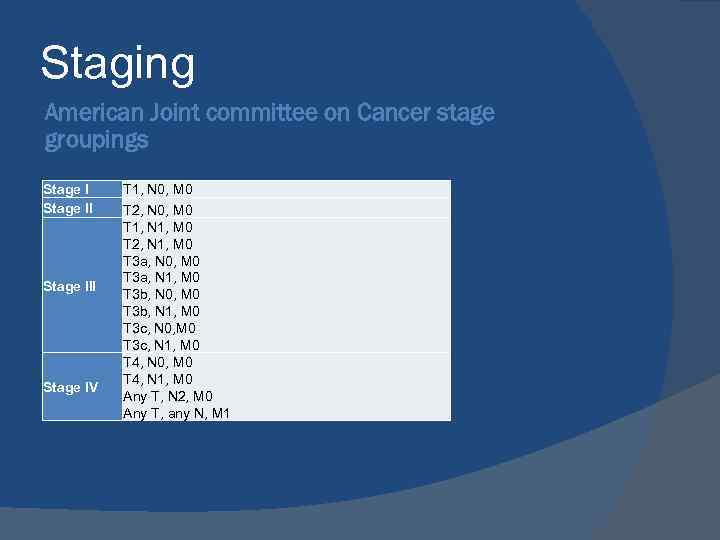 Staging American Joint committee on Cancer stage groupings Stage III Stage IV T 1, N 0, M 0 T 2, N 0, M 0 T 1, N 1, M 0 T 2, N 1, M 0 T 3 a, N 0, M 0 T 3 a, N 1, M 0 T 3 b, N 0, M 0 T 3 b, N 1, M 0 T 3 c, N 0, M 0 T 3 c, N 1, M 0 T 4, N 0, M 0 T 4, N 1, M 0 Any T, N 2, M 0 Any T, any N, M 1
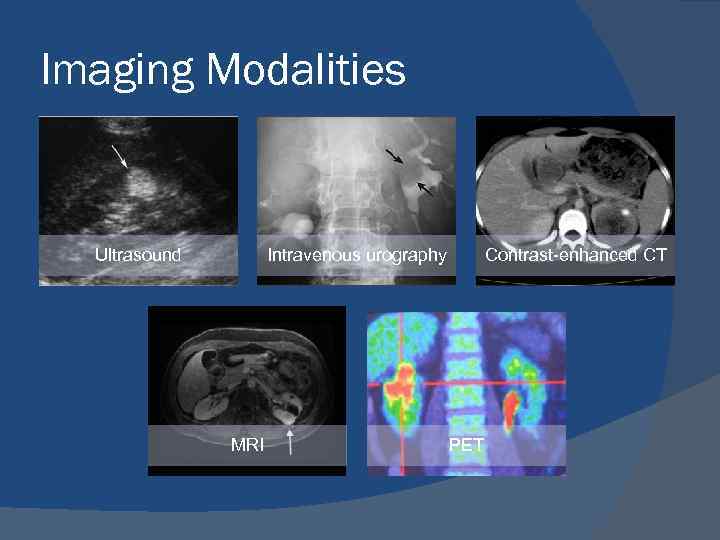 Imaging Modalities Ultrasound Intravenous urography MRI Contrast-enhanced CT PET
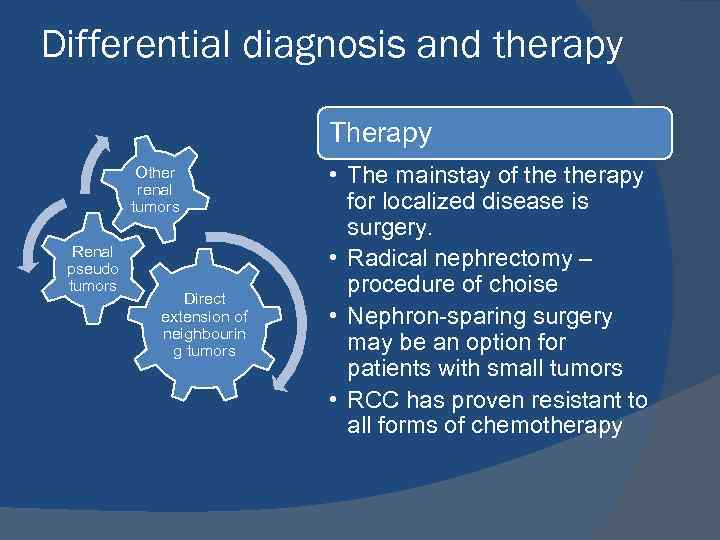 Differential diagnosis and therapy Therapy Other renal tumors Renal pseudo tumors Direct extension of neighbourin g tumors • The mainstay of therapy for localized disease is surgery. • Radical nephrectomy – procedure of choise • Nephron-sparing surgery may be an option for patients with small tumors • RCC has proven resistant to all forms of chemotherapy
 Prognosis can be variable depending both on histological subtype and stage St. I 90% 5 -year survival St. II 50% 5 -year survival St. III 30% 5 -year survival St. IV 5% 5 -year survival
 Clinical Case Patient Ch. , F, 59 y. o. was admitted to urology department with complaints on flank pain. Previous US-findings: neoplasm in left kidney. The patient was sent to MONIKI hospital to verify and follow up – CT-scan of abdomen and retroperitoneal space with intravenous contrastenhancement (Оптирей 300 -100 ml) with ensuing reconstruction.
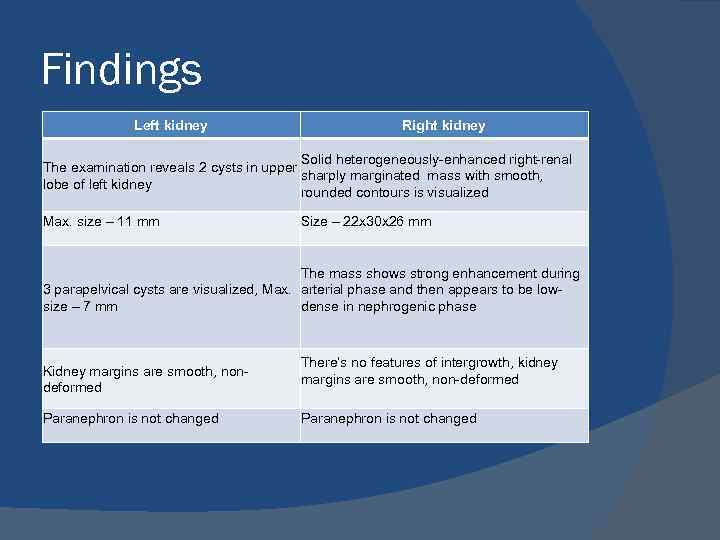 Findings Left kidney Right kidney Solid heterogeneously-enhanced right-renal The examination reveals 2 cysts in upper sharply marginated mass with smooth, lobe of left kidney rounded contours is visualized Max. size – 11 mm Size – 22 x 30 x 26 mm The mass shows strong enhancement during 3 parapelvical cysts are visualized, Max. arterial phase and then appears to be lowsize – 7 mm dense in nephrogenic phase Kidney margins are smooth, nondeformed Paranephron is not changed There’s no features of intergrowth, kidney margins are smooth, non-deformed Paranephron is not changed
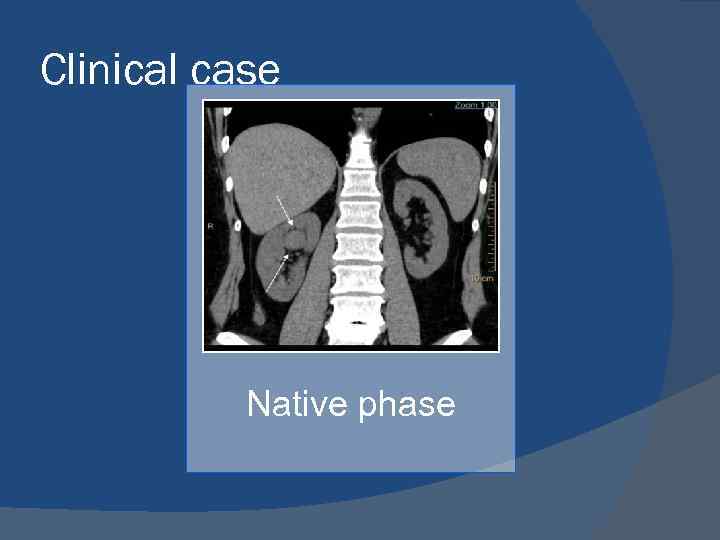 Clinical case Native phase
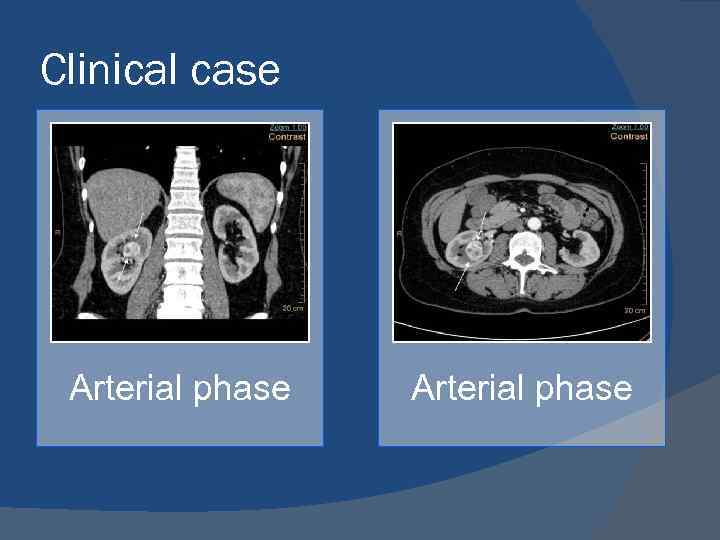 Clinical case Arterial phase
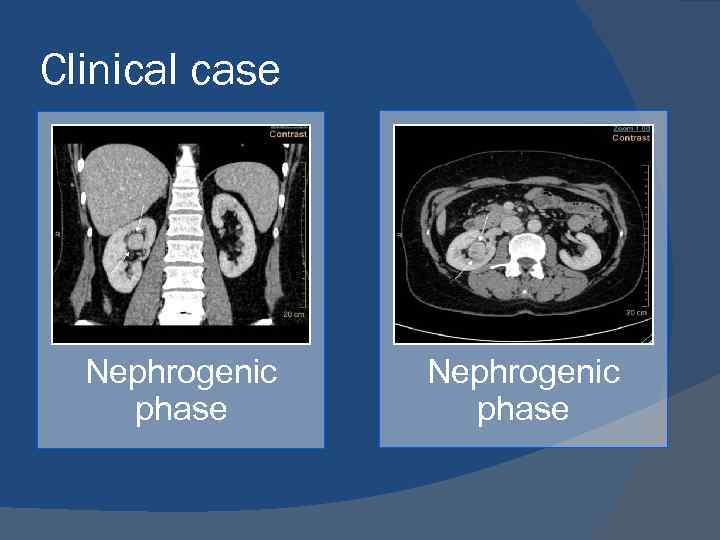 Clinical case Nephrogenic phase
 Impression Typical appearances of a right sided renal cell carcinoma. Resection of right kidney is recommended.
 Literature Imaging of kidney cancer/ Ali Guermazi 2006// A practical imaging classification for the noninvasive differentiation of renal cell carcinoma into its main subtypes/ Cupido BV/ 2016// Diagnostic accuracy of contrast-enhanced computed tomography and contrast-enhanced magnetic resonance imaging of small renal masses in real practice: sensitivity and specificity according to subjective radiologic interpretation/ Kim JH/2016 https: //radiopaedia. org/articles/renal-cellcarcinoma-1
 Thank you for your attention