


 Скачать презентацию The Client The Client The Nature
42cb05eff344913c769ba4797d8c688a.ppt
- Количество слайдов: 21
 The Client
 The Client ► The Nature of Clients § Patron: a client with expectations outside the norm & the funds to achieve them. § Master Builder: Hired by Patron created works not like any others of their time Michelangelo, Bernini, Christopher Wren, Thomas Jefferson § Most work was done by carpenters and masons for average user-owners § 1868; 1 st school of architecture at MIT – 4 students § Late 19 th century; new regulations forced professionalism § Mid 20 th century; licensed architect mandated by law
 ► Ours is a better world for the contributions of architects properly educated and ordained, to be sure… ► Nonetheless, it is a world in which the vast majority of clients bring not much more (or less) architectural appreciation to their projects than the average citizen with a desire to build or renovate in Jefferson’s Virginia, Wern’s London or Bernini’s Rome. ► The question is, would these clients hire an architect if they weren’t required to?
 Challenges Mandatory involvement (because of codes) = a great boost to business & many more challenges… 1. 2. 3. More varied clients (taste, character, sophistication, aspirations & willingness to work with an architect) including The vast middle sector of commercial and residential user/owners, who in the past would have been satisfied with the crudely sketched plans of masons and carpenters. Today’s clients represent many challenges; clients who don’t share an architect’s interest or commitment to design or who are concerned with $ above all else & those trying to procure design from another source.
 The Client Defined ►A client…. . . is at least one person with whom at least one architect will deal on what is often a remarkably intimate basis. That personal relationship is almost the single most important determinant of project success and of success in practice. ►. . has something to do with some aspect of a built environment ►. . always faces the need to deal with change ►. . must be in need of services; the client may not be aware of this so the architect must make them aware and turn them into clients. ►
 The Client Defined ► The definition of an architecture client: a person or group of people dealing with the effects of change on and in the built environment and in need of professional assistance.
 Client vs. Customer ► Each as a problem to be solved ► Each has choices of means of solving & sources for those means ► Both are searching for solutions, but if solution is defined as the end result (problem solved)…then solutions are NOT FOR SALE
 ► 3 primary parties in the construction industry § Owners § Design Professionals § Constructors
 Owner/clients ►Private clients ► Private clients who build for themselves are known as owner-users § Individual owner-clients, business owner-clients & institutional clients are usually long-term owners ► Private owners who build for others are known as developers § Developers may own to rent or sell projects
 Owner/clients ►Public clients ► Public clients include various governmental bodies. They commission huge amounts of construction. § Office buildings, schools, post offices, sports facilities, housing, military buildings & transit stations.
 Client vs. Customer “Unlike architects, who view the design & construction of a building as ‘an end’, the majority of clients see buildings as ‘a means’ to satisfy a wider set of requirements” G. Chong FAIA Clients & customers alike are searching for solutions to their problems. But if solution is defined as an end result – the problem solved – then solutions aren’t for sale. “Customers do not buy a ¾-inch drill; they buy a ¾inch hole” T. Levitt
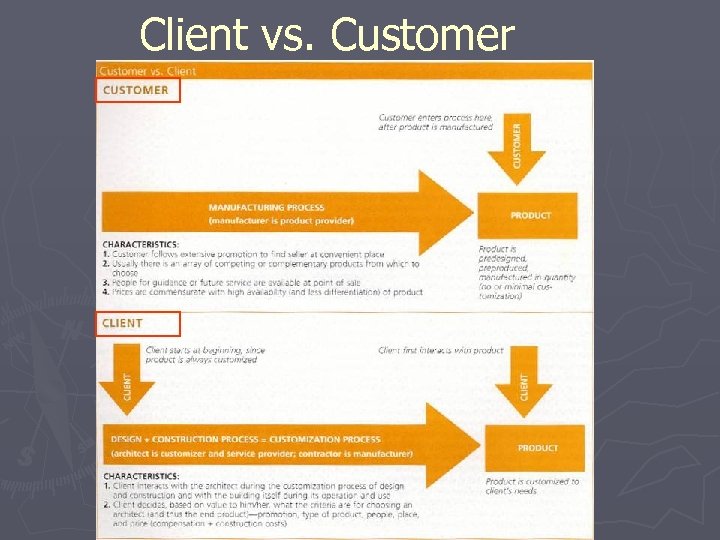 Client vs. Customer
 Selection Approaches ► Qualification-Based Selection: SF 254 & 255 ask the architect to describe their 5 P’s (not $) Request for Qualifications (RFQ) and Request for Proposal (RFP): Issued by clients large and small, smart architects craft their responses to match the values of the potential client
 Selection Approaches ► Cost-Based Selection: Selection based on the client’s willingness to pay higher or lower prices ► Design Competitions: Clients that value design use this method. Open to architects of various backgrounds. Usually spend more $ and time than anticipated
 Client Values – 5 P’s ► Promotion: Clients seek architects who reflect their own values & promotion is how they see that reflection ► Product: Clients with product orientation are interested in past projects that are similar to theirs ► People: Focuses on delivery, service & idea; knowledge and talent ► Place: Focuses on geographic location ► Price: Govern virtually every selection; focuses on the law of supply & demand
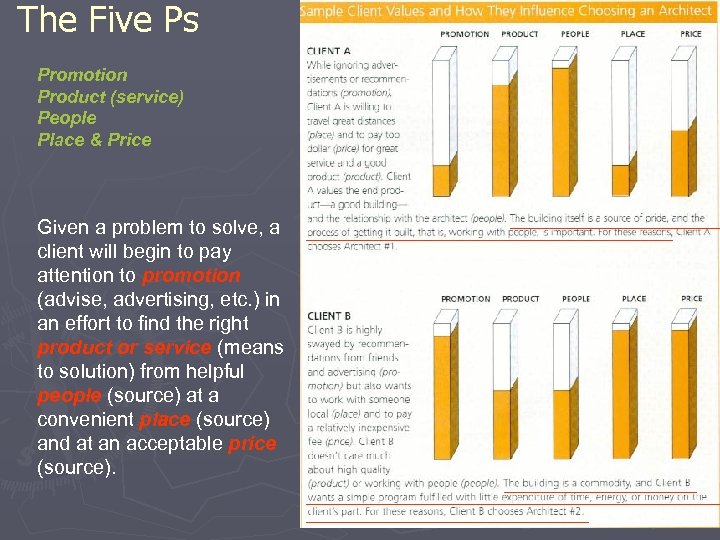 The Five Ps Promotion Product (service) People Place & Price Given a problem to solve, a client will begin to pay attention to promotion (advise, advertising, etc. ) in an effort to find the right product or service (means to solution) from helpful people (source) at a convenient place (source) and at an acceptable price (source).
 Service as a Strategy 3 Client Types Firms should focus on one client type…… ► Clients who value cost-effective project delivery most highly ► Clients who value the ideas embodied in great design most highly ► Clients, those squarely in the center, who value service most highly (most firms work in this middle ground) David Maister, The Coxe Group
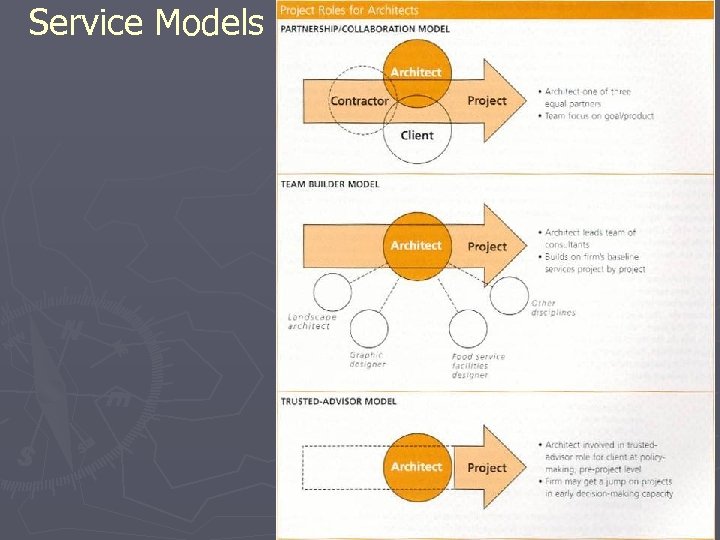 Service Models
 The Good Client ► mutual respect; ► enthusiasm for and open to new ideas; ► knowing their goals and able to articulate them; ► being clear about their resources and having matching expectations
 The Bad Client ► Think they know everything; ► They are secretive and distrustful; ► Naïve clients who lack knowledge of the process, lack business experience and who have unrealistic expectations, can be problematic ► Be aware of a potential client who comments on who dumb all his past architects were!
 The Rule ► Remember: architects are not obligated to take any client who wants to hire them. ► Other than for prejudicial reasons, you have the right to reject any potential commission ► Smart architects are highly selective in accepting clients ► Finally: ‘go after the client not the project’ I. M. Pei