


 Скачать презентацию The Classical Communist System Money Price Foreign trade
aca2c83b861de52dc60008d423dabd18.ppt
- Количество слайдов: 26
 The Classical Communist System Money Price Foreign trade CMEA
 Money l Formally: l Actually: Magnetized economy Semi-magnetized
 Institutions of Financial System Banking system - state owned State Budget
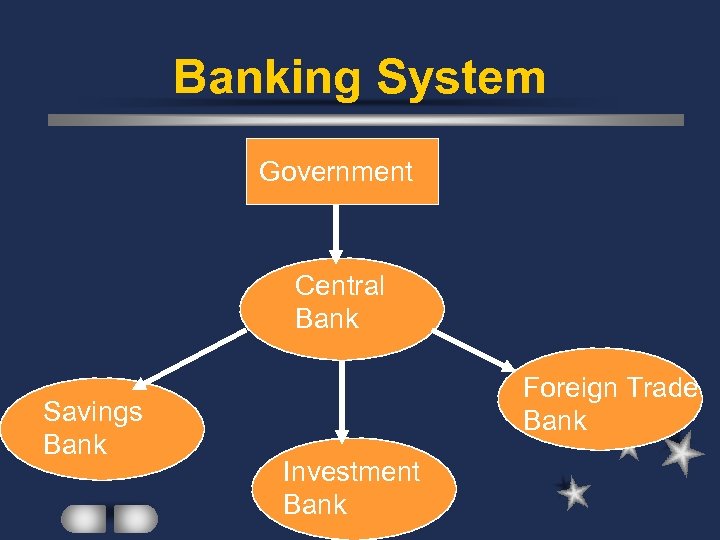 Banking System Government Central Bank Savings Bank Foreign Trade Bank Investment Bank
 Functions Central Bank: emission of money credit to SOE Investment bank - financing the investment Savings bank - public deposits and loans Foreign trade bank
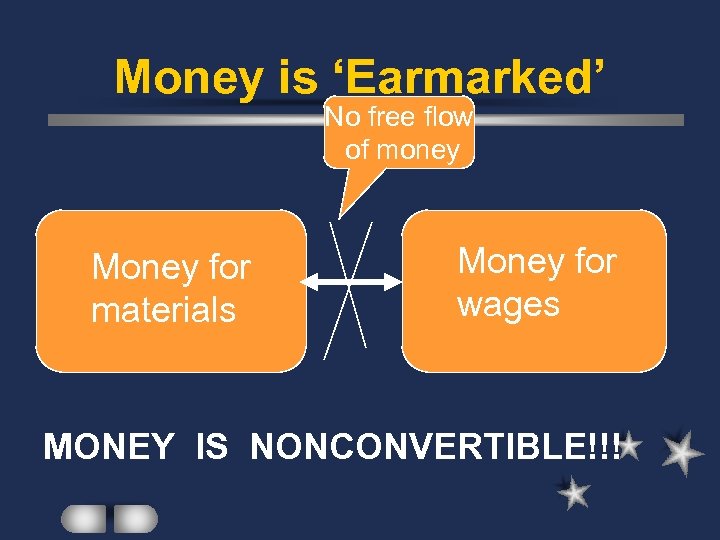 Money is ‘Earmarked’ No free flow of money Money for materials Money for wages MONEY IS NONCONVERTIBLE!!!
 Spheres of Classical Communist System With soft budget constraint and passive money - SOE With hard budget constraint and active money - formal and informal private sector - households
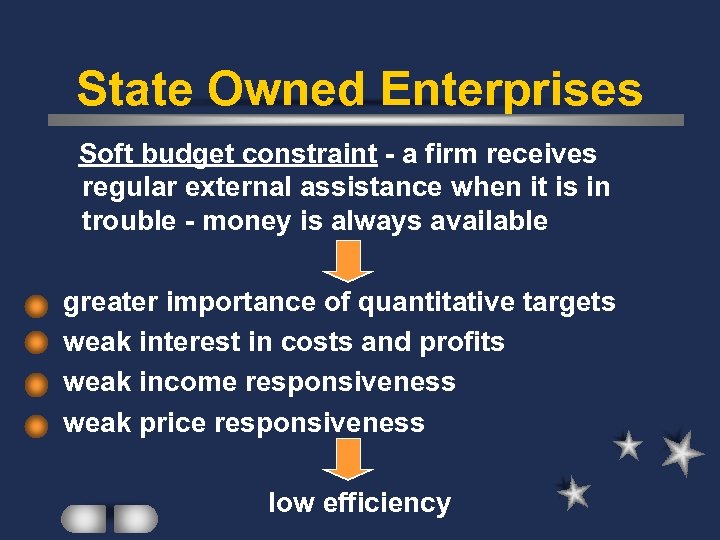 State Owned Enterprises Soft budget constraint - a firm receives regular external assistance when it is in trouble - money is always available greater importance of quantitative targets weak interest in costs and profits weak income responsiveness weak price responsiveness low efficiency
 Passive Money fails to operate as the general medium of exchange and plays a passive, supplementary, secondary role when SOEs conduct financial transactions with each other, the banking system and the state budget
 Private Sector & Households Hard budget constraint - the bureaucracy does not assist them in financial trouble - availability of the product desired. . . ? - availability of the purchase money…? stronger profit motive stronger responsiveness to income stronger responsiveness to price higher efficiency
 Active Money plays an active role in private and households sector
 Price Administrative producer price Administrative consumer price Market price
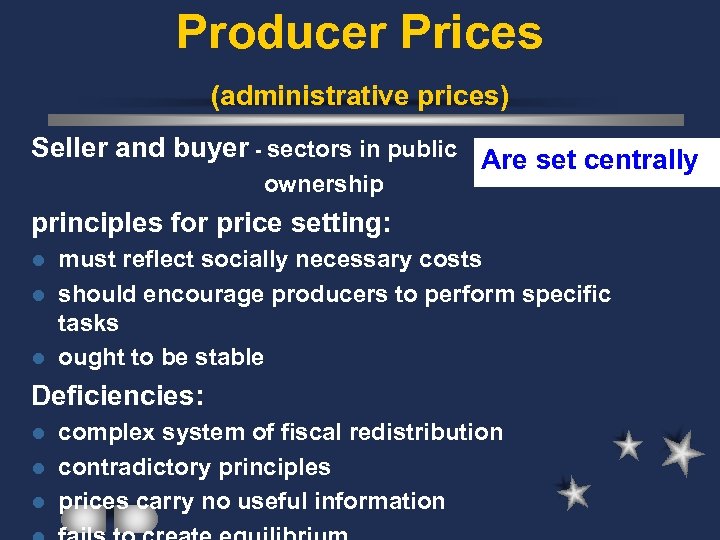 Producer Prices (administrative prices) Seller and buyer - sectors in public Are set centrally ownership principles for price setting: must reflect socially necessary costs l should encourage producers to perform specific tasks l ought to be stable l Deficiencies: complex system of fiscal redistribution l contradictory principles l prices carry no useful information l
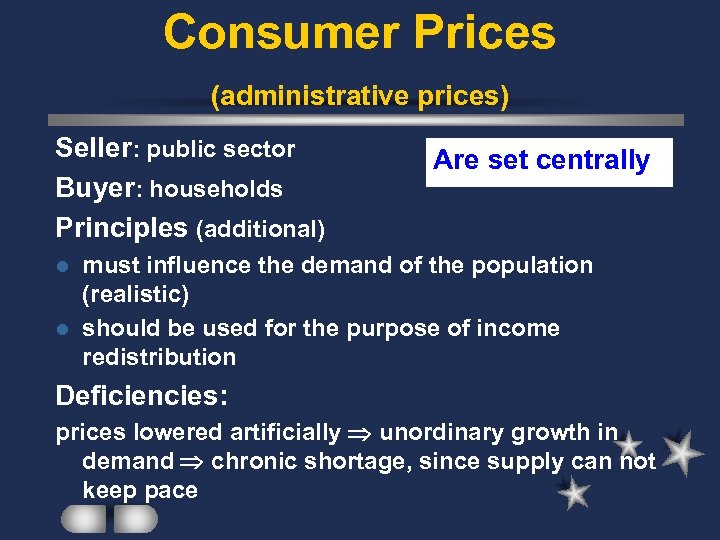 Consumer Prices (administrative prices) Seller: public sector Buyer: households Principles (additional) Are set centrally must influence the demand of the population (realistic) l should be used for the purpose of income redistribution l Deficiencies: prices lowered artificially unordinary growth in demand chronic shortage, since supply can not keep pace
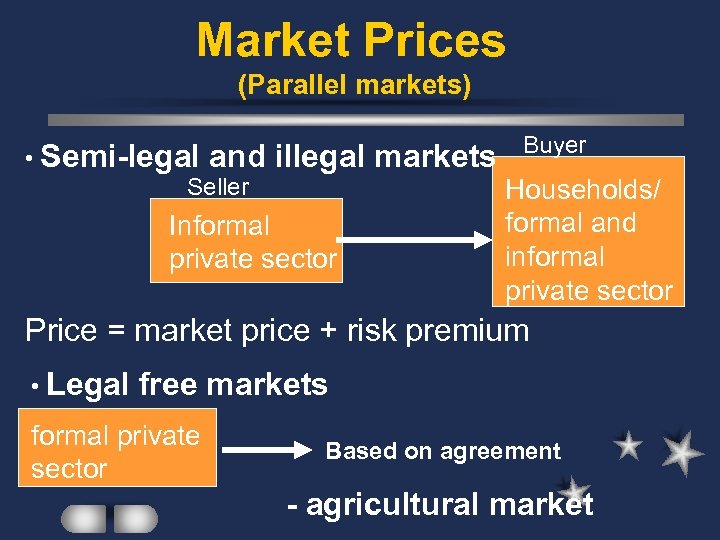 Market Prices (Parallel markets) • Semi-legal and Seller illegal markets Informal private sector Buyer Households/ formal and informal private sector Price = market price + risk premium • Legal free markets formal private sector Based on agreement - agricultural market
 External Economic Relations Political considerations are the prime criterion for controlling the external economic relations Economic considerations are subordinated to them economic, scientific and cultural isolation from the capitalist world expansion of foreign trade within the bloc (the Soviet Union and its allies)
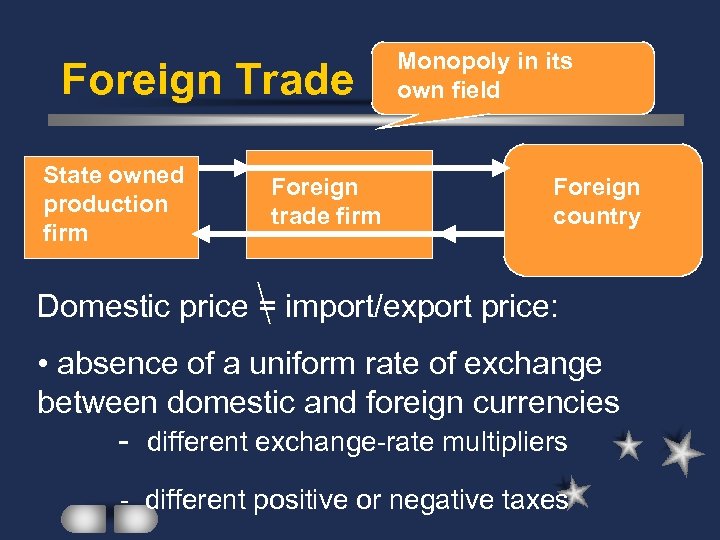 Foreign Trade State owned production firm Foreign trade firm Monopoly in its own field Foreign country Domestic price = import/export price: • absence of a uniform rate of exchange between domestic and foreign currencies - different exchange-rate multipliers - different positive or negative taxes
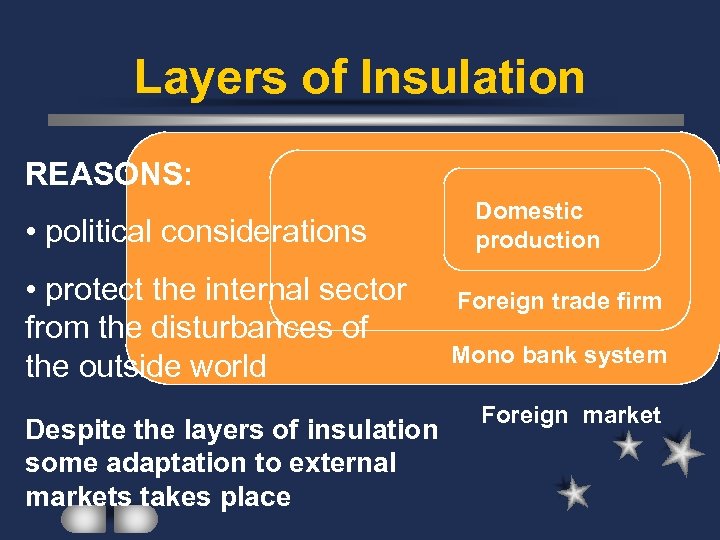 Layers of Insulation REASONS: • political considerations • protect the internal sector from the disturbances of the outside world Despite the layers of insulation some adaptation to external markets takes place Domestic production Foreign trade firm Mono bank system Foreign market
 Deficiencies More attention is paid to bargaining within the bureaucracy than with the foreign buyer, seller or bank inflexible foreign trade and credit activities l It is more important to win the approval of the superior organizations than to leave a foreign customer satisfied or to make the maximum financial profit l The production sector is not obliged to adjust flexibly and speedily to the situation on foreign markets l
 Foreign trade/financial relations with capitalist countries l Import hunger - import as much as possible - hunger for top-quality machines and equipment - chronic shortage l Export aversion - can not compete on the foreign market in terms of quality, modernity or reliable delivery price reduction l Propensity to indebtedness - to cover foreign trade deficit
 Foreign trade with socialist countries Import/export Bilateral relations - import hunger for the hard goods (good quality) - import aversion to the soft goods - no aversion on the export side (no force exporting) Tendency : zero trade balance
 CMEA(1949 - 1991) Council of Mutual Economic assistance (CMEA or COMECON) Members: (1990) - Soviet Union, Bulgaria, Czechoslovakia, East Germany, Hungary, Poland, Romania, Cuba, Mongolia, and Vietnam. Yugoslavia was a ‘limited participant’ Mission: to increase the trade among the socialist countries, namely within the CMEA, based mainly on bilateral negotiations
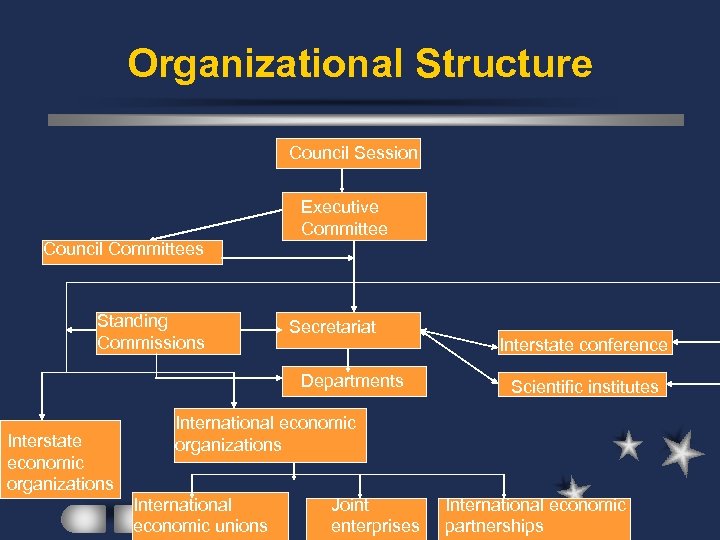 Organizational Structure Council Session Executive Committee Council Committees Standing Commissions Secretariat Departments Interstate economic organizations Interstate conference Scientific institutes International economic organizations International economic unions Joint enterprises International economic partnerships
 Deficiencies of CMEA Very little happened to promote a planned development of the international division of labor within the CMEA There was hardly any joint investment and no flow of capital between member countries Currency of member countries never became convertible Foreign trade was not measured in terms of money or profits increase rigidity
 Conclusion Money and Price - play passive role in sector with public ownership - play active role in sector without bureaucratic coordination Foreign trade - higher proportion among socialist countries based on bilateral relations CMEA - inefficient
 Thank You!