


 Скачать презентацию The Civil War Chapter 15 The Call
25f92802d4a02229565a4472c11f7622.ppt
- Количество слайдов: 42
 The Civil War Chapter 15
 The Call To Arms Taking Sides in the war After the first shots Lincoln called for volunteers ▪ Governors across the north were asked to raise a total of 75, 000 troops ▪ Many governors begged to send more men to put down the rebellion More States Secede ▪ Not all states were so quick to leave the union ▪ They did not however, want to furnish troops to the north to fight the south ▪ The President’s call for troops led other states to leave the union Virginia – April 17 (50 western counties voted against secession = WV) Arkansas – May 6 North Carolina – May 20 Tennessee – June 8
 The Call To Arms The Border States ▪ Loyalties remained divided in the border states ▪ Slave states that did not secede ▪ Delaware, Missouri, Kentucky, Maryland, and the new state of West Virginia ▪ Kentucky declared itself neutral ▪ They threw in support to the union when the confederacy invaded in September 1861
 The Call To Arms The Border States ▪ Martial Law was declared in Maryland ▪ This resulted after southern supporters damaged rail lines and telegraph lines ▪ Missouri was held by force ▪ Missouri’s government sided with the south ▪ Union supporters formed their own government ▪ Fighting broke out in the state and Lincoln sent troops to maintain order and ensure that MO stayed in the Union
 The Call To Arms North against Southern Advantages ▪ They were outnumbered – but the north must invade the south to win ▪ They would be fighting on their home turf with local support ▪ Most of the nations best military officers were southerners ▪ Robert E. Lee, Joseph Johnston, Albert Johnston
 The Call To Arms North against South Northern Advantages ▪ 110 K of the 130 K factories in the U. S. were in the North ▪ 2 x as much rail track and almost 2 x as much farm land ▪ 2/3 of the nations population lived in the North ▪ The North could feed and equip larger armies
 The Call To Arms The Two Sides Plan Strategies Union leaders hoped for a quick victory ▪ They used a blockade to isolate the south ▪ They needed to gain control of the Mississippi River as well ▪ They also planned to invade Virginia and seize Richmond, the capital Southern strategy was much simpler ▪ Defend their homeland until the North got tired of fighting ▪ Hope that England other European nations would help them to ensure a steady cotton supply for their factories
 The Call To Arms American vs. American The Civil war broke families apart ▪ ▪ Brothers against brothers Fathers against sons Mary Lincoln’s 4 brothers fought for the confederacy Senator John Crittenden (KY) had 2 sons ▪ One on each side Soldiers were young ▪ As young as 16 for the north and 14 for the south ▪ 750, 000 southerners fought in the army ▪ 2. 2 million northerners
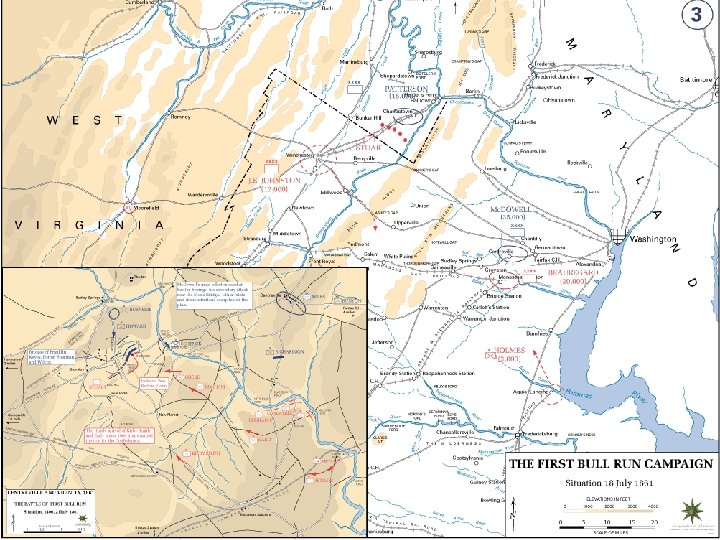
 The Call To Arms First Battle of Bull Run Poor situation for the North General Mc. Dowell ▪ 30, 000 men, but mostly untrained ▪ He wanted time – but northern reporters were demanding a quick victory ▪ He marches his army south from Washington into Virginia toward a rail station at Manassas ▪ About 25 miles away ▪ Hundreds of people make a picnic of the day – riding out from Washington to see the Union make quick work of the confederates The Confederates were ready to fight, the Union wasn’t ▪ The confederate advance stalled, but they were rallied by seeing General Thomas Jackson’s men fighting – they held like a “Stonewall” (Jackson gained the name Stonewall Jackson) ▪ They ended up retreating, defeated and bloodied
 The Call To Arms A Soldier’s Life Harsh conditions ▪ Camp conditions were often miserable ▪ Weather created muddy roads and fields ▪ Lack of clean water was a major health threat Smallpox, typhoid fever and other diseases were rampant Not unusual for 50% of the men in a regiment to be too sick to fight POW’s ▪ Camps were overcrowded on both sides ▪ Nearly 10% of the war deaths came from prison camps ▪ Elmira, NY ▪ Camp designed for 5, 000 men held 10, 000 men Rations were cut – prisoners forced to eat rats to survive ▪ Andersonville, GA ▪ Designed for 10, 000 men held 35, 000 men
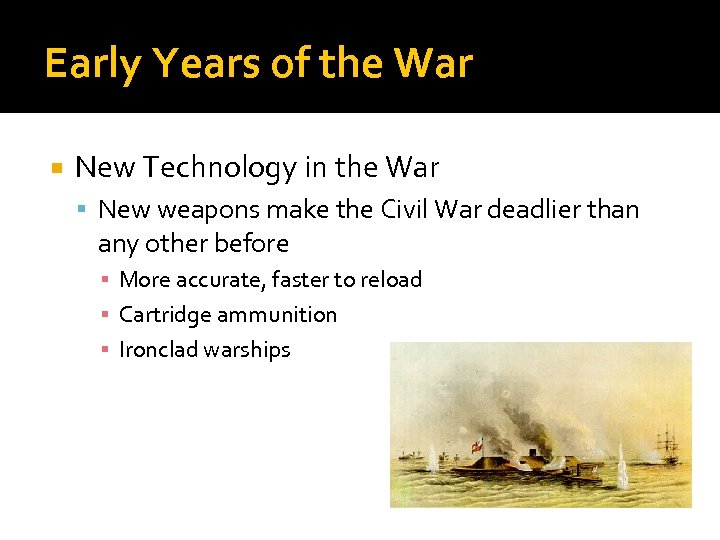 Early Years of the War New Technology in the War New weapons make the Civil War deadlier than any other before ▪ More accurate, faster to reload ▪ Cartridge ammunition ▪ Ironclad warships
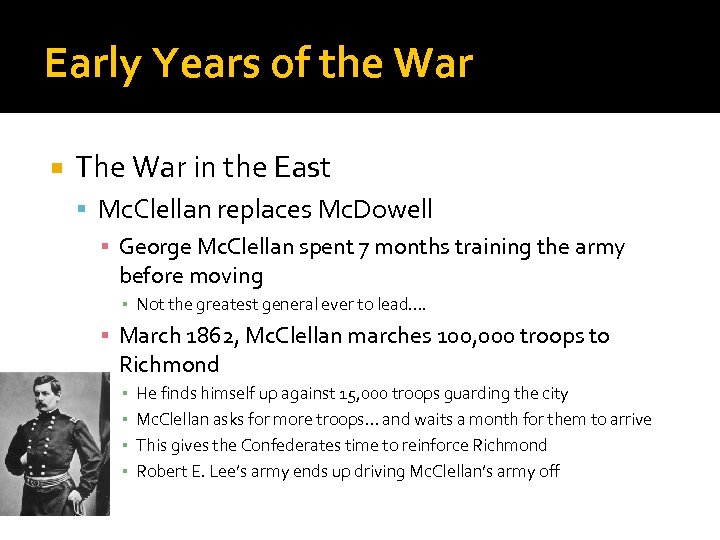 Early Years of the War The War in the East Mc. Clellan replaces Mc. Dowell ▪ George Mc. Clellan spent 7 months training the army before moving ▪ Not the greatest general ever to lead…. ▪ March 1862, Mc. Clellan marches 100, 000 troops to Richmond ▪ ▪ He finds himself up against 15, 000 troops guarding the city Mc. Clellan asks for more troops… and waits a month for them to arrive This gives the Confederates time to reinforce Richmond Robert E. Lee’s army ends up driving Mc. Clellan’s army off
 Early Years of the War A stroke of luck ▪ A union officer finds Lee’s battle plans that shows he is splitting his army and moving north ▪ Mc. Clellan’s troops attack the larger part of Lee’s army at Antietam Creek ▪ This becomes the bloodiest day of the Civil War 12, 000 union casualties 14, 000 confederate casualties ▪ Lee’s army retreats – but Mc. Clellan does not pursue him The War in the West Ulysses S. Grant led the most successful army ▪ Grant’s forces moved south from KY capturing confederate forts ▪ Fort Henry on the Tennessee River ▪ Fort Donelson on the Cumberland River
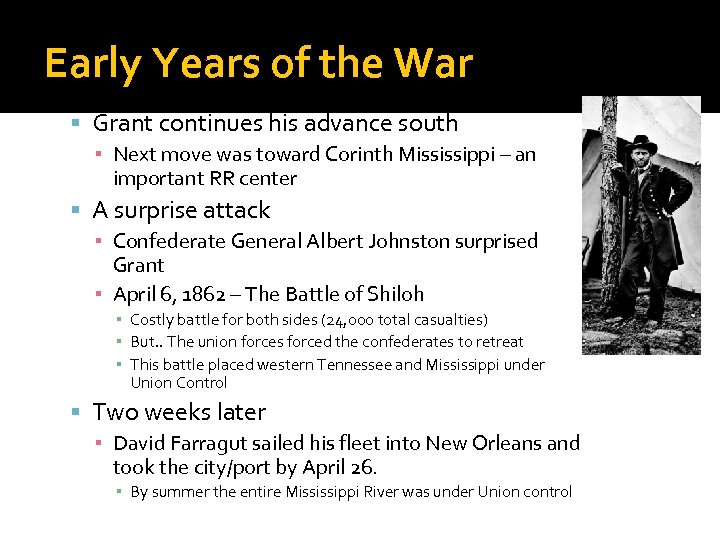 Early Years of the War Grant continues his advance south ▪ Next move was toward Corinth Mississippi – an important RR center A surprise attack ▪ Confederate General Albert Johnston surprised Grant ▪ April 6, 1862 – The Battle of Shiloh ▪ Costly battle for both sides (24, 000 total casualties) ▪ But. . The union forces forced the confederates to retreat ▪ This battle placed western Tennessee and Mississippi under Union Control Two weeks later ▪ David Farragut sailed his fleet into New Orleans and took the city/port by April 26. ▪ By summer the entire Mississippi River was under Union control
 Read pages 522 -523 Analyze the battle of Shiloh. Write a journal entry as if you are General Johnston during the battle. Include information about the battle and how the general may have felt about it. What impact would this journal entry have on his troops? When finished, analyze geography and history page 523
 The Emancipation Proclamation Emancipating the Enslaved Lincoln changes his mind ▪ The president at first resisted emancipation ▪ He feared that doing so would force the border states to secede ▪ His goal was to preserve the union, not free slaves ▪ What changed Lincoln’s mind? ▪ He realized how important slavery was to the South’s war effort
 The Emancipation Proclamation Emancipating the Enslaved A Famous Proclamation ▪ After Lee’s retreat from Antietam ▪ Lincoln meets with his Cabinet and issues a preliminary proclamation ▪ The final document is prepared ▪ January 1, 1863 Lincoln issues the Emancipation Proclamation ▪ It only freed slaves in areas where confederates were fighting the union This meant that it really did not effect anyone – because it did not free slaves in areas under union control, or in the border states
 The Emancipation Proclamation ▪ So what effects did the proclamation have? ▪ It changed the war to include freedom as a cause for fighting instead of just preserving the union ▪ It kept England from recognizing the independence of the Confederate states and helping their war effort African Americans Help the Union Volunteering for Service ▪ Some 189, 000 African Americans joined the cause ▪ Sailors fought alongside whites on ships ▪ In the army, all black regiments were formed under the command of white officers Blacks earned less pay than whites ▪ Despite disadvantages – African American troops fought with pride and courage ▪ “They make better soldiers than any troops I have ever had under my command” – a union general
 The Emancipation Proclamation Battles ▪ African American troops fought in at least 40 major battles and hundreds of smaller ones ▪ The most famous was the 54 th Massachusetts under the command of Col Robert Gould Shaw ▪ They led a charge on Confederate Fort Wagner July 18, 1863 Resisting Slavery ▪ With many slave owners off fighting the war, many slaves refused to work ▪ They informed Union soldiers of Confederate troop movements ▪ Anything to help their cause of freedom
 The Emancipation Proclamation Resisting Slavery ▪ With many slave owners off fighting the war, many slaves refused to work ▪ They informed Union soldiers of Confederate troop movements ▪ Anything to help their cause of freedom
 Monday, November 9, 2015 Homework: page 532 1 -3 Do Now: key terms page 528
 The Civil War and American Life Divisions Over the War Divisions in the South ▪ Opposition to the war was strongest in Georgia and North Carolina ▪ Barely half of Georgians supported secession ▪ Support was strong where slavery was important ▪ Backcountry regions did not rely on slavery – so support was low ▪ States Rights also created problems ▪ South Carolina’s governor did not want officers from any other state leading his men ▪ Governors of Georgia and North Carolina did not want the confederate government forcing their men to serve
 The Civil War and American Life Divisions Over the War Divisions in the North ▪ Many northerners opposed the war ▪ Some said the emancipation proclamation should not have been passed ▪ Others said the south had a right to secede and that Lincoln caused the war
 The Civil War and American Life Dealing with Disruptions ▪ People on both sides tried to disrupt the war effort ▪ They encouraged soldiers to desert ▪ Some helped POW’s escape ▪ Tried to prevent men from volunteering ▪ How Lincoln and Davis dealt with these ‘problems’ ▪ They both suspended the right of Habeas Corpus in some areas In the north, more than 13, 000 people were arrested and held without trial
 The Civil War and American Life The Draft Laws Desertion was a problem ▪ Between 300 -500 thousand troops left their units during the war ▪ At times ⅓ to ½ of some armies were AWOL To meet the need for troops each side established a draft System of required military service
 The Civil War and American Life ▪ In the south ▪ April of 1862 – white men ages 18 -35 were required to serve in the military Later that age range went from 17 to 50 ▪ In the North ▪ It began in 1863 – white men ages 20 -45 were required to serve ▪ There were exceptions to the rule ▪ In the north you could pay $300 and not serve Sounds easy, but that was a whole years wages for most people ▪ In the south if you had 20 slaves you did not have to serve ▪ Both sides allowed draftees to hire a substitute ▪ People on both sides complained that the draft made it a poor man’s war to fight
 The Civil War and American Life The War and Economic Strains Neither side was ready for what the Civil War did ▪ In the north ▪ They had a lot of industry – but the draft took workers away This caused constant shortages ▪ The government issued the first income tax to raise money ▪ The government issued federal currency This caused massive inflation (80% increase in cost of goods)
 The Civil War and American Life The War and Economic Strains Neither side was ready for what the Civil War did ▪ In the South ▪ The union blockade caused serious supply shortages ▪ People were starving Shortages led to rioting ▪ Goods became too expensive to buy (supply vs. demand)
 The Civil War and American Life Women in the Civil War Women played an important role in the war effort ▪ In both the north and the south ▪ Women ran farms and plantations ▪ More than 400 women dressed as men and fought ▪ They took over businesses and factory jobs ▪ The war also created new opportunities ▪ Many women became teachers ▪ About 10, 000 became nurses Elizabeth Blackwell – the first woman physician – trained nurses for the Union army Dorthea Dix, Harriet Tubman and Clara Barton all served as nurses

 Decisive Battles The Tide Turns After Antietam ▪ The war began to go badly for the Union ▪ The problem, was poor leadership (remember where the best generals went? ) ▪ Lincoln replaced Mc. Clellan with Ambrose Burnside after Mc. Clellan failed to pursue Lee Confederate Victories ▪ The new general – Burnside – knew that Mc. Clellan had been replaced for being cautious ▪ Burnside decides to be bold! ▪ He marches his 120, 000 troops straight to Richmond ▪ He sends wave after wave at the confederate forces that met him at Fredericksburg ▪ He watches 13, 000 of his men die ▪ Burnside is then replace by Joseph Hooker
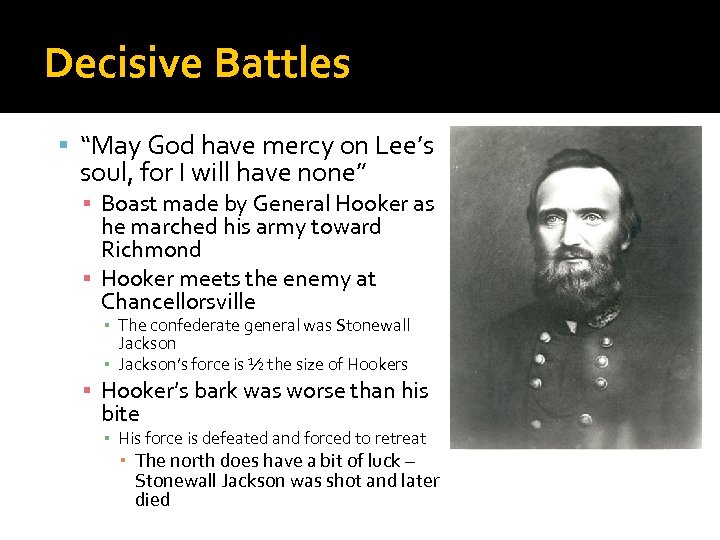 Decisive Battles “May God have mercy on Lee’s soul, for I will have none” ▪ Boast made by General Hooker as he marched his army toward Richmond ▪ Hooker meets the enemy at Chancellorsville ▪ The confederate general was Stonewall Jackson ▪ Jackson’s force is ½ the size of Hookers ▪ Hooker’s bark was worse than his bite ▪ His force is defeated and forced to retreat The north does have a bit of luck – Stonewall Jackson was shot and later died
 Decisive Battles The Battle of Gettysburg ▪ Confederate victories made Lee bolder ▪ He felt a victory on union soil would force the end of the war ▪ He marches his troops north to Pennsylvania Union troops led by General Meade pursued him ▪ Lee’s forces meet the Union army at Gettysburg July 1, 1863 A skirmish begins in the town when Confederate troops are looking for shoes
 Decisive Battles The Battle of Gettysburg ▪ 85, 000 Union against 75, 000 Confederate on July 2, 1863 ▪ The confederate troops began attacking the flanks of the Union lines ▪ The fighting continues into the next day ▪ July 3, 1863 ▪ Lee orders Pickett to charge the union lines in the middle Pickett’s Charge 7, 500 men died from the hail of bullets and cannon fire
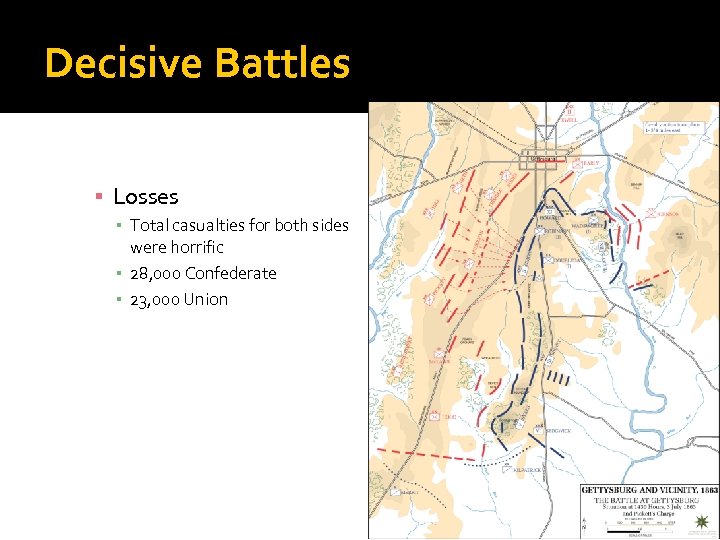 Decisive Battles ▪ Losses ▪ Total casualties for both sides were horrific ▪ 28, 000 Confederate ▪ 23, 000 Union
 Decisive Battles The Fall of Vicksburg ▪ As Lee’s army was retreating on July 4, 1863 the south suffered another major defeat at the hands of Ulysses S. Grant ▪ Grant had set up a siege in May 1863 ▪ Surrounding a fort/city and cutting it off from supplies ▪ Eventually the artillery and starvation forced the 30, 000 confederate troops to surrender ▪ Grant’s victory gave control of the Mississippi to the North
 Decisive Battles The Gettysburg Address ▪ Lincoln’s speech to some 15, 000 observers at Gettysburg to honor the fallen ▪ In his speech he said that he was looking forward to a union victory
 Decisive Battles Closing In on the Confederacy Lincoln had finally found his commander ▪ Ulysses S. Grant ▪ Grant knew that to end the war, Richmond must fall Grant vs. Lee ▪ Grant’s army hammered on Lee’s forces for months ▪ Union losses neared 55, 000 ▪ Confederate losses approached 35, 000 ▪ Grant knew that he could count on a steady supply of men and troops ▪ Lee was running short on both ▪ June of 1864 – Lee was trapped at Petersburg ▪ Grant began a siege – like he had done at Vicksburg Meanwhile ▪ General William Tecumseh Sherman marched on Atlanta
 Decisive Battles ▪ The capture of Atlanta gave Lincoln's re-election campaign a boost ▪ Lincoln won a huge victory over General Mc. Clellan ▪ November 1864 – Sherman orders Atlanta burned to the ground ▪ He continues his march toward the ocean – destroying all in his path ▪ Once he reached the sea – he turned north toward the Carolinas Peace at Last Grant’s Siege ▪ For months Grant had been fortifying and extending his lines ▪ Lee knew it was a matter of time before Grant took the city ▪ Lincoln also realized the war was near ending In his 2 nd inaugural address – Lincoln asked the country to forgive and forget ▪ On April 2, 1865 Grant’s troops break through Lee’s lines ▪ Lee retreats to Appomattox ▪ Grant takes Richmond
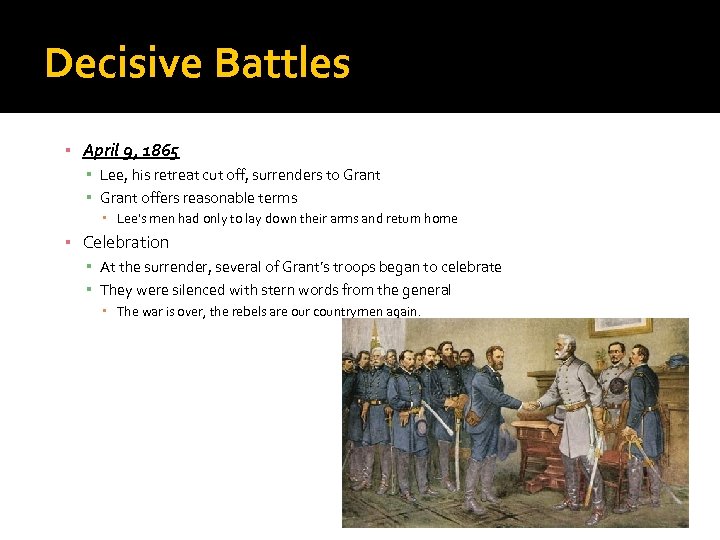 Decisive Battles ▪ April 9, 1865 ▪ Lee, his retreat cut off, surrenders to Grant ▪ Grant offers reasonable terms Lee’s men had only to lay down their arms and return home ▪ Celebration ▪ At the surrender, several of Grant’s troops began to celebrate ▪ They were silenced with stern words from the general The war is over, the rebels are our countrymen again.
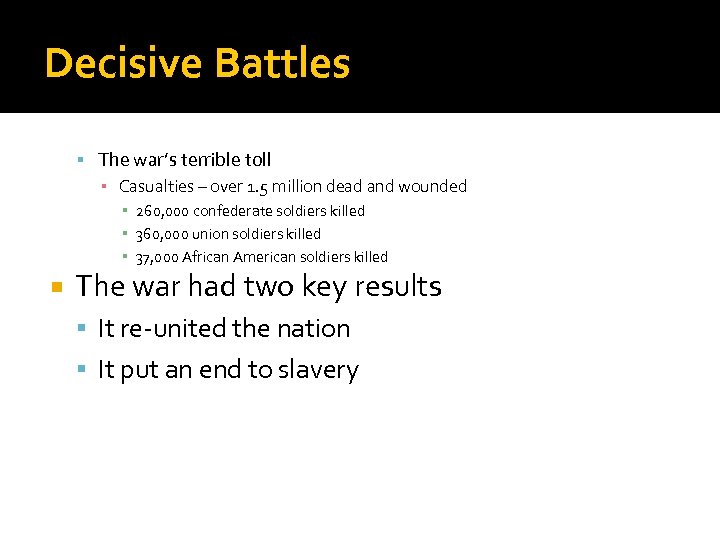 Decisive Battles The war’s terrible toll ▪ Casualties – over 1. 5 million dead and wounded ▪ 260, 000 confederate soldiers killed ▪ 360, 000 union soldiers killed ▪ 37, 000 African American soldiers killed The war had two key results It re-united the nation It put an end to slavery