


 Скачать презентацию The Cisco-Intel-Microsoft 21 st Century Skills Assessment Project
dea9ac907ab2640c0fc6d3205bb07d26.ppt
- Количество слайдов: 6
 The Cisco-Intel-Microsoft 21 st Century Skills Assessment Project Robert Kozma, Kozmalone Consulting Cisco/Intel/MS Project Consultant Education Sync Meeting of Melbourne Barry Mc. Gaw, University Executive Director 1
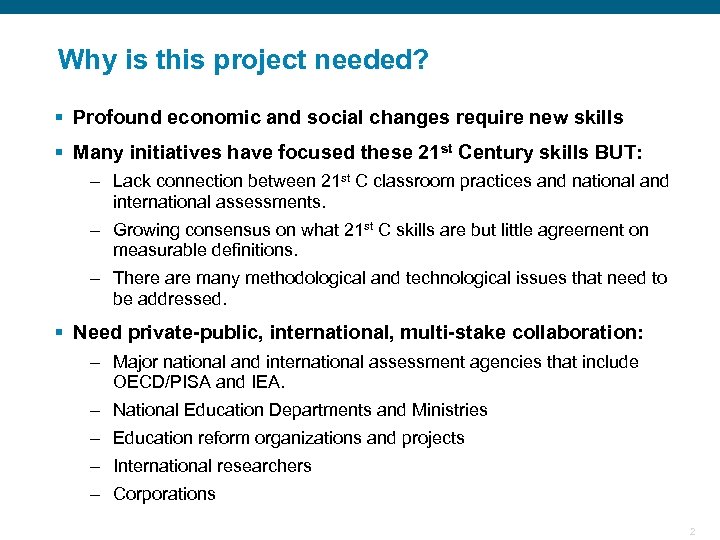 Why is this project needed? § Profound economic and social changes require new skills § Many initiatives have focused these 21 st Century skills BUT: – Lack connection between 21 st C classroom practices and national and international assessments. – Growing consensus on what 21 st C skills are but little agreement on measurable definitions. – There are many methodological and technological issues that need to be addressed. § Need private-public, international, multi-stake collaboration: – Major national and international assessment agencies that include OECD/PISA and IEA. – National Education Departments and Ministries – Education reform organizations and projects – International researchers – Corporations 2
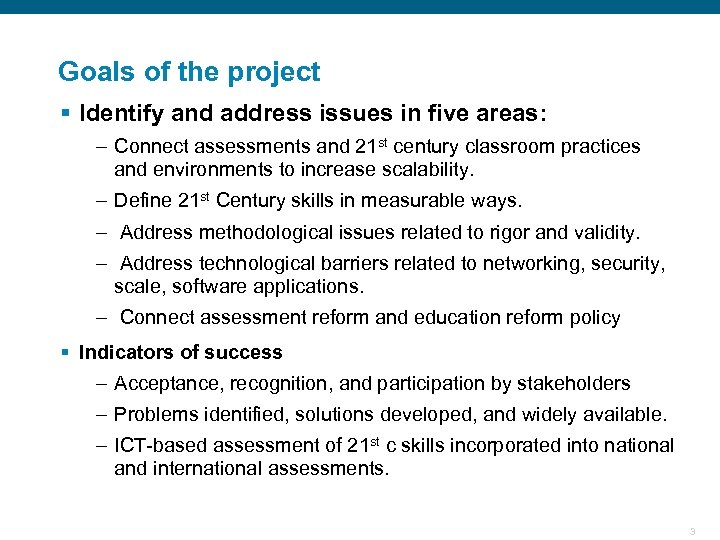 Goals of the project § Identify and address issues in five areas: – Connect assessments and 21 st century classroom practices and environments to increase scalability. – Define 21 st Century skills in measurable ways. – Address methodological issues related to rigor and validity. – Address technological barriers related to networking, security, scale, software applications. – Connect assessment reform and education reform policy § Indicators of success – Acceptance, recognition, and participation by stakeholders – Problems identified, solutions developed, and widely available. – ICT-based assessment of 21 st c skills incorporated into national and international assessments. 3
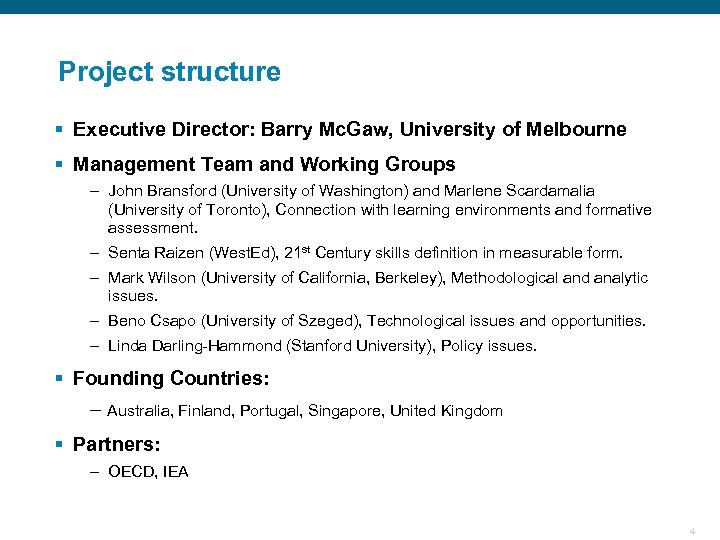 Project structure § Executive Director: Barry Mc. Gaw, University of Melbourne § Management Team and Working Groups – John Bransford (University of Washington) and Marlene Scardamalia (University of Toronto), Connection with learning environments and formative assessment. – Senta Raizen (West. Ed), 21 st Century skills definition in measurable form. – Mark Wilson (University of California, Berkeley), Methodological and analytic issues. – Beno Csapo (University of Szeged), Technological issues and opportunities. – Linda Darling-Hammond (Stanford University), Policy issues. § Founding Countries: – Australia, Finland, Portugal, Singapore, United Kingdom § Partners: – OECD, IEA 4
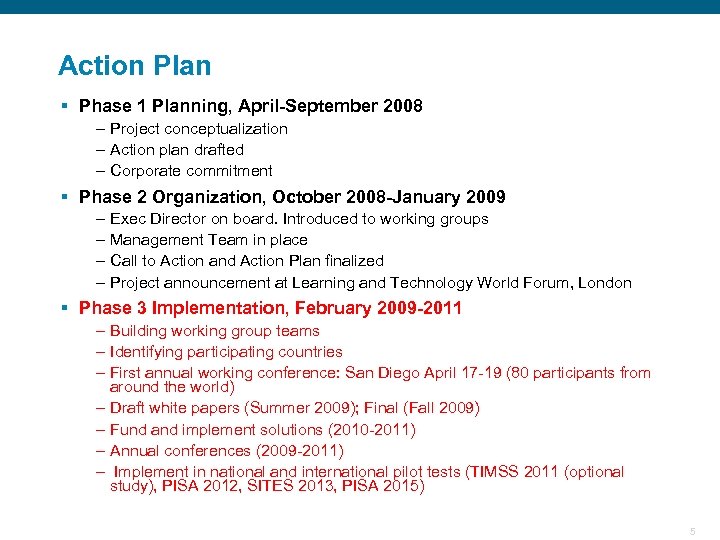 Action Plan § Phase 1 Planning, April-September 2008 – Project conceptualization – Action plan drafted – Corporate commitment § Phase 2 Organization, October 2008 -January 2009 – Exec Director on board. Introduced to working groups – Management Team in place – Call to Action and Action Plan finalized – Project announcement at Learning and Technology World Forum, London § Phase 3 Implementation, February 2009 -2011 – Building working group teams – Identifying participating countries – First annual working conference: San Diego April 17 -19 (80 participants from around the world) – Draft white papers (Summer 2009); Final (Fall 2009) – Fund and implement solutions (2010 -2011) – Annual conferences (2009 -2011) – Implement in national and international pilot tests (TIMSS 2011 (optional study), PISA 2012, SITES 2013, PISA 2015) 5
 How to get involved http: //www. atc 21 s. org/ Or contact: bob@robertkozma. com 6