


 Скачать презентацию The Chilean Experience with De Dollarization Kevin Cowan Prepared
258b7d61b29ab10f28bcaae904299e56.ppt
- Количество слайдов: 39
 The Chilean Experience with (De)Dollarization Kevin Cowan Prepared for the conference “Dollarization: Consequences and Policy Options” Istanbul, 15 th December 2006 1 CENTRAL BANK OF CHILE 15 th December 2006
 Outline 1. Why Chile? 2. Brief overview of determinants of dollarization – framework for discussion. 3. The Chilean experience. 4. Policy implications. 2 CENTRAL BANK OF CHILE 15 th December 2006
 I. Why Chile? 3 CENTRAL BANK OF CHILE OCTOBER 6 2006
 Why Chile? § After the early 80 s, low levels of (domestic) financial dollarization, despite history of high inflation => relatively low currency mismatches and associated vulnerabilities: § Banking sector § Government sector § Corporate sector 4 CENTRAL BANK OF CHILE OCTOBER 6 2006
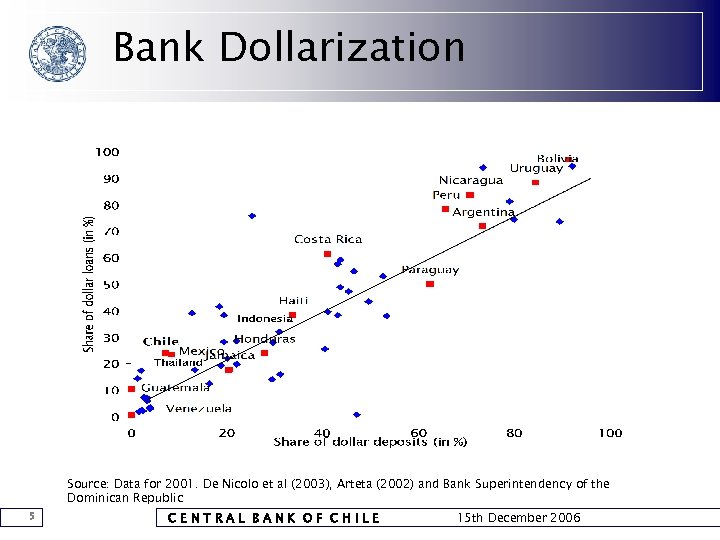 Bank Dollarization Source: Data for 2001. De Nicolo et al (2003), Arteta (2002) and Bank Superintendency of the Dominican Republic 5 CENTRAL BANK OF CHILE 15 th December 2006
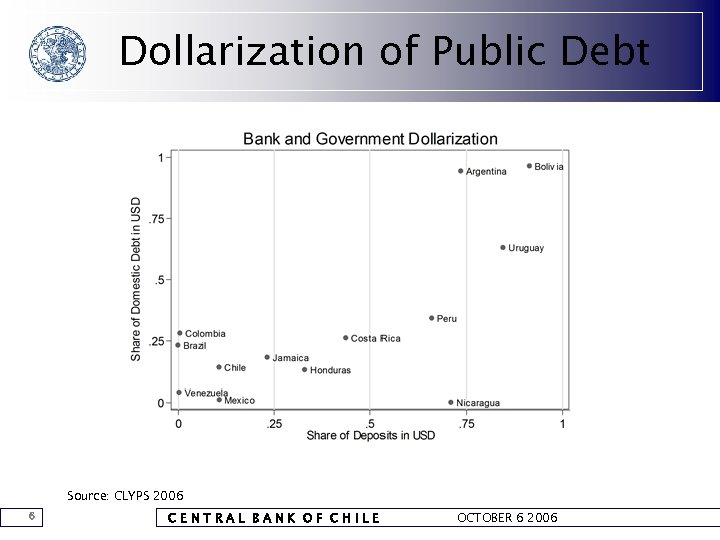 Dollarization of Public Debt Source: CLYPS 2006 6 CENTRAL BANK OF CHILE OCTOBER 6 2006
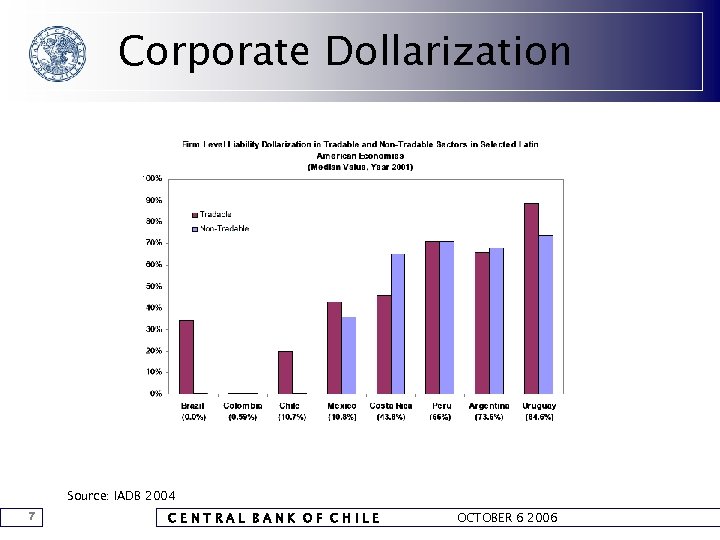 Corporate Dollarization Source: IADB 2004 7 CENTRAL BANK OF CHILE OCTOBER 6 2006
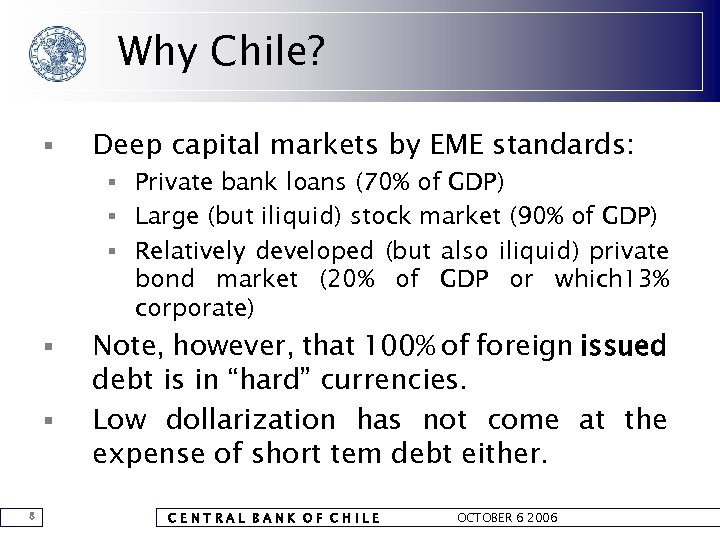 Why Chile? § Deep capital markets by EME standards: § Private bank loans (70% of GDP) § Large (but iliquid) stock market (90% of GDP) § Relatively developed (but also iliquid) private bond market (20% of GDP or which 13% corporate) § § 8 Note, however, that 100% of foreign issued debt is in “hard” currencies. Low dollarization has not come at the expense of short tem debt either. CENTRAL BANK OF CHILE OCTOBER 6 2006
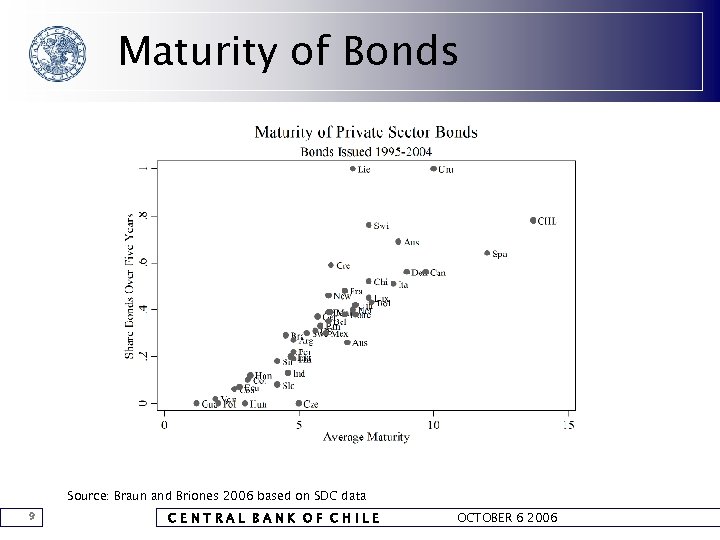 Maturity of Bonds Source: Braun and Briones 2006 based on SDC data 9 CENTRAL BANK OF CHILE OCTOBER 6 2006
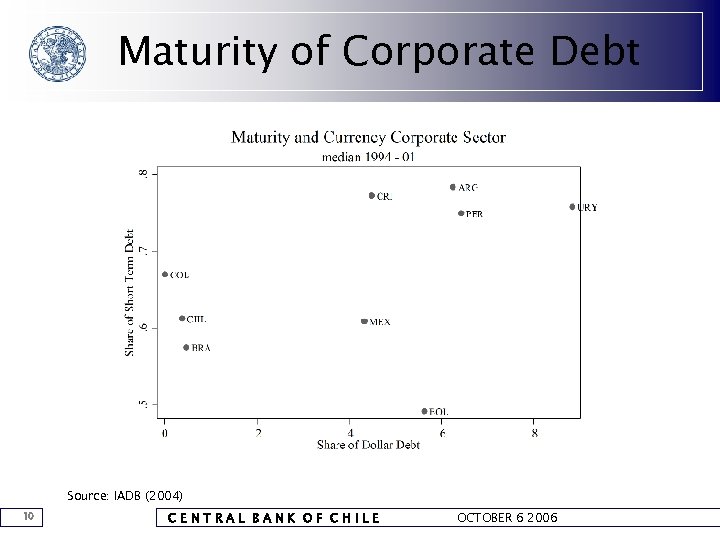 Maturity of Corporate Debt Source: IADB (2004) 10 CENTRAL BANK OF CHILE OCTOBER 6 2006
 II. Causes of Financial Dollarization 11 CENTRAL BANK OF CHILE OCTOBER 6 2006
 What drives dollarization? § § 12 To a large extent domestic financial dollarization can be explained by inflation uncertainty. If inflation risk is high, better to take on the real exchange rate risk of dollar contracts. This is the central result of the work on Minimum Variance Portfolios (MVPs) by Ize and Levy-Yeyati (2003) and De Nicolo , Honohan and Ize (2004). CENTRAL BANK OF CHILE OCTOBER 6 2006
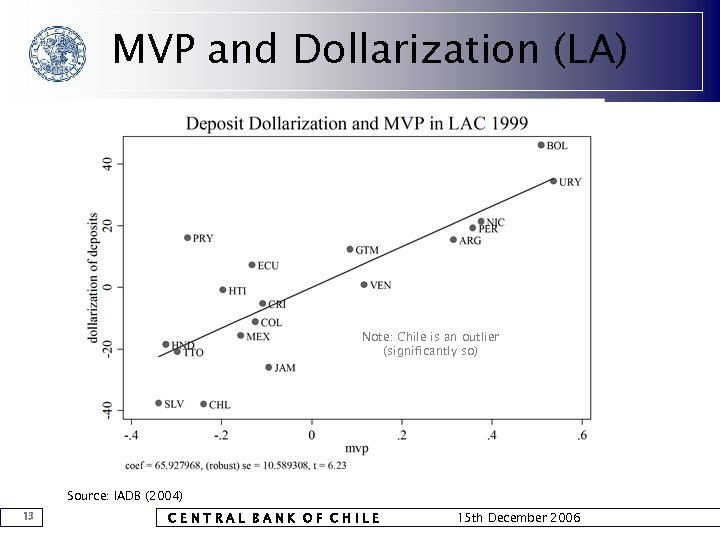 MVP and Dollarization (LA) Note: Chile is an outlier (significantly so) Source: IADB (2004) 13 CENTRAL BANK OF CHILE 15 th December 2006
 What drives dollarization? § § § Therefore, part of dollarization is “warranted” (conditional on agents priors of the distribution of prices and RER). Explains high correlation STD and dollar debt. This suggests that: § Policies that restrict dollarization, by increasing the risk of saving/borrowing, will lead to lower intermediation. § Cowan & Kamil (2004) find that this is indeed the case (dif-dif approach) 14 CENTRAL BANK OF CHILE OCTOBER 6 2006
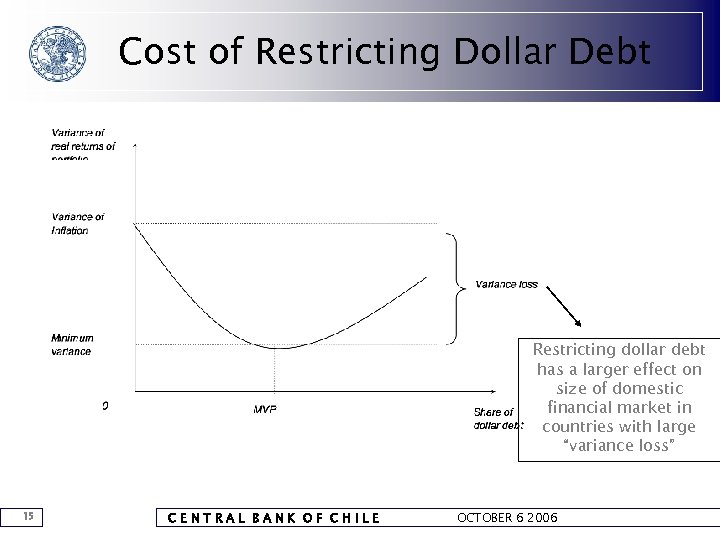 Cost of Restricting Dollar Debt Restricting dollar debt has a larger effect on size of domestic financial market in countries with large “variance loss” 15 CENTRAL BANK OF CHILE OCTOBER 6 2006
 What drives dollarization? § § Regarding foreign debt empirical evidence (Eichengreen et al 2003) suggest that domestic macro outcomes have scarce impact => “original sin”. Note, however: § Recent issuance in “pesos” (Tovar 2005) § Growing importance deliverable forwards (Selaive et al 2006) § Despite low variance in EMEs as to debt composition, high variance in overall composition of gross foreign liabilities. 16 CENTRAL BANK OF CHILE OCTOBER 6 2006
 Reducing Dollarization Restrictions => desintermediation II. Building credibility => timely (and learning possibly hindered by dollarization itself) III. Indexation: for moderate inflation levels, better hedge than dollar => many unsuccessful attempts (Galindo and Leiderman 2005), additional macro costs. I. 17 CENTRAL BANK OF CHILE OCTOBER 6 2006
 III. Dollarization in Chile 18 CENTRAL BANK OF CHILE OCTOBER 6 2006
 A Brief History of Indexation in Chile: The Unidad de Fomento § § § 1959: Centralized Savings and Loans system established for low income housing. Savings indexed to CPI or wages, annual. 1960: Following financial deregulation SINAP and CCAP (private and public savings and loans agencies set up. The CCAP indexed loans to CPI, latter extended to SINAP. 64 -70: Active promotion of indexation: § § § 19 65: Large share of state bank deposits indexed. 64: Central bank issues indexed bonds (CAR) UF created (later pefected to monthly and daily…) CENTRAL BANK OF CHILE OCTOBER 6 2006
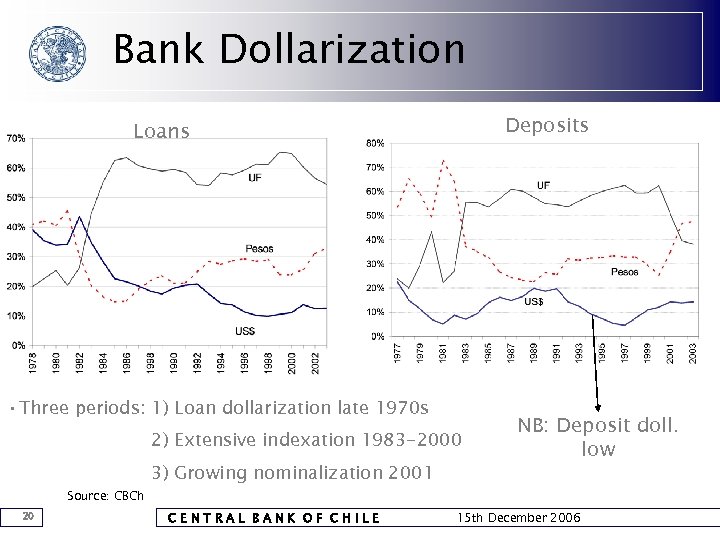 Bank Dollarization Deposits Loans • Three periods: 1) Loan dollarization late 1970 s 2) Extensive indexation 1983 -2000 3) Growing nominalization 2001 NB: Deposit doll. low Source: CBCh 20 CENTRAL BANK OF CHILE 15 th December 2006
 Late 70 s: Loan Dollarization § § 21 Late 70 s, remaining quantitative restrictions on capital inflows by banks lifted. Fixed exchange rate + currency blind bank regulation (necessarily so). Implicit bailouts + extensive related lending. Large private inflows intermediated by banking system => significant mismatches. CENTRAL BANK OF CHILE OCTOBER 6 2006
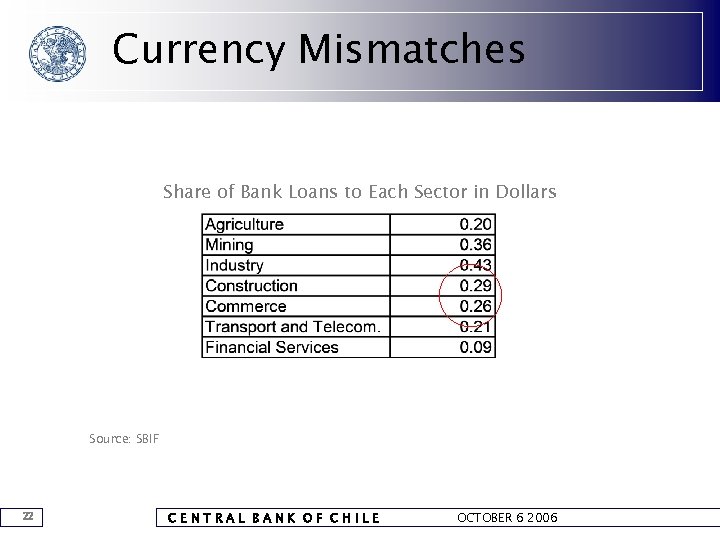 Currency Mismatches Share of Bank Loans to Each Sector in Dollars Source: SBIF 22 CENTRAL BANK OF CHILE OCTOBER 6 2006
 The UF period § § Financial crisis of 82 marks transition to next stage. Large scale bailout of financial system, tied to UF: § § § 23 UF bonds given to banks whose dollar loans were paid with the preferencial (low) dollar. Domestic debt restructured to UF. CBCh grants UF credit lines. CENTRAL BANK OF CHILE OCTOBER 6 2006
 The UF period § Real macro indexation: § § § 24 policy supportive of Real (UF) interest rate target, Exchange rate band aimed at stabilizing UF/dollar exchange rate, Gradual reduction of inflation, Issuance of CBCh debt in UF => long + liquid yield curve for UF instruments. Early 80 s: pension reform => “captive” demand for UF indexed debt. CENTRAL BANK OF CHILE OCTOBER 6 2006
 The UF period § § § Stable RER and high domestic rates => large capital inflows. Reflected in part in an upward trend in corporate external borrowing in 90 s Pervasive real indexation, in particular for wages: § § 25 2 year contracts 6 month indexation CENTRAL BANK OF CHILE OCTOBER 6 2006
 Nominalization § § Transition again marked by period of instability (1998=>) following Asia Crisis. Macro preconditions: § § 26 Fiscal prudence over almost 3 decades Steady fall in inflation (partial targeting since early 90 s) CENTRAL BANK OF CHILE OCTOBER 6 2006
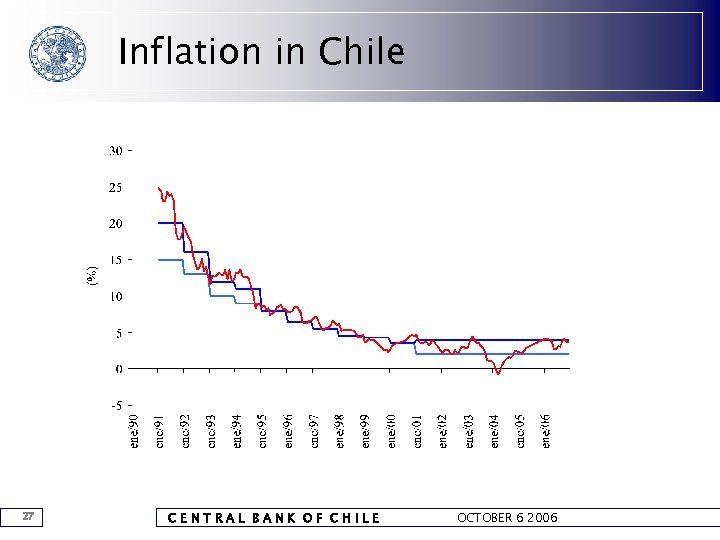 Inflation in Chile 27 CENTRAL BANK OF CHILE OCTOBER 6 2006
 Nominalization § § § Exchange rate band abandoned in Sep. 1999. Fully fledged IT adopted in 2001. Nominalization of CBCh monetary policy: § § 28 Nominal target rate (TPM), CBCh issues peso bonds in short end of curve. CENTRAL BANK OF CHILE OCTOBER 6 2006
 Nominalization § § Increased exchange rate variance after float. Falling corporate mismatches: § § § 29 Less borrowing More derivative hedging Better matching: similar results by Martinez and Werner for Mexico and by Kamil (2006) for sample of LA economies. CENTRAL BANK OF CHILE OCTOBER 6 2006
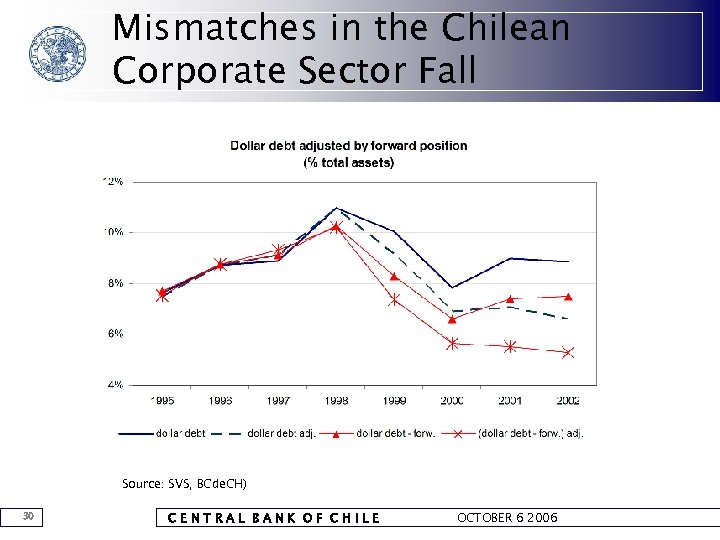 Mismatches in the Chilean Corporate Sector Fall Source: SVS, BCde. CH) 30 CENTRAL BANK OF CHILE OCTOBER 6 2006
 Nominalization + Float § § Increased exchange rate variance after float. Falling corporate mismatches: § § 31 Less borrowing Better matching => similar results by Martinez and Werner for Mexico and by Kamil (2006) for 6 LA countries. More derivative hedging Growth of FOREX derivative markets => consistent with cross country results by Selaive et al 2006. CENTRAL BANK OF CHILE OCTOBER 6 2006
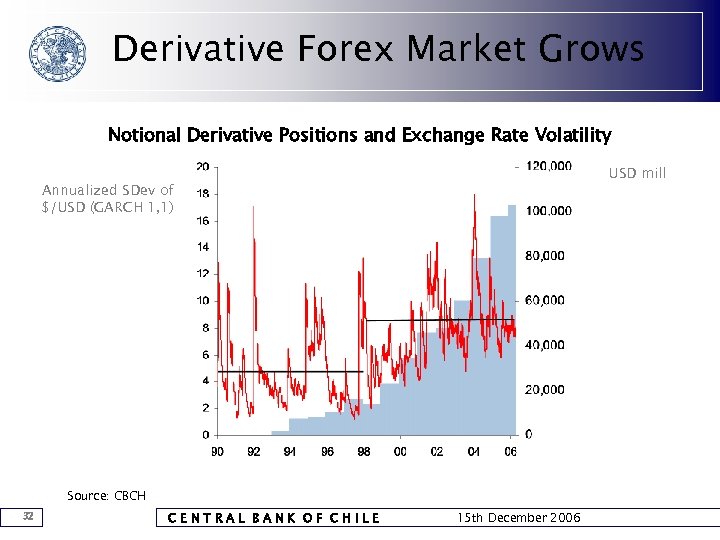 Derivative Forex Market Grows Notional Derivative Positions and Exchange Rate Volatility USD mill Annualized SDev of $/USD (GARCH 1, 1) Source: CBCH 32 CENTRAL BANK OF CHILE 15 th December 2006
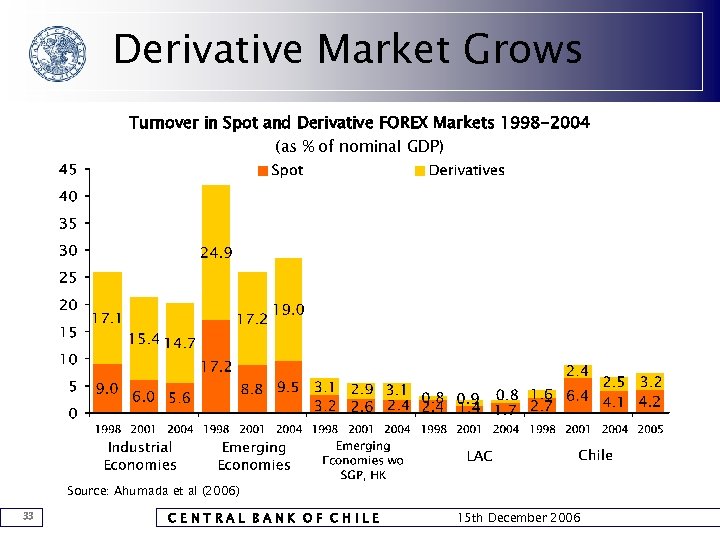 Derivative Market Grows Turnover in Spot and Derivative FOREX Markets 1998 -2004 (as % of nominal GDP) Source: Ahumada et al (2006) 33 CENTRAL BANK OF CHILE 15 th December 2006
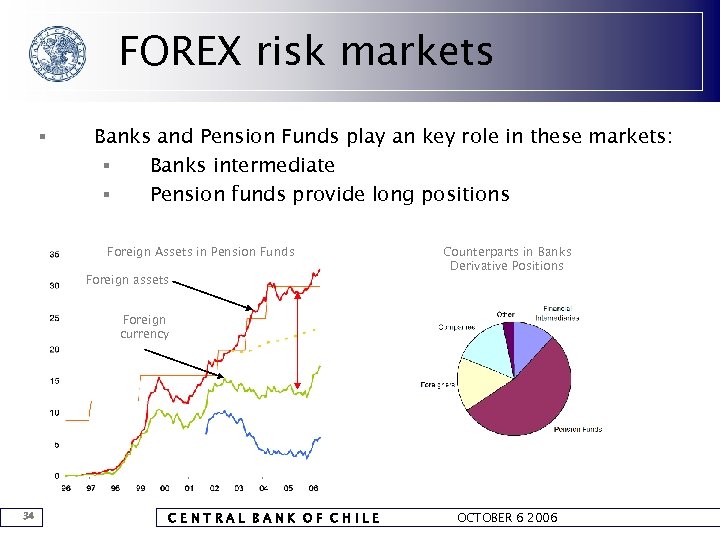 FOREX risk markets § Banks and Pension Funds play an key role in these markets: § Banks intermediate § Pension funds provide long positions Foreign Assets in Pension Funds Foreign assets Counterparts in Banks Derivative Positions Foreign currency 34 CENTRAL BANK OF CHILE OCTOBER 6 2006
 III. Policy Lessons 35 CENTRAL BANK OF CHILE OCTOBER 6 2006
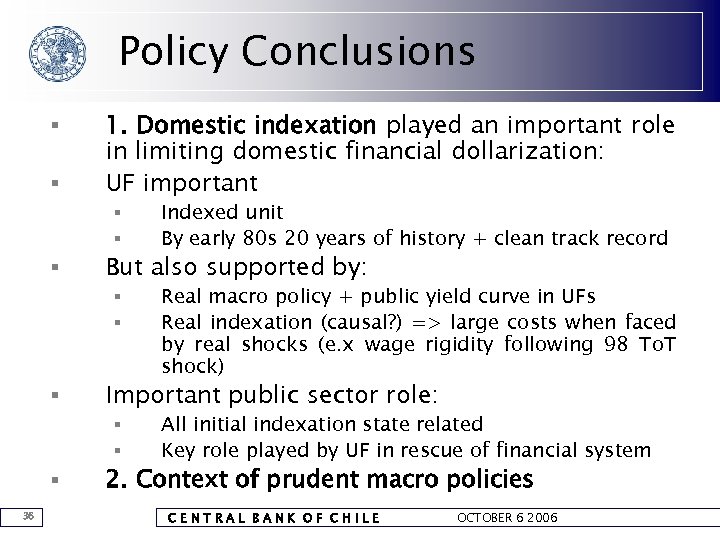 Policy Conclusions § § 1. Domestic indexation played an important role in limiting domestic financial dollarization: UF important § § § But also supported by: § § 36 Real macro policy + public yield curve in UFs Real indexation (causal? ) => large costs when faced by real shocks (e. x wage rigidity following 98 To. T shock) Important public sector role: § § Indexed unit By early 80 s 20 years of history + clean track record All initial indexation state related Key role played by UF in rescue of financial system 2. Context of prudent macro policies CENTRAL BANK OF CHILE OCTOBER 6 2006
 Policy Conclusions § 1. Domestic nominalization: Nominalization of CBCh monetary policy and IT framework have coincided with falling share of short term UF debt contracts: § § § 2. 37 Credibility => inflation track record + IT have reduced inflation uncertainty in medium term horizon. Peso yield curve (up to 10 years). Nominal target rate (stabilizes nominal rates…). Does not imply need to eliminate UF (works very well for long term contracts!) CENTRAL BANK OF CHILE OCTOBER 6 2006
 Policy Conclusions § 1. Foreign dollarization In Chile less an issue of the currency composition of external debt than level and allocation of risk in the economy: § § 2. 38 Exchange rate regime has played important role (pre 82, post 99): float has reduced borrowing and improved matching. Bank regulation played key role in 1982 episode. Current policy stance: attract foreigners to domestic market rather than issue abroad. . CENTRAL BANK OF CHILE OCTOBER 6 2006
 The Chilean Experience with (De)Dollarization Kevin Cowan Prepared for the conference “Dollarization: Consequences and Policy Options” Istanbul, 15 th December 2006 39 CENTRAL BANK OF CHILE 15 th December 2006