 Скачать презентацию The Chilbolton Observatory Contribution to Key Science Issues
80e6b3efc22562ec460a7dc1eb9041ac.ppt
- Количество слайдов: 15



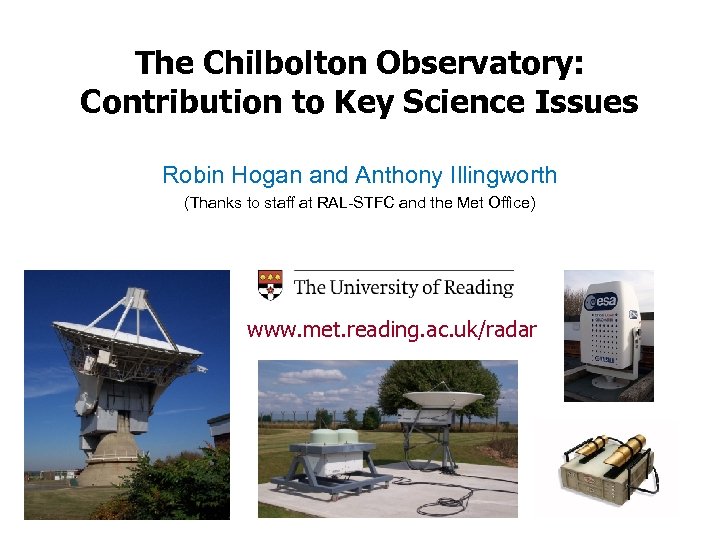
The Chilbolton Observatory: Contribution to Key Science Issues Robin Hogan and Anthony Illingworth (Thanks to staff at RAL-STFC and the Met Office) www. met. reading. ac. uk/radar
Overview 1. Science challenges addressed by Chilbolton 2. Radar and other observing equipment at Chilbolton 3. Evaluation of clouds and precipitation in models 4. Met Office Upper Air Network – and equipment at Chilbolton 5. Radar expertise and experience at Chilbolton 6. Publications and citations 7. New directions for radar meteorology
1. Key science challenges • Cloud representation in climate and NWP models – One of the largest uncertainties in climate prediction via radiative effect – A key component of the hydrological cycle; models make rain via clouds. – We need new microphysical parameterizations based on high resolution observations involving radar, lidar and aircraft – Evaluation of clouds in NWP models (e. g. cloud fraction & water content) essential to test parameterizations in all conditions over many years • Forecasting hazardous weather in high resolution NWP – 1. 5 -km resolution modelling now operational (soon <500 m) – Large errors remain in intensity, scale, organisation and timing of rain due to, for example, uncertain microphysics and sub-grid mixing – Only high resolution radar can provide the necessary detailed observations required of storms through their lifecycle • Data assimilation and operational radar products – Doppler, polarization and refractivity nearly operational – Research radars needed to develop new retrieval algorithms and data assimilation methodologies
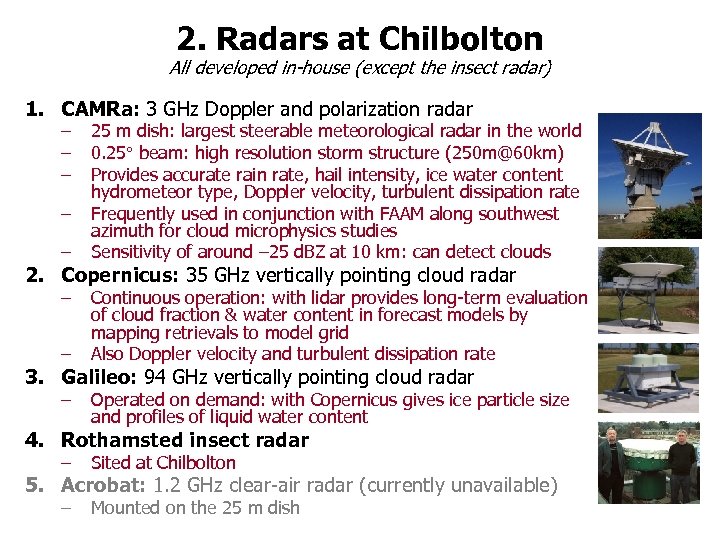
2. Radars at Chilbolton All developed in-house (except the insect radar) 1. CAMRa: 3 GHz Doppler and polarization radar – – – 25 m dish: largest steerable meteorological radar in the world 0. 25 beam: high resolution storm structure (250 m@60 km) Provides accurate rain rate, hail intensity, ice water content hydrometeor type, Doppler velocity, turbulent dissipation rate Frequently used in conjunction with FAAM along southwest azimuth for cloud microphysics studies Sensitivity of around – 25 d. BZ at 10 km: can detect clouds 2. Copernicus: 35 GHz vertically pointing cloud radar – – Continuous operation: with lidar provides long-term evaluation of cloud fraction & water content in forecast models by mapping retrievals to model grid Also Doppler velocity and turbulent dissipation rate 3. Galileo: 94 GHz vertically pointing cloud radar – Operated on demand: with Copernicus gives ice particle size and profiles of liquid water content 4. Rothamsted insect radar – Sited at Chilbolton – Mounted on the 25 m dish 5. Acrobat: 1. 2 GHz clear-air radar (currently unavailable)
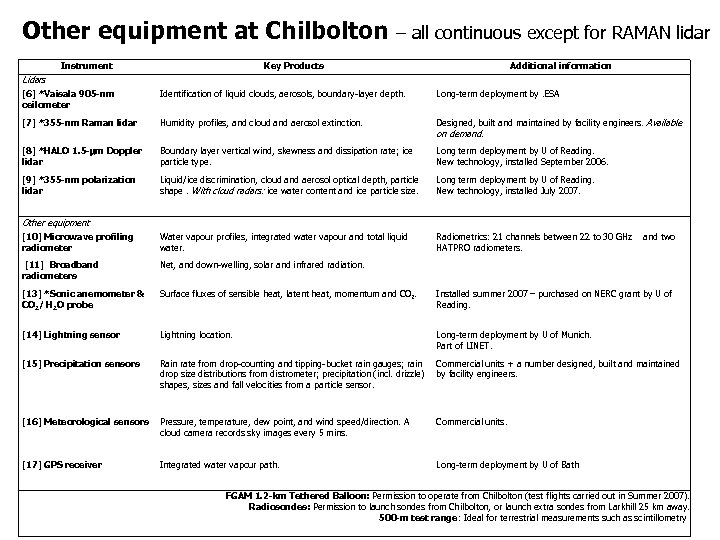
Other equipment at Chilbolton Instrument – all continuous except for RAMAN lidar Key Products Additional information Lidars [6] *Vaisala 905 -nm ceilometer Identification of liquid clouds, aerosols, boundary-layer depth. Long-term deployment by. ESA [7] *355 -nm Raman lidar Humidity profiles, and cloud and aerosol extinction. Designed, built and maintained by facility engineers. Available [8] *HALO 1. 5 -mm Doppler lidar Boundary layer vertical wind, skewness and dissipation rate; ice particle type. Long term deployment by U of Reading. New technology, installed September 2006. [9] *355 -nm polarization lidar Liquid/ice discrimination, cloud and aerosol optical depth, particle shape. With cloud radars: ice water content and ice particle size. Long term deployment by U of Reading. New technology, installed July 2007. [10] Microwave profiling radiometer Water vapour profiles, integrated water vapour and total liquid water. Radiometrics: 21 channels between 22 to 30 GHz HATPRO radiometers. [11] Broadband radiometers Net, and down-welling, solar and infrared radiation. [13] *Sonic anemometer & CO 2/ H 2 O probe Surface fluxes of sensible heat, latent heat, momentum and CO 2. Installed summer 2007 – purchased on NERC grant by U of Reading. [14] Lightning sensor Lightning location. Long-term deployment by U of Munich. Part of LINET. [15] Precipitation sensors Rain rate from drop-counting and tipping-bucket rain gauges; rain drop size distributions from distrometer; precipitation (incl. drizzle) shapes, sizes and fall velocities from a particle sensor. Commercial units + a number designed, built and maintained by facility engineers. [16] Meteorological sensors Pressure, temperature, dew point, and wind speed/direction. A cloud camera records sky images every 5 mins. Commercial units. [17] GPS receiver Integrated water vapour path. Long-term deployment by U of Bath on demand. Other equipment and two FGAM 1. 2 -km Tethered Balloon: Permission to operate from Chilbolton (test flights carried out in Summer 2007). Radiosondes: Permission to launch sondes from Chilbolton, or launch extra sondes from Larkhill 25 km away. 500 -m test range: Ideal for terrestrial measurements such as scintillometry
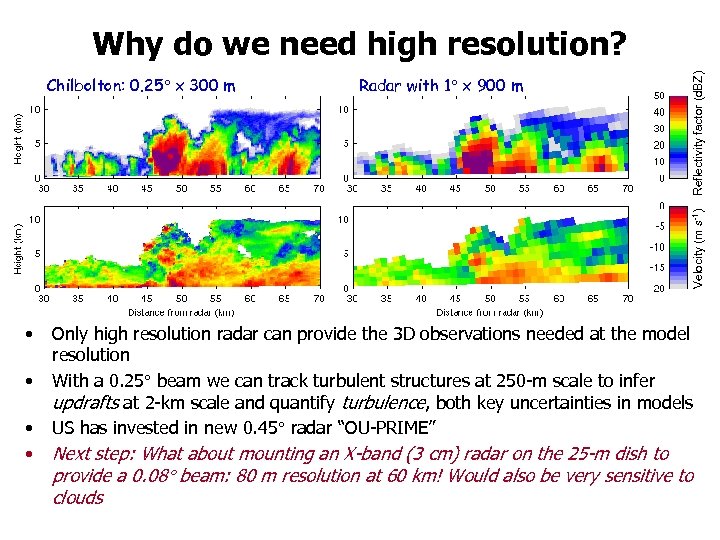
Radar with 1 x 900 m Velocity (m s-1) Chilbolton: 0. 25 x 300 m Reflectivity factor (d. BZ) Why do we need high resolution? • • Only high resolution radar can provide the 3 D observations needed at the model resolution With a 0. 25 beam we can track turbulent structures at 250 -m scale to infer updrafts at 2 -km scale and quantify turbulence, both key uncertainties in models US has invested in new 0. 45 radar “OU-PRIME” Next step: What about mounting an X-band (3 cm) radar on the 25 -m dish to provide a 0. 08 beam: 80 m resolution at 60 km! Would also be very sensitive to clouds
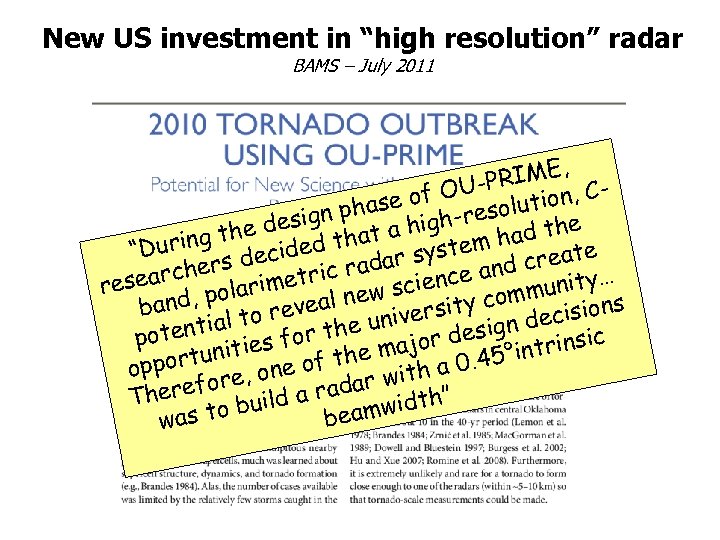
New US investment in “high resolution” radar BAMS – July 2011 , RIME P f OU- lution, Co phase so esign igh-re ad the d h ng the ided that a stem h reate “Duri s dec sy er radar nce and c h c … esearc polarimetri ew scie r munity com ecisions veal n band, s re univer esign d ial to e potent ities for th major d ic ntrins n e °i pportu e, one of th with a 0. 45 o r or heref build a rada idth” T as to beamw w
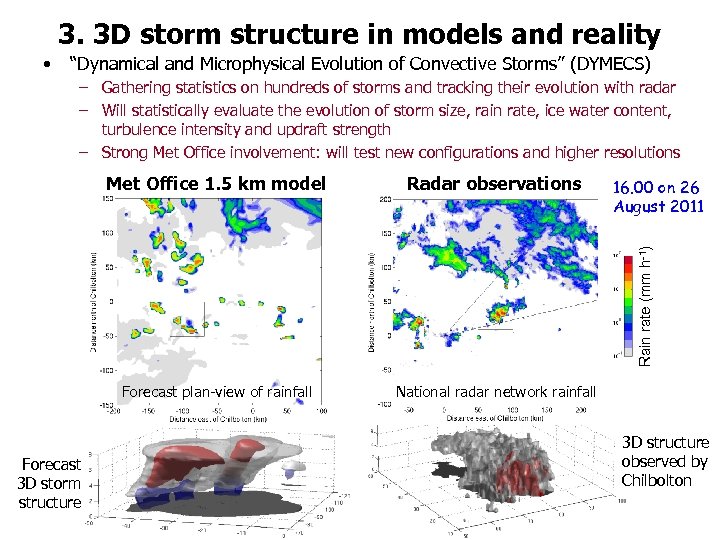
3. 3 D storm structure in models and reality • “Dynamical and Microphysical Evolution of Convective Storms” (DYMECS) – Gathering statistics on hundreds of storms and tracking their evolution with radar – Will statistically evaluate the evolution of storm size, rain rate, ice water content, turbulence intensity and updraft strength – Strong Met Office involvement: will test new configurations and higher resolutions Radar observations Forecast plan-view of rainfall National radar network rainfall 16. 00 on 26 August 2011 Rain rate (mm h-1) Met Office 1. 5 km model Forecast 3 D storm structure 3 D structure observed by Chilbolton
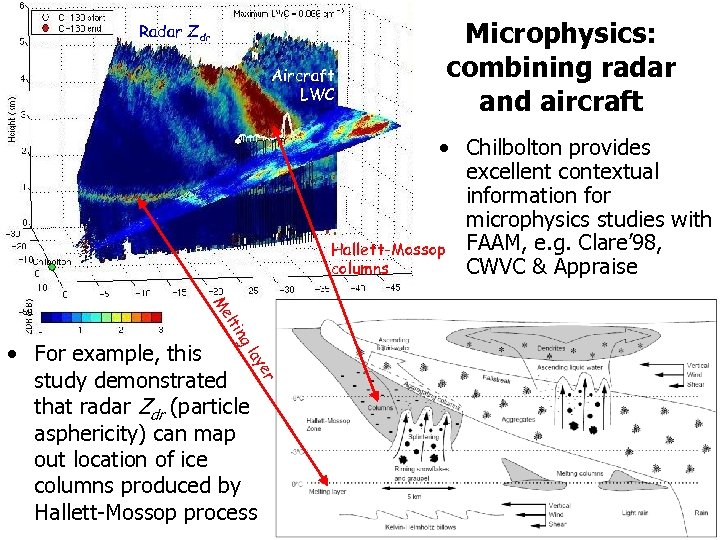
Radar Zdr Aircraft LWC Microphysics: combining radar and aircraft • Chilbolton provides excellent contextual information for microphysics studies with Hallett-Mossop FAAM, e. g. Clare’ 98, columns CWVC & Appraise ng lti Me er lay • For example, this study demonstrated that radar Zdr (particle asphericity) can map out location of ice columns produced by Hallett-Mossop process
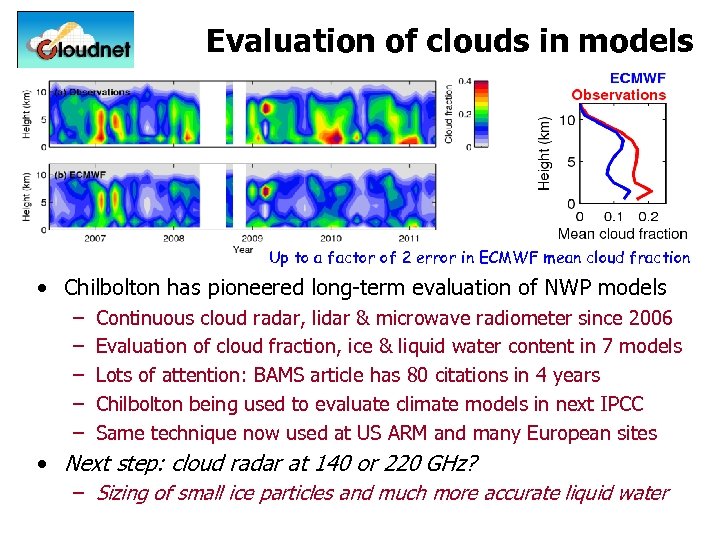
Evaluation of clouds in models Up to a factor of 2 error in ECMWF mean cloud fraction • Chilbolton has pioneered long-term evaluation of NWP models – – – Continuous cloud radar, lidar & microwave radiometer since 2006 Evaluation of cloud fraction, ice & liquid water content in 7 models Lots of attention: BAMS article has 80 citations in 4 years Chilbolton being used to evaluate climate models in next IPCC Same technique now used at US ARM and many European sites • Next step: cloud radar at 140 or 220 GHz? – Sizing of small ice particles and much more accurate liquid water
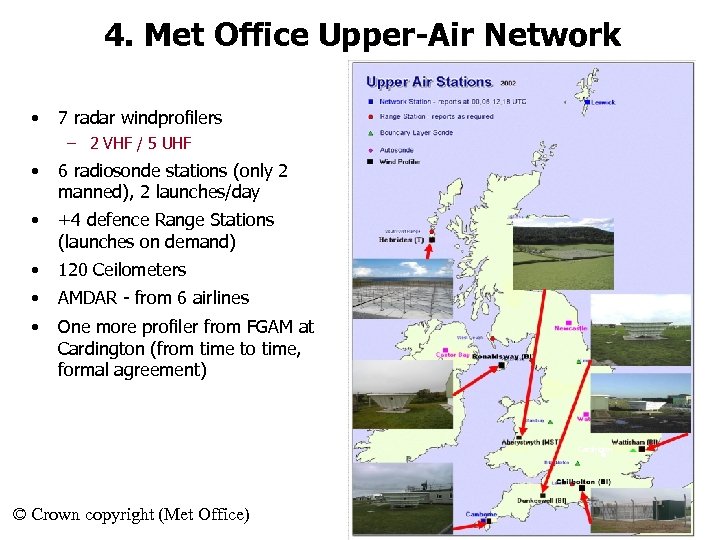
4. Met Office Upper-Air Network • 7 radar windprofilers – 2 VHF / 5 UHF • 6 radiosonde stations (only 2 manned), 2 launches/day • +4 defence Range Stations (launches on demand) • 120 Ceilometers • AMDAR - from 6 airlines • One more profiler from FGAM at Cardington (from time to time, formal agreement) Cardington © Crown copyright (Met Office)
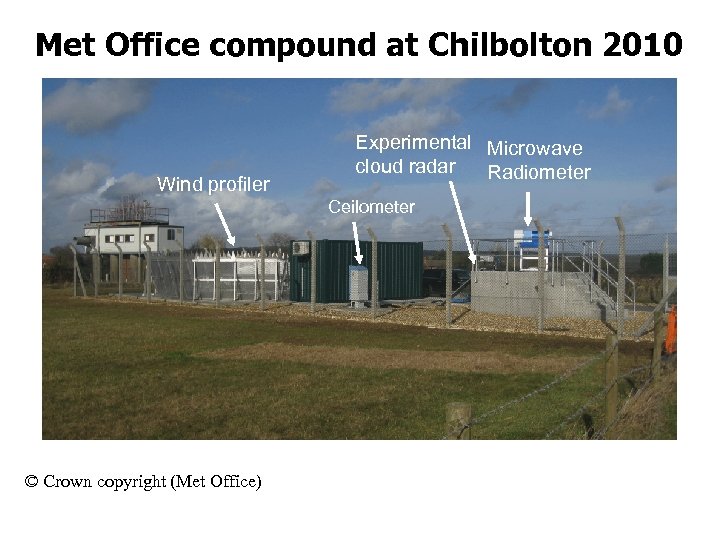
Met Office compound at Chilbolton 2010 Wind profiler Experimental Microwave cloud radar Radiometer Ceilometer © Crown copyright (Met Office)
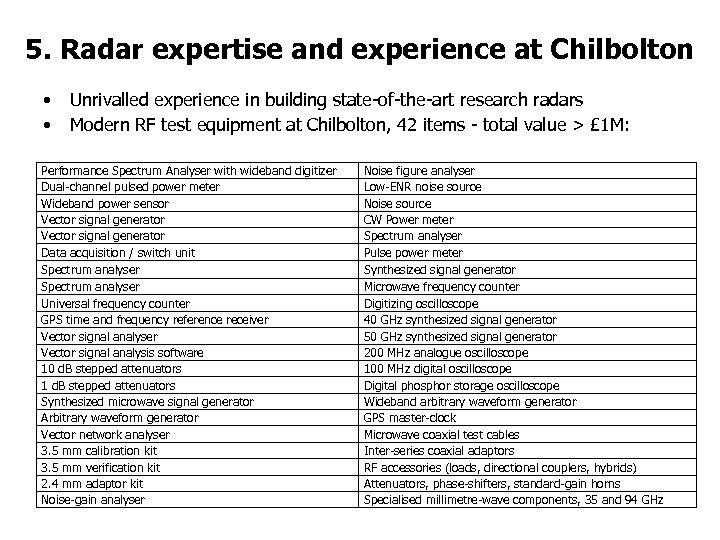
5. Radar expertise and experience at Chilbolton • • Unrivalled experience in building state-of-the-art research radars Modern RF test equipment at Chilbolton, 42 items - total value > £ 1 M: Performance Spectrum Analyser with wideband digitizer Dual-channel pulsed power meter Wideband power sensor Vector signal generator Data acquisition / switch unit Spectrum analyser Universal frequency counter GPS time and frequency reference receiver Vector signal analysis software 10 d. B stepped attenuators 1 d. B stepped attenuators Synthesized microwave signal generator Arbitrary waveform generator Vector network analyser 3. 5 mm calibration kit 3. 5 mm verification kit 2. 4 mm adaptor kit Noise-gain analyser Noise figure analyser Low-ENR noise source Noise source CW Power meter Spectrum analyser Pulse power meter Synthesized signal generator Microwave frequency counter Digitizing oscilloscope 40 GHz synthesized signal generator 50 GHz synthesized signal generator 200 MHz analogue oscilloscope 100 MHz digital oscilloscope Digital phosphor storage oscilloscope Wideband arbitrary waveform generator GPS master-clock Microwave coaxial test cables Inter-series coaxial adaptors RF accessories (loads, directional couplers, hybrids) Attenuators, phase-shifters, standard-gain horns Specialised millimetre-wave components, 35 and 94 GHz
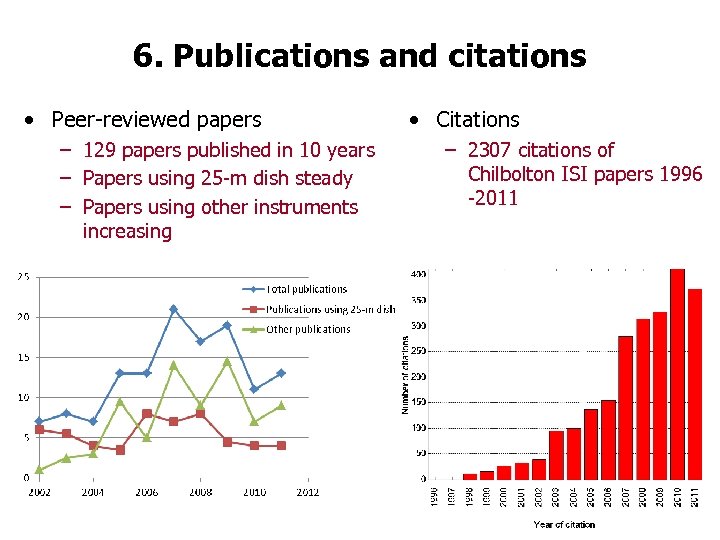
6. Publications and citations • Peer-reviewed papers – 129 papers published in 10 years – Papers using 25 -m dish steady – Papers using other instruments increasing • Citations – 2307 citations of Chilbolton ISI papers 1996 -2011
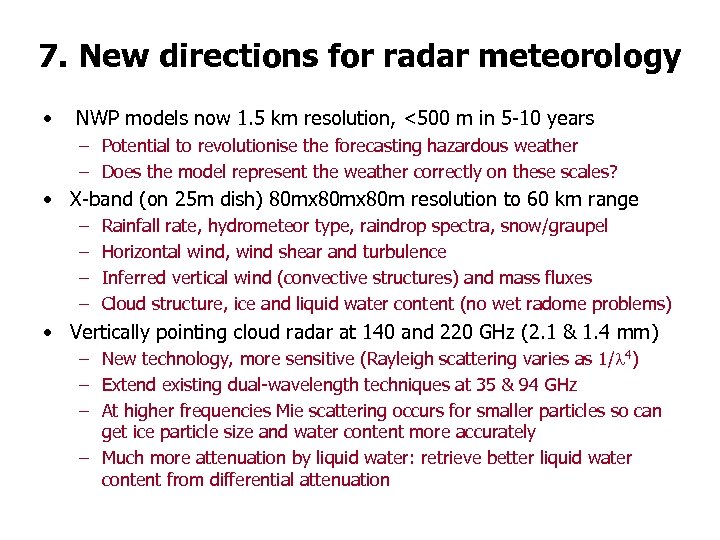
7. New directions for radar meteorology • NWP models now 1. 5 km resolution, <500 m in 5 -10 years – Potential to revolutionise the forecasting hazardous weather – Does the model represent the weather correctly on these scales? • X-band (on 25 m dish) 80 mx 80 m resolution to 60 km range – – Rainfall rate, hydrometeor type, raindrop spectra, snow/graupel Horizontal wind, wind shear and turbulence Inferred vertical wind (convective structures) and mass fluxes Cloud structure, ice and liquid water content (no wet radome problems) • Vertically pointing cloud radar at 140 and 220 GHz (2. 1 & 1. 4 mm) – New technology, more sensitive (Rayleigh scattering varies as 1/ 4) – Extend existing dual-wavelength techniques at 35 & 94 GHz – At higher frequencies Mie scattering occurs for smaller particles so can get ice particle size and water content more accurately – Much more attenuation by liquid water: retrieve better liquid water content from differential attenuation
Скачать презентацию The Chilbolton Observatory Contribution to Key Science Issues
80e6b3efc22562ec460a7dc1eb9041ac.ppt