


 Скачать презентацию The Chief Fire Officers Association Health and Safety
6ad41531b91b26af183edc2e2465bf0f.ppt
- Количество слайдов: 49
 The Chief Fire Officers Association Health and Safety Practitioners Seminar “The Shape of Things to Come” 9 December 2008 FRS Operational Competence and IPDS Simon Burtonshaw-Gunn Principal Management Consultant Risktec Solutions Limited, Warrington.
 Presentation. . • Introduction • The Growing Importance of Competency • Competence in the FRS – a case study • Broad and Detail Findings and Observations on: • Training • Selection and Promotion • Development • Competency Management in other industries • The Future and FRS Competency • Conclusions FRS Operational competency and IPDS
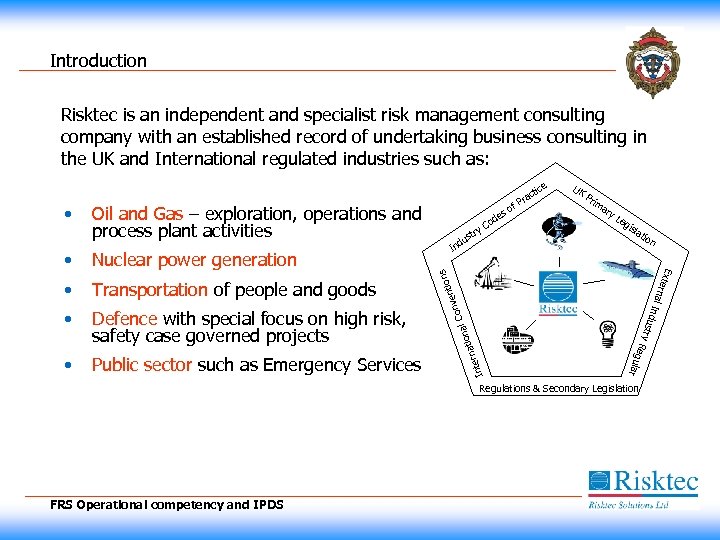 Introduction Risktec is an independent and specialist risk management consulting company with an established record of undertaking business consulting in the UK and International regulated industries such as: Oil and Gas – exploration, operations and process plant activities on ns Public sector such as Emergency Services lat i ntio • gis Ind Defence with special focus on high risk, safety case governed projects y L e nal • ar Exte r Transportation of people and goods im lar • Pr egu Nuclear power generation I UK ustr y R • u nd es od C y str e onv al C ion rnat Inte • of e tic rac P Regulations & Secondary Legislation FRS Operational competency and IPDS
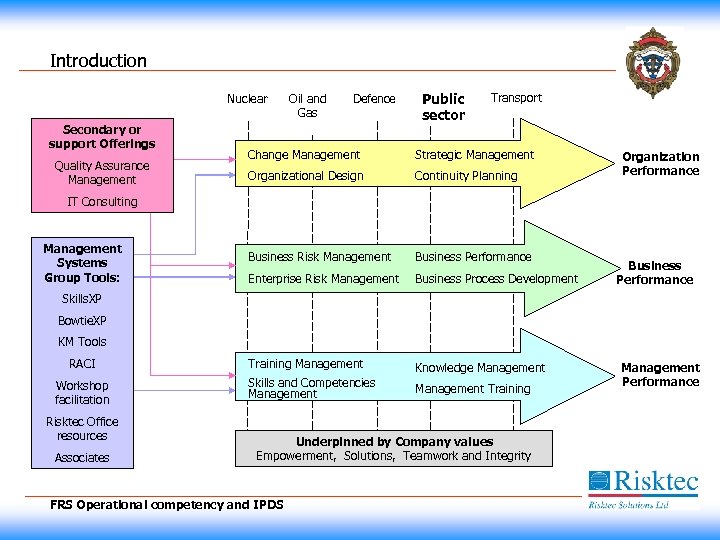 Introduction Nuclear Secondary or support Offerings Quality Assurance Management Oil and Gas Defence Public sector Transport Change Management Strategic Management Organizational Design Continuity Planning Business Risk Management Business Performance Enterprise Risk Management Business Process Development Training Management Knowledge Management Skills and Competencies Management Training Organization Performance IT Consulting Management Systems Group Tools: Business Performance Skills. XP Bowtie. XP KM Tools RACI Workshop facilitation Risktec Office resources Associates Underpinned by Company values Empowerment, Solutions, Teamwork and Integrity FRS Operational competency and IPDS Management Performance
 Introduction • Principal Management Consultant, joined Risktec in September 2007 • Well qualified in management: MA, MSc and Ph. D • Fellowship of four UK Professional Institutions • Widely published on a number of management topics, one book, four book chapters and over 40 conference / journal papers • Visiting Professor at the University of Salford in Manchester since 2004 • 30 years experience across a number of sectors, most notably in hightechnology. • Wide range of management system developments, the management of change and people-focused performance improvements in both private and public sectors. • Co-author of Risktec booklet “Guidelines for Successful Competency and Training Management” FRS Operational competency and IPDS
 The Growing Importance of Competency We have all heard that: "In a hierarchy every employee tends to rise to his/her level of Incompetence. " Laurence J. Peter, The Peter Principle (1969), US Educator & Writer (1919 - 1988) FRS Operational competency and IPDS
 The Growing Importance of Competency We have all heard that: "In a hierarchy every employee tends to rise to his/her level of Incompetence. " Its author also suggested that: “Competence. . . like truth, beauty and contact lenses, is in the eye of the beholder. ” Laurence J. Peter, The Peter Principle (1969), US Educator & Writer (1919 - 1988) FRS Operational competency and IPDS
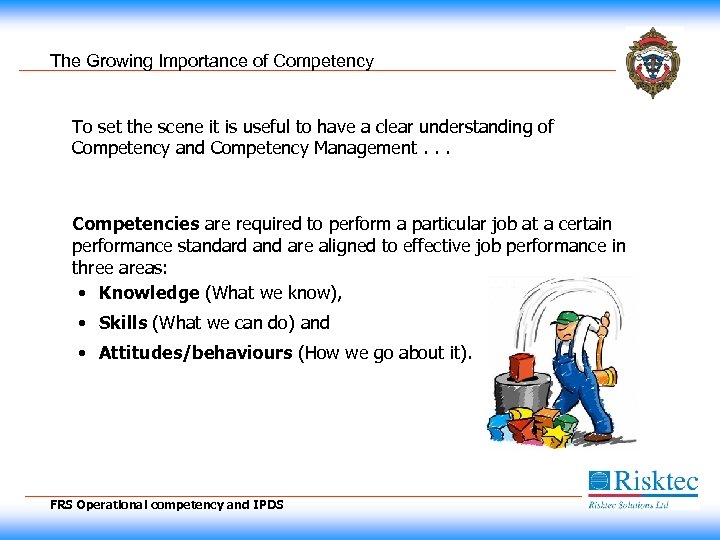 The Growing Importance of Competency To set the scene it is useful to have a clear understanding of Competency and Competency Management. . . Competencies are required to perform a particular job at a certain performance standard and are aligned to effective job performance in three areas: • Knowledge (What we know), • Skills (What we can do) and • Attitudes/behaviours (How we go about it). FRS Operational competency and IPDS
 The Growing Importance of Competency “Competence is commonly regarded to be the ability to perform the activities within an occupation or function to the standards expected in employment. This definition makes reference to standards. Thus, competence is equated to an ability to perform to the expected standard. Hence, competence assessment entails measuring a person’s performance against a standard. ” Source: Competence assessment for the hazardous industries, HSE 2003 “Competence management is the process for ensuring that enough suitably competent people are available to meet current and foreseeable business needs. ” Source: Article “Assuring the assurors” Dr David Bush (Head of Safety Analysis, National Air Traffic Services) and Christopher Lloyd, (Consultant), 2007 FRS Operational competency and IPDS
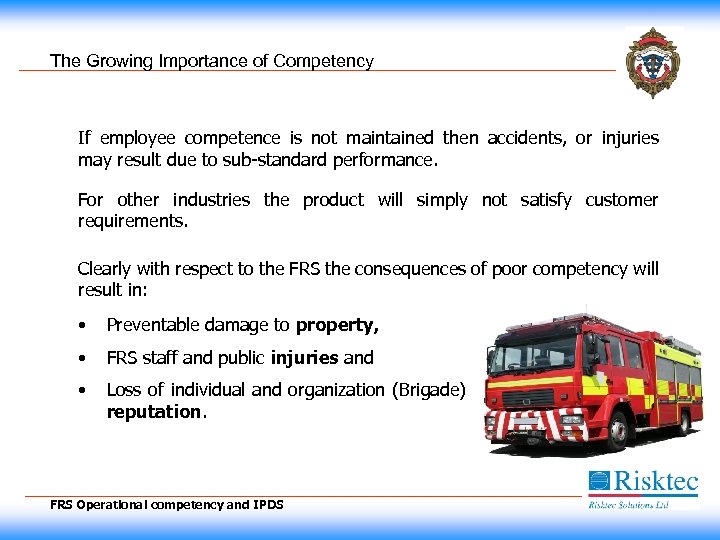 The Growing Importance of Competency If employee competence is not maintained then accidents, or injuries may result due to sub-standard performance. For other industries the product will simply not satisfy customer requirements. Clearly with respect to the FRS the consequences of poor competency will result in: • Preventable damage to property, • FRS staff and public injuries and • Loss of individual and organization (Brigade) reputation. FRS Operational competency and IPDS
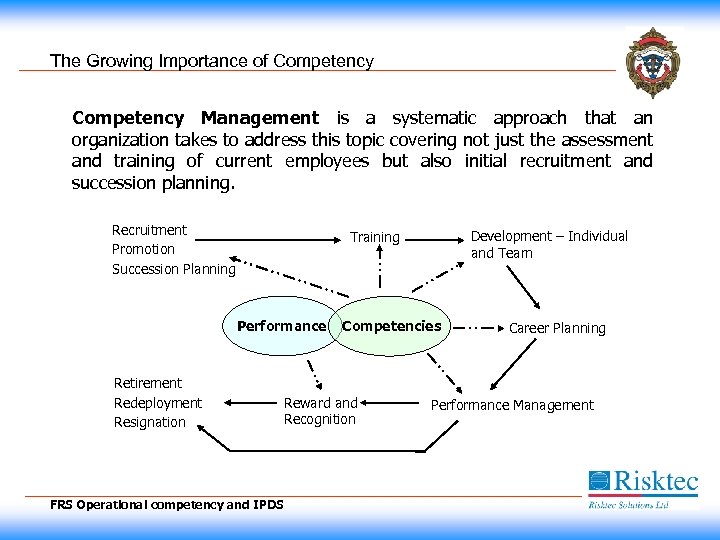 The Growing Importance of Competency Management is a systematic approach that an organization takes to address this topic covering not just the assessment and training of current employees but also initial recruitment and succession planning. Recruitment Promotion Succession Planning Performance Retirement Redeployment Resignation Development – Individual and Team Training Competencies Reward and Recognition FRS Operational competency and IPDS Career Planning Performance Management
 The Growing Importance of Competency The legal drivers for Competency Management can be seen in growing UK legislation, such as: • The Health and Safety and Work etc Act 1974 • The Human Rights Act 1998 • Management of Health and Safety at Work Regulations 1999 • Corporate Manslaughter and Homicide Act 2007 Against this backdrop there is a burden of responsibility to demonstrate Competency Management Systems are in place AND being actively used. FRS Operational competency and IPDS
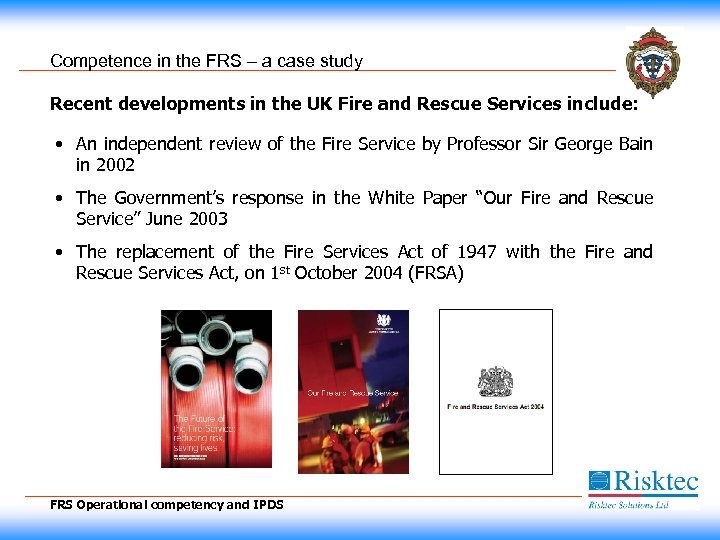 Competence in the FRS – a case study Recent developments in the UK Fire and Rescue Services include: • An independent review of the Fire Service by Professor Sir George Bain in 2002 • The Government’s response in the White Paper “Our Fire and Rescue Service” June 2003 • The replacement of the Fire Services Act of 1947 with the Fire and Rescue Services Act, on 1 st October 2004 (FRSA) FRS Operational competency and IPDS
 Competence in the FRS – a case study Recent developments in the UK Fire and Rescue Services include: • The introduction of Integrated Personal Development System (IPDS) with replacement of ‘ranks’ to ‘roles’, multi-level entry, accelerated development. • The Fire Services Examinations Board ceased activities following the final examination in early 2006. • The introduction of National Occupational Standards and Assessment Development Centres (ADCs) FRS Operational competency and IPDS
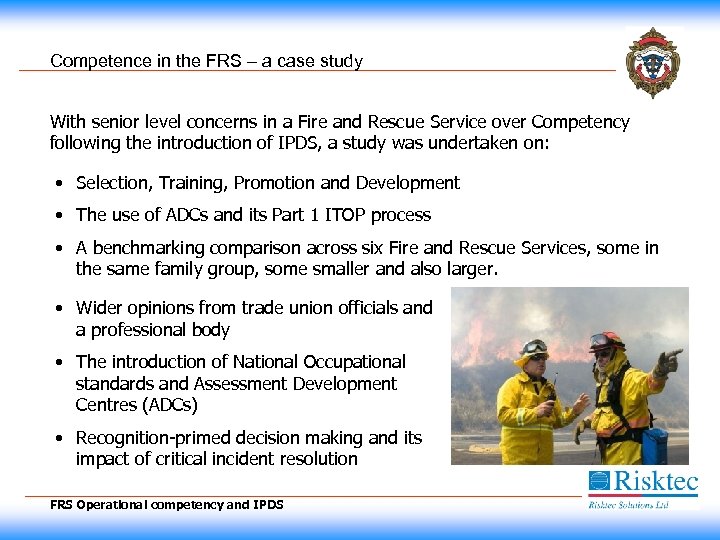 Competence in the FRS – a case study With senior level concerns in a Fire and Rescue Service over Competency following the introduction of IPDS, a study was undertaken on: • Selection, Training, Promotion and Development • The use of ADCs and its Part 1 ITOP process • A benchmarking comparison across six Fire and Rescue Services, some in the same family group, some smaller and also larger. • Wider opinions from trade union officials and a professional body • The introduction of National Occupational standards and Assessment Development Centres (ADCs) • Recognition-primed decision making and its impact of critical incident resolution FRS Operational competency and IPDS
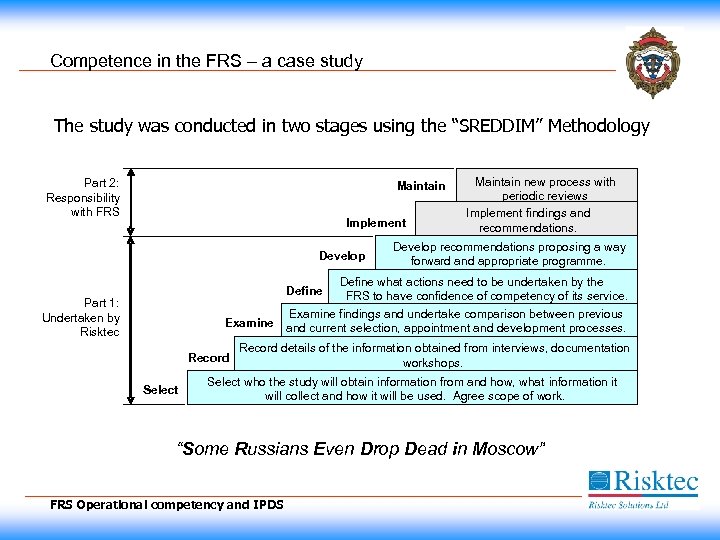 Competence in the FRS – a case study The study was conducted in two stages using the “SREDDIM” Methodology Part 2: Responsibility with FRS Maintain Implement Develop Define Part 1: Undertaken by Risktec Examine Record Select Maintain new process with periodic reviews Implement findings and recommendations. Develop recommendations proposing a way forward and appropriate programme. Define what actions need to be undertaken by Essex the FRS to have confidence of competency of service. its service. Examine findings and undertake comparison between previous and current selection, appointment and development processes. Record details of the information obtained from interviews, documentation, workshops. Select who the study will obtain information from and how, whatinformation we information it will collect and how it will be used. Agree scope of work. “Some Russians Even Drop Dead in Moscow” FRS Operational competency and IPDS
 Competence in the FRS – a case study The study covered: • A structured workshop approach to ascertain views on the four study areas: Selection, Training, Promotion and Development • Workshops with RDS staff, WT FF, Supervisory Officers, Group Managers, and the Strategic Management Board • Collection of reports, processes and documents • Semi-structured interviews with representatives of five other Fire and Rescue Services • A meeting with the Chairman of the IFE • A meeting with the Vice President of the FOA • A discussion with the General Secretary of the RFU FRS Operational competency and IPDS
 Broad Findings and Observations FRS Operational competency and IPDS
 Broad Findings and Observations (1) • The move to IPDS is widely accepted and acknowledged in the Fire and Rescue Service as the way forward in personal development. However Competency Management should provide benefits for both the individual AND the Organization. • It is fair to suggest that the understanding and acceptance of IPDS varies between FRSs and also between individuals. • Some FRSs consider it to be a natural extension to their existing people development systems; others that it was introduced at undue haste and without the full development. • There is a widespread belief that IPDS was a good concept in providing a framework but has failed in providing any detail behind this. FRS Operational competency and IPDS
 Broad Findings and Observations (2) • The ADC process involves candidates taking part in a variety of role related simulation exercises. This has resulted in a greater recognition of “softer” Personal Qualities and Attributes (PQAs) than on technical competency. • The ‘gap’ between the old and new systems leave employers vulnerable to breach of legal duties if they cannot robustly evidence the ‘professional technical competence’ of staff. • This also places other employees at risk to their health and well-being. • The risk-critical nature of the FRS means that the competent performance of people is absolutely vital to minimise the risks arising, both to Fire-Fighters and others, who may be affected by their work. FRS Operational competency and IPDS
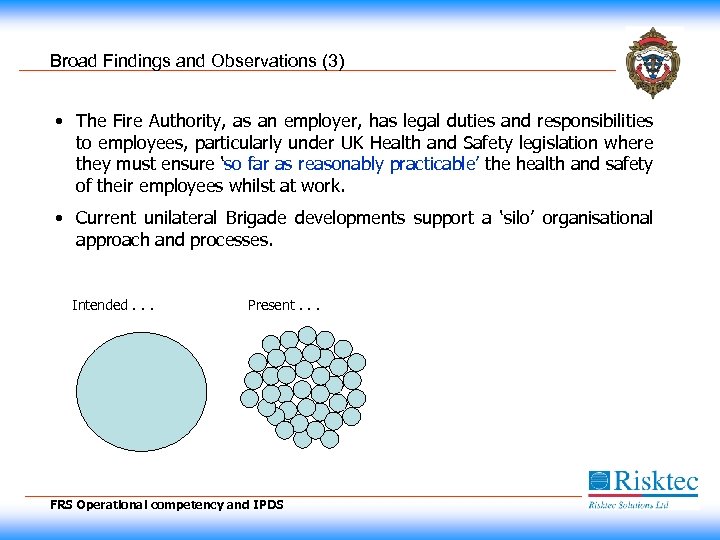 Broad Findings and Observations (3) • The Fire Authority, as an employer, has legal duties and responsibilities to employees, particularly under UK Health and Safety legislation where they must ensure ‘so far as reasonably practicable’ the health and safety of their employees whilst at work. • Current unilateral Brigade developments support a ‘silo’ organisational approach and processes. Intended. . . Present. . . FRS Operational competency and IPDS
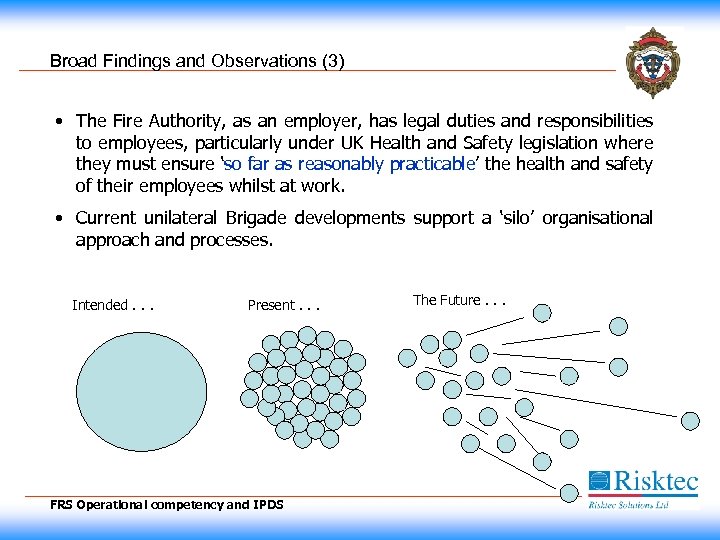 Broad Findings and Observations (3) • The Fire Authority, as an employer, has legal duties and responsibilities to employees, particularly under UK Health and Safety legislation where they must ensure ‘so far as reasonably practicable’ the health and safety of their employees whilst at work. • Current unilateral Brigade developments support a ‘silo’ organisational approach and processes. Intended. . . Present. . . FRS Operational competency and IPDS The Future. . .
 Detail Findings and Observations FRS Operational competency and IPDS
 Detail Findings and Observations – Training (1) • There is some variance in the length of the initial Fire-Fighter training ranging between 8 to 15 weeks - perhaps more than this. • There is a difference for Fire-Fighters in their development phase and as such the time when they are regarded as being fully competent. • Initial FF training differs between WT and RDS - although not always. • Best practice research suggests that there are two dimensions to competence management – the extent to which the needs of individuals are met . . and the extent to which the needs of the business are met However, tension between “directly relevant to their own needs” and the objective of encouraging a consistent pan-Service level of training for each role. FRS Operational competency and IPDS
 Detail Findings and Observations – Training (2) • There appears to be a difficulty for individuals to satisfy the general Role -required training in terms of obtaining evidence, its frequency and its applicability to their specific geographic-related incidents. • In looking at training records - some individuals are very proficient at recording their experience and aligning this to the National Occupational Standards - others less so. • The amount of time and effect in recording and cross-matching to the NOS was widely regarded as very time consuming. • Other findings covered the possibility to hide issues, manipulate or exaggerate the evidence to match the system’s requirements. FRS Operational competency and IPDS
 Detail Findings and Observations – Training (3) • There was a widespread view that the current training and development, was regarded as a good concept - the problem was in its implementation with some suggesting that the change had. . “thrown out the baby with the bathwater” • It was acknowledged that the previous system also had some deficiencies but the IPDS had replaced ALL - rather than retaining the best parts. FRS Operational competency and IPDS
 Detail Findings and Observations – Selection and Promotion (1) • Although many use the ITOP / ADC process, there appears to be no consistent or uniform approach, making cross-County transfers difficult. • Modifications to the National ADC toolkit appear to be common place and rarely are another FRSs process recognised by other Brigades. One FRS considered the unmodified, standard toolkit as “Unfit for purpose” • The ITOP uses the standard toolkit approach, itself unchanged since its introduction, prompts questions about its effectiveness in actually testing potential • For example. . . FRS Operational competency and IPDS
 Detail Findings and Observations – Selection and Promotion (2) • Each Brigade is able to set its own pass standard and modify this year by year depending on its future resource requirements. • Some consider that the national level is set too high to provide the number of appointments required and have as such reduced the criteria to allow a higher number of successful applicants. • These would suggest that either the standards required are inappropriate or that staff available are not of a sufficient standard to meet the needs of the roles. FRS Operational competency and IPDS
 Detail Findings and Observations – Selection and Promotion (3) • For those unsuccessfully completing the ITOP, resits are allowable. • It is not possible to establish if re-sit candidates pass as a result of their own commitment to selfdevelopment, external coaching or merely from improved memory from the previous test. • All ITOP candidates are said to receive feedback but comments are guarded to prevent “telling them the correct answers”. FRS Operational competency and IPDS
 Detail Findings and Observations – Selection and Promotion (4) • A brief look at the Internet reveals that information on the ITOP and ADC is available with coaching and support on such sites as www. passyouritop. com • It is not possible to establish any correlation between the ITOP and the ADC process, examples are available where failed, re-sit or scoremodified ITOP applicants have made very good appointments. • All six FRSs in the study commented on the amount of resources and expense of running the ITOP and ADC process. FRS Operational competency and IPDS
 Detail Findings and Observations – Selection and Promotion (5) • The ADC role play scenarios are limited. They have been changed since their introduction although it is stressed that such updating is widely regarded as superficial in affecting the outcomes. • Some FRS staff accepted that the scenarios used allow general management skills to be tested whilst other saw little benefit in being tested as an airport manager or health club manager. • Following successful completion of the ADC, candidates were provided with development plans. But differences here were in the level of development matched to the ADC results - achieving a high score may mean be taken to mean that lots/ little training is required. FRS Operational competency and IPDS
 Detail Findings and Observations – Selection and Promotion (6) • Completion of the ITOP/ADC is not a guarantee for promotion and the ADC “rules” say that the candidate must re-sit the ITOP and ADC again. • In a few cases successful ADC candidates have undertaken their identified development training, and yet failed the ADC re-sit. • Whilst the ITOP/ ADC process may be used for the appointment of nonuniform and indeed some non-operational uniform officers, it is not possible to establish or assess any technical level of operational competency using ADCs. FRS Operational competency and IPDS
 Detail Findings and Observations – Selection and Promotion (7) • The assessment of candidates it is considered that the 1 to 4 scoring is too coarse for this to have any significant value. • Furthermore the score is treated as too scientific and accurate with the final scores (once averaged) as being quoted to two decimal places. • One Brigade in the study reported that there is no correlation between the ITOP and the ADC scores. • Whilst in theory ADCs are applicable to RDS staff promotions it is unlikely that ADC will be considered suitable for promotions within the RDS sector. FRS Operational competency and IPDS
 Detail Findings and Observations – Development (1) • Individual and Station arranged training development is left to the individual in an informal, ad-hoc way. • Self development demonstrates a level of motivation and ambition and the Role maps provide an understanding of the next Role. • Whilst IPDS removed the Fire Services Examinations some individuals still consider them to be professionally valuable. • The IFE view was that the examinations did not verify competency but tested an acquired level of knowledge and understanding which could be enhanced with training to provide competency maintained by CPD. FRS Operational competency and IPDS
 Detail Findings and Observations – Development (2) • This is a similar view to the IPDS’s website which states that: “The exams are not and have never been a measure of current competence therefore it is inappropriate to use them as part of an ADC process where the focus is on assessment of potential” Sue Evans, Head of the National Assessment Unit, 2005 • There is a move to reconsider the current position with some brigades re -introducing formal examinations with the lead being taken by one FRS in making the IFE’s International examinations compulsory. FRS Operational competency and IPDS
 Competency in other industries (1) You are not alone!!! FRS Operational competency and IPDS
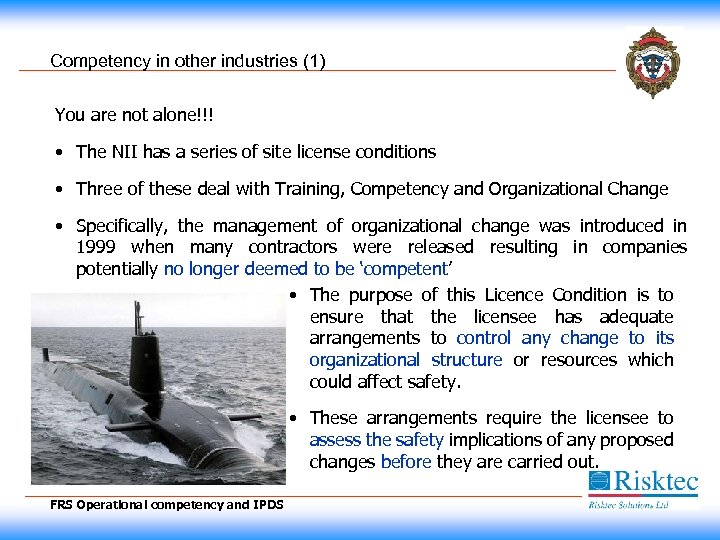 Competency in other industries (1) You are not alone!!! • The NII has a series of site license conditions • Three of these deal with Training, Competency and Organizational Change • Specifically, the management of organizational change was introduced in 1999 when many contractors were released resulting in companies potentially no longer deemed to be ‘competent’ • The purpose of this Licence Condition is to ensure that the licensee has adequate arrangements to control any change to its organizational structure or resources which could affect safety. • These arrangements require the licensee to assess the safety implications of any proposed changes before they are carried out. FRS Operational competency and IPDS
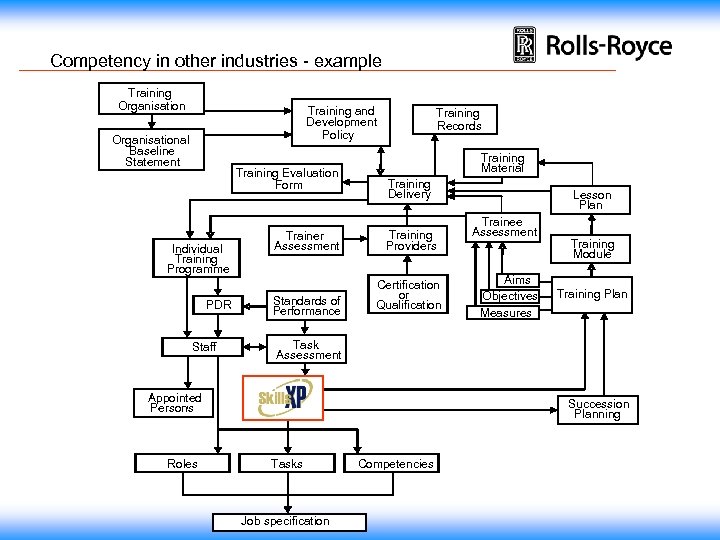 Competency in other industries - example Training Organisation Training and Development Policy Organisational Baseline Statement Training Evaluation Form Individual Training Programme PDR Staff Trainer Assessment Standards of Performance Training Records Training Delivery Training Providers Certification or or Qualification Lesson Plan Trainee Assessment Aims Objectives Measures Training Module Training Plan Task Assessment Appointed ‘ ‘Appointed Persons ’’ Roles Training Material Succession Planning Tasks Job specification Job Competencies
 Competency in other industries (2) • A significant reason for the creation of OPITO - The Oil & Gas Academy was to provide an effective link between the industry and those organisations that can provide the best learning and training across the UK to meet its needs. • Its remit is to provide skills solutions to the Oil & Gas Industry meeting standards for hazardous activities, National Occupational Standards, Approval of training delivery, workforce Capacity & Capability solutions • While OPITO does not actually deliver this training, it is responsible for the quality and content, and this is ensured through the approvals process. “A robust competence management system which is designed by the people for the business, will deliver success. Management commitment, not enforcement, is critical to success”. David Doig, OPITO Chief Executive FRS Operational competency and IPDS
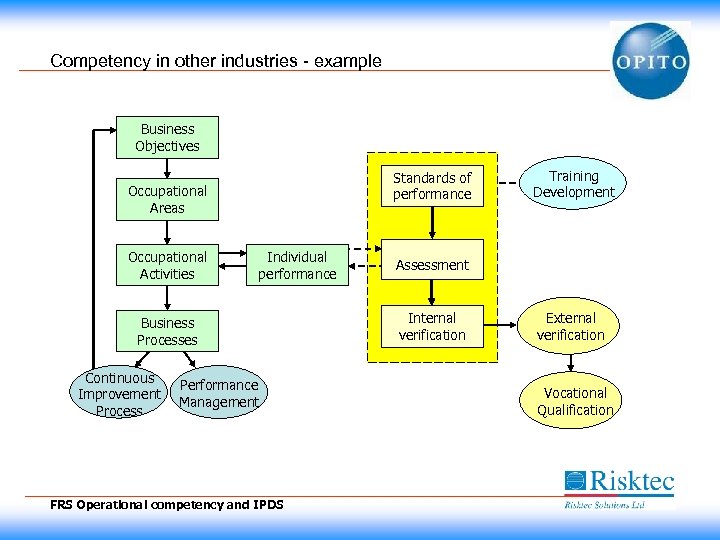 Competency in other industries - example Business Objectives Standards of performance Occupational Areas Occupational Activities Individual performance Business Processes Continuous Performance Improvement Management Process FRS Operational competency and IPDS Training Development Assessment Internal verification External verification Vocational Qualification
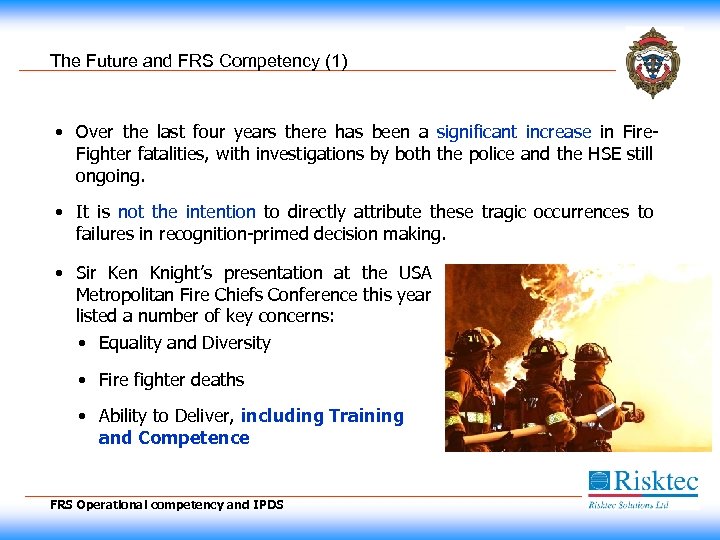 The Future and FRS Competency (1) • Over the last four years there has been a significant increase in Fire. Fighter fatalities, with investigations by both the police and the HSE still ongoing. • It is not the intention to directly attribute these tragic occurrences to failures in recognition-primed decision making. • Sir Ken Knight’s presentation at the USA Metropolitan Fire Chiefs Conference this year listed a number of key concerns: • Equality and Diversity • Fire fighter deaths • Ability to Deliver, including Training and Competence FRS Operational competency and IPDS
 The Future and FRS Competency (2) • Within IPDS the level of evidence required of individuals is very broad, enabling people to claim competence at seemingly ‘low levels’ of work activity. • It must be fundamental to the (operational) role the individual is applying for, that technical competence is a prerequisite. • Whilst local brigade action can reduce the short term exposure of risk, with implications for the Service at the national level, this is not the best solution. FRS Operational competency and IPDS
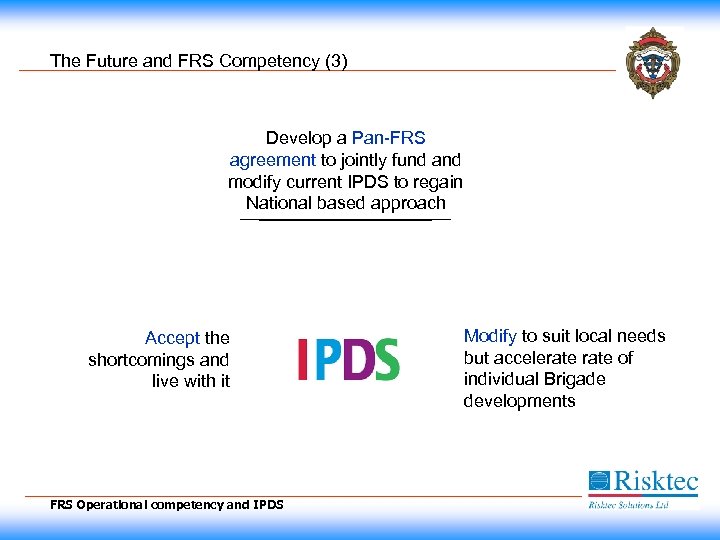 The Future and FRS Competency (3) Develop a Pan-FRS agreement to jointly fund and modify current IPDS to regain National based approach Accept the shortcomings and live with it FRS Operational competency and IPDS Modify to suit local needs but accelerate of individual Brigade developments
 The Future and FRS Competency (4) • Given the age profile of operational managers it is foreseeable that as people are replaced by newly appointed and promoted individuals, the technical understanding will reduce and subsequent risk to the organization will increase. • The ADC process needs to be supplemented with a method to determine, and at least provide some level of confidence in, an individual’s technical competency. • The promotion and selection processes need to be robust enough to withstand the scrutiny and challenge of any external body. • The challenge of the introduction and use of IPDS, like any significant Change Management programme, is knowing that it is seldom a “quick fix” but requires time and effort to be successfully undertaken. FRS Operational competency and IPDS
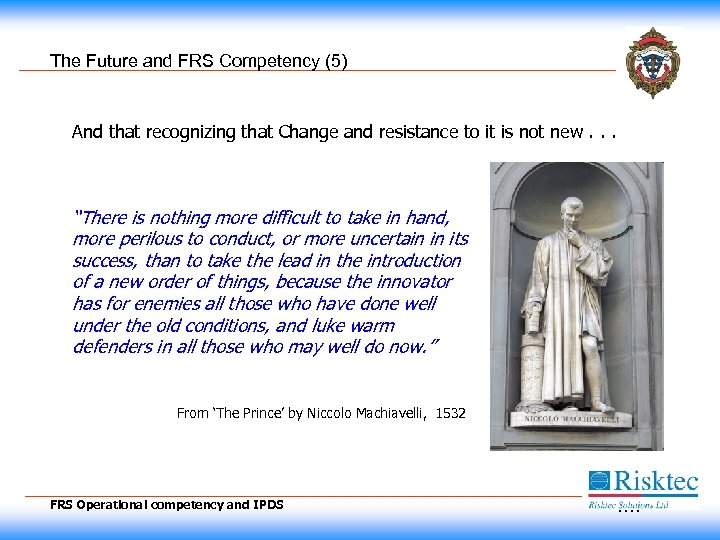 The Future and FRS Competency (5) And that recognizing that Change and resistance to it is not new. . . “There is nothing more difficult to take in hand, more perilous to conduct, or more uncertain in its success, than to take the lead in the introduction of a new order of things, because the innovator has for enemies all those who have done well under the old conditions, and luke warm defenders in all those who may well do now. ” From ‘The Prince’ by Niccolo Machiavelli, 1532 FRS Operational competency and IPDS ….
 The Future and FRS Competency (6) • In managing the competency requirements within an organization there a number of software programs available, for example PDR Pro, Skills. XP, for managing skills, work experience, qualifications and training assessments. • Typically such a database will record the competencies of a person matched to the tasks that they are required to perform and provide the following benefits: • Facilitation of a gap analysis to identify if further training is required • A clear demonstration of compliance with any legislative requirements. • An ability to undertake tactical resourcing decisions to meet the defined IRMP competency requirements and consider strategic HR planning such as succession planning, demographic profiling and recruitment requirements. • Opportunities to identify cost and time savings through economies of scale and more effective use of staff resources. • A demonstrable and auditable approach for matching agreed competency levels with assessed actuals and resulting training outcomes. FRS Operational competency and IPDS …
 The Future and FRS Competency (7) • From this limited FRS study there is a strong feeling at all levels on the importance of technical competency and the desire to ensure that this is not neglected. • . . perhaps Health and Safety legislation brings this back into focus. • With an increase in the need to manage and demonstrate competency - the use of skills databases, electronic PDRs and training matched to a Competence Framework needs to be considered across the Service as a whole. FRS Operational competency and IPDS . .
 Conclusions • Competency Management needs to provide benefits to the individual AND the Organization • It needs to be (and shown to be) used, reviewed, and improved - and collect evidence that it is doing so. • It is recognised that Competency Management is not easy BUT other industries have had success in managing this important organization function. • Technology can add significant value in record keeping, Training Management, resource management and providing confidence that this is being systematically managed. • Competencies may have to be wider than traditional ‘Fire’ eg Flood Rescue and broader roles undertaken. • National FRS competencies may be ‘core’ but with some regional differences. Recommend move from diversification to more centralisation. FRS Operational competency and IPDS .
 Thank You FRS Operational Competence and IPDS Professor Simon A. Burtonshaw-Gunn Ph. D, MA, MSc, DMS, IEng, FIET, FAPM, FCMI, FIBC Principal Management Consultant, Risktec Solutions Limited simon. burtonshaw-gunn@risktec. co. uk