 Скачать презентацию The Changing World of Digital Rights and Publishing
dfcc5204dc601e7a88c96b7eb0aeabcf.ppt
- Количество слайдов: 20



The Changing World of Digital Rights and Publishing Agreements Presented by Dana Newman
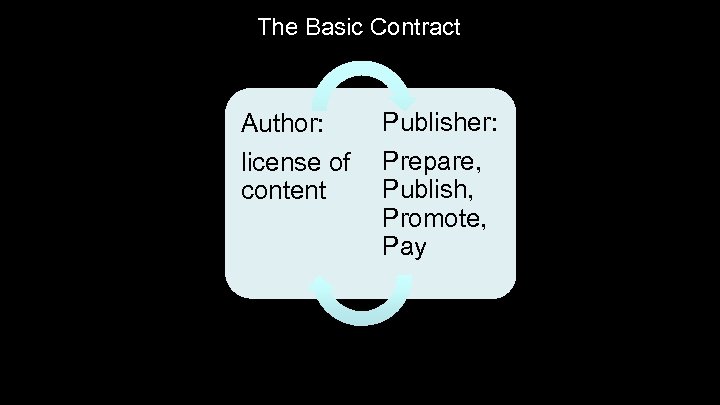
The Basic Contract Author: license of content Publisher: Prepare, Publish, Promote, Pay
© Publishing Agreements = Copyright Licenses § Rights Granted: - Reproduce and distribute the work in exchange for a royalty; not a sale - Author owns the copyright, reserves all rights not granted § Duration - term of copyright, or until work is “out of print” - Life of the author plus 70 years (works created after 1978)
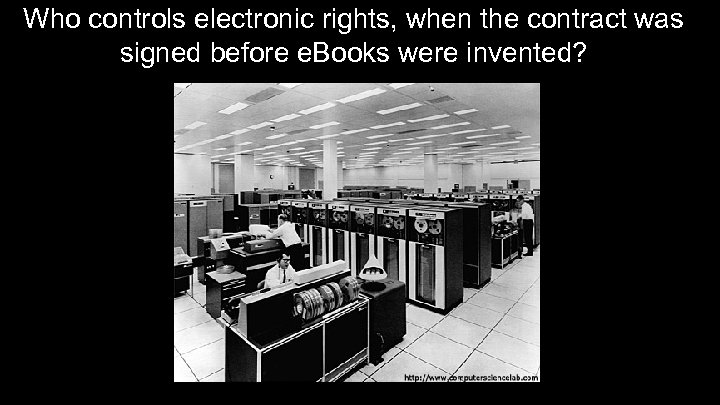
Who controls electronic rights, when the contract was signed before e. Books were invented?
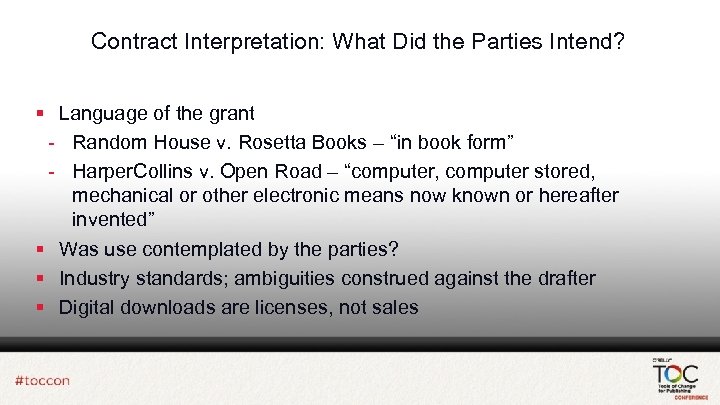
Contract Interpretation: What Did the Parties Intend? § Language of the grant - Random House v. Rosetta Books – “in book form” - Harper. Collins v. Open Road – “computer, computer stored, mechanical or other electronic means now known or hereafter invented” § Was use contemplated by the parties? § Industry standards; ambiguities construed against the drafter § Digital downloads are licenses, not sales
The Cosmic Clause
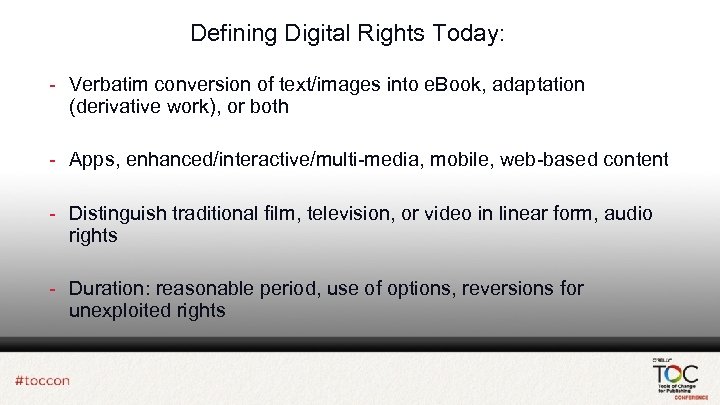
Defining Digital Rights Today: - Verbatim conversion of text/images into e. Book, adaptation (derivative work), or both - Apps, enhanced/interactive/multi-media, mobile, web-based content - Distinguish traditional film, television, or video in linear form, audio rights - Duration: reasonable period, use of options, reversions for unexploited rights
Royalties § The evolution of e-Book pricing § “Standard industry rate” for e. Books is a flat 25% of net receipts. In practice, rates vary widely. RH – sliding scale, up to 40%. § Competitive pressures to increase e. Book royalties are mounting: - Industry standards have changed - Technology reduces publishing costs - Digital only publishers, self-publishing options pay 50 -100% - Bundling print and e. Books – hybrid market
Digital Royalty Rate Strategies § Negotiate rate at the time of exercising the rights § Right to renegotiate /prevailing rate clause § Escalators – after costs recouped, rate increases § e. Book royalty floor tied to the highest print rate § Right of first refusal, reversion for unexploited digital rights
Accounting
Digital Royalty Accounting § “Net receipts” vs. retail list price - What deductions are allowed: direct costs (trade discounts, commissions, taxes) § Faster reporting, no reserve against returns for unsold inventory - Most digital publishers pay quarterly, sometimes even monthly - WSJ: Bookscan e. Book sales data - NYT: Royalty Share verifies vendors’ sales data against publisher’s
Digital books and print on demand means books can live forever
The Changing Meaning of “Out of Print” § “Not available in any format through major online retail channels” § Better: sales for 1 -2 successive periods are below a stated minimum § Term of License: a reasonable period (2 -3 years), instead of the term of copyright, subject to OOP clause? § Look out for copyright issues on multi-media works
Permissions § Does the author have the right to use the materials in an electronic version? § Multi-media works: text, photos, illustrations, animation, video, music, film/TV § Co-authors, ghostwriters, third party developers: written work for hire agreement, assignment, warranty and indemnification § Permissions should cover broad range of formats § Fee structure changes
Options § What type of work is covered? Even greater need to specify. § Where no advance is paid, less incentive to tie up future rights.
Non-Compete Clauses § Are ebooks a competing or derivative work? § Look for catch-all reservation of all non-specifically granted rights § Non-compete clauses are strictly interpreted, and are unenforceable where too broadly worded.
Business Models for Licensing Digital Rights § Agency model applies to the majority of e. Book sales: 17. 5% (25% of 70%) § Digital Publishers/Distributors – Open Road, Carina Press, Untreed Reads, Entangled, BSTSLLR, Coliloquy - 50/40 § Self-Publish through an aggregator (Bookbaby, Smashwords), or Amazon Kindle Direct, i. Books Author - 100/85/70 § Crowdsourcing (Unbound, Kickstarter)
Other Possibilities § Subscription model (Netflix/Hulu) – “books as a service” § “Freemium” model (Spotify) - ad based - Issue of fee to author: license, 50%; but how to apportion it? § Story. Bundle – 5 books, pay-what-you-want; consumer chooses royalty § Public broadcasting model, rightsholder sets price – Unglue. it § Fractured/Aggregated Content – Amazon Singles, Bookriff, Byliner (buy a chapter at a time? ) § Service contracts, administration deals, co-publishing, 360 deals
Dana Newman Attorney and Literary Agent, Dana Newman Literary http: //about. me/dananewman @Dana. Newman
Скачать презентацию The Changing World of Digital Rights and Publishing
dfcc5204dc601e7a88c96b7eb0aeabcf.ppt