 Скачать презентацию The changing landscape of international education and Cambridge s
b5793070634aa0ea5cb9fdbccbe1f778.ppt
- Количество слайдов: 41



The changing landscape of international education and Cambridge’s response to it ESSARP Conference Buenos Aires 2016 Dr Tristian Stobie Director of Education
Overview of presentation 4 The changing landscape of international education 4 What are the implications for schools? 4 What are the implications for Cambridge 4 What more should Cambridge be doing in supporting schools and teachers?
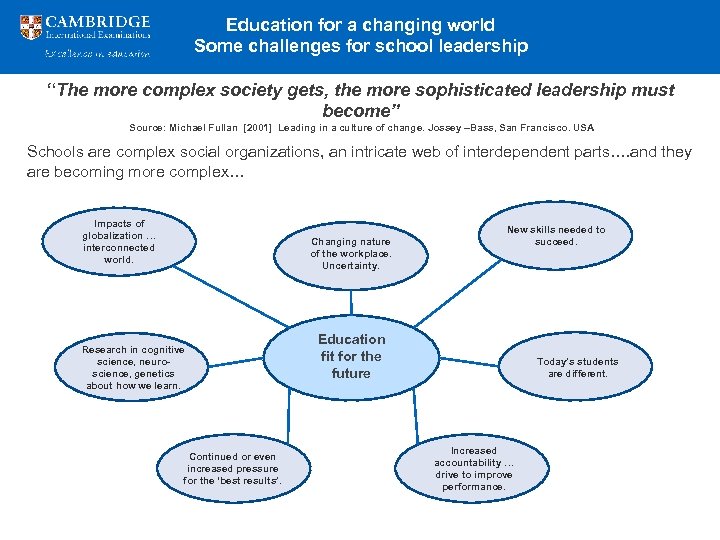
Education for a changing world Some challenges for school leadership “The more complex society gets, the more sophisticated leadership must become” Source: Michael Fullan [2001] Leading in a culture of change. Jossey –Bass, San Francisco. USA Schools are complex social organizations, an intricate web of interdependent parts…. and they are becoming more complex… Impacts of globalization … interconnected world. Changing nature of the workplace. Uncertainty. Research in cognitive science, neuroscience, genetics about how we learn. Continued or even increased pressure for the ‘best results’. New skills needed to succeed. Education fit for the future Today’s students are different. Increased accountability … drive to improve performance.
The Changing Nature of International Schools 4 While international Schools continue to grow in number their nature is changing. 4 The term international school no longer means a school for expatriates it also includes private and state schools who prefer the international brand. 4 The international schools market has grown to 7, 620 international schools, teaching 3. 9 million students, and employing 363, 000 members of staff (data from ISC Research as of January 2015). In 2001 the number was 2585. 4 In 1989 at least 80% of international school students were expatriate, today 80% are locals 4 More than half the worlds international schools are now based in Asia and two thirds of all new international schools are being built on this continent 4 Most newly opened international schools are for profit. Source: International Schools Consultancy [2013] Australia
Not just the growth in International schools Influence on State Education “It should be clear that the search for best practices is now an international one. With it come high expectations that there are easily borrowed protocols that can vastly improve local educational systems……. . . The search for best practice is built on an optimistic faith that a school is a school. It assumes that a practice that works in in say Finland will work as well in the United States or Germany. It assumes Education is like Engineering. ” Source: [Kamens. D. [2013] Pisa Power and Policy. The emergence of global educational governance Heinz-Dieter Meyer and Aaron Benavot [Eds] Symposium Books UK
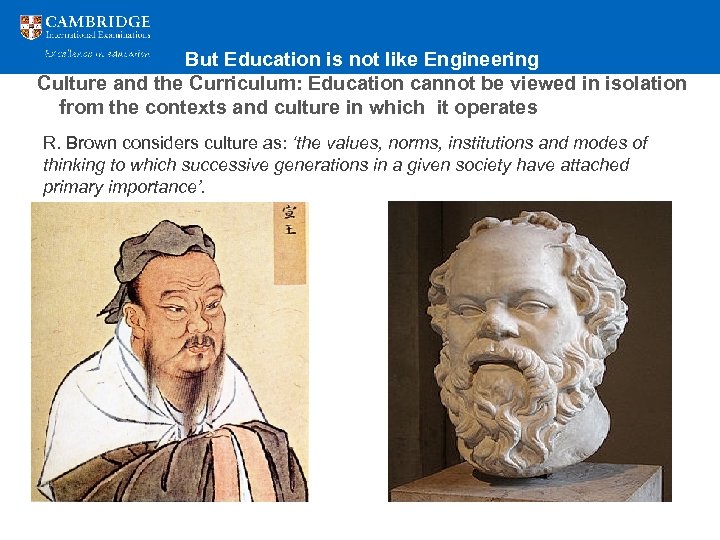
But Education is not like Engineering Culture and the Curriculum: Education cannot be viewed in isolation from the contexts and culture in which it operatesit is delivered R. Brown considers culture as: ‘the values, norms, institutions and modes of thinking to which successive generations in a given society have attached primary importance’.
Search for Best International Practice Forces driving search: 4 OECD. The challenge of 21 st Century Education 4 League Tables [PISA, TIMSS]. 4 Positional Competition [individual, school level and national] 4 English as world language 4 Constructivist learning paradigm is becoming dominant 4 Student mobility and global competition for university entrance Consequences: 4 Copying of what is perceived as international best practice 4 Rise in the number of schools that can broadly be defined as international serving local populations 4 Increasing use of national and international brands Curriculum is now more about cultural transformation than transmission
Cultural Transmission or Cultural Transformation? Cultural Transmission All curriculum require selection to be made based on values about what is considered to be important: 4 Lawton: curriculum needs to be planned to ensure that an appropriate selection from culture is made Lawton, D. [1996] Beyond the national curriculum. Teacher professionalism and empowerment. London Hodder and Stoughton. Cultural transformation Characteristics of the modern world demand new competencies. 1. Information overload 2. Constant change and speed of change 3. Uncertainty 4. Multiple careers. No longer ‘a job for life’ 5. Importance of interdisciplinary understanding to solve problems 6. Adaptability and creativity needed for an individual [and a society] to succeed.
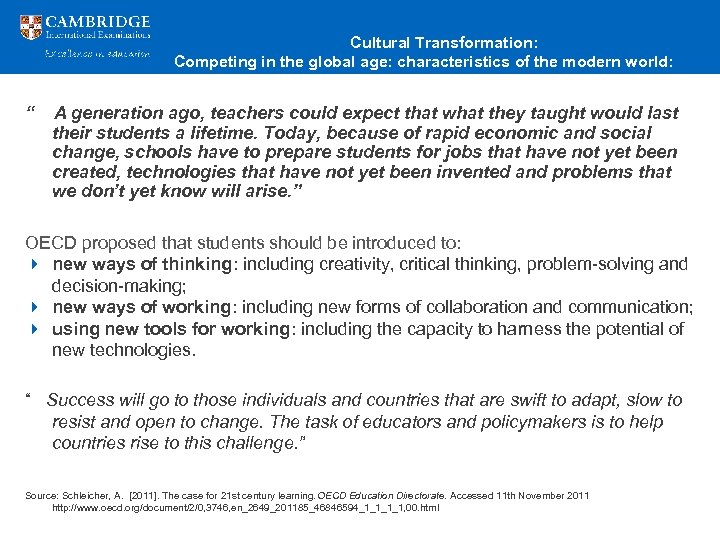
Cultural Transformation: Competing in the global age: characteristics of the modern world: “ A generation ago, teachers could expect that what they taught would last their students a lifetime. Today, because of rapid economic and social change, schools have to prepare students for jobs that have not yet been created, technologies that have not yet been invented and problems that we don’t yet know will arise. ” OECD proposed that students should be introduced to: 4 new ways of thinking: including creativity, critical thinking, problem-solving and decision-making; 4 new ways of working: including new forms of collaboration and communication; 4 using new tools for working: including the capacity to harness the potential of new technologies. “ Success will go to those individuals and countries that are swift to adapt, slow to resist and open to change. The task of educators and policymakers is to help countries rise to this challenge. ” Source: Schleicher, A. [2011]. The case for 21 st century learning. OECD Education Directorate. Accessed 11 th November 2011 http: //www. oecd. org/document/2/0, 3746, en_2649_201185_46846594_1_1, 00. html
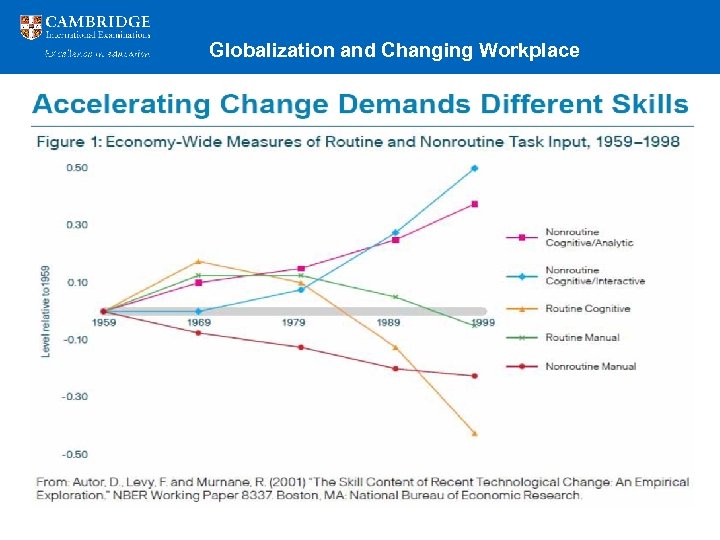
Globalization and Changing Workplace
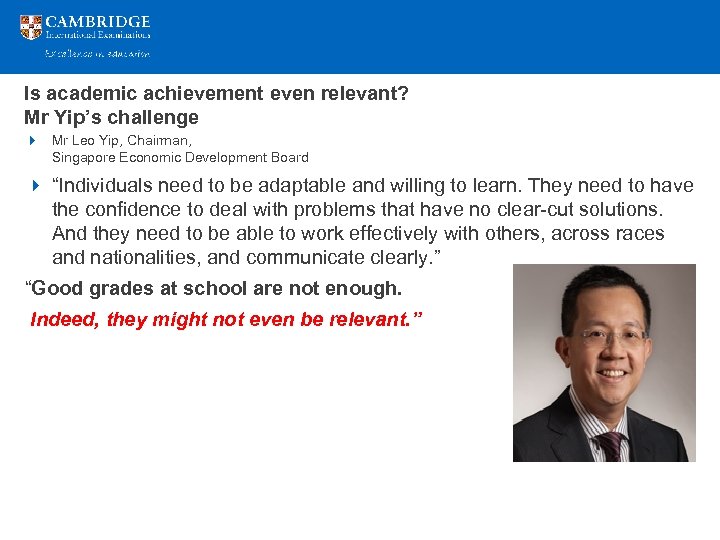
Is academic achievement even relevant? Mr Yip’s challenge 4 Mr Leo Yip, Chairman, Singapore Economic Development Board 4 “Individuals need to be adaptable and willing to learn. They need to have the confidence to deal with problems that have no clear-cut solutions. And they need to be able to work effectively with others, across races and nationalities, and communicate clearly. ” “Good grades at school are not enough. Indeed, they might not even be relevant. ”
![The Curriculum Battleground Different Perspectives / Priorities / Tensions [somewhat simplistic and generalized] Traditional](https://present5.com/presentation/b5793070634aa0ea5cb9fdbccbe1f778/image-12.jpg "The Curriculum Battleground Different Perspectives / Priorities / Tensions [somewhat simplistic and generalized] Traditional")
The Curriculum Battleground Different Perspectives / Priorities / Tensions [somewhat simplistic and generalized] Traditional Modern 4 Cultural transmission 4 Cultural transformation 4 Disciplinary 4 Interdisciplinary / phenomenon based 4 Knowledge / content based 4 Narrow learning objectives 4 Summative assessment based on tests / examinations emphasising reliability 4 Teachers deliver curriculum 4 Teachers not directly involved in high states assessment 4 Process / skills led 4 Broad learning objectives with a focus on competencies 4 Authentic summative assessment based on portfolios and teacher assessment valid to broader educational aims 4 Teachers create curriculum 4 Teachers involved in high stakes summative assessment marking coursework
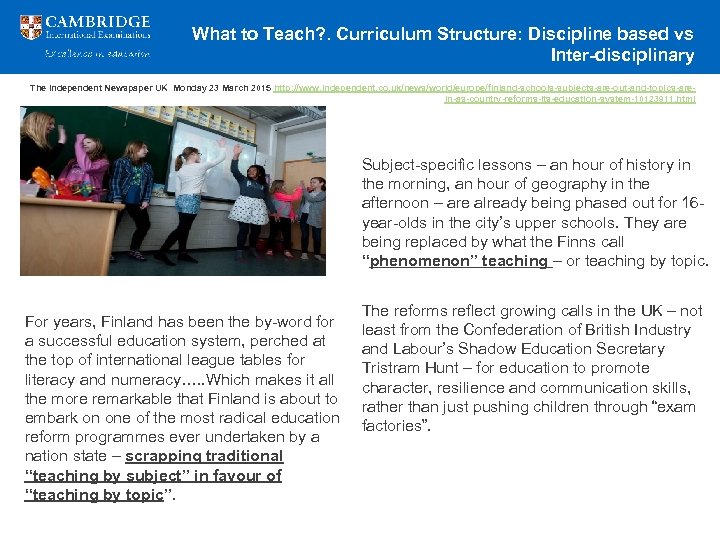
What to Teach? . Curriculum Structure: Discipline based vs Inter-disciplinary The Independent Newspaper UK Monday 23 March 2015 http: //www. independent. co. uk/news/world/europe/finland-schools-subjects-are-out-and-topics-arein-as-country-reforms-its-education-system-10123911. html Subject-specific lessons – an hour of history in the morning, an hour of geography in the afternoon – are already being phased out for 16 year-olds in the city’s upper schools. They are being replaced by what the Finns call “phenomenon” teaching – or teaching by topic. For years, Finland has been the by-word for a successful education system, perched at the top of international league tables for literacy and numeracy…. . Which makes it all the more remarkable that Finland is about to embark on one of the most radical education reform programmes ever undertaken by a nation state – scrapping traditional “teaching by subject” in favour of “teaching by topic”. The reforms reflect growing calls in the UK – not least from the Confederation of British Industry and Labour’s Shadow Education Secretary Tristram Hunt – for education to promote character, resilience and communication skills, rather than just pushing children through “exam factories”.
Crisis in Curriculum Theory? Young believes that one significant reason why there is what he describes as a ‘crisis in curriculum theory’ is an increasing acceptance of the idea that knowledge itself is not intrinsically significant. Based on this view the question that teachers are faced with becomes ‘Is this curriculum meaningful to my students? ’ rather than ‘What are the meanings this curriculum gives my students access to? ’ Knowledge is increasingly seen as something intimidating or irrelevant while skills are emphasised. Source: Young, M. (2013) Overcoming the Crisis in Curriculum Theory: a knowledge-based approach, Journal of Curriculum Studies, 45(2), 101 -118. http: //dx. doi. org/10. 1080/00220272. 2013. 764505
Professor Elizabeth Rata, University of Auckland Source: The New Zealand Herald, 7 th September 2013. http: //www. nzherald. co. nz/nz/news/article. cfm? c_id=1&objectid=11120838 The Importance of Academic Rigor “The reasonable concern with the way academic knowledge was taught in the past led, not to holding on to such valuable knowledge and improving the way it is taught, but to abandoning knowledge for skills……. Another reason, one growing in influence today, is also equally misguided. It is the notion that knowledge is a process. That it is not content. This ‘Knowledge Age’ or ‘ 21 st Future Learning’ approach is gaining ground because it offers what some call an exciting digital utopianism. Dispense with the teacher, bring out the i. Pad, let's co-inquire together. But pupils don't know what they don't know. You can't look it up on Google when you don't know what you are looking for. You can't recognise it when you see it, and you can't judge it if you do find it……. Good teachers are knowledgeable teachers. When we remember this we will value them again. But it is a status that must be earned. A teacher who says "I co-inquire with my students", "I learn from them", "we construct knowledge together" does not deserve that status. ”
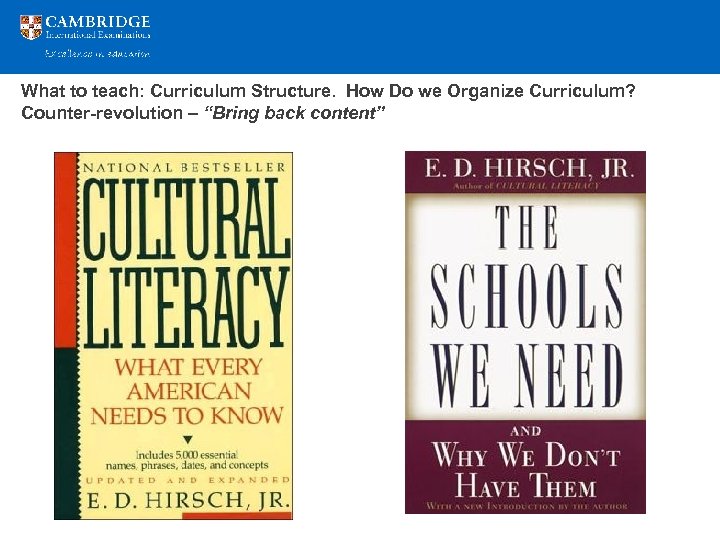
What to teach: Curriculum Structure. How Do we Organize Curriculum? Counter-revolution – “Bring back content”
![West look East [England]:](https://present5.com/presentation/b5793070634aa0ea5cb9fdbccbe1f778/image-17.jpg "West look East [England]:")
West look East [England]:
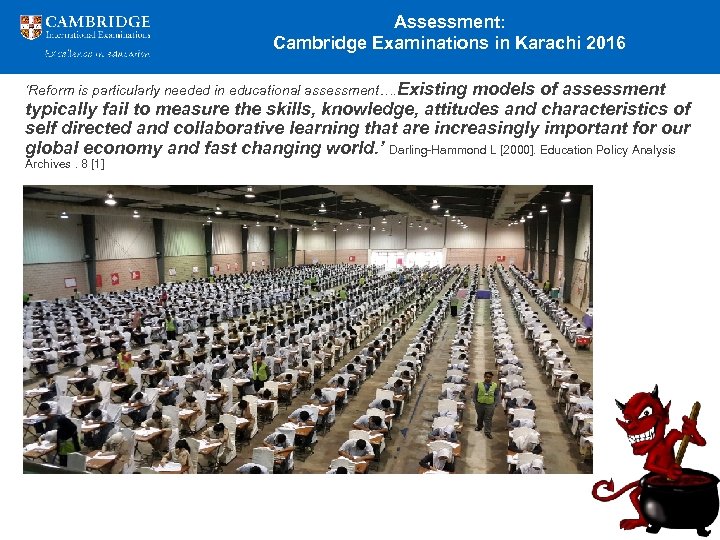
Assessment: Cambridge Examinations in Karachi 2016 ‘Reform is particularly needed in educational assessment…. Existing models of assessment typically fail to measure the skills, knowledge, attitudes and characteristics of self directed and collaborative learning that are increasingly important for our global economy and fast changing world. ’ Darling-Hammond L [2000]. Education Policy Analysis Archives. 8 [1]
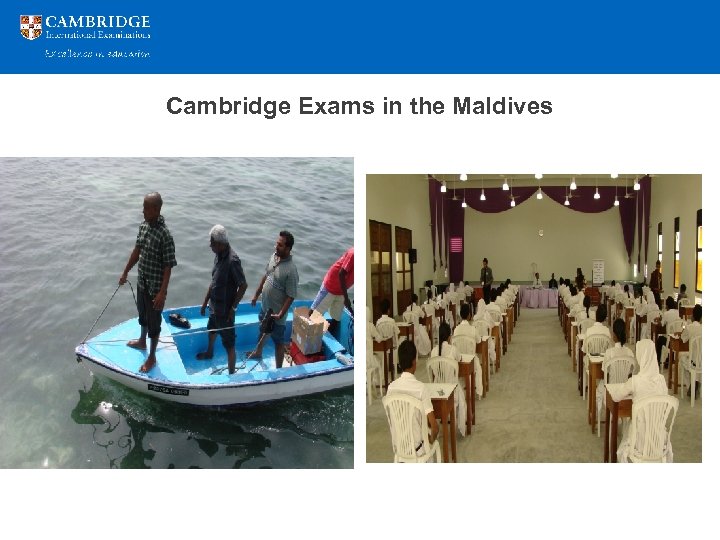
Cambridge Exams in the Maldives
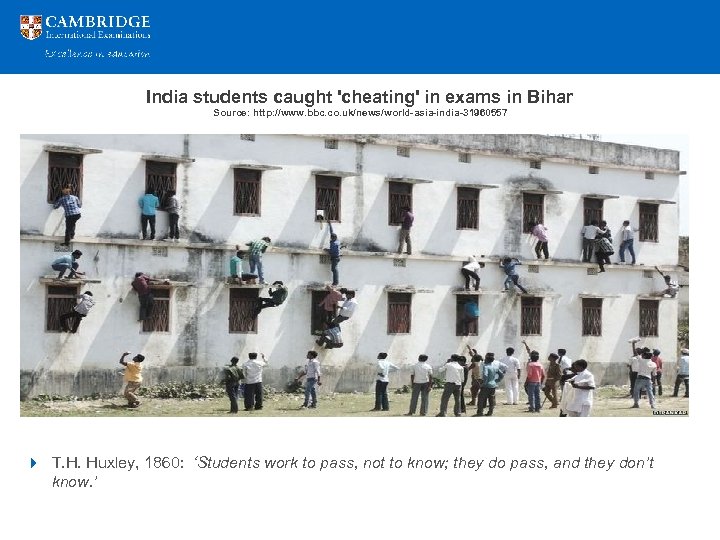
India students caught 'cheating' in exams in Bihar Source: http: //www. bbc. co. uk/news/world-asia-india-31960557 4 T. H. Huxley, 1860: ‘Students work to pass, not to know; they do pass, and they don’t know. ’
What are the implications for schools?
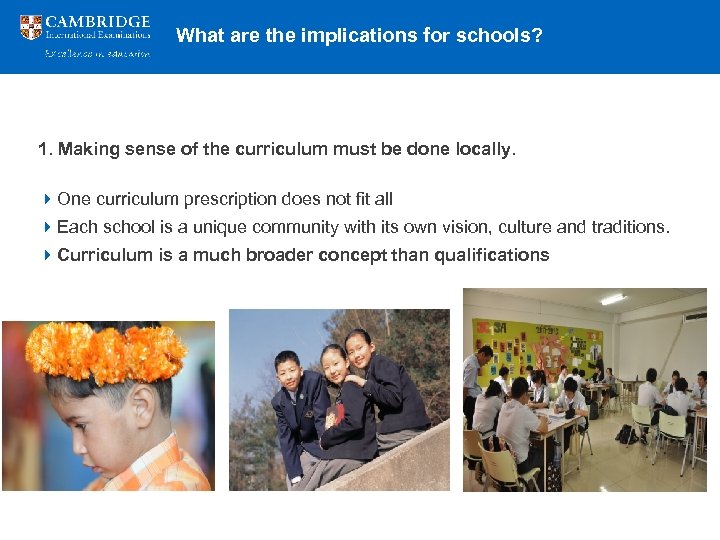
What are the implications for schools? 1. Making sense of the curriculum must be done locally. 4 One curriculum prescription does not fit all 4 Each school is a unique community with its own vision, culture and traditions. 4 Curriculum is a much broader concept than qualifications
![What are the implications for schools? 1 [continued] A Broad and Balanced Curriculum Might](https://present5.com/presentation/b5793070634aa0ea5cb9fdbccbe1f778/image-23.jpg "What are the implications for schools? 1 [continued] A Broad and Balanced Curriculum Might")
What are the implications for schools? 1 [continued] A Broad and Balanced Curriculum Might be considered to include: 4 Language Development: Student’s first language and the language of instruction of the school. Bilingualism highly desirable 4 The development of Mathematical, Science and Technology competences 4 Social, cultural and civic awareness and expression. Developing an informed sense of self in place and time starts with local and includes global awareness 4 Creative, artistic, enterprise 4 Physical education and sport 4 Co-Curricula opportunities for service and leadership 4 Learning to learn [including information literacy] should be infused in all disciplines not a separate course A mixture of local / international Balance of activities as well as subjects… Curriculum Coherence: The whole should be more than the sum of its parts.
![1 [continued ] What are the benefits of bilingualism? 1. Increased mental processing capacity](https://present5.com/presentation/b5793070634aa0ea5cb9fdbccbe1f778/image-24.jpg "1 [continued ] What are the benefits of bilingualism? 1. Increased mental processing capacity")
1 [continued ] What are the benefits of bilingualism? 1. Increased mental processing capacity 2. Greater control over mental processing 3. Improved memory 4. Greater meta-linguistic awareness 5. Increased mental flexibility 6. Improved health 7. Improved inter-cultural skills 8. Increased opportunities for trade 9. Increased income Mehisto, P. Excellence in Bilingual Education: A Guide for School Principals, CIE/CUP, 2012
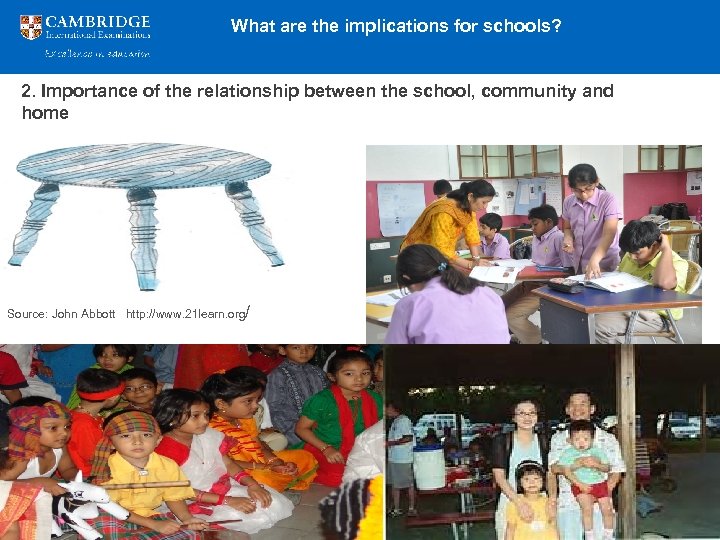
What are the implications for schools? 2. Importance of the relationship between the school, community and home Source: John Abbott http: //www. 21 learn. org/
![What are the implications for schools? 3. Focus on Powerful Knowledge [M. Young] 4](https://present5.com/presentation/b5793070634aa0ea5cb9fdbccbe1f778/image-26.jpg "What are the implications for schools? 3. Focus on Powerful Knowledge [M. Young] 4")
What are the implications for schools? 3. Focus on Powerful Knowledge [M. Young] 4 Curriculum planning should start from a student’s entitlement to knowledge, not from the student as learner. 4 Students should have access to the most powerful knowledge we have. 4 Powerful knowledge is both disciplinary and inter-disciplinary 4 The essential difference between everyday knowledge and school based knowledge, is that the latter empowers students by providing access to understandings and methodologies that extend beyond their everyday experience. ‘What is the powerful knowledge that students should be able to acquire at school? ’ is the critical question curriculum planners in schools have to answer. This will have a cultural dimension.
What are the implications for schools? 4. Disciplinary vs Interdisciplinary learning “Interdisciplinarity is excellent if it is firmly rooted in disciplinarity. Each subject is not an end in itself but it must be an efficient tool. We must keep its identity and especially its own methodology. Only on that basis will we be able to construct progressively a serious interdisciplinarity otherwise we will lead or student’s to mental confusion and superficial surveys. ” Source: G. Renaud [1989] Paper presented to the International Schools association, Geneva
![What are the implications for schools? 4. [continued] Disciplinary Understanding Selective Depth 4 Creativity](https://present5.com/presentation/b5793070634aa0ea5cb9fdbccbe1f778/image-28.jpg "What are the implications for schools? 4. [continued] Disciplinary Understanding Selective Depth 4 Creativity")
What are the implications for schools? 4. [continued] Disciplinary Understanding Selective Depth 4 Creativity must be fundamental to all disciplines 4 Importance of understanding the deep structure of a discipline 4 Stretched in the classroom and through assessments 4 Embed problem solving, creativity, collaborative, research, inquiry in syllabuses 4 Balance of depth and breadth: Coverage is the enemy of understanding [Howard Gardner] 4 Benchmarked to clear international standards Teaching for transfer 4 A role of the teacher is to help students make connections, to build bridges in students’ minds between what they learn in on context and application in another 4 Important role for the prescription of activities, courses, qualifications that draw on students’ experiences across the curriculum [global perspectives] 4 Curriculum planning should make links evident to encourage cross referencing within disciplines and across disciplines.
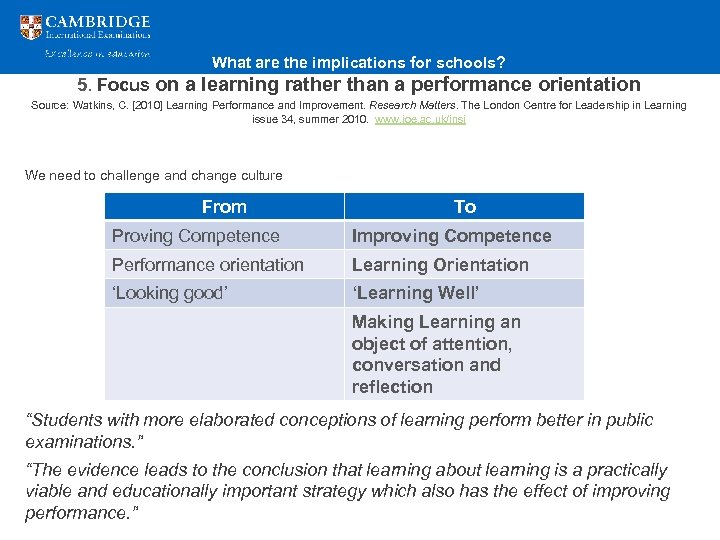
What are the implications for schools? 5. Focus on a learning rather than a performance orientation Source: Watkins, C. [2010] Learning Performance and Improvement. Research Matters. The London Centre for Leadership in Learning issue 34, summer 2010. www. ioe. ac. uk/insi We need to challenge and change culture From To Proving Competence Improving Competence Performance orientation Learning Orientation ‘Looking good’ ‘Learning Well’ Making Learning an object of attention, conversation and reflection “Students with more elaborated conceptions of learning perform better in public examinations. ” “The evidence leads to the conclusion that learning about learning is a practically viable and educationally important strategy which also has the effect of improving performance. ”
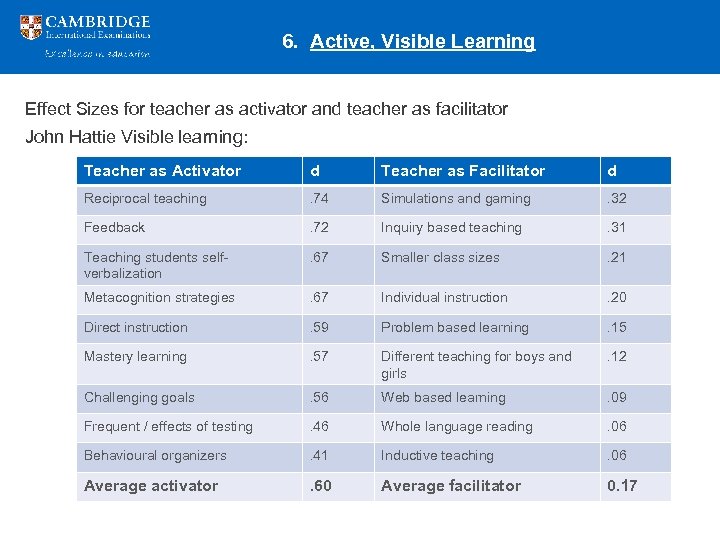
6. Active, Visible Learning Effect Sizes for teacher as activator and teacher as facilitator John Hattie Visible learning: Teacher as Activator d Teacher as Facilitator d Reciprocal teaching . 74 Simulations and gaming . 32 Feedback . 72 Inquiry based teaching . 31 Teaching students selfverbalization . 67 Smaller class sizes . 21 Metacognition strategies . 67 Individual instruction . 20 Direct instruction . 59 Problem based learning . 15 Mastery learning . 57 Different teaching for boys and girls . 12 Challenging goals . 56 Web based learning . 09 Frequent / effects of testing . 46 Whole language reading . 06 Behavioural organizers . 41 Inductive teaching . 06 Average activator . 60 Average facilitator 0. 17
![6 [cont]. Visible Learning When teachers see learning through the eyes of the student](https://present5.com/presentation/b5793070634aa0ea5cb9fdbccbe1f778/image-31.jpg "6 [cont]. Visible Learning When teachers see learning through the eyes of the student")
6 [cont]. Visible Learning When teachers see learning through the eyes of the student When students see themselves as their own teachers Teachers are among the most powerful influences in learning Active and guided instruction is much more effective than unguided and facilitative instruction. Teachers need to: 4 be directive, influential, caring and actively engaged in the passion of teaching and learning 4 to construct meaningful experiences in the light of what each student is thinking. 4 have proficient knowledge and understanding of their subject to provide meaningful and appropriate feedback 4 know the learning intention and success criteria of each lesson and how well they are attaining these and where to go next 4 teach for transfer…relating and extending ideas 4 create a learning environment where error is welcomed as a learning opportunity Hattie. J [2009] Visible learning: A synthesis of over 800 Meta-Analyses Relating to Achievement Routledge. Oxford UK.
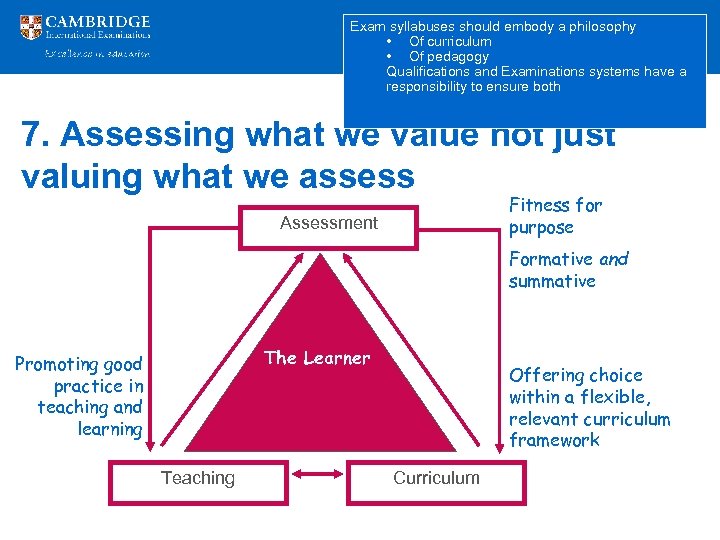
Exam syllabuses should embody a philosophy • Of curriculum • Of pedagogy Qualifications and Examinations systems have a responsibility to ensure both 7. Assessing what we value not just valuing what we assess Fitness for purpose Assessment Formative and summative The Learner Promoting good practice in teaching and learning Teaching Offering choice within a flexible, relevant curriculum framework Curriculum
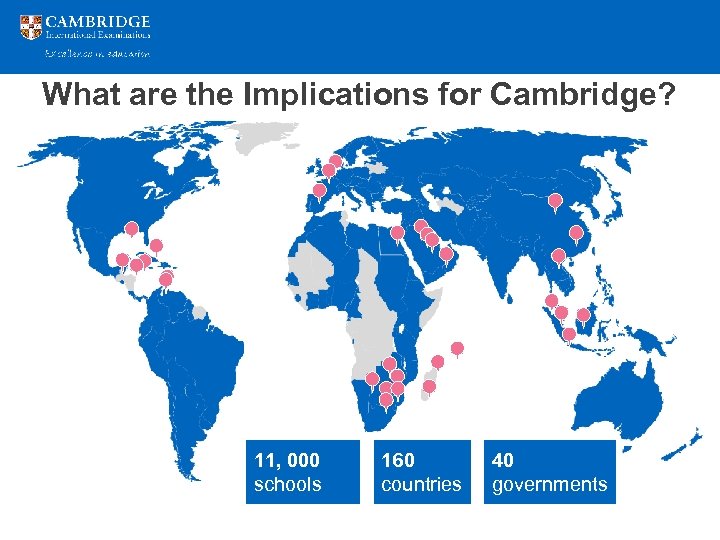
What are the Implications for Cambridge? 11, 000 schools 160 countries 40 governments
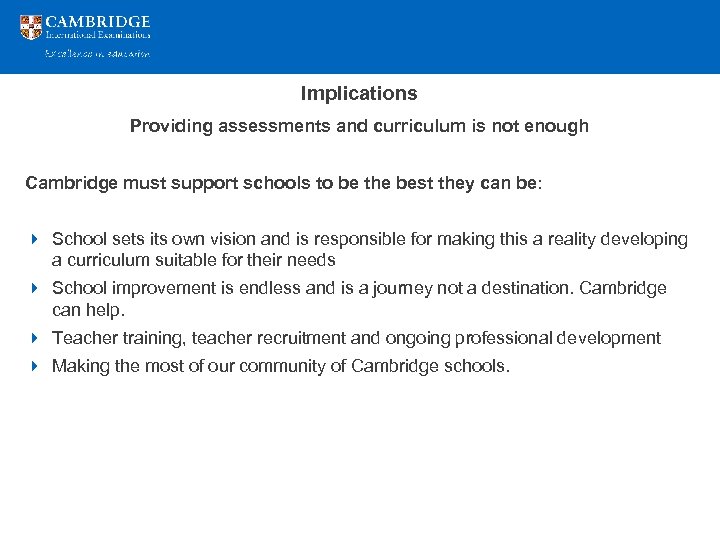
Implications Providing assessments and curriculum is not enough Cambridge must support schools to be the best they can be: 4 School sets its own vision and is responsible for making this a reality developing a curriculum suitable for their needs 4 School improvement is endless and is a journey not a destination. Cambridge can help. 4 Teacher training, teacher recruitment and ongoing professional development 4 Making the most of our community of Cambridge schools.
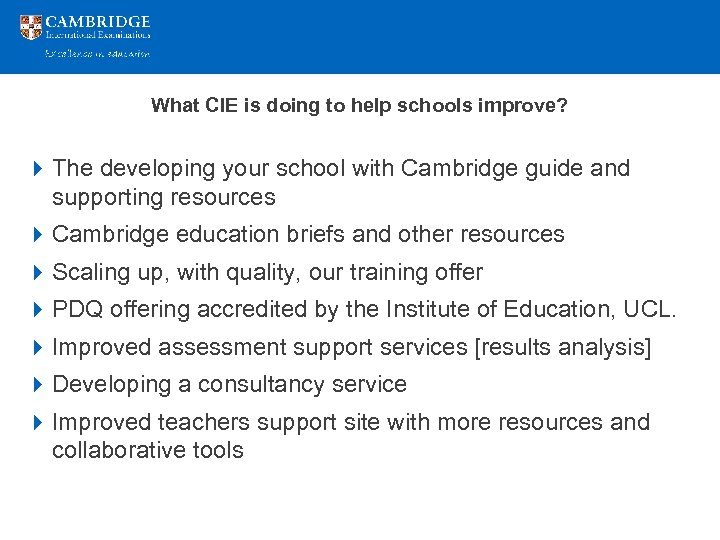
What CIE is doing to help schools improve? 4 The developing your school with Cambridge guide and supporting resources 4 Cambridge education briefs and other resources 4 Scaling up, with quality, our training offer 4 PDQ offering accredited by the Institute of Education, UCL. 4 Improved assessment support services [results analysis] 4 Developing a consultancy service 4 Improved teachers support site with more resources and collaborative tools
Cambridge Professional Development 4 1200 events annually 4 Professional development and training 4 Introductory 4 Development 4 Enrichment 4 Syllabus- and assessment-based 4 Professional Development Qualifications (PDQs)
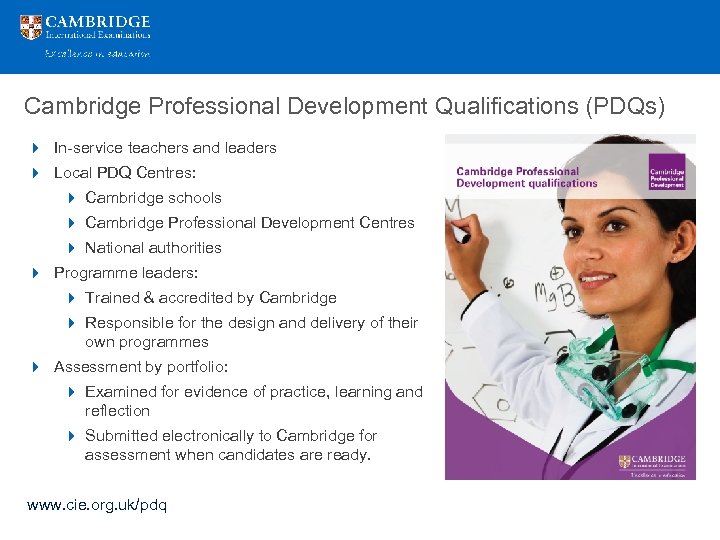
Cambridge Professional Development Qualifications (PDQs) 4 In-service teachers and leaders 4 Local PDQ Centres: 4 Cambridge schools 4 Cambridge Professional Development Centres 4 National authorities 4 Programme leaders: 4 Trained & accredited by Cambridge 4 Responsible for the design and delivery of their own programmes 4 Assessment by portfolio: 4 Examined for evidence of practice, learning and reflection 4 Submitted electronically to Cambridge for assessment when candidates are ready. www. cie. org. uk/pdq
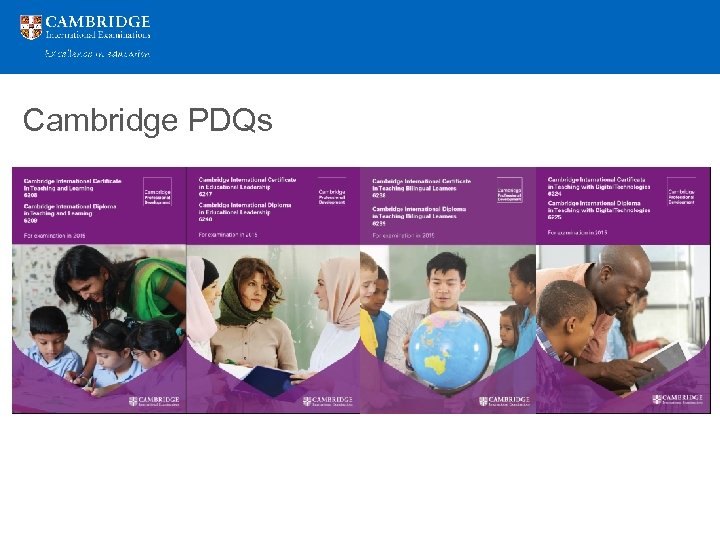
Cambridge PDQs
Helping Schools Improve Richer Assessment Feedback: Results Analysis Live in 2016 Initial syllabuses covered IGCSEs: 4 0486 English Literature 4 0510 English Second Language (oral endorsement) 4 0511 English Second Language (count-in oral) 4 0500 English First language 4 0522 English First Language (UK) 4 0610 Biology 4 0620 Chemistry 4 0625 Physics 4 0580 Mathematics 4 0450 Business Studies
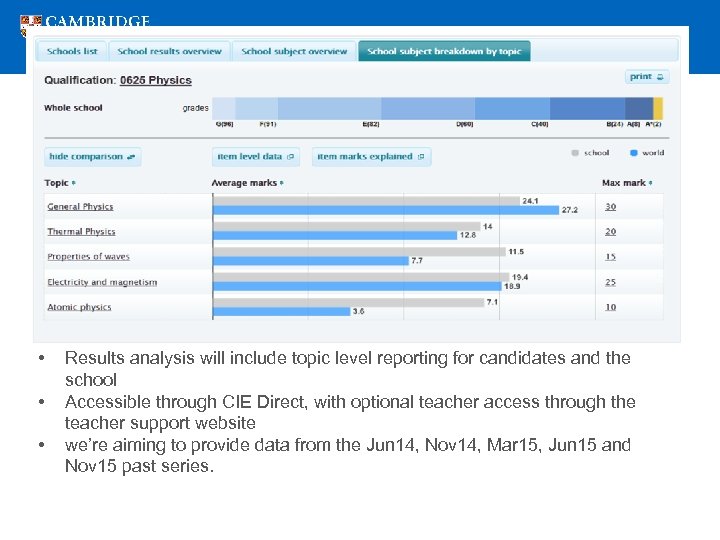
• • • Results analysis will include topic level reporting for candidates and the school Accessible through CIE Direct, with optional teacher access through the teacher support website we’re aiming to provide data from the Jun 14, Nov 14, Mar 15, Jun 15 and Nov 15 past series.
What more should Cambridge do to help schools improve?
Скачать презентацию The changing landscape of international education and Cambridge s
b5793070634aa0ea5cb9fdbccbe1f778.ppt