


 Скачать презентацию The Challenges for Tourism in a failing agricultural
9a0c8a7035720dafb1fad0fc8e7ef3c1.ppt
- Количество слайдов: 37
 The Challenges for Tourism in a failing agricultural economy: the case of the Windward Islands Patsy Lewis Sir Arthur Lewis Institute for Social and Economic Studies, Mona, Jamaica July 2003
 2 Introduction Aim of presentation Assess some of the challenges inherent in attempts to transform agricultural economies to services, with special emphasis on tourism. Declining agriculture as context for increasing tourism’s intake
 3 Introduction Focus of presentation: Windward Islands – Dominica, St. Vincent, St. Lucia (banana producers) – who are experiencing a decline in the agricultural sector in the wake of the adverse WTO ruling on the EU’s banana regime.
 4 Introduction Manifestation of decline l Mass exodus of farmers Dominica (1990 -2000) – 64% (from 6, 675 to 2, 410) St. Vincent (1990 -1997)-- 17% St. Lucia 49% l Declining income
 5 Introduction What accounts for exodus? l Efficiency programme introduced in banana sector l Fluctuating prices l General instability
 6 Introduction Impact of industry’s decline High levels of unemployment (1995) Dominica 23. 1% St. Lucia 16. 2% SVG 19. 8 Source: UN Development system for the Eastern Caribbean, 2000.
 7 Introduction Impact of industry’s decline l High levels of poverty, particularly in rural areas l Dominica: 33% poor l St. Lucia: 25. 1% poor; 7. 1% indigent l St. Vincent: 37. 5% individuals poor, 25. 7 indigent Concentration of poor in rural agricultural sector Source: Kairi poverty reports for Caribbean Development Bank
 8 Introduction Characterization of W. I. banana industry l small farms, five acres and under l Low productivity l Low technology/mechanisation l High cost l Middle-aged farmers l Primary school education
 9 Introduction Governments’ approach to ailing agricultural sector is to attempt to focus on developing a service economy l Tourism l Services Decline of agriculture presents specific challenges for any development strategy, including one embracing tourism
 10 Introduction Challenges of developing a tourism strategy to address problems of ailing agricultural sector l Absorbing displaced farmers l Increasing government’s earnings
 11 Windward Islands’ economies Agriculture’s contribution to WI economies Employment Agriculture (and fisheries): l Dominica (1997) – 31. 4% l St. Lucia (1999) -- 21. 7% l SVG (1999) -- 24. 8%
 12 Windward Islands’ economies Since those figures, however, there has been a general decline in agriculture’s contribution to employment: 2000 -2001 l Dominica – 11. 4% drop l St. Lucia -- 24. 37% drop l St. Vincent – 7. 24% drop
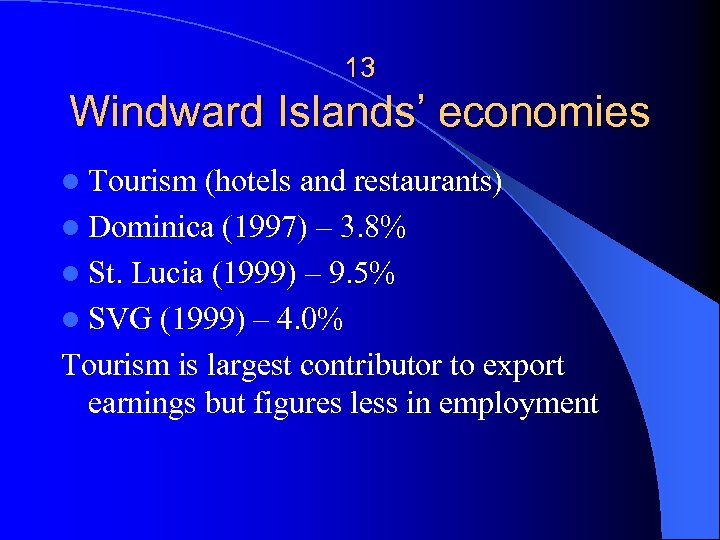 13 Windward Islands’ economies l Tourism (hotels and restaurants) l Dominica (1997) – 3. 8% l St. Lucia (1999) – 9. 5% l SVG (1999) – 4. 0% Tourism is largest contributor to export earnings but figures less in employment
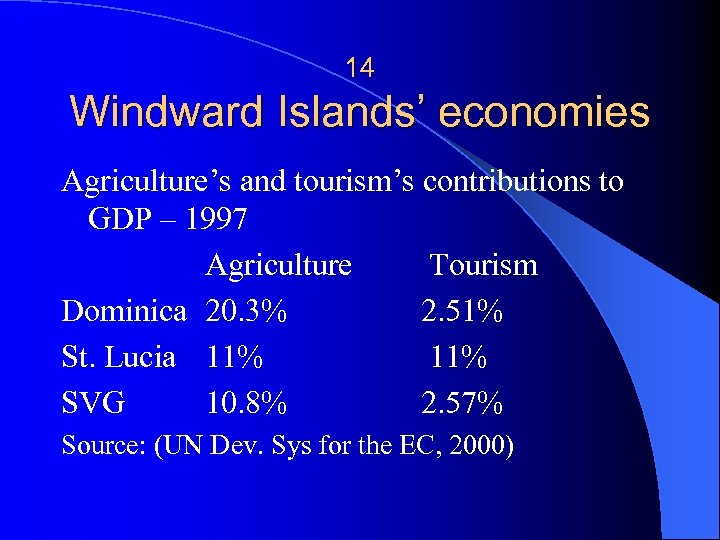 14 Windward Islands’ economies Agriculture’s and tourism’s contributions to GDP – 1997 Agriculture Tourism Dominica 20. 3% 2. 51% St. Lucia 11% SVG 10. 8% 2. 57% Source: (UN Dev. Sys for the EC, 2000)
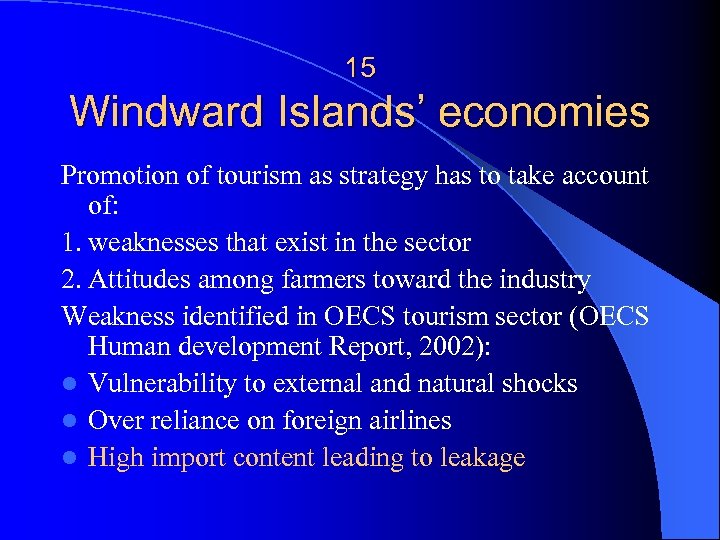 15 Windward Islands’ economies Promotion of tourism as strategy has to take account of: 1. weaknesses that exist in the sector 2. Attitudes among farmers toward the industry Weakness identified in OECS tourism sector (OECS Human development Report, 2002): l Vulnerability to external and natural shocks l Over reliance on foreign airlines l High import content leading to leakage
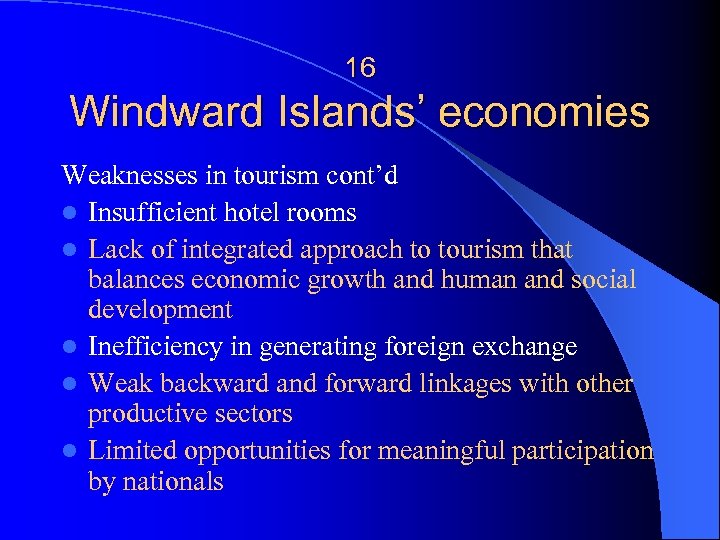 16 Windward Islands’ economies Weaknesses in tourism cont’d l Insufficient hotel rooms l Lack of integrated approach to tourism that balances economic growth and human and social development l Inefficiency in generating foreign exchange l Weak backward and forward linkages with other productive sectors l Limited opportunities for meaningful participation by nationals
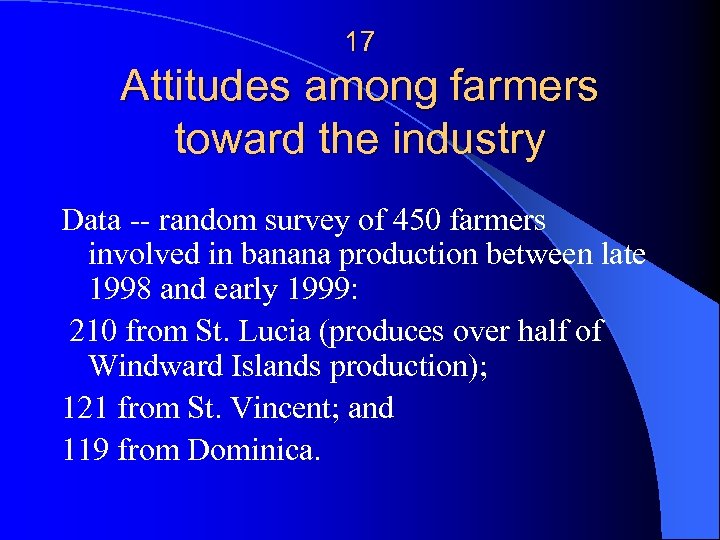 17 Attitudes among farmers toward the industry Data -- random survey of 450 farmers involved in banana production between late 1998 and early 1999: 210 from St. Lucia (produces over half of Windward Islands production); 121 from St. Vincent; and 119 from Dominica.
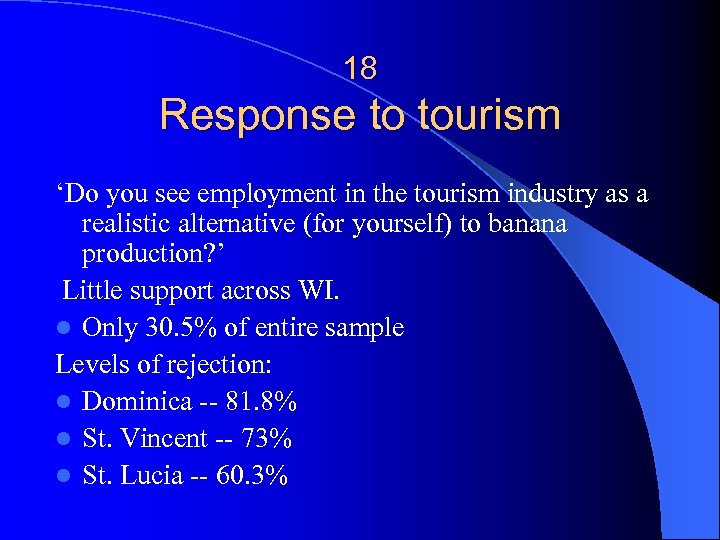 18 Response to tourism ‘Do you see employment in the tourism industry as a realistic alternative (for yourself) to banana production? ’ Little support across WI. l Only 30. 5% of entire sample Levels of rejection: l Dominica -- 81. 8% l St. Vincent -- 73% l St. Lucia -- 60. 3%
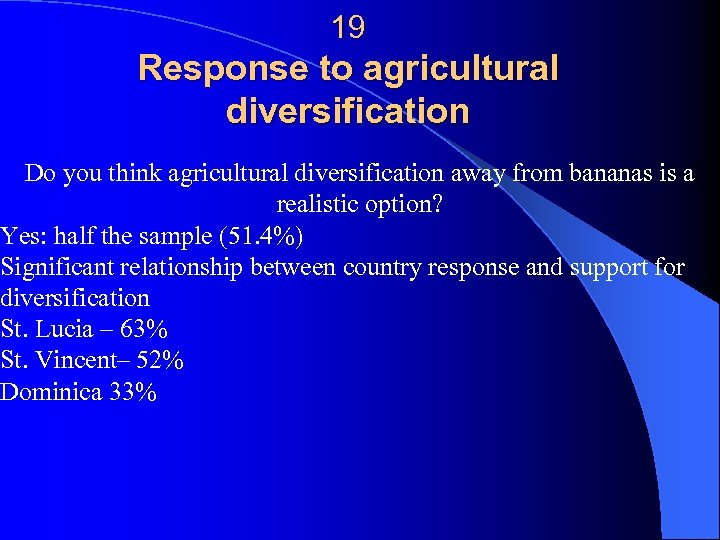 19 Response to agricultural diversification Do you think agricultural diversification away from bananas is a realistic option? Yes: half the sample (51. 4%) Significant relationship between country response and support for diversification St. Lucia – 63% St. Vincent– 52% Dominica 33%
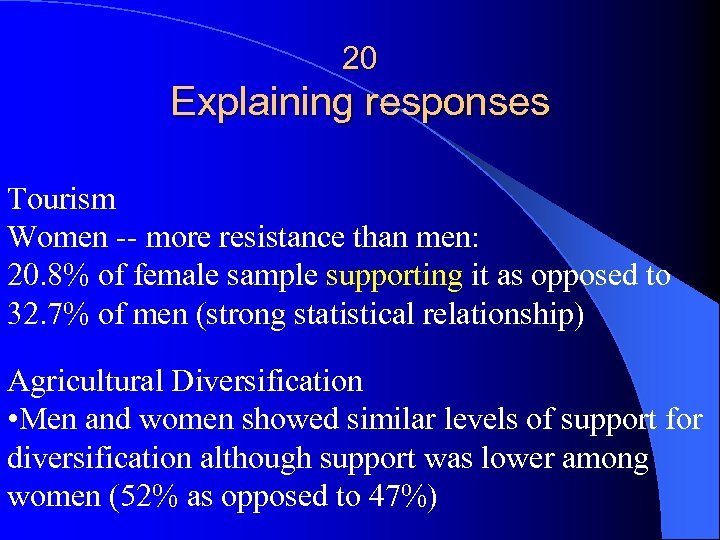 20 Explaining responses Tourism Women -- more resistance than men: 20. 8% of female sample supporting it as opposed to 32. 7% of men (strong statistical relationship) Agricultural Diversification • Men and women showed similar levels of support for diversification although support was lower among women (52% as opposed to 47%)
 21 Explaining responses Farmer is not/interested/equipped/educated/doesn’t see a role for himself in the industry – main reason in all l Banana industry provides better earning potential and employment opportunities than tourism is the second most important reason for Dominica and the third for St. Vincent and St. Lucia l Farmer’s too old -- St. Vincent and St. Lucia l Tourism holds few opportunities for rural people St. Vincent and Dominica l
 22 Explaining responses l Tourism is vulnerable/not viable was the second most popular reason for St. Lucian’s rejection of the industry(22. 4%) l 7. 3% of Dominicans rejected it on this basis
 23 Explaining responses Possible explanations for resistance to the industry l underdeveloped state of the industry in Dominica and St. Vincent l Resistance to change which goes beyond changing jobs reflected in: – farmer’s transformation from Independent producer to wage labourer.
 24 Explaining responses l rejection of a different way of life and the likelihood of different types of social relationships than they have experienced as independent agricultural producers.
 25 Challenges for tourism Challenges given farmers’ response: l Forge greater linkages with agriculture – high food import bill l Increase tourism’s contribution to GDP l Ensure broader distribution of sector’s earnings l Increase local population’s stake in the industry
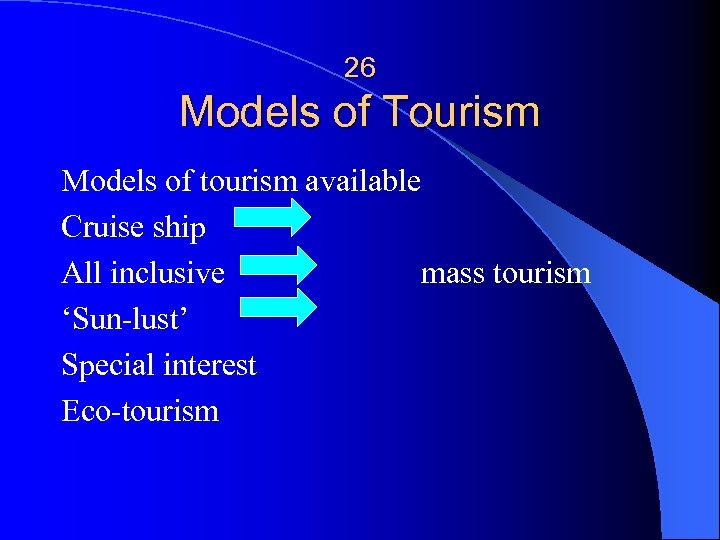 26 Models of Tourism Models of tourism available Cruise ship All inclusive mass tourism ‘Sun-lust’ Special interest Eco-tourism
 27 Models of Tourism Segmentation Special interest tourism l Agro-tourism l Community-based tourism l Health tourism l Adventure tourism l Heritage/cultural Eco-tourism closely related to all of above
 28 Models of Tourism Segmentation Agri-tourism l Treating agricultural production as a tourism product – already begun but limited l Integrating with community tourism l increasing industry’s sourcing of food locally -- Reduce high food import bill Eco-tourism -- Dominica
 29 Models of Tourism Mass Tourism: All inclusives l adopting an ‘all-inclusive’ rather than the exclusive approach of the ‘all-inclusives’ in order to increase spread of earnings – Features of the model: l Shielding of tourists from ills of society – high poverty, low-employment, reflected in high levels of tourist harassment
 30 Models of Tourism l Tendency to marginalize groups already involved in the industry – vendors, taxi operators, small hoteliers l Possibilities for the marginalisation of entire communities leading to potential conflicts.
 31 Models of Tourism Limitations of the all-inclusive model in small societies l Special relation of population to the sea -- free access to beaches l Small physical space making it more difficult to shield tourists l Problems of conflict over land utilization – agriculture vs. tourism. l Greater and more obvious impact of unemployment and poverty
 32 Challenges to agricultural diversification Agricultural diversification l provides a real possibility for giving displaced banana farmers a stake in the tourism industry Challenges of agricultural diversification strategy -- relying on displaced banana farmers to be motor of diversification strategy l Continued limited access to resources l Absence of support structures available to banana producers
 33 Challenges to agricultural diversification l Continued issues of quality and cost competitiveness -- vital to national market as it is to export agriculture. l In other words, hotels are unlikely to rely on low-quality, high-cost, irregular suppliers.
 34 Challenges to agricultural diversification Possible strategies for overcoming these difficulties l partnership between agricultural sector -- hotels and farmers. l easier access to credits and farming support
 35 Conclusions Tourism is unlikely to and should not be perceived as displacing agriculture. l Agriculture remains the mainstay of Windward Islands’ economies, especially given their social structure – small urban centers, large rural farming communities l It has played a role in alleviating rural poverty and in generating economic stability given its role in supporting significant sections of the labour force. l
 36 Conclusions l Government must work to revitalize agriculture while diversifying the economies by strengthening tourism and manufacture. l The banana industry has the potential to be explosive because of its role in the lives of so many – St. Lucia 1990 s, Dominica 2002
 37 Conclusions l Finally, tourism plans should involve local communities, taking into account their reservations and perceptions. As P. E. Murphy notes: “Tourism … relies on the goodwill and cooperation of local people because they are part of its product. Where development and planning do not fit in with local aspirations and capacity, resistance and hostility can … destroy the industry’s potential altogether. ” (Tourism: A Community Approach, 1985: 153. Quoted in Dallen Timothy, ‘Participatory Planning: A View of Tourism in Indonesia’, Annals of Tourism, vol. 26 (2), p. 373)