 Скачать презентацию The challenge of IRB implementation Dr Alexandros BENOS
93c01c28ec11d141ed05bc29d5cf2f7d.ppt
- Количество слайдов: 30



The challenge of IRB implementation Dr. Alexandros BENOS Director, Group Risk Control & Structure National Bank of Greece Group
NBG Group General Information 2 Presentation to Bank Fin. Ing Palic, Serbia May 12 th, 2010
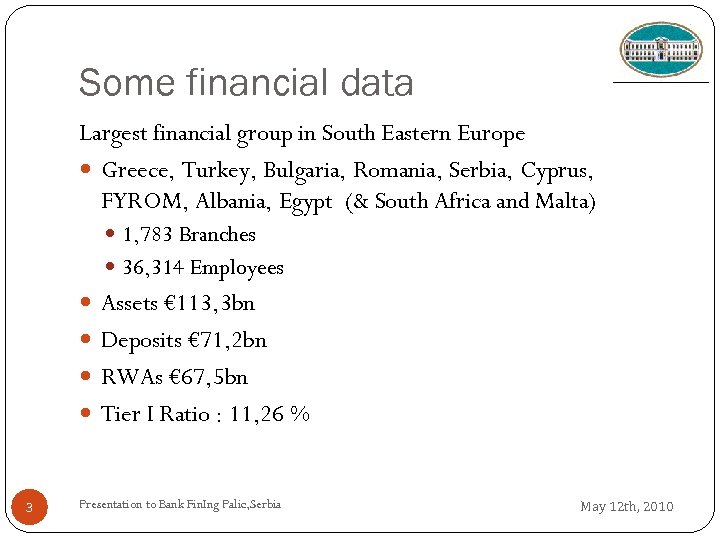
Some financial data Largest financial group in South Eastern Europe Greece, Turkey, Bulgaria, Romania, Serbia, Cyprus, FYROM, Albania, Egypt (& South Africa and Malta) 1, 783 Branches 36, 314 Employees Assets € 113, 3 bn Deposits € 71, 2 bn RWAs € 67, 5 bn Tier I Ratio : 11, 26 % 3 Presentation to Bank Fin. Ing Palic, Serbia May 12 th, 2010
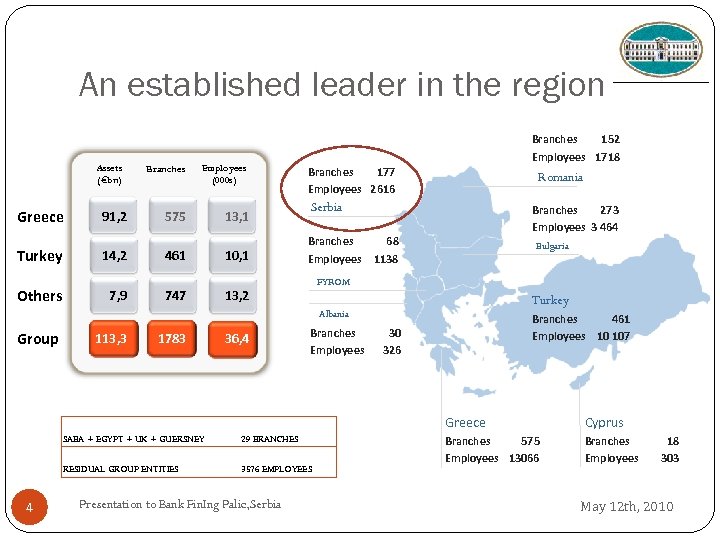
An established leader in the region Assets (€bn) Branches Employees (000 s) Greece 91, 2 575 13, 1 Turkey 14, 2 461 10, 1 Others 7, 9 747 Branches 152 Employees 1718 Branches 177 Employees 2616 Romania Serbia Branches Employees Branches 273 Employees 3 464 68 1138 Bulgaria FYROM 13, 2 Turkey Albania Group 113, 3 1783 36, 4 Branches Employees Branches 461 Employees 10 107 30 326 Greece SABA + EGYPT + UK + GUERSNEY RESIDUAL GROUP ENTITIES 4 29 BRANCHES 3576 EMPLOYEES Presentation to Bank Fin. Ing Palic, Serbia Cyprus Branches 575 Employees 13066 Branches Employees 18 303 May 12 th, 2010
Basel II Current status 5 Presentation to Bank Fin. Ing Palic, Serbia May 12 th, 2010
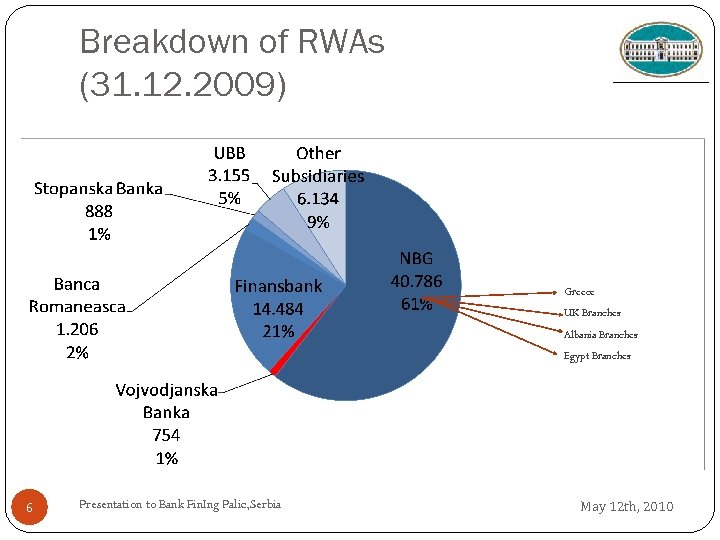
Breakdown of RWAs (31. 12. 2009) Greece UK Branches Albania Branches Egypt Branches 6 Presentation to Bank Fin. Ing Palic, Serbia May 12 th, 2010
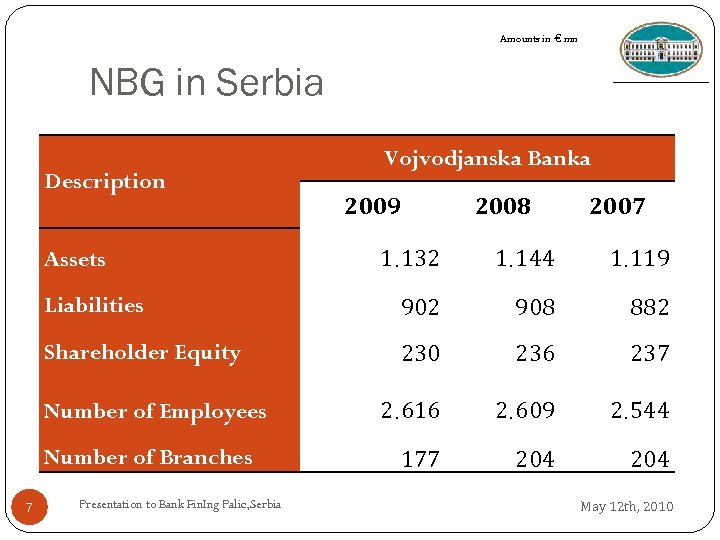
Amounts in € mn NBG in Serbia Description Vojvodjanska Banka 2009 2008 2007 1. 132 1. 144 1. 119 Liabilities 902 908 882 Shareholder Equity 230 236 237 2. 616 2. 609 2. 544 177 204 Assets Number of Employees Number of Branches 7 Presentation to Bank Fin. Ing Palic, Serbia May 12 th, 2010
Basel II Program Gaps, Processes & Models 8 Presentation to Bank Fin. Ing Palic, Serbia May 12 th, 2010
Gap Analysis (2004) SCOPE To identify the ‘gaps’ associated with compliance of existing situation against the target NBG Basel II approaches within each subsidiary and across the Group as a whole 9 Presentation to Bank Fin. Ing Palic, Serbia May 12 th, 2010
Gap Analysis (2004) Pillar 1 – Gaps and Challenges People & Processes Models & Methodologies Data & Systems Organization & Governance Pillar 2 Definition of Risk strategy / appetite Board-wide understanding of Risks Treatment of “other” risks Pillar 3 Qualitative disclosure on policies Confidential / Insignificant / Irrelevant information 10 Presentation to Bank Fin. Ing Palic, Serbia May 12 th, 2010
People & Processes Embed Risk Culture in the Bank Performance management and rewards systems Link Risk Management to Business Planning Align Credit Policy for Basel II requirements Portfolio reporting to senior management and Board Educating + Training Staff Modelling capabilities Additional specialist staff needed 11 Presentation to Bank Fin. Ing Palic, Serbia May 12 th, 2010
Models & Methodologies (IRB) Impacts: Developing & monitoring models within the Bank Providing evidence to regulator that models satisfy Basel II requirements Hence, need for Bank-wide standards for development, validation and back-testing of models Sufficient scope and coverage of models Group vs. Country Embedding the rating system in the Bank USE TEST (pricing, provisions, limits, etc. ) Correct default definitions 90/180 days past due vs. Current practice 12 Presentation to Bank Fin. Ing Palic, Serbia May 12 th, 2010
Models for Corporate Portfolios Corporate Risk Rating Model (CRRM) SMEs Model Slotting Criteria model Object Finance (Shipping) Project Finance Expert Judgement Model 13 Presentation to Bank Fin. Ing Palic, Serbia May 12 th, 2010
Use of CRRM in FIRB 2004 – 2007: use of Moody’s Risk Advisor (MRA) “Out of the box” model 2 H 06: Development of CRRM implemented on MRA platform Customization and validation project Bank’s experience incorporated Steps 1. 2. 3. Data Cleansing Optimization Validation Objectives To select the financial ratios with optimal discriminatory power To re-weight qualitative criteria to reflect the Bank’s credit culture and environment To validate and calibrate the new model 14 Presentation to Bank Fin. Ing Palic, Serbia May 12 th, 2010
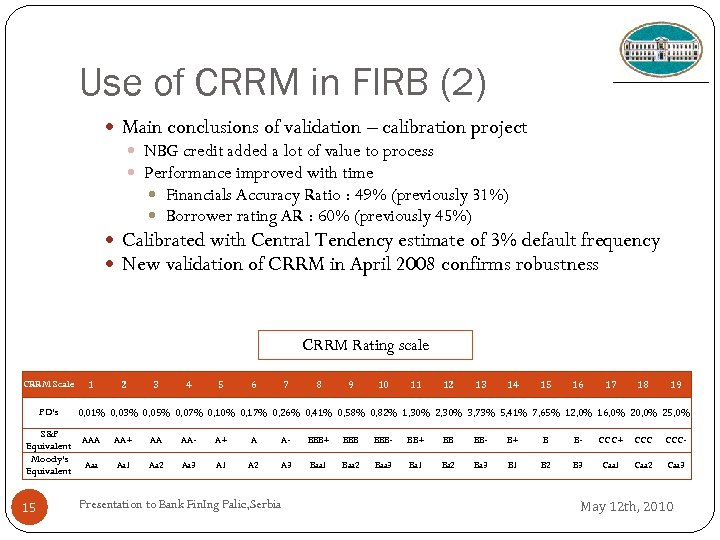
Use of CRRM in FIRB (2) Main conclusions of validation – calibration project NBG credit added a lot of value to process Performance improved with time Financials Accuracy Ratio : 49% (previously 31%) Borrower rating AR : 60% (previously 45%) Calibrated with Central Tendency estimate of 3% default frequency New validation of CRRM in April 2008 confirms robustness CRRM Rating scale CRRM Scale PD's S&P Equivalent Moody's Equivalent 15 1 2 3 4 5 6 7 8 9 10 11 12 13 14 15 16 17 18 19 0, 01% 0, 03% 0, 05% 0, 07% 0, 10% 0, 17% 0, 26% 0, 41% 0, 58% 0, 82% 1, 30% 2, 30% 3, 73% 5, 41% 7, 65% 12, 0% 16, 0% 20, 0% 25, 0% AAA AA+ AA AA- A+ A A- BBB+ BBB- BB+ BB BB- B+ B B- CCC+ CCC- Aaa Aa 1 Aa 2 Aa 3 A 1 A 2 A 3 Baa 1 Baa 2 Baa 3 Ba 1 Ba 2 Ba 3 B 1 B 2 B 3 Caa 1 Caa 2 Caa 3 Presentation to Bank Fin. Ing Palic, Serbia May 12 th, 2010
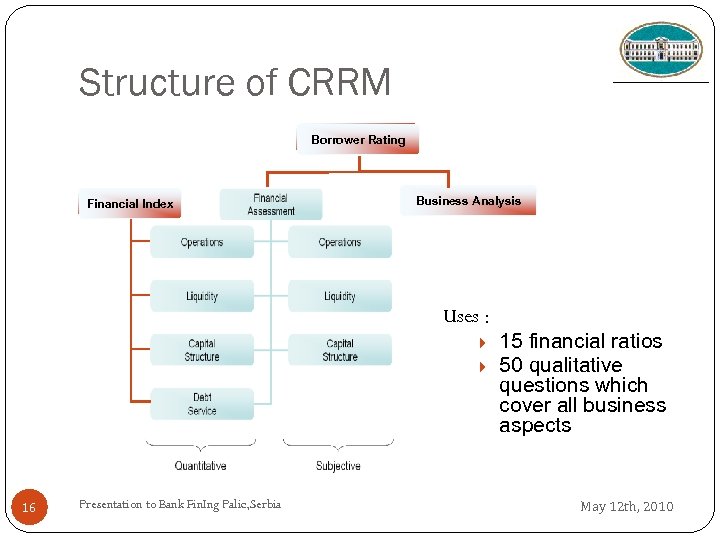
Structure of CRRM Borrower Rating Financial Index Business Analysis Uses : 16 Presentation to Bank Fin. Ing Palic, Serbia 15 financial ratios 50 qualitative questions which cover all business aspects May 12 th, 2010
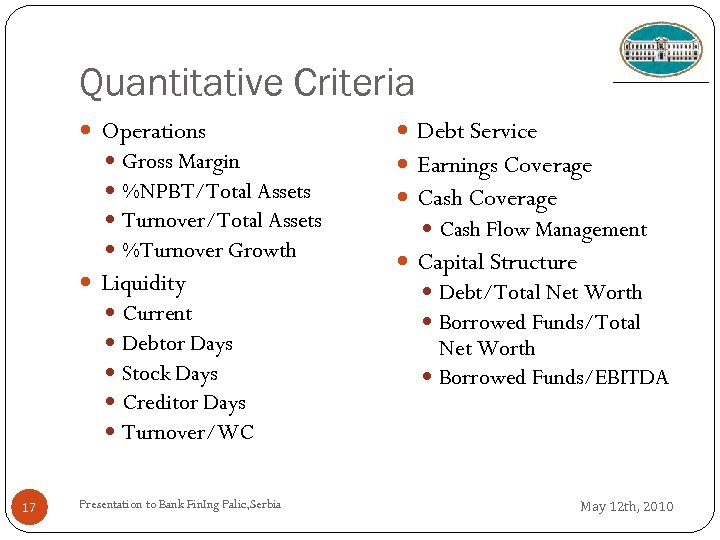
Quantitative Criteria Operations Gross Margin %NPBT/Total Assets Turnover/Total Assets %Turnover Growth Liquidity 17 Current Debtor Days Stock Days Creditor Days Turnover/WC Presentation to Bank Fin. Ing Palic, Serbia Debt Service Earnings Coverage Cash Flow Management Capital Structure Debt/Total Net Worth Borrowed Funds/EBITDA May 12 th, 2010
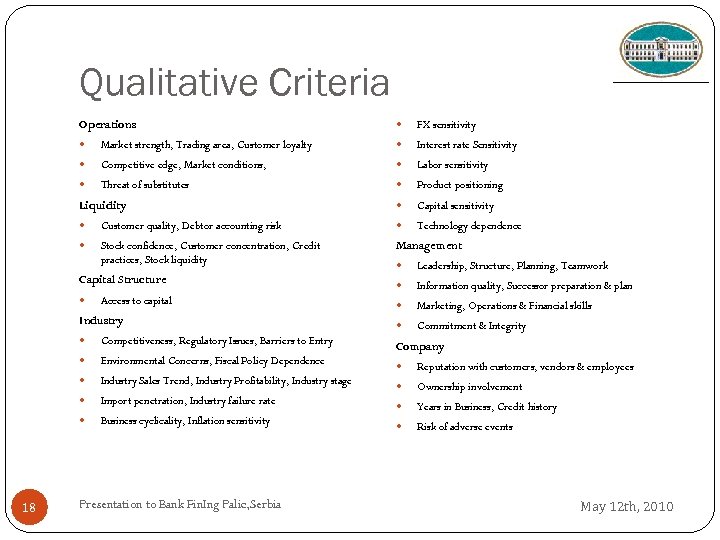
Qualitative Criteria Operations FX sensitivity Market strength, Trading area, Customer loyalty Interest rate Sensitivity Competitive edge, Market conditions, Labor sensitivity Threat of substitutes Product positioning Capital sensitivity Technology dependence Liquidity Customer quality, Debtor accounting risk Stock confidence, Customer concentration, Credit practices, Stock liquidity Management Capital Structure Access to capital Industry Leadership, Structure, Planning, Teamwork Information quality, Successor preparation & plan Marketing, Operations & Financial skills Commitment & Integrity Environmental Concerns, Fiscal Policy Dependence Reputation with customers, vendors & employees Industry Sales Trend, Industry Profitability, Industry stage Ownership involvement Import penetration, Industry failure rate Years in Business, Credit history 18 Competitiveness, Regulatory Issues, Barriers to Entry Business cyclicality, Inflation sensitivity Risk of adverse events Presentation to Bank Fin. Ing Palic, Serbia Company May 12 th, 2010
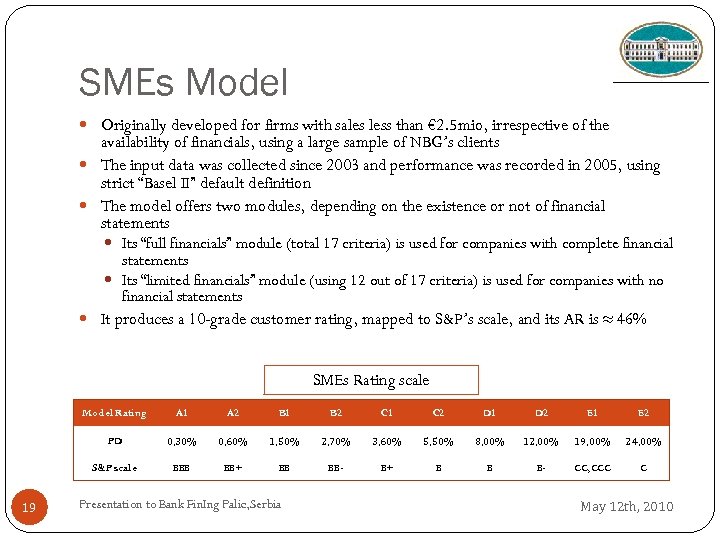
SMEs Model Originally developed for firms with sales less than € 2. 5 mio, irrespective of the availability of financials, using a large sample of NBG’s clients The input data was collected since 2003 and performance was recorded in 2005, using strict “Basel II” default definition The model offers two modules, depending on the existence or not of financial statements Its “full financials” module (total 17 criteria) is used for companies with complete financial statements Its “limited financials” module (using 12 out of 17 criteria) is used for companies with no financial statements It produces a 10 -grade customer rating, mapped to S&P’s scale, and its AR is ≈ 46% SMEs Rating scale Model Rating A 2 B 1 B 2 C 1 C 2 D 1 D 2 E 1 E 2 PD 0, 30% 0, 60% 1, 50% 2, 70% 3, 60% 5, 50% 8, 00% 12, 00% 19, 00% 24, 00% S&P scale 19 A 1 BBB BB+ BB BB- B+ B B B- CC, CCC C Presentation to Bank Fin. Ing Palic, Serbia May 12 th, 2010
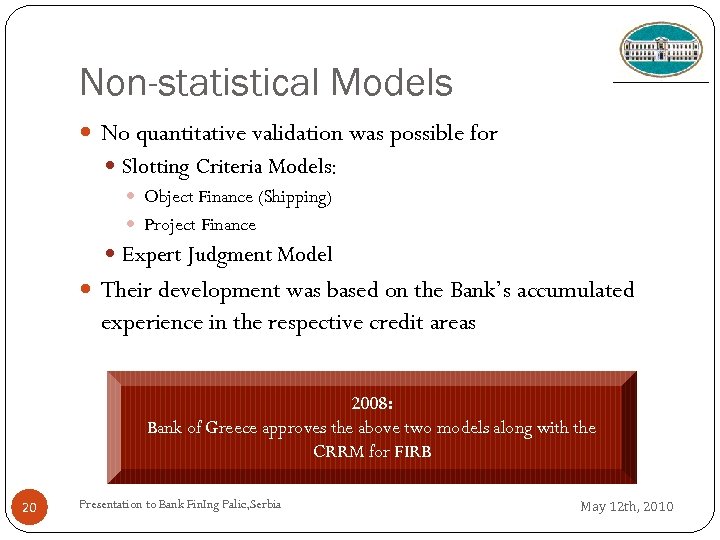
Non-statistical Models No quantitative validation was possible for Slotting Criteria Models: Object Finance (Shipping) Project Finance Expert Judgment Model Their development was based on the Bank’s accumulated experience in the respective credit areas 2008: Bank of Greece approves the above two models along with the CRRM for FIRB 20 Presentation to Bank Fin. Ing Palic, Serbia May 12 th, 2010
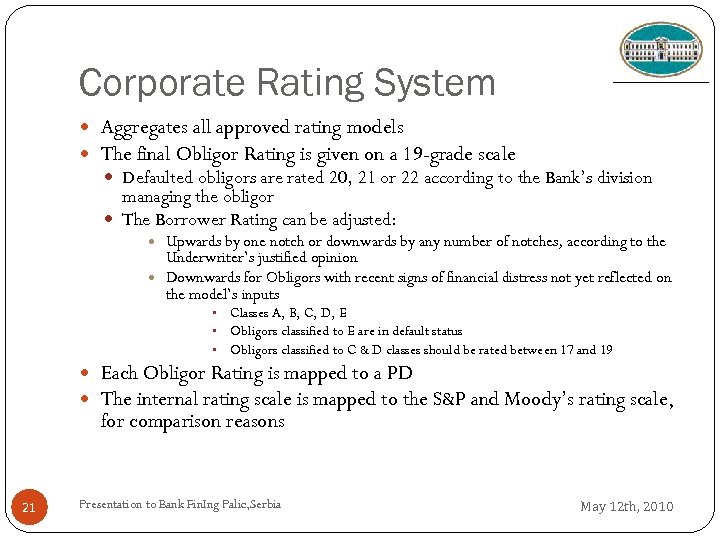
Corporate Rating System Aggregates all approved rating models The final Obligor Rating is given on a 19 -grade scale Defaulted obligors are rated 20, 21 or 22 according to the Bank’s division managing the obligor The Borrower Rating can be adjusted: Upwards by one notch or downwards by any number of notches, according to the Underwriter’s justified opinion Downwards for Obligors with recent signs of financial distress not yet reflected on the model’s inputs • Classes A, B, C, D, E • Obligors classified to E are in default status • Obligors classified to C & D classes should be rated between 17 and 19 Each Obligor Rating is mapped to a PD The internal rating scale is mapped to the S&P and Moody’s rating scale, for comparison reasons 21 Presentation to Bank Fin. Ing Palic, Serbia May 12 th, 2010
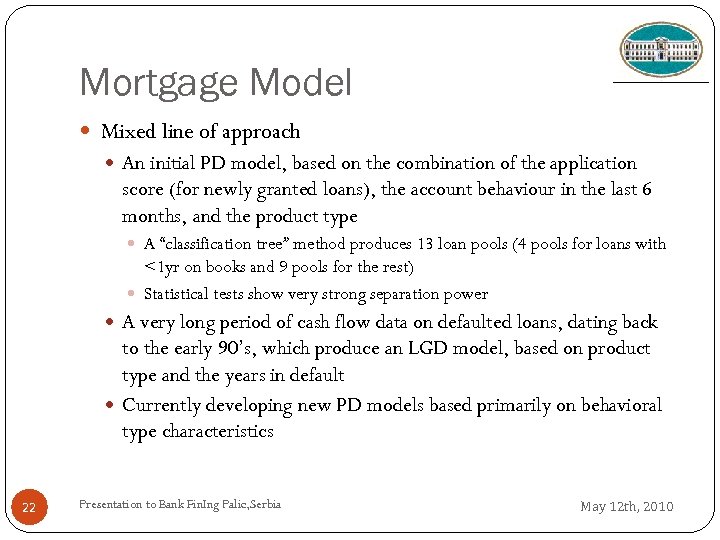
Mortgage Model Mixed line of approach An initial PD model, based on the combination of the application score (for newly granted loans), the account behaviour in the last 6 months, and the product type A “classification tree” method produces 13 loan pools (4 pools for loans with <1 yr on books and 9 pools for the rest) Statistical tests show very strong separation power A very long period of cash flow data on defaulted loans, dating back to the early 90’s, which produce an LGD model, based on product type and the years in default Currently developing new PD models based primarily on behavioral type characteristics 22 Presentation to Bank Fin. Ing Palic, Serbia May 12 th, 2010
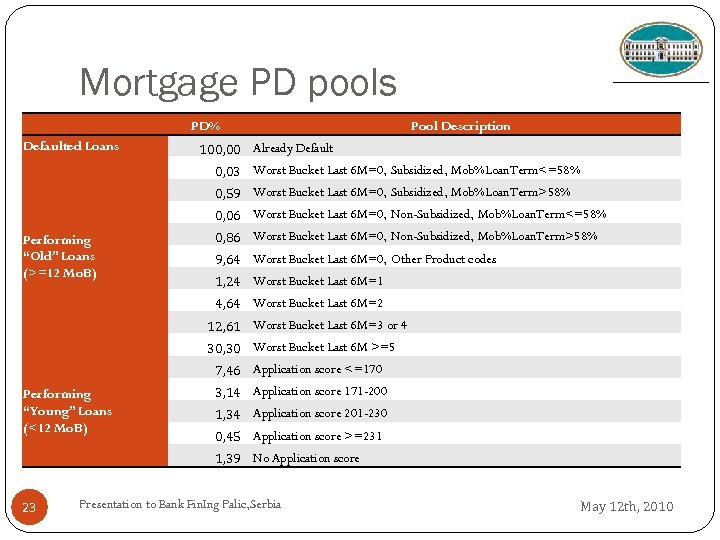
Mortgage PD pools Defaulted Loans PD% Pool Description 100, 00 Already Default 0, 03 Worst Bucket Last 6 M=0, Subsidized, Mob%Loan. Term<=58% 0, 59 Worst Bucket Last 6 M=0, Subsidized, Mob%Loan. Term>58% 0, 06 Worst Bucket Last 6 M=0, Non-Subsidized, Mob%Loan. Term<=58% Performing “Old” Loans (>=12 Mo. B) 0, 86 Worst Bucket Last 6 M=0, Non-Subsidized, Mob%Loan. Term>58% 9, 64 Worst Bucket Last 6 M=0, Other Product codes 1, 24 Worst Bucket Last 6 M=1 4, 64 Worst Bucket Last 6 M=2 12, 61 Worst Bucket Last 6 M=3 or 4 30, 30 Worst Bucket Last 6 M >=5 Performing “Young” Loans (<12 Mo. B) 7, 46 Application score <=170 3, 14 Application score 171 -200 1, 34 Application score 201 -230 0, 45 Application score >=231 1, 39 No Application score 23 Presentation to Bank Fin. Ing Palic, Serbia May 12 th, 2010
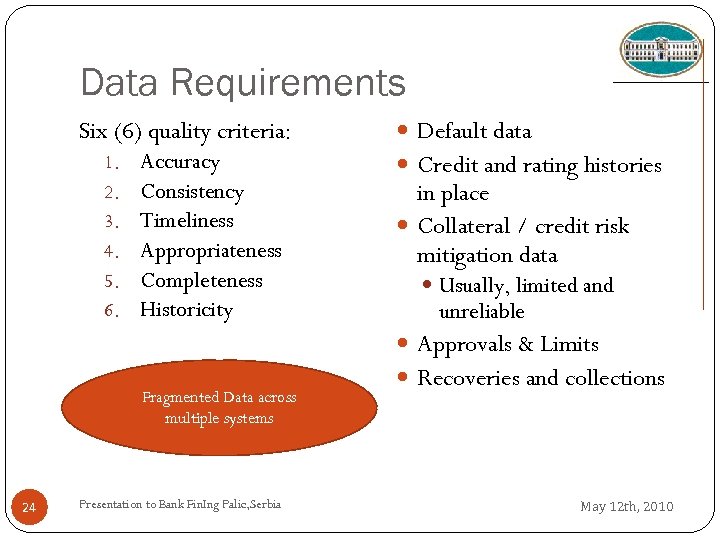
Data Requirements Six (6) quality criteria: 1. 2. 3. 4. 5. 6. Accuracy Consistency Timeliness Appropriateness Completeness Historicity Fragmented Data across multiple systems 24 Presentation to Bank Fin. Ing Palic, Serbia Default data Credit and rating histories in place Collateral / credit risk mitigation data Usually, limited and unreliable Approvals & Limits Recoveries and collections May 12 th, 2010
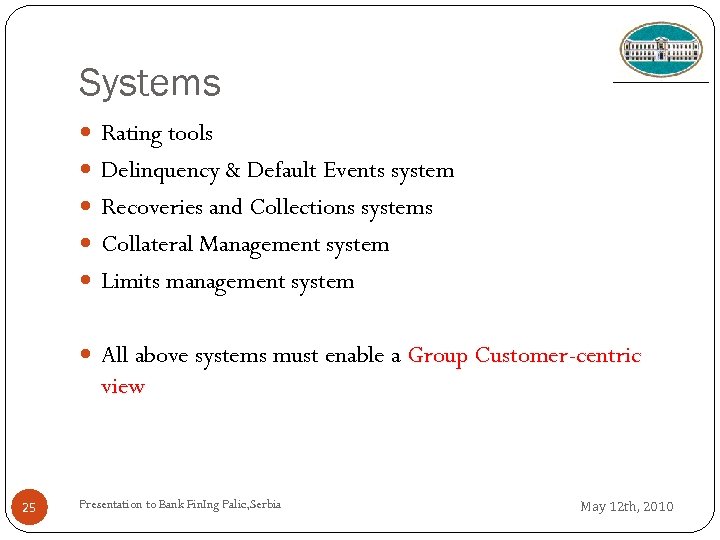
Systems Rating tools Delinquency & Default Events system Recoveries and Collections systems Collateral Management system Limits management system All above systems must enable a Group Customer-centric view 25 Presentation to Bank Fin. Ing Palic, Serbia May 12 th, 2010
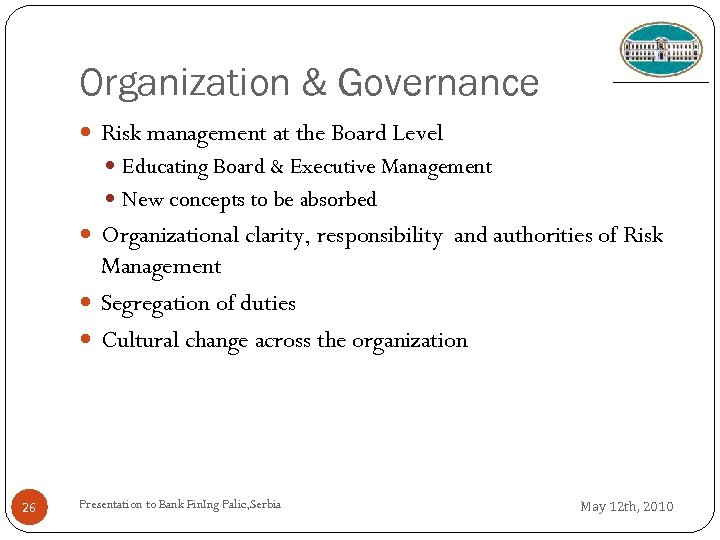
Organization & Governance Risk management at the Board Level Educating Board & Executive Management New concepts to be absorbed Organizational clarity, responsibility and authorities of Risk Management Segregation of duties Cultural change across the organization 26 Presentation to Bank Fin. Ing Palic, Serbia May 12 th, 2010
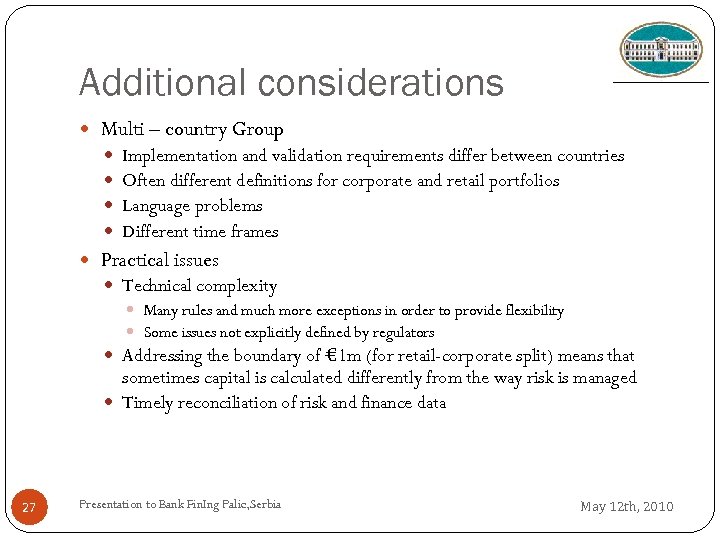
Additional considerations Multi – country Group Implementation and validation requirements differ between countries Often different definitions for corporate and retail portfolios Language problems Different time frames Practical issues Technical complexity Many rules and much more exceptions in order to provide flexibility Some issues not explicitly defined by regulators Addressing the boundary of € 1 m (for retail-corporate split) means that sometimes capital is calculated differently from the way risk is managed Timely reconciliation of risk and finance data 27 Presentation to Bank Fin. Ing Palic, Serbia May 12 th, 2010
Basel II Program Results 28 Presentation to Bank Fin. Ing Palic, Serbia May 12 th, 2010
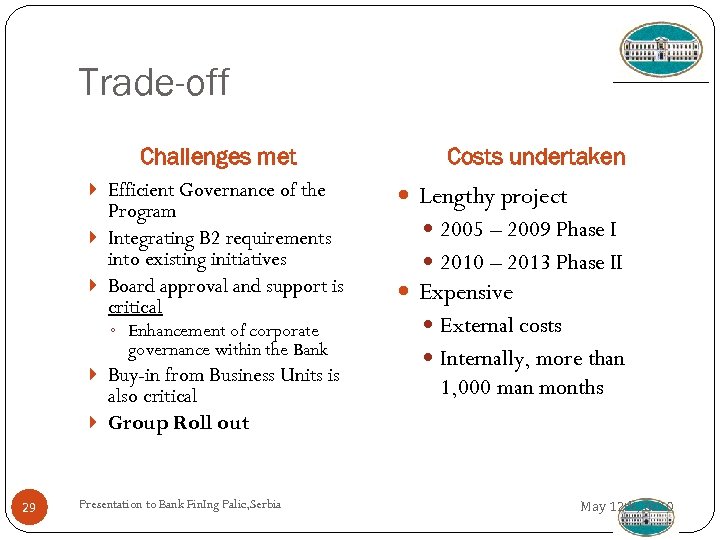
Trade-off Challenges met Efficient Governance of the Program Integrating B 2 requirements into existing initiatives Board approval and support is critical ◦ Enhancement of corporate governance within the Bank Buy-in from Business Units is also critical Group Roll out 29 Presentation to Bank Fin. Ing Palic, Serbia Costs undertaken Lengthy project 2005 – 2009 Phase I 2010 – 2013 Phase II Expensive External costs Internally, more than 1, 000 man months May 12 th, 2010
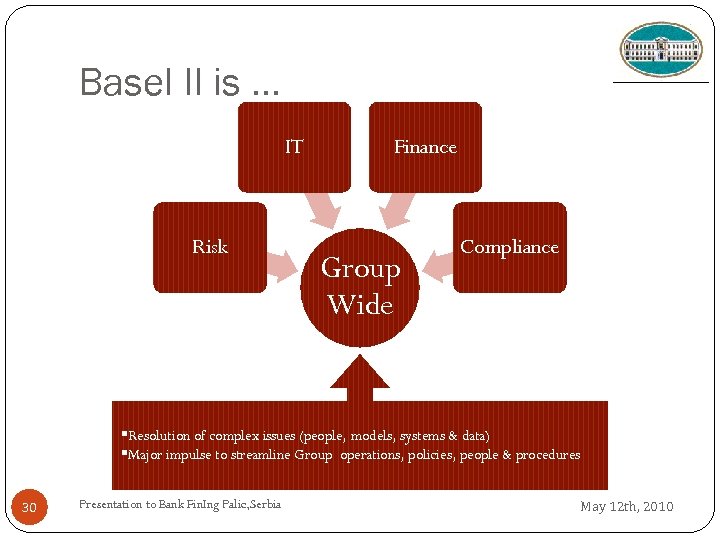
Basel II is … IT Risk Finance Group Wide Compliance §Resolution of complex issues (people, models, systems & data) §Major impulse to streamline Group operations, policies, people & procedures 30 Presentation to Bank Fin. Ing Palic, Serbia May 12 th, 2010
Скачать презентацию The challenge of IRB implementation Dr Alexandros BENOS
93c01c28ec11d141ed05bc29d5cf2f7d.ppt