Скачать презентацию The CEMAR Organisation 2013 What is Coordinator 4
5d4ce623ffddca9eb16b352856d41f13.ppt
- Количество слайдов: 7

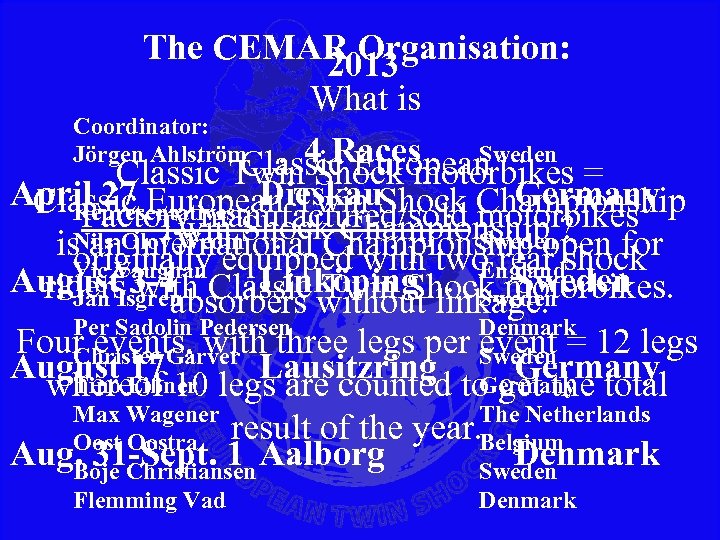 The CEMAR Organisation: 2013 What is Coordinator: 4 Races Jörgen Ahlström Sweden Classic European Classic Twin Shock motorbikes = April 27 Dieskau Germany Classic European Twin Shock Championship Representatives: Factory manufactured/sold motorbikes Twin Shock Championship ? Nils-Olov Wedin Sweden is an international Championship open for originally equipped with two rear shock Vic Vaughan August 3 -4 Linköping England Sweden riders with Classic Twin Shock motorbikes. Jan Isgren Sweden absorbers without linkage. Per Sadolin Pedersen Denmark Four events, with three legs per event = 12 legs Christer Garver August 17 Lausitzring Sweden Germany Tino Eißner Germany whereof 10 legs are counted to get the total Max Wagener The Netherlands Oostra result of the year. Belgium Aug. 31 -Sept. 1 Aalborg Sweden Denmark Boje Christiansen Flemming Vad Denmark
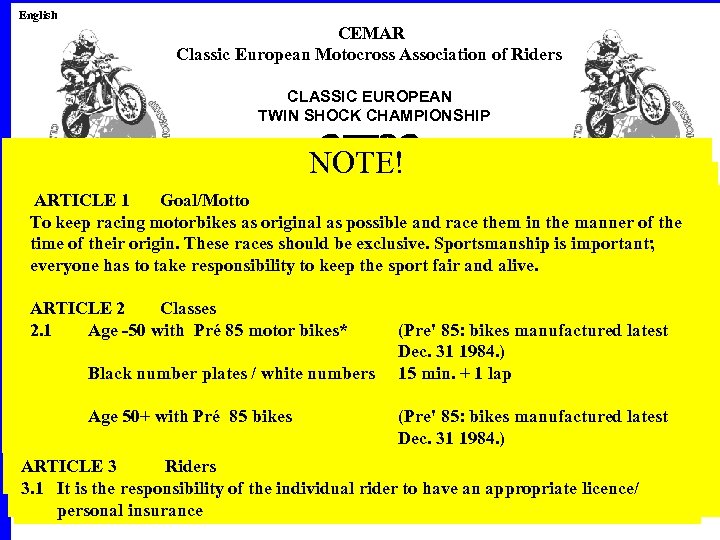 English CEMAR Classic European Motocross Association of Riders REGLEMENT CLASSIC EUROPEAN TWIN SHOCK CHAMPIONSHIP CETSC NOTE! 2. 2 The classes ride together if max. allowed number of riders is not exceeded. (See 2. 5) 2. 3 Qualification will be used in cases where max. allowed number of riders per ARTICLE 1 Goal/Motto Version 2012 - 2014 class/leg is exceeded. (See 2. 5). To keep racing motorbikes as original as possible and race them in the manner of the (Ex. training lap times or special qualification legs over 4 laps – organizers decision) time of their origin. These races should be exclusive. Sportsmanship is important; ARTICLE 1 Goal/Motto The 10 first riders in the total result after previous CETSC race are directly everyone has to take responsibility to keep the sport fair and alive. To keep racing motorbikes as original as possible and race them in the manner of the time of their origin. These races should be exclusive. Sportsmanship is important; everyone has to take responsibility to keep the sport fair and alive. qualified. (In the first race of the year the total result from last year decides. ) ARTICLE 2 Classes 2. 1 Age -50 with Pré 85 motor bikes* (Pre' 85: bikes manufactured latest Dec. 31 1984. ) Riders that have not qualified can participate in a B-final or in the open classes. 2. 1 Age -50 with Pré 85 motor bikes* (Pre' 85: bikes manufactured latest Black number plates / white numbers 15 min. + 1 lap Dec. 31 1984. ) Age 50+ with Pré 85 bikes (Pre' 85: bikes manufactured latest Dec. 31 1984. ) 2. 4 Date to define the rider’s age is December 31 st of the current year. Black number plates / white numbers 15 min. + 1 lap Yellow number plates / black numbers 15 min. + 1 lap Age class -50 = min. 16, max. 49 years of age. * Min. age 16, max age 49 years Age 50+ with Pré 85 bikes (Pre' 85: bikes manufactured latest 2. 2 The classes ride together if max. allowed number of riders is not exceeded. (See 2. 5) 2. 5 Participation: Max. 48 riders per leg, or if lower, the max. No. of riders allowed for Dec. 31 1984. ) 2. 3 Qualification will be used in cases where max. allowed number of riders per class/leg is exceeded. (See 2. 5). (Ex. training lap times or special qualification legs over 4 laps – organizers decision) actual race-track. Yellow number plates / black numbers 15 min. + 1 lap ARTICLE 3 Riders The 10 first riders in the total result after previous TSC race are directly qualified. (In the first race of the year the total result from * Min. age 16, max age 49 years last year decides. ) Riders that have not qualified can participate in a B-final or in the open classes. 3. 1 It is the responsibility of the individual rider to have an appropriate licence/ The following is an excerpt from the regulations to give a general view of the basics of CETSC. It is important for riders/organizers to read/know the complete regulations! 2. 4 Date to define the rider’s age is December 31 st of the current year. Age class -50 = min. 16, max. 49 years of age. personal insurance 2. 5 Participation: Max. 48 riders per leg, or if lower, the max. No. of riders allowed for actual race-track.
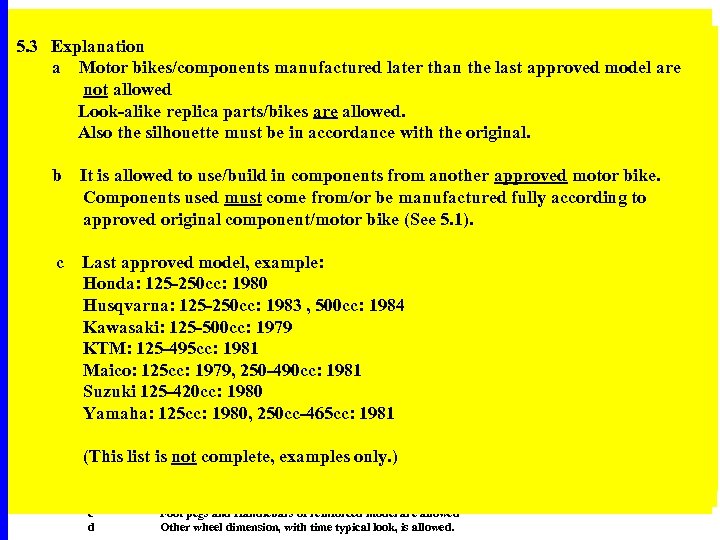 ARTICLE 4 Rules 4. 1 The race track must be safety-inspected and prepared if/as needed before each CETSC training/race. 5. 2 For all motor bikes: Use of approved components in keeping with the time according 5. 3 Three legs per race. All except 2 legs of the total are counted (ex. 4 races = 12 legs of which 10 are counted). Explanation 4. 2 to 5. 1 only. 4. 3 Pre start/start procedure. Positioning in the Waiting zone: In the first leg the positioning in the waiting zone is determined by the a Motor bikes/components manufactured later than the last approved model are rider’s best training lap time or lottery per draw. (The organizer’s choice – Transponder or not. ) In the second and third leg 4. 2 Three legs per race, ex. 4 races = 12 legs of which 10 are counted not allowed according to the result in previous leg. The waiting zone closes 10 min. prior to start. This to allow the organizer to check for the total result of the year. Exception: motorbikes and riders to follow the regulations before the start. The riders have free choice of position at the starting gate. Look-alike replica parts/bikes are allowed. Pre start/start procedure. 4. 4 4. 3 a Wheel hubs of later design with time typical characteristic can be used. The rider must have, when passing the finish line, completed 2/3 of the leg for his performance to be considered by the jury. 4. 6 The race organizer gives three cups per class for the result of the day. Also the silhouette must be in accordance with the original. 4. 5 Points per leg: The winner of the leg gets 40 points, second 37, than 35, 33, 31, 30, 29, 28, 27 etc. Positioning in the Waiting zone: In the first leg the positioning in the waiting 4. 6 4. 5 The race organizer gives three cups for the result of the day. Points per leg: The winner of the leg gets 40 points, second 37, than zone is determined by the rider’s best training lap time or lottery per draw. The CETSC Organisation gives cups to the three best riders + cups to the 35, 33, 31, 30, 29, 28, 27 etc. The CEMAR Organisation gives cups to the three best riders + cups to the best 125 cc, 250 cc and 4 -stroke rider b Silencer of later design, for the purpose of lower noice level, is allowed. b It is allowed to use/build in components from another approved motor bike. per age class for the total result of the year. (The organizer’s choice – Transponder or not. ) best 125 cc, 250 cc and 4 -stroke rider per age class for the total result of the 4. 7 The CETSC -champion is announced directly after the last race of the year is completed. Components used must come from/or be manufactured fully according to 4. 8 The race organizer must immediately send the results in Excel format to the CEMAR -Coordinator: 5. 1 c All bikes must have folding footrests, silencer and handle bar mattress year. c Foot pegs and Handlebars of reinforced model are allowed. approved original component/motor bike (See 5. 1). Jörgen Ahlström jorgen. ahlstrom@ektv. nu In the second and third leg according to the result in previous leg. protection (regardless type of handlebar). : 4. 9 It is the rider’s own responsibility to be aware of the actual CETSC regulations. ARTIKEL 5 Bikes Pré -85 4. 10 The modern FIM/UEM Motocross rules/regulations must be followed unless exceptions/additions are specially stated in these The CETSC -champions are announced directly after the last race of the 4. 7 d Other wheel dimension, with time typical look, is allowed. 5. 1 Pré -85, factory manufactured/sold motorbikes originally equipped with two rear c Last approved model, example: regulations. (Ex. Safety, flag signals etc. ) The waiting zone closes 10 min. prior to start. This to allow the organizer to d Not allowed: up-side down front forks, linkage suspension, disc year is completed. shock absorbers without linkage and drum brake front/rear and air cooled engine. Honda: 125 -250 cc: 1980 check motorbikes and riders to follow the regulations before the start. ARTICLE 5 Bikes Pré -85 brakes, water cooling. e Ignition components of later design are allowed. (Last approved model per manufacturer, see example in 5. 1) Husqvarna: 125 -250 cc: 1983 , 500 cc: 1984 5. 1 Pré -85, factory manufactured/sold motorbikes originally equipped with two rear shock absorbers without linkage and drum brake front/rear and air cooled engine. (Last approved model per manufacturer, see example in 5. 1) Kawasaki: 125 -500 cc: 1979 The riders have free choice of position at the starting gate. a Exception: Centre fitted shock absorber(-s) without linkage (ex. Yamaha Mono Shock, Krämer-Maico). e The following components are only allowed if they were originally f Suspension: Accessory shock absorbers (acc to 5. 2) + components like springs a Exception: Centre fitted shock absorber(-s) without linkage KTM: 125 -495 cc: 1981 b Doubt over the bike's identity/year: The rider must prove the bikes origin. (Picture + certificate/ brochure from the fitted from the factory on a approved motor bike: and valves of later design is allowed. factory). Further doubts: the jury will decide. Maico: 125 cc: 1979, 250 -490 cc: 1981 (ex. Yamaha Mono Shock, Kramer-Maico). c All bikes must have folding footrests, silencer and handle bar mattress-protection (regardless type of handlebar). : External gas and/or hydraulic adjustment devices is not allowed. Flat slide carburettor, reed-valves, suspension components with Suzuki 125 -420 cc: 1980 d Not allowed: up-side down front forks, linkage suspension, disc brakes, water cooling. e The following components are only allowed if they were originally fitted from the factory on a approved motor b adjustable compression/rebound. Doubt over the bike's identity/year: The rider must prove the bikes origin. Yamaha: 125 cc: 1980, 250 cc-465 cc: 1981 bike: Flat slide carburettor, reed-valves, suspension components with adjustable compression/rebound. (Picture + certificate/ brochure from the factory). f Motor bikes which do not fulfil the requirements in the regulations can not participate. f Motor bikes which do not fulfil the requirements in the regulations can 5. 2 For all motor bikes: Use of approved components in keeping with the time according to 5. 1 only. Further doubts: the jury will decide. (This list is not complete, examples only. ) Exception: not participate. a Wheel hubs of later design with time typical characteristic can be used. b c d Silencer of later design, for the purpose of lower noice level, is allowed Foot pegs and Handlebars of reinforced model are allowed Other wheel dimension, with time typical look, is allowed.
 6. 1 The jury consists of: - Chairman: representative from CETSC (has no vote) ARTICLE 6 Organisation 6. 0 The organizer must ensure that the track is suitable for Twin Shock motor bikes and to use qualified flag officials only. 6. 2 It is the responsibility of the organizer to have a sufficient event insurance. 6. 1 The jury consists of: - Chairman: representative from CEMAR (has no vote) - Clerk of the course - Contact person from the organising country - 1 Country representatives* * = Selected by draw, done by the chairman of the jury meeting, from list of country representatives. Rider’s insurance/licence and safety equipment are to be checked by the race 6. 3 The three first riders go, right after the finish of each leg to a Park Fermé 6. 2 It is the responsibility of the organizer to have a sufficient event insurance. - Contact person from the organising country organizer. Rider’s insurance/licence and safety equipment are to be checked by the race organizer (At Race office/Technical inspection and at the for a compulsory technical inspection. (Max. 10 min. ) entrance gate to the race track) (At Race office/Technical inspection and at the entrance gate to the race track) 6. 3 The three first riders go, right after the finish of each leg to a Park Fermé for a compulsory technical inspection. - 1 Country representative* (Max. 10 min. ) Refusal results in disqualification. 6. 4 The invitation will be published/for down load on www. classicmx. se 6. 5 The enrolment must be send by the riders to arrive to the organizer within time specified in the invitation. * = Selected by draw, done by the chairman of the jury meeting, 6. 4 The invitation will be published/for down load on www. classicmx. se 6. 6 Technical inspection must be performed. from list of country representatives. 6. 7 The organizer sets up an inspection staff consisting of 2 inspectors from the organizing country and responsible CEMAR representative selects 1 inspector, from the country representatives, by lottery draw. 6. 5 The enrolment must be send by the riders to arrive to the organizer within 6. 8 Each technical inspector must be familiar with the current regulations. 6. 9 Practice before the races: primary minimum 2 x 15, or if this is not possible for the day’s program 1 x 25 minutes available for each time specified in the invitation. rider. (Organizers decision) Max 60 riders on the track simultaneously. 6. 9 Practice before the races: primary minimum 2 x 15, or if this is not possible 6. 10 In case of special local rules (which are not according to these regulations) are called for in an event (ex. safety etc. ), this must be for the day’s program 1 x 25 minutes available for each rider. announced by the organizer to the CEMAR Coordinator, Jörgen Ahlström jorgen. ahlstrom@ektv. nu in advance. After confirmation 6. 6 Technical inspection must be performed. from the CEMAR Coordinator, the Organizer must inform the riders in time before the race. (Organizers decision) 6. 11 Entry fee, riders: 1 day race max. € 40, 2 days race max. € 65 to be paid in EURO + in case of application after the last date of entry an additional fee of € 10 to the race organizer. 1 day race max. € 40, Each CETSC organizer pays an org. fee, € 200, to the CEMAR account: see below. Max 60 riders on the track simultaneously. 2 days race max. € 65 to be paid in EURO 6. 12 Event toilets and showers must be free of charge and based on No. of riders and visitors, and be open Friday – Monday 6. 13 On demand of the organizer the jury is entitled to make decisions within the regulations. Such decisions must be + in case of application after the last date of entry an additional fee of € 10 to documented and reported to the CEMAR Coordinator Jörgen Ahlström, jorgen. ahlstrom@ektv. nu And one more thing - Don’t forget to read the complete regulations ! the race organizer. Others: In case of a dispute regarding the content in a translation of this document, this English original has priority.