


 Скачать презентацию The category of intentional torts False imprisonment Trespass
Legal_citations.pptx
- Количество слайдов: 12
 The category of intentional torts False imprisonment Trespass Negligence
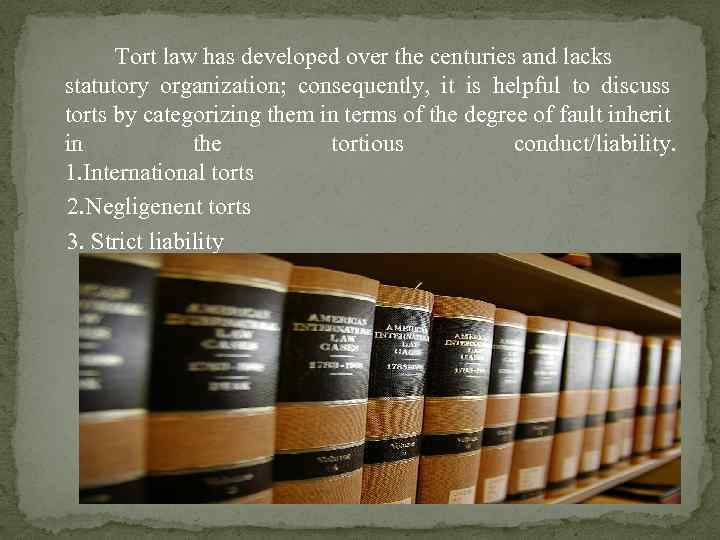 Tort law has developed over the centuries and lacks statutory organization; consequently, it is helpful to discuss torts by categorizing them in terms of the degree of fault inherit in the tortious conduct/liability. 1. International torts 2. Negligenent torts 3. Strict liability

 Intentional torts Proof of an intentional tort requires showing that a protected rights has been intentionally breached. Obviously, the difficulty here lies in proving another's state of mind, since for obvious reasons the statements of the defendant regarding his or her own intent are questionable. Therefore, intent is most often proved through circumstantial evidence: the defendant's conduct, in the context of his or her surroundings and what he or she presumably knew and perceived. Two major types of intentional torts are: 1. personal torts such as assault, battery, and false imprisonment and 2. property torts such as trespass to land trespass to chattels.
 Let’s look at an example: Bhaskar looks his shop at the end of the day. Unknown to Bhaskar, Kanad was in the restroom. As a result, Kanad could not exit the store until Bhaskar returned the next day.
 False imprisonment is a restraint of a person in a bounded area without justification or consent. False imprisonment is a common-law felony and a tort. It applies to private as well as governmental detention. When it comes to public police, the proving of false imprisonment is sufficient to obtain a writ of habeas corpus
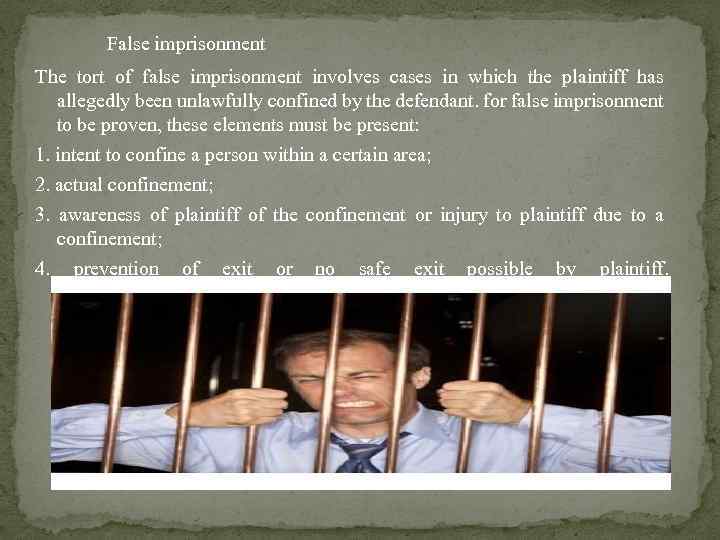 False imprisonment The tort of false imprisonment involves cases in which the plaintiff has allegedly been unlawfully confined by the defendant. for false imprisonment to be proven, these elements must be present: 1. intent to confine a person within a certain area; 2. actual confinement; 3. awareness of plaintiff of the confinement or injury to plaintiff due to a confinement; 4. prevention of exit or no safe exit possible by plaintiff.
 Trespass, the most familiar of the property torts, prohibits the unauthorized entry off a person or thing onto the property of another. The right to exclusive possession of the land is the basic for this tort, a right that had its origin in feudal times and was most fiercely defended. Unlike in other countries where citizens may have the right to temprorary access to all undeveloped lands , U. S. law allows landowners to close off land completely to others.
 A prima facie case of trespass must include an act with the intent to cause entry by the defendant, and an invasion of the plaintiff's land. In other words, the person must have intended to earlier another's land. Damages are not required to be proven for intentional trespass. Only when the entry onto another's land is negligent is there any requirement for showing actual damages. Property interests are such that failure to remove something from the land can be considered a trespass. If for example, you had been given permission to leave your car parked on your neighbor's property for six months and you didn't remove it at the end of six months, that could be considered a trespass. Trespass can even be remaining on another's land after a privilege expires;

 Negligence
 Negligence The central factor in negligence is determining what the standard of care imposed upon the public should be: as a general rule, all persons are under a duty to conduct themselves in such a manner as not to create unreasonable risks of physical harm to others. During a trial, the conduct of the defendant is reviewed to determine if he or she has met the reasonable person standard: that is, would a reasonable person have acted similarly under similar circumstances? For the court to impose liability for negligence, the following elements, which we will discuss separately, must be proven: 1. that the defendant had a duty of care; 2. that there was a breach of that duty by negligent conduct 3. that the act of omission caused injury; and 4. that the act or omission is not subject to the defenses of assumption of the risk or contributory negligence.