

The category of case The category of case


 Скачать презентацию The category of case The category of case
38540-6the_category_of_case.ppt
- Количество слайдов: 8
The category of case
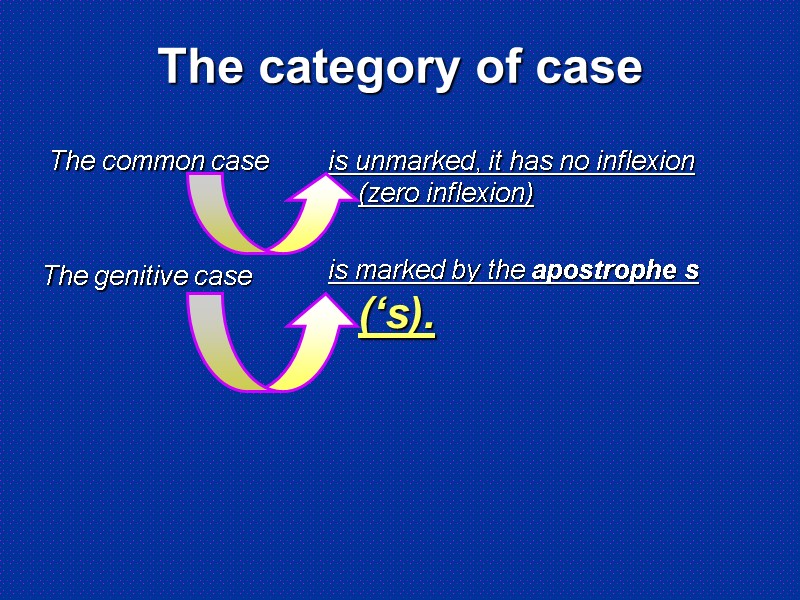
The category of case The common case The genitive case is unmarked, it has no inflexion (zero inflexion) is marked by the apostrophe s (‘s).
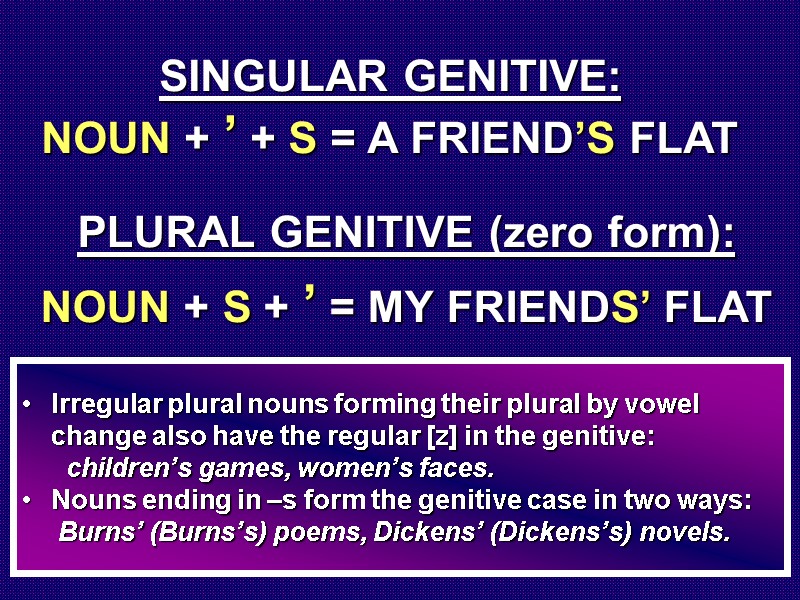
SINGULAR GENITIVE: NOUN + ’ + S = A FRIEND’S FLAT PLURAL GENITIVE (zero form): NOUN + S + ’ = MY FRIENDS’ FLAT Irregular plural nouns forming their plural by vowel change also have the regular [z] in the genitive: children’s games, women’s faces. Nouns ending in –s form the genitive case in two ways: Burns’ (Burns’s) poems, Dickens’ (Dickens’s) novels.
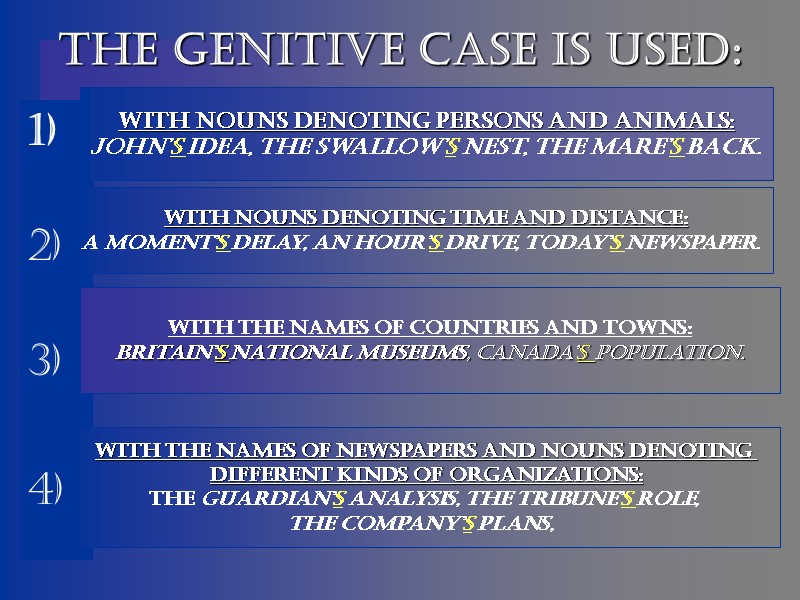
The genitive case is used: 1) 2) 3) 4) With nouns denoting persons and animals: John’s idea, the swallow’s nest, the mare’s back. With nouns denoting time and distance: a moment’s delay, an hour’s drive, today’s newspaper. With the names of countries and towns: Britain’s national museums, Canada’s population. With the names of newspapers and nouns denoting different kinds of organizations: the Guardian’s analysis, the Tribune’s role, the company’s plans,
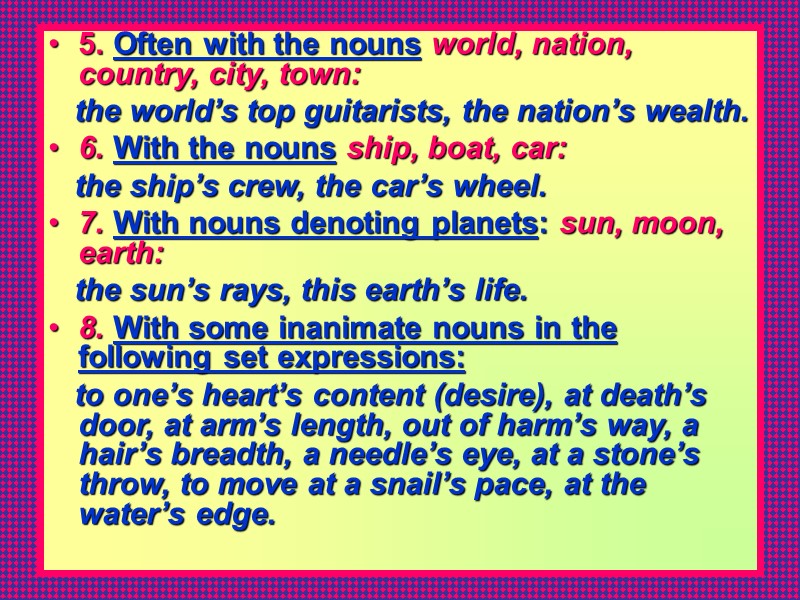
5. Often with the nouns world, nation, country, city, town: the world’s top guitarists, the nation’s wealth. 6. With the nouns ship, boat, car: the ship’s crew, the car’s wheel. 7. With nouns denoting planets: sun, moon, earth: the sun’s rays, this earth’s life. 8. With some inanimate nouns in the following set expressions: to one’s heart’s content (desire), at death’s door, at arm’s length, out of harm’s way, a hair’s breadth, a needle’s eye, at a stone’s throw, to move at a snail’s pace, at the water’s edge.
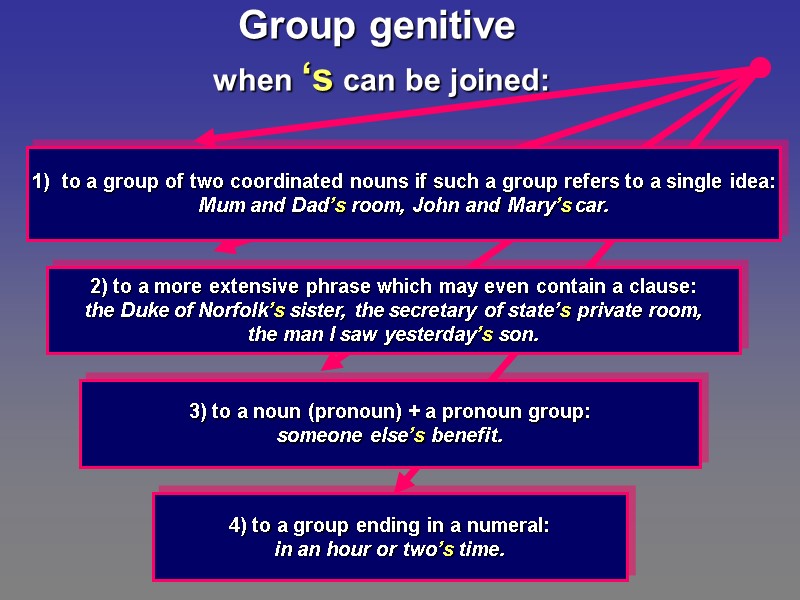
Group genitive when ‘s can be joined: 4) to a group ending in a numeral: in an hour or two’s time. 3) to a noun (pronoun) + a pronoun group: someone else’s benefit. 2) to a more extensive phrase which may even contain a clause: the Duke of Norfolk’s sister, the secretary of state’s private room, the man I saw yesterday’s son. to a group of two coordinated nouns if such a group refers to a single idea: Mum and Dad’s room, John and Mary’s car.
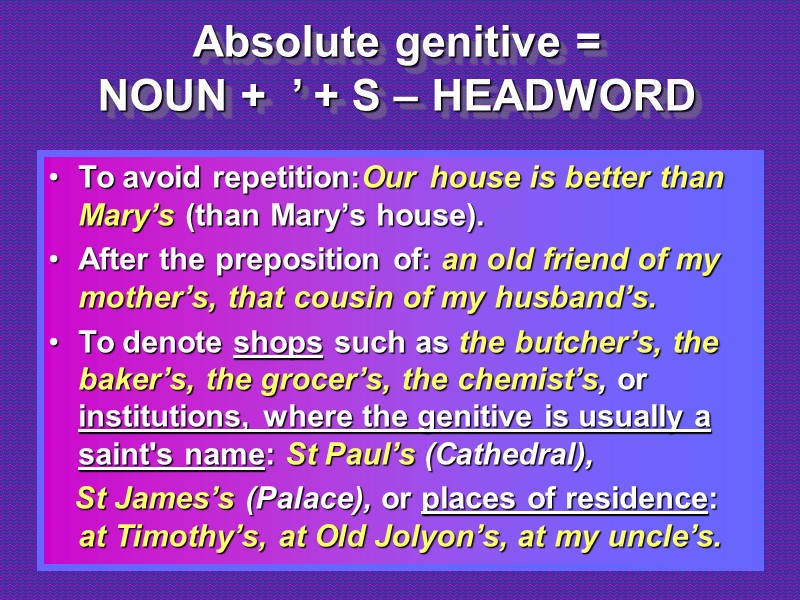
Absolute genitive = NOUN + ’ + S – HEADWORD To avoid repetition:Our house is better than Mary’s (than Mary’s house). After the preposition of: an old friend of my mother’s, that cousin of my husband’s. To denote shops such as the butcher’s, the baker’s, the grocer’s, the chemist’s, or institutions, where the genitive is usually a saint's name: St Paul’s (Cathedral), St James’s (Palace), or places of residence: at Timothy’s, at Old Jolyon’s, at my uncle’s.
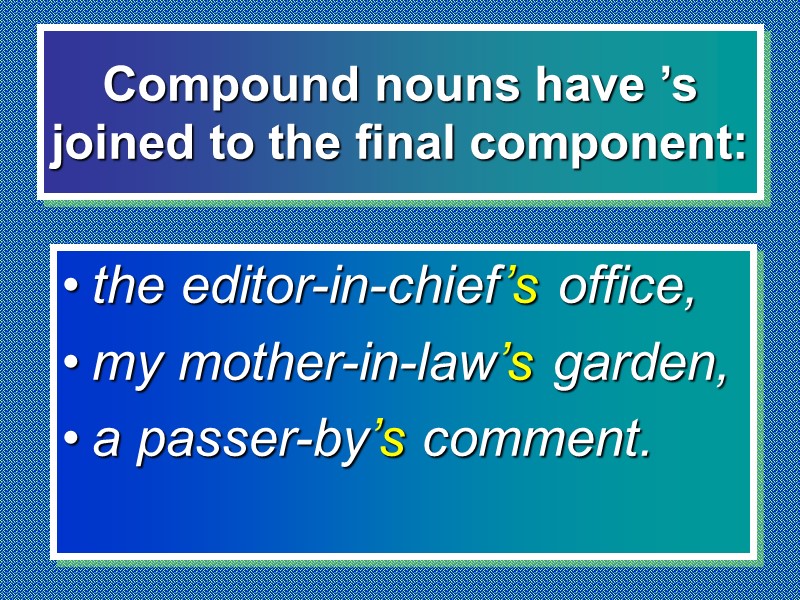
Compound nouns have ’s joined to the final component: the editor-in-chief’s office, my mother-in-law’s garden, a passer-by’s comment.