


 Скачать презентацию The Case for Infection Control Practices in Home
248697717201c1976e152996b35bb0d1.ppt
- Количество слайдов: 19
 The Case for Infection Control Practices in Home and Community Settings Elizabeth Scott, Ph. D Co-director Simmons College Center for Hygiene and Health in Home and Community Settings. Scientific board member of the International Forum on Home Hygiene
 General historical perspective on infection control in home and community • History of advice on hygiene, cleaning & infection control dates back at least to the mid 19 th century • Today - renewed interest : – emerging infections: e. g. SARS, influenza, – cross-contamination & person-person transmission, – antibiotic resistance, – viral agents – immuno-compromised groups in the community
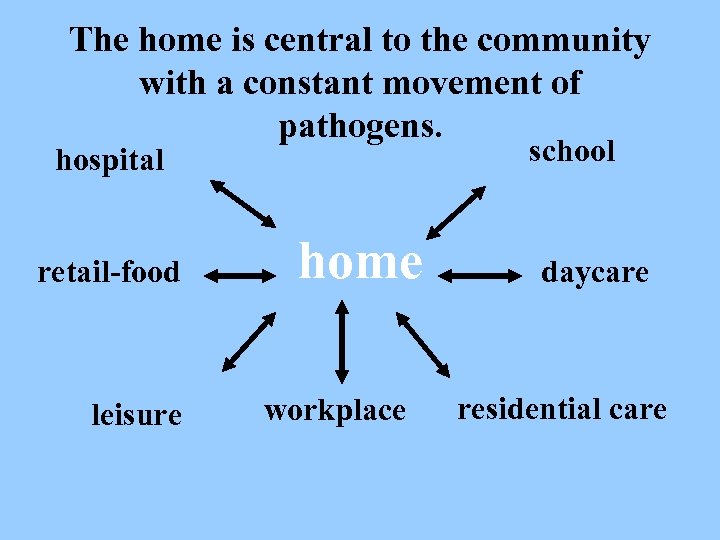 The home is central to the community with a constant movement of pathogens. school hospital retail-food leisure home workplace daycare residential care
 Why infection control in the home? It is a multifunctional setting which lends itself to the transmission of infection – Residence –mix of ages & health status – Food preparation – Healthcare delivery – Daycare – Pets
 Sources of pathogens into the home (Scott 2001) • HUMANS: enteric bacterial pathogens, Staph. aureus ( & MRSA), norovirus, rotavirus, rhinovirus, influenza, hepatitis A, RSV, SARS etc. • PETS: enteric pathogens, protozoa, herpes B, toxoplasma, MRSA • FOOD: Salmonella, Campylobacter, E. coli O 157, Listeria, Bacillus cereus, enteric viruses • AIR: fungi, respiratory agents, aerosols from food preparation & toilet flush etc (bacteria & viruses). • WATER : enteric bacterial pathogens, Cryptosporidium, Legionella
 Home food preparation & consumption in the USA • 76 million Americans get a foodborne illness each year, or 1 in 4 of the population. • Studies indicate that more than 50% of Salmonella and Campylobacter infections are home based (Scott 1996) • ~ 50% of raw chicken is contaminated with either Salmonella or Campylobacter • E. coli O 157 study - 80% suspect hamburgers eaten at home.
 Pets in the home • Cats & dogs can serve as reservoirs of salmonellas, campylobacters, toxoplasma, MRSA etc. • More than 50% of households in Englishspeaking world have cats/dogs
 Out -of -home and home-based daycare in the USA • Massive potential for infectious disease outbreak in daycare settings and for transfer of infections to and from the home. • 13 million children under 6 are in daycare (Brady 2005). • 40% of children of working mothers are cared for at homes of relatives ( Brady 2005) • Antibiotic use in children who attend daycare is increased by 2. 4 -3. 6 ( Brady 2005) • URI and GI infections up to 3. 5 times greater in children who attend daycare ( Lu et al 2004) • In daycare settings, rotavirus accounts for 20 -40% of diarrheal outbreaks ( Dennehy 2000)
 At-risk community at home • Homes contain a mix of generations and health status. • Approx 25% of the population is considered immunocompromised • Vast majority (73%) of elders are not in institutional care. (US Census Bureau) – The proportion of the population aged 65 and over is rising steadily. Today, 36 million or ~12% of the total population are over 65 (US Census Bureau) – By 2030, 20% (71. 5 million)of the population will be aged 65 and over. (US Census Bureau)
 Home based healthcare delivery in the USA • Many developed countries are experiencing a shift in healthcare delivery from hospitals to home, especially for the elderly • Dramatic shift in health care delivery with 8 million patients nursed at home in USA • 66% of home-based patients are over 65 years
 Community settings • Child & elder day-care settings, pre-schools and schools provide high risk environments for the transmission of infections. • Infectious agents move back and forth between community and home. • Hand transmission of infectious agents can occur in all community settings. • Handwashing facilities often not readily available. • Lack of awareness of the importance of hand hygiene.
 Examples from the literature of hygiene failures & associated infection outbreaks in the home. • Infant salmonellosis (Van Schothorst et al 1978, Schutze et al 1999) • E. coli O 157 (Mead et al 1997, Parry & Salmon 1998) • Staph. aurues & MRSA ( Masterton et al 1995, Allen et al 1997) • Rotavirus & SRSV – contamination of hands & environmental surfaces in daycare settings (Scott et al 2001)
 More examples of hygiene failures & infection outbreaks in the home. • Shigella sonnei (epidemic dysentery), following introduction from daycare (Kahn 1982) • Group A streptococcal infections (Schwartz et al 1992) • Clostridium difficile following introduction from daycare centers (Ahmed et al 1993) • Stenotrophomonas maltophilia in children with cystic fibrosis. (Denton 2001)
 Targeted hygiene • Aim: to reduce the numbers of pathogens to a level where there is no longer a threat to health • Targeted hygiene involves identifying the sites, surfaces and situations in the home where pathogens are most likely to be found, as well as considering whether the pathogen represents an infectious dose and the probability of human exposure to the pathogen
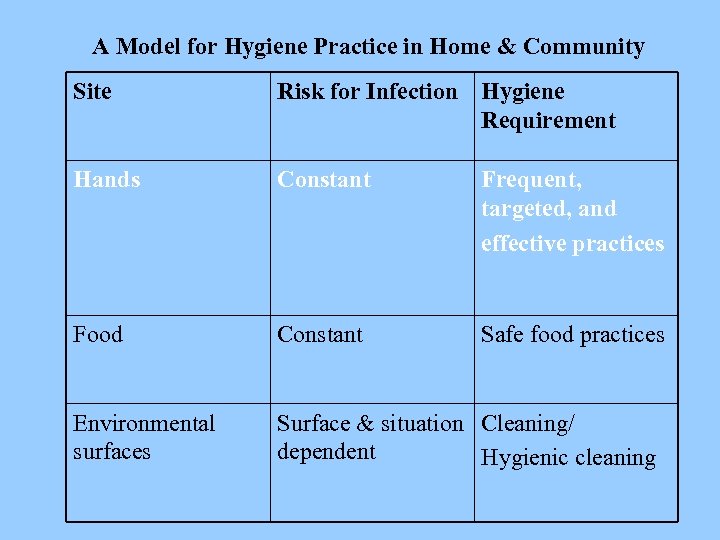 A Model for Hygiene Practice in Home & Community Site Risk for Infection Hygiene Requirement Hands Constant Frequent, targeted, and effective practices Food Constant Safe food practices Environmental surfaces Surface & situation Cleaning/ dependent Hygienic cleaning
 Hygienic cleaning and hygiene • Hygienic cleaning removes dirt and reduces the numbers of pathogens, either by removing them or killing them by a disinfection process. • The choice of hygienic cleaning or hand hygiene procedure depends on the situation.
 The role of targeted hygiene • Hygiene standards need to maintained throughout the community. • Hygiene initiatives should be based on risk assessment and should focus on reducing exposure to harmful numbers of pathogens. • This approach is likely to be the most effective in preventing disease and the least likely to disturb harmless exposure to microbes.
 Summary • The home is a multifunctional setting with scenarios of increased risk. • Infectious disease continues to be a significant threat. • Transmission of infection occurs throughout a range of community settings, including the home. • Throughout the community, hand hygiene is a primary defense against infectious disease. • Home & community hygiene practices offers benefits in terms of reducing the level of crosscontamination.
 Summary (continued) • Hygiene practice becomes even more important in an age of antibiotic resistance • Hygiene promotion raises standards of hygiene awareness and practice, both in the home and in the general community. • Effective home & community hygiene practice includes the targeted use of antimicrobial agents.