 Скачать презентацию The Case for a Wide-Table Approach to Manage
c00a0c4b65f78f36e1cfebf8021c9b86.ppt
- Количество слайдов: 33



The Case for a Wide-Table Approach to Manage Sparse Relational Data Sets University of Wisconsin-Madison Eric Chu Jennifer Beckmann Jeffrey Naughton SIGMOD 2007
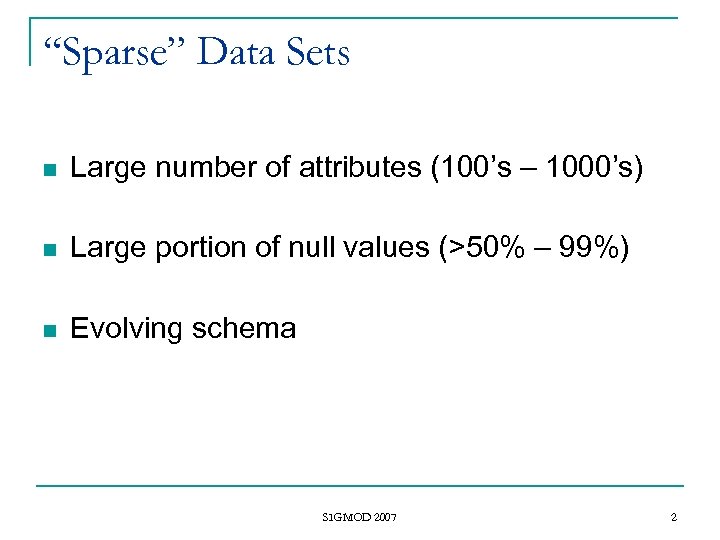
“Sparse” Data Sets n Large number of attributes (100’s – 1000’s) n Large portion of null values (>50% – 99%) n Evolving schema SIGMOD 2007 2
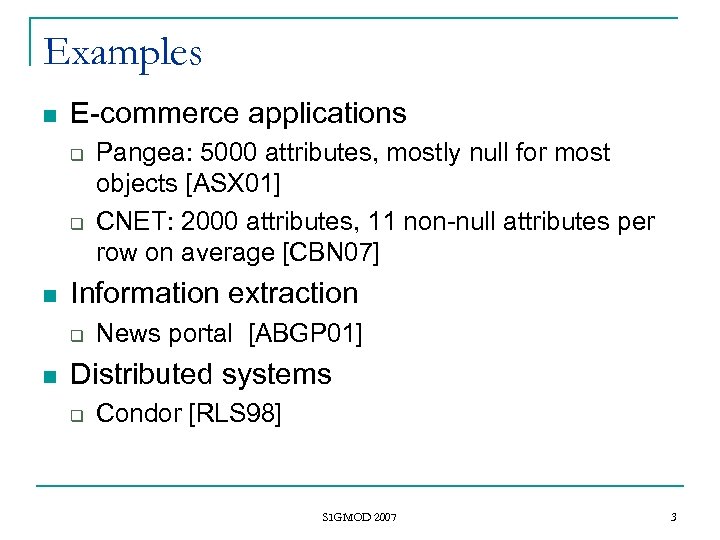
Examples n E-commerce applications q q n Information extraction q n Pangea: 5000 attributes, mostly null for most objects [ASX 01] CNET: 2000 attributes, 11 non-null attributes per row on average [CBN 07] News portal [ABGP 01] Distributed systems q Condor [RLS 98] SIGMOD 2007 3
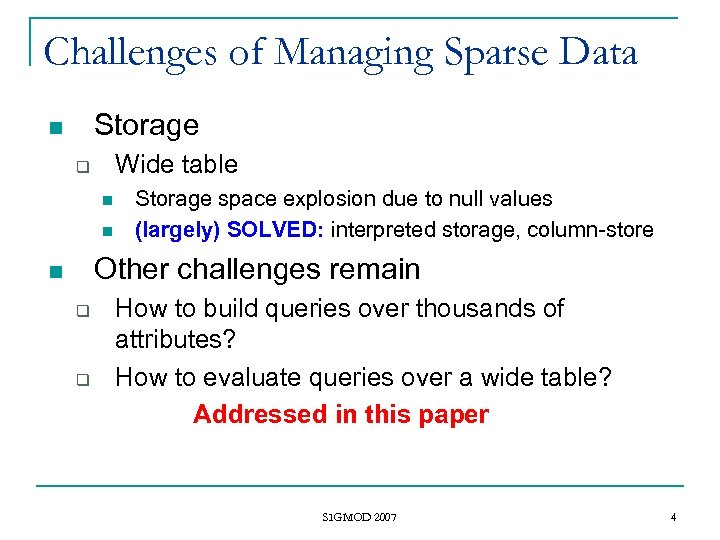
Challenges of Managing Sparse Data Storage n Wide table q n n Storage space explosion due to null values (largely) SOLVED: interpreted storage, column-store Other challenges remain n q q How to build queries over thousands of attributes? How to evaluate queries over a wide table? Addressed in this paper SIGMOD 2007 4
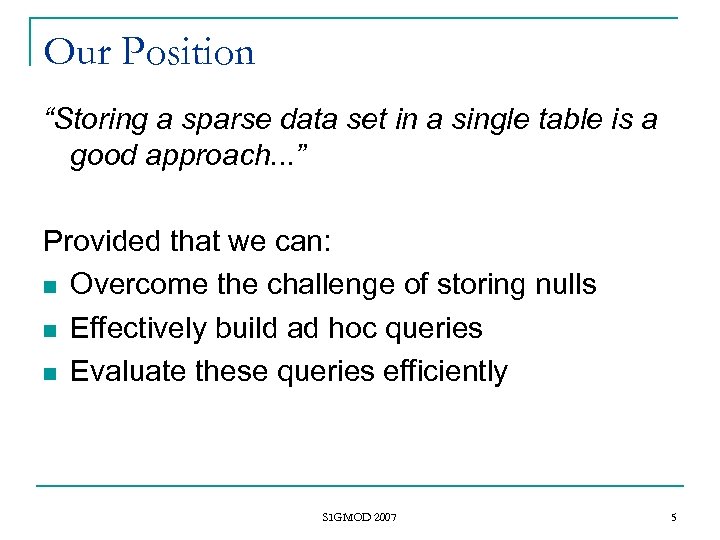
Our Position “Storing a sparse data set in a single table is a good approach. . . ” Provided that we can: n Overcome the challenge of storing nulls n Effectively build ad hoc queries n Evaluate these queries efficiently SIGMOD 2007 5
RDBMS Support for Sparse Data n One-table VS Multi-table n Building queries over sparse data n Evaluating queries over a wide table SIGMOD 2007 6
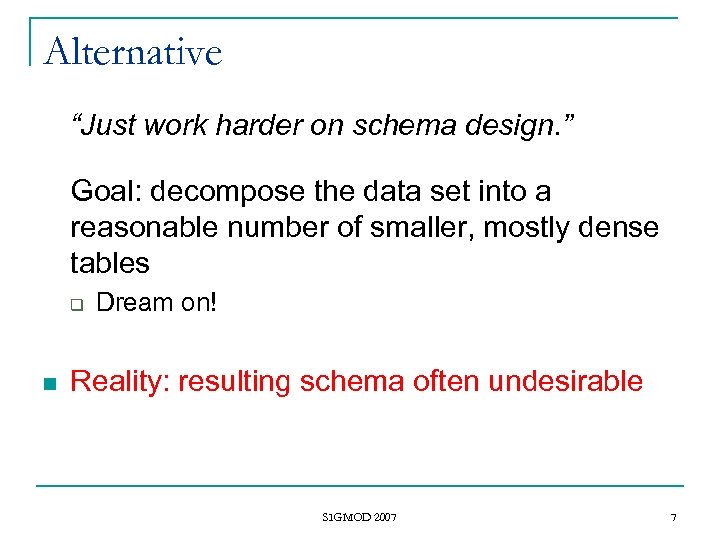
Alternative “Just work harder on schema design. ” Goal: decompose the data set into a reasonable number of smaller, mostly dense tables q n Dream on! Reality: resulting schema often undesirable SIGMOD 2007 7
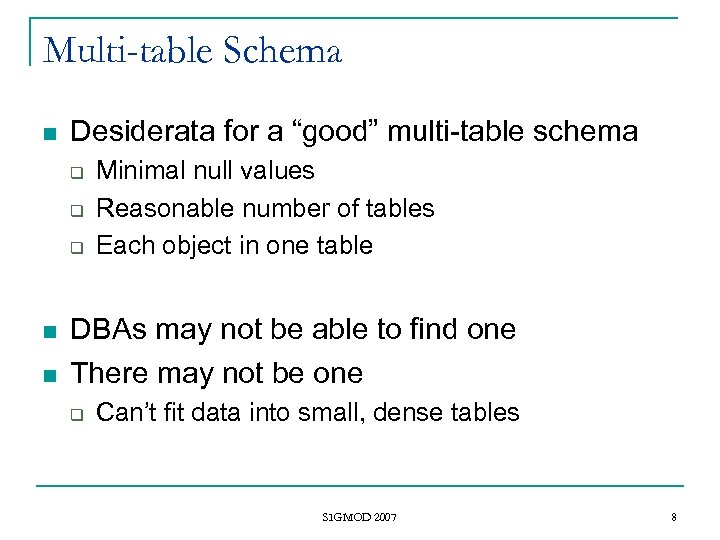
Multi-table Schema n Desiderata for a “good” multi-table schema q q q n n Minimal null values Reasonable number of tables Each object in one table DBAs may not be able to find one There may not be one q Can’t fit data into small, dense tables SIGMOD 2007 8
One Table Satisfy all the desiderata! n No null values stored q n Interpreted storage or column store No need to join tables SIGMOD 2007 9
Wide Table VS Universal Relation n Not the same as Universal Relation q n n Wide virtual schema covering all physical tables Our approach: one physical table for all entities that loosely belong to an entity set Example q q All products in an online catalog NOT products, customers, and “purchased_by” relation SIGMOD 2007 10
RDBMS Support for Sparse Data n One-table VS Multi-table n Building queries over sparse data n Evaluating queries over a wide table SIGMOD 2007 11
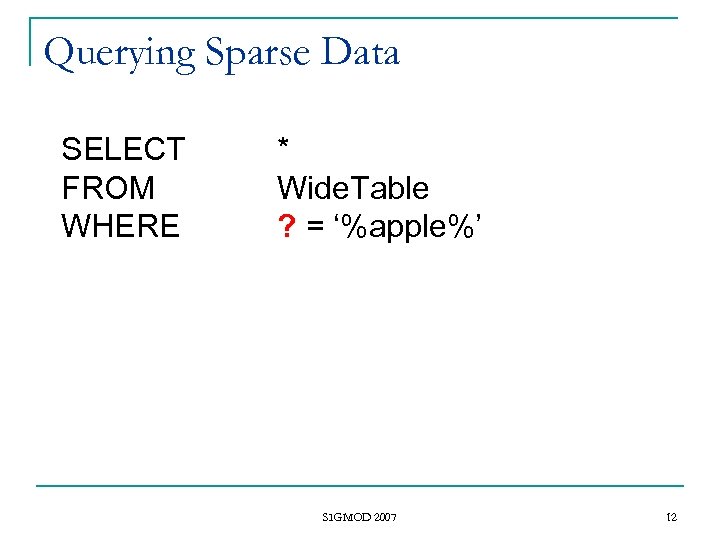
Querying Sparse Data SELECT FROM WHERE * Wide. Table ? = ‘%apple%’ SIGMOD 2007 12
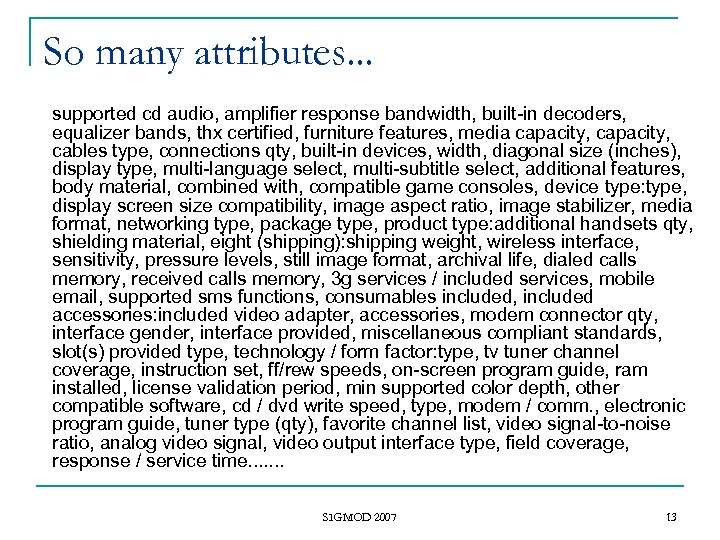
So many attributes. . . supported cd audio, amplifier response bandwidth, built-in decoders, equalizer bands, thx certified, furniture features, media capacity, cables type, connections qty, built-in devices, width, diagonal size (inches), display type, multi-language select, multi-subtitle select, additional features, body material, combined with, compatible game consoles, device type: type, display screen size compatibility, image aspect ratio, image stabilizer, media format, networking type, package type, product type: additional handsets qty, shielding material, eight (shipping): shipping weight, wireless interface, sensitivity, pressure levels, still image format, archival life, dialed calls memory, received calls memory, 3 g services / included services, mobile email, supported sms functions, consumables included, included accessories: included video adapter, accessories, modem connector qty, interface gender, interface provided, miscellaneous compliant standards, slot(s) provided type, technology / form factor: type, tv tuner channel coverage, instruction set, ff/rew speeds, on-screen program guide, ram installed, license validation period, min supported color depth, other compatible software, cd / dvd write speed, type, modem / comm. , electronic program guide, tuner type (qty), favorite channel list, video signal-to-noise ratio, analog video signal, video output interface type, field coverage, response / service time. . . . SIGMOD 2007 13
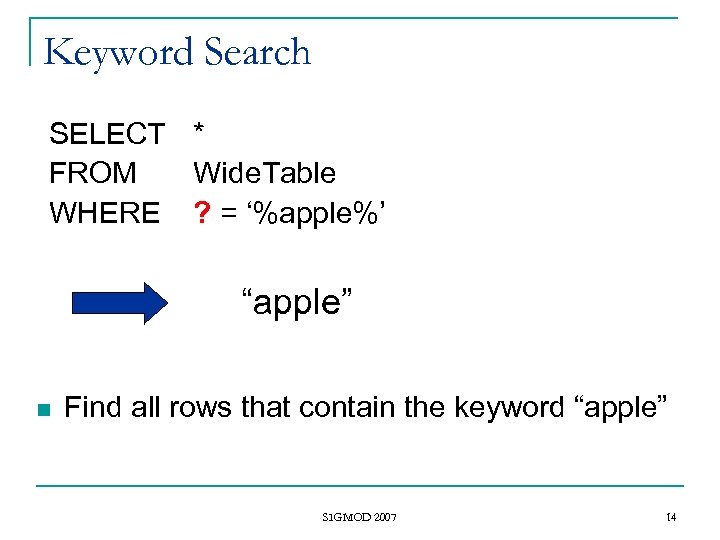
Keyword Search SELECT * FROM Wide. Table WHERE ? = ‘%apple%’ “apple” n Find all rows that contain the keyword “apple” SIGMOD 2007 14
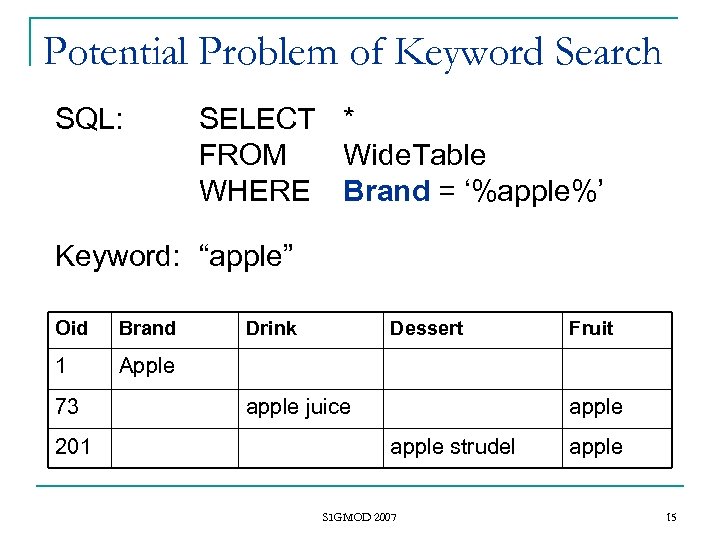
Potential Problem of Keyword Search SQL: SELECT * FROM Wide. Table WHERE Brand = ‘%apple%’ Keyword: “apple” Oid Brand 1 Apple 73 201 Drink Dessert apple juice Fruit apple strudel SIGMOD 2007 apple 15
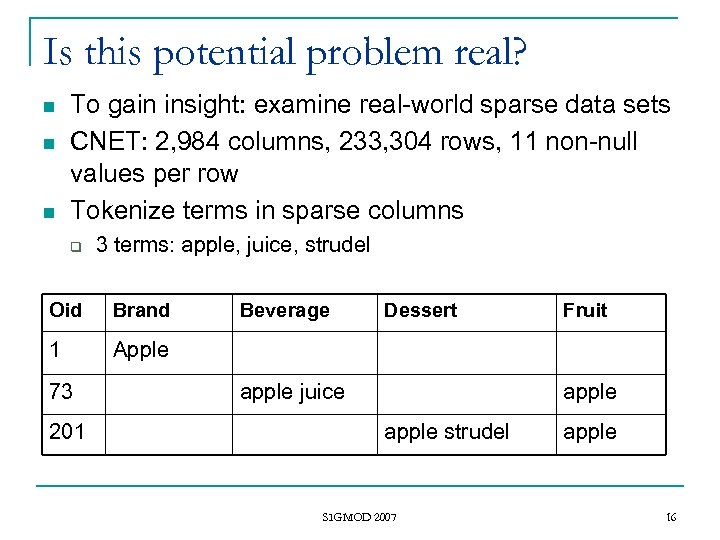
Is this potential problem real? n n n To gain insight: examine real-world sparse data sets CNET: 2, 984 columns, 233, 304 rows, 11 non-null values per row Tokenize terms in sparse columns q 3 terms: apple, juice, strudel Oid Brand 1 Apple 73 201 Beverage Dessert apple juice Fruit apple strudel SIGMOD 2007 apple 16
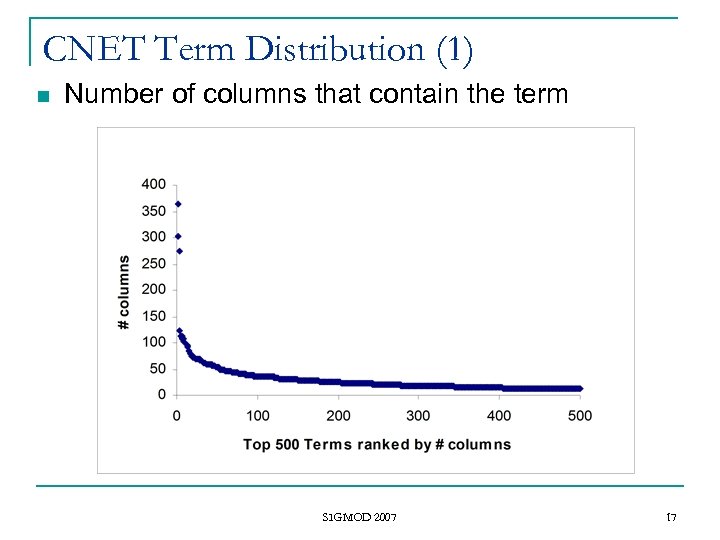
CNET Term Distribution (1) n Number of columns that contain the term SIGMOD 2007 17
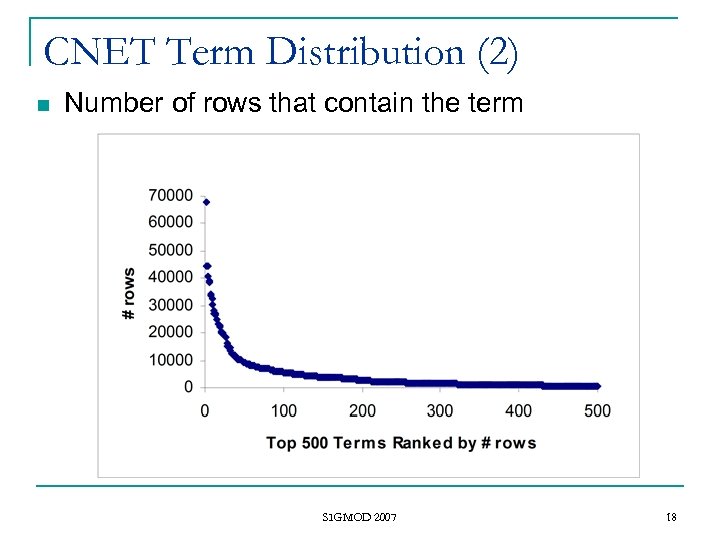
CNET Term Distribution (2) n Number of rows that contain the term SIGMOD 2007 18
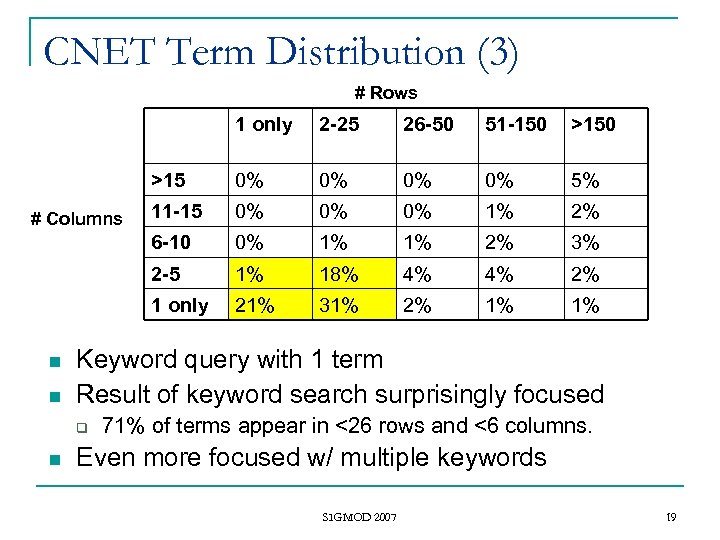
CNET Term Distribution (3) # Rows 1 only 0% 0% 5% 11 -15 0% 0% 0% 1% 2% 0% 1% 1% 2% 3% 1% 18% 4% 4% 2% 1 only 21% 31% 2% 1% 1% Keyword query with 1 term Result of keyword search surprisingly focused q n >150 2 -5 n 51 -150 6 -10 n 26 -50 >15 # Columns 2 -25 71% of terms appear in <26 rows and <6 columns. Even more focused w/ multiple keywords SIGMOD 2007 19
Keyword Search over Sparse Data n In general, keyword search is effective IF terms follow a Zipf-like distribution q n No need to specify attributes Many data sets follow Zipf-like term distributions SIGMOD 2007 20
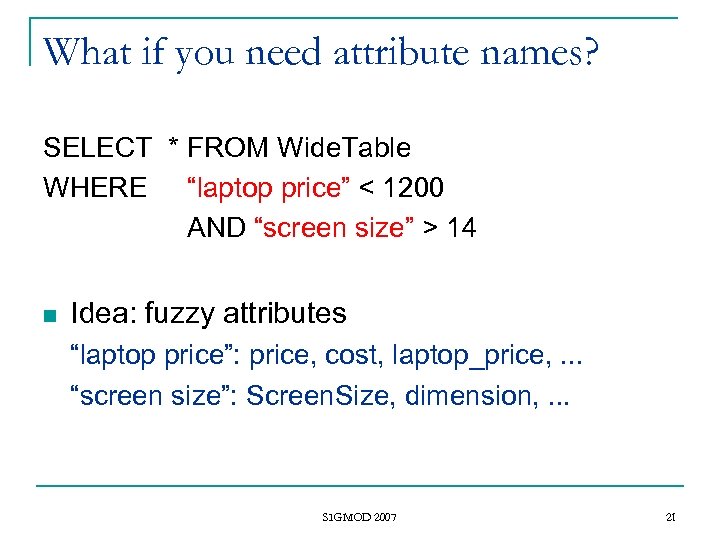
What if you need attribute names? SELECT * FROM Wide. Table WHERE “laptop price” < 1200 AND “screen size” > 14 n Idea: fuzzy attributes “laptop price”: price, cost, laptop_price, . . . “screen size”: Screen. Size, dimension, . . . SIGMOD 2007 21
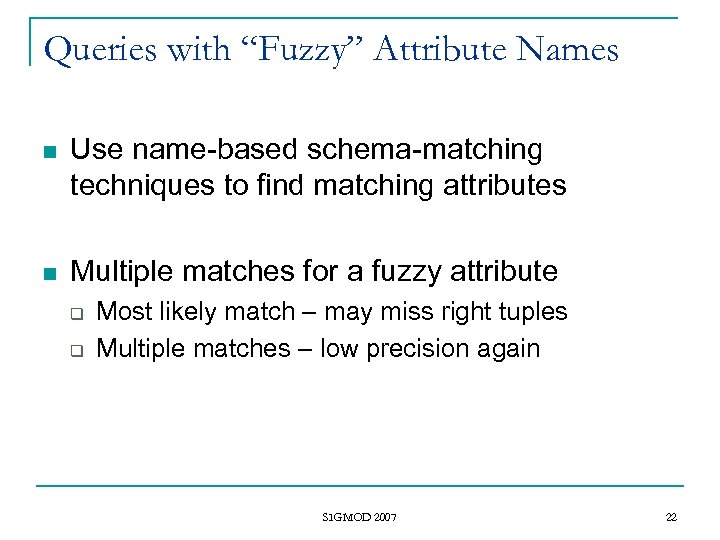
Queries with “Fuzzy” Attribute Names n Use name-based schema-matching techniques to find matching attributes n Multiple matches for a fuzzy attribute q q Most likely match – may miss right tuples Multiple matches – low precision again SIGMOD 2007 22
RDBMS Support for Sparse Data n One-table VS Multi-table n Building queries over sparse data n Evaluating queries over a wide table SIGMOD 2007 23
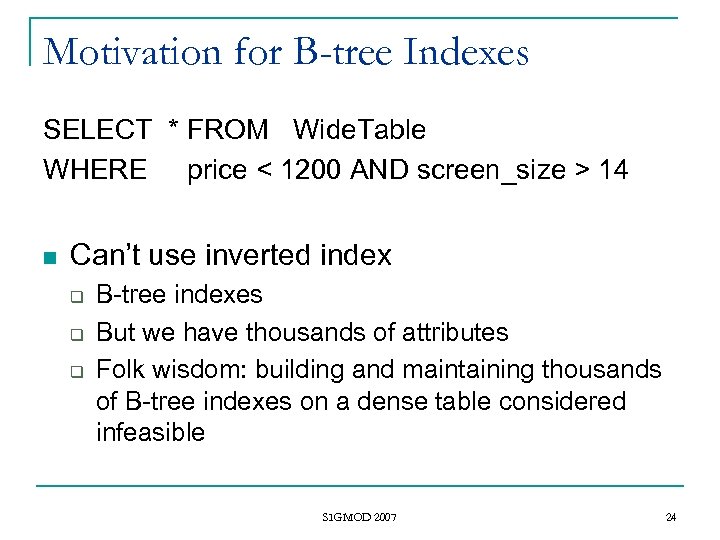
Motivation for B-tree Indexes SELECT * FROM Wide. Table WHERE price < 1200 AND screen_size > 14 n Can’t use inverted index q q q B-tree indexes But we have thousands of attributes Folk wisdom: building and maintaining thousands of B-tree indexes on a dense table considered infeasible SIGMOD 2007 24
Solution: Sparse B-tree Indexes n Map non-null values to oids n Similar to partial indexes [S 89] CREATE INDEX sparse. Ind ON table(a 1) WHERE a 1 is not NULL n More suitable for sparse data than partial indexes q q More efficient index maintenance Lower overhead for lookups SIGMOD 2007 25
Advantages over Full Indexs n Experiment q n 1 -column sparse index 50 times smaller than full counterpart q n 640 sparse indexes take less space than 13 full indexes Tuple insertion/deletion q n 250 k rows, 7 non-null values per row out of 640 varchar(16) attributes 7 updates for sparse VS 640 for full More efficient bulkloading SIGMOD 2007 26
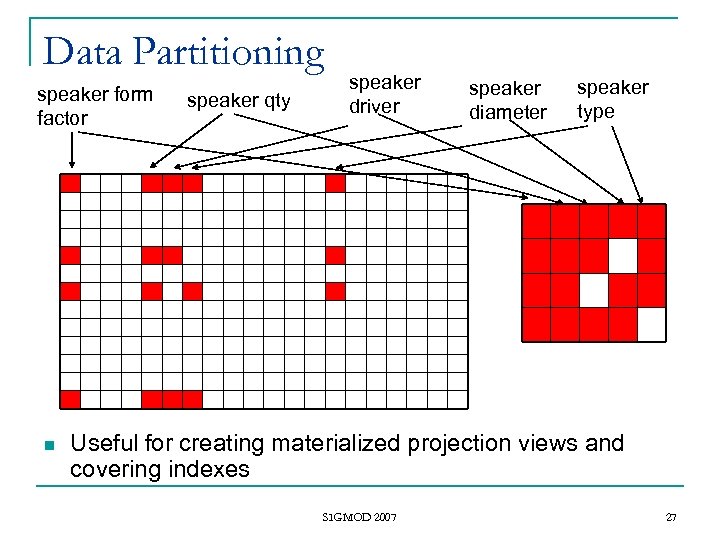
Data Partitioning speaker form factor n speaker qty speaker driver speaker diameter speaker type Useful for creating materialized projection views and covering indexes SIGMOD 2007 27
Hidden Schema n Our approach q n Infer hidden schema automatically q q n Group together attributes that are either both nonnull or both null in a row Jaccard(AX, AY) = |X Y|/||X Y| X = set of rows with non-null values in attribute AX Use k-mean clustering No constraints on # partitions or # joins to get each object SIGMOD 2007 28
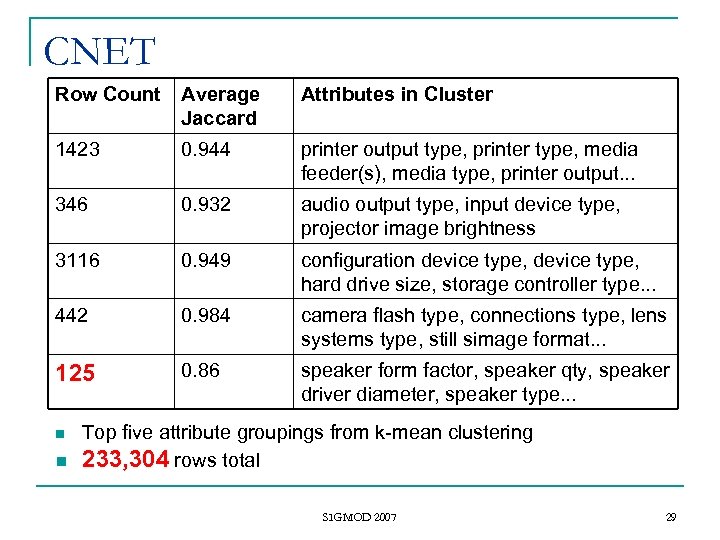
CNET Row Count Average Jaccard Attributes in Cluster 1423 0. 944 printer output type, printer type, media feeder(s), media type, printer output. . . 346 0. 932 audio output type, input device type, projector image brightness 3116 0. 949 configuration device type, hard drive size, storage controller type. . . 442 0. 984 camera flash type, connections type, lens systems type, still simage format. . . 125 0. 86 speaker form factor, speaker qty, speaker driver diameter, speaker type. . . Top five attribute groupings from k-mean clustering n 233, 304 rows total n SIGMOD 2007 29
Browsing Directory n When partitions make semantic sense q n Can build a browsing directory based on hidden schema In addition to keyword search and SQL queries with fuzzy attributes SIGMOD 2007 30
Storage and Maintenance of Materialized Projection Views n Costs could be high when data is dense q But surprisingly low when data is sparse n Extra Storage – about the same as wide table using interpreted storage n Maintenance – 2 updates for tuples belonging to one partition q Base table and the view SIGMOD 2007 31
Conclusion n “Single table” actually good approach for sparse data q q q n Interpreted storage for space efficiency (previous) Sparse index for scalable indexability Automatically discovered hidden schema for defining views and covering indexes Querying remains a challenge q Combination of keyword search, SQL with “fuzzy” attributes, and directory based on hidden schema SIGMOD 2007 32
Current Work n Observation: wide table provides flexible storage for information extraction q q n Relational workbench for extracting and querying structure from documents q n A row corresponds to a document New feature stored in new column Incremental evolution E. Chu, A. Baid, T. Chen, A. Doan, J. Naughton. "A Relational Approach to Incrementally Extracting and Querying Structure in Unstructured Data. " To appear in VLDB 2007. SIGMOD 2007 33
Скачать презентацию The Case for a Wide-Table Approach to Manage
c00a0c4b65f78f36e1cfebf8021c9b86.ppt